
A complete issue · 36 pages · 1922
Judge — January 28, 1922
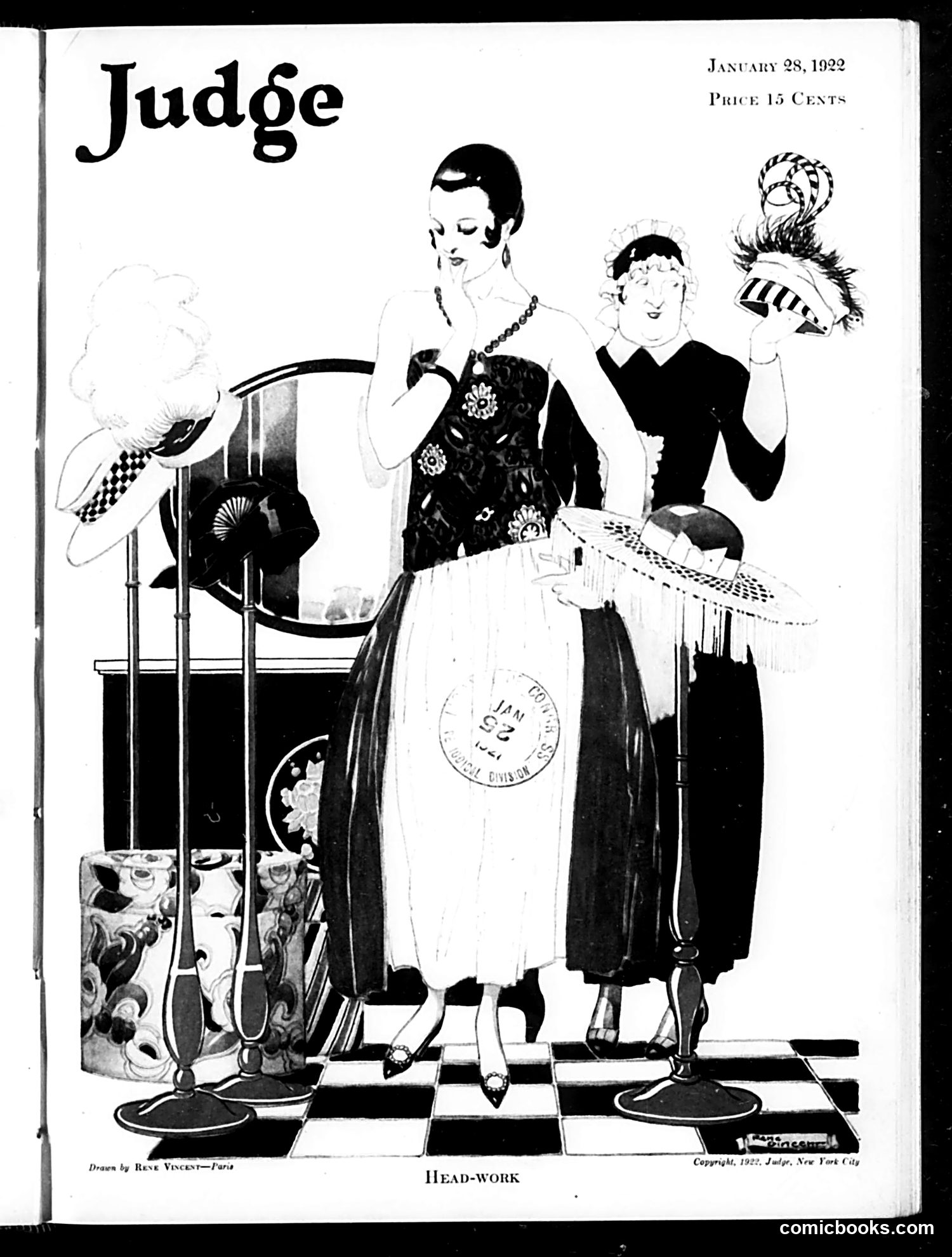
This illustration, drawn by Ralph Vincent for Judge magazine, satirizes women's fashion and beauty standards of the early 1920s. The title "Head-Work" is a pun referring both to intellectual labor and literal head-focused vanity. The cartoon depicts three fashionable women displaying elaborate hairstyles and accessories—feathered headpieces, headbands, and jewelry—suggesting that women's appearance and grooming constituted their primary "work." The ornate mirror and dressing room setting reinforce this focus on beauty rituals. The satire critiques either the superficiality of women's concerns during the Jazz Age or, conversely, the reduction of women's value to appearance despite growing feminist movements of the era. The exaggerated styling mocks both the trend itself and perhaps society's expectations of women's priorities.
This page is **advertising copy**, not a political cartoon. It promotes Leslie's Weekly magazine's January 28 issue. The ad announces that **Reginald Wright Kauffman**, a noted novelist, will reveal inside details about secret service agents guarding an "Arms Conference" in Washington. William J. Burns, head of the Department of Justice's Bureau of Investigation, authorized these agents with orders to "Shoot to Kill!" if necessary. The ad also touts other articles: Samuel Hopkins Adams on the clothing industry, Seammon Lockwood's serial story, and a Severance Johnson article on chiropractic. The appeal targets readers interested in espionage, government intrigue, and contemporary social commentary—standard magazine promotion for the era (appears to be early 1920s based on references).
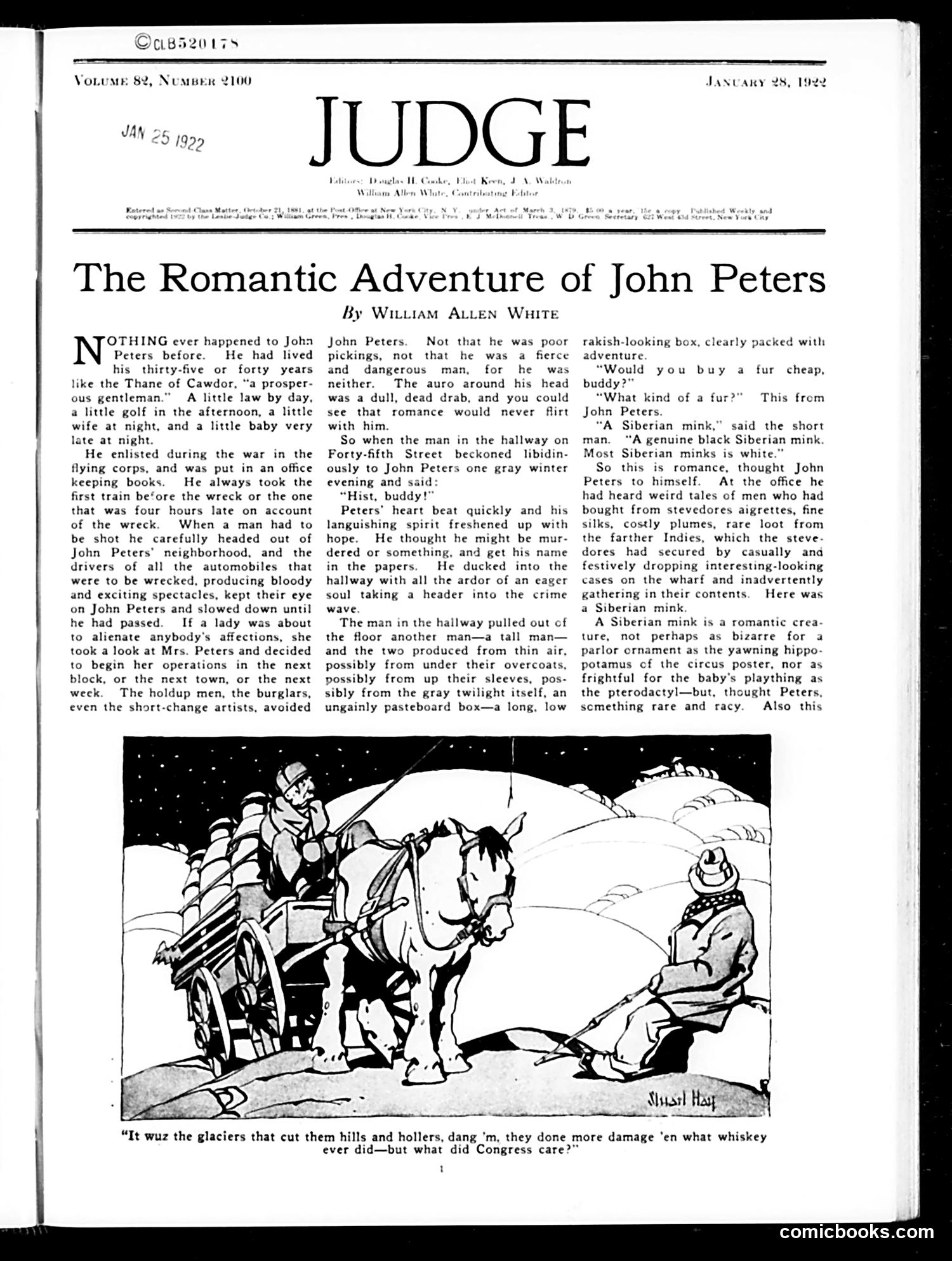
This page presents a short story by William Allen White about a mundane office worker whose life takes an unexpected turn when he purchases a Siberian mink fur. The illustrated cartoon below depicts a winter scene with figures and a horse-drawn sleigh, captioned with dialogue about glaciers and whiskey damage—likely a reference to Prohibition-era politics. The joke appears to target Congress's perceived ineffectiveness: the speaker suggests glaciers caused more geological damage than whiskey, sarcastically questioning whether Congress addressed either problem. This reflects 1922 frustration with legislative gridlock during Prohibition's enforcement debates. The cartoon uses frontier/Alaskan imagery to underscore the remoteness of congressional concerns from ordinary Americans' lives.
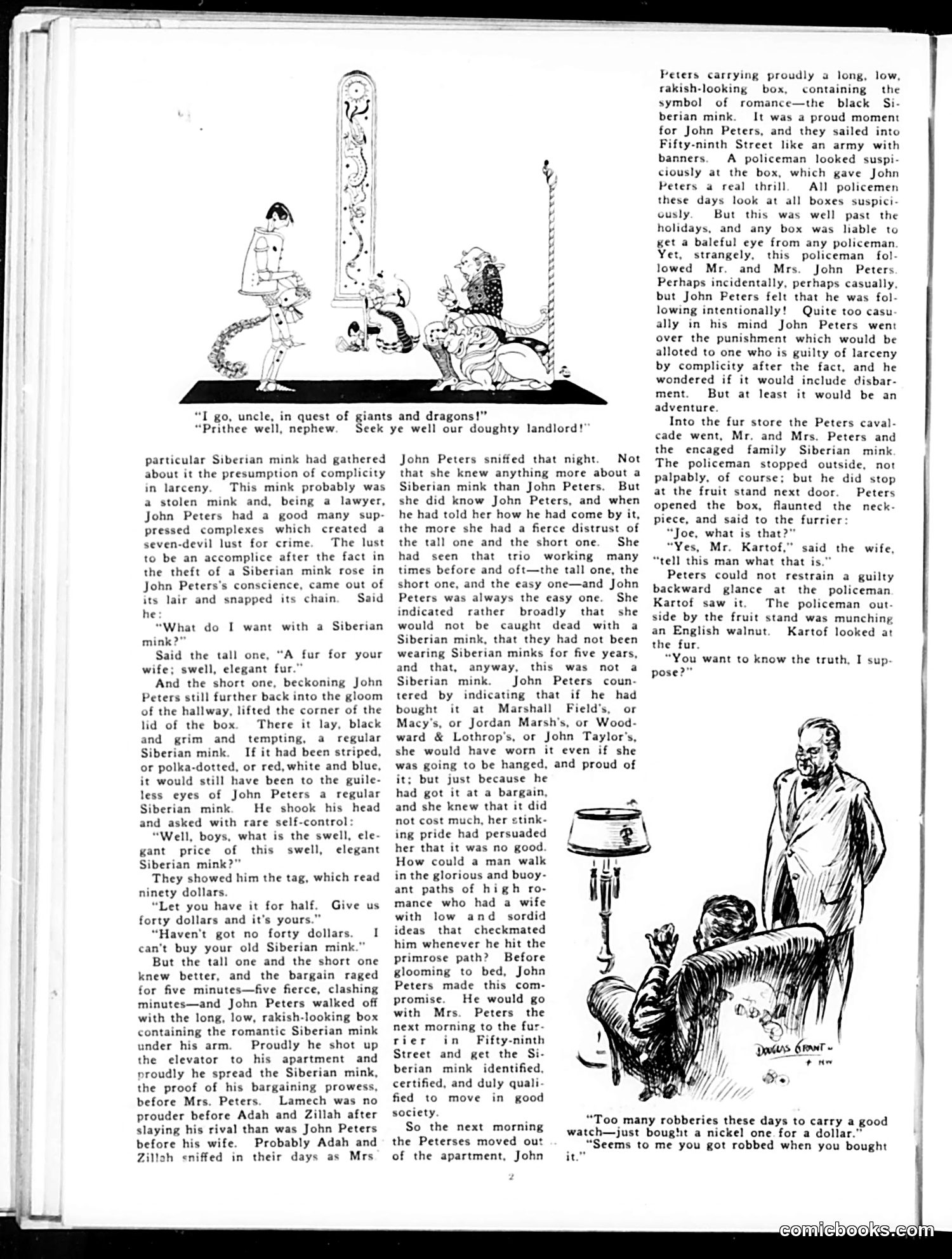
This page contains a short story about John Peters purchasing a Siberian mink coat at a bargain price. The narrative satirizes the materialism and social pretension of the era—Peters is so proud of the fur that he parades it through his neighborhood like a trophy, despite his wife's concerns about it being cheap. The cartoon illustrates a policeman stopping Peters and warning him about robberies, suggesting that displaying expensive items invites theft. The satire targets both Peters's vanity and the broader 1920s-30s anxiety about urban crime and conspicuous consumption. The humor derives from the irony: Peters's bargain purchase actually makes him a robbery target—his pride in a cheap acquisition paradoxically endangers him.
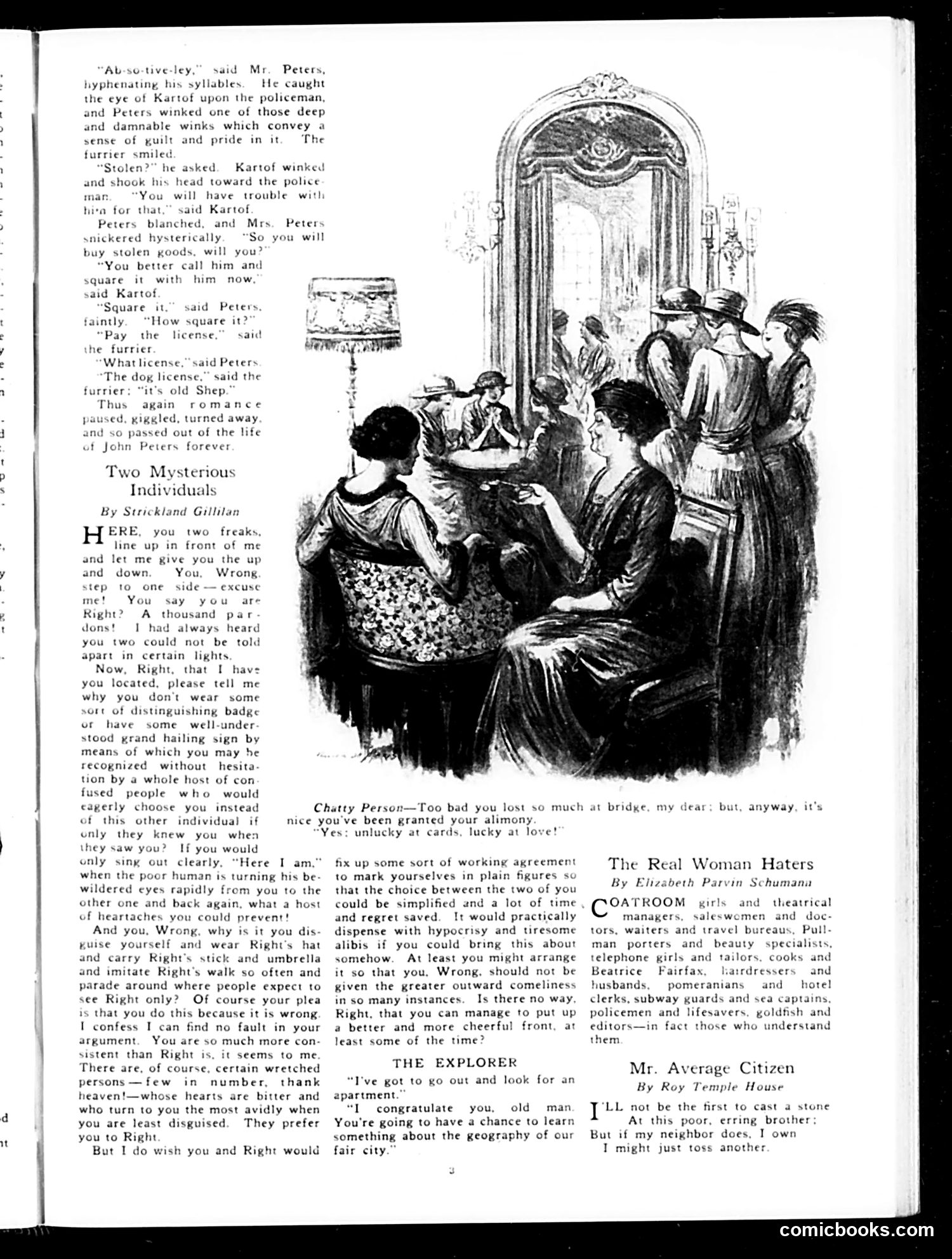
This page contains three distinct satirical pieces rather than a single cartoon. The main illustration depicts a fortune-telling or séance scene, accompanying "Two Mysterious Individuals" by Strickland Gilliian. The sketch appears to satirize spiritualism or con-artist fortune tellers popular in that era—showing figures in a darkened room with mystical props, mocking those who sought supernatural guidance. Below are separate short pieces: "The Real Woman Haters" by Elizabeth Jordan and "Mr. Average Citizen" by Roy Temple House. These appear to be social satire targeting women in various professions and ordinary citizens' attitudes. Without clearer dating or additional context, the specific contemporary references remain unclear, though the content reflects early-20th-century Judge magazine's typical satirical approach to social trends and gender roles.
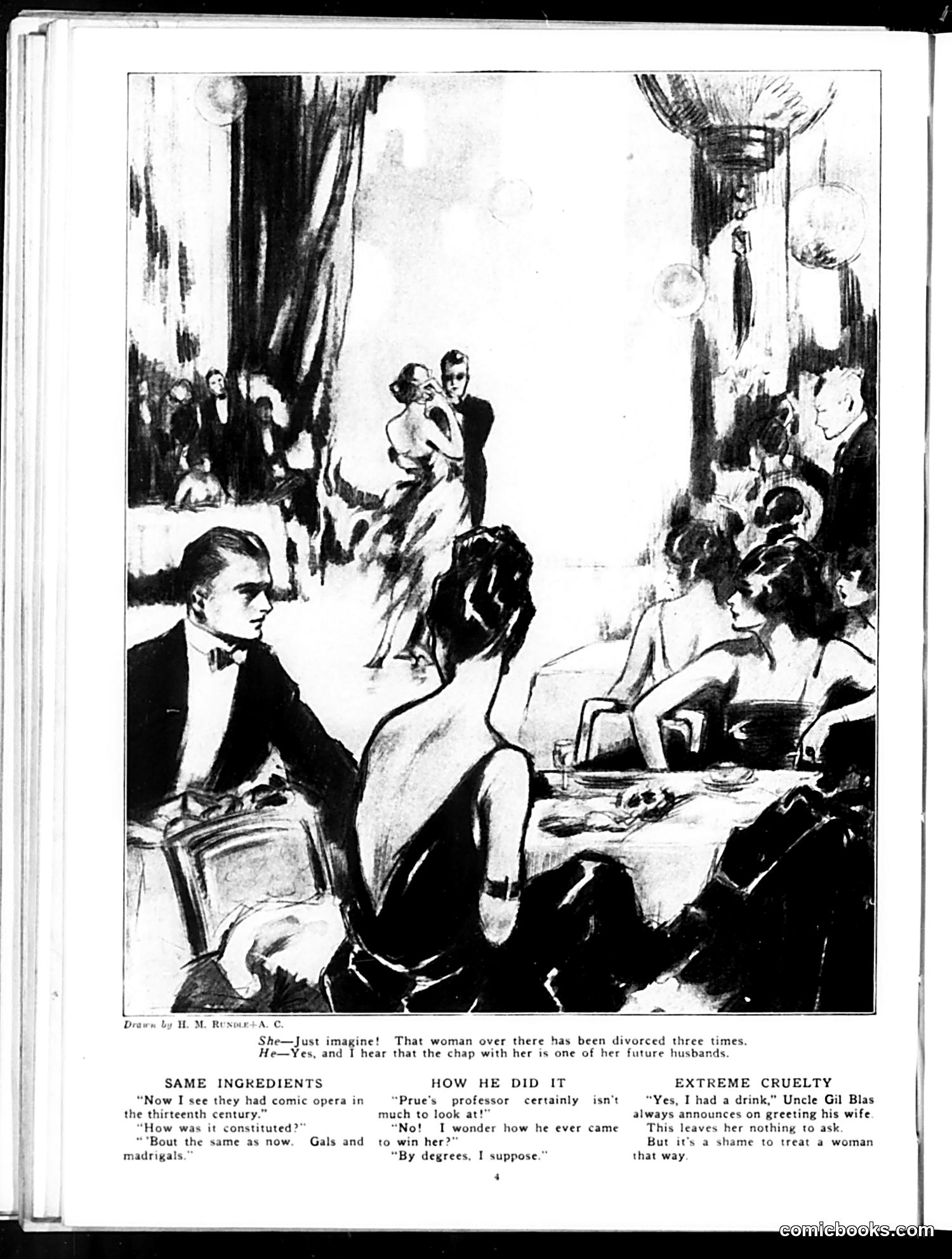
This page contains a single illustration by H.M. Rundse depicting a formal dinner party scene, with accompanying dialogue snippets below. The main joke concerns a woman's marital history: one character gossips that "that woman over there has been divorced three times" and speculates about her current male companion being "one of her future husbands." The three captioned vignettes below ("Same Ingredients," "How He Did It," "Extreme Cruelty") appear to be separate satirical takes on divorce and marriage dynamics. They mock the ease of obtaining divorces and suggest marital discord stems from trivial causes—"comic opera" constituents, academic pretension, and casual rudeness toward spouses. The satire targets early-20th-century attitudes about divorce as scandalous yet increasingly common among the wealthy social set.
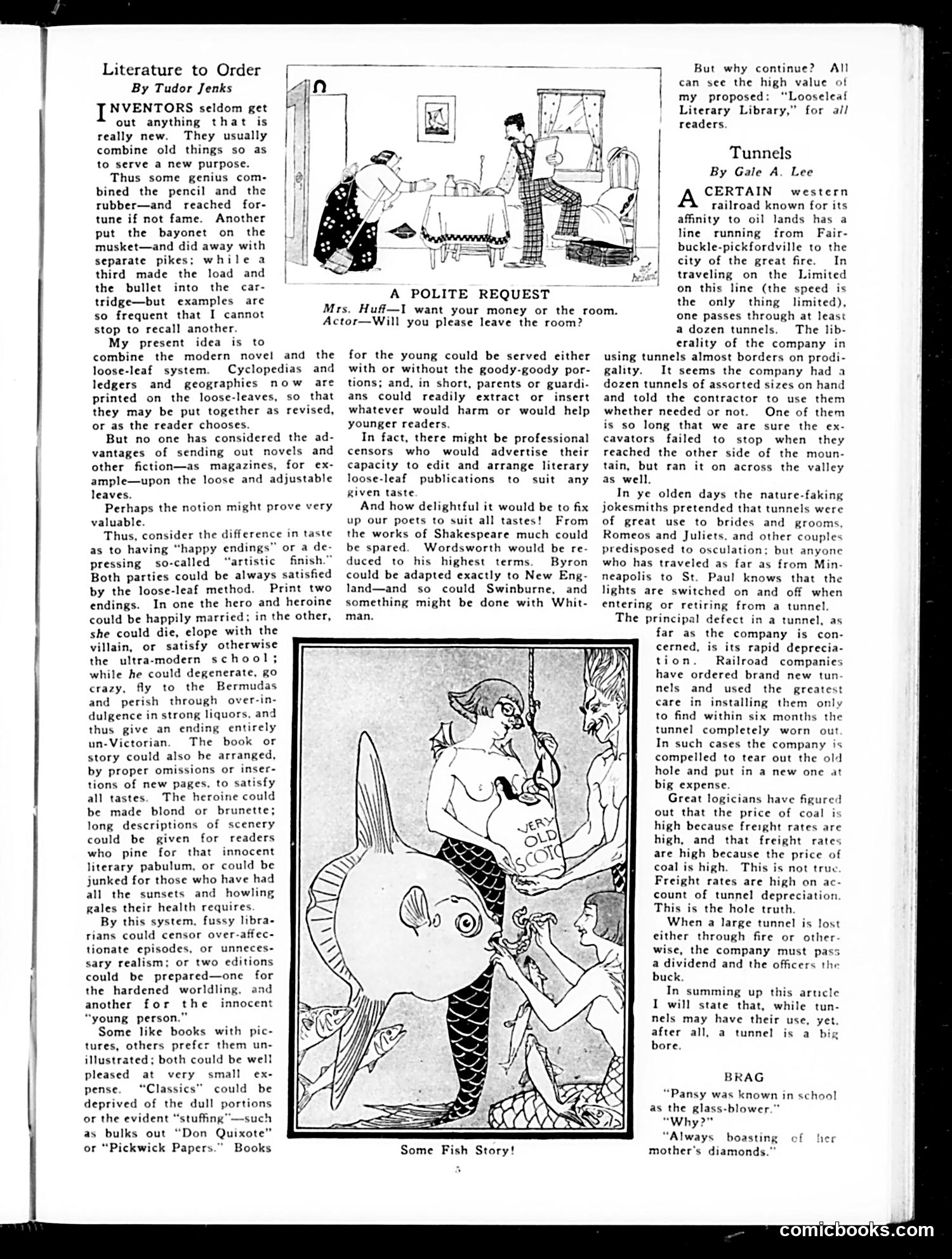
This Judge magazine page contains two satirical pieces: **"Literature to Order"** mocks the idea of customizable books using loose-leaf printing. The author humorously proposes novels with interchangeable endings and removable passages so readers can choose happy or sad conclusions, skip descriptions, or remove "objectionable" content. The satire targets both prudish censorship and changing literary tastes—suggesting that if literature became this modular, censors and publishers could sanitize classics like Shakespeare and Byron for different audiences. **"A Polite Request"** cartoon shows an actress (Mrs. Huff) demanding money or the room from an actor, while he politely requests she leave the room. The humor lies in the absurd contrast between her aggressive extortion and his courteous response—likely satirizing theatrical company dynamics or actor-landlord disputes of the era. Both pieces mock early 20th-century anxieties about literature's moral impact and genteel social conventions.
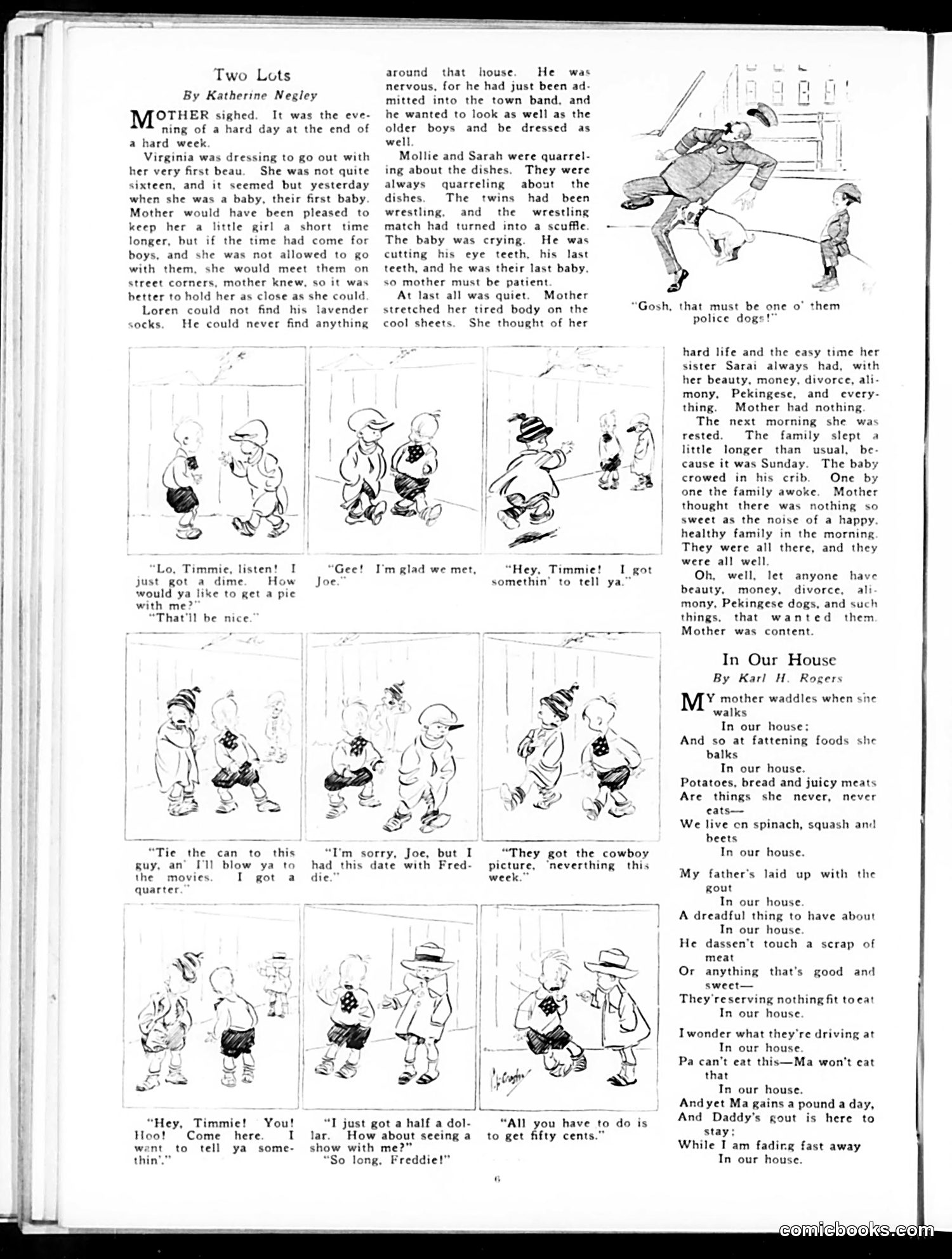
**"Two Lots"** by Katherine Negley contrasts two mothers' lives through narrative and comic panels. One mother—tired, poor, with many children—struggles through domestic chaos: quarreling daughters, wrestling twins, a teething baby. Her sister Sarah enjoys wealth, beauty, and leisure (with a Pekingese dog and alimony). Yet the story's point is class-conscious irony: the exhausted mother finds contentment in her "happy, healthy family," while implying Sarah's luxuries are hollow. The comic strips show neighborhood children making childhood deals—trading dimes for pie, haggling over movie dates—depicting working-class urban youth. **"In Our House"** by Karl H. Rogers is a humorous poem about domestic health contradictions: the mother restricts herself to vegetables while gaining weight; the father, gouty and forbidden rich foods, watches helplessly as his wife gains a pound daily while he "fades away." The satire targets ineffective dieting and domestic irony—sacrifice producing opposite results. Both pieces reflect early 20th-century anxieties about class, family, health, and women's roles.
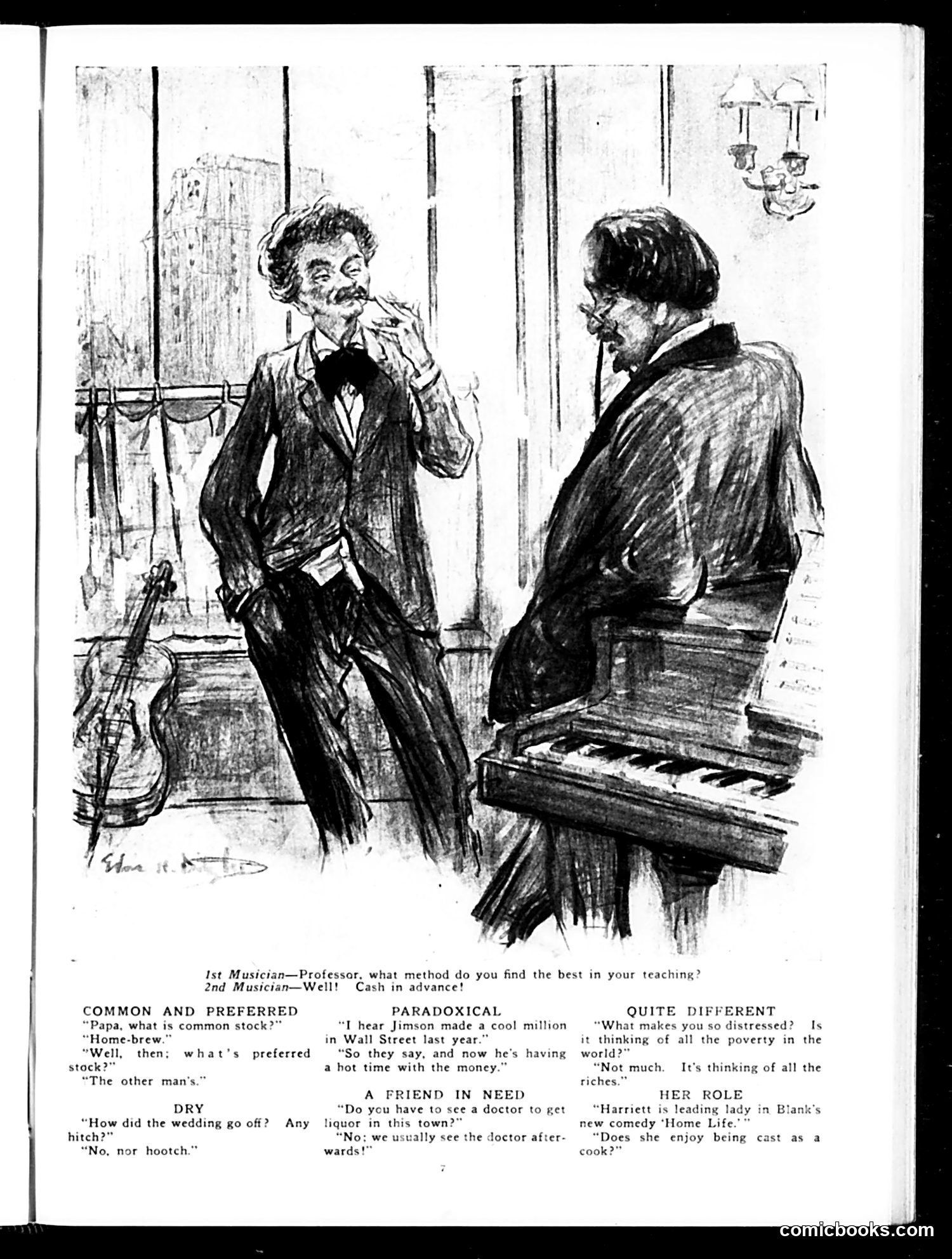
This page from *Judge* magazine (likely 1920s-era, given Prohibition references) contains six separate jokes satirizing American social and economic conditions. The main cartoon depicts two musicians discussing teaching methods, with the punchline "Cash in advance!"—mocking financial desperation during economic uncertainty. The surrounding text jokes address: - **Stock market confusion** during the era of financial speculation - **Prohibition's effects**: "hootch" (illegal liquor) jokes about wedding guests and doctors dispensing alcohol as "medicine" - **Wall Street wealth** creating reckless spending ("hot time with the money") - **Class anxiety**: a character distressed by *others'* wealth rather than poverty - **Gender roles**: a female actor cast as a domestic cook in a play called "Home Life," likely satirizing limited opportunities for women performers The satire targets Prohibition hypocrisy, financial instability, class consciousness, and gender stereotypes—all pressing social issues of the era.
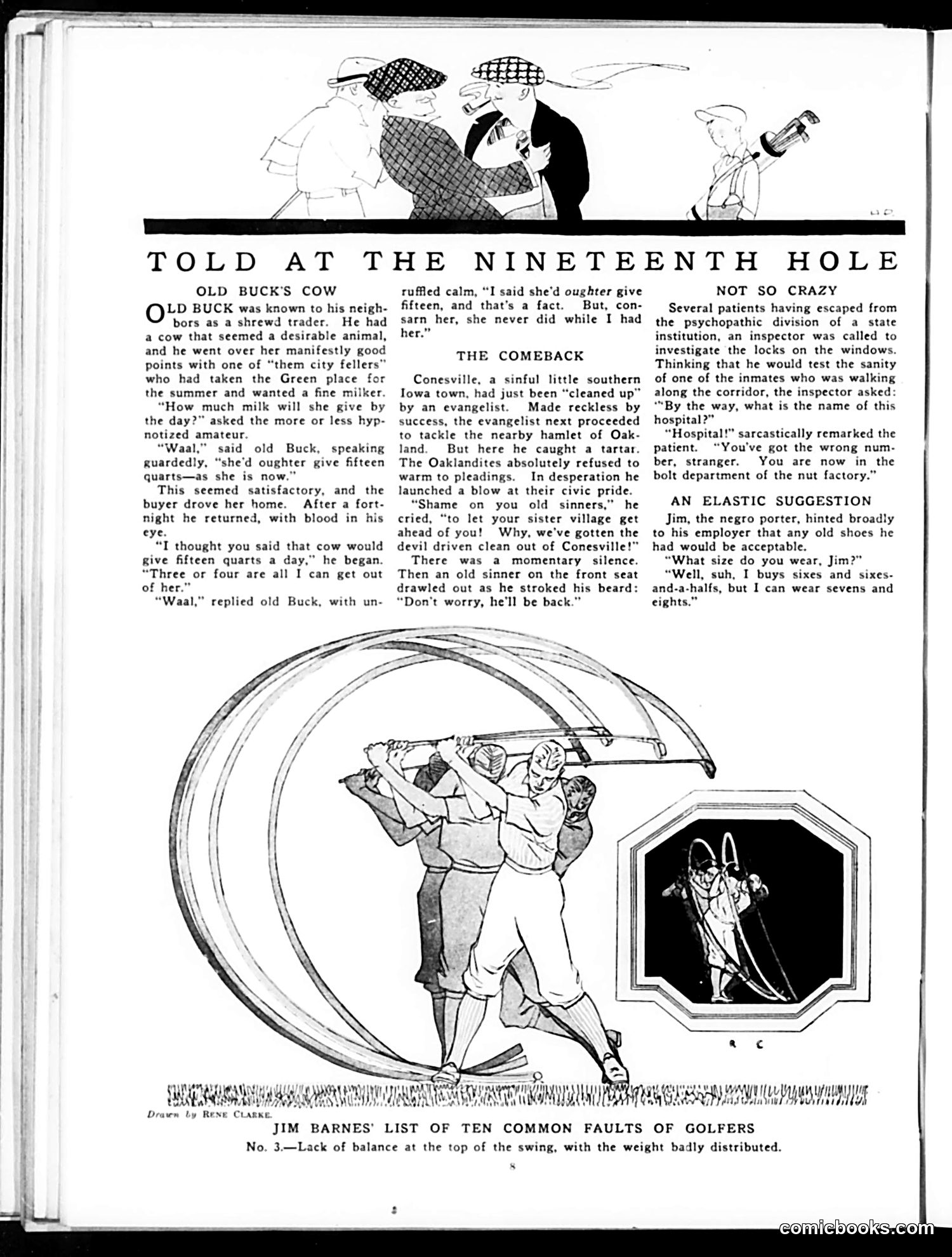
This page presents three humorous anecdotes told at a golf club's nineteenth hole (the bar), plus a golf instruction tip. **"Old Buck's Cow"**: A rural trader deceives a city visitor by claiming the cow *ought* to give fifteen quarts daily—a verbal trick since the cow never actually produced that amount even for Buck himself. **"The Comeback"**: An evangelist boasts of cleaning sin from Conesville and challenges nearby Oakland to match this. An old sinner replies dryly that the devil will return, mocking the evangelist's naive moral certainty. **"Not So Crazy"**: A hospital inspector tests an inmate's sanity by asking the hospital's name. The patient sarcastically corrects him: he's actually in "the bolt department of the nut factory"—the lunatic asylum itself. **"An Elastic Suggestion"**: A Black porter hints his employer should give him old shoes; when asked his size, he claims he can stretch to wear multiple sizes, playing along with whatever is offered. These stories satirize rural cunning, religious hypocrisy, institutional absurdity, and economic desperation.
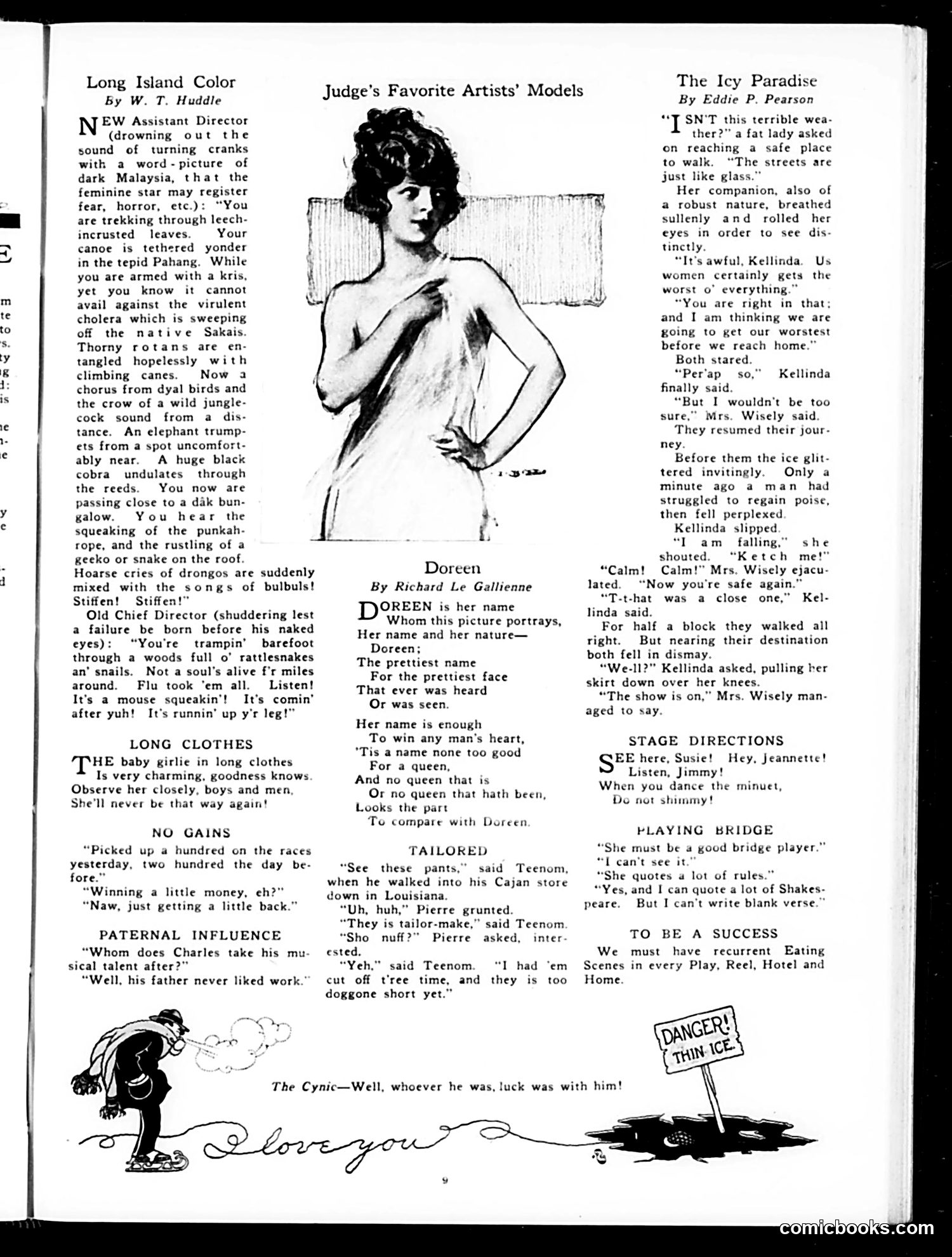
This is a satirical magazine page mixing theatrical commentary with humorous short pieces and illustrations. The main content satirizes film directing: an overly theatrical "New Assistant Director" delivers an absurdly elaborate, melodramatic description of a Malaysian jungle setting to frighten an actress, while the experienced "Old Chief Director" counters with an even more ridiculous American horror scenario (plague, snakes, flu). The satire mocks pretentious, excessive acting direction in the early silent film era. Secondary pieces include light humor about fashion, gambling losses, and social behavior. "Doreen" is a romantic poem about an artist's model. A small cartoon at bottom appears to show someone slipping on ice—connecting to "The Icy Paradise" story about two women struggling on icy streets, finding dark humor in their repeated falls. The overall tone reflects 1920s attitudes toward theater, gender roles, and physical comedy, with particular emphasis on satirizing overwrought artistic pretension in the nascent film industry.
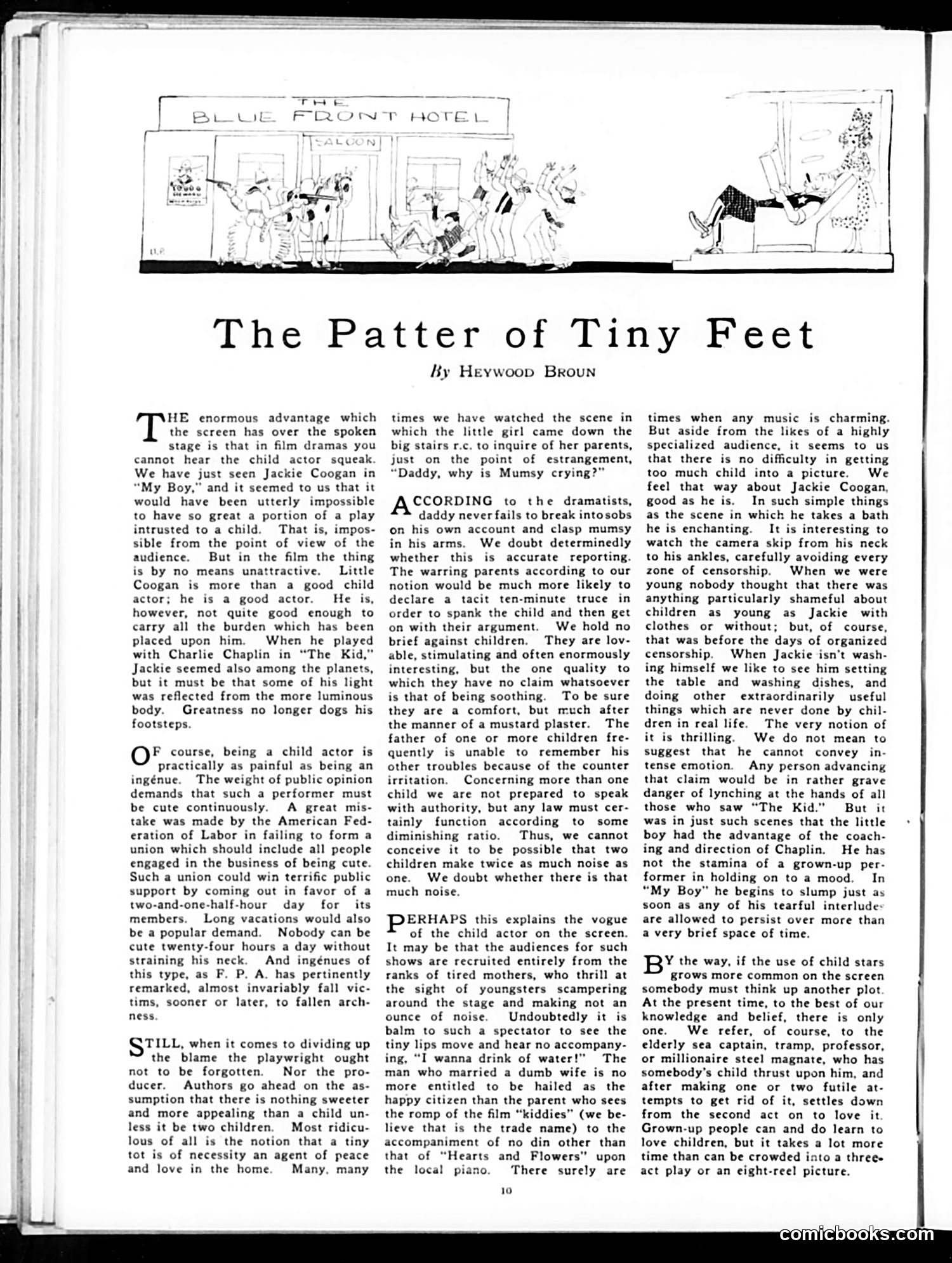
This essay reviews child actor **Jackie Coogan**, famous for appearing with Charlie Chaplin in *The Kid*. Broun argues Coogan is talented but has become overrated—his earlier success relied partly on Chaplin's luminosity. The piece satirizes **theatrical conventions about children**, particularly the tired dramatic trope where a crying child reconciles estranged parents. Broun skewers this as unrealistic: parents quarreling would more likely spank the interrupting child than embrace. He mocks playwrights' assumption that children are inherently "soothing" or peace-bringing to homes, when in reality they're irritating—comparable to mustard plasters. The cartoon at top (labeled "The Blue Front Hotel") appears to show chaotic scenes of child actors in a theatrical setting. Broun's broader point: child actors work precisely *because* film is silent—audiences (implied to be exhausted mothers) enjoy watching children move without hearing them squeak or whine. It's escapism, not genuine dramatic talent.
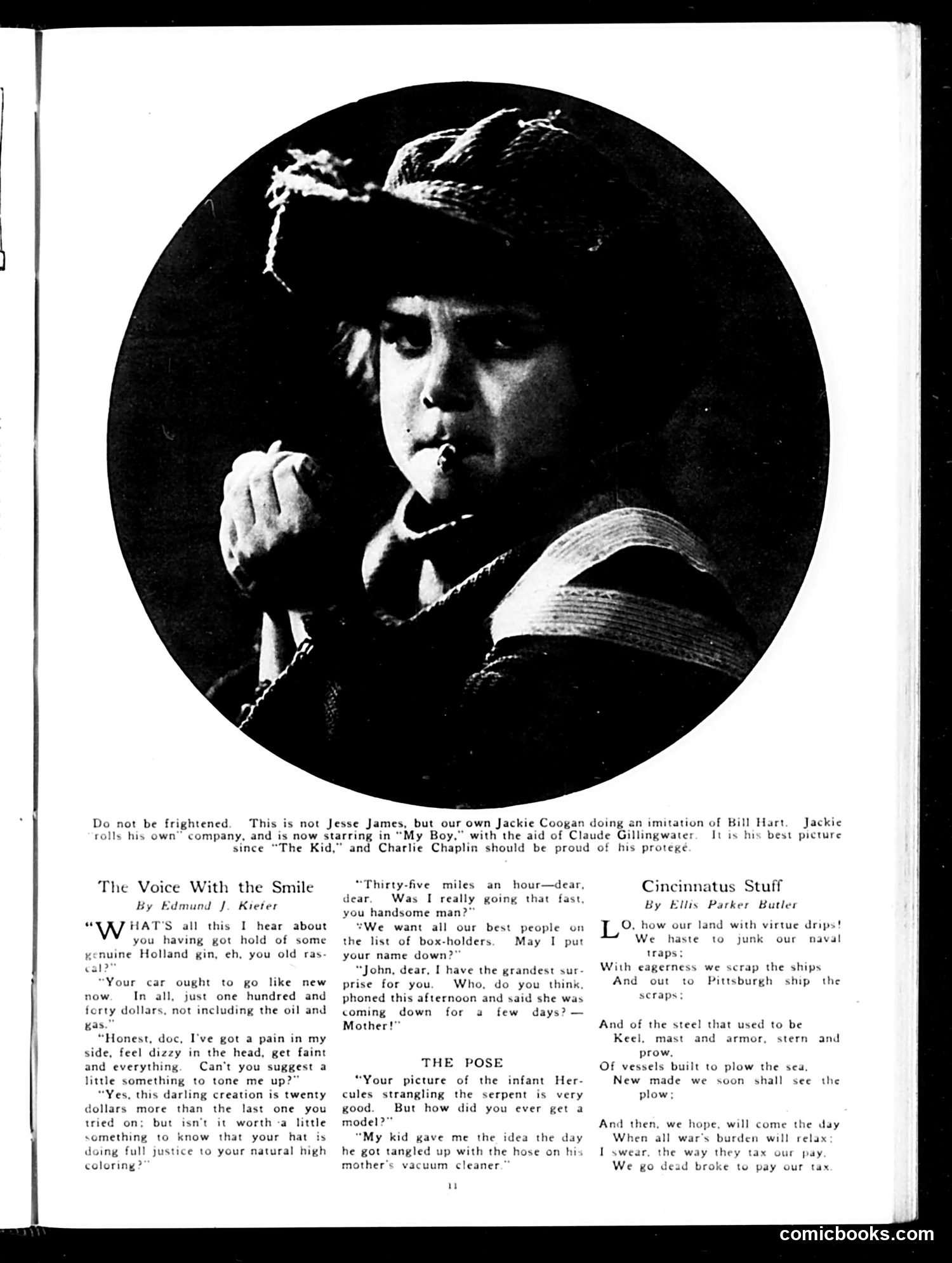
This page contains two satirical pieces targeting consumer culture and sales tactics of the era. **"The Voice With the Smile"** presents a series of dialogue snippets mocking deceptive sales pitches—a mechanic inflating car repair costs, a hat salesman using flattery, a doctor prescribing unnecessary tonics, and a theater box-holder using social pressure. The satire critiques how merchants manipulate customers through charm and psychological pressure. **The photograph and caption** feature child actor Jackie Coogan (famous from Chaplin's "The Kid") imitating Western star Bill Hart in "My Boy." This is promotional material, not satire. **"Cincinnatus Stuff"** satirizes post-WWI disarmament policy, celebrating the conversion of naval ships into plowshares for agriculture. The title references the Roman leader who gave up power for farming. The final stanza mocks the irony: while the nation supposedly saves money through disarmament, ordinary citizens face heavy taxation anyway—suggesting government isn't actually reducing costs despite military cutbacks. Both pieces reflect post-war American anxieties about consumer deception and government fiscal management.
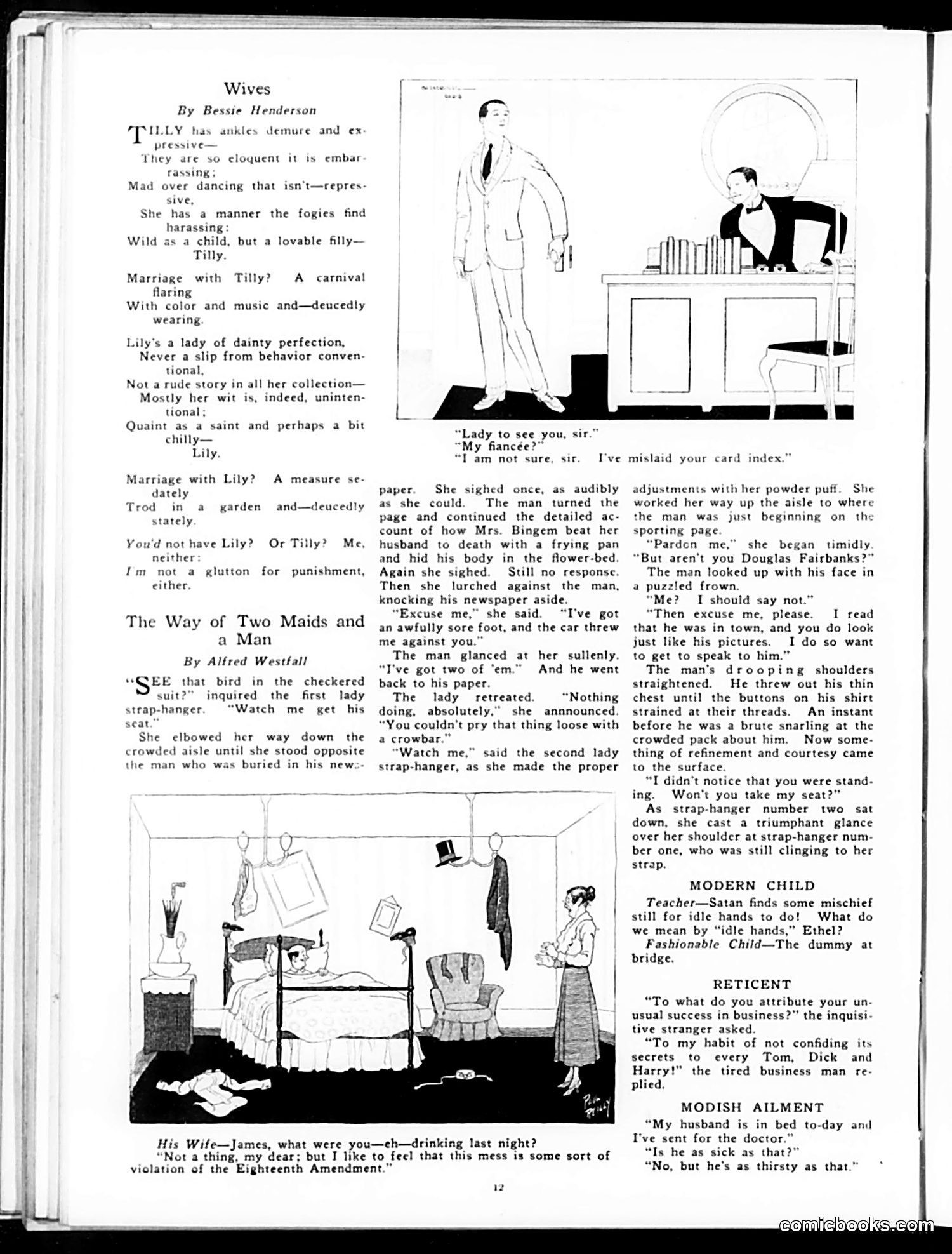
This page contains three satirical pieces reflecting early 20th-century social attitudes: **"Wives"** (poem): Contrasts two female stereotypes—"Tilly," a wild, fun-loving dancer, and "Lily," a demure, proper lady. The joke: the male narrator rejects both as marriage material, claiming he's "not a glutton for punishment." **"The Way of Two Maids and a Man"** (story): Two women compete for a newspaper-reading man's subway seat. The first tries sympathy (fake injury); fails. The second flatters him as "Douglas Fairbanks" (a famous handsome actor). His pride inflated, he offers his seat. The satire mocks male vanity and the manipulative tactics women employ. **Brief items below** joke about modern children's bridge-playing, business discretion, and Prohibition-era drinking (the "Eighteenth Amendment" reference). The overall tone reflects Jazz Age gender dynamics—women portrayed as scheming but clever, men as vain and easily manipulated.
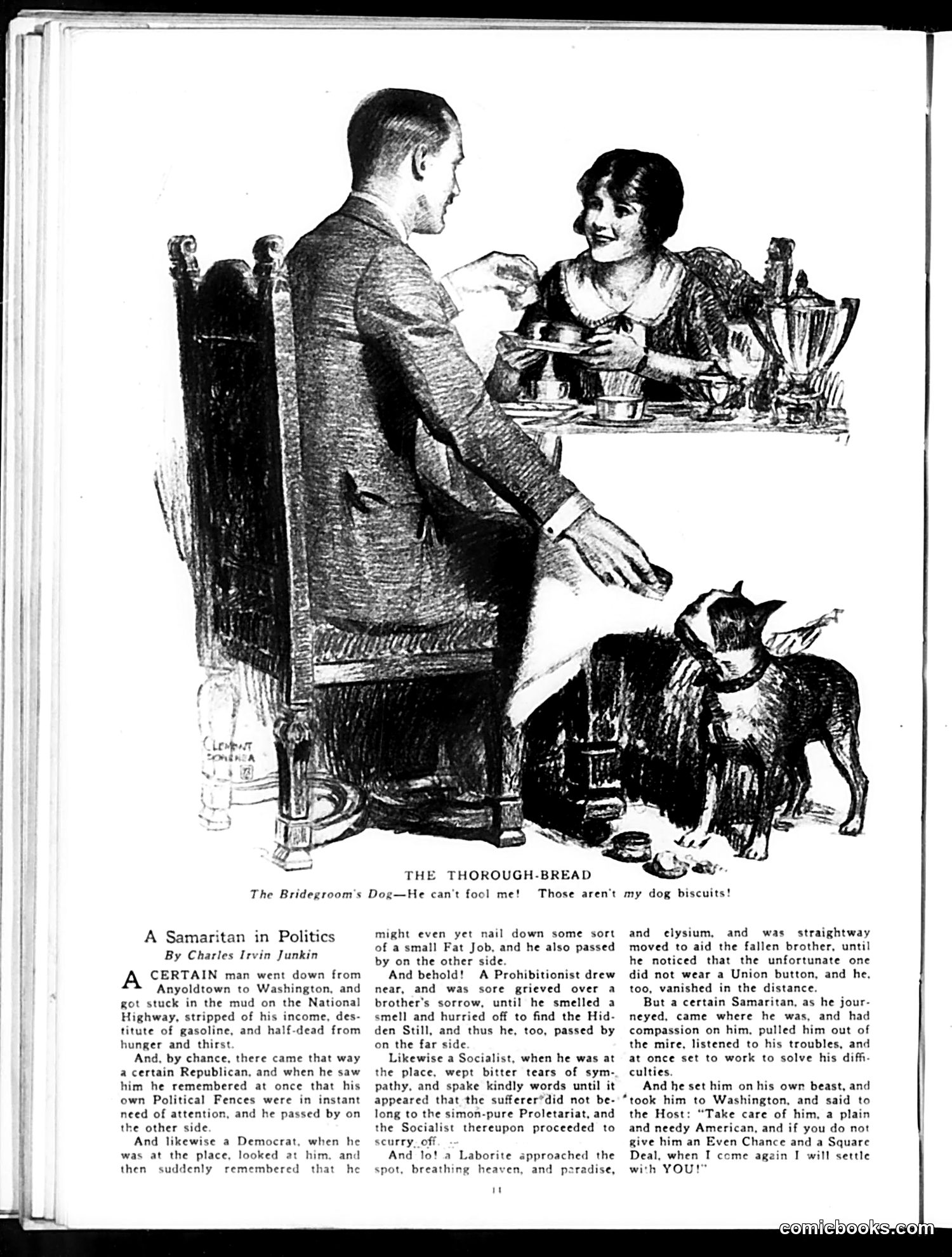
This page presents "A Samaritan in Politics," a satirical retelling of the Biblical Good Samaritan parable. The story mocks American political factions of the early 20th century by showing how various ideological groups—Republicans, Democrats, Prohibitionists, Socialists, and Laborites—each encounter a struggling man on the road to Washington but pass by, motivated by self-interest rather than compassion. Only a "Samaritan" (representing a figure of genuine goodwill, unnamed) actually helps the needy American and takes him to Washington, demanding fair treatment and a "Square Deal." The cartoon above ("The Thorough-Bread") shows a bridegroom's dog rejecting dog biscuits, sarcastically suggesting political parties offer only inferior substitutes to voters. The satire criticizes how politicians exploit suffering rather than genuinely serve citizens.
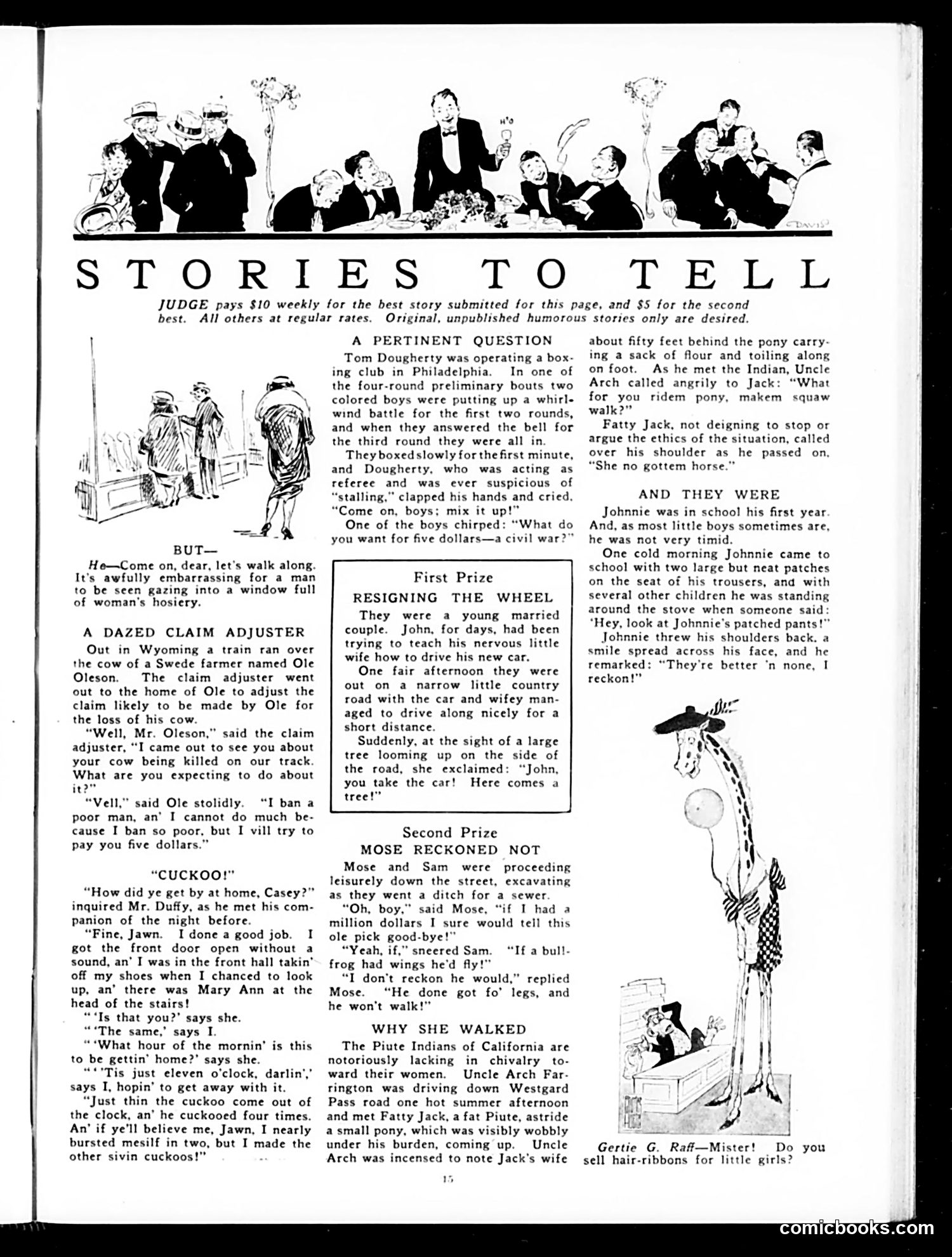
This is a humor submission page from Judge magazine, featuring five short comedic stories with accompanying illustrations. The page includes: **Social satire targets:** - **"A Dazed Claim Adjuster"**: Mocks Scandinavian immigrants (Ole Oleson's dialect) and their perceived poverty/naivety - **"Cuckoo!"**: Irish-American working-class humor about a man sneaking home drunk, using the cuckoo clock's chimes to cover his late arrival - **Boxing story**: Uses "colored boys" and dialect humor about a boxing match - **"Resigning the Wheel"**: Gentle satire of women drivers as nervous and incompetent - **"Why She Walked"**: Stereotypes Native Americans (Piute) as uncivilized and dismissive of women The cartoons employ period ethnic caricatures and stereotypes common to early 20th-century American humor. The page rewards readers' submissions ($10 for best story), indicating this was participatory magazine content reflecting contemporary attitudes toward marginalized groups.
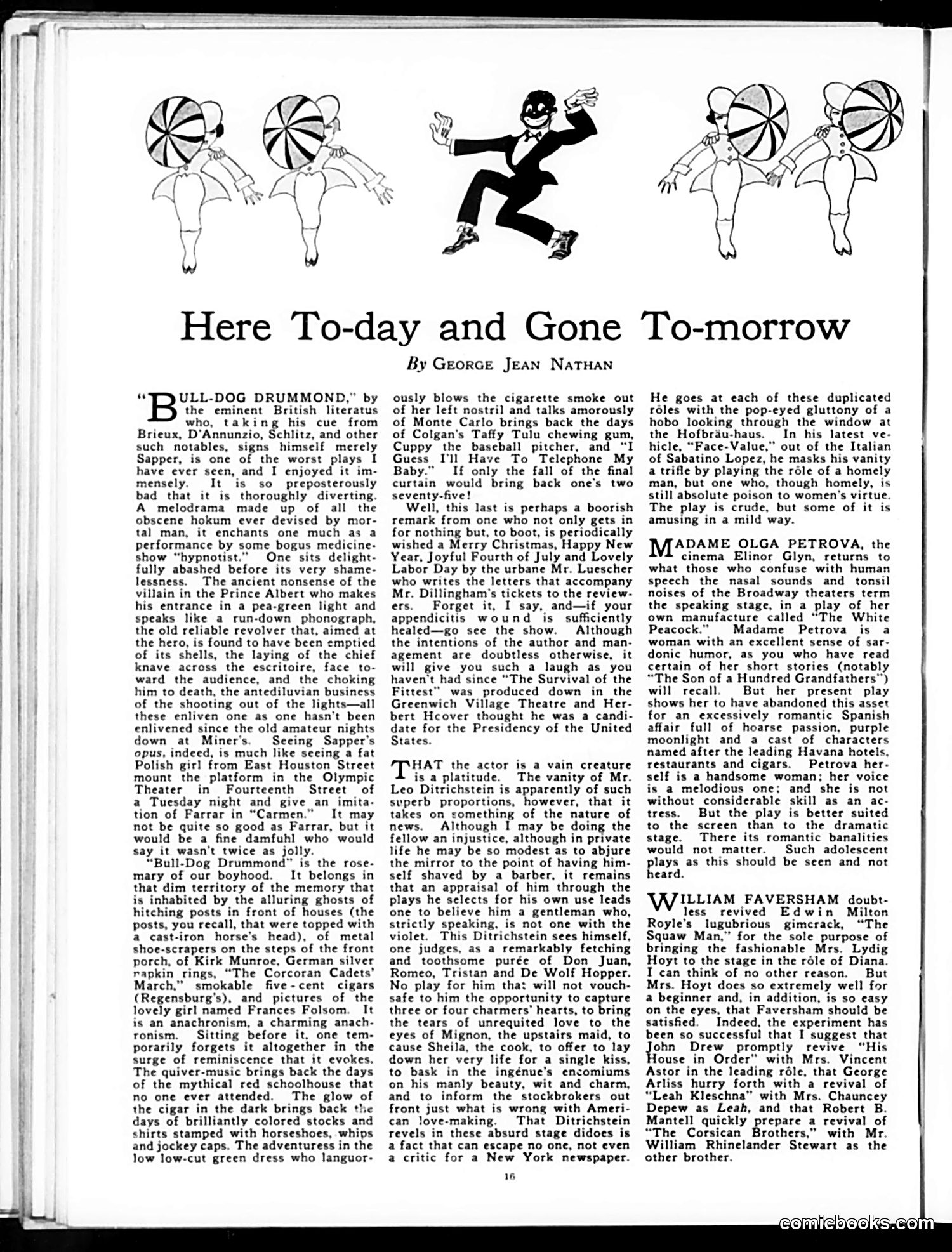
This page contains theater reviews by George Jean Nathan, a prominent drama critic of the early 20th century. The illustrations show chorus girls and a male performer in comedic poses. **"Bull-Dog Drummond"** review satirizes a melodramatic British play by Sapper. Nathan praises it as entertainment *precisely because* it's absurdly bad—comparing it to watching incompetent amateur theater. He catalogs its clichéd tricks: villains in formal wear, malfunctioning revolvers, dramatic lighting effects. The review is nostalgic satire, suggesting the play belongs to a bygone era of simple melodrama, like remembered childhood artifacts (cast-iron hitching posts, five-cent cigars, Frances Folsom). The second review discusses actor **Leo Ditrichstein's** excessive vanity, suggesting his self-regard has become newsworthy itself. **Point**: Nathan uses humor to mock both the play's dated conventions and theater-goers' nostalgia for such entertainment. The satire targets not just the production but audiences' susceptibility to theatrical hokum.
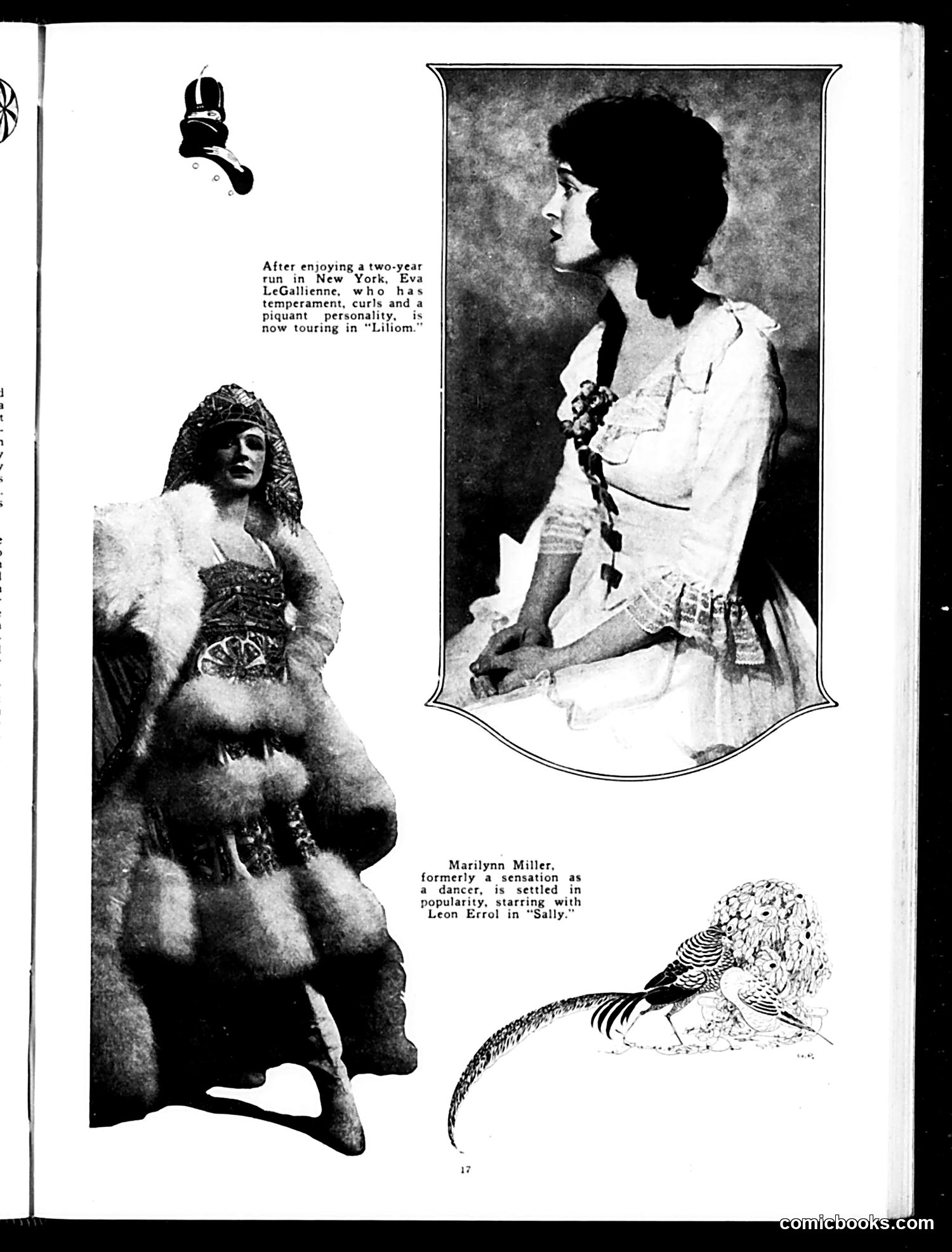
This page features theatrical entertainment news and photographs from the early 1920s. The text discusses two actresses: Eva LeGallienne, who completed a two-year New York run and is now touring in the play "Liliom," and Marilynn Miller, a former dancer turned actress starring opposite Leon Errol in "Sally." The layout includes portrait photographs of these performers in costume or promotional poses, along with decorative illustrations (a hanging lamp and a bird). This appears to be straightforward entertainment coverage rather than political satire—typical "society and stage" content from Judge magazine documenting Broadway's popular stars of that era. The tone is celebratory and gossipy rather than satirical.
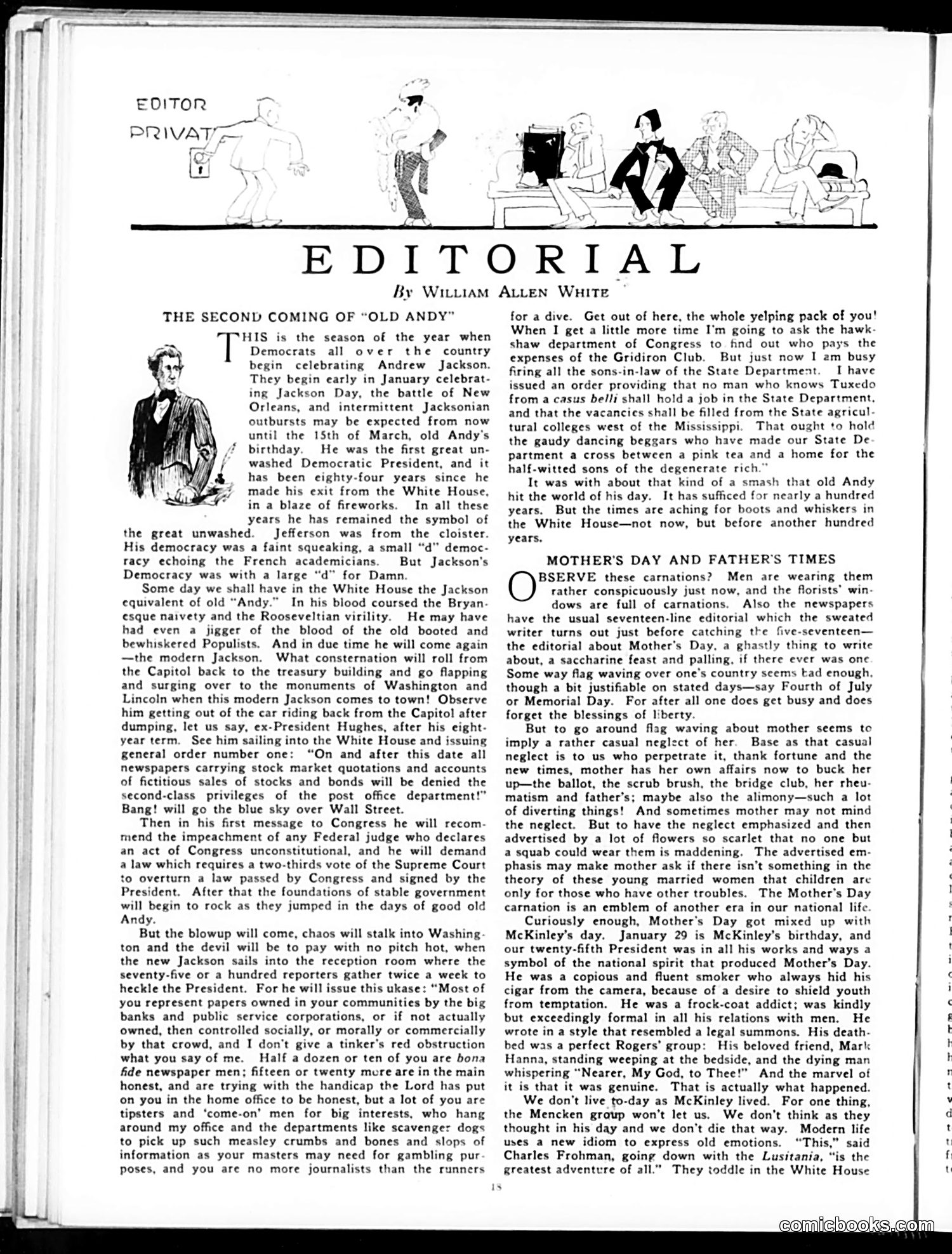
This editorial by William Allen White satirizes the Democratic Party's romanticization of Andrew Jackson while warning of a hypothetical "modern Jackson" who would disrupt the political establishment. **The Setup:** Democrats annually celebrate Jackson Day (January 15), treating Jackson as a symbol of populist, anti-establishment democracy—the "great unwashed" leader. **The Satire:** White imagines a future Jackson-like president who would: - Ban newspapers owned by financial interests from postal privileges - Impeach federal judges who declare laws unconstitutional - Demand Congressional supermajority power over Supreme Court rulings - Purge State Department officials by bloodline connections - Expel journalists from White House press access **The Point:** White mocks both Democratic nostalgia for Jackson AND progressive reformist overreach. The satirical "modern Jackson" represents an anti-establishment populist so extreme he would fundamentally destabilize constitutional governance. The piece warns that romanticizing Jackson's era blinds Democrats to dangerous authoritarian impulses in actual populist movements. This reflects early 20th-century anxieties about unchecked executive power and media manipulation.
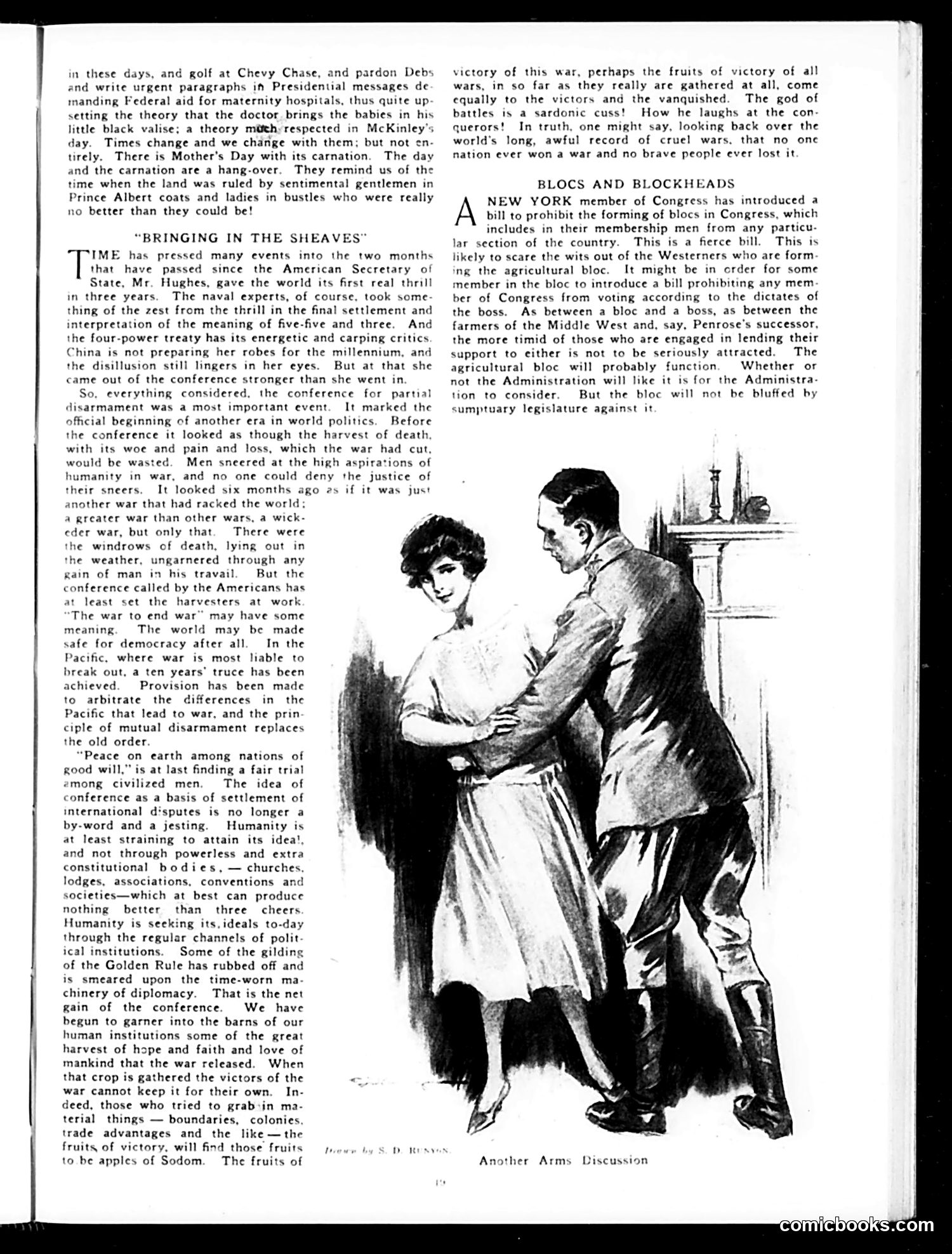
This Judge magazine cartoon satirizes post-WWI diplomatic efforts, particularly Secretary of State Hughes's 1921-1922 naval disarmament conference. The illustration depicts a woman (representing democracy or peace) in conversation with a military officer, likely symbolizing the tension between civilian idealism and military interests. The accompanying text celebrates the conference as humanity's attempt to convert war's devastation into constructive peace—"bringing in the sheaves" (harvesting hope). However, the satire lies in the juxtaposition: while diplomats conference hopefully, the cartoon suggests the military establishment remains skeptical and unconvinced. The text criticizes those seeking material gains (colonies, trade advantages) from victory, warning such "fruits" will prove hollow. The overall message: wartime idealism is being tested against peacetime realities, and genuine transformation depends on whether nations truly embrace cooperation over territorial ambition.
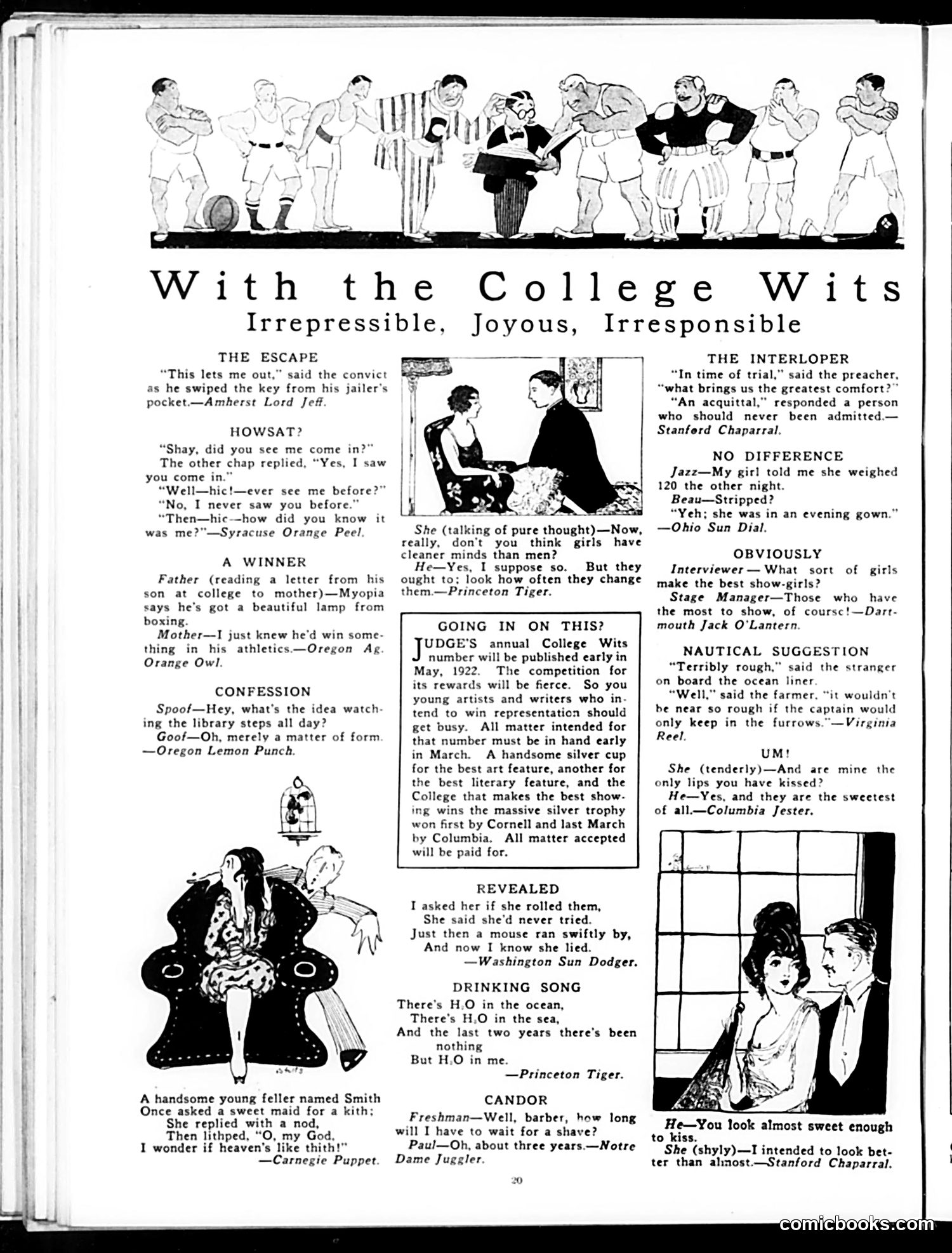
This page collects humorous submissions from college publications across America, showcasing student wit from 1920s campuses (Cornell, Princeton, Stanford, Columbia, etc.). The satirical humor targets contemporary college life: drunken students ("Howsat?" jokes about inebriation), boxing as trivial college achievement, flirtation and dating rituals, and the sexual double standards of the era (women's "purity" versus their actual behavior). The running gag about "H₂O in me" references Prohibition (1920-1933)—students drinking illicitly. The "cleaner minds" joke mocks superficial gender stereotypes. The barber's "three years" wait-time joke likely alludes to fashion or grooming trends of the period. The illustrated vignette shows a couple courting. Overall, the page presents college students as irreverent, pleasure-seeking, and evasive—mocking both their pretensions and authority figures' blindness to their actual behavior.
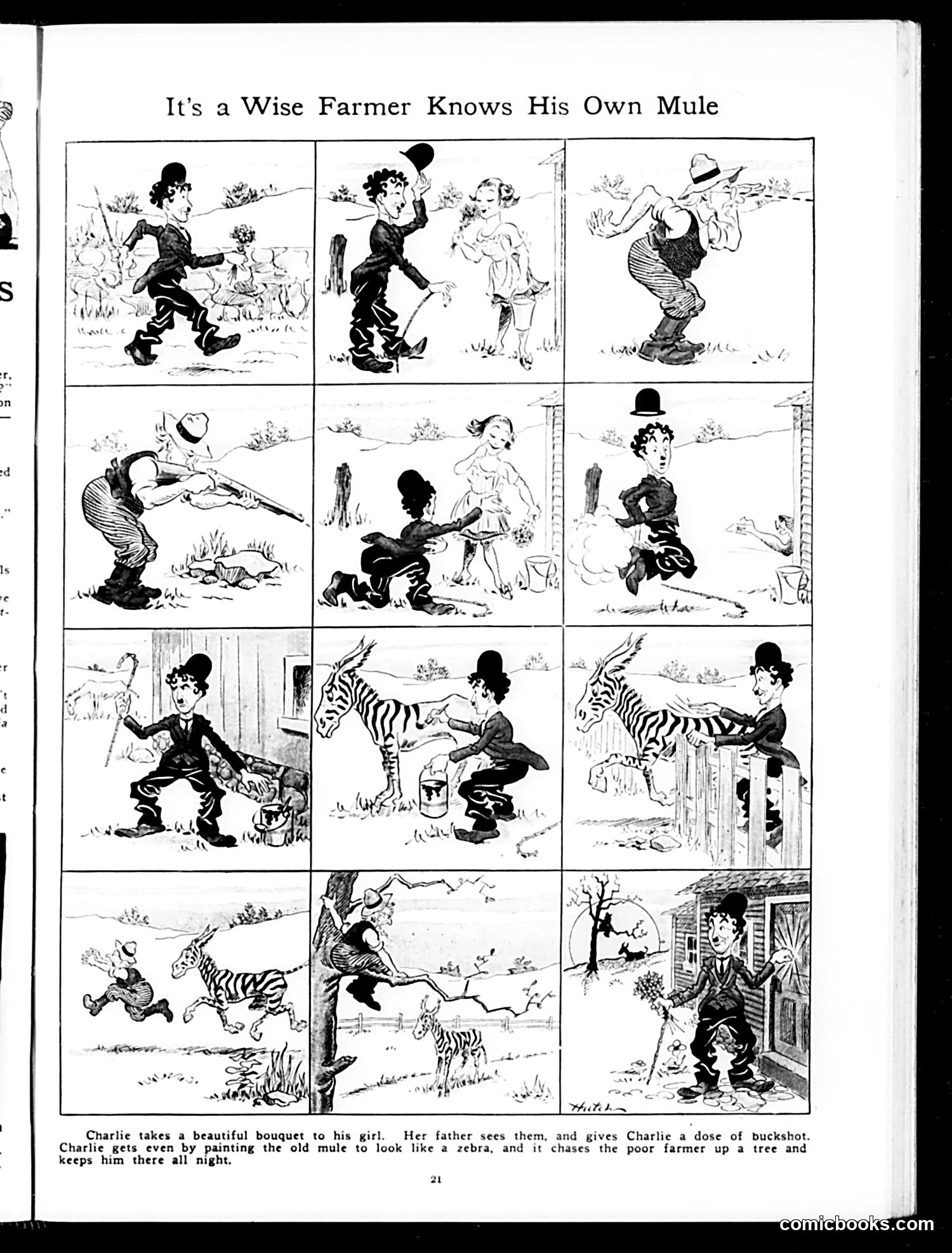
This is a sequential comic strip about courtship and revenge. Charlie, apparently a young suitor of modest means, attempts to court a farmer's daughter with flowers. The girl's protective father responds violently with buckshot—reflecting period attitudes about daughters and male callers. Charlie's revenge is absurdist: he paints the farmer's mule to resemble a zebra, creating a disguised animal the farmer doesn't recognize. The mule then chases the farmer up a tree, trapping him overnight. The humor relies on the pun in the title—the farmer literally fails to "know his own mule" when disguised. The comic satirizes rural courtship customs, paternal overprotectiveness, and the foolishness of both the aggressive father and the prankster suitor. The exaggerated consequences (extended tree-sitting) emphasize the joke's absurdity rather than realistic consequence.
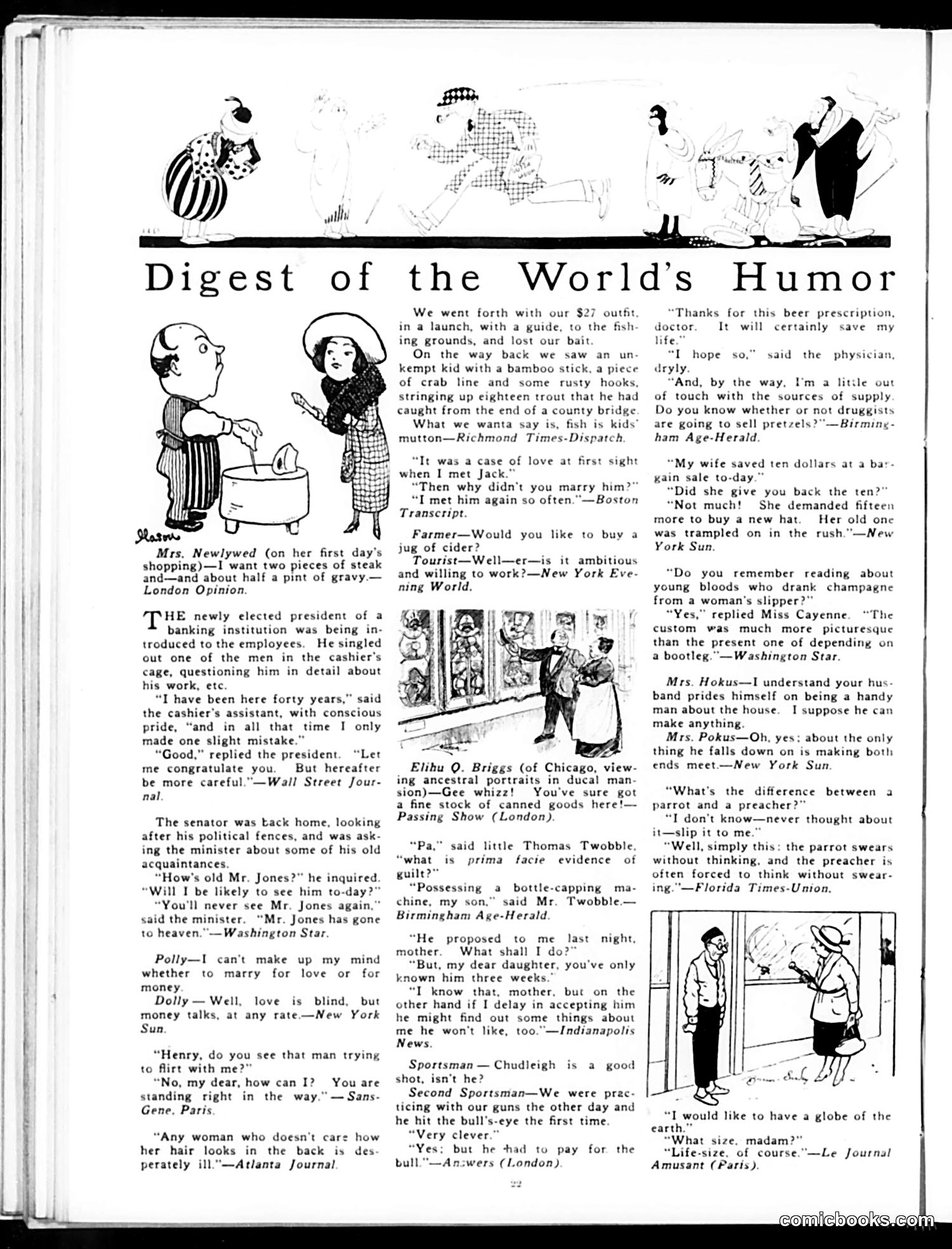
This page collects brief humorous anecdotes from various international publications, typical of Judge's format. The jokes reflect early-20th-century attitudes and concerns: **Key themes:** - **Gender roles**: A newlywed wife's ignorance about cooking; women's vanity about appearance; marriage as financial transaction - **Class satire**: A banker praising a 40-year employee for one mistake (absurd standards); a tourist mistaking ancestral portraits for "canned goods" - **Prohibition-era humor**: References to beer prescriptions and bootleg alcohol (suggesting Prohibition era) - **Marital discord**: A wife hoarding bargain-sale savings; couples' miscommunications - **Social commentary**: Child understanding legal terms; working-class fishing vs. leisure activities The cartoons accompanying the text appear generic, illustrating domestic scenes rather than specific political figures. The humor relies on stereotypes—foolish tourists, penny-pinching wives, bumbling husbands—rather than topical satire.
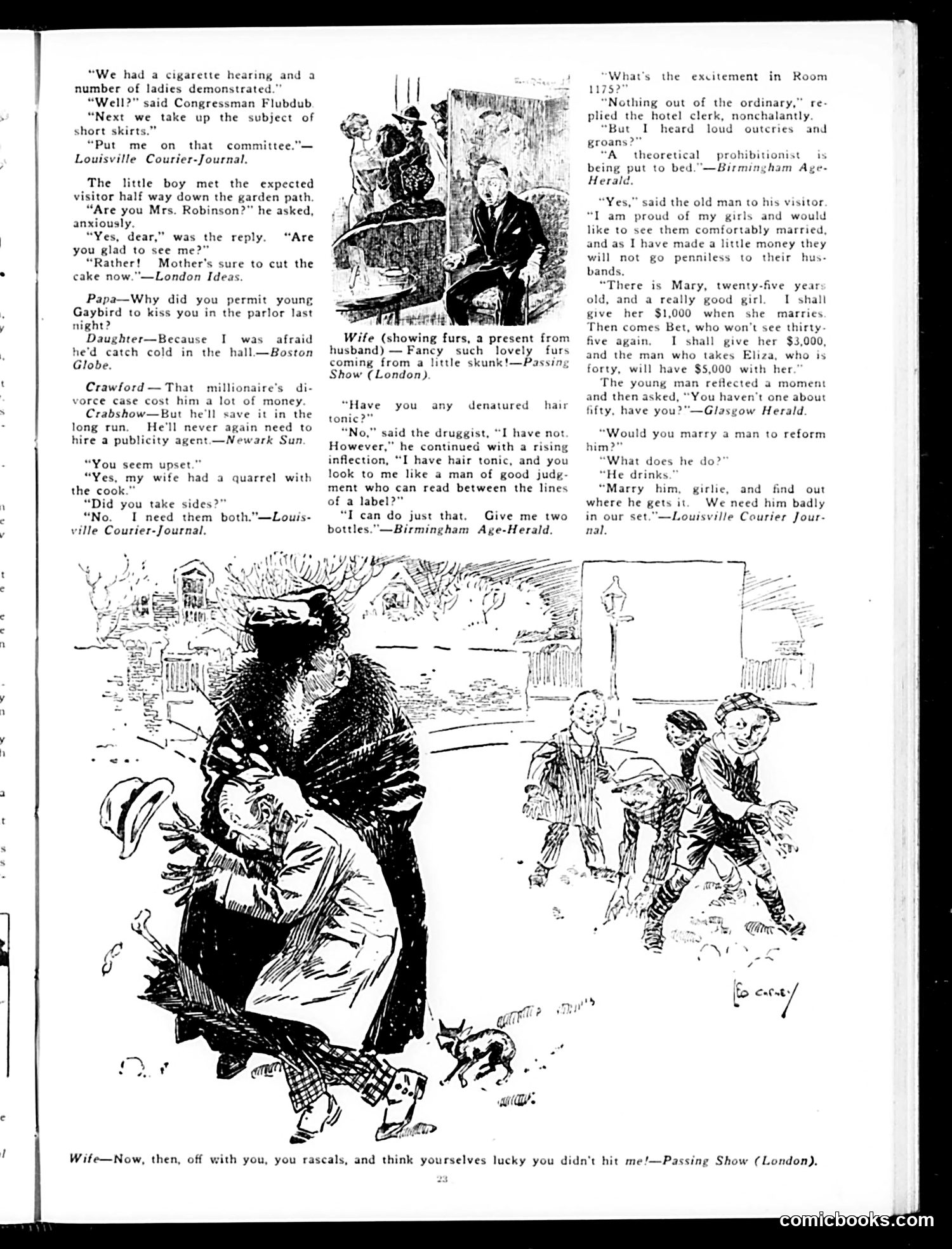
This page collects brief humorous anecdotes satirizing early 20th-century American life. Key themes include: **Gender and Marriage**: Multiple jokes mock women's marriageability and financial value. A father explicitly prices his daughters by age (younger = less dowry needed), while another joke suggests marrying a drunk man to "reform him" is absurd. **Women's Fashion**: A congressman eagerly volunteers for a committee on "short skirts," satirizing male hypocrisy about women's changing dress codes during the era. **Prohibition**: One anecdote references a "theoretical prohibitionist" in distress, likely mocking anti-alcohol activists as impractical idealists. **Class and Materialism**: Several jokes center on money, divorce costs, and transactional relationships, suggesting anxiety about wealth's corrosive social effects. The large illustration shows a woman scolding children, accompanying a final joke about misbehavior—typical period family humor emphasizing maternal discipline. Overall, the page reflects early 20th-century anxieties about changing gender roles, consumerism, and social propriety.
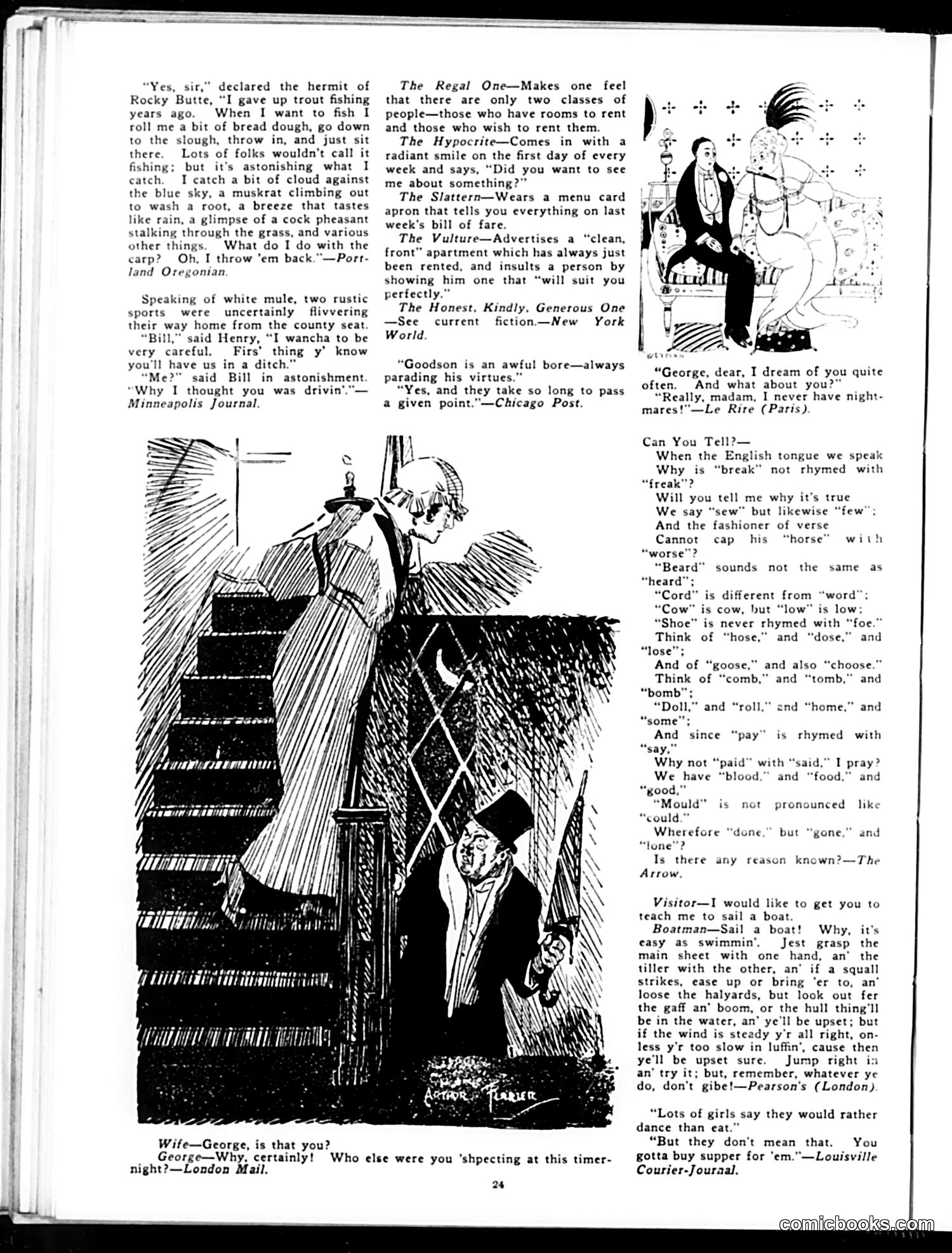
This page contains several satirical pieces typical of early 20th-century American humor magazines: **Left side cartoons**: Anecdotes mocking rural/working-class speech and behavior—a hermit philosophizing about fishing with bread dough, two drunk drivers uncertain who's driving their "flivver" (Model T Ford). **Right side**: A series of character types satirizing landlords and apartment-hunting (the "Regal One," "Vulture," "Slattern"), exposing housing market deceptions and landlord exploitation. The "Honest, Kindly, Generous One" is sarcastically noted as existing only in fiction. **"Can You Tell?" section**: A linguistic puzzle highlighting English language irregularities—why certain words don't rhyme as expected despite similar spellings. This plays on period fascination with language quirks. **Bottom dialogues**: A boatman's incomprehensibly complex sailing instructions (humor through confusion) and commentary on dating economics—that girls say they prefer dancing to eating, but expect dinner anyway, mocking courtship conventions. The overall tone reflects Judge's satirical approach to everyday American life, class tensions, and social hypocrisy.
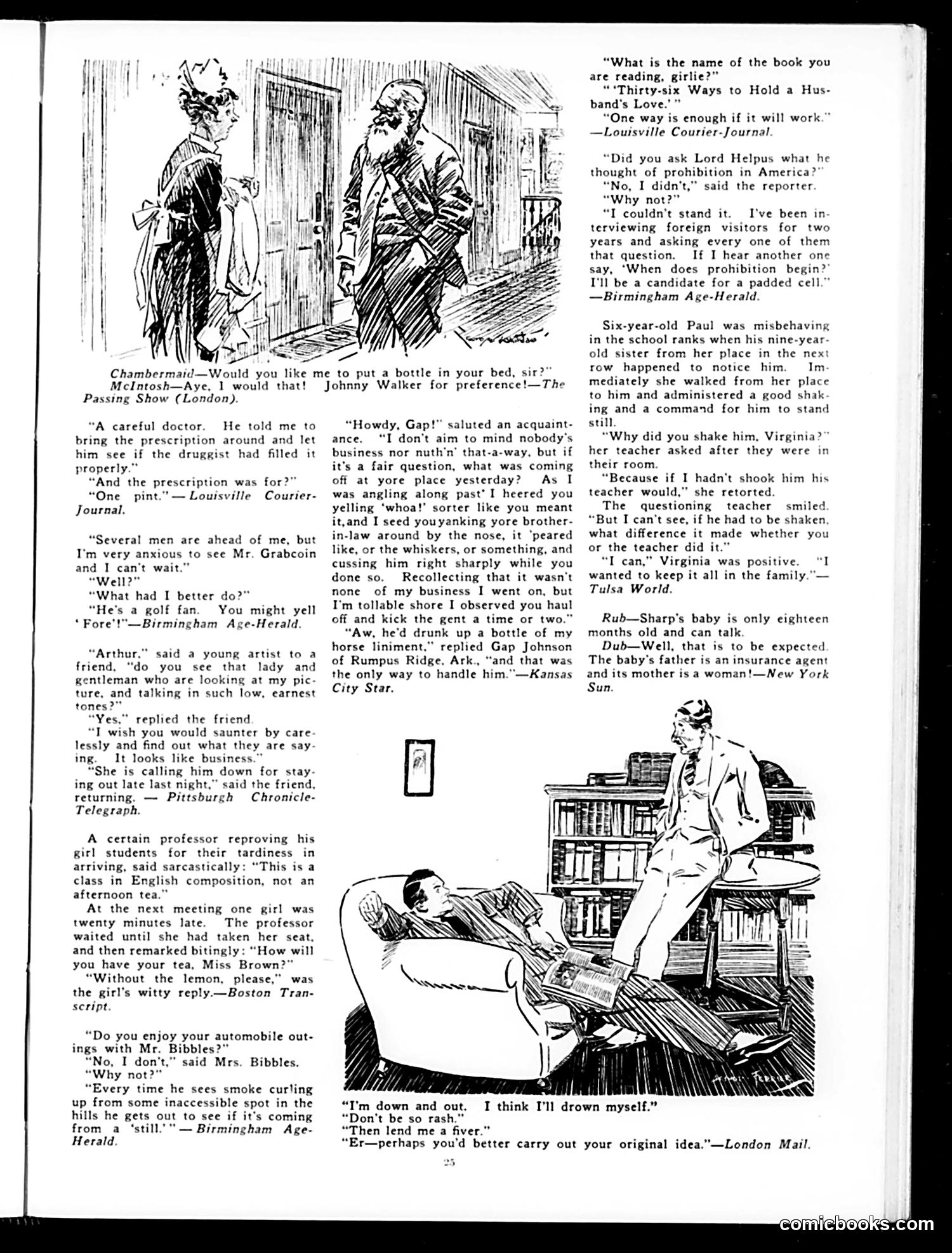
This page collects brief humorous anecdotes from various American and British newspapers, typical of Judge's format. The jokes target domestic life and social conventions: **Key themes:** - **Marital discord**: A wife reads "Thirty-six Ways to Hold a Husband's Love" but only needs one method that works - **Prohibition era**: A reporter exhausted from interviewing foreign visitors about America's new prohibition laws - **Automobile culture**: A man constantly stops his car to investigate smoke, hoping to find illegal stills (suggesting widespread bootlegging despite prohibition) - **Class/manners**: Jokes about doctors, professors, and social interactions **The cartoons** (two visible illustrations) show domestic/office scenes consistent with these themes—one depicting someone at a desk, another showing figures in conversation. The humor reflects 1920s concerns: prohibition's unpopularity, marriage stability anxieties, and the era's social awkwardness. These aren't political cartoons but rather social satire targeting everyday situations and character types.
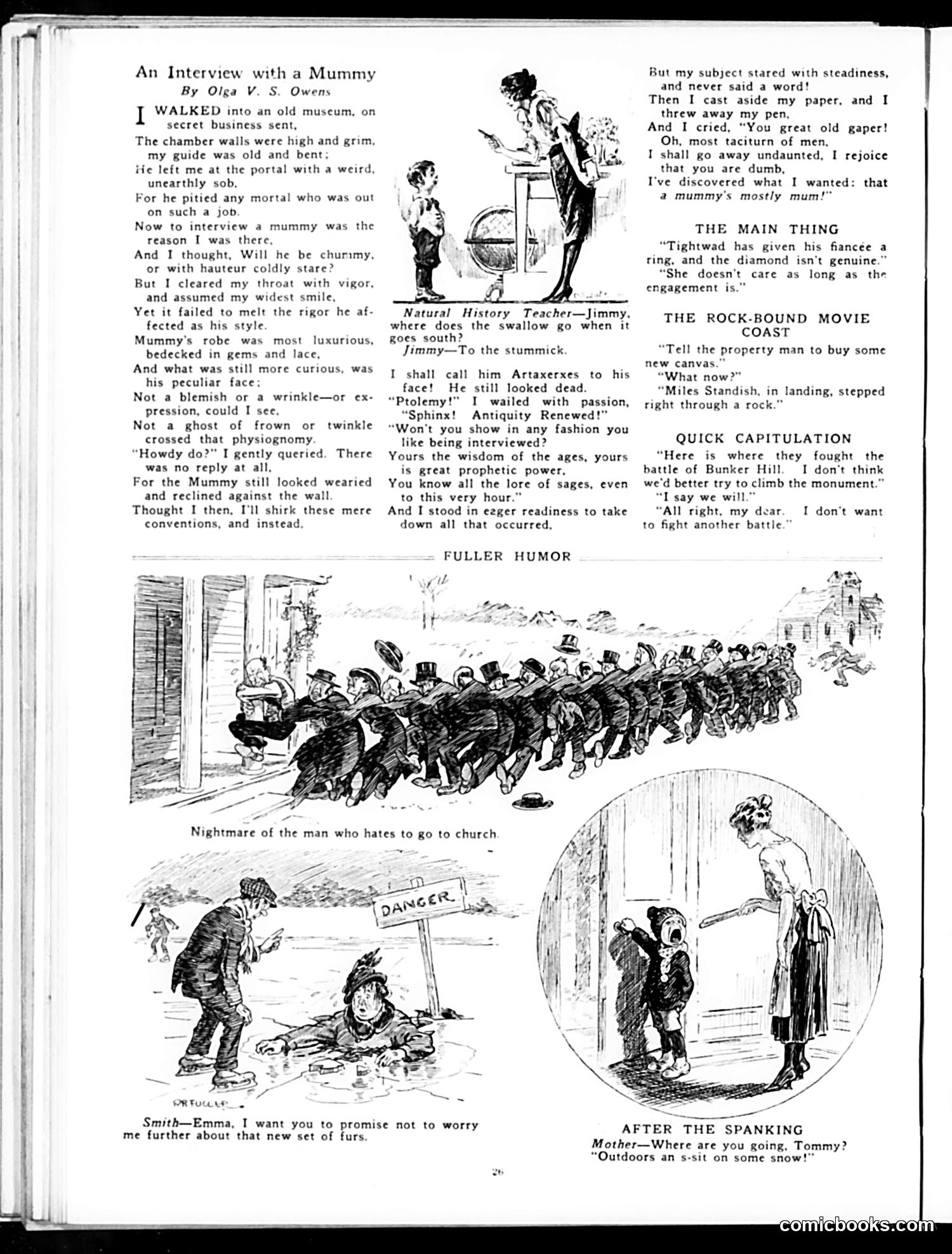
This page contains a humorous poem by Olga V.S. Owens about a journalist attempting to interview an Egyptian mummy in a museum. The joke is that despite the narrator's elaborate efforts—flattery, rhetorical questions, passionate appeals to the mummy's ancient wisdom—the mummy remains completely silent and unresponsive. The punchline is that the narrator discovers "a mummy's mostly mum" (silent/mute), a pun on the word "mum." The page also includes unrelated cartoons and jokes typical of Judge magazine's format: a child's misheard answer about swallows, domestic humor about furs and engagement rings, and a film industry joke about movie props. These represent the satirical magazine's mix of wordplay, social commentary, and slapstick humor aimed at early 20th-century readers.
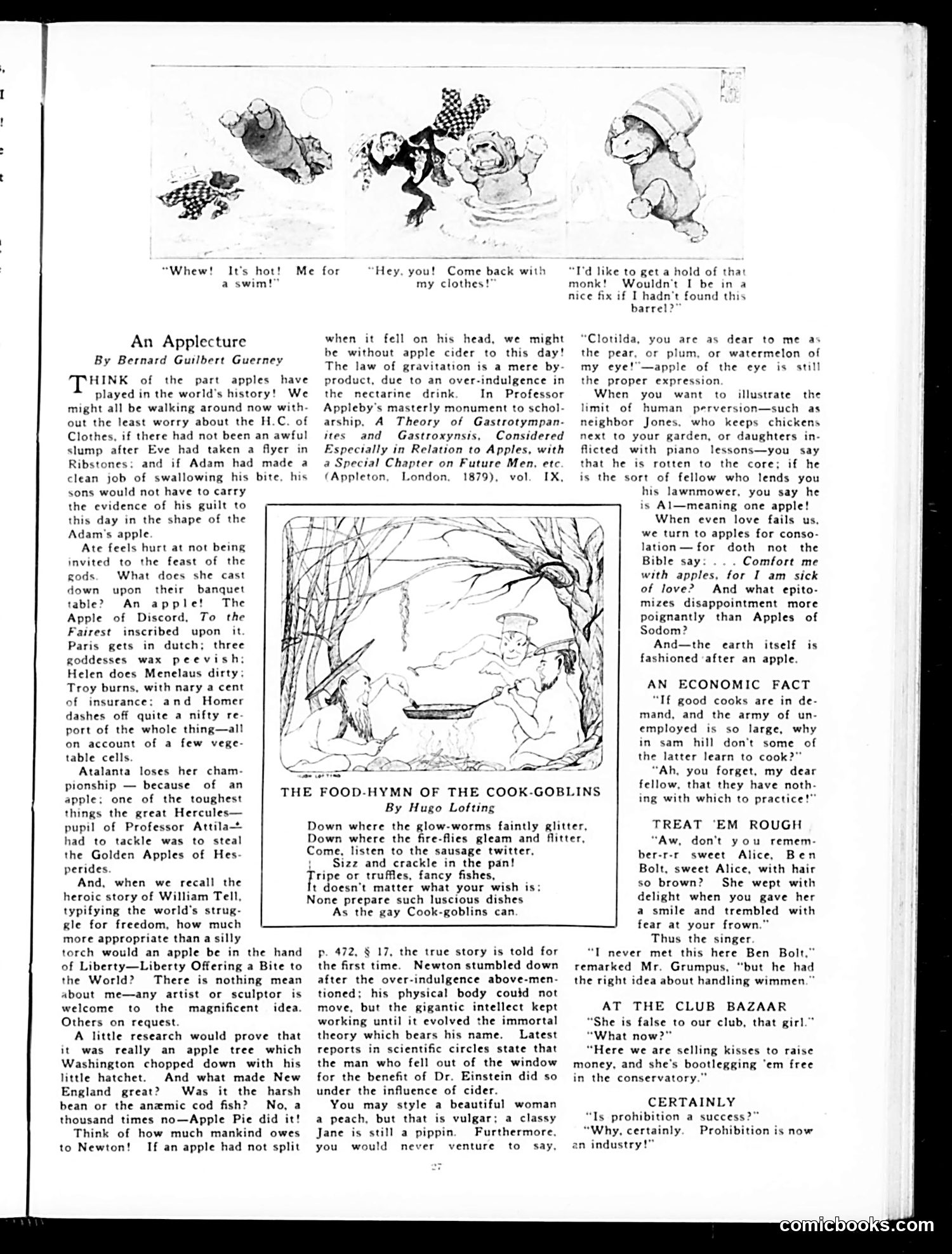
This page features a humorous essay by Bernard Guilbert Guerney celebrating apples' role in history and culture. The piece is satirical in tone—mock-seriously tracing apples' influence from Adam and Eve through Newton, William Tell, and George Washington, attributing major historical events to apples while inflating their importance absurdly. The accompanying cartoons show children in summer situations (swimming, playing), while "The Food-Hymn of the Cook-Goblins" is a whimsical poem by Hugo Lofting about magical creatures preparing food. The satire targets grandiose historical narratives and pseudointellectual discourse (note the fabricated scholarly reference to "Professor Appleby's" dense tome). By tracing everything to apples—from the Fall of Man to relativity—Guerney mocks how writers construct elaborate arguments around trivial premises. The humor relies on readers recognizing this exaggerated scholarly pomposity.
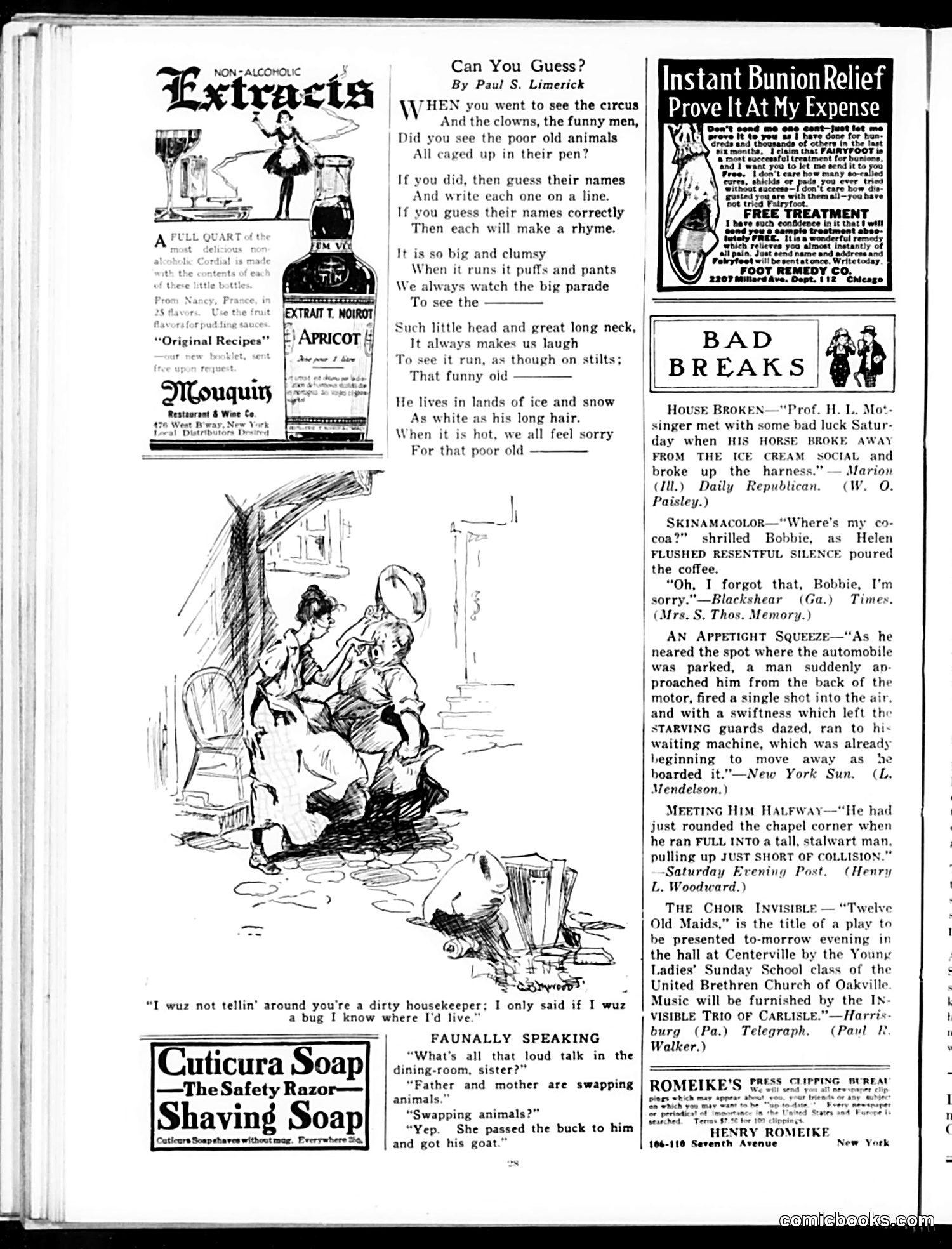
This page features a children's riddle poem asking readers to guess circus animals by their descriptions. The clues describe an elephant ("so big and clumsy...puffs and pants"), a giraffe ("little head and great long neck"), and a polar bear ("lands of ice and snow...white as his long hair"). Readers are meant to fill in the blanks, creating rhymes. Below is an unrelated joke labeled "Funnally Speaking" playing on idioms—a mother "passed the buck" (avoided responsibility) to her husband and "got his goat" (annoyed him) during an argument, with "swapping animals" being the humorous misunderstanding. The page also contains advertisements (Cuticura Soap, bunion relief) and brief humorous newspaper anecdotes titled "Bad Breaks," typical of Judge magazine's satirical content.
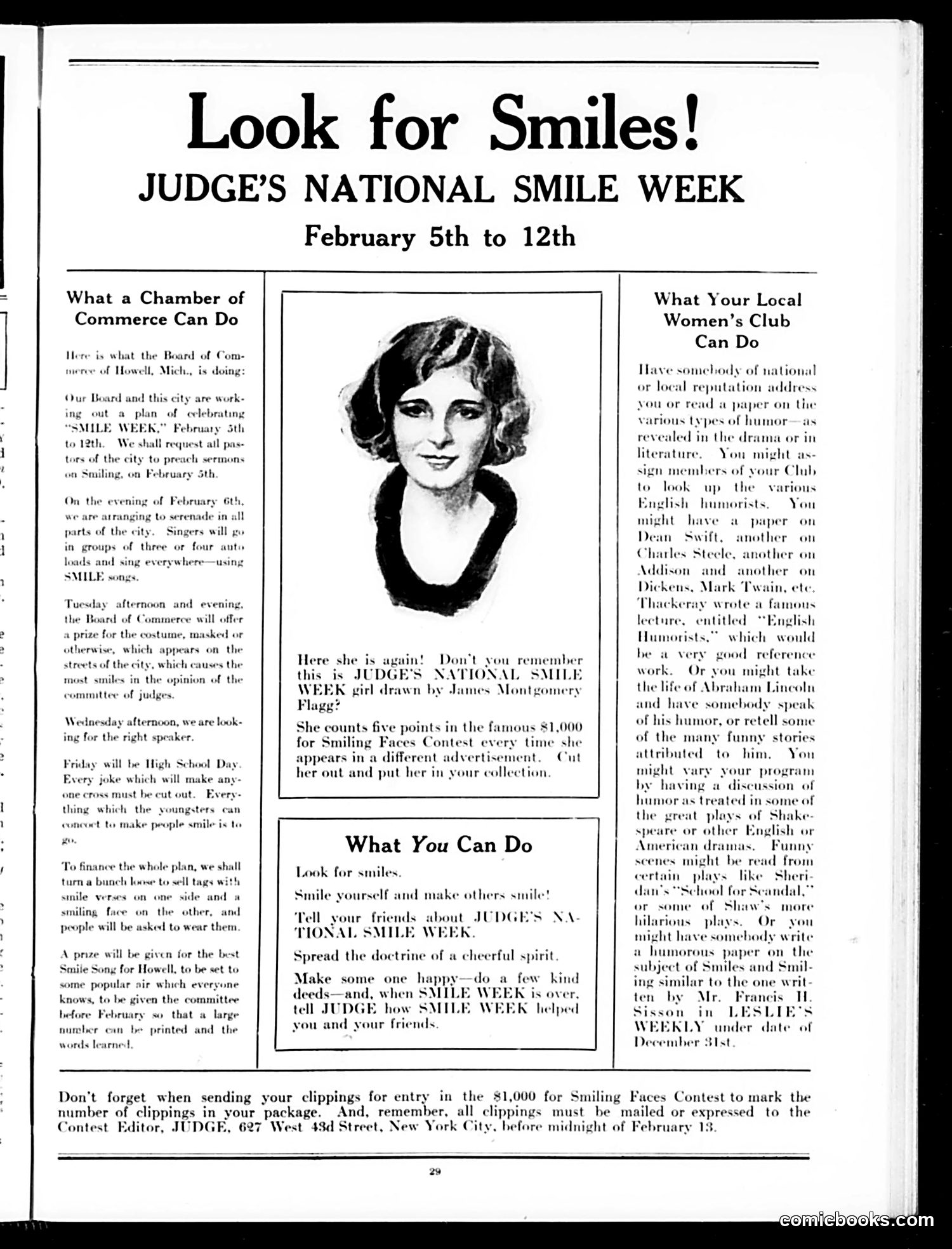
This page promotes Judge magazine's "National Smile Week" (February 5-12), a promotional campaign encouraging Americans to cultivate cheerfulness and humor. The illustrated girl, drawn by James Montgomery Flagg, serves as the campaign's mascot—she appears in advertisements throughout the issue, with readers collecting her images for a "$1,000 for Smiling Faces Contest." The page offers practical suggestions for civic participation: the Chamber of Commerce in Howell, Michigan organized parades and competitions; women's clubs could host lectures on literary humorists (Swift, Dickens, Thackeray, Mark Twain); ordinary citizens were encouraged to smile, perform kindnesses, and spread "the doctrine of a cheerful spirit." This reflects early 20th-century American civic boosterism and Judge's role as an arbiter of humor and culture. The campaign promotes optimism and social cohesion through shared participation in a mass media event—a precursor to modern promotional weeks and contests.
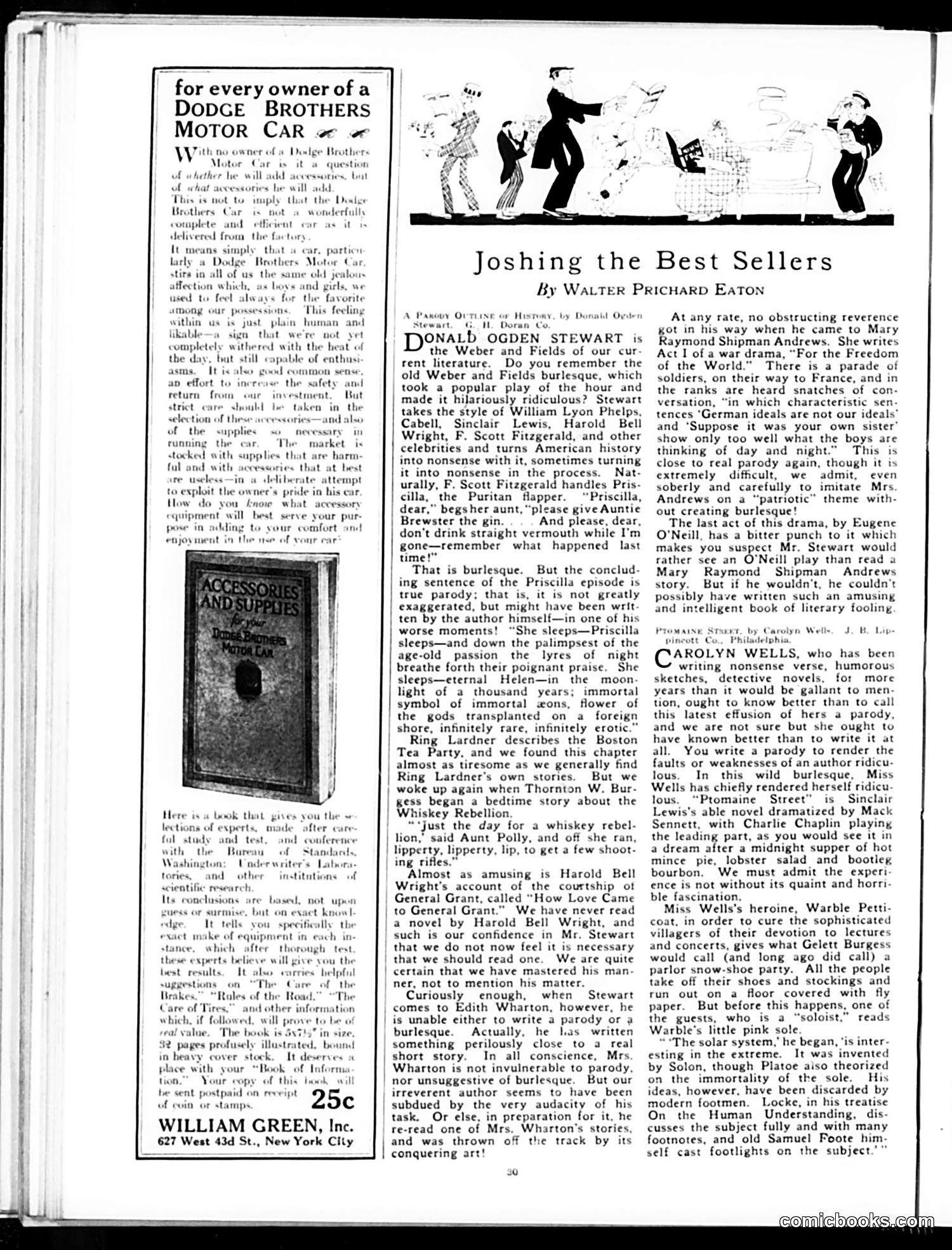
This page contains **advertising and book reviews**, not political cartoons. The **Dodge Brothers Motor Car ad** (left) is a period automobile advertisement emphasizing accessory quality and safety—typical 1920s marketing appealing to owner pride. The main content is **"Joshing the Best Sellers"** by Walter Prichard Eaton, a book review of Donald Ogden Stewart's *A Parody Outline of History*. The review explains Stewart's satirical method: he parodies famous contemporary authors (F. Scott Fitzgerald, Ring Lardner, Sinclair Lewis, Harold Bell Wright) by mimicking their distinctive writing styles while applying them absurdly to American history. The **joke** is that Stewart exaggerates these authors' actual mannerisms—their flowery prose, sentimentality, and pretension—to comic effect. For example, Fitzgerald's description of Priscilla (a "Puritan flapper") uses his characteristic lush romanticism applied to ridiculous content. The review suggests Stewart succeeds best when his parody remains **plausible** as something these famous writers might actually produce, rather than obviously exaggerated. This reflects 1920s literary culture's self-conscious humor about popular contemporary authors.
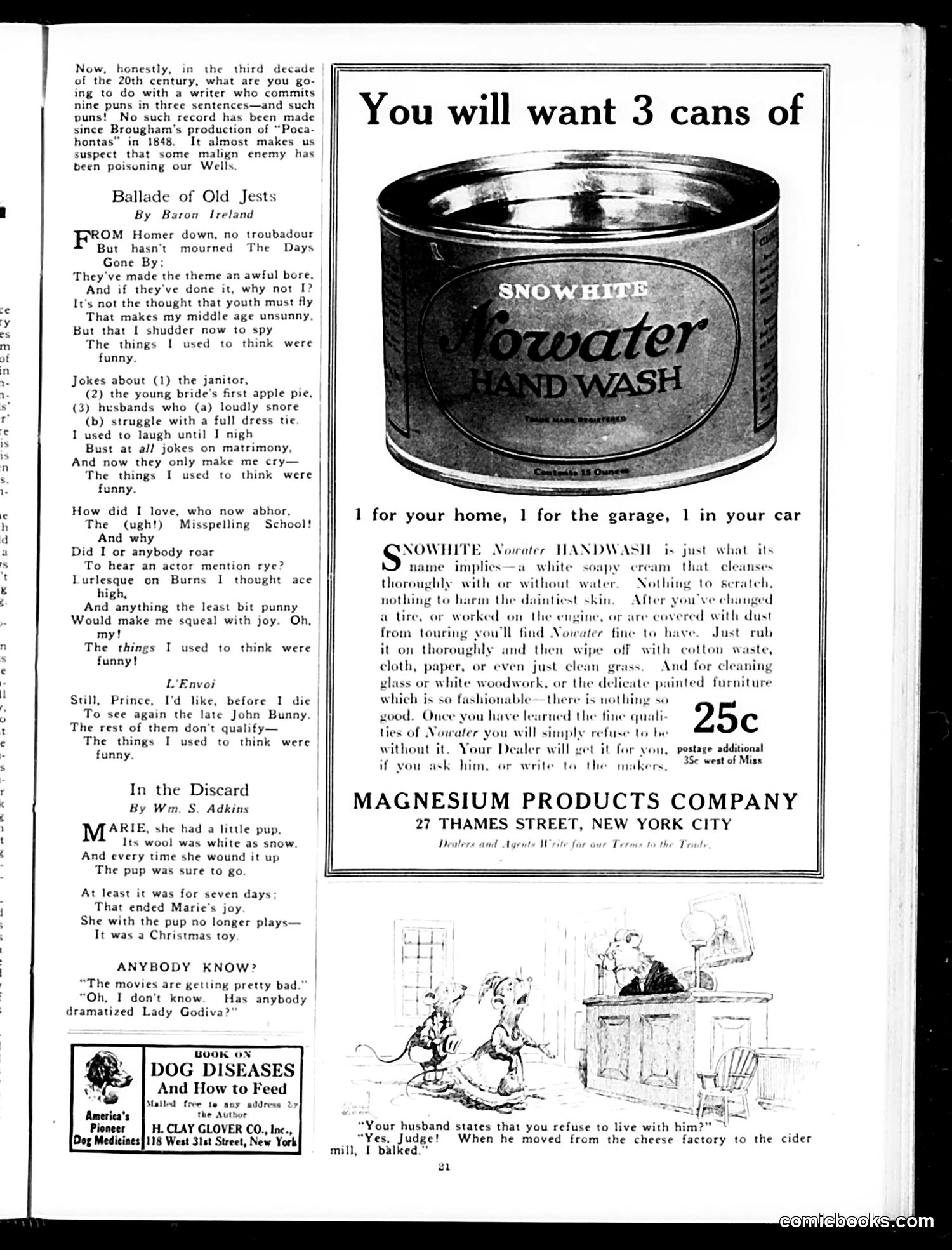
This page from *Judge* magazine is primarily **advertising and light humor**, not political satire. The main content includes: 1. **"Ballade of Old Jests"** — A poem lamenting how jokes that seemed hilarious in youth (puns, newlywed humor, slapstick about snoring husbands) now feel stale and unfunny. It's nostalgic commentary on changing taste in humor. 2. **"In the Discard"** — A brief joke about a wind-up toy pup that breaks after a week, rendering it useless. 3. **"Anybody Know?"** — A quip about movies becoming "pretty bad," jokingly asking if anyone's dramatized *Lady Godiva* (referring to the famous nude legend). 4. **The cartoon at bottom** — Shows a marital dispute where a woman refused to move with her husband from a cheese factory to a cider mill, making a pun on "balked" (refused/hesitated). The **dominant feature is a full-page advertisement** for Snowhite Nowater Hand Wash (25¢), emphasizing its usefulness for cleaning after automotive work or household tasks. This reflects early 20th-century consumer marketing targeting homeowners and car owners.
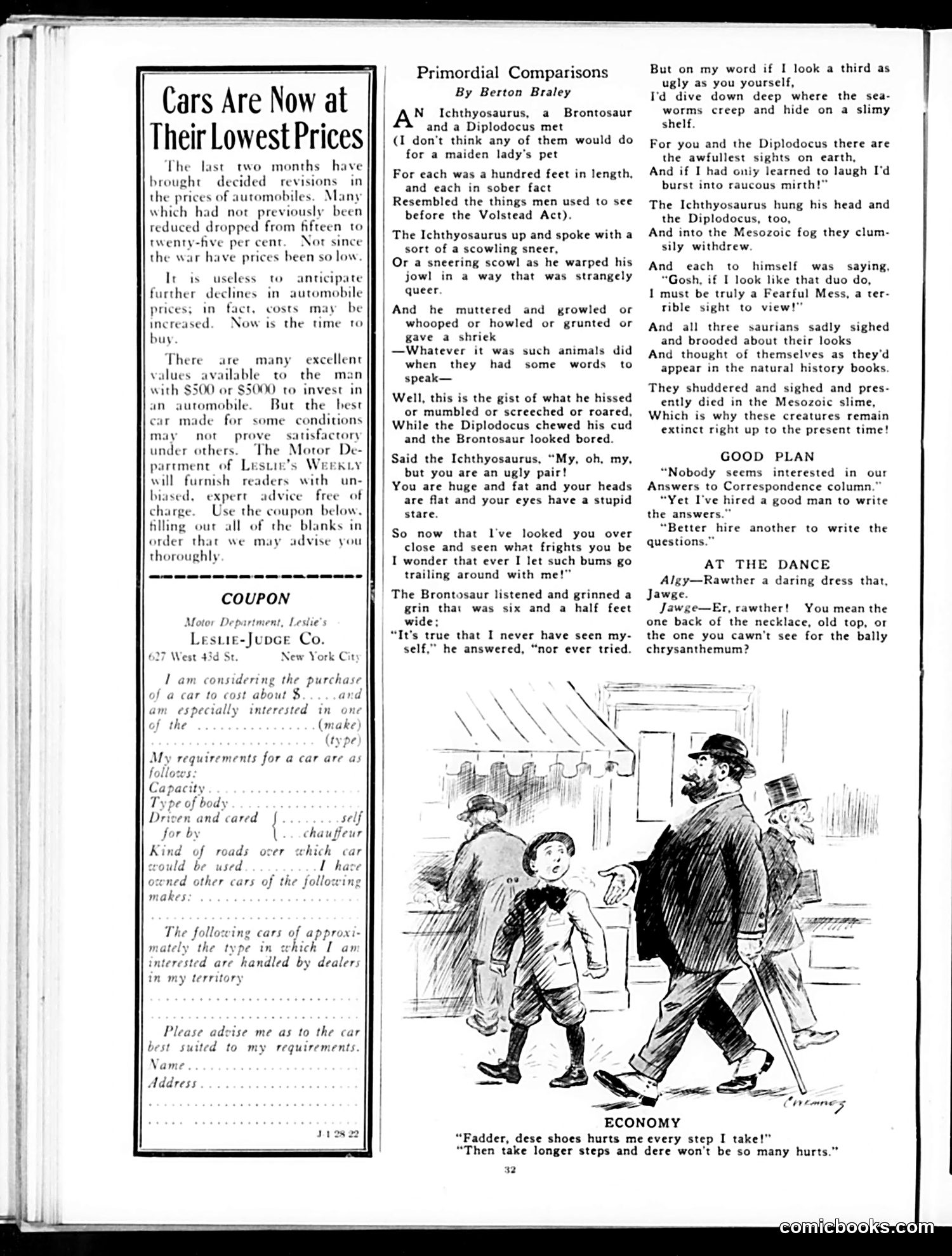
This page contains several satirical pieces typical of the era: **Main Content:** - **"Primordial Comparisons"** (poem by Berton Braley): Three prehistoric dinosaurs insult each other's appearance, each convinced they're handsome until insulted in return. The satire likely references the "Volstead Act" (Prohibition), suggesting people behaved like these creatures when intoxicated—the humor being that even extinct creatures would be embarrassed by their own looks. - **"At the Dance"** (dialogue joke): Two upper-class men use affected British slang ("Rawther," "Jawge") to comment on a woman's revealing dress and excessive floral accessory. The satire mocks pretentious fashion commentary and aristocratic affectation. - **"Economy"** (cartoon): A father tells his son to take longer steps to avoid shoe wear; the child misunderstands literally rather than grasping frugality advice—satirizing impractical parenting or class differences. The **automobile advertisement/coupon** promotes Leslie's Weekly's free car-buying advice service during a period of falling auto prices post-WWI.
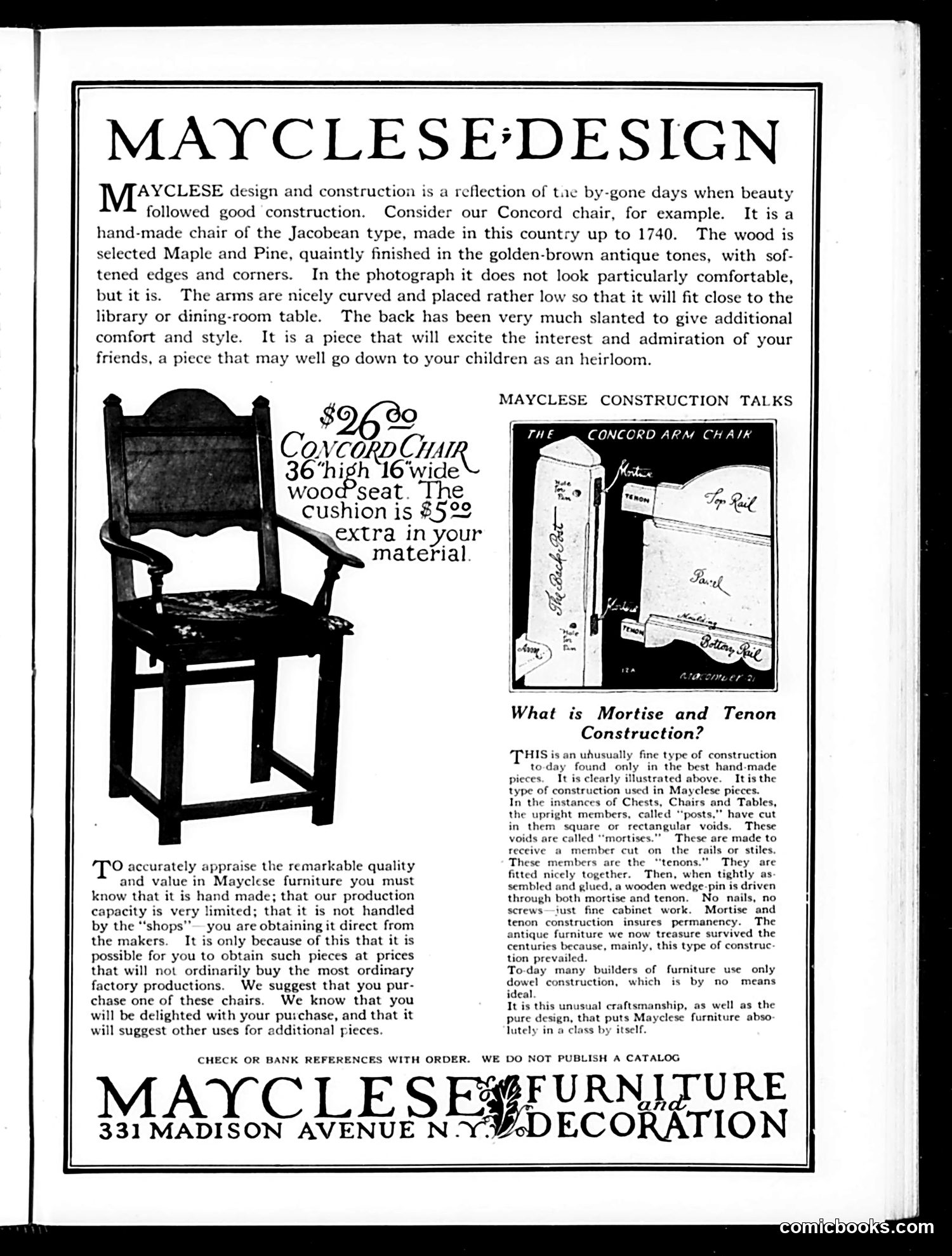
This is not a political cartoon but rather a **furniture advertisement** for Mayclese Furniture and Decoration, located at 331 Madison Avenue in New York. The page promotes a hand-made "Concord Chair" ($26.80, with optional $5.99 cushion) styled after Jacobean furniture from pre-1740 America. The advertisement emphasizes **craftsmanship and quality over mass production**, contrasting hand-made pieces with factory-produced furniture typical of the era. The right section explains "mortise and tenon construction"—a traditional woodworking technique using interlocking joints rather than nails or screws. This technical detail serves as marketing, positioning Mayclese furniture as superior and durable compared to cheaper "dowel construction" used by competitors. The overall message targets affluent consumers seeking heirloom-quality furniture, positioning handcrafted design as both aesthetically superior and practically lasting.
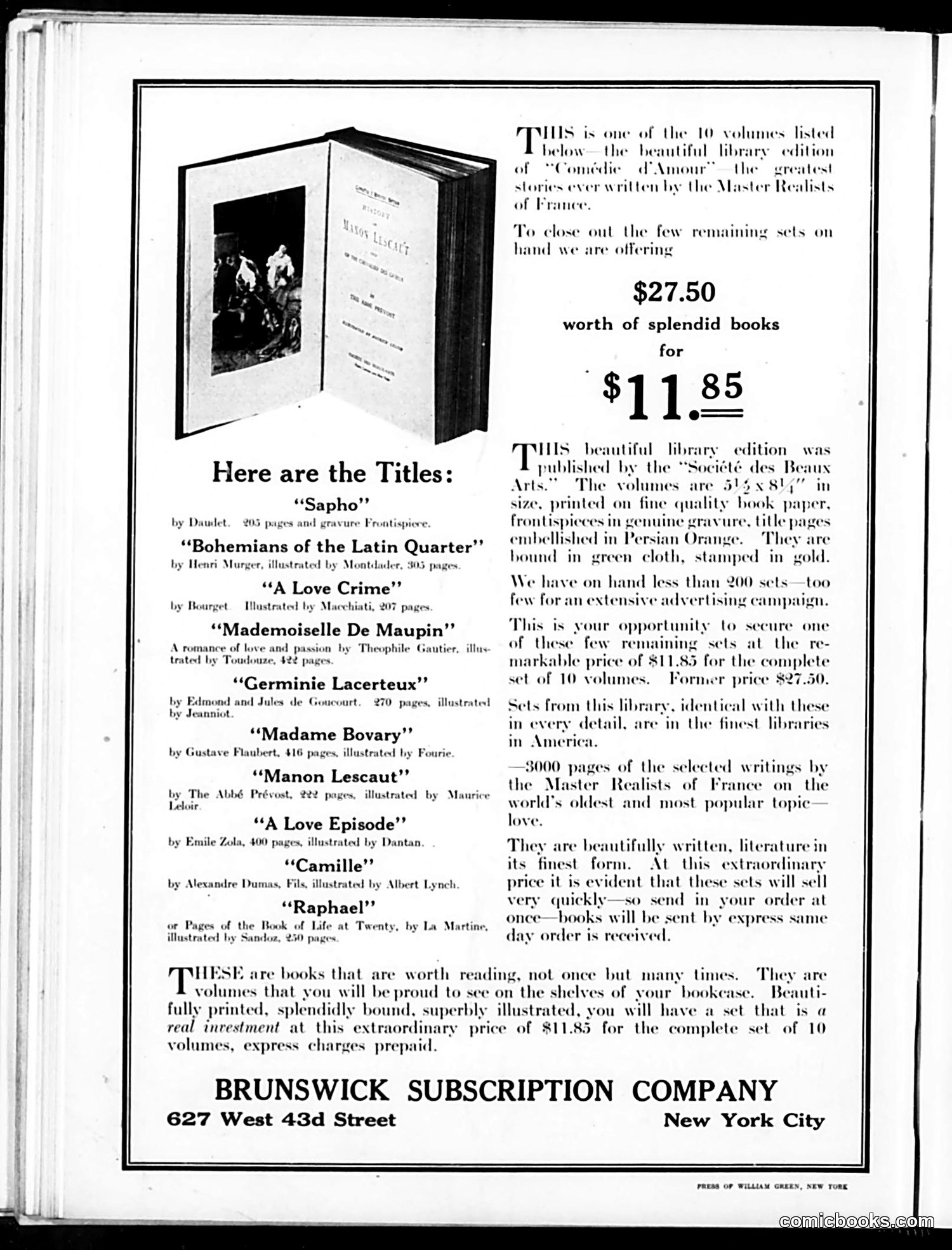
This page contains no cartoon or satire. It is a straightforward advertisement by the Brunswick Subscription Company promoting a discounted 10-volume library set titled "Comédie d'Amour," featuring works by French Master Realists. The advertisement lists classic French novels—including *Madame Bovary* by Flaubert and *A Love Crime* by Bourget—each focusing on romantic themes. The appeal emphasizes the books' quality binding, fine printing, and illustrations, marketed as worthy of distinguished bookshelves. The company is clearing inventory at $11.85 (marked down from $27.50) and promises prompt delivery. This represents typical early-20th-century American advertising for imported cultural goods targeting educated, affluent readers.