
Judge, 1922-01-28 · page 20 of 36
Judge — January 28, 1922 — page 20: what you’re looking at
What you’re looking at
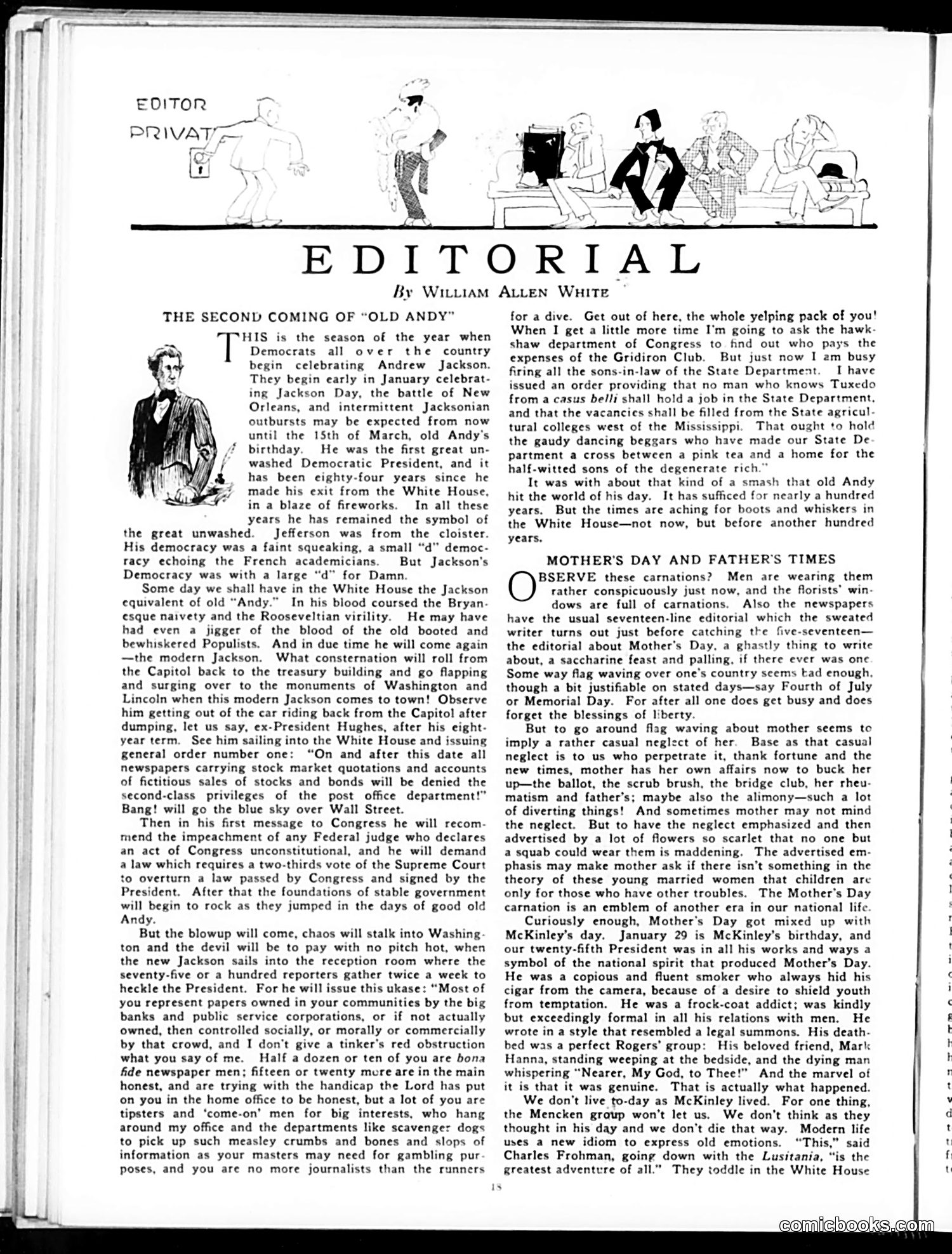
This editorial by William Allen White satirizes the Democratic Party's romanticization of Andrew Jackson while warning of a hypothetical "modern Jackson" who would disrupt the political establishment. **The Setup:** Democrats annually celebrate Jackson Day (January 15), treating Jackson as a symbol of populist, anti-establishment democracy—the "great unwashed" leader. **The Satire:** White imagines a future Jackson-like president who would: - Ban newspapers owned by financial interests from postal privileges - Impeach federal judges who declare laws unconstitutional - Demand Congressional supermajority power over Supreme Court rulings - Purge State Department officials by bloodline connections - Expel journalists from White House press access **The Point:** White mocks both Democratic nostalgia for Jackson AND progressive reformist overreach. The satirical "modern Jackson" represents an anti-establishment populist so extreme he would fundamentally destabilize constitutional governance. The piece warns that romanticizing Jackson's era blinds Democrats to dangerous authoritarian impulses in actual populist movements. This reflects early 20th-century anxieties about unchecked executive power and media manipulation.
📄 Transcribed text from this page (OCR, searchable)
Machine-transcribed from the original scan — historical spelling and the odd misread are preserved.
EDITORIAL By WitiiamM ALLEN WHITE “ THE SECOND COMING OF “OLD ANDY” HIS is the season of the year when Democrats all over the country begin celebrating Andrew Jackson. They begin early in January celebrat- ing Jackson Day, the battle of New Orleans, and intermittent Jacksonian outbursts may be expected from now until the 15th of March, old Andy's birthday. He was the first great un- washed Democratic President, and it has been eighty-four years since he made his exit from the White House, in a blaze of fireworks. In all these years he has remained the symbol of the great unwashed. Jefferson was from the cloister. His democracy was a faint squeaking, a small “d" democ- racy echoing the French academicians. But Jackson's Democracy was with a large “d” for Damn. Some day we shall have in the White House the Jackson equivalent of old “Andy.” In his blood coursed the Bryan- esque naivety and the Rooseveltian virility. He may have had even a jigger of the blood of the old booted and bewhiskered Populists. And in due time he will come again —the modern Jackson. What consternation will roll from the Capitol back to the treasury building and go flapping and surging over to the monuments of Washington and Lincoln when this modern Jackson comes to town! Observe him getting out of the car riding back from the Capitol after dumping, let us say, ex-President Hughes, after his eight- year term. See him sailing into the White House and issuing general order number one: “On and after this date all newspapers carrying stock market quotations and accounts of fictitious sales of stocks and bonds will be denied the second-class privileges of the post office department!” Bang! will go the blue sky over Wall Street. Then in his first message to Congress he will recom- mend the impeachment of any Federal judge who declares an act of Congress unconstitutional, and he will demand a law which requires a two-thirds vote of the Supreme Court to overturn a law passed by Congress and signed by the President. After that the foundations of stable government will begin to rock as they jumped in the days of good old Andy. But the blowup will come, chaos will stalk into Washing ton and the devil will be to pay with no pitch hot, when the new Jackson sails into the reception room where the seventy-five or a hundred reporters gather twice a week to heckle the President. For he will issue this ukase: “Most of you represent papers owned in your communities by the big banks and public service corporations, or if not actually owned, then controlled socially, or morally or commercially by that crowd, and I don't give a tinker’s red obstruction what you say of me. Half a dozen or ten of you are bona fide newspaper men; fifteen or twenty more are in the main honest, and are trying with the handicap the Lord has put on you in the home office to be honest, but a lot of you are tipsters and ‘come-on’ men for big interests, who hang around my office and the departments like scavenger dogs to pick up such measley crumbs and bones and slops of information as your masters may need for gambling pur poses, and you are no more journalists than the runners for a dive. Get out of here, the whole yelping pack of you! When I get a little more time I'm going to ask the hawk- shaw department of Congress to find out who pays the expenses of the Gridiron Club. But just now I am busy firing all the sons-in-law of the State Department. I have issued an order providing that no man who knows Tuxedo from a casus belli shall hold a job in the State Department, and that the vacancies shall be filled from the State agricul- tural colleges west of the Mississippi. That ought to hold the gaudy dancing beggars who have made our State De partment a cross between a pink tea and a home for the half-witted sons of the degenerate rich.” It was with about that kind of a smash that old Andy hit the world of his day. It has sufficed for nearly a hundred years. But the times are aching for boots and whiskers in the White House—not now, but before another hundred years. MOTHER'S DAY AND FATHER’S TIMES BSERVE these carnations? Men are wearing them rather conspicuously just now, and the florists’ win- dows are full of carnations. Also the newspapers have the usual seventeen-line editorial which the sweated writer turns out just before catching the five-seventeen— the editorial about Mother's Day, a ghastly thing to write about, a saccharine feast and palling, if there ever was one Some way flag waving over one's country seems tad enough, though a bit justifiable on stated days—say Fourth of July or Memorial Day. For after all one does get busy and does forget the blessings of liberty. But to go around flag waving about mother seems to imply a rather casual neglect of her. Base as that casual neglect is to us who perpetrate it, thank fortune and the new times, mother has her own affairs now to buck her up—the ballot, the scrub brush, the bridge club, her rheu- matism and father’s; maybe also the alimony—such a lot of diverting things! And sometimes mother may not mind the neglect. But to have the neglect emphasized and then advertised by a lot of flowers so scarlet that no one but a squab could wear them is maddening. The advertised em- phasis may make mother ask if there isn’t something in the theory of these young married women that children are only for those who have other troubles. The Mother's Day carnation is an emblem of another era in our national life: Curiously enough, Mother's Day got mixed up with McKinley’s day. January 29 is McKinley's birthday, and our twenty-fifth President was in all his works and ways a symbol of the national spirit that produced Mother’s Day. He was a copious and fluent smoker who always hid his cigar from the camera, because of a desire to shield youth from temptation. He was a frock-coat addict; was kindly but exceedingly formal in all his relations with men. He wrote in a style that resembled a legal summons. His death- bed was a perfect Rogers’ group: His beloved friend, Mark Hanna, standing weeping at the bedside, and the dying man whispering “Nearer, My God, to Thee!” And the marvel of it is that it was genuine. That is actually what happened. We don't live to-day as McKinley lived. For one thing, the Mencken graup won't let us. We don’t think as they thought in his day and we don’t die that way. Modern life uses a new idiom to express old emotions. “This,” said Charles Frohman, going down with the Lusitania, “is the greatest adventere of all.” They toddle in the White House