
Judge, 1922-01-28 · page 18 of 36
Judge — January 28, 1922 — page 18: what you’re looking at
What you’re looking at
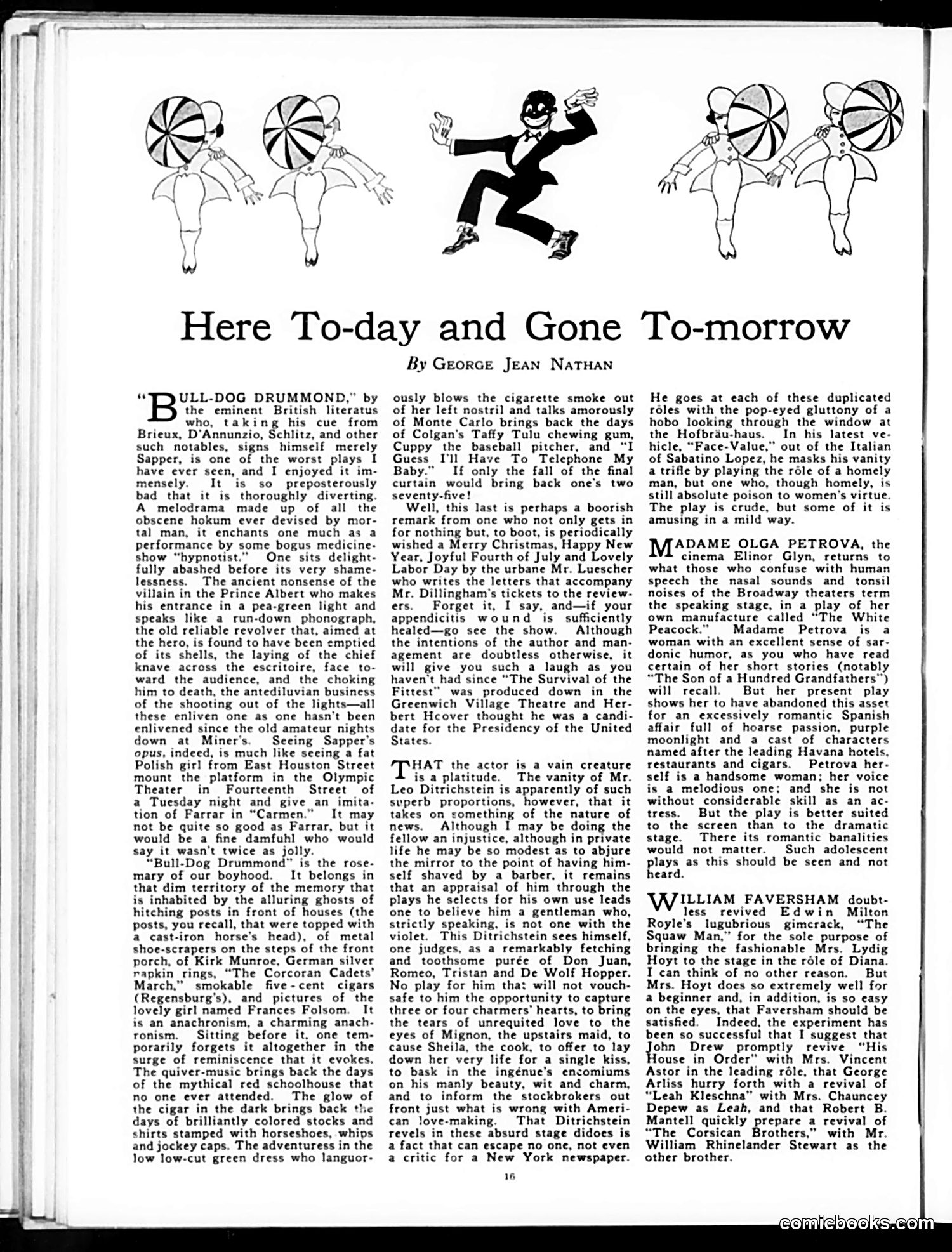
This page contains theater reviews by George Jean Nathan, a prominent drama critic of the early 20th century. The illustrations show chorus girls and a male performer in comedic poses. **"Bull-Dog Drummond"** review satirizes a melodramatic British play by Sapper. Nathan praises it as entertainment *precisely because* it's absurdly bad—comparing it to watching incompetent amateur theater. He catalogs its clichéd tricks: villains in formal wear, malfunctioning revolvers, dramatic lighting effects. The review is nostalgic satire, suggesting the play belongs to a bygone era of simple melodrama, like remembered childhood artifacts (cast-iron hitching posts, five-cent cigars, Frances Folsom). The second review discusses actor **Leo Ditrichstein's** excessive vanity, suggesting his self-regard has become newsworthy itself. **Point**: Nathan uses humor to mock both the play's dated conventions and theater-goers' nostalgia for such entertainment. The satire targets not just the production but audiences' susceptibility to theatrical hokum.
📄 Transcribed text from this page (OCR, searchable)
Machine-transcribed from the original scan — historical spelling and the odd misread are preserved.
Here To-day “ ULL-DOG DRUMMOND,” by the eminent British literatus who, taking his cue from Brieux, D’Annunzio, Schlitz, and other such notables, signs himself merely Sapper, is one of the worst plays I have ever seen, and I enjoyed it im- mensely. It is so preposterously bad that it is thoroughly diverting. A melodrama made up of all the obscene hokum ever devised by mor- tal man, it enchants one much as a performance by some bogus medicine- show “hypnotist.” One sits delight- fully abashed before its very shame- lessness. The ancient nonsense of the villain in the Prince Albert who makes his entrance in a pea-green light and speaks like a run-down phonograph, the old reliable revolver that, aimed at the hero, is found to have been emptied of its shells, the laying of the chief knave across the escritoire, face to- ward the audience, and the choking him to death, the antediluvian business of the shooting out of the lights—all these enliven one as one hasn't been enlivened since the old amateur nights down at Miner's. Seeing Sapper’s opus, indeed, is much like seeing a fat Polish girl from East Houston Street mount the platform in the Olympic Theater in Fourteenth Street of a Tuesday night and give an imita- tion of Farrar in “Carmen.” It may not be quite so good as Farrar, but it would be a fine damfuhl who would say it wasn't twice as jolly. “Bull-Dog Drummond” is the rose- mary of our boyhood. It belongs in that dim territory of the memory that is inhabited by the alluring ghosts of hitching posts in front of houses (the posts, you recall, that were topped with a cast-iron horse’s head), of metal shoe-scrapers on the steps of the front porch, of Kirk Munroe, German silver rapkin rings, “The Corcoran Cadets’ March,” smokable five-cent cigars (Regensburg’s), and pictures of the lovely girl named Frances Folsom. It is an anachronism, a charming anach- ronism. Sitting before it, one tem- porarily forgets it altogether in the surge of reminiscence that it evokes. The quiver-music brings back the days of the mythical red schoolhouse that no one ever attended. The glow of the cigar in the dark brings back the days of brilliantly colored stocks and shirts stamped with horseshoes, whips and jockey caps. The adventuress in the low low-cut green dress who languor- ously blows the cigarette smoke out of her left nostril and talks amorously of Monte Carlo brings back the days of Colgan's Taffy Tulu chewing gum, Cuppy the baseball pitcher, and “I Guess I'll Have To Telephone My Baby.” If only the fall of the final curtain would bring back one’s two seventy-five! Well, this last is perhaps a boorish remark from one who not only gets in for nothing but, to boot, is periodically wished a Merry Christmas, Happy New Year, Joyful Fourth of July and Lovely Labor Day by the urbane Mr. Luescher who writes the letters that accompany Mr. Dillingham’s tickets to the review- ers. Forget it, I say, and—if your appendicitis wound is sufficiently healed—go see the show. Although the intentions of the author and man- agement are doubtless otherwise, it will give you such a laugh as you haven't had since “The Survival of the Fittest" was produced down in the Greenwich Village Theatre and Her- bert Hcover thought he was a candi- date for the Presidency of the United States. HAT the actor is a vain creature is a platitude. The vanity of Mr. Leo Ditrichstein is apparently of such superb proportions, however, that it takes on something of the nature of news. Although I may be doing the fellow an injustice, although in private life he may be so modest as to abjure the mirror to the point of having him- self shaved by a barber, it remains that an appraisal of him through the plays he selects for his own use leads one to believe him a gentleman who, strictly speaking, is not one with the violet. This richstein sees himself, one judges, as a remarkably fetching and toothsome purée of Don Juan, Romeo, Tristan and De Wolf Hopper. No play for him that will not vouch- safe to him the opportunity to capture three or four charmers’ hearts, to bring the tears of unrequited love to the eyes of Mignon, the upstairs maid, to cause Sheila, the cook, to offer to lay down her very life for a single kiss, to bask in the ingénue’s encomiums on his manly beauty, wit and charm, and to inform the stockbrokers out front just what is wrong with Ameri- can love-making. That Ditrichstein revels in these absurd stage didoes is a fact that can escape no one, not even a critic for a New York newspaper. 16 and Gone To-morrow By Georce Jean NaTHAN He goes at each of these duplicated roles with the pop-eyed gluttony of a hobo looking through the window at the Hofbrau-haus. In his latest ve- hicle, “Face-Value,” out of the Italian of Sabatino Lopez, he masks his vanity a trifle by playing the rdle of a homely man, but one who, though homely, is still absolute poison to women’s virtue. The play is crude, but some of it is amusing in a mild way. ADAME OLGA PETROVA, the cinema Elinor Glyn, returns to what those who confuse with human speech the nasal sounds and tonsil noises of the Broadway theaters term the speaking stage, in a play of her own manufacture called “The White Peacock.” Madame Petrova is a woman with an excellent sense of sar- donic humor, as you who have read certain of her short stories (notably “The Son of a Hundred Grandfathers”) will recall. But her present play shows her to have abandoned this asset for an excessively romantic Spanish affair full of hoarse passion, purple moonlight and a cast of characters named after the leading Havana hotels. restaurants and cigars. Petrova her- self is a handsome woman; her voice is a melodious one; and she is not without considerable skill as an ac- tress. But the play is better suited to the screen than to the dramatic stage. There its romantic banalities would not matter. Such adolescent plays as this should be seen and not heard. ILLIAM FAVERSHAM doubt- less revived Edwin Milton Royle’s lugubrious gimcrack, “The Squaw Man,” for the sole purpose of bringing the fashionable Mrs. Lydig Hoyt to the stage in the réle of Diana. I can think of no other reason. But Mrs. Hoyt does so extremely well for a beginner and, in addition, is so easy on the eyes, that Faversham should be satisfied. Indeed, the experiment has been so successful that I suggest that qebn Drew promptly revive “His ouse in Order” with Mrs. Vincent Astor in the leading réle, that George Arliss hurry forth with a revival of “Leah Kleschna” with Mrs. Chauncey Depew as Leah, and that Robert B. Mantell quickly peepee a revival of “The Corsican Brothers,” with Mr. William Rhinelander Stewart as the other brother.