
Judge, 1922-01-28 · page 12 of 36
Judge — January 28, 1922 — page 12: what you’re looking at
What you’re looking at
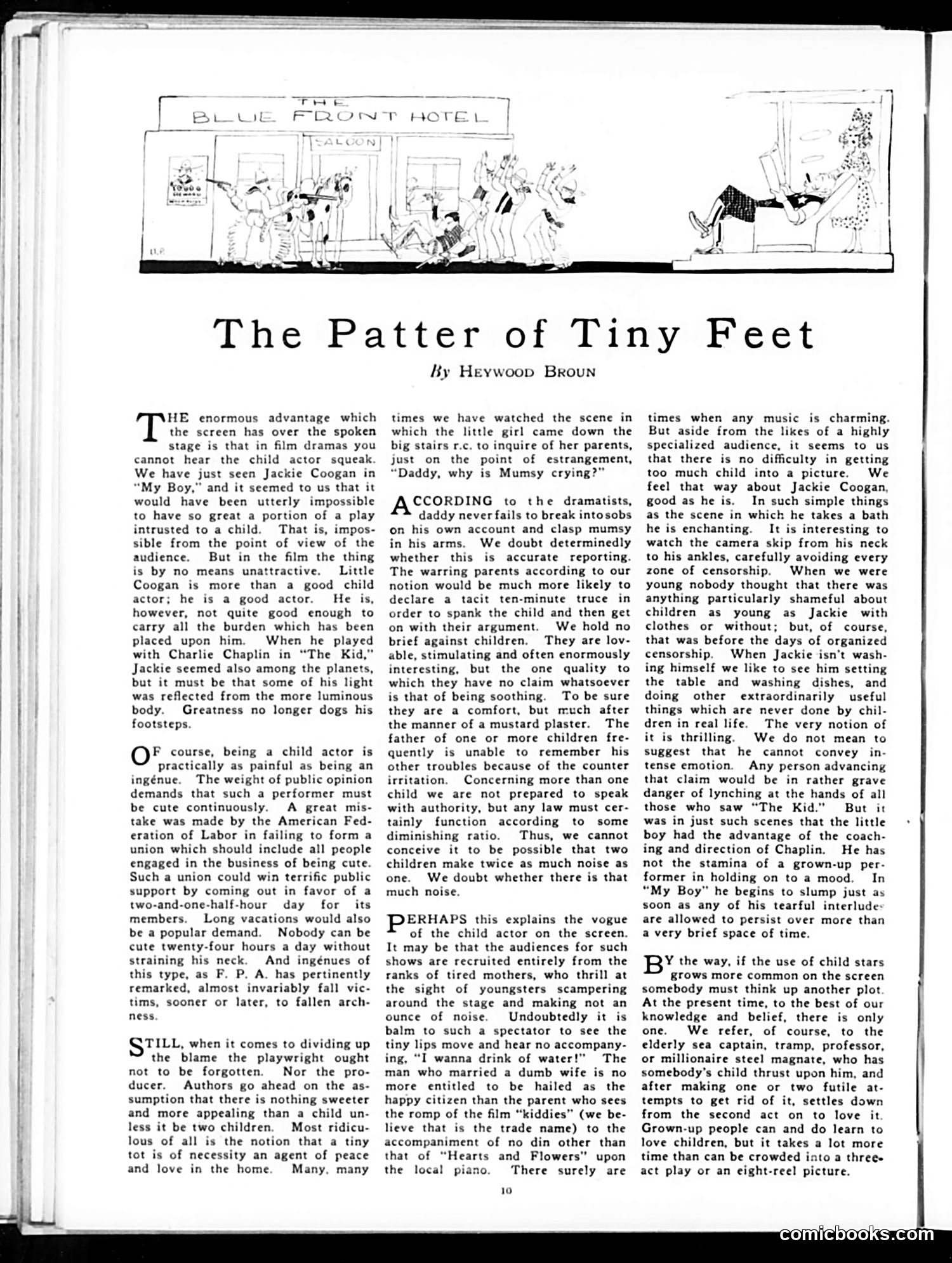
This essay reviews child actor **Jackie Coogan**, famous for appearing with Charlie Chaplin in *The Kid*. Broun argues Coogan is talented but has become overrated—his earlier success relied partly on Chaplin's luminosity. The piece satirizes **theatrical conventions about children**, particularly the tired dramatic trope where a crying child reconciles estranged parents. Broun skewers this as unrealistic: parents quarreling would more likely spank the interrupting child than embrace. He mocks playwrights' assumption that children are inherently "soothing" or peace-bringing to homes, when in reality they're irritating—comparable to mustard plasters. The cartoon at top (labeled "The Blue Front Hotel") appears to show chaotic scenes of child actors in a theatrical setting. Broun's broader point: child actors work precisely *because* film is silent—audiences (implied to be exhausted mothers) enjoy watching children move without hearing them squeak or whine. It's escapism, not genuine dramatic talent.
📄 Transcribed text from this page (OCR, searchable)
Machine-transcribed from the original scan — historical spelling and the odd misread are preserved.
4 a ] i HE enormous advantage which the screen has over the spoken stage is that in film dramas you cannot hear the child actor squeak. We have just seen Jackie Coogan in “My Boy,” and it seemed to us that it would have been utterly impossible to have so great a portion of a play intrusted to a child. That is, impos- sible from the point of view of the audience. But in the film the thing is by no means unattractive. Little Coogan is more than a good child actor; he is a good actor. He is, however, not quite good enough to carry all the burden which has been placed upon him. When he played with Charlie Chaplin in “The Kid,” Jackie seemed also among the planets, but it must be that some of his light was reflected from the more luminous body. Greatness no longer dogs his footsteps. F course, being a child actor is practically as painful as being an ingénue. The weight of public opinion demands that such a performer must be cute continuously. A great mis- take was made by the American Fed- eration of Labor in failing to form a union which should include all people engaged in the business of being cute. Such a union could win terrific public support by coming out in favor of a two-and-one-half-hour day for its members. Long vacations would also be a popular demand. Nobody can be cute twenty-four hours a day without straining his neck. And ingénues of this type, as F. P. A. has pertinently remarked, almost invariably fall vic- tims, sooner or later, to fallen arch- ness. STILL, when it comes to dividing up the blame the playwright ought not to be forgotten. Nor the pro- ducer. Authors go ahead on the as- sumption that there is nothing sweeter and more appealing than a child un- less it be two children. Most ridicu- lous of all is the notion that a tiny tot is of necessity an agent of peace and love in the home Many. many The Patter of Tiny Feet By Heywoop Broun times we have watched the scene in which the little girl came down the big stairs r.c, to inquire of her parents, just on the point of estrangement, “Daddy, why is Mumsy crying?” CCORDING to the dramatists, daddy never fails to break intosobs on his own account and clasp mumsy in his arms. We doubt determinedly whether this is accurate reporting. The warring parents according to our notion would be much more likely to declare a tacit ten-minute truce in order to spank the child and then get on with their argument. We hold no brief against children. They are lov- able, stimulating and often enormously interesting, but the one quality to which they have no claim whatsoever is that of being soothing. To be sure they are a comfort, but much after the manner of a mustard plaster. The father of one or more children fre- quently is unable to remember his other troubles because of the counter irritation. Concerning more than one child we are not prepared to speak with authority, but any law must cer- tainly function according to some diminishing ratio. Thus, we cannot conceive it to be possible that two children make twice as much noise as one. We doubt whether there is that much noise. PERHAPS this explains the vogue of the child actor on the screen. It may be that the audiences for such shows are recruited entirely from the ranks of tired mothers, who thrill at the sight of youngsters scampering around the stage and making not an ounce of noise. Undoubtedly it is balm to such a spectator to see the tiny lips move and hear no accompany- ing, “I wanna drink of water!" The man who married a dumb wife is no more entitled to be hailed as the happy citizen than the parent who sees the romp of the film “kiddies” (we be- lieve that is the trade name) to the accompaniment of no din other than that of “Hearts and Flowers” upon the local piano. There surely are 10 times when any music is charming. But aside from the likes of a highly specialized audience, it seems to us that there is no difficulty in getting too much child into a picture. We feel that way about Jackie Coogan, good as he is. In such simple things as the scene in which he takes a bath he is enchanting. It is interesting to watch the camera skip from his neck to his ankles, carefully avoiding every zone of censorship. When we were young nobody thought that there was anything particularly shameful about children as young as Jackie with clothes or without; but, of course, that was before the days of organized censorship. When Jackie isn't wash- ing himself we like to see him setting the table and washing dishes, and doing other extraordinarily useful things which are never done by chil- dren in real life. The very notion of it is thrilling. We do not mean to suggest that he cannot convey in- tense emotion. Any person advancing that claim would be in rather grave danger of lynching at the hands of all those who saw “The Kid.” But it was in just such scenes that the little boy had the advantage of the coach- ing and direction of Chaplin. He has not the stamina of a grown-up per- former in holding on to a mood. In “My Boy” he begins to slump just as soon as any of his tearful interlude: are allowed to persist over more than a very brief space of time. BY the way, if the use of child stars grows more common on the screen somebody must think up another plot At the present time, to the best of our knowledge and belief, there is only one. We refer, of course, to the elderly sea captain, tramp, professor, or millionaire steel magnate, who has somebody’s child thrust upon him, and after making one or two futile at- tempts to get rid of it, settles down from the second act on to love it Grown-up people can and do learn to love children, but it takes a lot more time than can be crowded into a threes act play or an eight-reel picture.