
Judge, 1922-01-28 · page 7 of 36
Judge — January 28, 1922 — page 7: what you’re looking at
What you’re looking at
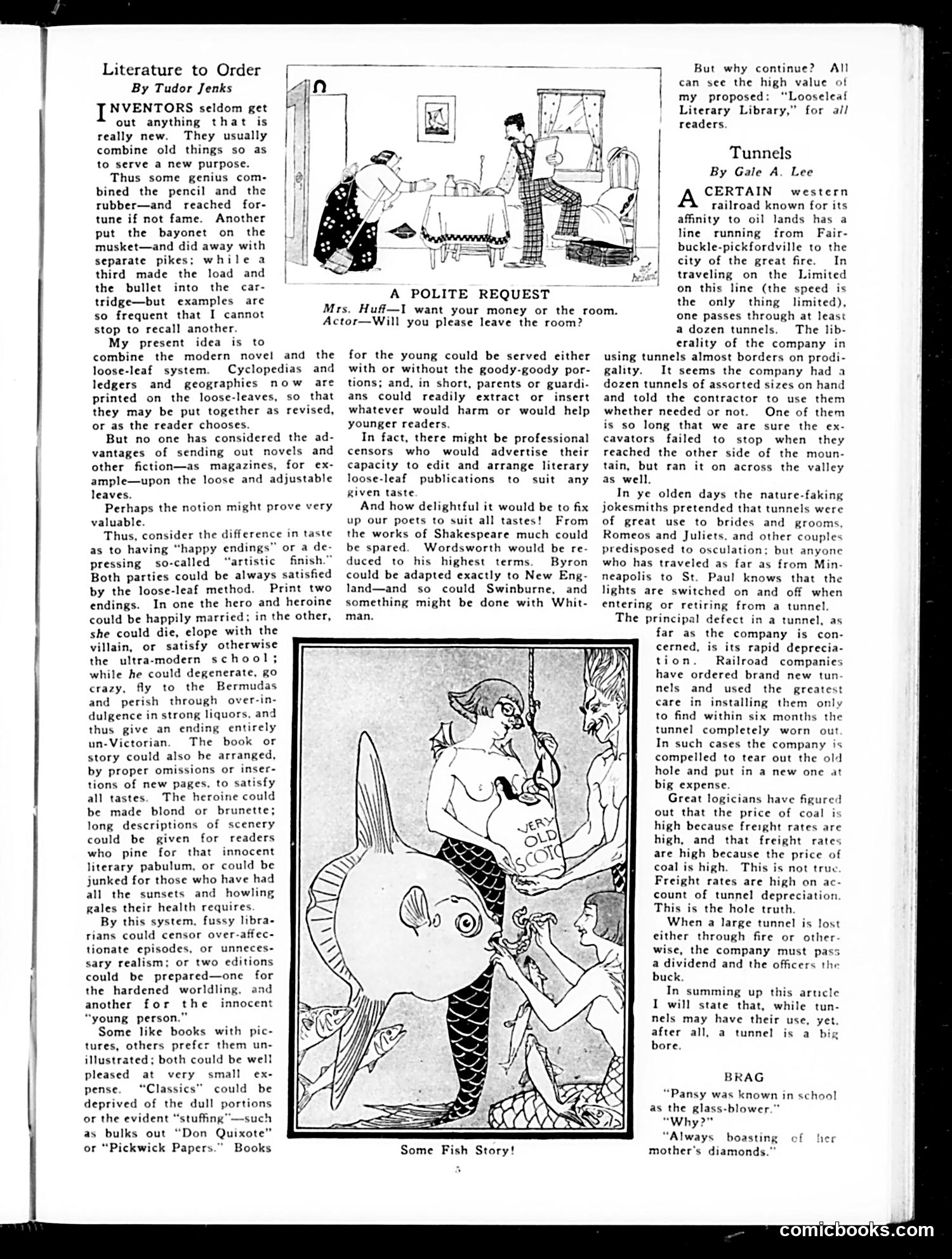
This Judge magazine page contains two satirical pieces: **"Literature to Order"** mocks the idea of customizable books using loose-leaf printing. The author humorously proposes novels with interchangeable endings and removable passages so readers can choose happy or sad conclusions, skip descriptions, or remove "objectionable" content. The satire targets both prudish censorship and changing literary tastes—suggesting that if literature became this modular, censors and publishers could sanitize classics like Shakespeare and Byron for different audiences. **"A Polite Request"** cartoon shows an actress (Mrs. Huff) demanding money or the room from an actor, while he politely requests she leave the room. The humor lies in the absurd contrast between her aggressive extortion and his courteous response—likely satirizing theatrical company dynamics or actor-landlord disputes of the era. Both pieces mock early 20th-century anxieties about literature's moral impact and genteel social conventions.
📄 Transcribed text from this page (OCR, searchable)
Machine-transcribed from the original scan — historical spelling and the odd misread are preserved.
Literature to Order By Tudor Jenks [ NVENTORS seldom get out anything that is really new. They usually combine old things so as to serve a new purpose. Thus some genius com- bined the pencil and the rubber—and reached for- tune if not fame. Another put the bayonet on the musket—and did away with separate pikes; while a third made the load and the bullet into the car- tridge—but examples are so frequent that I cannot stop to recall another. My present idea is to combine the modern novel and the loose-leaf system. Cyclopedias and ledgers and geographies now are printed on the loose-leaves, so that they may be put together as revised, or as the reader chooses. But no one has considered the ad- vantages of sending out novels and other fiction—as magazines, for ex- ample—upon the loose and adjustable leaves. Perhaps the notion might prove very valuable. Thus, consider the difference in taste as to having “happy endings” or a de- pressing so-called “artistic finish.” Both parties could be always satisfied by the loose-leaf method. Print two endings. In one the hero and heroine could be happily married; in the other, she could die, elope with the villain, or satisfy otherwise the ultra-modern school; while he could degenerate, go crazy, fly to the Bermudas and perish through over-in- dulgence in strong liquors, and thus give an ending entirely un-Victorian. The book or story could also be arranged, by proper omissions or inser- tions of new pages. to satisfy all tastes. The heroine could be made blond or brunette; long descriptions of scenery could be given for readers who pine for that innocent literary pabulum, or could be junked for those who have had all the sunsets and howling gales their health requires By this system, fussy libra- rians could censor over-affec- tionate episodes, or unneces- sary realism; or two editions could be prepared—one for the hardened worldling. and another for the innocent “young person.” Some like books with pic- tures, others prefer them un- ilustrated; both could be well pleased at very small ex- pense. “Classics” could be deprived of the dull portions or the evident “stuffing”—such as bulks out “Don Quixote” or “Pickwick Papers.” Books A POLITE REQUEST Mrs. Huff—I want your money or the room. Actor—Will you please leave the room? for the young could be served either with or without the goody-goody por- tions; and, in short, parents or guardi- ans could readily extract or insert whatever would harm or would help younger readers. In fact, there might be professional censors who would advertise their capacity to edit and arrange literary loose-leaf publications to suit any given taste And how delightful it would be to fix up our poets to suit all tastes!) From the works of Shakespeare much could be spared. Wordsworth would be re- duced to his highest terms. Byron could be adapted exactly to New Eng- land—and so could Swinburne, and something might be done with Whit- man. Some Fish Story! But why continue? All can see the high value of my proposed: “Looseleaf Literary Library,” for al/ readers. Tunnels By Gale A. Lee CERTAIN western railroad known for its affinity to oil lands has a line running from Fair- buckle-pickfordville to the city of the great fire. In traveling on the Limited on this line (the speed is the only thing limited), one passes through at least a dozen tunnels. The lib- erality of the company in using tunnels almost borders on prodi- gality. It seems the company had a dozen tunnels of assorted sizes on hand and told the contractor to use them whether needed or not. One of them is so long that we are sure the ex- cavators failed to stop when they reached the other side of the moun- tain, but ran it on across the valley as well. In ye olden days the nature-faking jokesmiths pretended that tunnels were of great use to brides and grooms, Romeos and Juliets, and other couples predisposed to osculation: but anyone who has traveled as far as from Min- neapolis to St. Paul knows that the lights are switched on and off when entering or retiring from a tunnel, The principal defect in a tunnel, as far as the company is con- cerned, is its rapid deprecia- tion. Railroad companies have ordered brand new tun nels and used the greatest care in installing them only to find within six months the tunnel completely worn out In such cases the company is compelled to tear out the old hole and put in a new one at big expense. Great logicians have figured out that the price of coal is high because freight rates are high, and that freight rates are high because the price of coal is high. This is not true Freight rates are high on ac- count of tunnel depreciation, This is the hole truth. When a large tunnel is lost either through fire or other wise, the company must pass a dividend and the officers the buck. In summing up this article I will state that, while tun- nels may have their use, yet. after all, a tunnel is a big bore. BRAG “Pansy was known in school as the glass-blower.” “Why?” “Always boasting mother's diamond: