
Judge, 1922-01-28 · page 17 of 36
Judge — January 28, 1922 — page 17: what you’re looking at
What you’re looking at
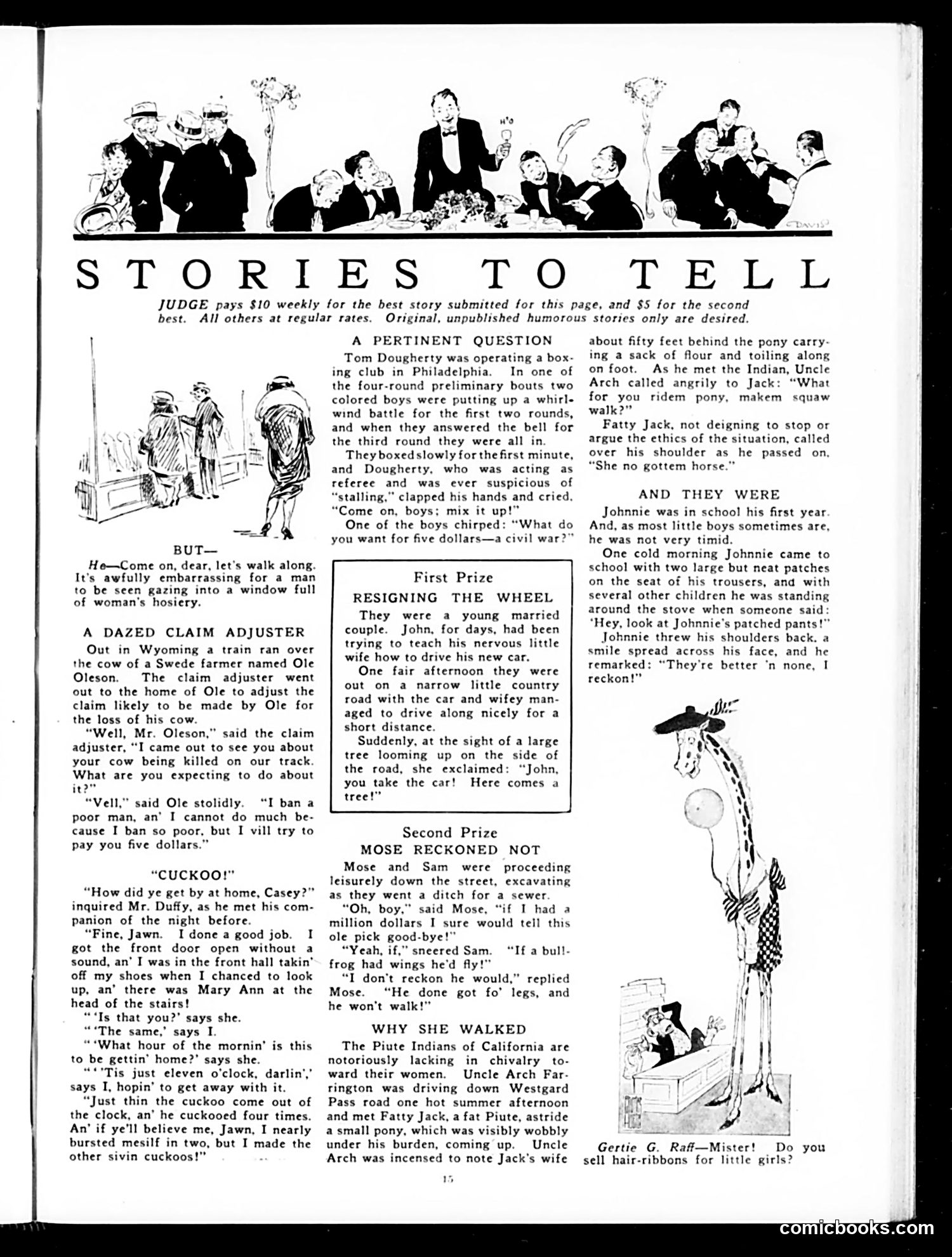
This is a humor submission page from Judge magazine, featuring five short comedic stories with accompanying illustrations. The page includes: **Social satire targets:** - **"A Dazed Claim Adjuster"**: Mocks Scandinavian immigrants (Ole Oleson's dialect) and their perceived poverty/naivety - **"Cuckoo!"**: Irish-American working-class humor about a man sneaking home drunk, using the cuckoo clock's chimes to cover his late arrival - **Boxing story**: Uses "colored boys" and dialect humor about a boxing match - **"Resigning the Wheel"**: Gentle satire of women drivers as nervous and incompetent - **"Why She Walked"**: Stereotypes Native Americans (Piute) as uncivilized and dismissive of women The cartoons employ period ethnic caricatures and stereotypes common to early 20th-century American humor. The page rewards readers' submissions ($10 for best story), indicating this was participatory magazine content reflecting contemporary attitudes toward marginalized groups.
📄 Transcribed text from this page (OCR, searchable)
Machine-transcribed from the original scan — historical spelling and the odd misread are preserved.
S TORTI ES TO tf Eee, Lb JUDGE pays $10 weekly for the best story submitted for this page, and $5 for the second best. BUT— He—Come on, dear, let's walk along. It's awfully embarrassing for a man to be seen gazing into a window full of woman's hosiery. A DAZED CLAIM ADJUSTER Out in Wyoming a train ran over the cow of a Swede farmer named Ole Oleson. The claim adjuster went out to the home of Ole to adjust the claim likely to be made by Ole for the loss of his cow. “Well, Mr. Oleson,” said the claim adjuster, “I came out to see you about your cow being killed on our track. What are you expecting to do about it?” “Vell,” said Ole stolidly. “I bana poor man, an’ I cannot do much be- cause I ban so poor, but I vill try to pay you five dollars.” “CUCKOO!” “How did ye get by at home, Casey?” inquired Mr. Duffy, as he met his com- panion of the night before. “Fine, Jawn. I done a good job. I got the front door open without a sound, an’ I was in the front hall takin’ off my shoes when I chanced to look up, an’ there was Mary Ann at the head of the stairs! “Is that you?’ says she. “The same,’ says I. “*What hour of the mornin’ is this to be gettin’ home?’ says she. ““"Tis just eleven o'clock, darlin’,’ says I, hopin’ to get away with it. “Just thin the cuckoo come out of the clock, an’ he cuckooed four times. An’ if ye’ll believe me, Jawn, I nearly bursted mesilf in two, but I made the other sivin cuckoos!” All others at regular rates. A PERTINENT QUESTION Tom Dougherty was operating a box- ing club in Philadelphia. In one of the four-round preliminary bouts two colored boys were putting up a whirl- wind battle for the first two rounds, and when they answered the bell for the third round they were all in. They boxed slowly forthe first minute, and Dougherty, who was acting as referee and was ever suspicious of “stalling,” clapped his hands and cried, “Come on, boys; mix it up!” One of the boys chirped: “What do you want for five dollars—a civil war?” First Prize RESIGNING THE WHEEL They were a young married couple. John, for days, had been trying to teach his nervous little wife how to drive his new car. One fair afternoon they were out on a narrow little country road with the car and wifey man- aged to drive along nicely for a short distance. Suddenly, at the sight of a large tree looming up on the side of the road, she exclaimed: “John, you take the car! Here comes a tree!” Second Prize MOSE RECKONED NOT Mose and Sam were proceeding leisurely down the street, excavating as they went a ditch for a sewer “Oh, boy,” said Mose, “if I had a million dollars I sure would tell this ole pick good-bye!” “Yeah, sneered Sam. frog had wings he'd fly!” “I don’t reckon he would,” replied Mose. “He done got fo’ legs, and he won't walk!” WHY SHE WALKED The Piute Indians of California are notoriously lacking in chivalry to- ward their women. Uncle Arch Far- rington was driving down Westgard Pass road one hot summer afternoon and met Fatty Jack, a fat Piute, astride a small pony, which was visibly wobbly under his burden, coming up. Uncle Arch was incensed to note Jack's wife “If a bull- Original, unpublished humorous stories only are desired. about fifty feet behind the pony carry- ing a sack of flour and toiling along on foot. As he met the Indian, Uncle Arch called angrily to Jack: “What for you ridem pony, makem squaw walk?” Fatty Jack, not deigning to stop or argue the ethics of the situation, called over his shoulder as he passed on, “She no gottem horse.” AND THEY WERE Johnnie was in school his first year And, as most little boys sometimes are, he was not very timid. One cold morning Johnnie came to school with two large but neat patches on the seat of his trousers, and with several other children he was standing around the stove when someone said: ‘Hey, look at Johnnie's patched pants!” Johnnie threw his shoulders back. a smile spread across his face, and he remarked: “They're better ‘n none, I reckon!” Gertie G. Raffi—Mister! Do sell hair-ribbons for little girls? you comicbooks.com