
Judge, 1922-01-28 · page 32 of 36
Judge — January 28, 1922 — page 32: what you’re looking at
What you’re looking at
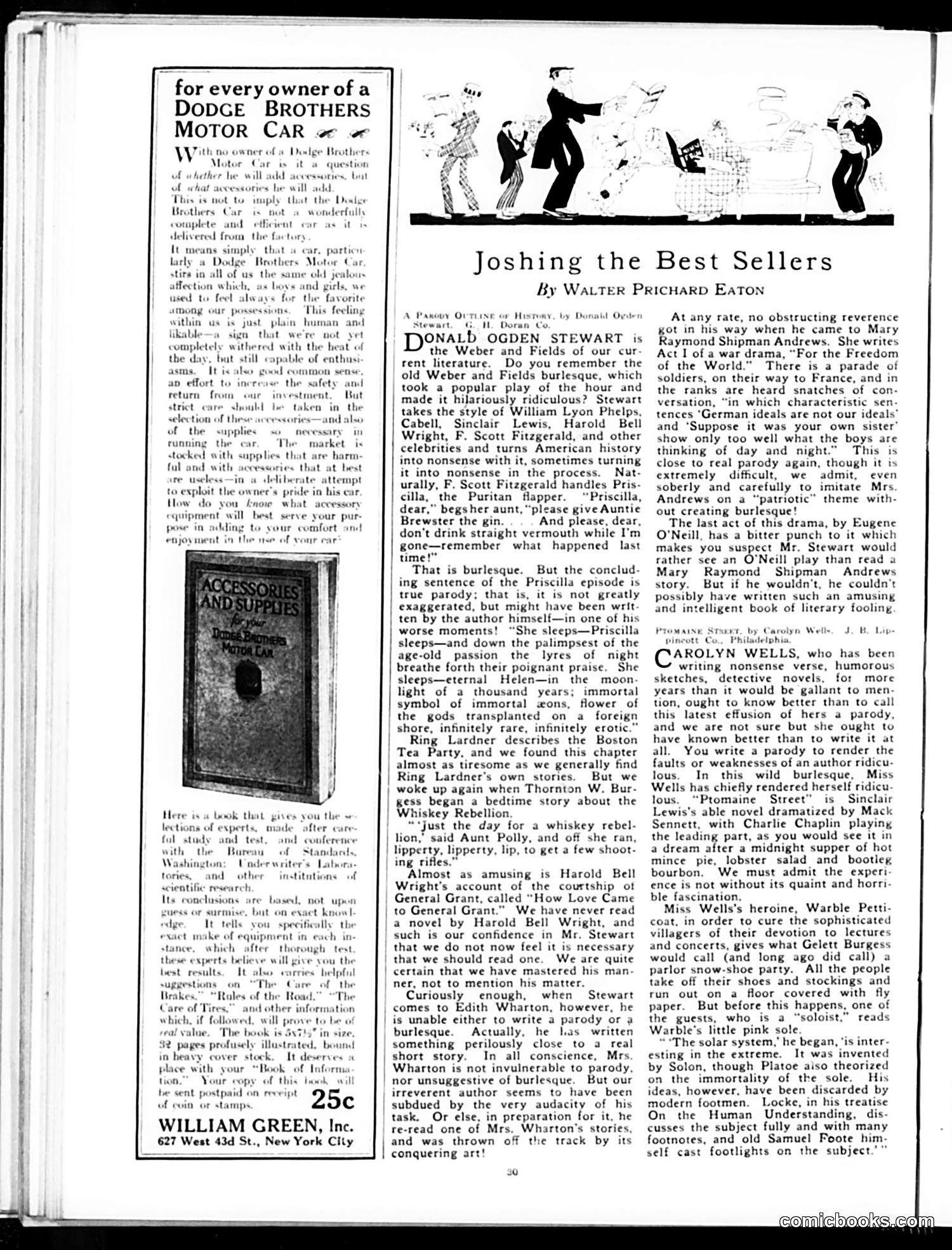
This page contains **advertising and book reviews**, not political cartoons. The **Dodge Brothers Motor Car ad** (left) is a period automobile advertisement emphasizing accessory quality and safety—typical 1920s marketing appealing to owner pride. The main content is **"Joshing the Best Sellers"** by Walter Prichard Eaton, a book review of Donald Ogden Stewart's *A Parody Outline of History*. The review explains Stewart's satirical method: he parodies famous contemporary authors (F. Scott Fitzgerald, Ring Lardner, Sinclair Lewis, Harold Bell Wright) by mimicking their distinctive writing styles while applying them absurdly to American history. The **joke** is that Stewart exaggerates these authors' actual mannerisms—their flowery prose, sentimentality, and pretension—to comic effect. For example, Fitzgerald's description of Priscilla (a "Puritan flapper") uses his characteristic lush romanticism applied to ridiculous content. The review suggests Stewart succeeds best when his parody remains **plausible** as something these famous writers might actually produce, rather than obviously exaggerated. This reflects 1920s literary culture's self-conscious humor about popular contemporary authors.
📄 Transcribed text from this page (OCR, searchable)
Machine-transcribed from the original scan — historical spelling and the odd misread are preserved.
DODGE BROTHERS MOTOR CAR « « Dealge Brother it a questi of whether We will accessories, bat This is not to imply that the Dodge Brothers Car + wonderfully ient car as it the factory 4 Dodge Brothers all of us the same old jealous affection which, Is, we used to feel alw favorite smong our po feeling within us is just plain human and lika «sign that we're not yet completely withe with the heat of the day, but still able of enthusi asms, It is also good common sense ap effort tu increase the safety and return frown But strict « “ selection of th of the supplies <0 necessary ii running the car Vhe market is stocked with supplies that are harm: ful 1 with access that use in a attempt to exploit the owner's pride in his car tlow do you know what accessory serve your pur- your comfort and of vonr car « book that gives you the + lections of experts, made ‘after care fal study and test, and conference with th Bureau of Standards. Washington: Under writer's Labor tories, and other — institutio atific research conclusions are based, not upon . but on exact know! you specifically the t make of equipment in each in- which after thorough test these experts believe will give vou the best results. It also carries’ helpful suggestions on “The ¢ Mo the rakes.” “Rules of the Roa The Care of Tires,” and other informatic h. if followed, will real value. ‘The book is n size, 32 pages profusely illustrated, bound in heavy cover stock. It deserves :« place with your “Book of Informa tion, Your copy of this book wil fetes" 25 WILLIAM GREEN, Inc. 627 West 43d St., New York City for every owner of a Joshing the A Pawopy OUTLINE oF HisTeRy, by Donald Ogden Stewart. G. HL Doran Co. DONALD OGDEN STEWART is the Weber and Fields of our cur rent literature. Do you remember the old Weber and Fields burlesque, which took a popular play of the hour and made it hilariously ridiculous? Stewart takes the style of William Lyon Phelps, Cabell, Sinclair Lewis, Harold Bell Wright, F. Scott Fitzgerald, and other celebrities and turns American history into nonsense with it, sometimes turning it into nonsense in the process. Nat- urally, F. Scott Fitzgerald handles Pris- cilla, the Puritan flapper. “Priscilla, dear,” begsher aunt, “please give Auntie Brewster the gin. And please, dear, don’t drink straight vermouth while I'm gone—remember what happened last time!" That is burlesque. But the conclud- ing sentence of the Priscilla episode is true parody; that is, it is not greatly exaggerated, but might have been writ ten by the author himself—in one of his worse moments! “She sleeps—Priscilla sleeps—and down the palimpsest of the age-old passion the lyres of night breathe forth their poignant praise. She sleeps—eternal Helen—in the moon- light of a thousand years; immortal symbol of immortal sons, Hower of the gods transplanted on a foreign shore, infinitely rare, infinitely erotic. Ring Lardner describes the Boston Tea Party, and we found this chapter almost as tiresome as we generally find Ring Lardner's own stories. But we woke up again when Thornton W. Bur- gess began a bedtime story about the Whiskey Rebellion “‘just the day for a whiskey rebel- lion,’ said Aunt Polly, and off she ran, lipperty, lipperty, lip, to get a few shoot- | ing ri Almost as amusing is Harold Bell Wright's account of the courtship ot General Grant, called “How Love Came to General Grant.” We have never read a novel by Harold Bell Wright, and such is our confidence in Mr. Stewart that we do not now feel it is necessary that we should read one. We are quite certain that we have mastered his man- ner, not to mention his matter. Curiously enough, when Stewart comes to Edith Wharton, however, he is unable either to write a parody or a burlesque. Actually, he las written something perilously close to a real short story. In all conscience, Mrs. Wharton is not invulnerable to parody, nor unsuggestive of burlesque. But our irreverent author seems to have been subdued by the very audacity of his task. Or else, in preparation for it, he re-read one of Mrs. Wharton's stories, and was thrown off the track by its conquering art! 20 Best Sellers By Water PricHarD Eaton At any rate, no obstructing reverence got in his way when he came to Mary Raymond Shipman Andrews. She writes Act I of a war drama, “For the Freedom of the World.” There is a parade of soldiers, on their way to France, and in the ranks are heard snatches of con- versation, “in which characteristic sen- tences ‘German ideals are not our ideals’ and ‘Suppose it was your own sister’ show only too well what the boys are thinking of day and night.” This is close to real parody again, though it is extremely difficult, we admit, even soberly and carefully to imitate Mrs. Andrews on a “patriotic” theme with- out creating burlesque! The last act of this drama, by Eugene O'Neill, has a bitter punch to it which makes you suspect Mr. Stewart would rather see an O'Neill play than read a Mary Raymond Shipman Andrews story. But if he wouldn't, he couldn't possibly have written such an amusing and intelligent book of literary fooling Wells, J. BL Lip- tt Ce Ip! AROL YN ‘WELLS, who has been writing nonsense verse, humorous sketches, detective novels, for more years than it would be gallant to men- tion, ought to know better than to call this latest effusion of hers a parody, and we are not sure but she ought to have known better than to write it at all. You write a parody to render the faults or weaknesses of an author ridicu- lous. In this wild burlesque, Miss Wells has chiefly rendered herself ridicu- lous. “Ptomaine Street” is Sinclair Lewis's able novel dramatized by Mack Sennett, with Charlie Chaplin playing the leading part, as you would see it in a dream after a midnight supper of hot mince pie, lobster salad and bootleg bourbon. We must admit the experi ence is not without its quaint and horri- ble fascination. Miss Wells’s heroine, Warble Petti- coat, in order to cure the sophisticated villagers of their devotion to lectures and concerts, gives what Gelett Burgess would call (and long ago did call) a parlor snow-shoe party. All the people take off their shoes and stockings and run out on a floor covered with fly paper. But before this happens, one of the guests, who is a “soloist,” reads Warble’s little pink sole. “The solar system,’ he began, ‘is inter- esting in the extreme. It was invented by Solon, though Platoe aiso theorized on the immortality of the sole. His ideas, however, have been discarded by modern footmen. Locke, in his treatise On the Human Understanding, dis- cusses the subject fully and with many footnotes, and old Samuel Foote him- self cast footlights on the subject.’