
A complete issue · 36 pages · 1918
Judge — June 1, 1918
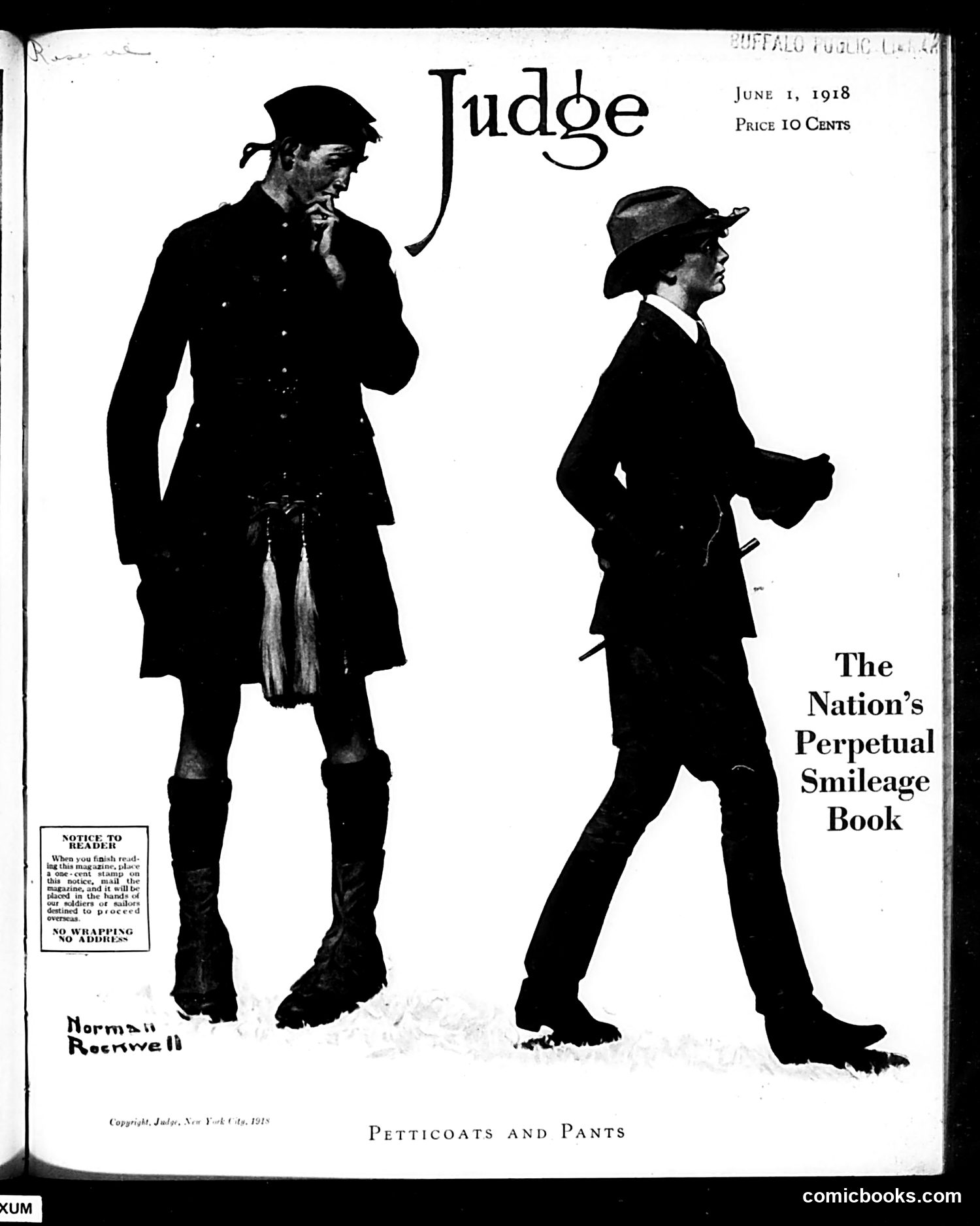
This is primarily a **fashion advertisement** rather than political satire. The cover showcases two silhouetted male figures modeling "Petticoats and Pants"—likely a humorous commentary on men's wartime fashion trends during World War I. The title "The Nation's Perpetual Smileage Book" suggests Judge's comedic purpose. The artwork is credited to Norman Rockwell, a prominent illustrator of the era. The notice to readers mentions stamping on back covers and mailing without wrapping—standard subscription information. The 10-cent price reflects 1918 costs. The satire appears light: poking fun at changing men's fashion silhouettes rather than addressing serious political issues, which was common in humor magazines of this period.
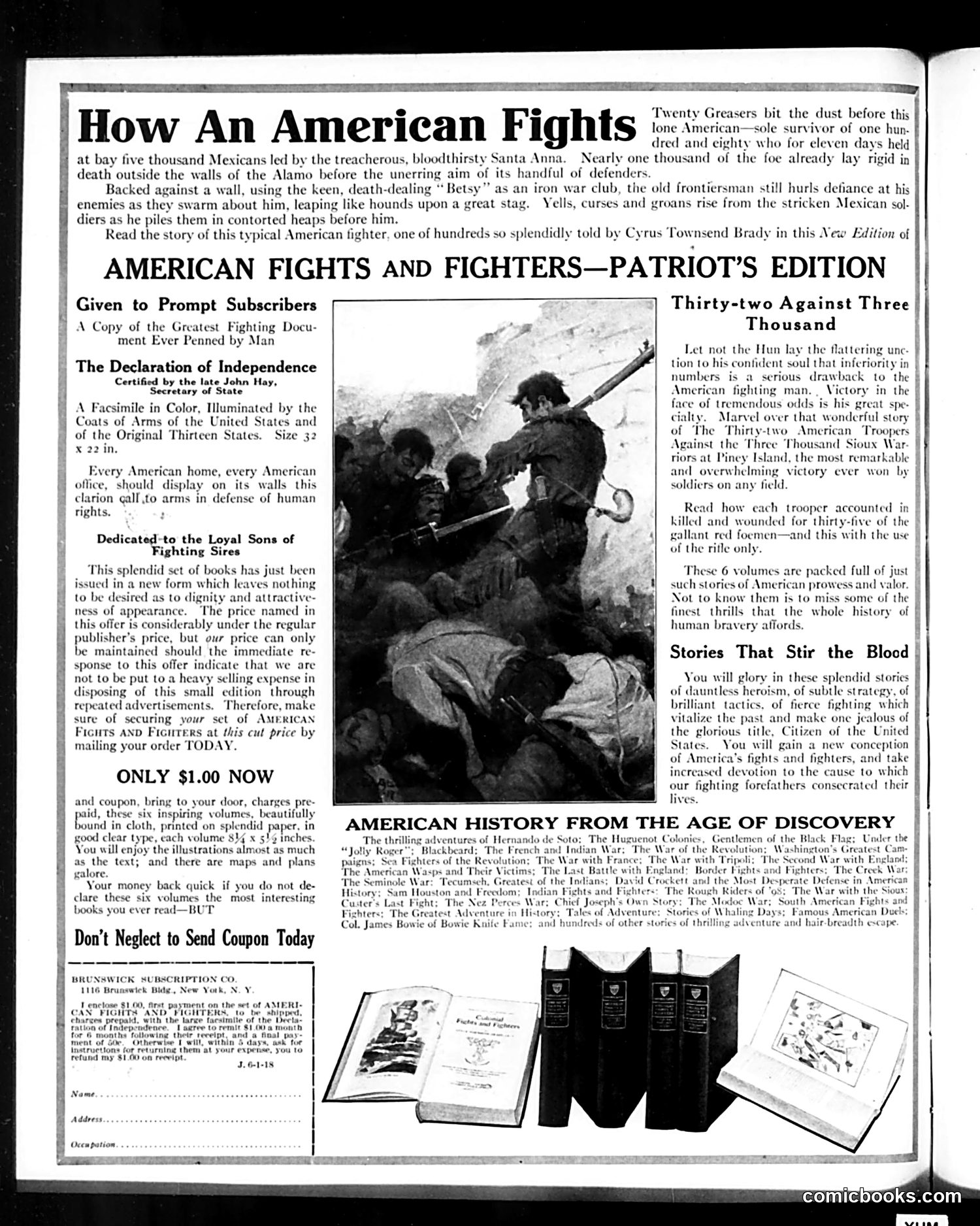
This page is **primarily advertising**, not satire or political commentary. It promotes a book series called "American Fights and Fighters—Patriot's Edition," marketed as a subscription offer for $1.00. The central image shows soldiers in combat, illustrating the book's content about American military history. The text advertises six volumes covering conflicts from the American Revolution through recent wars, emphasizing heroic narratives of American soldiers. The bottom displays the book set itself. This appears to be wartime or patriotic-era advertising (likely early 20th century, given references to various wars), designed to appeal to nationalist sentiment by celebrating American military achievements and "splendid stories of dauntless heroism." There is no evident satire or political critique—this is straightforward commercial promotion wrapped in patriotic language.
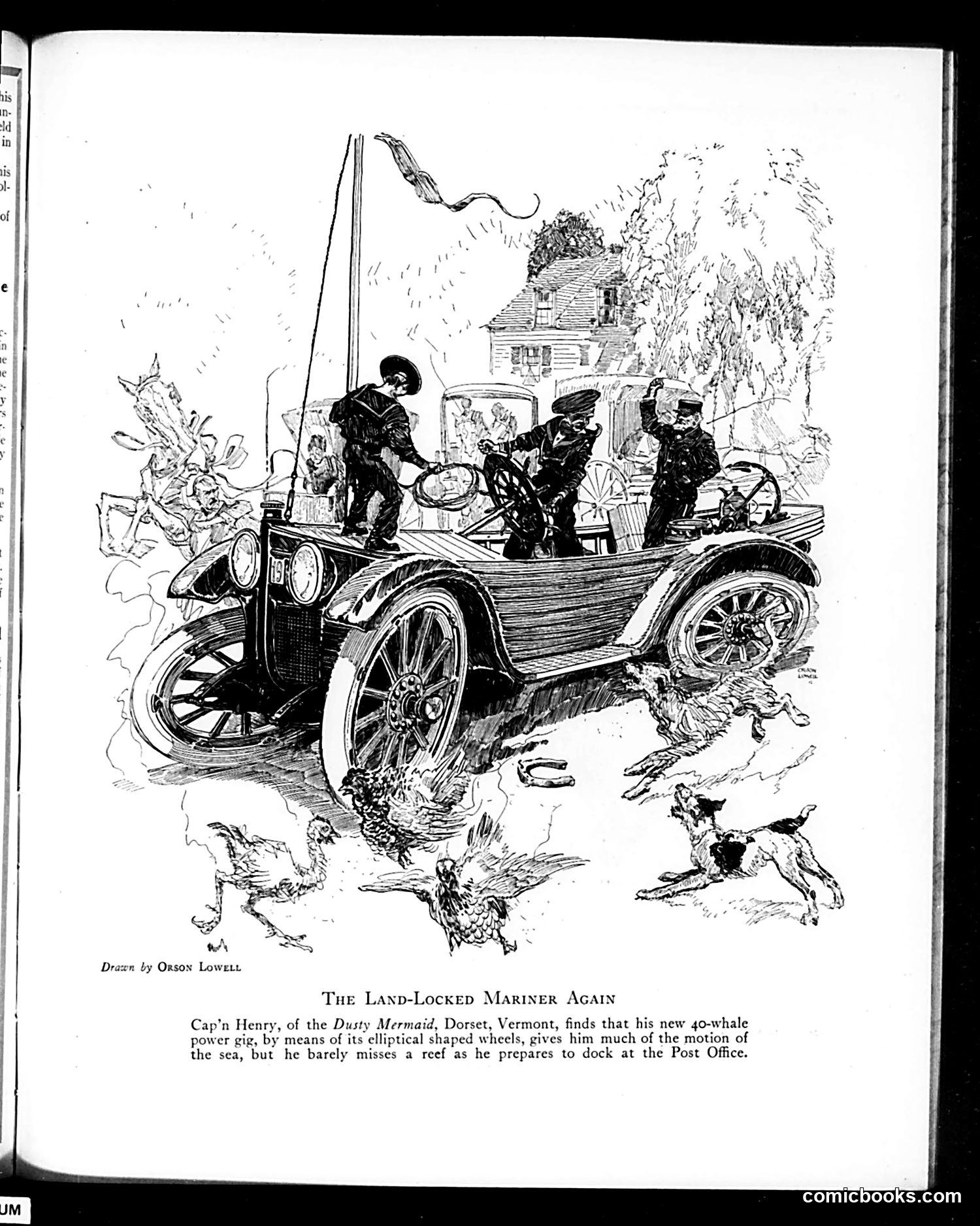
This cartoon depicts Captain Henry of the *Duty Mermaid* from Dorset, Vermont, driving a 40-horsepower automobile with elliptical wheels. The satire plays on the tension between old and new transportation: a sea captain—traditionally associated with ocean voyages—is now operating a land-based motorcar. The pack of dogs chasing the vehicle reinforces the comedy: despite the car's supposed smooth, ship-like motion from its special wheels, it still provokes the traditional response reserved for any vehicle on rural roads. The joke targets early automobile culture and the absurdity of applying nautical concepts (smooth sailing motion) to landlocked contraptions, while highlighting rural Vermont's unfamiliarity with modern vehicles.
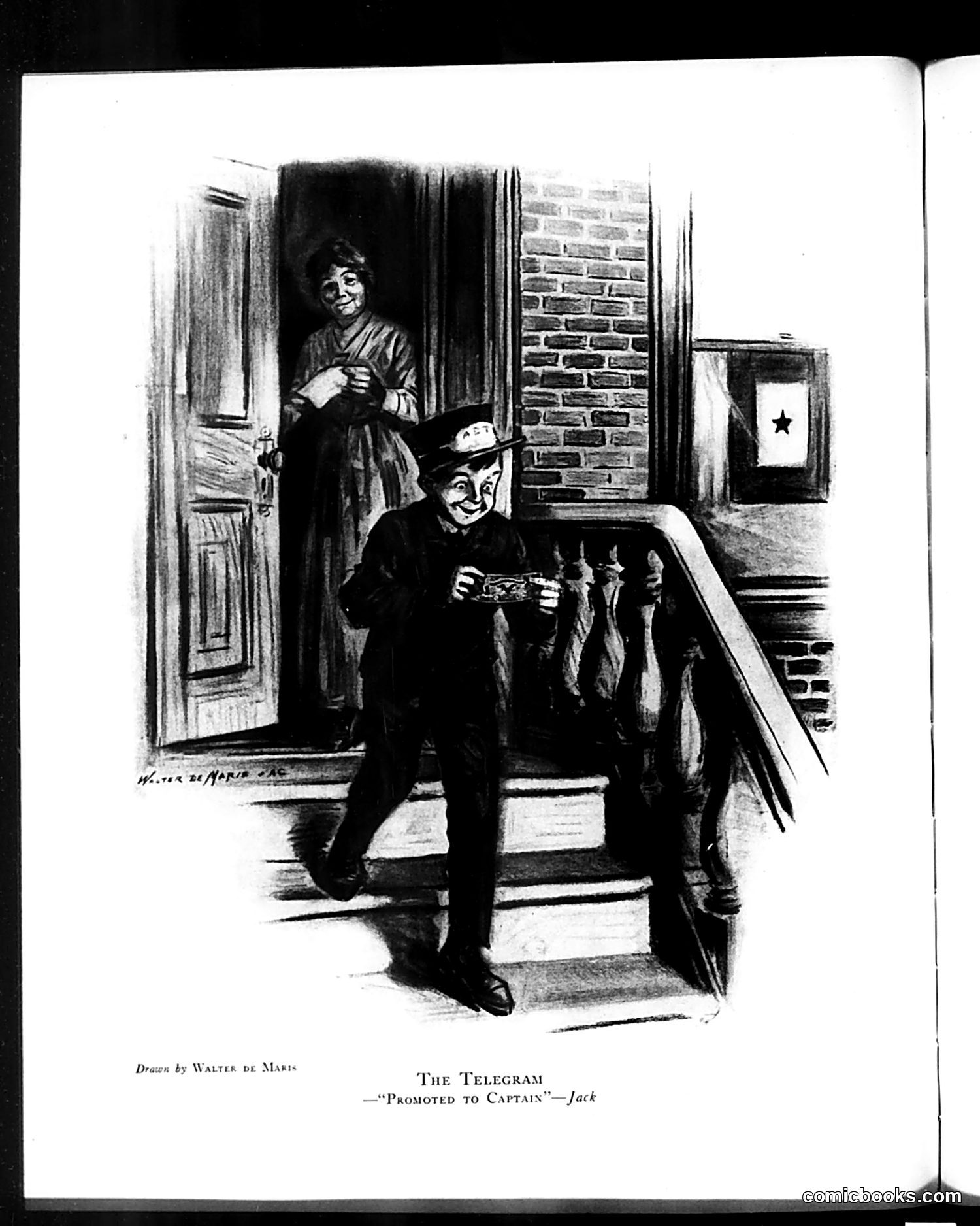
This cartoon by Walter de Maris depicts a young boy (Jack) excitedly holding what appears to be a telegram announcing his promotion to captain. A woman (likely his mother) stands in a doorway watching his reaction with apparent approval or satisfaction. The satire likely plays on military promotion hierarchies and the enthusiasm of youth receiving official recognition. The telegram format suggests this was a notable or formal announcement. Without additional context about which specific Jack or promotion event this references, the humor appears to center on the disparity between the boy's evident excitement and the somewhat modest nature of the honor being announced—possibly satirizing either military bureaucracy or parental pride in children's achievements.
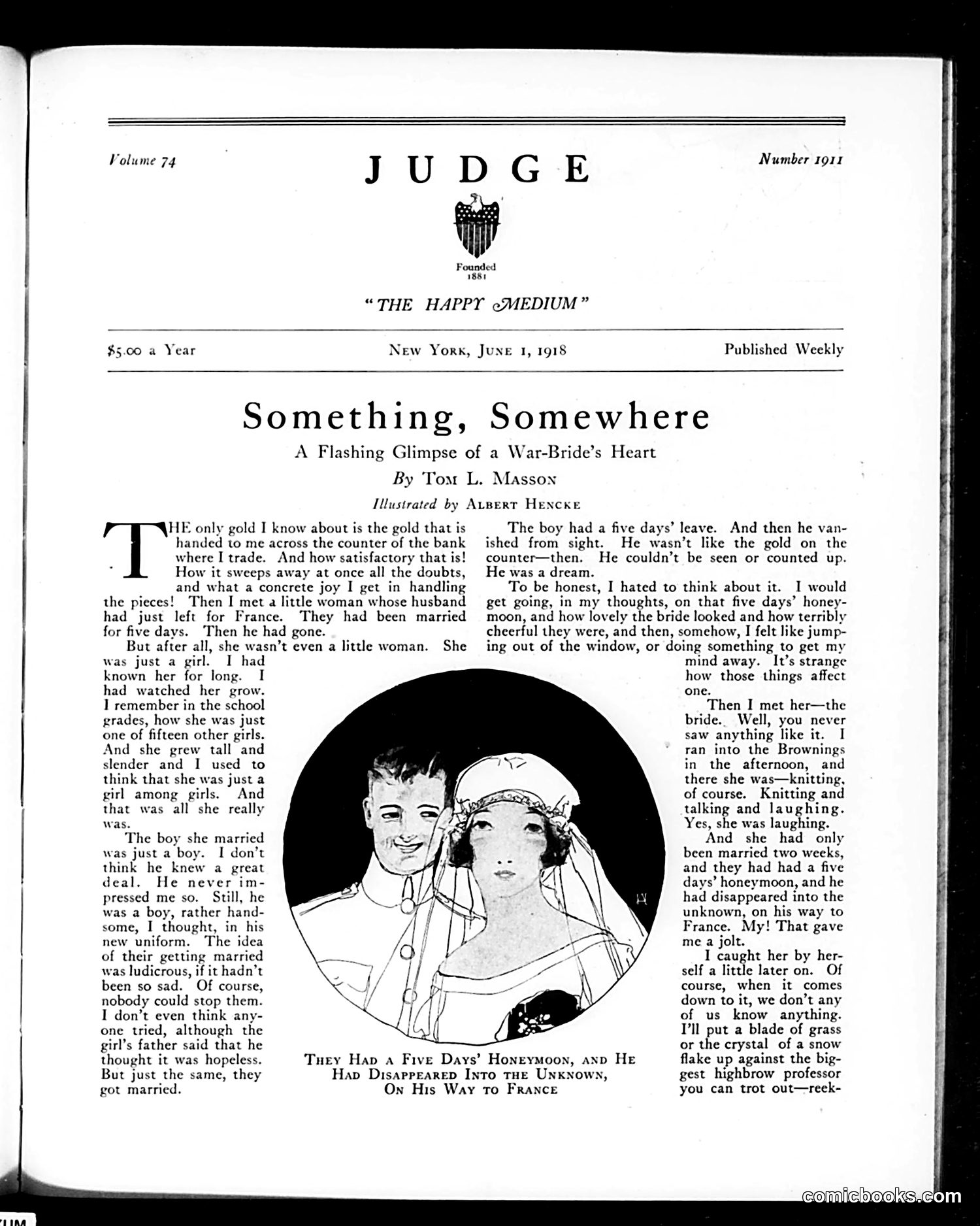
This 1918 Judge magazine piece tells a sentimental wartime story by Tom L. Masson, illustrated by Albert Hencke. The narrative concerns a young couple who married hastily before the husband deployed to France during World War I. They had only a five-day honeymoon before he "disappeared into the unknown, on his way to France." The illustration depicts the newlyweds together, capturing their brief happiness. The story explores the emotional impact on the bride—her anxiety about her husband's fate, her struggle to cope with uncertainty, and the bittersweet nature of wartime romance. This reflects common American anxieties during WWI about soldiers' safety and the emotional toll on families left behind. The piece uses intimate domestic narrative to humanize broader wartime experiences.
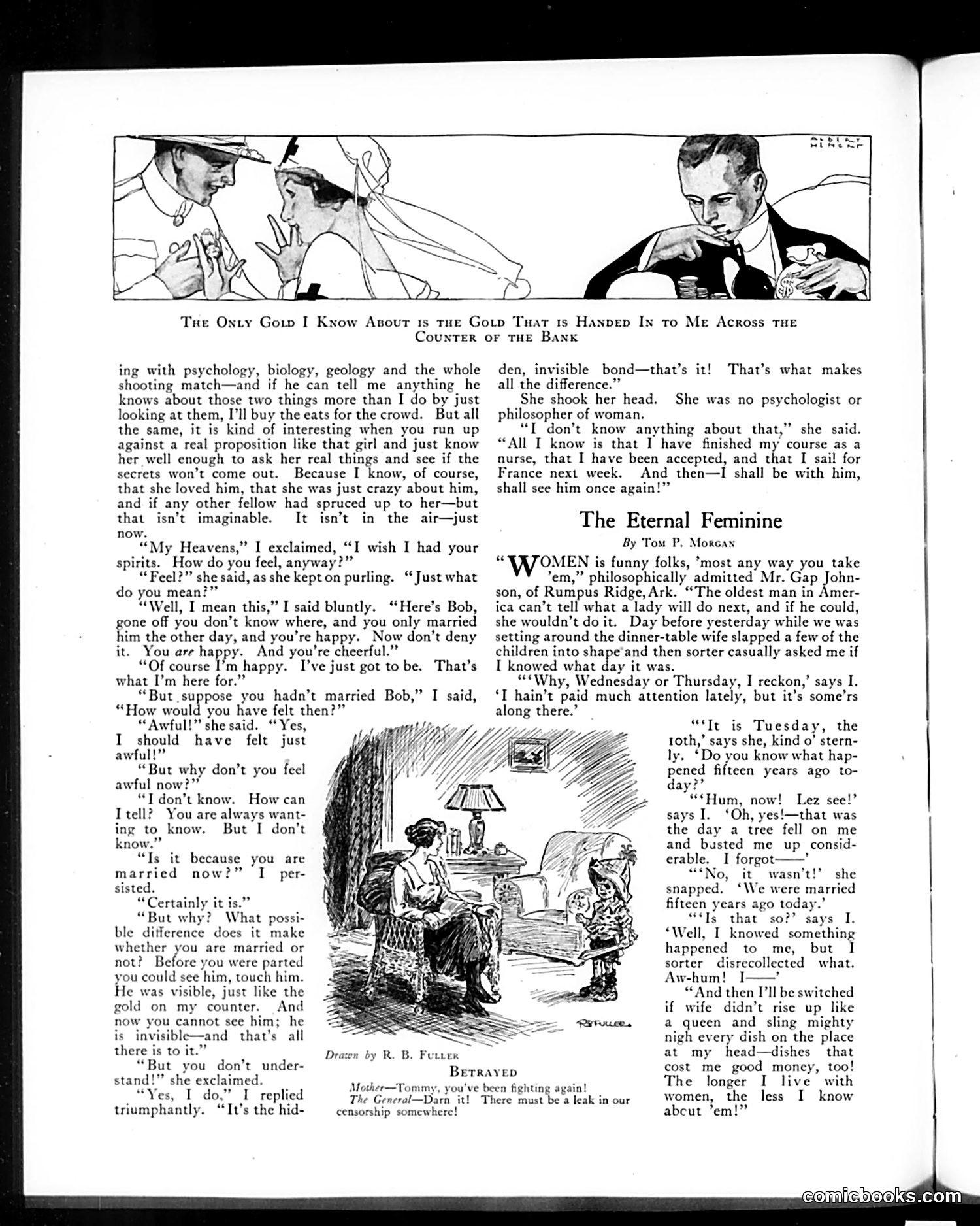
This page contains two distinct pieces: **Top cartoon**: Shows a man and woman in a boat, and a man at a bank counter. The caption references "Gold...Handed In to Me Across the Counter of the Bank," suggesting commentary on financial matters or gold standards—likely relevant to early 20th-century monetary debates. **"The Eternal Feminine" article** by Tom P. Morgan: A humorous piece about gender differences and marriage. A man complains that women are unpredictable and illogical, while a woman counters that men simply don't understand female psychology. The included illustration shows domestic life. The humor relies on period stereotypes about inherent gender incompatibility. The "bank" reference in the top cartoon remains unclear without additional context, though it may relate to financial security in marriage discussions.
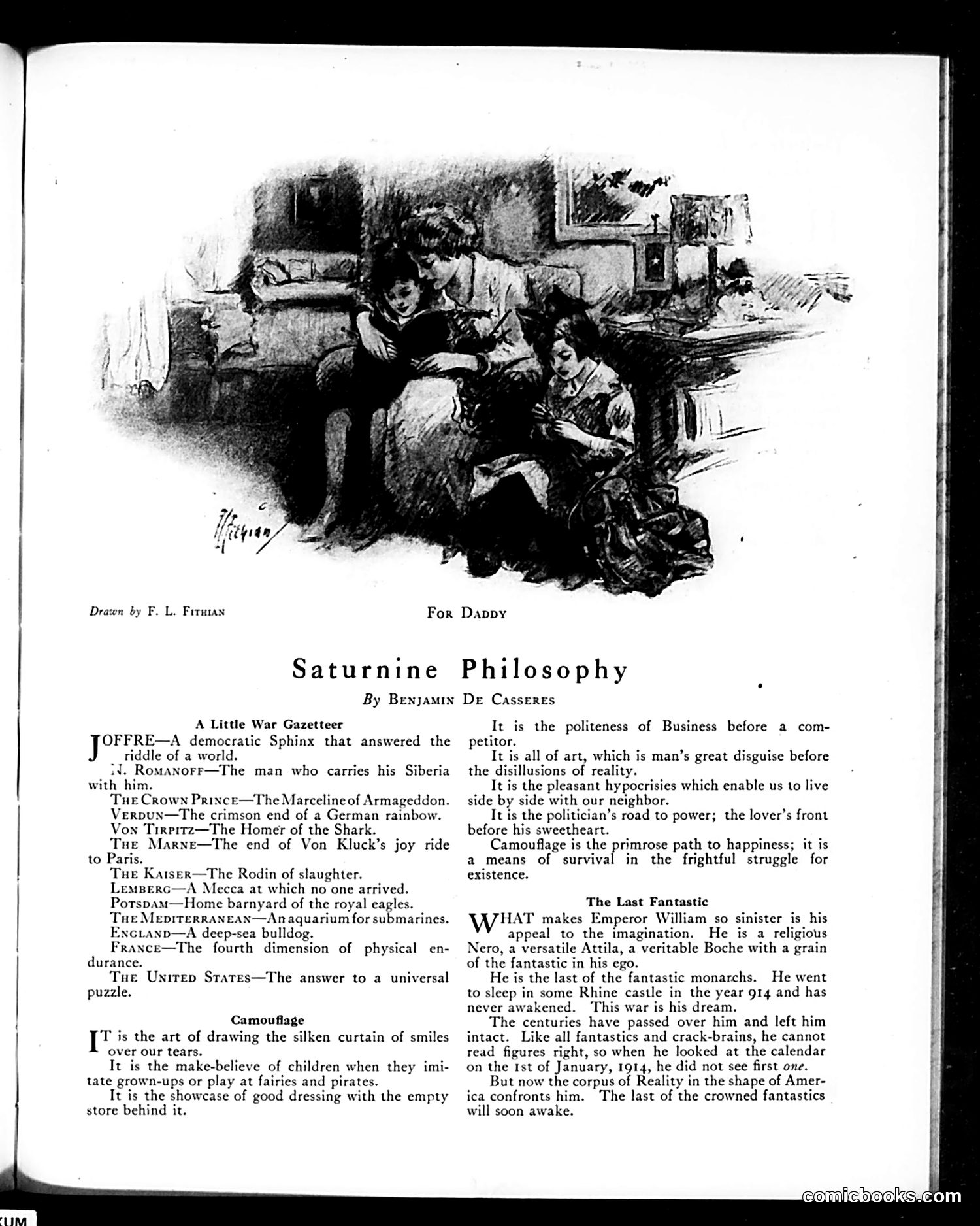
This WWI-era satirical page targets German leadership through darkly humorous definitions. The "Little War Gazetteer" mocks key figures: the Kaiser (Wilhelm II, depicted as "Rodin of slaughter"), Crown Prince Wilhelm ("Marcelino of Armageddon"), and Von Tirpitz (German admiral, "Homer of the Shark"). References like "the Marne" mock Von Kluck's failed march on Paris. The main essay, "The Last Fantastic," directly attacks Kaiser Wilhelm II, characterizing him as a delusional medieval monarch who sleeps through centuries, unable to read reality—literally misreading 1914's calendar. The satire suggests his war ambitions are fantasies detached from actual power and consequences. The implication is that America's entry into the war represents harsh "Reality" awakening this dreaming autocrat. The accompanying illustration appears to show a domestic family scene, likely contrasting innocent home life with the article's wartime political critique.
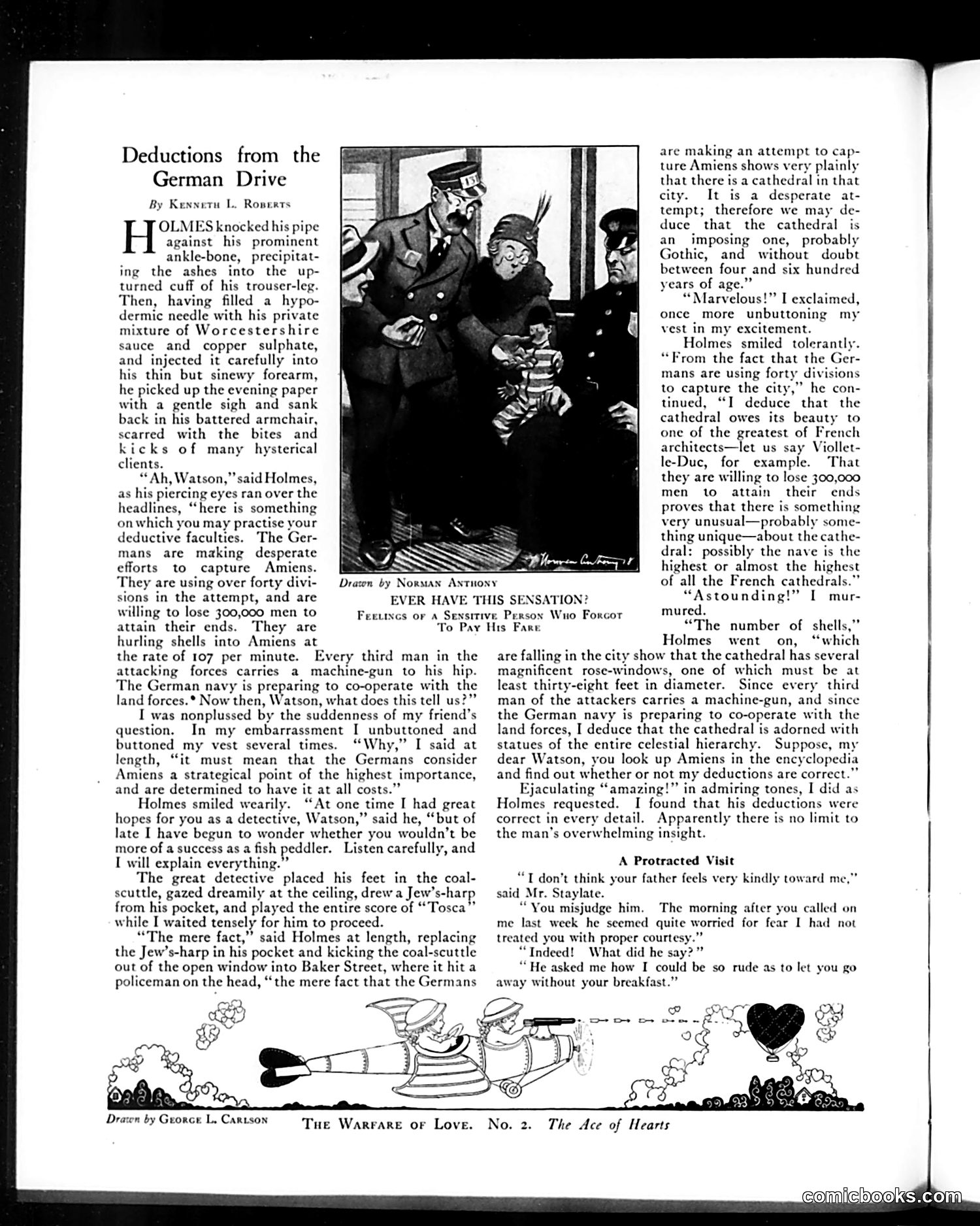
This is a Sherlock Holmes pastiche satirizing German military strategy during World War I. The story parodies Holmes's deductive method by having him analyze German attacks on Amiens (a real French city under German assault in 1918) to absurd conclusions. Holmes examines casualty figures, troop deployments, and artillery rates—genuine military data—then "deduces" that Germany's massive effort proves Amiens has a magnificent Gothic cathedral. Each military detail becomes comical "evidence" of the cathedral's architectural grandeur: forty divisions mean it's imposing; willingness to lose 300,000 men suggests unique rose-windows; machine-gun deployment indicates celestial statue decorations. The satire targets German cultural destruction during WWI. Germany was widely accused of deliberately targeting French cathedrals and cultural monuments. By reversing the logic—treating military destruction as proof of cultural value rather than acknowledgment of it—the piece indicts German willingness to destroy irreplaceable art for strategic gain.
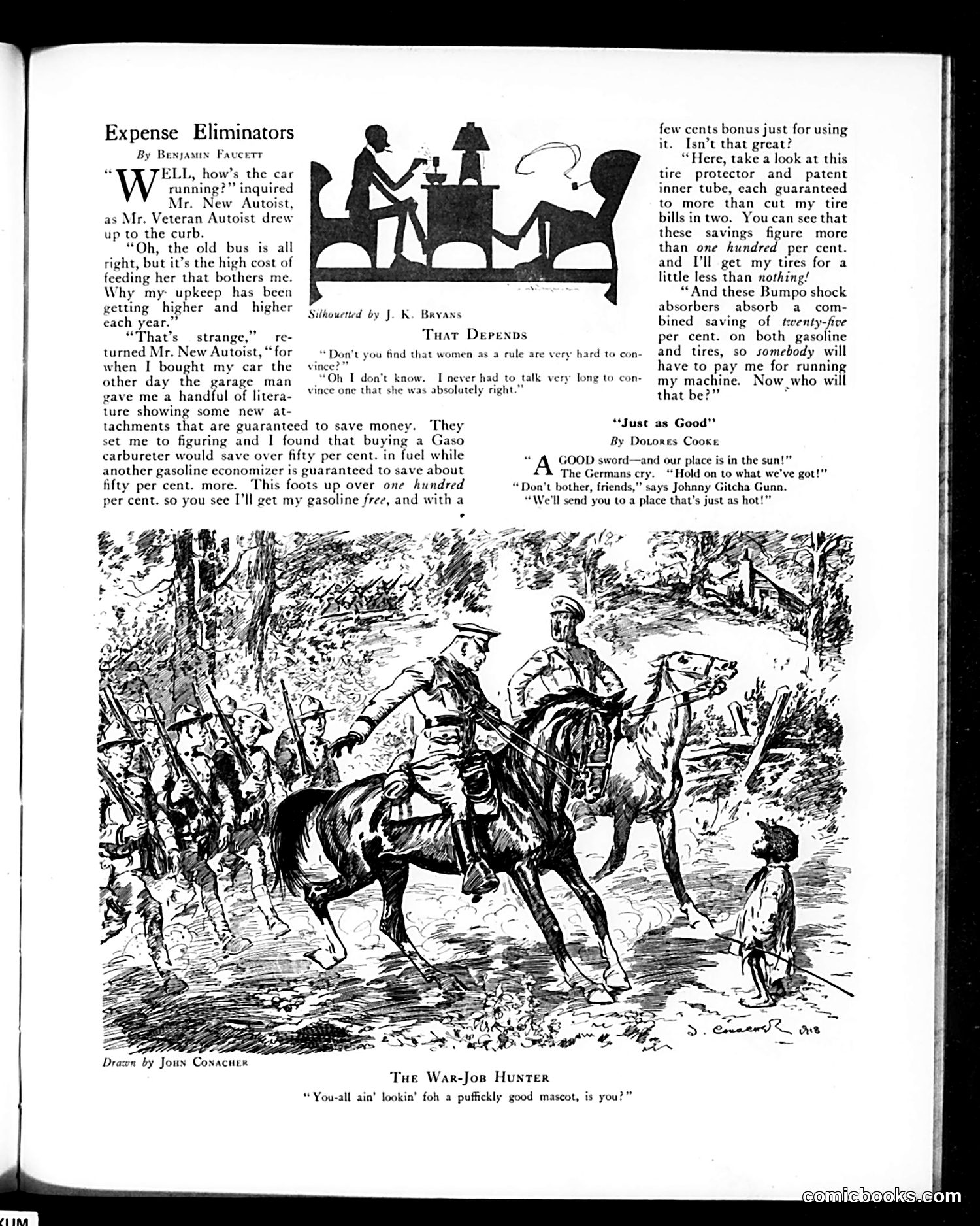
The page contains two separate satirical pieces: **"Expense Eliminators"** mocks the automobile industry's exaggerated marketing claims. A "New Autoist" boasts to a "Veteran Autoist" about gadgets and attachments guaranteed to save money on fuel and maintenance—claiming combined savings exceeding 100%, meaning he'll eventually be *paid* to drive. The satire targets manufacturers' dubious promises and consumers' gullibility in the early automotive era. **"That Depends"** is a brief joke about convincing women, playing on stereotypes about female stubbornness. **"The War-Job Hunter"** (illustration by John Cormacher) depicts a soldier on horseback asking a rural boy if he's "lookin' for a puffickly good mascot." This appears to reference WWI-era recruitment or war efforts, using dialect humor. The accompanying text fragment about "Germans cry" and "send you to a place" suggests wartime context, though the full meaning is unclear from this excerpt. The page primarily satirizes consumerism and automotive industry marketing excess.
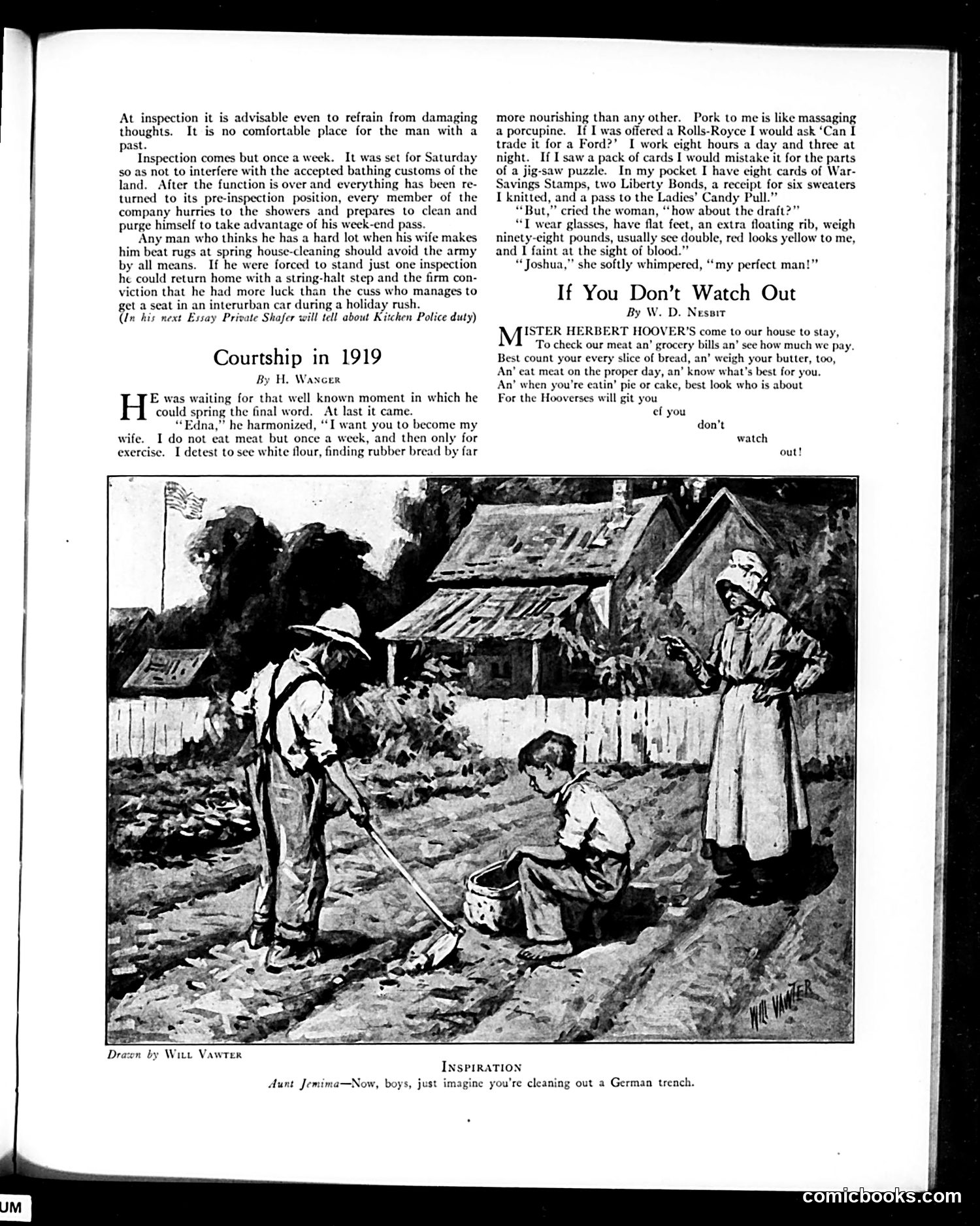
This Judge magazine page contains three pieces of WWI-era satire: **"Courtship in 1919"** mocks a suitor's marriage proposal by listing extreme wartime sacrifices—eating rubber bread, avoiding meat, working grueling hours, and most relevantly, claiming exemption from the draft due to physical disabilities (flat feet, poor vision, fainting spells). The humor lies in depicting a man so devoted to wartime restrictions that even his courtship reflects them, while simultaneously boasting of draft dodging. **"If You Don't Watch Out"** targets Herbert Hoover's food conservation program (Hoovervism), warning that government oversight of household rationing will police citizens' eating habits. The mock-threatening tone parodies children's cautionary verses. **"Inspiration"** uses an enslaved Black woman (Aunt Jemima, a stereotyped commercial icon) to motivate soldiers by comparing trench-cleaning to demeaning domestic labor—reflecting both period racism and dark military humor. All three satirize WWI's pervasive rationing, draft evasion, and social regimentation.
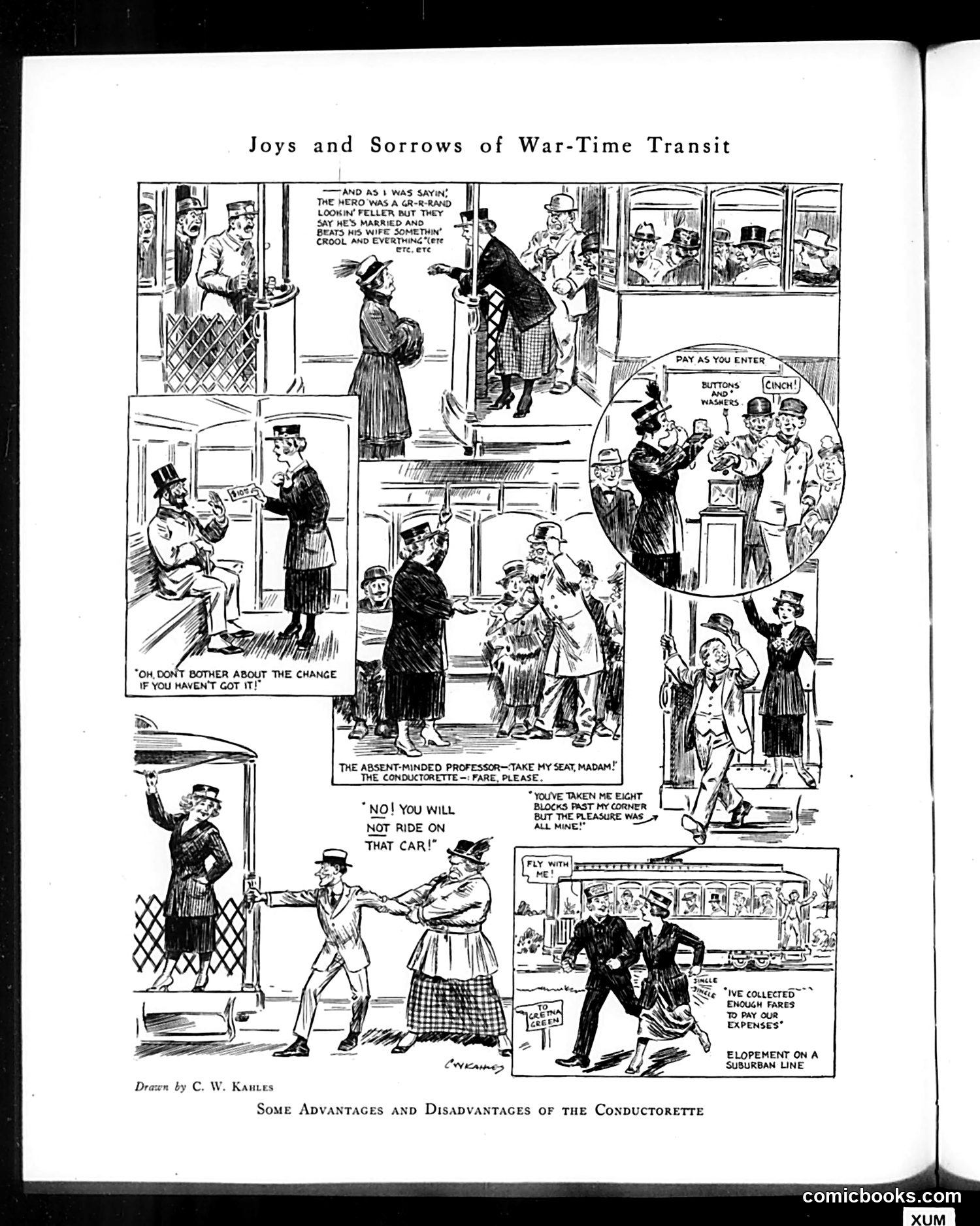
This WWI-era Judge page satirizes "conductorettes"—women hired as streetcar conductors when men went to war. The comic shows both advantages and disadvantages of this wartime employment shift. The scenarios depict: - **Women handling difficult passengers** (gossips, absent-minded professors, fare disputes) - **Courtesy conflicts**: a conductorette allowing a romantic couple to ride past their stop - **Financial problems**: conductors collecting insufficient fares to cover expenses - **Authority challenges**: a woman unable to enforce "no riding" rules against a man The satire critiques whether women could maintain professional standards in a traditionally male role, while also mocking passenger behavior—gossiping about soldiers, taking advantage of female conductors' politeness, and financial irresponsibility. The title indicates Judge views conductorettes as simultaneously beneficial (filling labor gaps) and problematic (lacking enforcement authority), reflecting contemporary gender anxieties about women's wartime work.
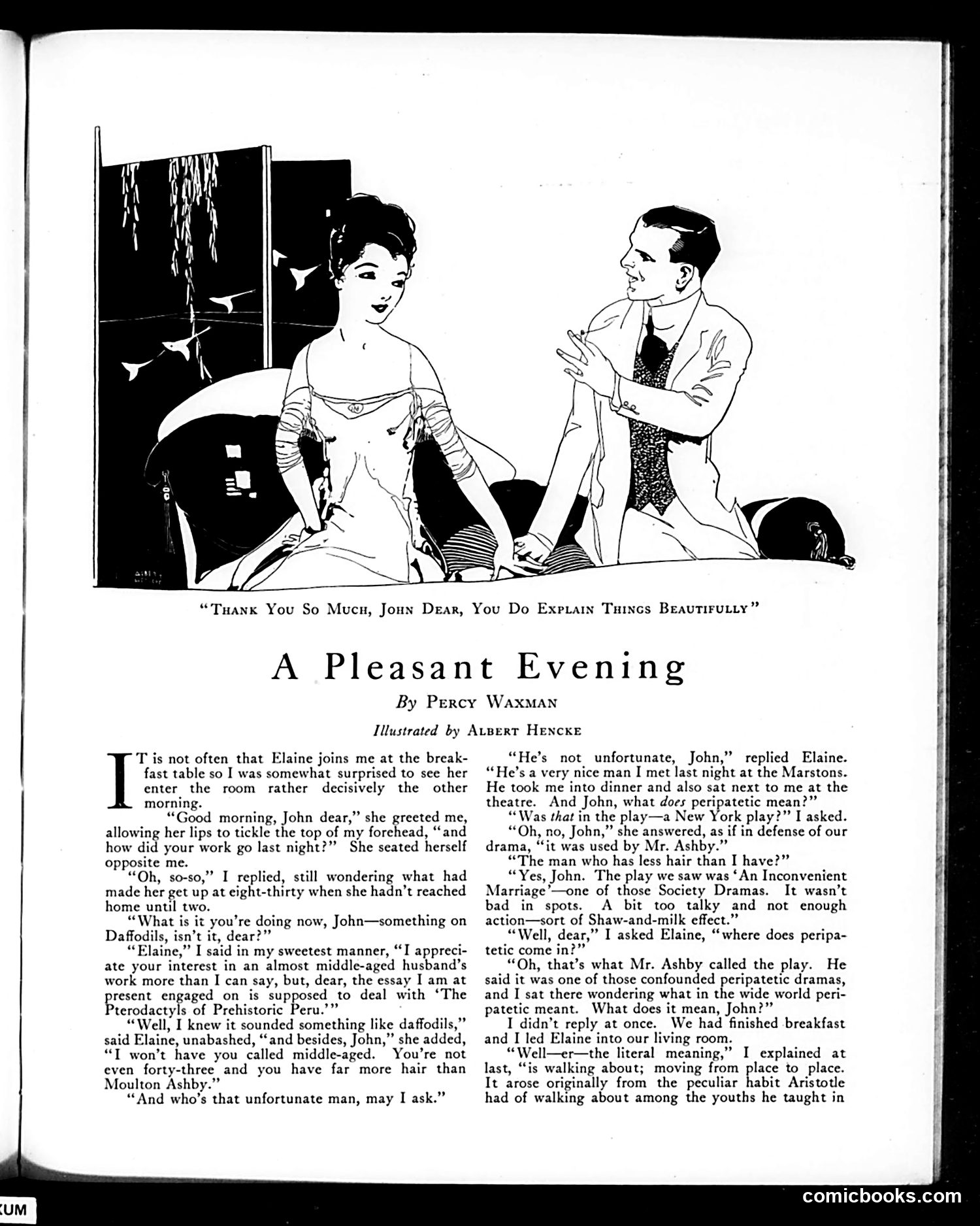
This is a humorous domestic sketch satirizing early 20th-century marriage dynamics and intellectual pretension. The story depicts a husband ("John") who discovers his wife Elaine returned home at 2 a.m. from an evening out, yet casually interrogates *him* about his work the next morning. The satire centers on Elaine's encounter with a man named Moulton Ashby at a social event, where she heard the word "peripatetic" used to describe a play. Rather than look up the word herself, she peppers her husband with questions while studiously avoiding mentioning Ashby's name or their evening together—a comedic role reversal of typical marital interrogation. The humor lies in her feigned innocence ("I knew it sounded like daffodils"), competitive remarks about Ashby's appearance, and the husband's gradual realization he's being tested or manipulated. The illustration shows them in comfortable domestic conversation, masking the subtle tension underneath—a commentary on how spouses communicate (or don't) honestly about their activities and relationships.
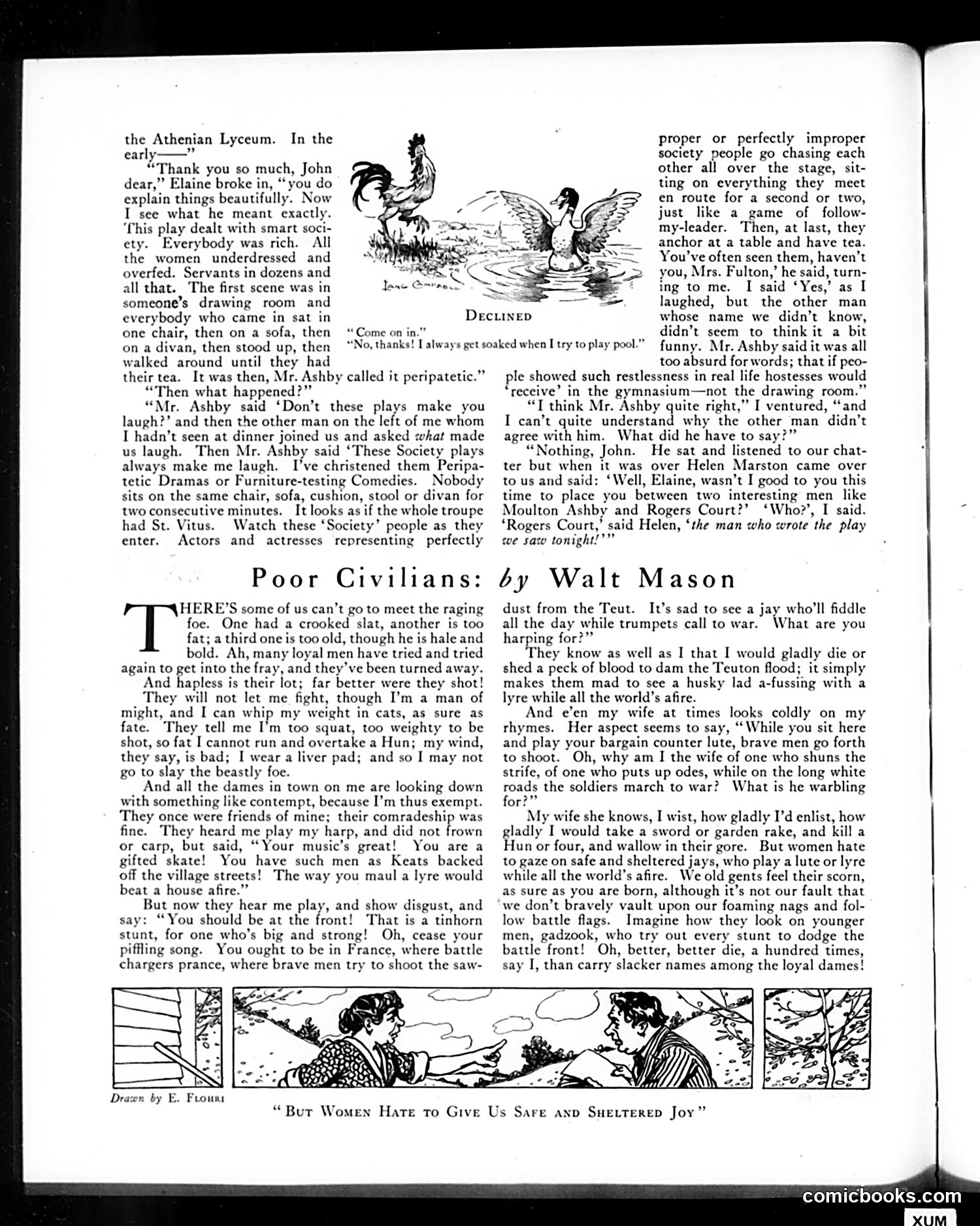
This page contains two distinct pieces of social commentary from the World War I era. **Top Section**: A conversation satirizing theatrical society plays. Characters mock the absurdity of wealthy characters constantly moving between furniture—what they term "Peripatetic Dramas or Furniture-testing Comedies." The satire targets both the shallow plots of fashionable theater and the pretensions of high society it depicts. **Bottom Section ("Poor Civilians")**: Walt Mason's poem mocks men rejected from military service during WWI. The narrator, deemed unfit to fight (too short, too fat, weak), faces social contempt from women who once admired his musical talents. The satire cuts both ways: it ridicules both the arbitrary rejection standards and the women's shame-based pressure on civilians unable to serve. The cartoon illustrations (by E. Fiori) show two figures discussing this social stigma. The overall theme: social expectations and judgment are absurd and contradictory—whether in theatrical fashion or wartime masculine duty.
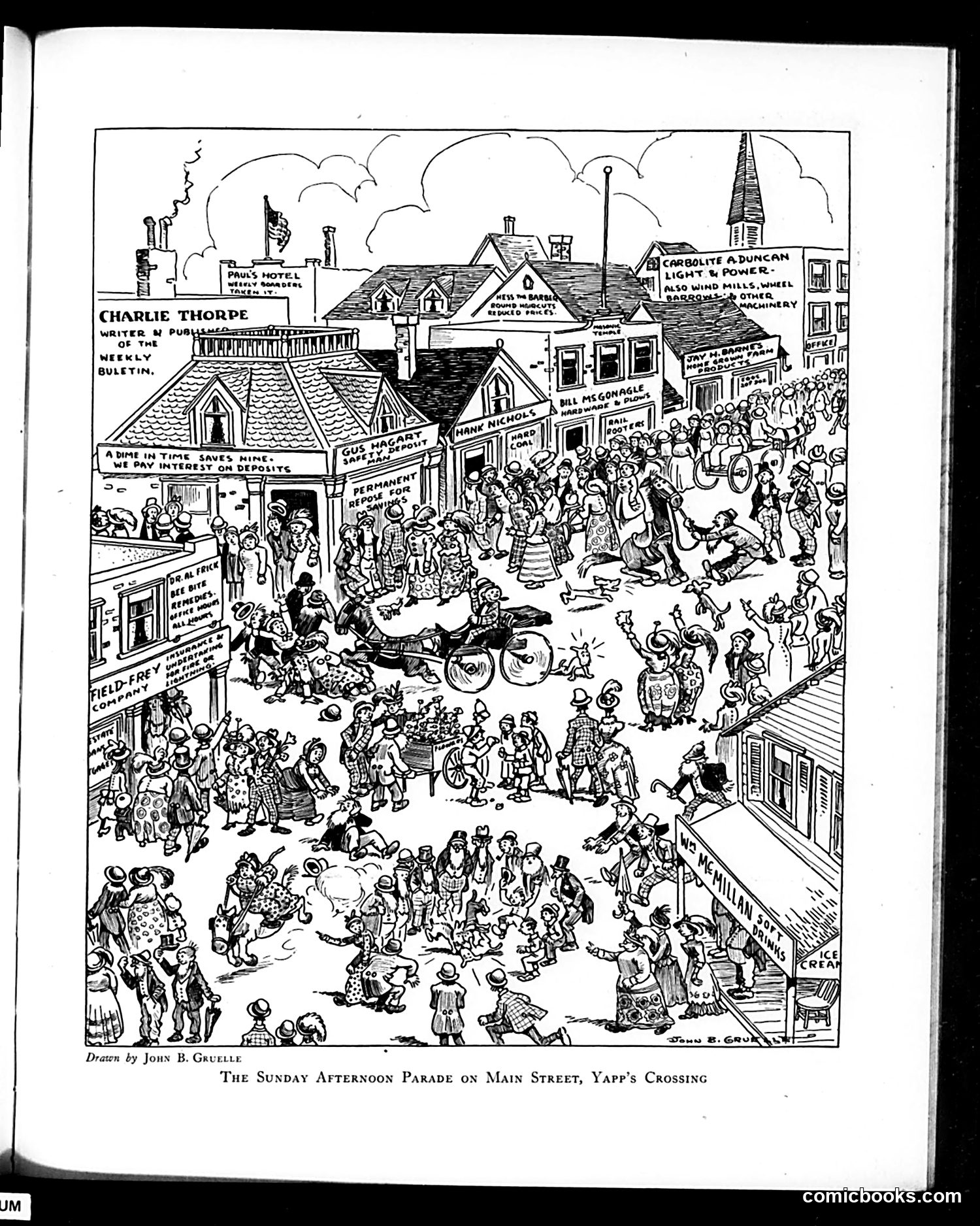
This is a densely detailed satirical illustration depicting a crowded small-town street scene. The drawing shows numerous storefronts with business signs (Charlie Thorpe's newspaper office, various shops), buildings, and hundreds of townspeople engaged in various activities—shopping, socializing, and parading. The satire appears to target small-town American life and commercialism. The cluttered scene, with its proliferation of business advertisements covering nearly every surface, mocks the commercialization of even everyday community events. The phrase "A Dime in Time Saves Nine" visible on a storefront suggests commentary on penny-pinching consumerism. The illustration is drawn by John B. Gruelle, a notable cartoonist of the era. Without additional context about specific figures or the magazine's date, the precise political targets remain unclear, though the work generally satirizes small-town mercantilism and crowded, chaotic American civic life.
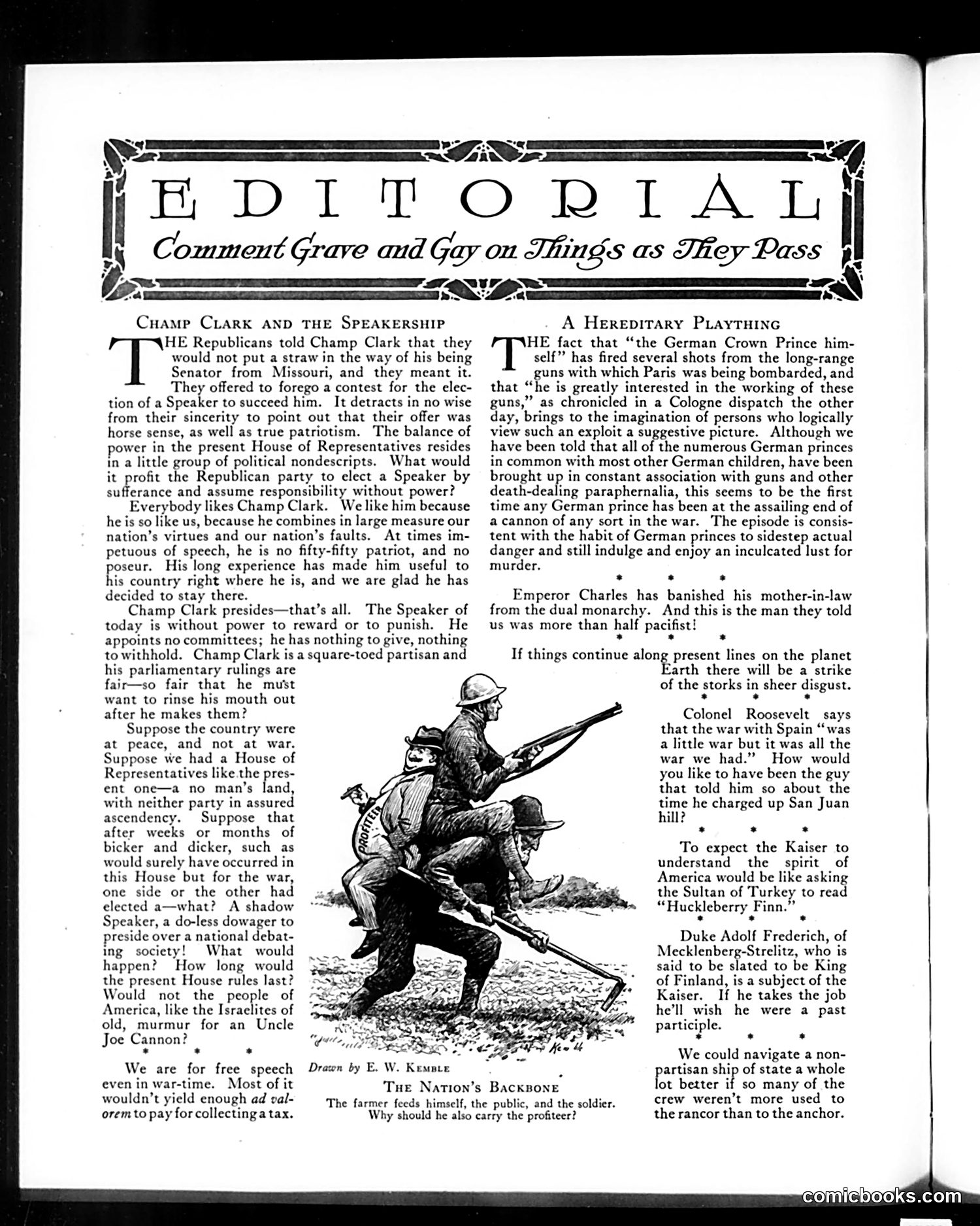
This editorial page critiques American politics during World War I. The main article defends **Champ Clark**, Speaker of the House, against Republican pressure to leave that position for a Senate seat. The writer argues Clark should stay because the Speaker's office lacks real power in a divided Congress—he merely presides. The piece warns that without strong leadership, Congress would devolve into chaos, invoking **Uncle Joe Cannon** (former powerful Speaker) as comparison. The right column's satirical items mock **the German Crown Prince** for firing ceremonial cannon shots while avoiding actual combat—consistent with aristocratic cowardice. It also ridicules **Kaiser Wilhelm** for pacifism claims and jabs **Colonel Roosevelt** about his Spanish-American War boasting. The **E.W. Kemble illustration** depicts soldiers carrying war's burdens on their backs, captioned "The Nation's Backbone," emphasizing farmers and workers bear war's costs. The satire targets wartime political maneuvering, German leadership hypocrisy, and American nostalgia for strong congressional power.
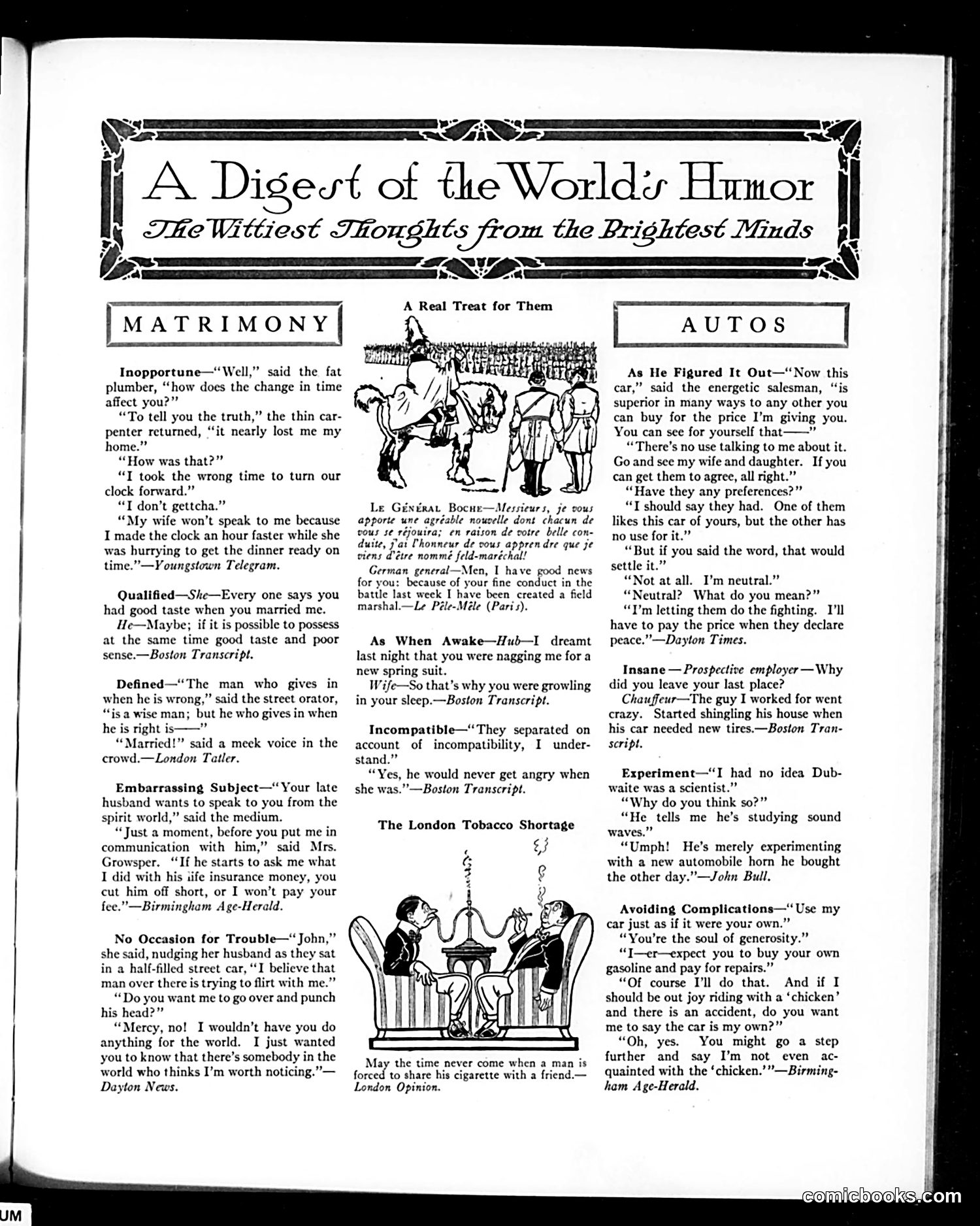
This page from Judge presents humorous anecdotes satirizing early 20th-century American life, organized by topic. The **MATRIMONY** section mocks marriage through jokes about wives nagging husbands—one involves a clock set forward causing marital discord, another features a widow worried about discussing insurance money with her dead husband's spirit. The **AUTOS** section ridicules the era's automobile culture: a salesman can't convince a husband to buy a car because his wife and daughter disagree; a prospective employer thinks a man "crazy" for shingling his house instead of fixing his car; and another joke conflates a car horn with scientific "sound wave" experimentation. The central illustrated anecdotes include a French general announcing his promotion to field marshal and a couple's incompatible temperaments. The **Tobacco Shortage** cartoon references wartime rationing—apparently a London concern. Overall, the satire targets gender dynamics in marriage, the growing obsession with automobiles, and period-specific social anxieties. The humor relies on exaggeration and domestic situations recognizable to Judge's middle-class readership.
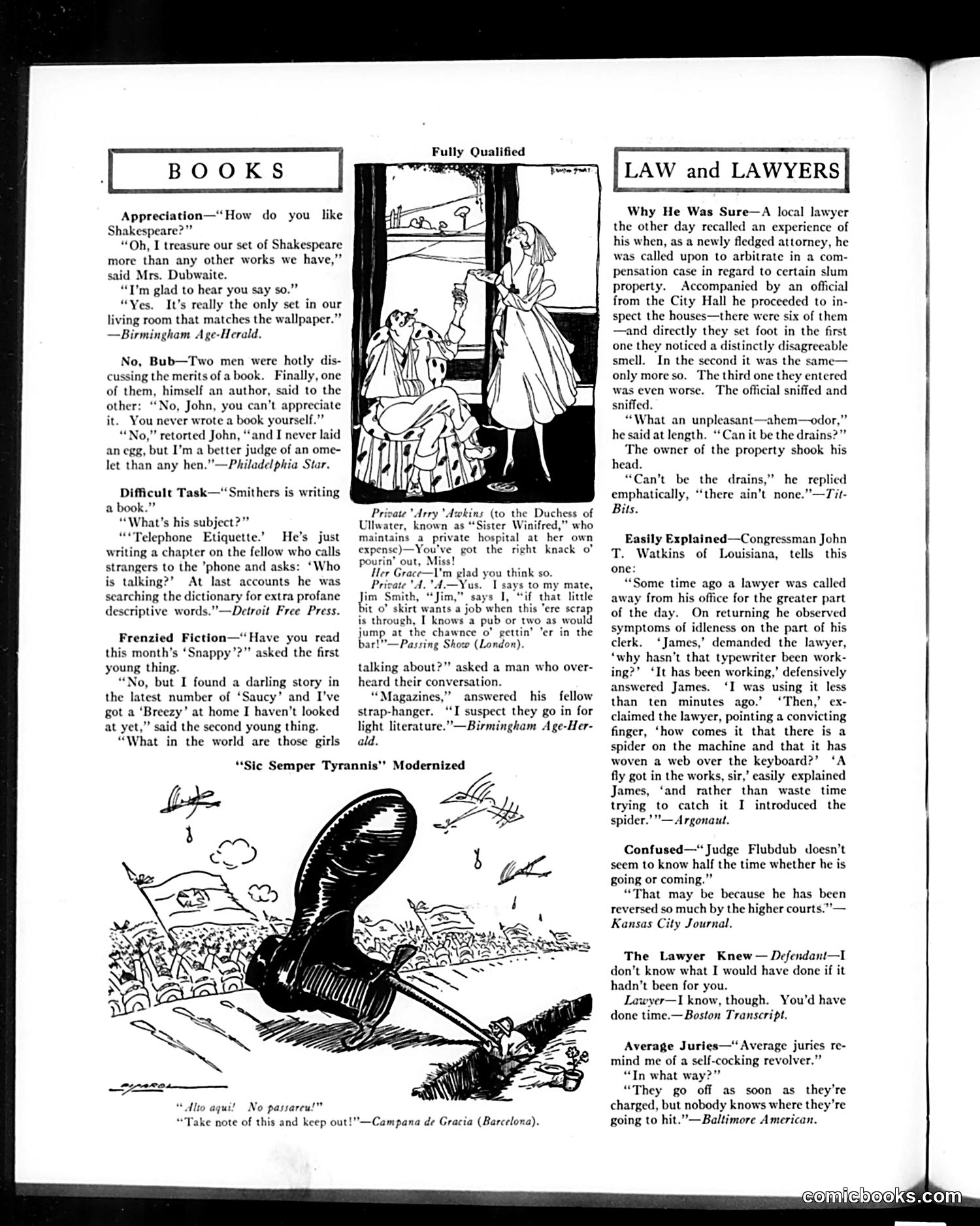
This page from Judge magazine contains humorous anecdotes mocking social pretension and professional incompetence, typical of early-20th-century American satire. The **"Books" section** ridicules cultural affectation: Mrs. Dubwaite values Shakespeare only because it matches her wallpaper—satirizing status-conscious consumers who collect books for decoration rather than reading. The telephone etiquette joke mocks the difficulty of describing rudely intrusive phone calls, requiring "extra profane descriptive words." The **"Law and Lawyers" section** uses anecdotes to highlight professional absurdity: a lawyer arbitrating slum property inspections discovers the buildings have no drains (yet tenants tolerate them); a congressman's clerk explains a spider on a typewriter keyboard by claiming he "introduced the spider" to catch a fly—absurd problem-solving masquerading as logic. The cartoon shows a modernized version of tyranny: what appears to be a pen or quill destroying figures, captioned in Spanish ("Here! No passage!"). This likely satirizes authoritarian control. Overall, the page targets pretentious middle-class values, professional incompetence, and absurd social conventions through everyday scenarios.
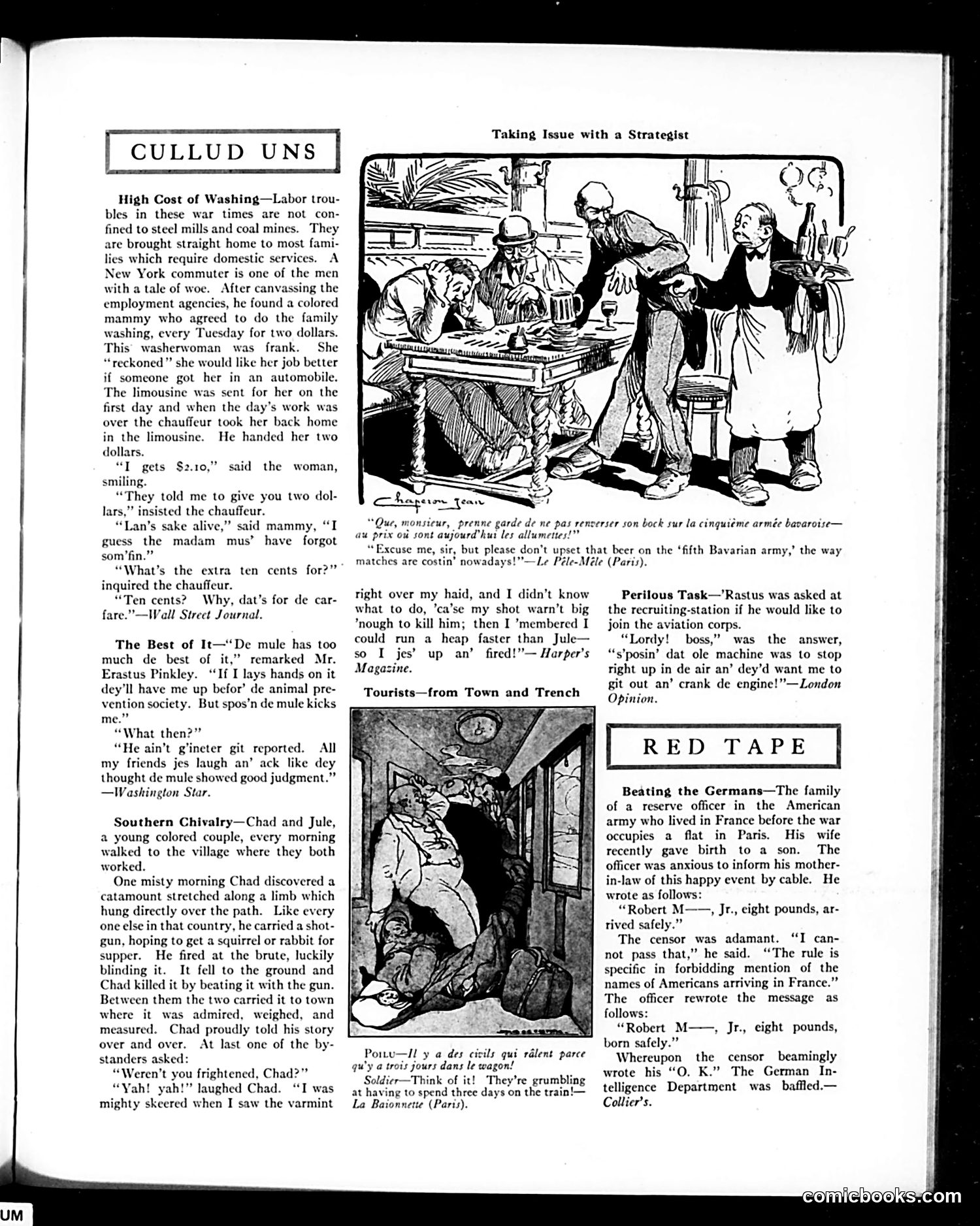
This page from the WWI-era *Judge* magazine contains several brief satirical anecdotes mocking labor disputes and military bureaucracy: **"Cullud Uns"** presents racist dialect humor about a Black washerwoman who negotiates higher pay by requesting automobile transportation—the joke being her supposed greed or cunning. **"Taking Issue with a Strategist"** is a European cartoon about a drunk soldier concerned that spilled beer might damage a map of the Bavarian army, joking about wartime scarcity (matches are expensive). **"Red Tape"** satirizes military censorship: an American officer in France tries to cable news of his newborn son's birth weight, but the censor blocks it under rules forbidding mention of Americans in France—defeating the rule's actual purpose through absurd literalism. The page reflects early-20th-century attitudes: casual racism in domestic-worker stories, dark WWI humor, and critique of military bureaucratic excess. Modern readers should recognize these reflect *period* prejudices, not endorsed viewpoints.
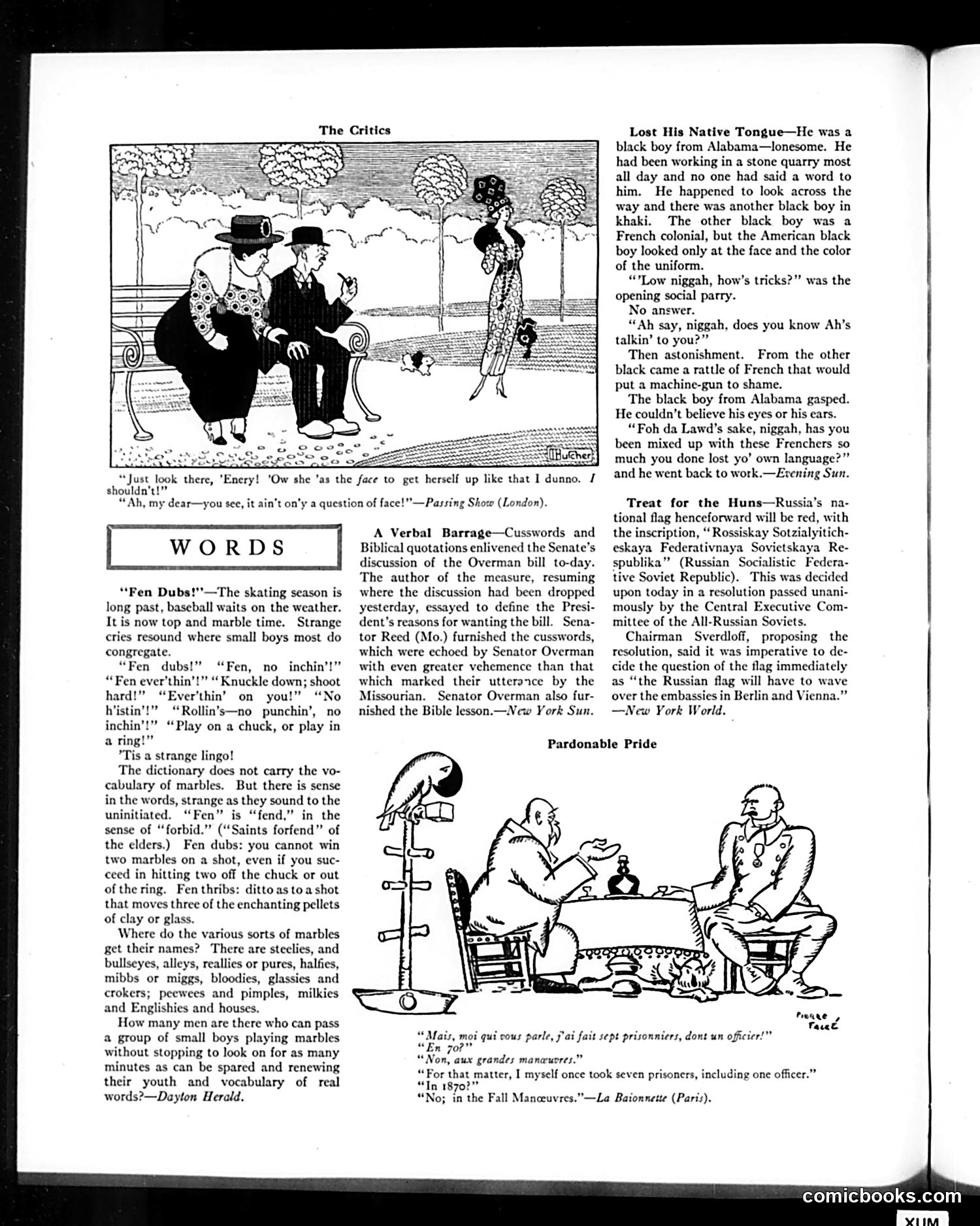
**"The Critics" (top cartoon):** Two well-dressed men on a sofa criticize a woman's appearance across the room. The joke plays on "face"—one says she has the audacity to dress that way; the other notes it's not merely a question of facial features but of shamelessness. It's a period joke about female vanity and impropriety. **"Words" section:** Celebrates the slang vocabulary of marble-playing boys ("Fen dubs," "Fen thribs"), arguing this childish argot deserves nostalgic appreciation from adult men. It's sentimental rather than satirical. **"Lost His Native Tongue":** An African American soldier from Alabama, encountering a French colonial Black soldier, cannot understand his French and laments that he's "lost" his own language. The anecdote plays on themes of cultural displacement and the shock of encountering unexpected foreignness. **"Treat for the Huns":** Reports Russia's new red flag with Cyrillic inscription, sarcastically suggesting this pleases Germany ("Huns"), likely implying Soviet Russia's weakness or capitulation during WWI negotiations. **"Pardonable Pride":** French soldiers compare prisoner-captures, boasting competitively about wartime exploits.
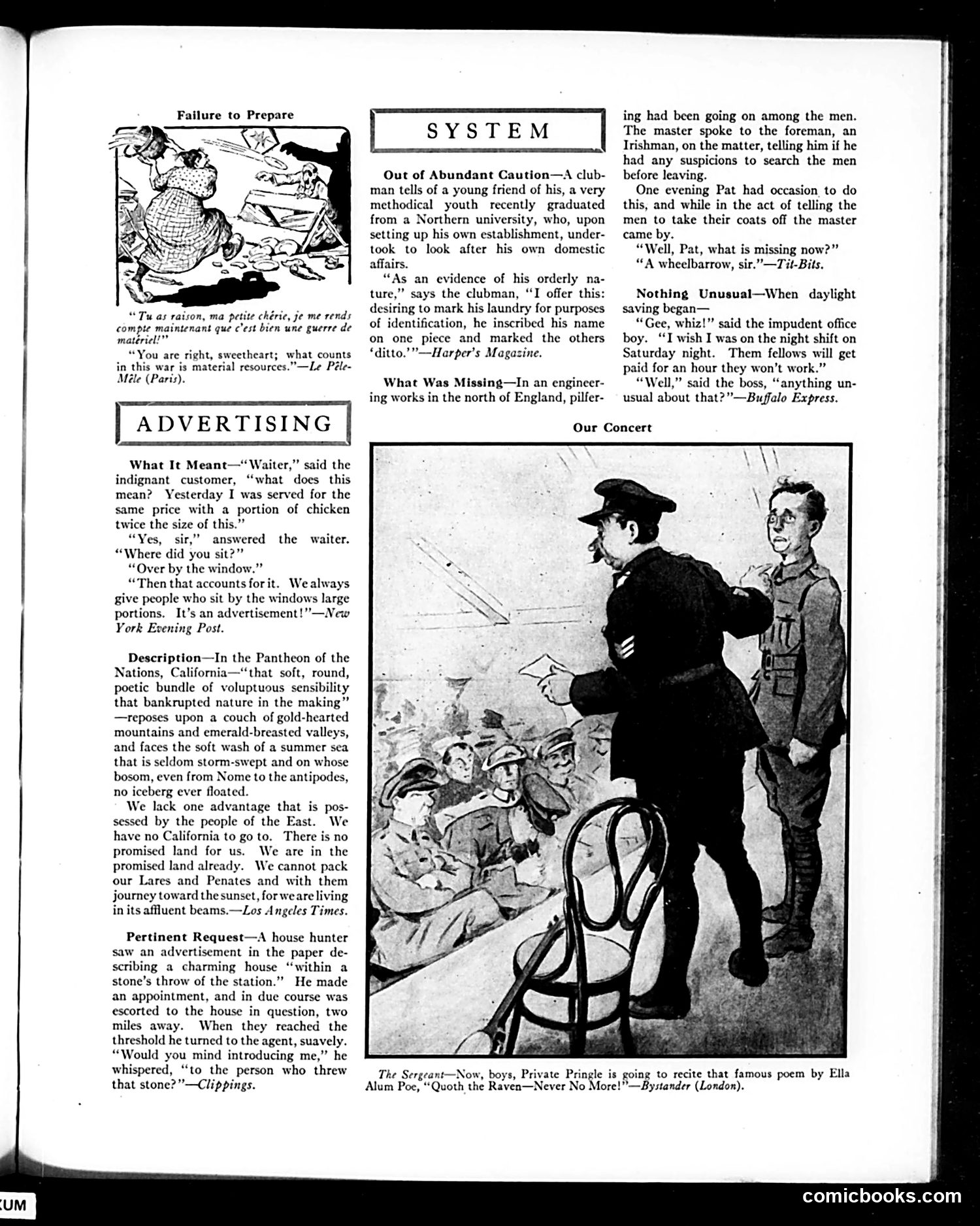
This page collects brief satirical anecdotes and one cartoon about wartime and everyday absurdities, likely from World War I era (based on the French quote about "guerre de matériel"—war as material resources). **The cartoon "Our Concert"** shows a sergeant announcing that Private Pringle will recite Poe's "The Raven," while soldiers sit restlessly. The joke: forcing reluctant soldiers to endure tedious entertainment is presented as punishment disguised as culture. **The text anecdotes mock:** - Poor restaurant portions disguised as "advertising" - False real estate claims ("stone's throw from the station" actually two miles away) - Bureaucratic over-organization (a graduate meticulously labeling laundry) - Wartime profiteering and theft - Daylight saving time exploited by clever workers The page's theme is **deceptive appearances**—claims and presentations that don't match reality, whether in commerce, military life, or daily wartime experience. The humor relies on recognizing how ordinary people navigate dishonest systems.
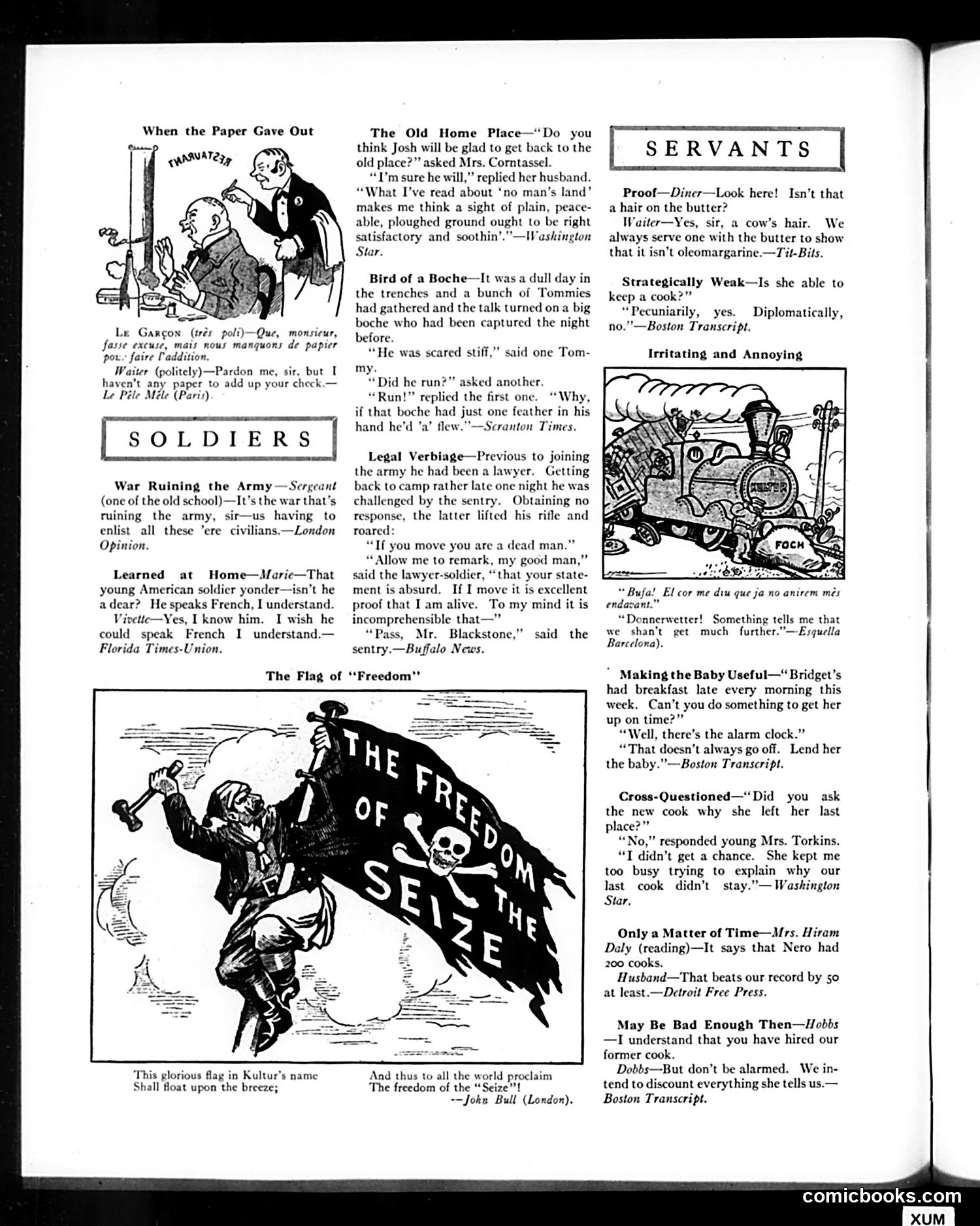
This satirical page from Judge magazine collects wartime humor, likely from WWI era (references to "Boche," trenches, and "no man's land" confirm this). **Main cartoon: "The Flag of 'Freedom'"** depicts Germany's Kaiser claiming to spread "freedom" while the flag ironically reads "The Freedom of the Seize"—mocking German militarism and seizure as false liberation. **Other jokes** mock soldiers, domestic life, and bureaucracy: - A lawyer-turned-soldier uses verbose legal language when challenged by a sentry - American soldiers' French flirtations and homesickness - Domestic complaints about cooks and servants **Tone**: Lighthearted, anti-German propaganda mixed with everyday comic complaints. The page uses humor to sustain civilian morale while ridiculing enemy ideology and poking fun at universal wartime inconveniences—missing paper, unreliable servants, marital exasperation.
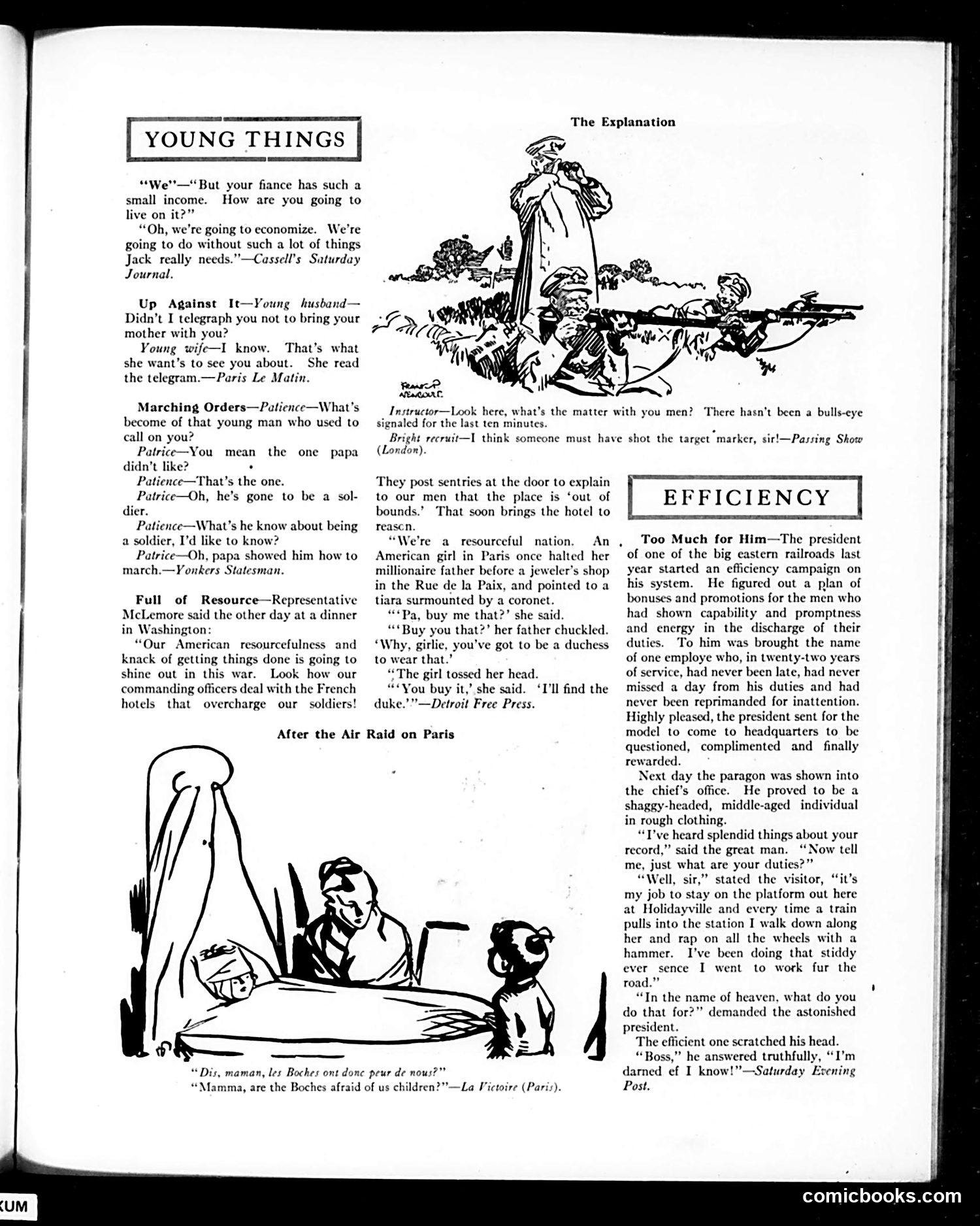
This page contains three sections of satirical humor typical of WWI-era Judge magazine: **"Young Things"** presents brief domestic comedy sketches mocking newlyweds and courtship, sourced from international publications. The jokes rely on stereotypes about women's materialism and marital dynamics. **"The Explanation"** cartoon (top right) depicts a military shooting drill where recruits haven't hit the target. The humor comes from the recruit's absurd excuse that someone shot the target marker itself—suggesting incompetence masked by creative blame-shifting. **"Efficiency"** tells of a railroad president rewarding a twenty-two-year model employee, only to discover the man's entire job—repeatedly tapping train wheels with a hammer—serves no actual purpose. The satire mocks both corporate efficiency campaigns (popular management fad of the era) and mindless bureaucratic work. The page also includes a brief anecdote about American resourcefulness during WWI, contrasting practical military solutions with American consumerism abroad.
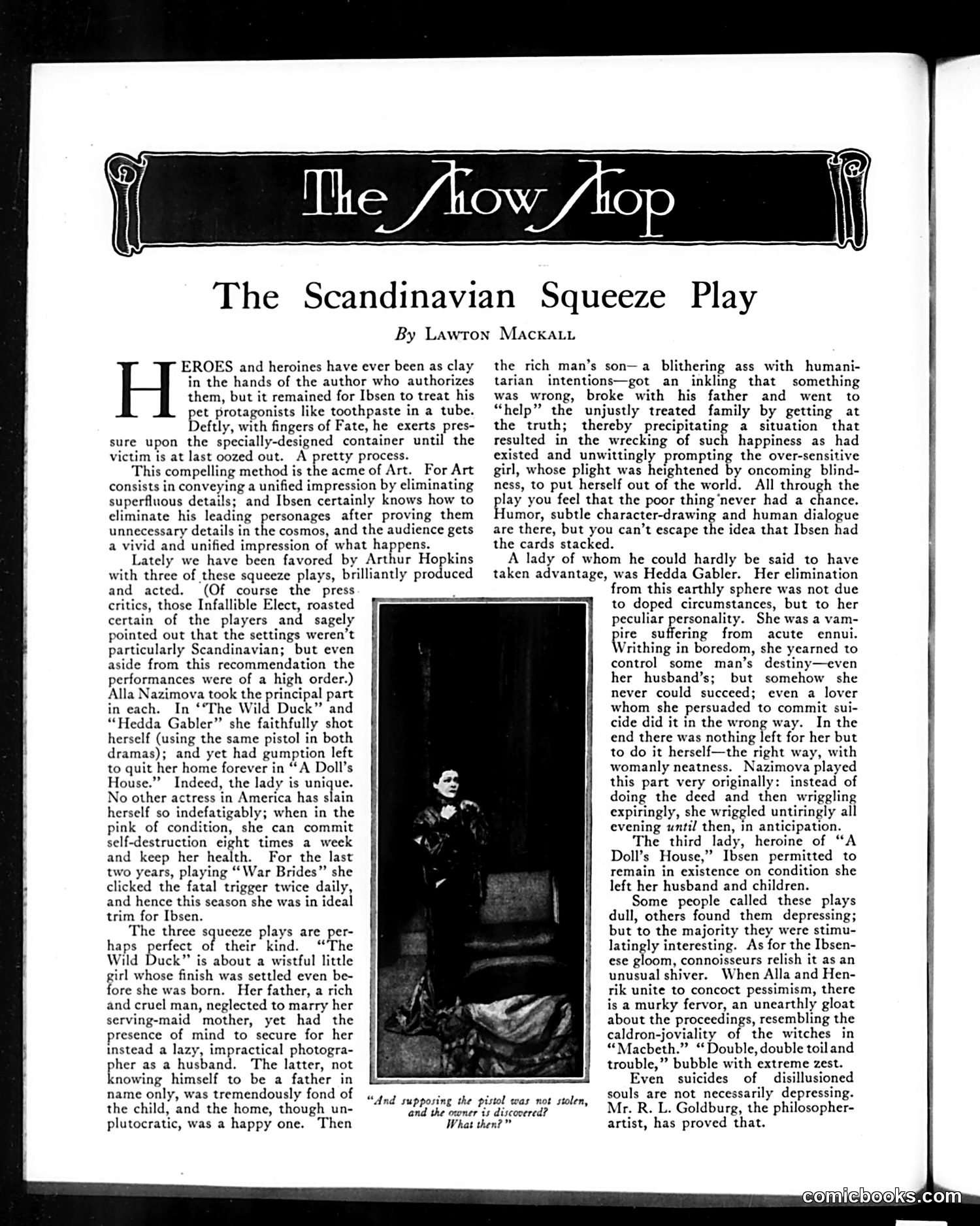
This is a theater review by Lawton Mackall critiquing Henrik Ibsen's dramatic works as presented by producer Arthur Hopkins, starring Russian-American actress Alla Nazimova. The piece sarcastically praises Ibsen's technique of methodically "squeezing" characters to their tragic conclusions—like toothpaste from a tube. Mackall uses dark humor to describe Nazimova's repeated on-stage suicides across three productions (*The Wild Duck*, *Hedda Gabler*, *A Doll's House*), noting her stamina in dying "eight times a week" while maintaining her health. The accompanying photograph shows Nazimova in character. The review acknowledges Ibsen's artistic skill in eliminating superfluous details but suggests his plots feel deliberately rigged—the "cards stacked"—leaving audiences with depression rather than catharsis. The tone is witty mockery of both Ibsen's deterministic fatalism and Nazimova's commitment to playing doomed heroines.
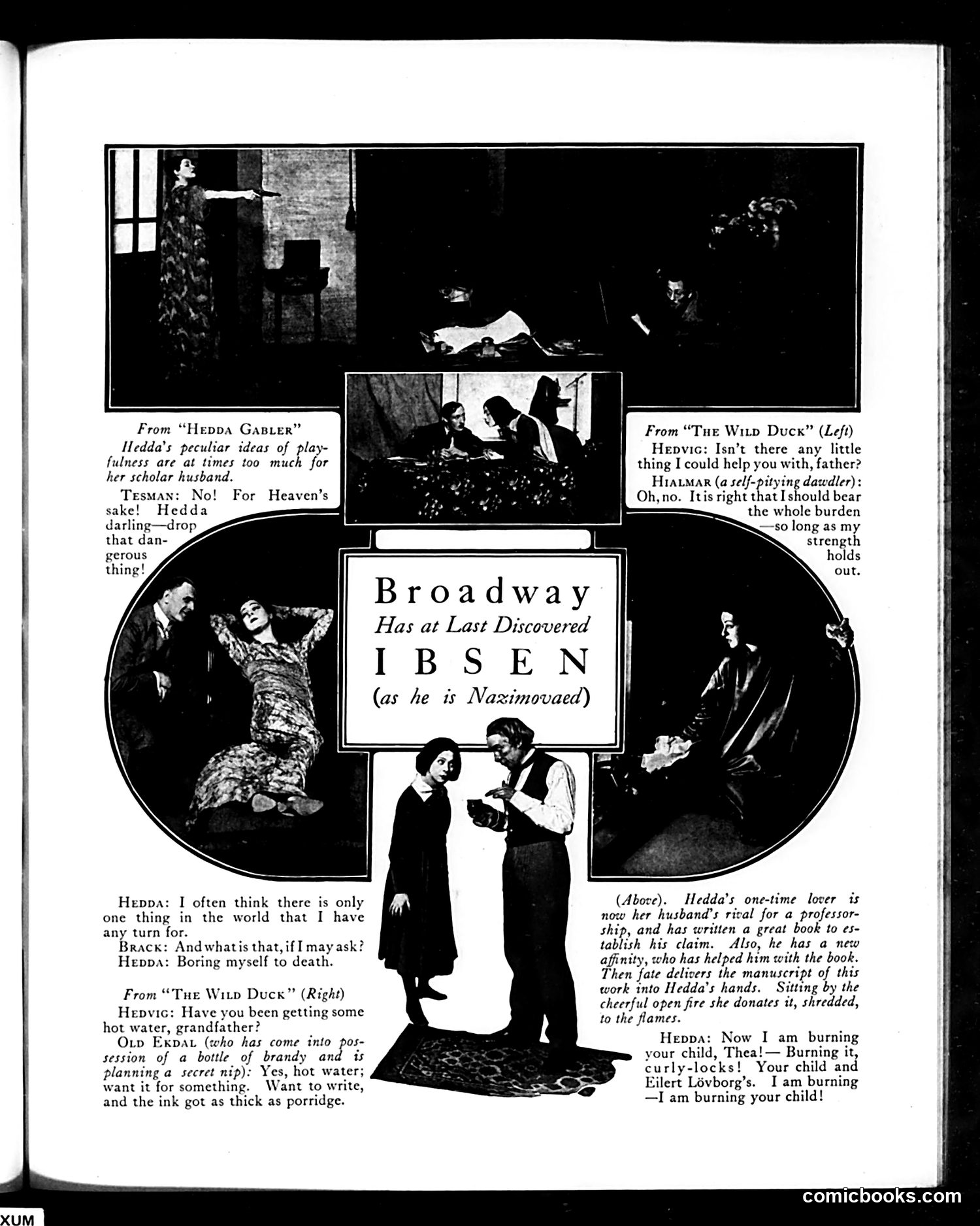
This page satirizes Broadway's recent embrace of Henrik Ibsen's plays, featuring scenes from three of his works: *Hedda Gabler*, *The Wild Duck*, and an unnamed third play. The humor targets both Ibsen's themes—psychological torment, moral compromise, domestic dysfunction—and the theatrical world's sudden fashionability of his dark, introspective Nordic drama. The captions quote key moments showing Ibsen's characters as neurotic and self-absorbed: Hedda admitting she only enjoys "boring myself to death," a character planning secret drinking, another wallowing in self-pity. The satirical point appears to be that Broadway has discovered Ibsen as trendy entertainment, with the parenthetical "(as he is Nazimovaed)" suggesting the plays are being performed by actress Alla Nazimova, making serious psychological drama into fashionable spectacle for audiences seeking artistic sophistication.
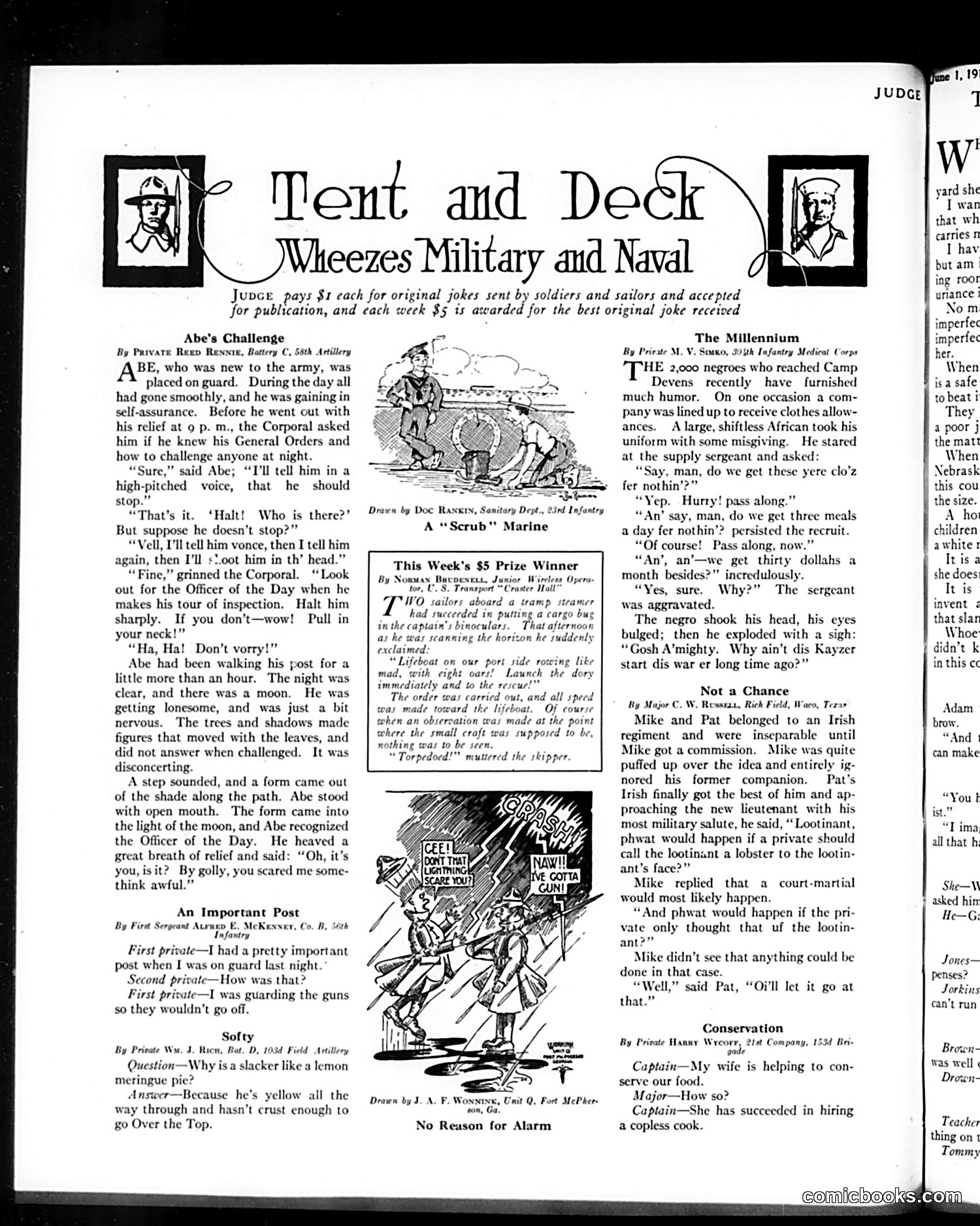
This page from *Judge* magazine features humorous contributions from soldiers and sailors during World War I, paying $1 per joke and $5 for the best weekly submission. **"Abe's Challenge"**: A greenhorn soldier with a heavy accent is instructed on guard duty procedures, specifically how to challenge approaching figures. The humor derives from his literal-minded, overly aggressive interpretation—he'll shoot anyone who doesn't stop immediately. When the Officer of the Day approaches, Abe freezes in panic rather than executing his instructions, revealing his actual incompetence. **"A Scrub Marine"**: Two sailors prank their captain by placing a cargo bug in his binoculars, causing him to see imaginary rescues and order a pointless rescue mission. The joke targets gullible authority. **"The Millennium"**: A newly-arrived Black soldier receives clothing, meals, and pay at Camp Devens with shock and gratitude, leading him to exclaim that Kaiser Wilhelm should have started the war sooner. The "joke" relies on a racist stereotype of African Americans as simple-minded and easily amazed by basic provisions—reflecting deeply offensive period attitudes toward Black soldiers. These jokes reveal both wartime humor and the era's pervasive racism.
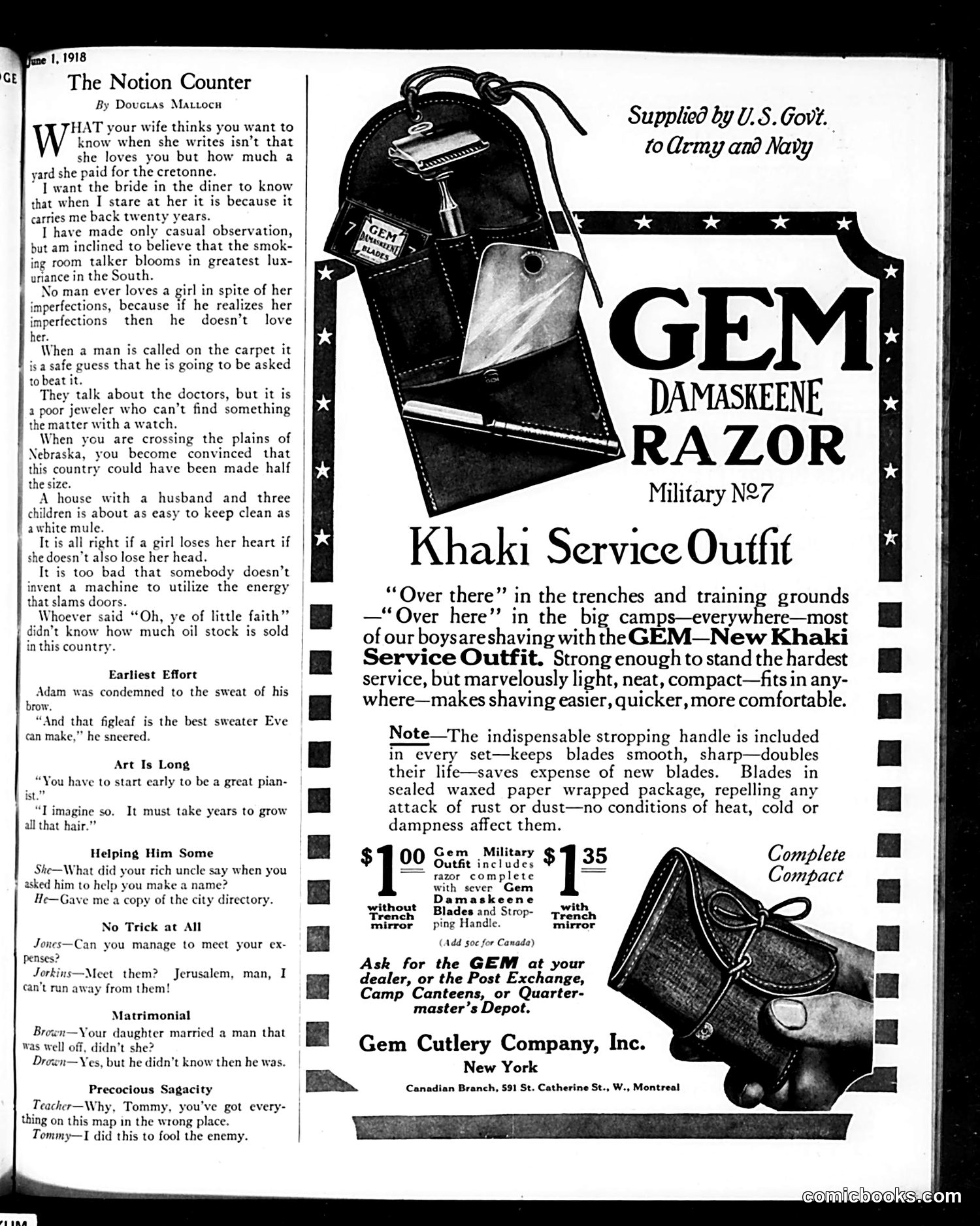
This page contains two distinct elements: satirical humor columns and wartime advertising. **"The Notion Counter" Column** presents cynical observations about marriage, human nature, and American society. Authored by Douglas Malloch, brief jokes mock matrimony (husbands inconvenience wives), materialism (women care about fabric costs), and American expansion (Nebraska is wastefully large). These are light domestic satire typical of early 20th-century humor magazines. **The Primary Content**: A full-page GEM Razor advertisement explicitly marketed to U.S. military forces ("Supplied by U.S. Govt. to Army and Navy"). The ad emphasizes shaving's practical importance for soldiers "Over there" in trenches and training camps. The razor is presented as durable, compact, and convenient for military conditions. **Historical Context**: Published June 1918, during World War I's final year, this reflects American soldiers' needs abroad. The ad explicitly targets military distribution through post exchanges and quartermaster depots, making this a direct government-endorsed military advertisement within the magazine's pages.
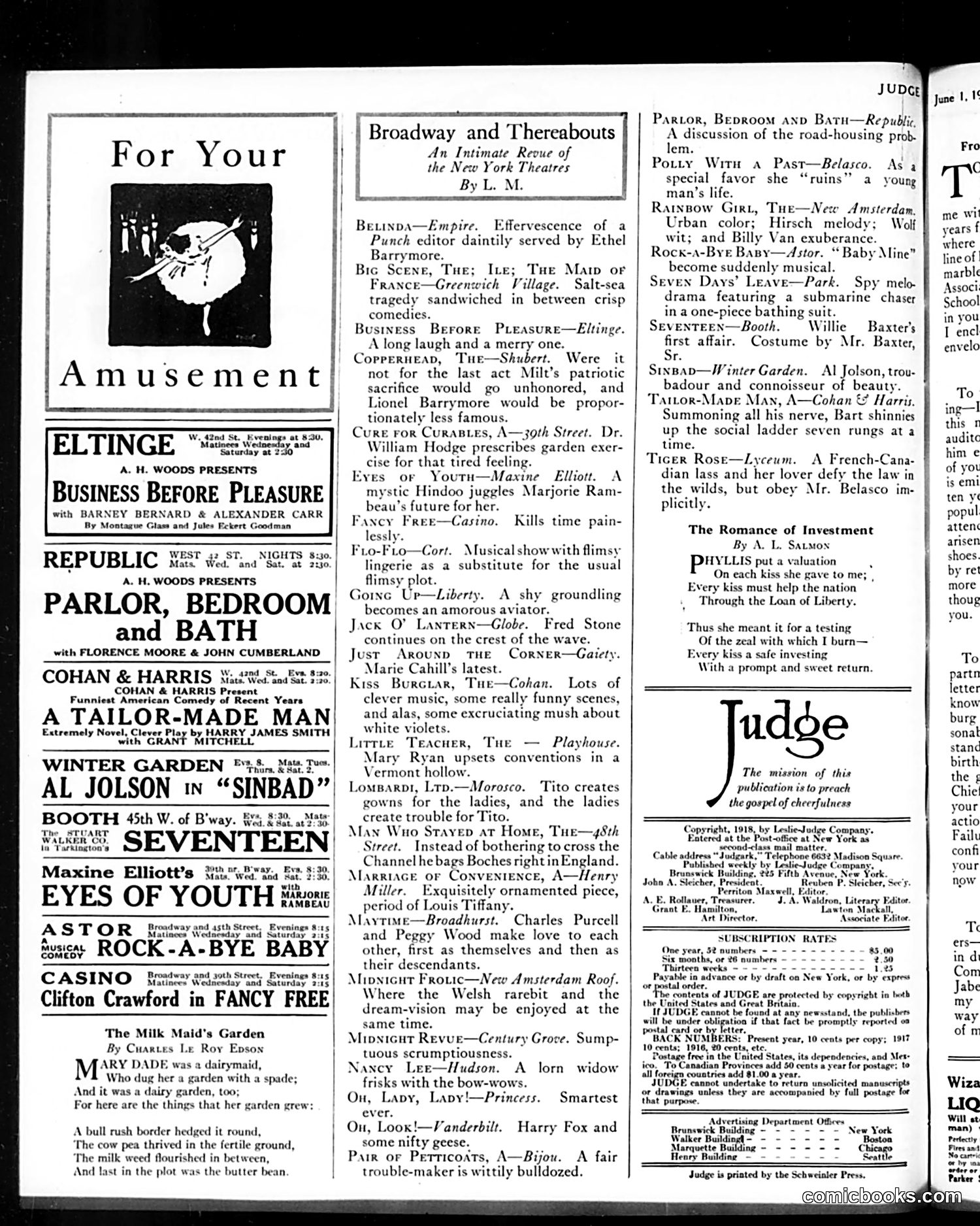
This page is primarily **theatrical advertising and reviews** from Judge magazine (dated June 1, 1918). The small cartoon in the upper left corner titled "For Your Amusement" appears to show silhouetted figures in an intimate moment—likely a visual gag about theater-going or romance, though details are unclear from the image quality. The bulk of the page comprises Broadway theater listings and brief critical reviews by "L.M." These mock various 1918 productions with witty one-liners. For example, *Flo-Flo* is criticized for having "flimsy lingerie as a substitute for the usual flimsy plot," and *The Kiss Burglar* is noted for "some really funny scenes, and alas, some excruciating mush about white violets." The satirical humor relies on theater-goers' familiarity with these productions and performers (Ethel Barrymore, Al Jolson, Marie Cahill). The reviews mock predictable plots, overwrought sentimentality, and tired theatrical conventions—standard satirical fare for a humor magazine targeting educated urban audiences during WWI-era Broadway's heyday.
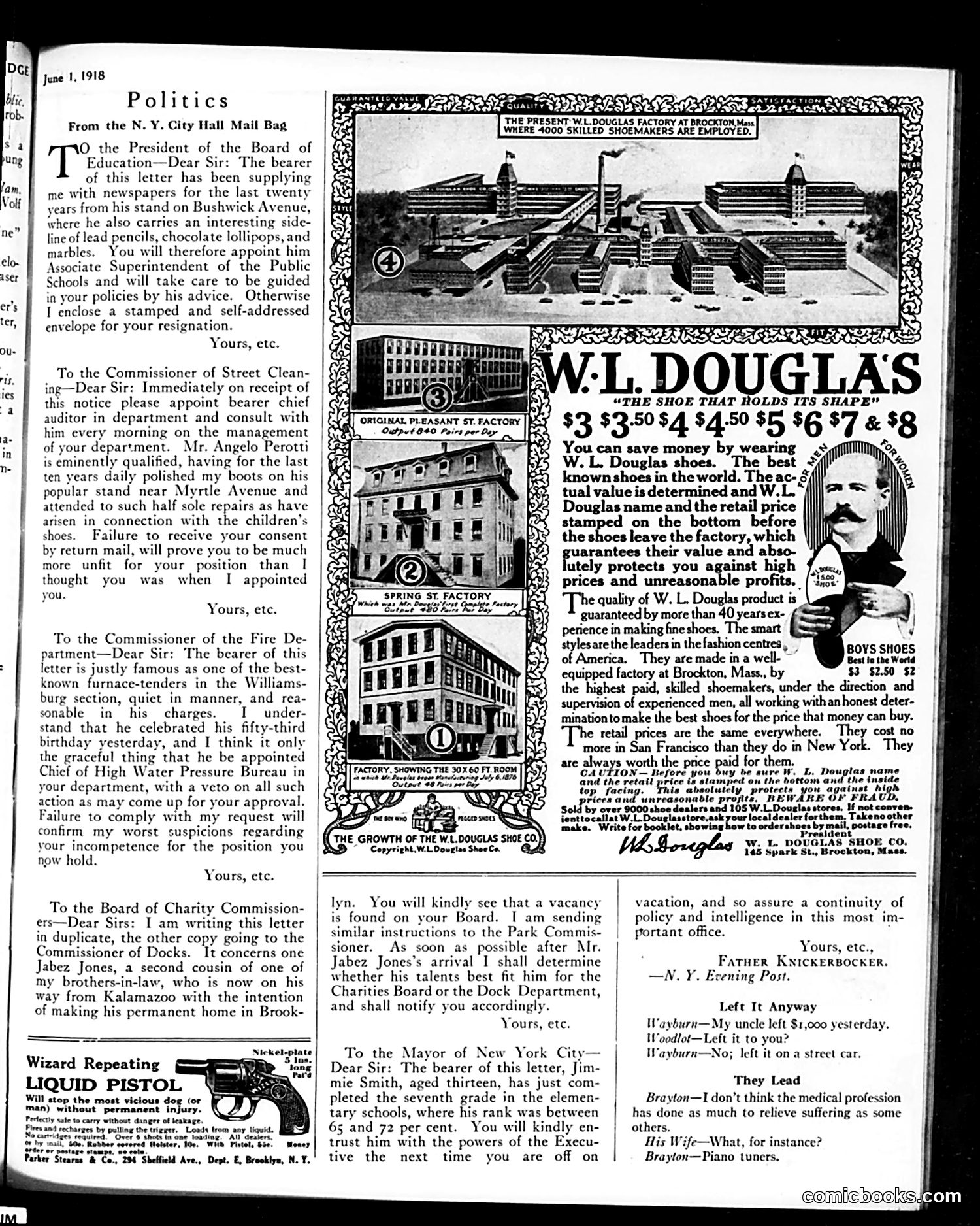
This is satirical commentary on political patronage and corruption in early-20th-century New York City government. The cartoon presents fictional letters supposedly sent to various city officials—the Board of Education, Commissioner of Street Cleaning, Fire Department, and Board of Charity Commissioners. Each letter humorously demands that unqualified individuals be appointed to prestigious positions based solely on personal connections: a newspaper vendor becomes Associate Superintendent of Schools, a bootblack becomes chief auditor, a furnace-tender becomes Chief of High Water Pressure Bureau. The writers threaten resignation if demands aren't met. The satire targets the widespread practice of political appointments made through patronage networks rather than merit. It mocks how ordinary citizens expected to leverage personal relationships to secure plum government jobs for themselves or associates—a common complaint about machine politics and Tammany Hall-style corruption in that era. The exaggeration emphasizes how absurd (yet commonplace) such arrangements actually were.
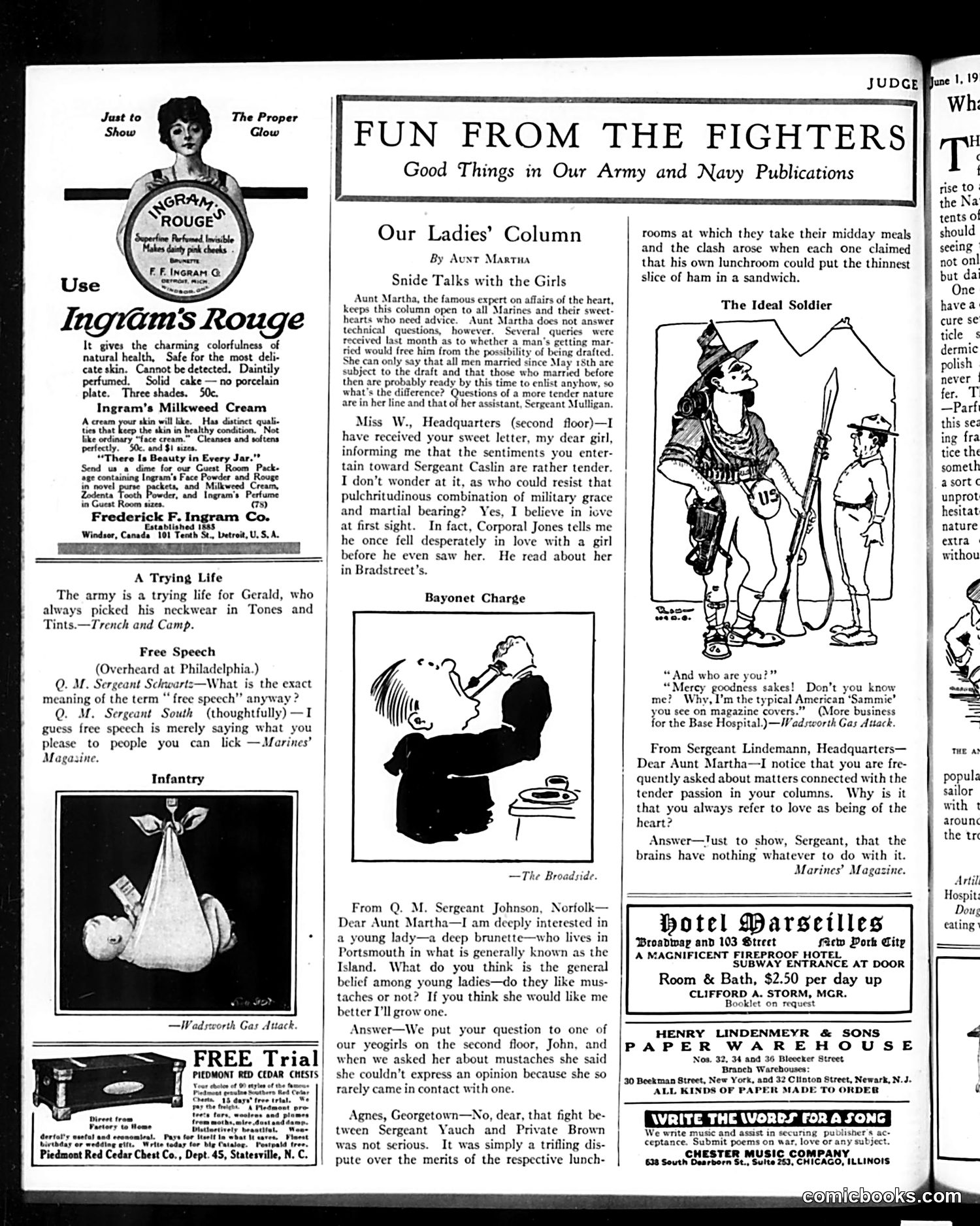
This is a page primarily featuring "Our Ladies' Column," a humor section written by "Aunt Martha" offering advice to soldiers and sailors, particularly about romantic matters. The content reflects WWI-era military life. **Key elements:** The **Bayonet Charge cartoon** shows a soldier proposing to a woman, illustrating one of the column's jokes about military romance. **The satire:** - The column humorously portrays soldiers' naive romantic expectations—one Marine admits he fell in love with a girl before even seeing her, based on reading about her in a business directory - Questions from servicemen reveal stereotypical concerns (should I grow a mustache? do girls prefer mustaches?) answered with gentle mockery - A joke depicts officers arguing not about military matters but about whose lunchroom serves thinner ham sandwiches—satirizing the absurdity of peacetime military hierarchy during wartime **"The Ideal Soldier" cartoon** at right appears to show a boastful figure claiming to be the "typical American 'Sammie'" (American soldier slang), likely mocking overly romanticized portrayals of soldiers in propaganda. The page is mostly advertisements for cosmetics and home furnishings.
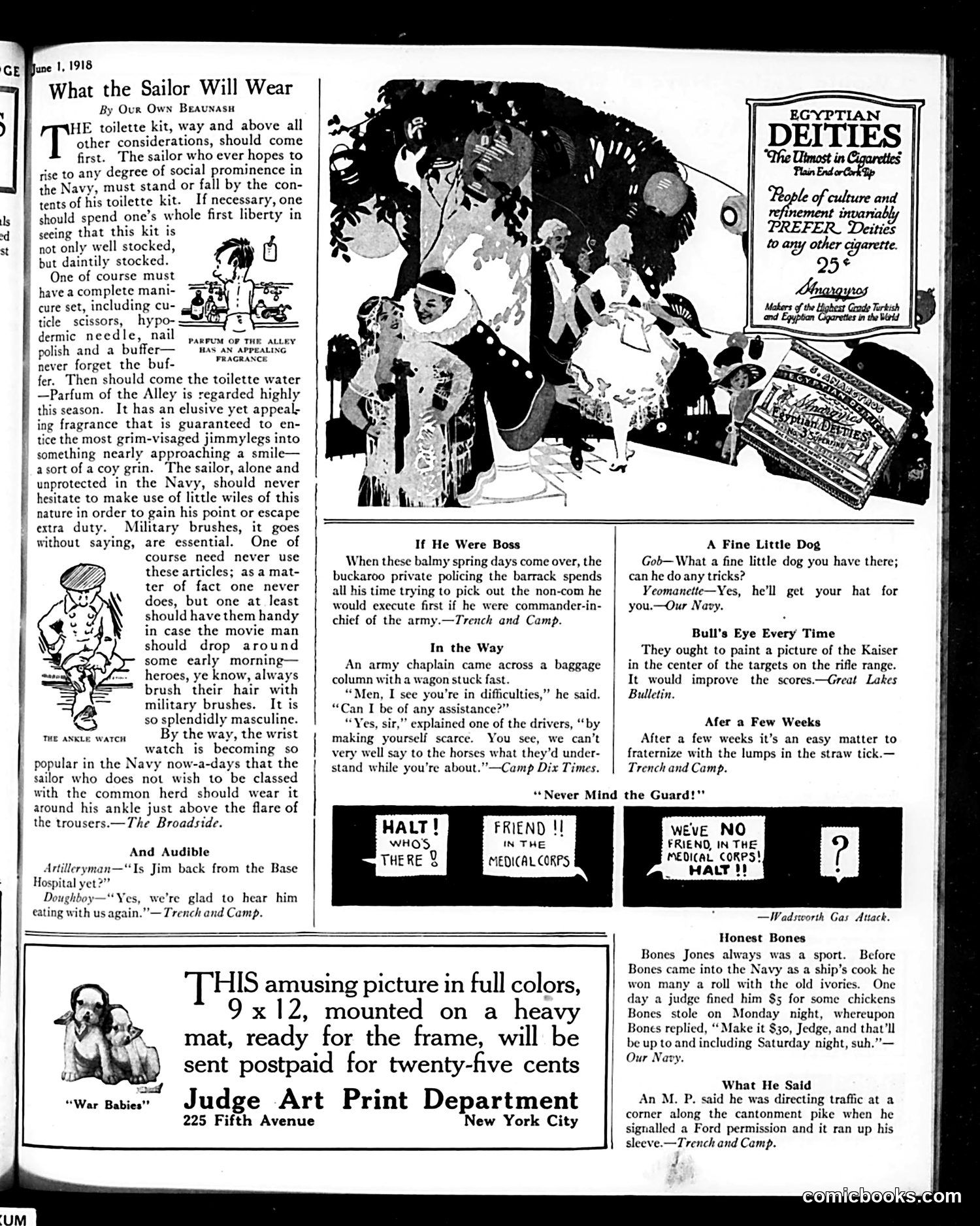
This page satirizes naval and military life during World War I through humor columns and comic strips. The main article, "What the Sailor Will Wear," mocks enlisted sailors' obsession with grooming and personal appearance as a path to advancement, suggesting they use perfume ("Parfum of the Alley") and manicure sets to curry favor with officers—a jab at vanity and the absurdity of military hierarchy. The comic strips below ridicule military life: soldiers fantasizing about executing unpopular officers; chaplains being unwanted nuisances; soldiers joking about fraternizing with vermin in straw bedding. One panel shows medical corps personnel refusing to help—likely referencing inter-unit tensions. The humor consistently targets the gap between military dignity and soldiers' actual experiences: discomfort, resentment of authority, and survival strategies. These pieces reflect wartime soldier morale and the irreverent attitude expressed in military humor publications like *Trench and Camp* (cited multiple times).
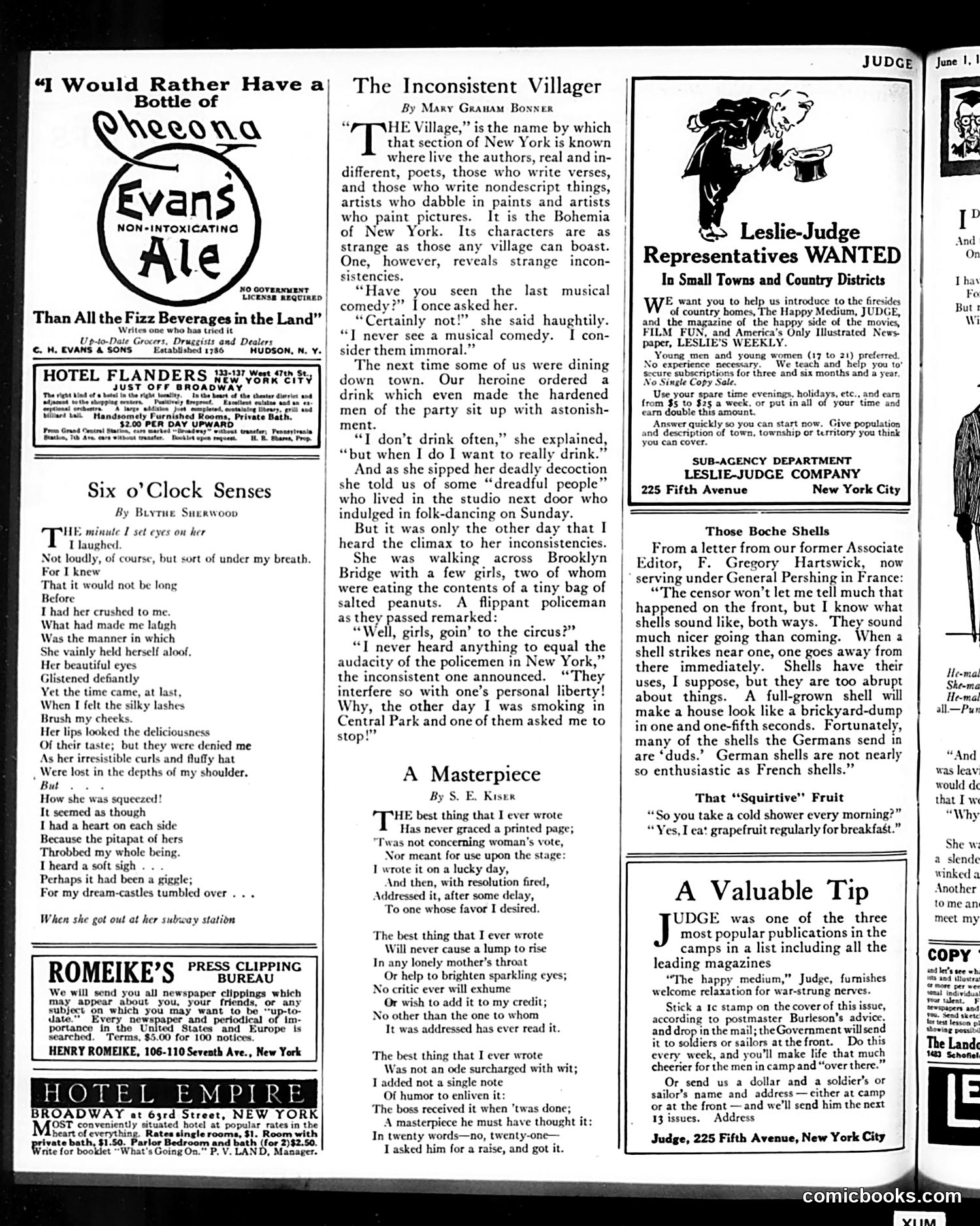
This page from *Judge* magazine (appears to be from June 1, likely 1917 based on WWI reference) contains several distinct elements: **The "Inconsistent Villager" story** satirizes Greenwich Village bohemians—artists, writers, and intellectuals living in New York's Village neighborhood. The satire targets a woman who claims moral superiority (refuses musical comedies as "immoral," criticizes "folk-dancing") yet drinks heavily, smokes in parks, and contradicts herself. The joke is that Village residents who posed as enlightened free-thinkers were often hypocritical and self-righteous. **The advertisements** promote non-alcoholic beer (pre-Prohibition era), hotels, and recruitment for magazine subscriptions. **A minor reference** mentions German artillery shells ("Boche Shells"), indicating WWI context. The page's humor relies on exposing the pretentiousness of 1910s bohemian culture—mocking people who adopted artistic, moralistic personas while engaging in the opposite behavior.
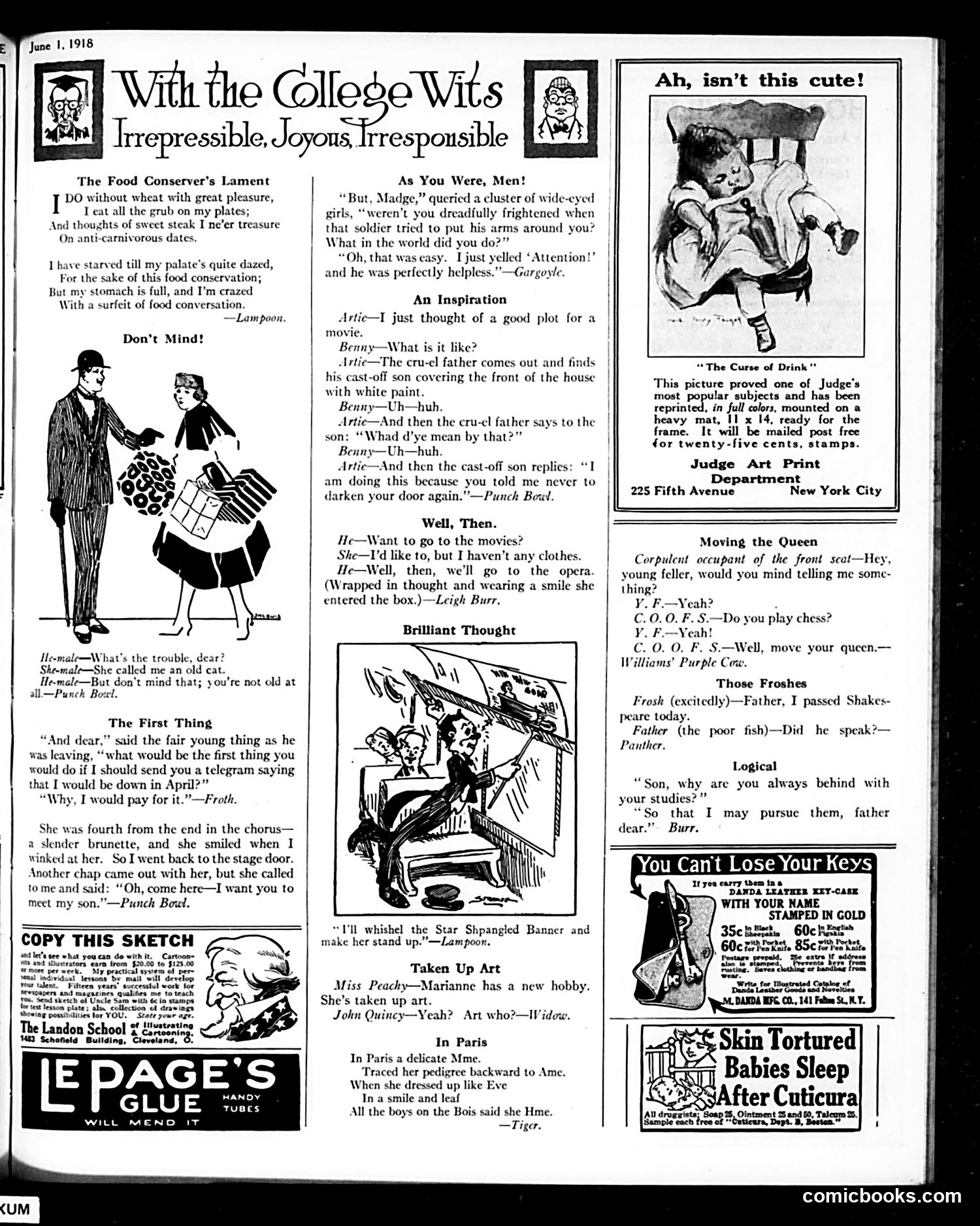
This page collects humorous short jokes and comic sketches from college humor magazines (Harvard's Lampoon, Yale's Record, etc.), reprinted for Judge's readers. The humor targets typical college and young-adult situations: romantic misunderstandings, flirtation, domestic squabbles, and generational conflict. Key jokes include: a soldier discouraged by a woman yelling "Attention!"; a father confused when his son calls him "the poor fish"; and a student explaining he stays behind in studies *to pursue* them. The cartoons depict dating scenarios and social awkwardness. The page also advertises Judge's "Art Print Department" offering a popular image called "The Curse of Drink" (showing a child, visible in the sketch), reflecting Progressive-Era moral concerns about alcohol. One advertisement recruits cartoonists for newspapers, indicating cartooning as a viable profession. The overall tone is lighthearted satire of young people navigating romance and family expectations during WWI (note the soldier reference).
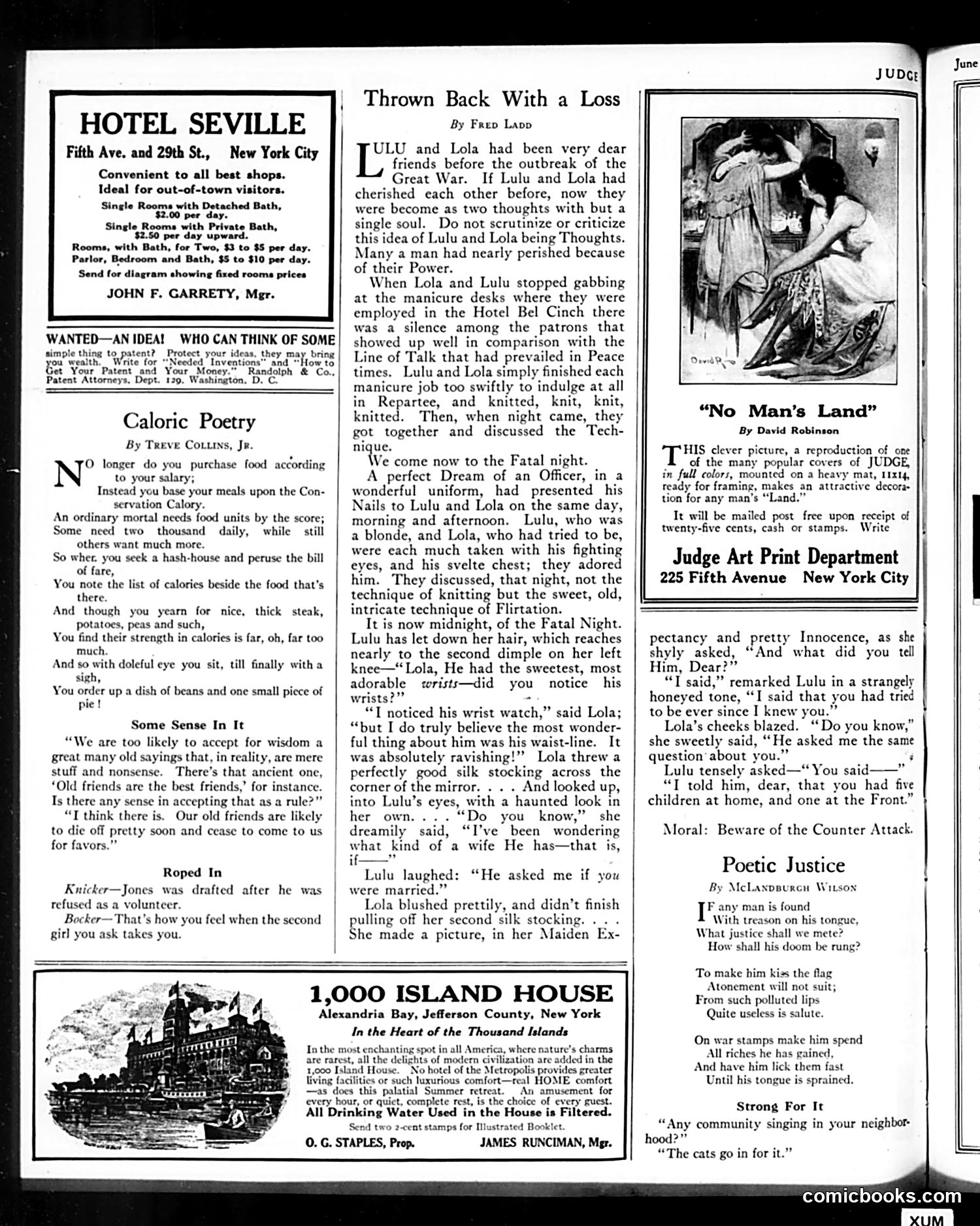
This WWI-era story satirizes how romantic rivalries persist even during wartime. Two close female friends, Lulu and Lola, work as manicurists at a fancy hotel. During peacetime they were inseparable; during the Great War, they knit together silently for the war effort, sublimating their personalities. When a charming military officer visits for manicures, both women become infatuated with him. Rather than supporting each other, they compete—Lolu praising his "adorable wrists," Lola his "ravishing waist-line." The satire mocks how supposedly patriotic women abandon solidarity to pursue romantic attraction, and how even in serious times (wartime), petty jealousy and vanity override nobler impulses. The title suggests their friendship will be "thrown back"—lost—because of this romantic competition.
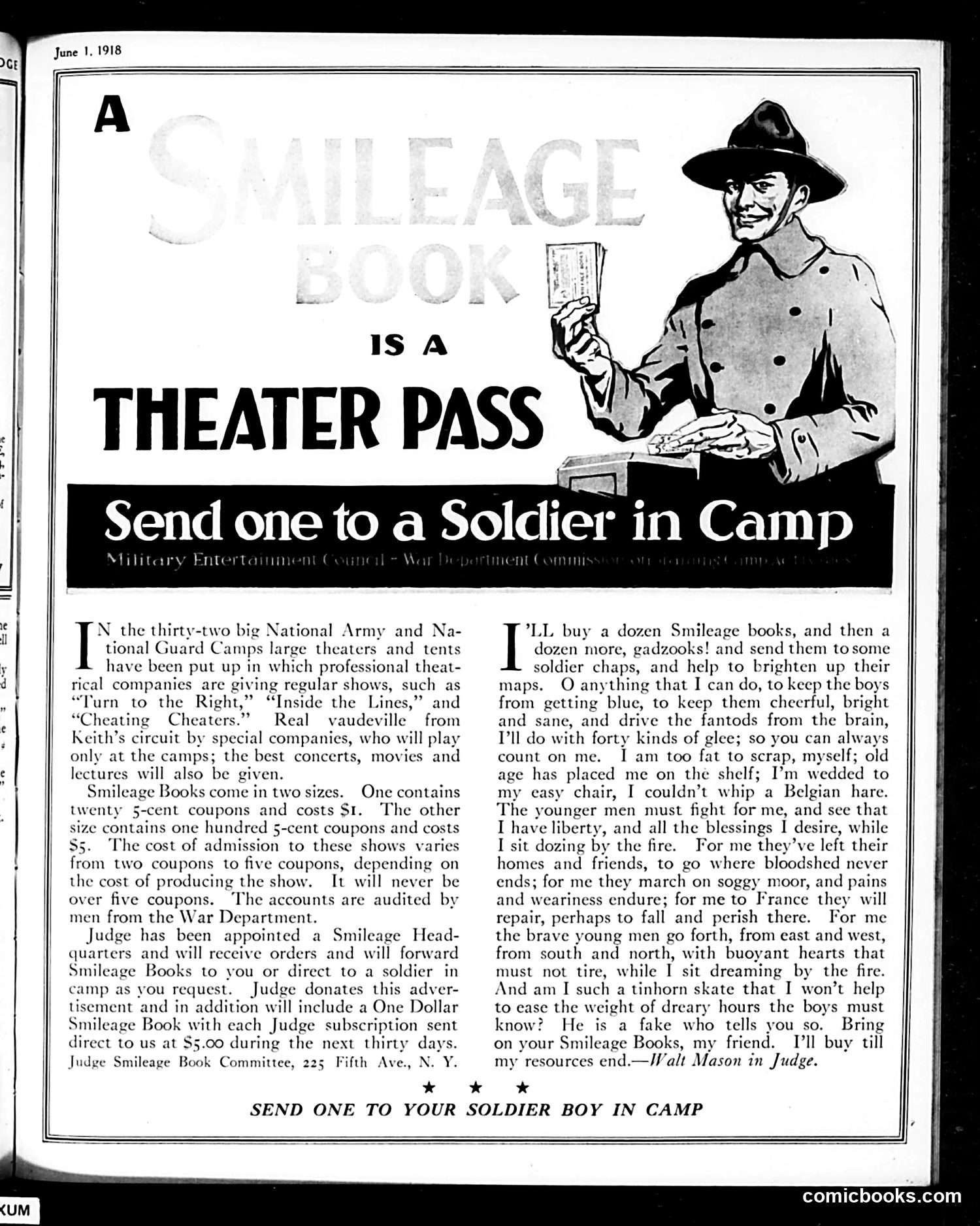
This is a **fundraising advertisement**, not satire. Published June 1, 1918 (during WWI), it promotes "Smileage Books"—coupon booklets that provided theater passes for soldiers in military camps. The illustration shows a cheerful man in a cowboy hat holding a pass, encouraging civilians to purchase these books. The accompanying poem by "Walt Mason" (a real Judge contributor) shames older men like himself who cannot fight in France, urging them to instead buy Smileage Books to entertain troops. The poem's self-deprecating tone—"I am too fat to scrap...I'm wedded to my easy chair"—motivates readers through guilt: if you can't serve militarily, at least support soldiers' morale. The actual satire is **implicit**: the poem gently mocks civilian reluctance to contribute while younger men sacrifice their lives. Two book sizes were offered ($1 and $5), with Judge magazine itself distributing them as a patriotic service during wartime.
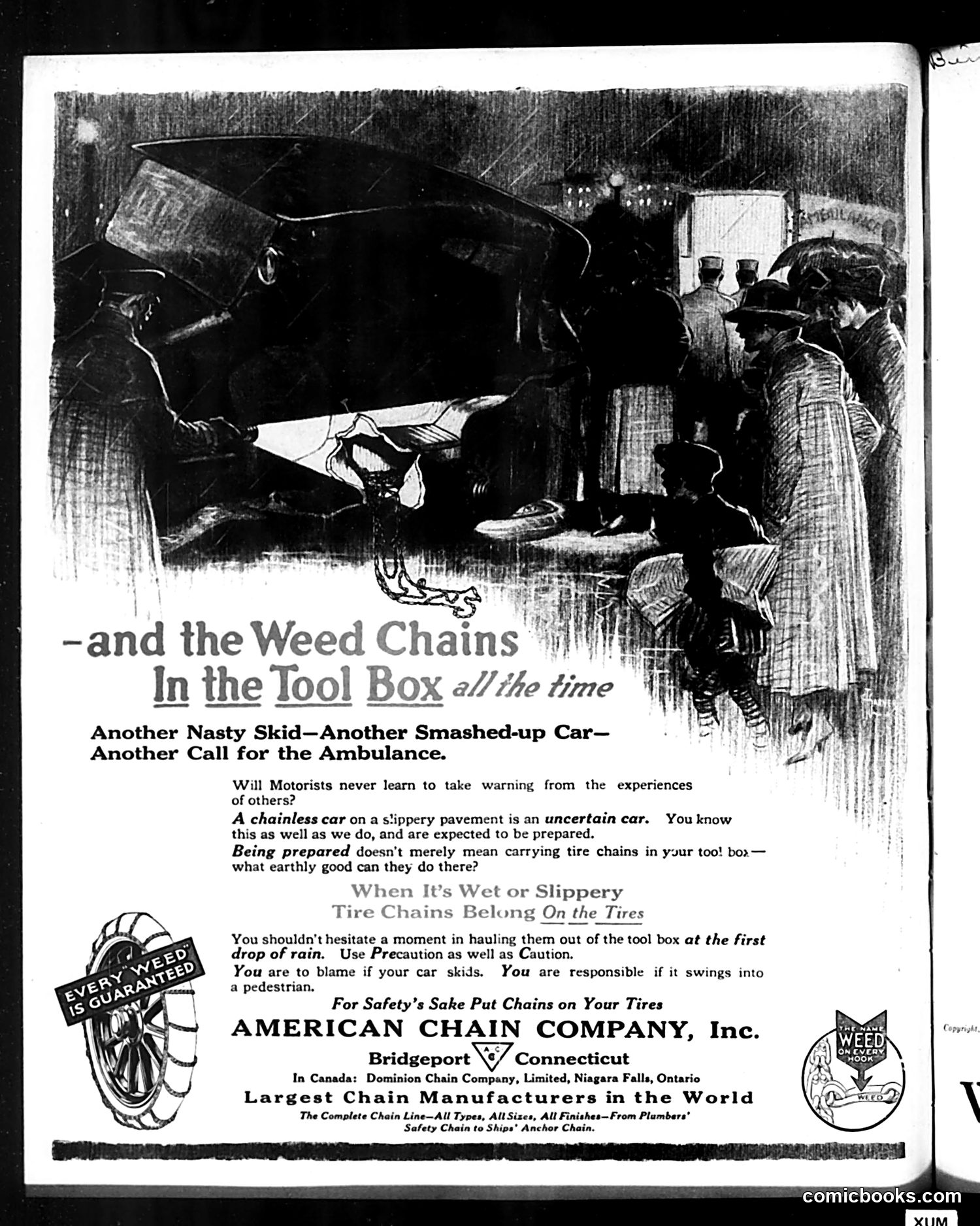
This is primarily a **safety advertisement** for tire chains, not political satire. The illustration depicts a car accident scene with an ambulance being called, establishing the danger premise. The "satire" here is directed at **motorists themselves**, not political figures. The ad argues that drivers who fail to install tire chains during wet weather are responsible for accidents—both for their own safety and for potentially hitting pedestrians. The headline "and the Weed Chains In the Tool Box all the time" sarcastically suggests that chains sitting unused in a toolbox are worthless. The moral message is direct: **drivers bear responsibility for road safety**. Installing chains isn't optional caution—it's a legal and ethical obligation. This reflects early automotive-era attitudes about motorist accountability and public safety. The "Everyweed is Guaranteed" seal suggests American Chain Company's quality branding. This appears to be vintage advertising (likely 1920s-30s based on car and typography style), when tire chains were standard winter equipment.