
Judge, 1918-06-01 · page 10 of 36
Judge — June 1, 1918 — page 10: what you’re looking at
A restored page from Judge, 1918-06-01. Page through the whole issue in the reader above.
📄 Transcribed text from this page (OCR, searchable)
Machine-transcribed from the original scan — historical spelling and the odd misread are preserved.
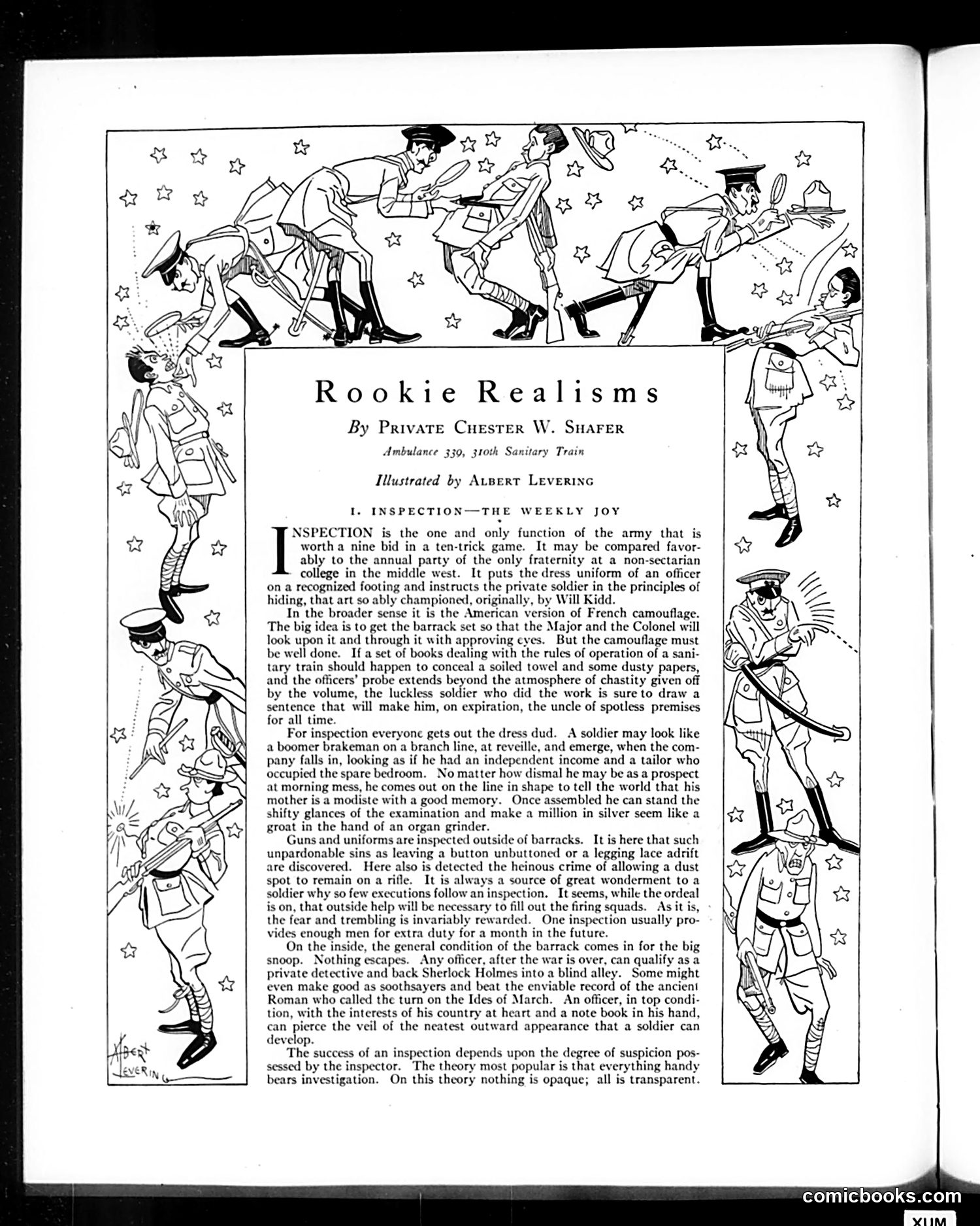
Rookie Realisms By Private Cuester W. SHAFER Ambulance 330, 310th Sanitary Train Illustrated by AvBeRT LEVERING I. INSPECTION—THE WEEKLY JOY NSPECTION is the one and only function of the army that is worth a nine bid in a ten-trick game. It may be compared favor- ably to the annual party of the only fraternity at a non-sectarian college in the middle west. It puts the dress uniform of an officer on a recognized footing and instructs the private soldier in the principles of hiding, that art so ably championed, originally, by Will Kidd. In the broader sense it is the American version of French camouflage. The big idea is to get the barrack set so that the Major and the Colonel will look upon it and through it with approving cy But the camouflage must be well done. If a set of books dealing with the rules of operation of a sani- tary train should happen to conceal a soiled towel and some dusty papers, and the officers’ probe extends beyond the atmosphere of chastity given off by the volume, the luckless soldier who did the work is sure to draw a sentence that will make him, on expiration, the uncle of spotless premises for all time. For inspection everyone gets out the dress dud. A soldier may look like a boomer brakeman on a branch line, at reveille, and emerge, when the com- pany falls in, looking as if he had an independent income and a tailor who occupied the spare bedroom. No matter how dismal he may be as a prospect at morning mess, he comes out on the line in shape to tell the world that his mother is a modiste with a good memory. Once assembled he can stand the shifty glances of the examination and make a million in silver seem like a groat in the hand of an organ grinder. Guns and uniforms are inspected outside of barracks. It is here that such unpardonable sins as leaving a button unbuttoned or a legging lace adrift are discovered. Here also is detected the heinous crime of allowing a dust spot to remain on a rifle. It is always a source of great wonderment to a soldier why so few executions follow an inspection. It seems, while the ordeal is on, that outside help will be necessary to fill out the firing squads. is, the fear and trembling is invariably rewarded. One inspection usually pro- vides enough men for extra duty for a month in the future. On the inside, the general condition of the barrack comes in for the big snoop. Nothing escapes. Any officer, after the war is over, can qualify as a private detective and back Sherlock Holmes into a blind alley. Some might even make good as soothsayers and beat the enviable record of the ancient Roman who called the turn on the Ides of March. An officer, in top condi- tion, with the interests of his country at heart and a note book in his hand, can pierce the veil of the neatest outward appearance that a soldier can develop. The success of an inspection depends upon the degree of suspicion pos- sessed by the inspector. The theory most popular is that everything handy bears investigation. On this theory nothing is opaque; all is transparent. comicbooks.com