
Judge, 1918-06-01 · page 18 of 36
Judge — June 1, 1918 — page 18: what you’re looking at
What you’re looking at
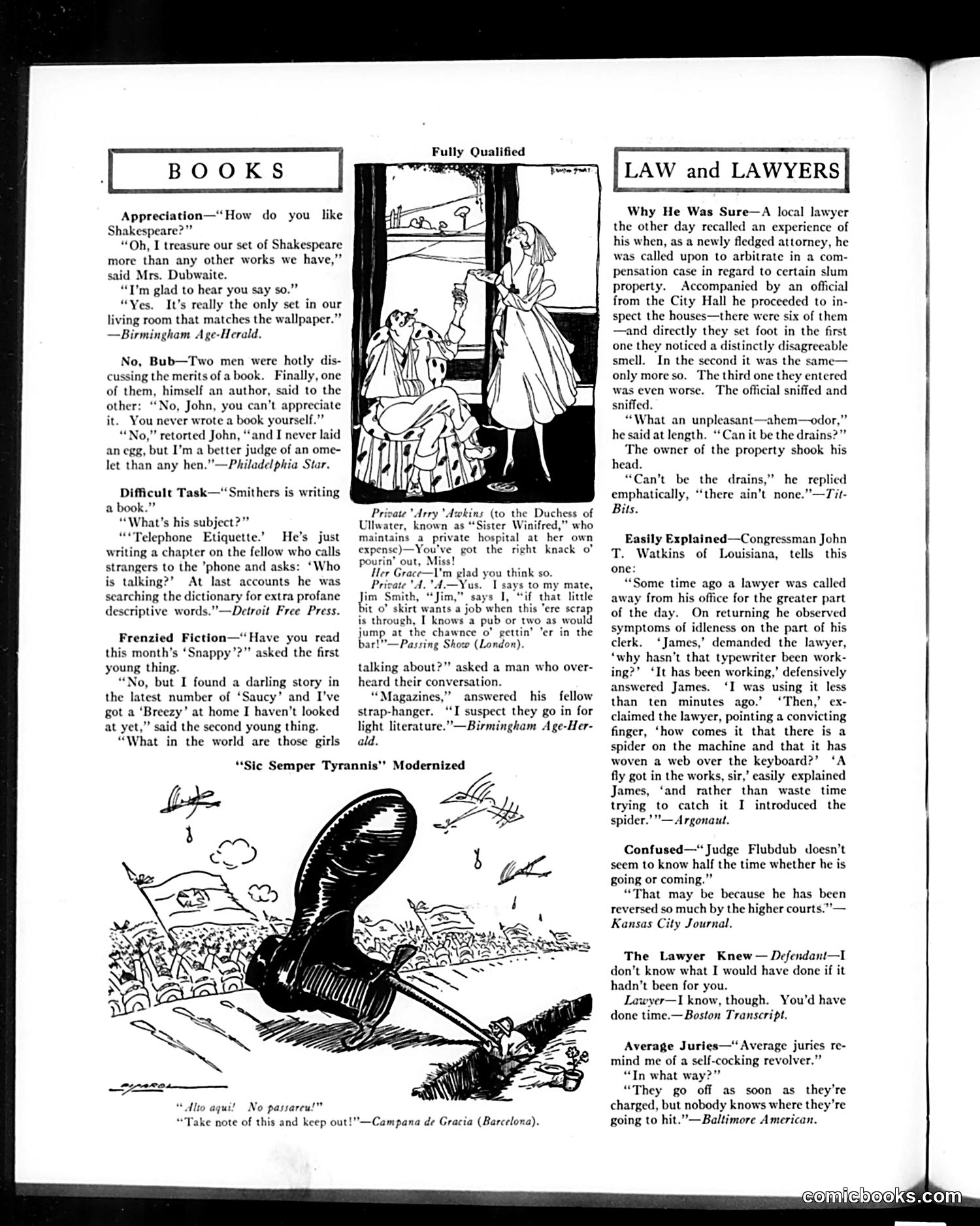
This page from Judge magazine contains humorous anecdotes mocking social pretension and professional incompetence, typical of early-20th-century American satire. The **"Books" section** ridicules cultural affectation: Mrs. Dubwaite values Shakespeare only because it matches her wallpaper—satirizing status-conscious consumers who collect books for decoration rather than reading. The telephone etiquette joke mocks the difficulty of describing rudely intrusive phone calls, requiring "extra profane descriptive words." The **"Law and Lawyers" section** uses anecdotes to highlight professional absurdity: a lawyer arbitrating slum property inspections discovers the buildings have no drains (yet tenants tolerate them); a congressman's clerk explains a spider on a typewriter keyboard by claiming he "introduced the spider" to catch a fly—absurd problem-solving masquerading as logic. The cartoon shows a modernized version of tyranny: what appears to be a pen or quill destroying figures, captioned in Spanish ("Here! No passage!"). This likely satirizes authoritarian control. Overall, the page targets pretentious middle-class values, professional incompetence, and absurd social conventions through everyday scenarios.
📄 Transcribed text from this page (OCR, searchable)
Machine-transcribed from the original scan — historical spelling and the odd misread are preserved.
. BOOKS Appreciation—‘How do you like Shakespeare?” “Oh, I treasure our set of Shakespeare more than any other works we have,” said Mrs. Dubwaite. ‘m glad to hear you say so.” “Yes. It’s really the only set in our living room that matches the wallpaper.” —Birmingham Age-Herald. No, Bub—Two men were hotly dis- cussing the merits of a book. Finally, one of them, himself an author, said to the other: ‘No, John, you can’t appreciate it. You never wrote a book yourself.” “No,” retorted John, “and I never laid an egg, but I’m a better judge of an ome- let than any hen.”—Philadelphia Star, Difficult Task—“ Smithers is writing a book.” “What’s his subject?” “*Telephone Etiquette.’ He's just writing a chapter on the fellow who calls strangers to the ‘phone and asks: ‘Who is talking?’ At last accounts he was searching the dictionary for extra profane descriptive words.”"—Detroit Free Press. Frenzied Fiction this month’s ‘Snappy young thing. “No, but I found a darling story in the latest number of ‘Saucy’ and I’ve got a ‘Breezy’ at home I haven't looked at yet,” said the second young thing. “What in the world are those girls “Have you read ” asked the first ully Qualified cate "Ary 'dwkins (to the Duchess of Ullwater, known as “Sister Winifred,” who maintains a private hospital at her own expense)—You've got the right knack o° pourin’ out, Mi Her Grace—I'm her ores ad you think so. us. I says to my mate, Smith, “Jim,” says I, “if that little o” skirt wants a job when this ‘ere scrap is through, I knows a pub or two as would jump at the chawnce o° gettin’ ‘er in the bar!” —Passing Show (London). talking about?” asked a man who over- heard their conversation. “Magazines,” answered his fellow strap-hanger. “I suspect they go in for light literature.” —Birmingham A ge-Her- ald. “Sic Semper Tyrannis"’ Modernized 22204 “Alto aqui! No passareu!” “Take note of this and keep out!""—Campana de Gracia (Barcelona). Why He Was Sure—A local lawyer the other day recalled an experience of his when, as a newly fledged attorney, he was called upon to arbitrate in a com- pensation case in regard to certain slum property. Accompanied by an official from the City Hall he proceeded to in- spect the houses—there were six of them —and directly they set foot in the first one they noticed a distinctly disagreeable smell. In the second it was the same— only more so. The third one they entered was even worse. The official sniffed and sniffed. “What an unpleasant—ahem—odor, he said at length. “Can it be the drains: The owner of the property shook his head. “Can't be the drains,” he replied emphatically, ‘there ain’t none.”—Tit- Bits. Easily Explained—Congressman John T. Watkins of Louisiana, tells this one: “Some time ago a lawyer was called away from his office for the greater part of the day. On returning he observed symptoms of idleness on the part of his clerk. ‘James,’ demanded the lawyer, ‘why hasn't that typewriter been work- ing?’ ‘It has been working,’ defensively answered James. ‘I was using it less than ten minutes ago.’ ‘Then,’ ex- claimed the lawyer, pointing a convicting finger, ‘how comes it that there is a spider on the machine and that it has woven a web over the keyboard?’ ‘A fly got in the works, sir,’ easily explained James, ‘and rather than waste time trying to catch it I introduced the spider.’ —Argonaut. Confused—“ Judge Flubdub doesn’t seem to know half the time whether he is going or coming.” “That may be because he has been reversed so much by the higher courts.” — Kansas City Journal. The Lawyer Knew — Defendant—I don’t know what I would have done if it hadn’t been for you. Lawyer—I know, though. You'd have done time.—Boston Transcript. Average Juries—‘ Average juries re- mind me of a self-cocking revolver.” “In what way?” “They go off as soon as they’re charged, but nobody knows where they’re going to hit.”—Baltimore American.