
Judge, 1918-06-01 · page 7 of 36
Judge — June 1, 1918 — page 7: what you’re looking at
What you’re looking at
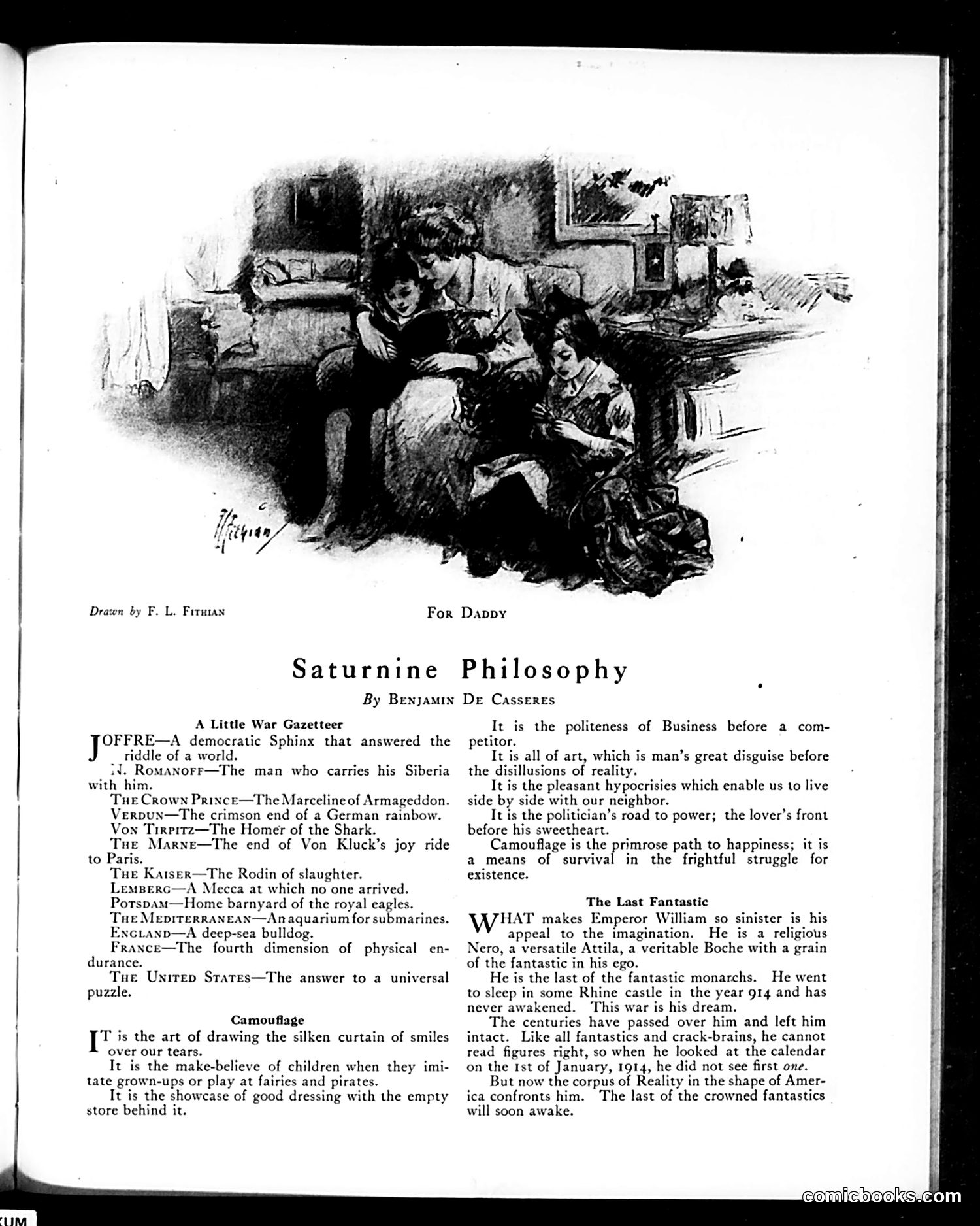
This WWI-era satirical page targets German leadership through darkly humorous definitions. The "Little War Gazetteer" mocks key figures: the Kaiser (Wilhelm II, depicted as "Rodin of slaughter"), Crown Prince Wilhelm ("Marcelino of Armageddon"), and Von Tirpitz (German admiral, "Homer of the Shark"). References like "the Marne" mock Von Kluck's failed march on Paris. The main essay, "The Last Fantastic," directly attacks Kaiser Wilhelm II, characterizing him as a delusional medieval monarch who sleeps through centuries, unable to read reality—literally misreading 1914's calendar. The satire suggests his war ambitions are fantasies detached from actual power and consequences. The implication is that America's entry into the war represents harsh "Reality" awakening this dreaming autocrat. The accompanying illustration appears to show a domestic family scene, likely contrasting innocent home life with the article's wartime political critique.
📄 Transcribed text from this page (OCR, searchable)
Machine-transcribed from the original scan — historical spelling and the odd misread are preserved.
rlIAA Drawn by F. L. Firman For Dappy Saturnine Philosophy By Benjamin De Casseres A Little War Gazetteer OFFRE—A democratic Sphinx that answered the riddle of a world. iY. Romanorr—The man who carries his Siberia with him. ‘Tue Crown Prince—The Marcelineof Armageddon. Verpun—The crimson end of a German rainbow. Von Tirpitz—The Homer of the Shark. Tue Marne—The end of Von Kluck’s joy ride to Paris. Tue Katser—The Rodin of slaughter. Le MBERG—A Mecca at which no one arrived. —Home barnyard of the royal eagles. TeDITERRANEAN—/ Anaquarium for submarines. —A deep-sea bulldog. Fe ANcE—The fourth dimension of physical en- durance. Tue Uniteo Stares—The answer to a universal puzzle. Camouflage I" is the art of drawing the silken curtain of smiles over our tears. It is the make-believe of children when they imi- tate grown-ups or play at fairies and pirates. It is the showcase of good dressing with the empty store behind it. It is the politeness of Business before a com- petitor. It is all of art, which is man’s great disguise before the disillusions of reality. It is the pleasant hypocrisies which enable us to live side by side with our neighbor. It is the politician’s road to power; the lover’s front before his sweetheart. Camouflage is the primrose path to happiness; it is a means of survival in the frightful struggle for existence. The Last Fantastic WHat makes Emperor William so sinister is his appeal to the imagination. He is a religious Nero, a versatile Attila, a veritable Boche with a grain of the fantastic in his ego. He is the last of the fantastic monarchs. He went to sleep in some Rhine castle in the year 914 and has never awakened. This war is his dream. The centuries have passed over him and left him intact. Like all fantastics and crack-brains, he cannot read figures right, so when he looked at the calendar on the Ist of January, 1914, he did not see first one. But now the corpus of Reality in the shape of Amer- ica confronts him. The last of the crowned fantastics will soon awake.