
Judge, 1918-06-01 · page 14 of 36
Judge — June 1, 1918 — page 14: what you’re looking at
What you’re looking at
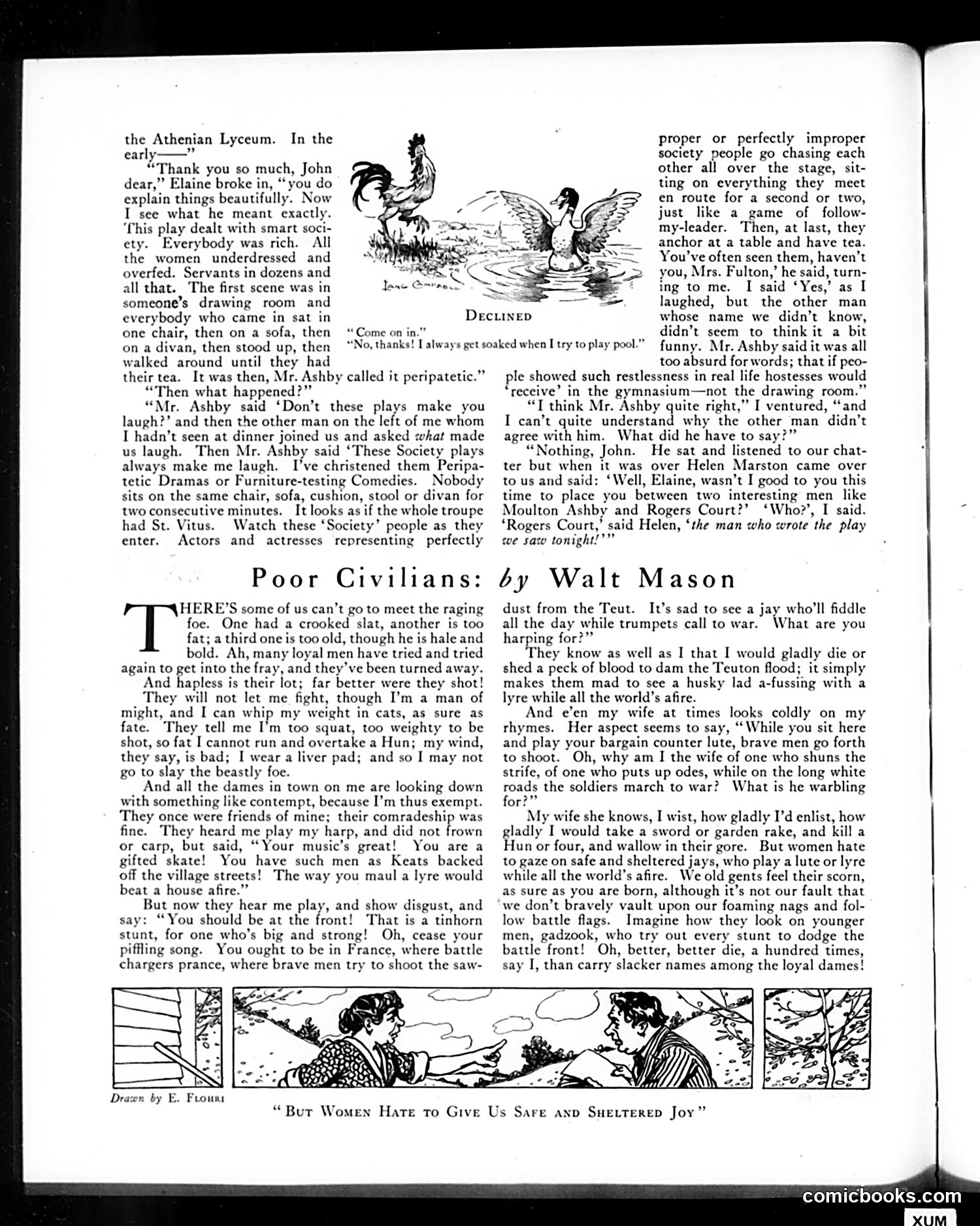
This page contains two distinct pieces of social commentary from the World War I era. **Top Section**: A conversation satirizing theatrical society plays. Characters mock the absurdity of wealthy characters constantly moving between furniture—what they term "Peripatetic Dramas or Furniture-testing Comedies." The satire targets both the shallow plots of fashionable theater and the pretensions of high society it depicts. **Bottom Section ("Poor Civilians")**: Walt Mason's poem mocks men rejected from military service during WWI. The narrator, deemed unfit to fight (too short, too fat, weak), faces social contempt from women who once admired his musical talents. The satire cuts both ways: it ridicules both the arbitrary rejection standards and the women's shame-based pressure on civilians unable to serve. The cartoon illustrations (by E. Fiori) show two figures discussing this social stigma. The overall theme: social expectations and judgment are absurd and contradictory—whether in theatrical fashion or wartime masculine duty.
📄 Transcribed text from this page (OCR, searchable)
Machine-transcribed from the original scan — historical spelling and the odd misread are preserved.
the Athenian Lyceum. In the early——” e “Thank you so much, John dear,” Elaine broke in, “you do explain things beautifully. Now I see what he meant exactly. ‘This play dealt with smart soci- ety. Everybody was rich. All the women underdressed and overfed. Servants in dozens and all that. The first scene was in someone’s drawing room and everybody who came in sat in one chair, then on a sofa, then on a divan, then stood up, then walked around until they had their tea. It was then, Mr. Ashby called it peripatetic.” “Then what happened?” “Mr. Ashby said ‘Don’t these plays make you laugh?’ and then the other man on the left of me whom I hadn’t seen at dinner joined us and asked «what made us laugh. Then Mr. Ashby said ‘These Society plays always make me laugh. I’ve christened them Peripa- tetic Dramas or Furniture-testing Comedies. Nobody sits on the same chair, sofa, cushion, stool or divan for two consecutive minutes. It looks as if the whole troupe had St. Vitus. Watch these ‘Society’ people as they enter. Actors and actresses representing perfectly “Come on in.” Poor Civilians: HERE’S some of us can’t go to meet the raging foe. One had a crooked slat, another is too fat; a third one is too old, though he is hale and bold. Ah, many loyal men have tried and tried again to get into the fray, and they’ve been turned away. And hapless is their lot; far better were they shot! They will not let me fight, though I’m a man of might, and I can whip my weight in cats, as sure as fate. They tell me I’m too squat, too weighty to be shot, so fat I cannot run and overtake a Hun; my wind, they say, is bad; I wear a liver pad; and so I may not go to slay the beastly foe. And all the dames in town on me are looking down with something like contempt, because I’m thus exempt. They once were friends of mine; their comradeship was fine. They heard me play my harp, and did not Rowe or carp, but said, “Your music’s great! You are a gifted skate! You have such men as Keats backed off the village streets! The way you maul a lyre would beat a house afire. But now they hear me play, and show disgust, and say: “You should be at the front! That is a tinhorn stunt, for one who's big and strong! Oh, cease your piffling song. You ought to be in France, where battle chargers prance, where brave men try to shoot the saw- Dec.ineD proper or perfectly improper society people go chasing each other all over the stage, sit- ting on everything they meet en route for a second or two, just like a game of follow- my-leader. Then, at last, they anchor at a table and have tea. You've often seen them, haven’t you, Mrs. Fulton,’ he said, turn- ing to me. I said ‘Yes,’ as I laughed, but the other man whose name we didn’t know, didn’t seem to think it a bit “No, thanks! I always get soaked when I try to play pool.” funny. Mr. Ashby said it was all too absurd for words; that if peo- ple showed such restlessness in real life hostesses would ‘receive’ in the gymnasium—not the drawing room.” “T think Mr. Ashby quite right,” I ventured, “and I can’t quite understand why the other man didn’t agree with him. What did he have to say?” “Nothing, John. He sat and listened to our chat- ter but when it was over Helen Marston came over to us and said: ‘Well, Elaine, wasn’t I good to you this time to place you between two interesting men like Moulton Ashby and Rogers Court?’ ‘Who?’, I said. ‘Rogers Court,’ said Helen, ‘the man who wrote the play wwe sate tonight!’” by Walt Mason dust from the Teut. It’s sad to see a jay who'll fiddle all the day while trumpets call to war. What are you harping for?” They know as well as I that I would gladly die or shed a peck of blood to dam the Teuton flood; it simply makes them mad to see a husky lad a-fussing with a lyre while all the world’s afire. And e’en my wife at times looks coldly on my thymes. Her aspect seems to say, “While you sit here and play your bargain counter lute, brave men go forth to shoot. Oh, why am I the wife of one who shuns the strife, of one who puts up odes, while on the long white roads the soldiers march to war? What is he warbling for?” My wife she knows, I wist, how gladly I’d enlist, how gladly I would take a sword or garden rake, and kill a Hun or four, and wallow in their gore. But women hate to gaze on safe and sheltered jays, who play a lute or lyre while all the world’s afire. We old gents feel their scorn, as sure as you are born, although it’s not our fault that we don’t bravely vault upon our foaming nags and fol- low battle flags. Imagine how they look on younger men, gadzook, who try out every stunt to dodge the battle front! Oh, better, better die, a hundred times, say I, than carry slacker names among the loyal dames! Drawn by E. Frourt “But Women Hate to Give Us Sare anp SHELTERED Joy” comicbooks.com