
Judge, 1918-06-01 · page 16 of 36
Judge — June 1, 1918 — page 16: what you’re looking at
What you’re looking at
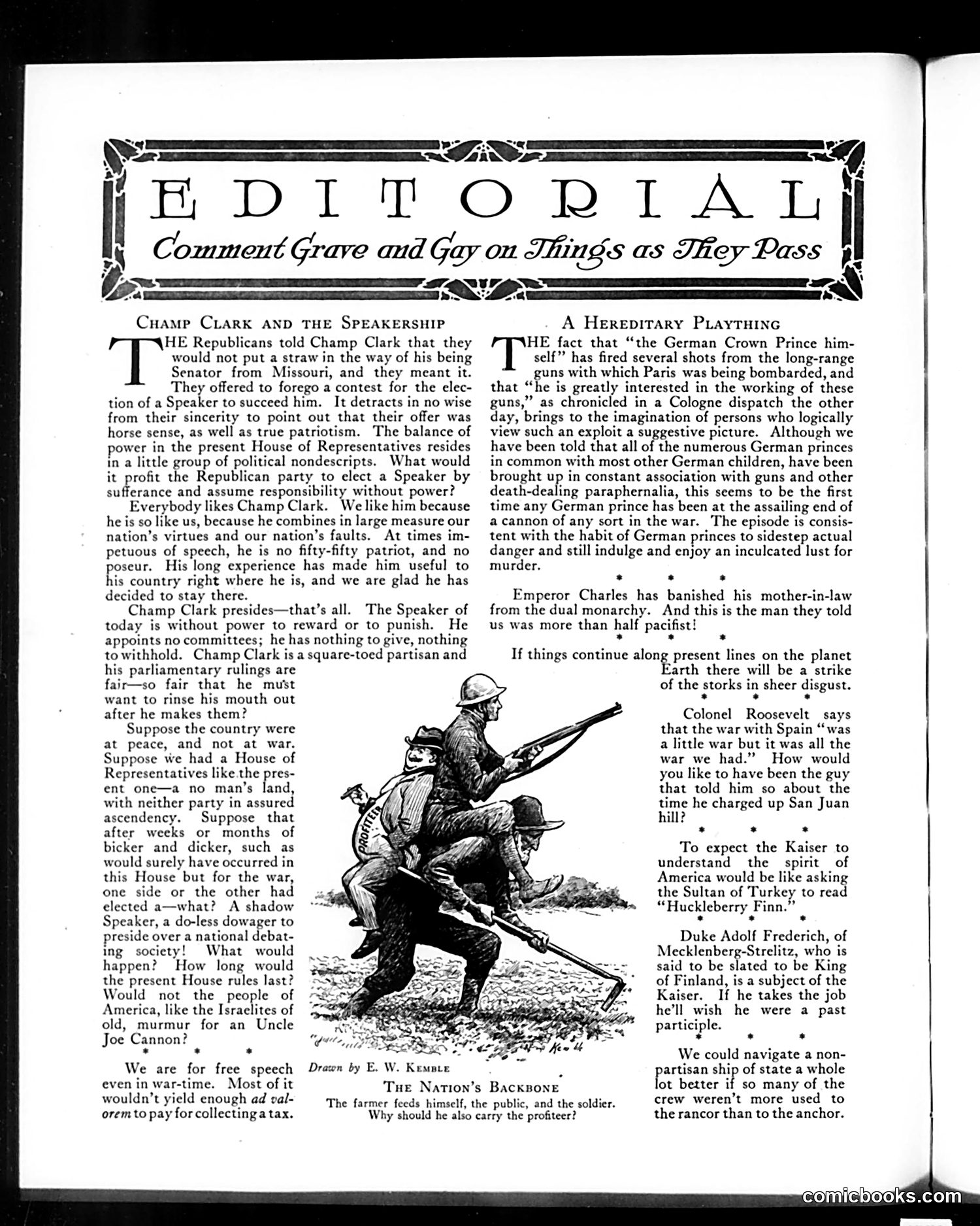
This editorial page critiques American politics during World War I. The main article defends **Champ Clark**, Speaker of the House, against Republican pressure to leave that position for a Senate seat. The writer argues Clark should stay because the Speaker's office lacks real power in a divided Congress—he merely presides. The piece warns that without strong leadership, Congress would devolve into chaos, invoking **Uncle Joe Cannon** (former powerful Speaker) as comparison. The right column's satirical items mock **the German Crown Prince** for firing ceremonial cannon shots while avoiding actual combat—consistent with aristocratic cowardice. It also ridicules **Kaiser Wilhelm** for pacifism claims and jabs **Colonel Roosevelt** about his Spanish-American War boasting. The **E.W. Kemble illustration** depicts soldiers carrying war's burdens on their backs, captioned "The Nation's Backbone," emphasizing farmers and workers bear war's costs. The satire targets wartime political maneuvering, German leadership hypocrisy, and American nostalgia for strong congressional power.
📄 Transcribed text from this page (OCR, searchable)
Machine-transcribed from the original scan — historical spelling and the odd misread are preserved.
Gri pele _ Comite? Grave aud Gay on Things as They Pass 4 E£ NIL Cuamp CLARK AND THE SPEAKERSHIP HE Republicans told Champ Clark that they would not put a straw in the way of his being Senator from Missouri, and they meant it. They offered to forego a contest for the elec- tion of a Speaker to succeed him. It detracts in no wise from their sincerity to point out that their offer was horse sense, as well as true patriotism. The balance of power in the present House of Representatives resides in a little group of political nondescripts. What would it profit the Republican party to elect a Speaker by sufferance and assume responsibility without power? Everybody likes Champ Clark. We like him because he is so like us, because he combines in large measure our nation’s virtues and our nation’s faults. At times im- petuous of speech, he is no fifty-fifty patriot, and no poseur. His long experience has made him useful to his country right where he is, and we are glad he has decided to stay there. Champ Clark presides—that’s all. The Speaker of today is without power to reward or to punish. He appoints no committees; he has nothing to give, nothing towithhold. Champ Clark is a square-toed partisan and his parliamentary rulings are fair—so fair that he must want to rinse his mouth out after he makes them? Suppose the country were at peace, and not at war. Suppose we had a House of Representatives like.the pres- ent one—a no man’s land, with neither party in assured ascendency. Suppose that after weeks or months of bicker and dicker, such as would surely have occurred in this House but for the war, one side or the other had elected a—what? A shadow Speaker, a do-less dowager to preside over a national debat- ing society! What would happen? How long would the present House rules last? Would not the people of America, like the Israelites of old, murmur for an Uncle Joe Cannon? * * . We are for free speech Drawn by E. W. Kempre even in war-time. Most of it Tue Nation’s wouldn’t yield enough ad val- The farmer feeds himself, the orem to pay forcollectinga tax. >— i A Herepirary PLAYTHING HE fact that “the German Crown Prince him- self” has fired several shots from the long-range guns with which Paris was being bombarded, and that She is greatly interested in the working of these guns,” as chronicled in a Cologne dispatch the other day, brings to the imagination of persons who logically view such an exploit a suggestive picture. Although we have been told that all of the numerous German princes in common with most other German children, have been brought up in constant association with guns and other death-dealing paraphernalia, this seems to be the first time any German prince has been at the assailing end of acannon of any sort in the war. The episode is consis- tent with the habit of German princes to sidestep actual danger and still indulge and enjoy an inculcated lust for murder. * . . Emperor Charles has banished his mother-in-law from the dual monarchy. And this is the man they told us was more than half pacifist! If things continue along present lines on the planet Earth there will be a strike of the storks in sheer disgust. * . . Colonel Roosevelt says that the war with Spain “was a little war but it was all the war we had.” How would you like to have been the guy that told him so about the time he charged up San Juan hill? . . * To expect the Kaiser to understand the spirit of America would be like asking the Sultan of Turkey to read “Huckleberry Finn.” * * Duke Adolf Frederich, of Mecklenberg-Strelitz, who is said to be slated to be King of Finland, is a subject of the Kaiser. If he takes the job he'll wish he were a past participle. * * We could navigate a non- paraean ship of state a whole ot better if so many of the crew weren’t more used to the rancor than to the anchor. BackBONE public, and the soldier. Why should he also carry the profiteer? at =A