
Judge, 1918-06-01 · page 5 of 36
Judge — June 1, 1918 — page 5: what you’re looking at
What you’re looking at
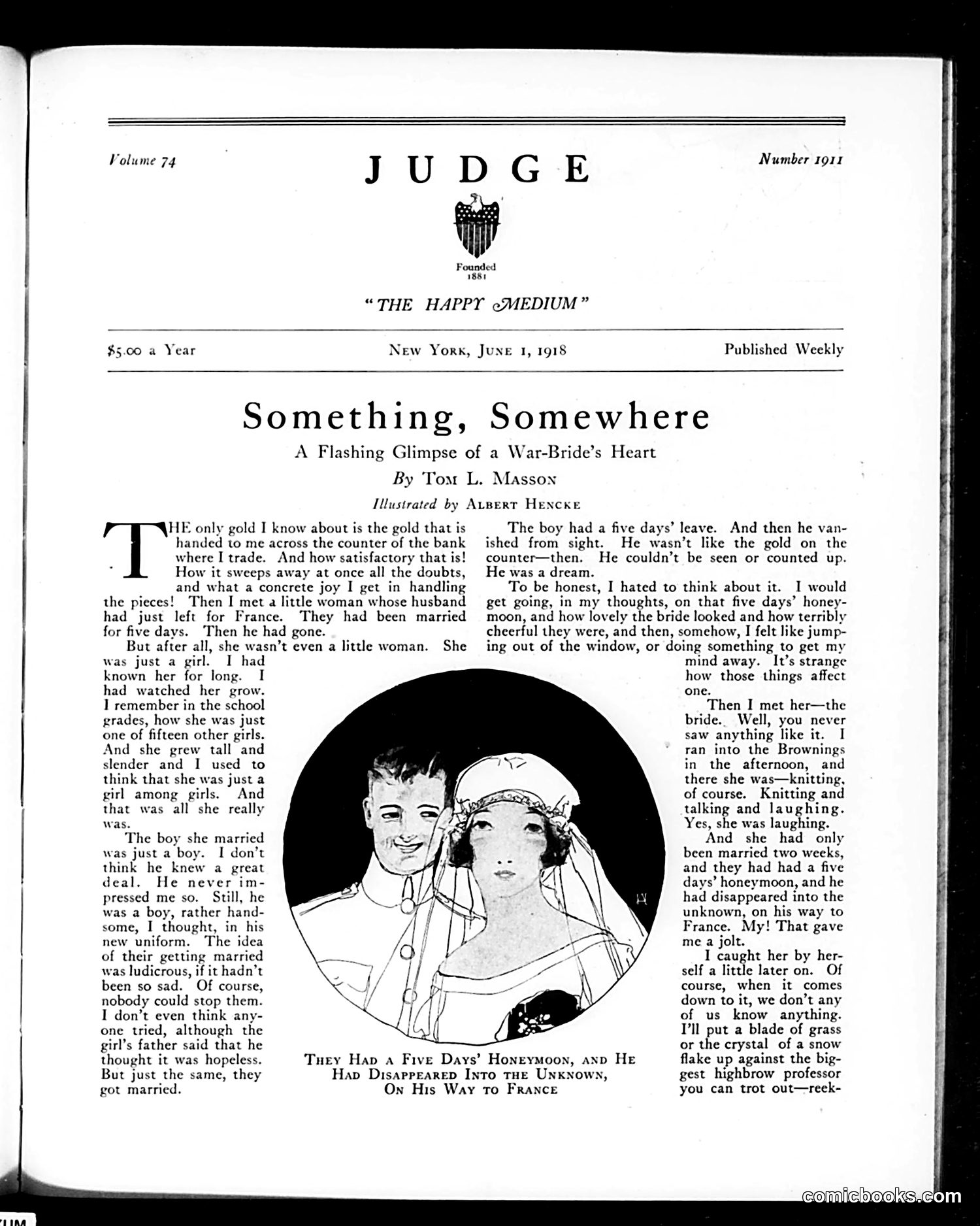
This 1918 Judge magazine piece tells a sentimental wartime story by Tom L. Masson, illustrated by Albert Hencke. The narrative concerns a young couple who married hastily before the husband deployed to France during World War I. They had only a five-day honeymoon before he "disappeared into the unknown, on his way to France." The illustration depicts the newlyweds together, capturing their brief happiness. The story explores the emotional impact on the bride—her anxiety about her husband's fate, her struggle to cope with uncertainty, and the bittersweet nature of wartime romance. This reflects common American anxieties during WWI about soldiers' safety and the emotional toll on families left behind. The piece uses intimate domestic narrative to humanize broader wartime experiences.
📄 Transcribed text from this page (OCR, searchable)
Machine-transcribed from the original scan — historical spelling and the odd misread are preserved.
SL TETYT Volume 74 JUDGE bi Number 1911 Founded 1881 “THE HAPPY eMEDIUM” $5.00 a Year New York, June 1, 1918 Published Weekly Something, Somewhere A Flashing Glimpse of a War-Bride’s Heart By Tom L. Masson Illustrated by AvBert HeNcKE HE only gold I know about is the gold that is handed to me across the counter of the bank where I trade. And how satisfactory that is! How it sweeps away at once all the doubts, and what a concrete joy I get in handling the pieces! Then I met a little woman whose husband had just left for France. They had been married for five days. ‘Then he had gone. But after all, she wasn’t even a little woman. She was just a girl. I had known her for long. I had watched her grow. I remember in the school grades, how she was just one of fifteen other girls. And she grew tall and slender and I used to think that she was just a girl among girls. And that was all she really was. The boy she married was just a boy. I don’t think he knew a great deal. He never im- pressed me so. Still, he was a boy, rather hand- some, I thought, in his new uniform. The idea of their getting married was ludicrous, if it hadn’t been so sad. Of course, nobody could stop them. I don’t even think any- one tried, although the girl’s father said that he thought it was hopeless. But just the same, they got married. Tuey Hap a Five Days’ Honeymoon, anp He Hap Disaprearep Into THE Unknown, On His Way To France The boy had a five days’ leave. And then he van- ished from sight. He wasn’t like the gold on the counter—then. He couldn’t be seen or counted up. He was a dream. To be honest, I hated to think about it. I would get going, in my thoughts, on that five days’ honey- moon, and how lovely the bride looked and how terribly cheerful they were, and then, somehow, I felt like jump- ing out of the window, or doing something to get my mind away. It’s strange how those things affect one. Then I met her—the bride. Well, you never saw anything like it. I ran into the Brownings in the afternoon, and there she was—knitting, of course. Knitting and talking and laughing. Yes, she was laughing. And she had only been married two weeks, and they had had a five days’ honeymoon, and he had disappeared into the unknown, on his way to France. My! That gave me a jolt. I caught her by her- self a little later on. Of course, when it comes down to it, we don’t any of us know anything. T’ll put a blade of grass or the crystal of a snow flake up against the big- gest highbrow professor you can trot out—reek-