
Judge, 1918-06-01 · page 24 of 36
Judge — June 1, 1918 — page 24: what you’re looking at
What you’re looking at
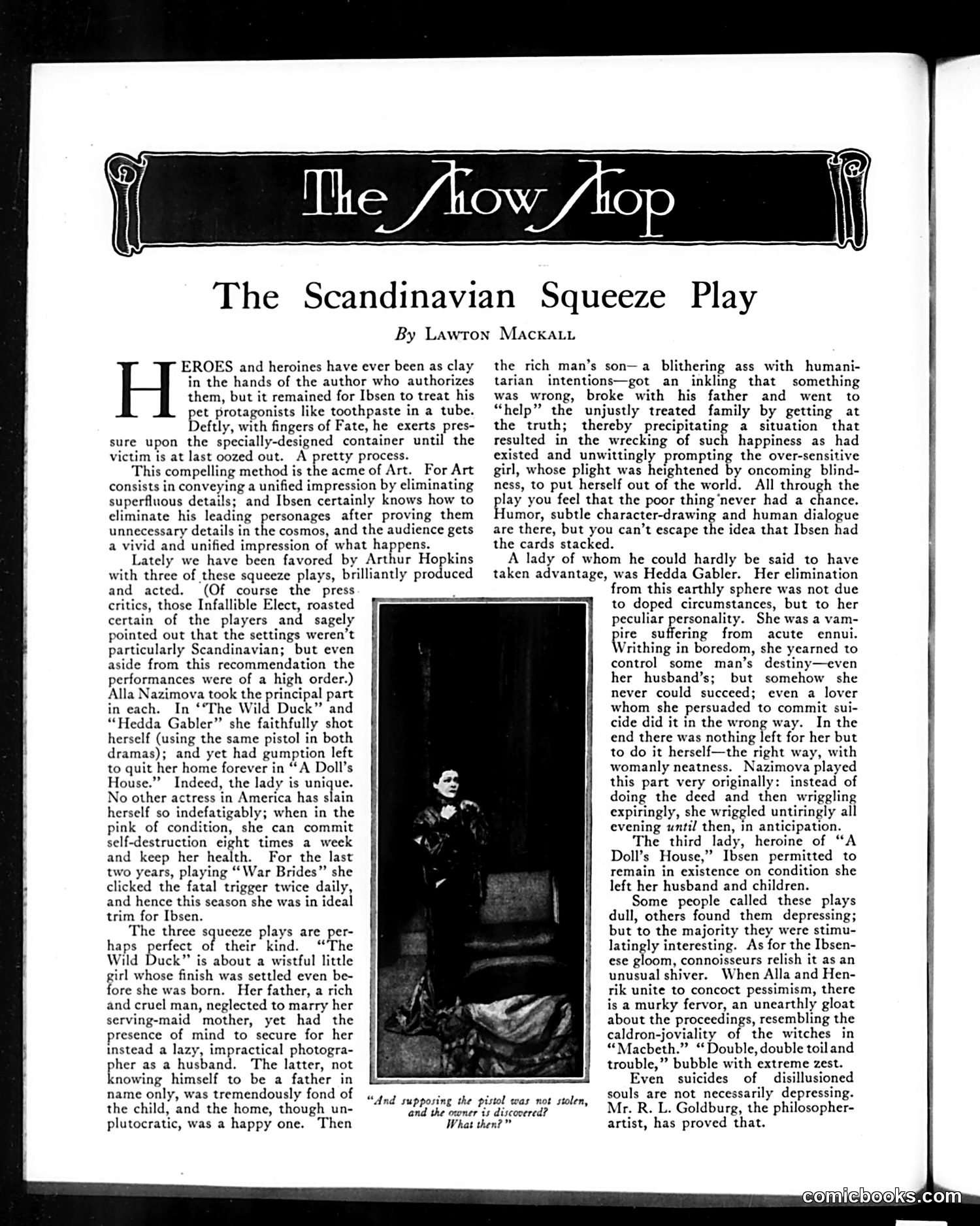
This is a theater review by Lawton Mackall critiquing Henrik Ibsen's dramatic works as presented by producer Arthur Hopkins, starring Russian-American actress Alla Nazimova. The piece sarcastically praises Ibsen's technique of methodically "squeezing" characters to their tragic conclusions—like toothpaste from a tube. Mackall uses dark humor to describe Nazimova's repeated on-stage suicides across three productions (*The Wild Duck*, *Hedda Gabler*, *A Doll's House*), noting her stamina in dying "eight times a week" while maintaining her health. The accompanying photograph shows Nazimova in character. The review acknowledges Ibsen's artistic skill in eliminating superfluous details but suggests his plots feel deliberately rigged—the "cards stacked"—leaving audiences with depression rather than catharsis. The tone is witty mockery of both Ibsen's deterministic fatalism and Nazimova's commitment to playing doomed heroines.
📄 Transcribed text from this page (OCR, searchable)
Machine-transcribed from the original scan — historical spelling and the odd misread are preserved.
The Scandinavian Squeeze Play By Lawron Macka.u EROES and heroines have ever been as clay in the hands of the author who authorizes them, but it remained for Ibsen to treat his Fet protagonists like toothpaste in a tube. Deftly, with fingers of Fate, he exerts pres- sure upon the specially-designed container until the victim is at last oozed out. A pretty process. This compelling method is the acme of Art. For Art consists in conveying a unified impression by eliminating superfluous details; and Ibsen certainly knows how to eliminate his leading personages after proving them unnecessary details in the cosmos, and the audience gets a vivid and unified impression of what happens. Lately we have been favored by Arthur Hopkins with three of these squeeze plays, brilliantly produced and acted. (Of course the press critics, those Infallible Elect, roasted certain of the players and sagely pointed out that the settings weren’t particularly Scandinavian; but even aside from this recommendation the performances were of a high order.) Alla Nazimova took tas principal part in each. In ‘The Wild Duck” and “Hedda Gabler” she faithfully shot herself (using the same pistol in both dramas); and yet had gumption left to quit her home forever in “A Doll’s House.” Indeed, the lady is unique. No other actress in America has slain herself so indefatigably; when in the pink of condition, she can commit self-destruction eight times a week and keep her health. For the last two years, playing “War Brides” she clicked the fatal trigger twice daily, and hence this season she was in ideal trim for Ibsen. The three squeeze plays are per- haps perfect of their kind. “The Wild Duck” is about a wistful little girl whose finish was settled even be- fore she was born. Her father, a rich and cruel man, neglected to marry her serving-maid mother, yet had the presence of mind to secure for her instead a lazy, impractical photogra- pher as a husband. The latter, not nowing himself to be a father in name only, was tremendously fond of . the child, and the home, though un- ‘ead the plutocratic, was a happy one. Then ‘And supposing the pistol was not stolen, owner is discovered? What then?” the rich man’s son—a_ blithering ass with humani- tarian intentions—got an inkling that something was wrong, broke with his father and went to “help” the unjustly treated family by getting at the truth; thereby precipitating a situation that resulted in the wrecking of such happiness as had existed and unwittingly prompting the over-sensitive girl, whose plight was heightened by oncoming blind- ness, to put herself out of the world. All through the lay you feel that the poor thing‘never had a chance. umor, subtle character-drawing and human dialogue are there, but you can’t escape the idea that Ibsen had the cards stacked. A lady of whom he could hardly be said to have taken advantage, was Hedda Gabler. Her elimination from this earthly sphere was not due to doped circumstances, but to her peculiar personality. She was a vam- firs suffering from acute ennui. Writhing in boredom, she yearned to control some man’s destiny—even her husband’s; but somehow she never could succeed; even a lover whom she persuaded to commit sui- cide did it in the wrong way. In the end there was nothing left for her but to do it herself—the right way, with womanly neatness. Nazimova played this part very originally: instead of doing the deed and then wriggling expiringly, she wriggled untiringly all evening until then, in anticipation. The third lady, heroine of “A Doll’s House,” Ibsen permitted to remain in existence on condition she left her husband and children. Some people called these plays dull, others found them depressing; but to the majority they were stimu- latingly interesting. As for the Ibsen- ese gloom, connoisseurs relish it as an unusual shiver. When Alla and Hen- rik unite to concoct pessimism, there is a murky fervor, an unearthly gloat about the proceedings, resembling the caldron-joviality of the witches in “Macbeth.” “Double, double toil and trouble,” bubble with extreme zest. Even suicides of disillusioned souls are not necessarily depressing. Mr. R. L. Goldburg, the philosopher- artist, has proved that.