
Judge, 1918-06-01 · page 13 of 36
Judge — June 1, 1918 — page 13: what you’re looking at
What you’re looking at
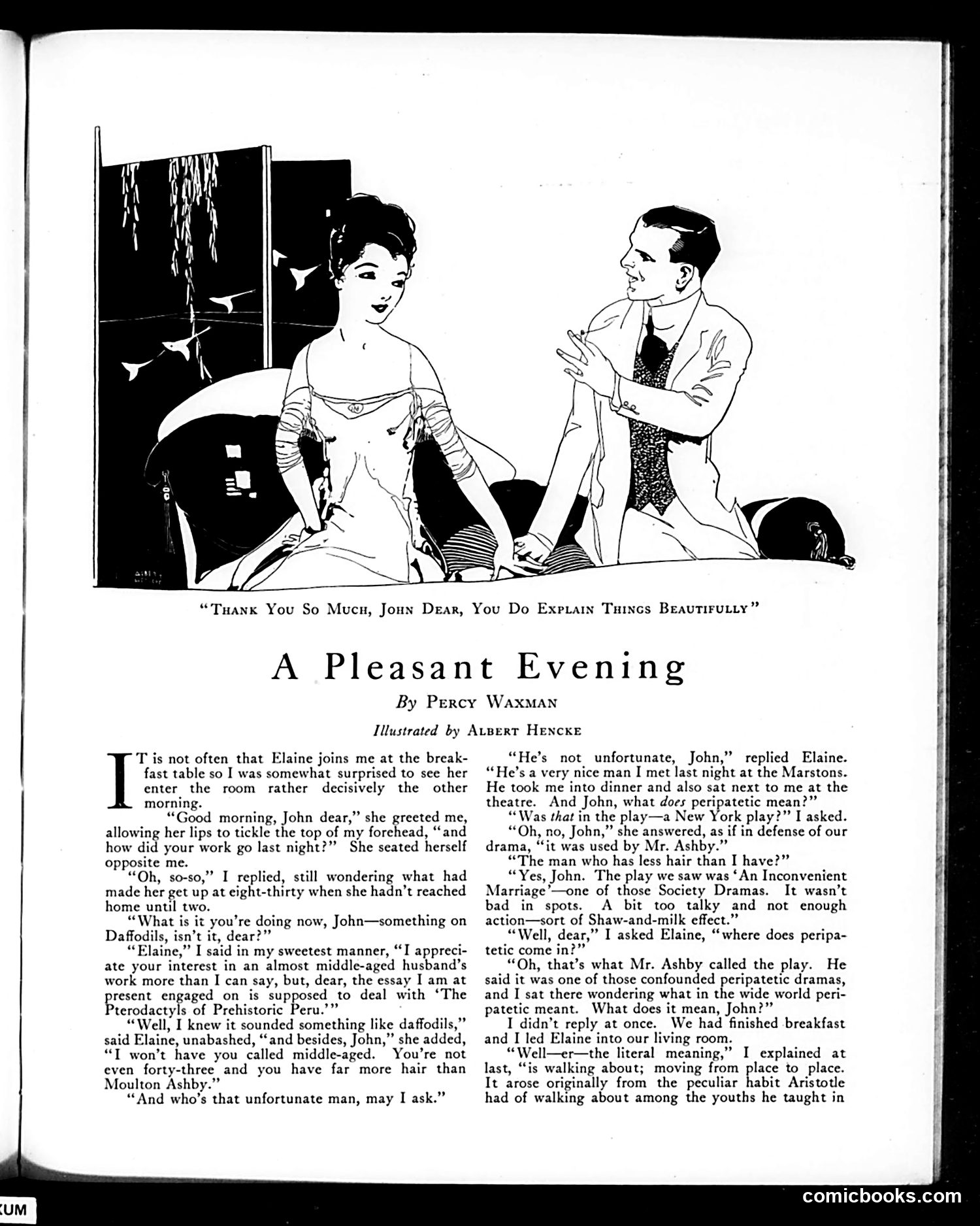
This is a humorous domestic sketch satirizing early 20th-century marriage dynamics and intellectual pretension. The story depicts a husband ("John") who discovers his wife Elaine returned home at 2 a.m. from an evening out, yet casually interrogates *him* about his work the next morning. The satire centers on Elaine's encounter with a man named Moulton Ashby at a social event, where she heard the word "peripatetic" used to describe a play. Rather than look up the word herself, she peppers her husband with questions while studiously avoiding mentioning Ashby's name or their evening together—a comedic role reversal of typical marital interrogation. The humor lies in her feigned innocence ("I knew it sounded like daffodils"), competitive remarks about Ashby's appearance, and the husband's gradual realization he's being tested or manipulated. The illustration shows them in comfortable domestic conversation, masking the subtle tension underneath—a commentary on how spouses communicate (or don't) honestly about their activities and relationships.
📄 Transcribed text from this page (OCR, searchable)
Machine-transcribed from the original scan — historical spelling and the odd misread are preserved.
“Tuank You So Mucu, Joun Dear, You Do Expiain Tuincs Beautirutty” A Pleasant Evening By Percy WaxMAN Illustrated by Aubert HENCKE T is not often that Elaine joins me at the break- fast table so I was somewhat surprised to see her enter the room rather decisively the other morning. “Good morning, John dear,” she greeted me, allowing her lips to tickle the top of my forehead, “and how did your work go last night?” She seated herself opposite me. “Oh, so-so,” I replied, still wondering what had made her get up at eight-thirty when she hadn’t reached home untl two. “What is it you’re doing now, John—something on Daffodils, isn’t it, dear?” “Elaine,” I said in my sweetest manner, “I appreci- ate your interest in an almost middle-aged husband’s work more than I can say, but, dear, the essay I am at resent engaged on is supposed to deal with ‘The Prerodacty s of Prehistoric Peru.’” “Well, I knew it sounded something like daffodils,” said Elaine, unabashed, “and besides, John,” she added, “TI won’t have you called middle-aged. You’re not even forty-three and you have far more hair than Moulton Ashby.” “And who’s that unfortunate man, may I ask.” “He’s not unfortunate, John,” replied Elaine. “He’s a very nice man I met last night at the Marstons. He took me into dinner and also sat next to me at the theatre. And John, what does peripatetic mean?” “Was that in the play—a New York play?” I asked. “Oh, no, John,” she answered, as if in defense of our drama, “it was used by Mr. Ashby.” “The man who has less hair than I have?” “Yes, John. The play we saw was ‘An Inconvenient Marriage’—one of those Society Dramas. It wasn’t bad in spots. A bit too talky and not enough action—sort of Shaw-and-milk effect.” “Well, dear,” I asked Elaine, “where does peripa- tetic come in?” “Oh, that’s what Mr. Ashby called the play. He said it was one of those confounded peripatetic dramas, and I sat there wondering what in the wide world peri- patetic meant. What does it mean, John?” I didn’t reply at once. We had finished breakfast and I led Elaine into our living room. “Well—er—the literal meaning,” I explained at last, “is walking about; moving from place to place. It arose originally from the peculiar habit Aristotle had of walking about among the youths he taught in comicbooks.com