
A complete issue · 36 pages · 1918
Judge — March 30, 1918
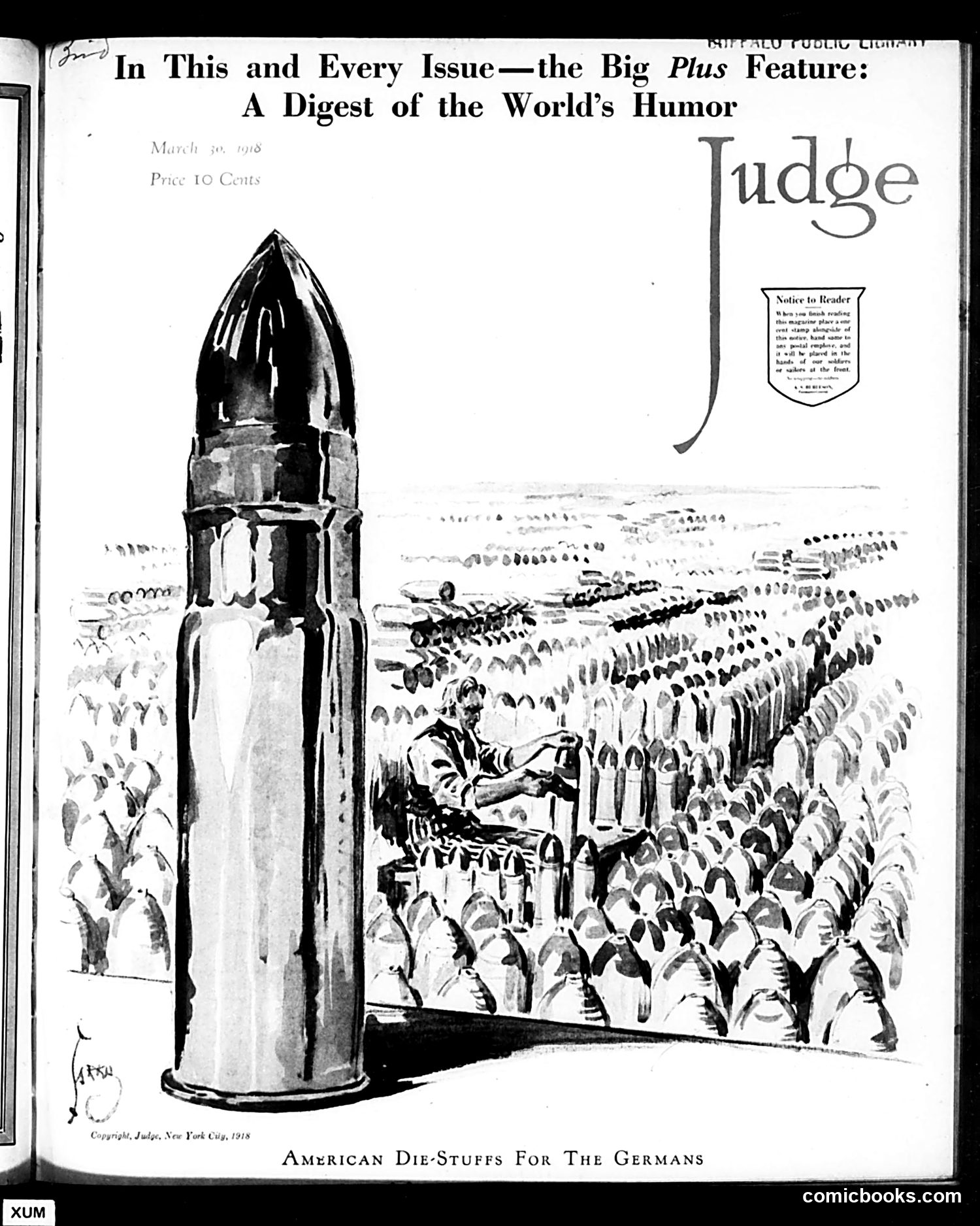
This is the cover of Judge magazine from March 30, 1918, during World War I. The cartoon, titled "American Die-Stuffs For The Germans," depicts a massive artillery shell or bomb surrounded by rows of uniformed soldiers—American troops. A figure in the center operates or directs the weapon. The satire works on multiple levels: it presents American soldiers as "ammunition" or "material" being supplied to Germany (ironically labeled as "die-stuffs"—a pun on industrial dyes), while simultaneously suggesting American military power is the real threat to Germany. The joke critiques either American war production capacity or, more likely, sardonically comments on the scale of American military involvement in the war effort against Germany.
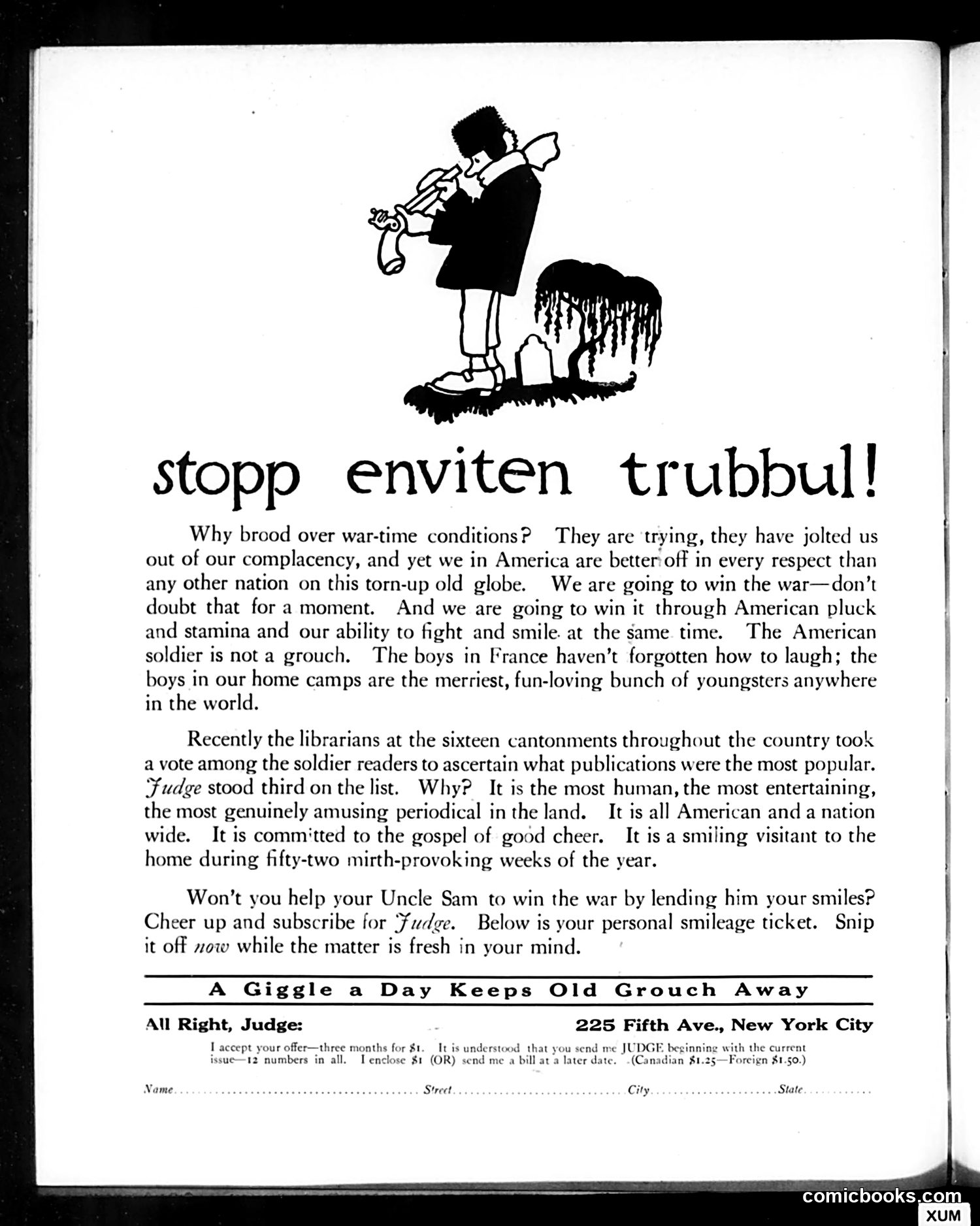
This is a **wartime morale advertisement** for *Judge* magazine, likely from World War I (references to soldiers "in France" and war effort). The cartoon shows a figure playing a trumpet while standing over what appears to be a gravestone or troublesome situation, illustrating the headline "stopp enviten trubbul!" (Stop inviting trouble). The text argues Americans shouldn't worry about wartime hardships—the U.S. is better off than other nations, and soldiers remain cheerful and resilient. It positions *Judge* magazine as morale-boosting entertainment, noting librarians at military cantonments voted it the third most popular publication among soldiers. The subscription pitch frames reading *Judge* as patriotic duty: "lending your smiles" to help win the war through good cheer. The tagline "A Giggle a Day Keeps Old Grouch Away" emphasizes humor as wartime medicine.
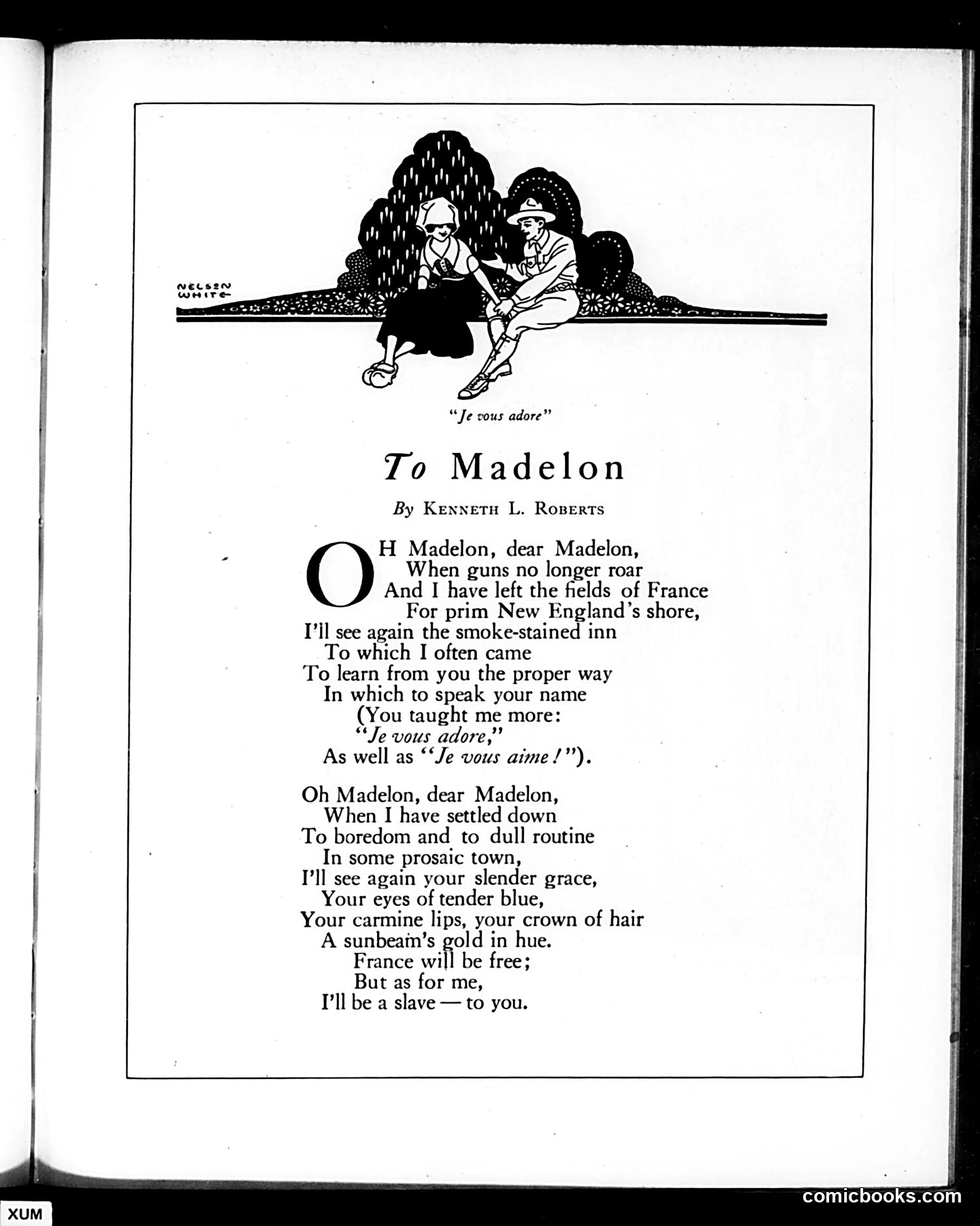
This page reproduces a romantic poem rather than satire. The illustration shows two soldiers in a trench during wartime, with one teaching the other French phrases—specifically "Je vous adore" ("I adore you"). The poem itself appears to reference World War I, mentioning "guns no longer roar" and leaving "fields of France" for "New England's shore." It's a sentimental piece about a soldier's memory of a French woman named Madelon and his longing for her after returning home. "Madelon" likely references the famous French WWI song "La Madelon," which became a cultural touchstone of the war. Roberts's poem transforms this into a personal love story, blending wartime experience with romantic nostalgia.
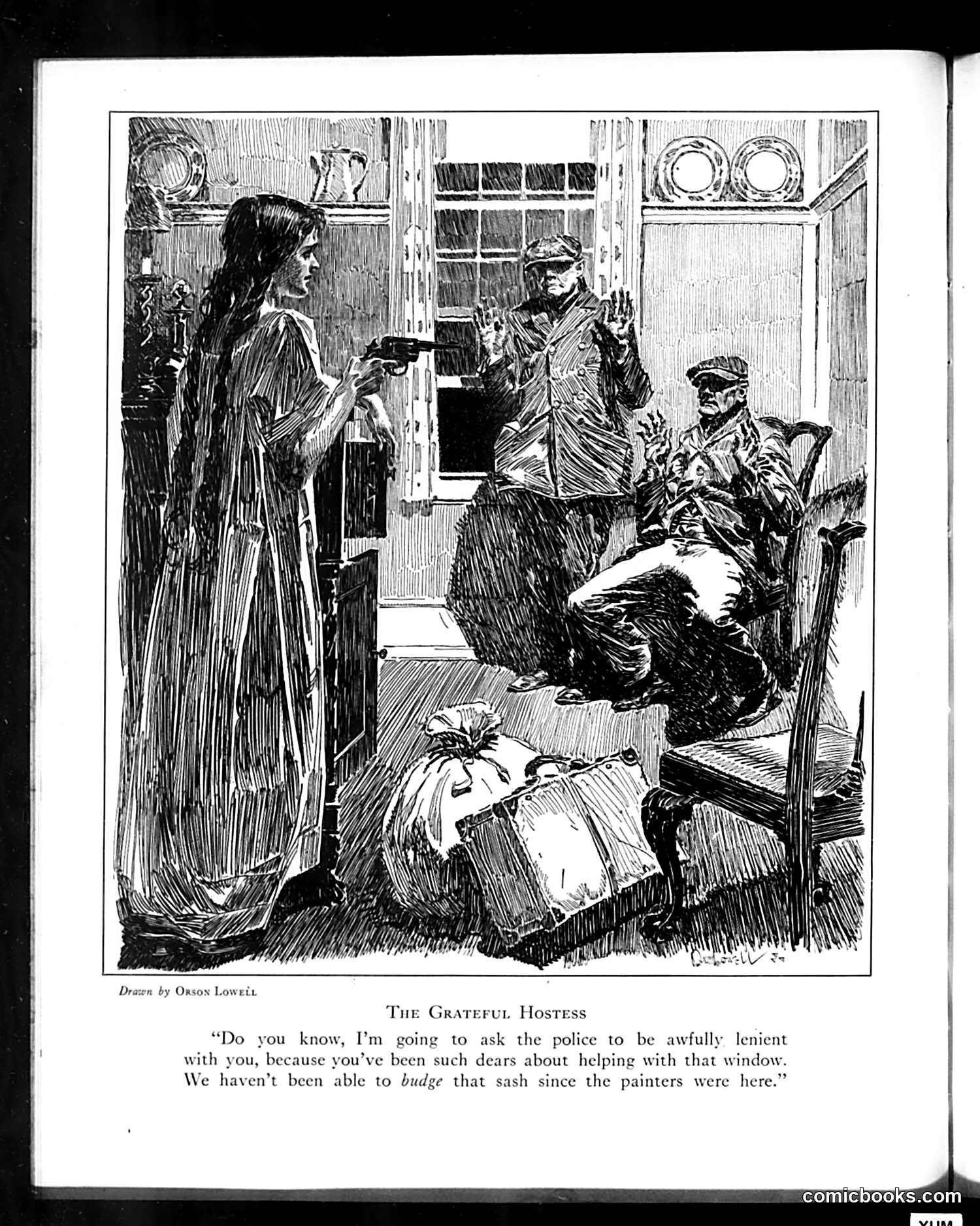
This cartoon satirizes a woman threatening burglars with police action—not for the break-in itself, but for damaging her window sash while entering. The humor derives from misplaced priorities: she's outraged about minor property damage (the painted window frame) yet treats the actual criminals ("dears") with surprising courtesy. The satire likely targets either: 1. The absurdity of wealthy homeowners' complaints about trivial damages amid actual crime 2. A specific incident involving burglars and property disputes 3. The contradictions of upper-class politeness extended inappropriately to criminals The woman's elaborate dress and the home's furnishings (plates, shelving) indicate she's affluent. Her concern about "budging that sash since the painters were here" reveals she cares more about household aesthetics than security—a humorous inversion of reasonable priorities.
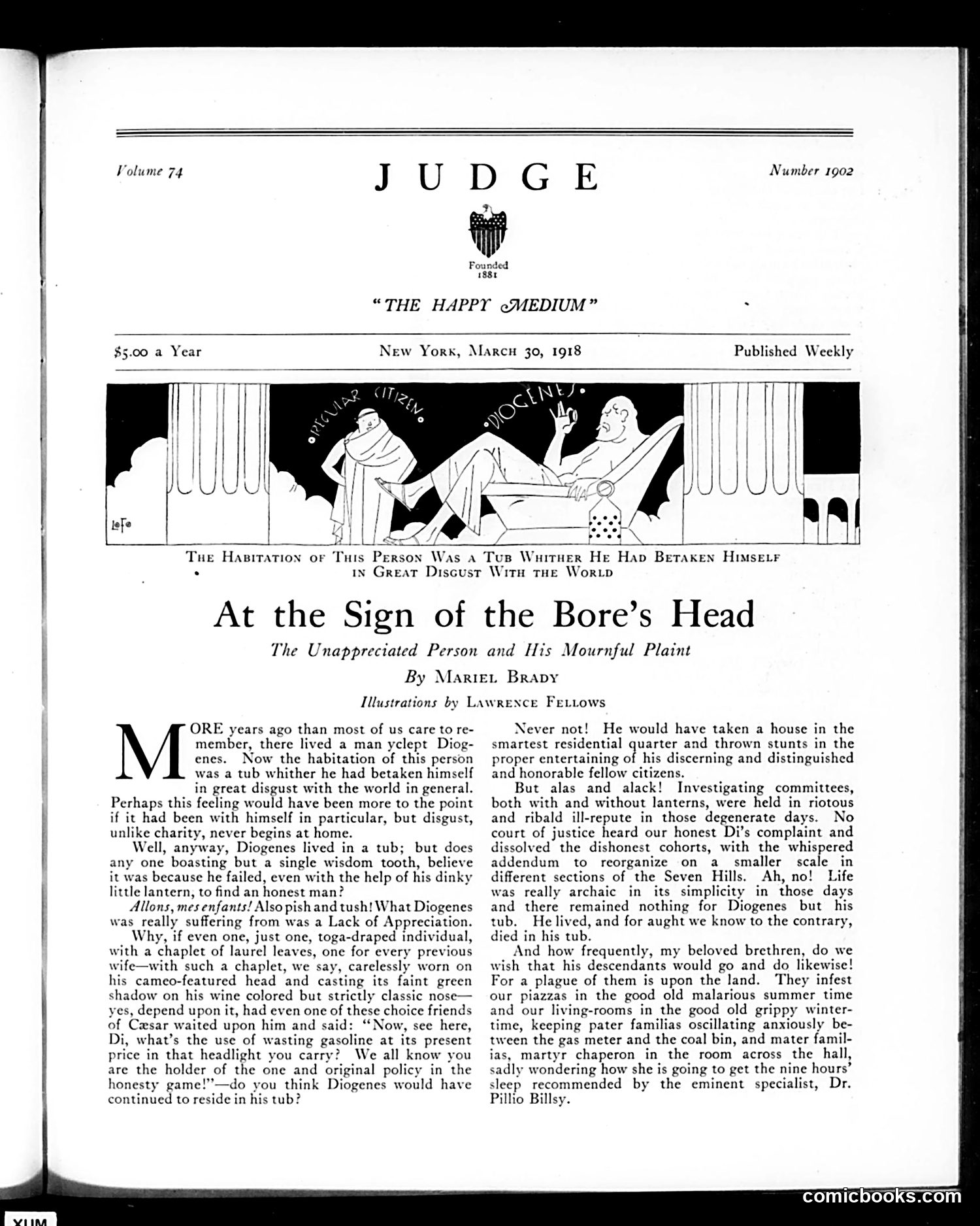
This March 30, 1918 *Judge* page satirizes an "unappreciated person" through the story of Diogenes (the ancient Greek philosopher famous for living ascetically in a tub). The cartoon depicts this person complaining about lack of recognition despite supposed merit. The satire mocks someone who believes themselves distinguished and worthy of honor but has been rejected by society and subjected to investigating committees and "ribald ill-repute." The piece argues this person's suffering stems not from injustice but from a "Lack of Appreciation"—suggesting the subject is simply tedious and unlikeable, not unfairly treated. The cartoon illustrates the figure in a tub-like setting, reinforcing the Diogenes comparison and the theme of self-imposed or deserved isolation from respectable society.
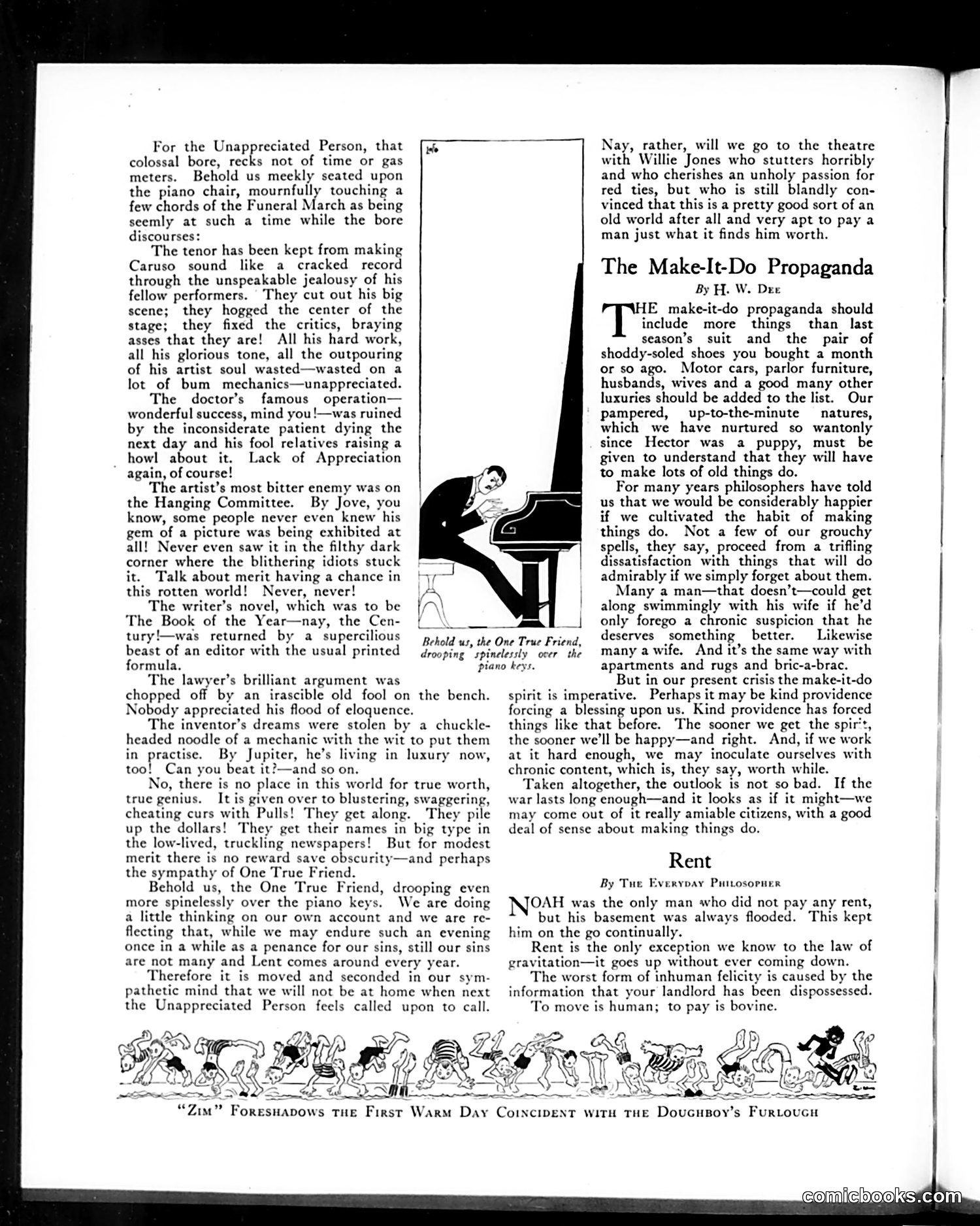
The page contains three separate satirical pieces: 1. **Left column**: Untitled critique mocking an "Unappreciated Person"—likely a struggling artist or performer. The satire ridicules someone whose mediocre talents go unrecognized, blaming their lack of success on others' jealousy rather than merit. References to a "tenor," "Caruso," and "Hanging Committee" suggest criticism of someone in music or visual arts. 2. **"The Make-It-Do Propaganda"** (center/right): Satirizes wartime thrift messaging encouraging Americans to repair and reuse items rather than buy new ones. The humor targets how such propaganda lists increasingly absurd luxuries as things to sacrifice. 3. **"Rent"** (bottom right): A brief philosophical piece playing on the fact that rent, unlike gravity, must be actively paid—making it uniquely human burden. The page reflects WWI-era American concerns about waste, appreciation, and economic hardship.
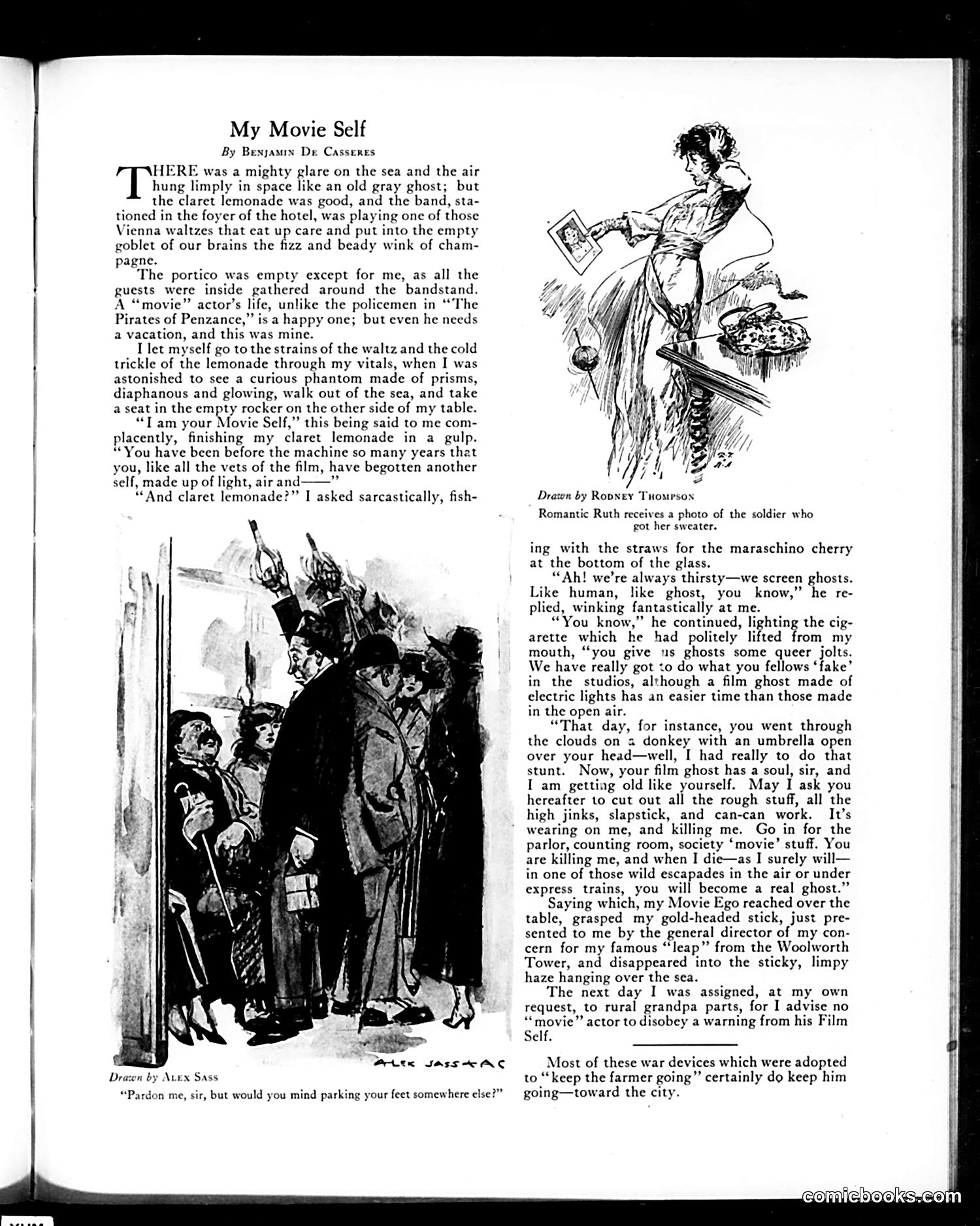
This page contains two satirical pieces about early cinema: **Main Story ("My Movie Self"):** An actor on vacation encounters his supernatural "movie self"—a phantom made of light and air created by years of film work. This ghost-self complains about the physical toll of performing dangerous stunts (like riding a donkey through clouds with an umbrella, or jumping from the Woolworth Tower) that actors must actually execute to match their on-screen images. The satire mocks both the absurd demands placed on film actors and the era's primitive special effects. The actor heeds the warning and accepts safer roles. **Bottom Cartoons:** Two separate pieces—one showing crowded feet in cramped quarters (social satire about urban overcrowding), and another captioned "Romantic Ruth receives a photo of the soldier who got her sweater" (wartime humor about relationships and small romantic gestures). The overall tone critiques early Hollywood's dangerous working conditions while celebrating cinema's novelty.
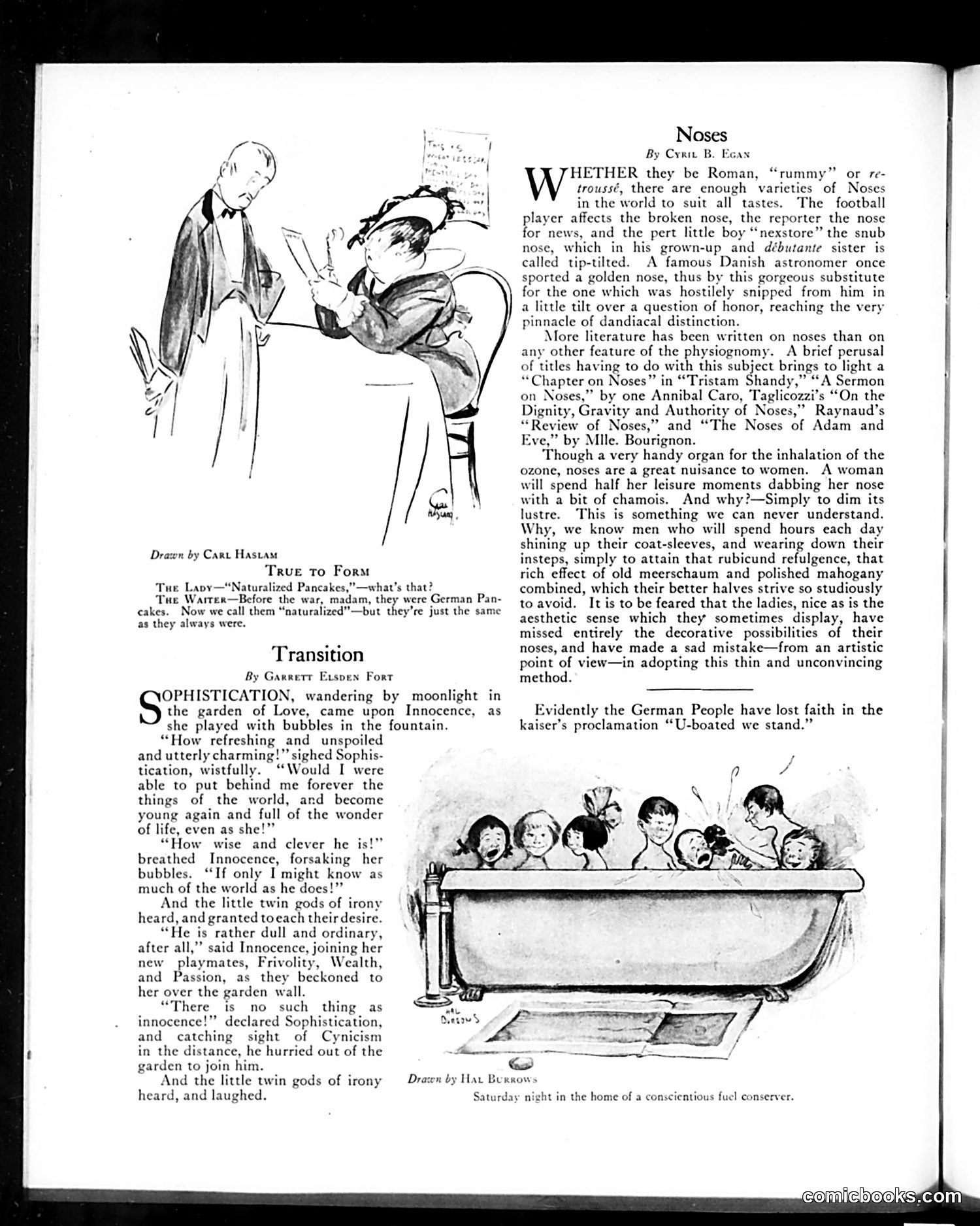
This page contains three distinct pieces of satirical content: **"True to Form"** (top cartoon by Carl Haslam): A waiter explains "naturalized pancakes" to a lady customer—they were called "German Pancakes" before the war but remain unchanged. This mocks the WWI-era practice of renaming German-origin products with patriotic alternatives (similar to how "sauerkraut" became "liberty cabbage"), satirizing the superficiality of such rebranding when the actual product is identical. **"Transition"** (poem by Garrett Elsden Fort): An allegorical tale where Sophistication and Innocence meet, each envying the other. After the "twin gods of irony" grant their wishes, both become corrupted—Innocence becomes frivolous and worldly; Sophistication becomes cynical. It's a commentary on how desire for what we lack inevitably leads to disappointment and moral compromise. **"Noses"** (essay by Cyril B. Egan): A humorous essay on nose varieties and literature about noses, concluding with criticism of women for dimming their nose's shine while men obsess over polishing theirs—social commentary on gendered beauty standards and vanity. The final cartoon references German U-boat submarines, suggesting lost faith in Germany's naval strategy.
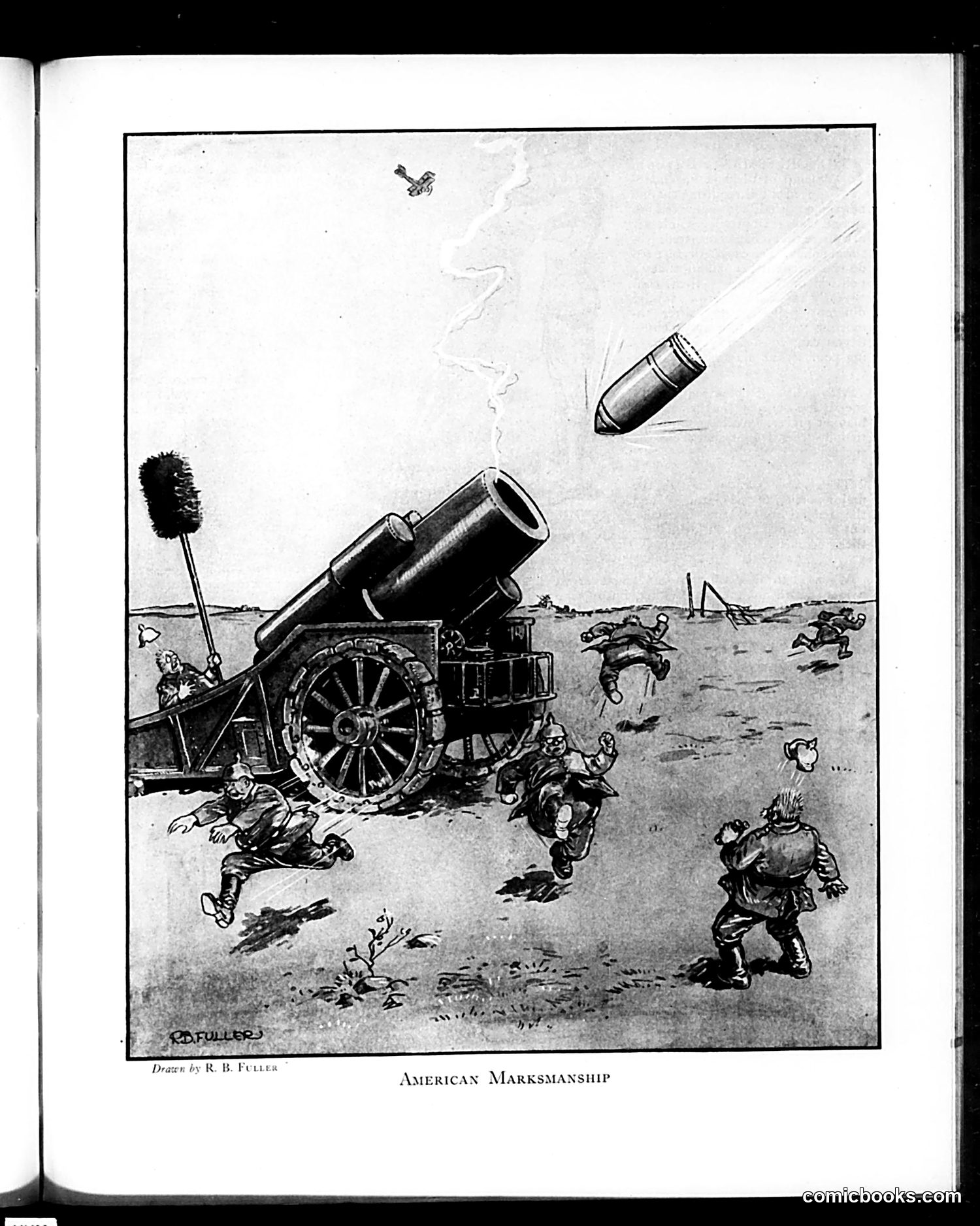
This cartoon by R.B. Fuller satirizes American military accuracy or competence. A large cannon on a wheeled carriage fires projectiles across a battlefield, but the shots wildly miss their marks. Soldiers scatter in panic—some diving, others running—suggesting chaos and poor aim rather than skilled marksmanship. The title's irony is the point: the cartoon mockingly comments on incompetence masquerading as "American" prowess. Without knowing the specific historical moment, this likely critiques either actual military failures, inadequate training, or contemporary debates about American military preparedness. The exaggerated chaos emphasizes the gap between boasted capabilities and actual performance. The cartoon appears designed for Judge magazine's typically satirical take on American military or political affairs.
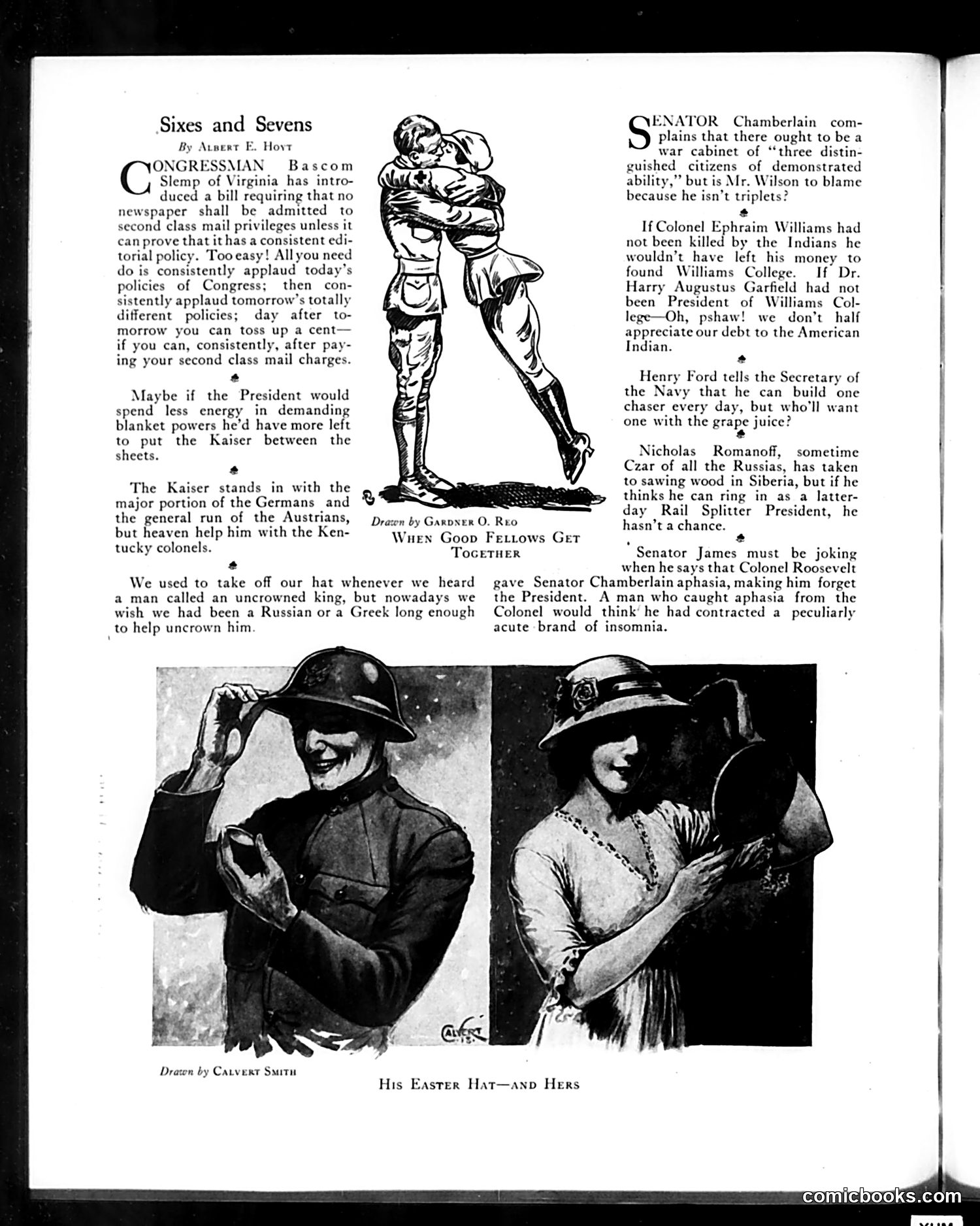
This satirical page from *Judge* magazine lampoons American political figures during World War I, likely circa 1917-1918. **"Sixes and Sevens"** column by Albert E. Hoyt mocks: - Congressman Bascom Slemp's bill requiring newspapers prove consistent editorial policy—absurdly suggesting papers can flip positions daily while remaining "consistent" - President Wilson for demanding executive powers instead of focusing on defeating the Kaiser - Senator Chamberlain's complaint about the war cabinet, joking Wilson can't help not having triplets - Henry Ford's boast about building naval chasers (warships), sarcastically questioning who'd want one with "grape juice" (reference to Ford's famous temperance views) - Nicholas Romanoff (the deposed Russian Czar) attempting a political comeback, comparing him ironically to Lincoln **Bottom illustration** ("His Easter Hat—and Hers") by Calvert Smith simply shows contrasting men's and women's Easter hats—a fashion humor piece unrelated to the political satire above. The overall tone criticizes wartime leadership incompetence and political hypocrisy.
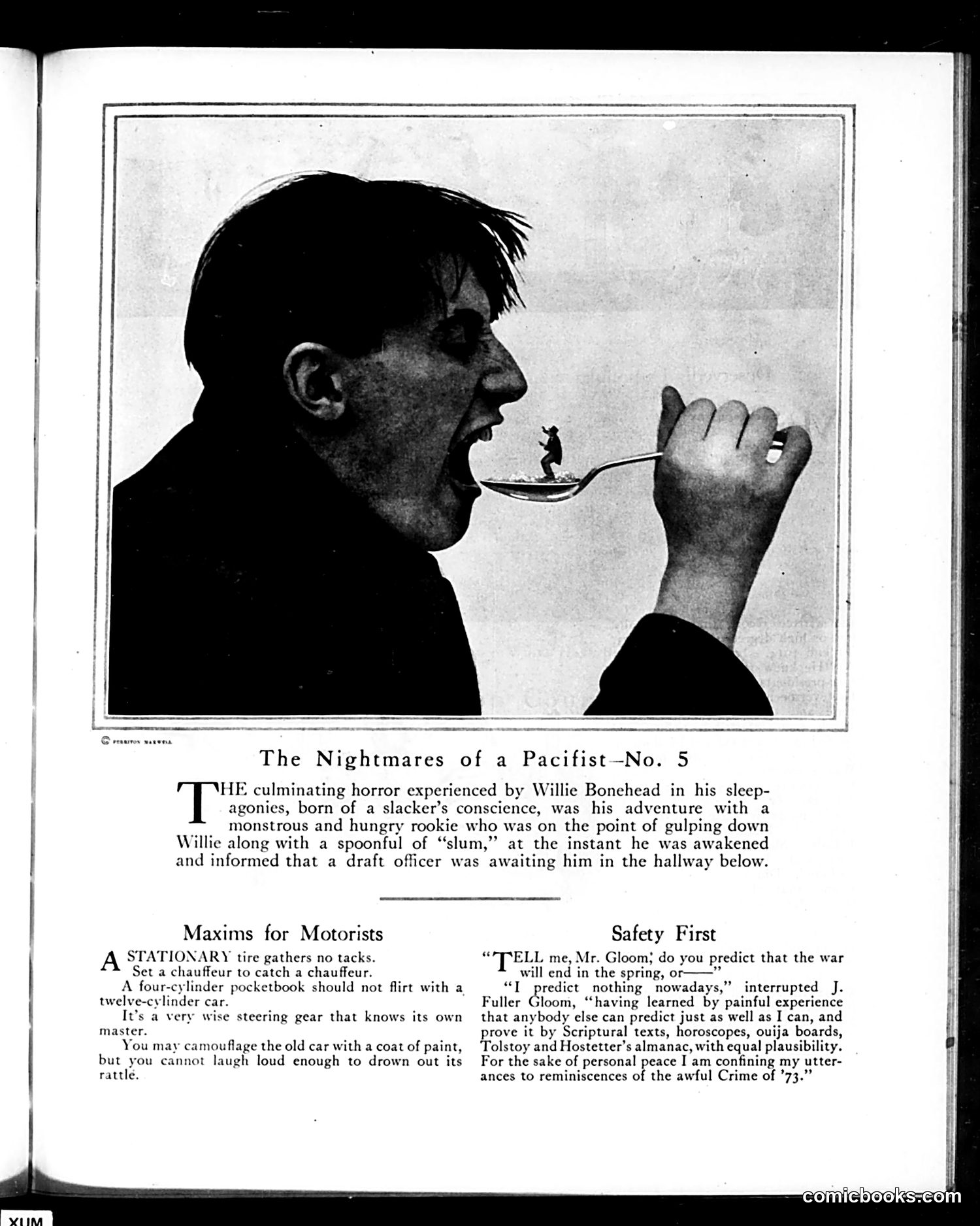
This Judge magazine page contains anti-pacifist propaganda from World War I era. "The Nightmares of a Pacifist—No. 5" depicts Willie Bonehead, a draft dodger, experiencing a fever dream where a starving soldier ("hungry rookie") tries to eat him—suggesting pacifists' moral cowardice will literally consume society. The draft officer waiting downstairs represents inescapable military obligation. The satire mocks pacifists as selfish "slackers" endangering the nation. The lower sections are filler: "Maxims for Motorists" offers car-humor puns unrelated to the main cartoon, while "Safety First" features a character cynically refusing predictions after the "Crime of '73" (likely the 1873 financial panic), treating all forecasts as equally unreliable. The overall page reflects wartime pressure on Americans to support military service.
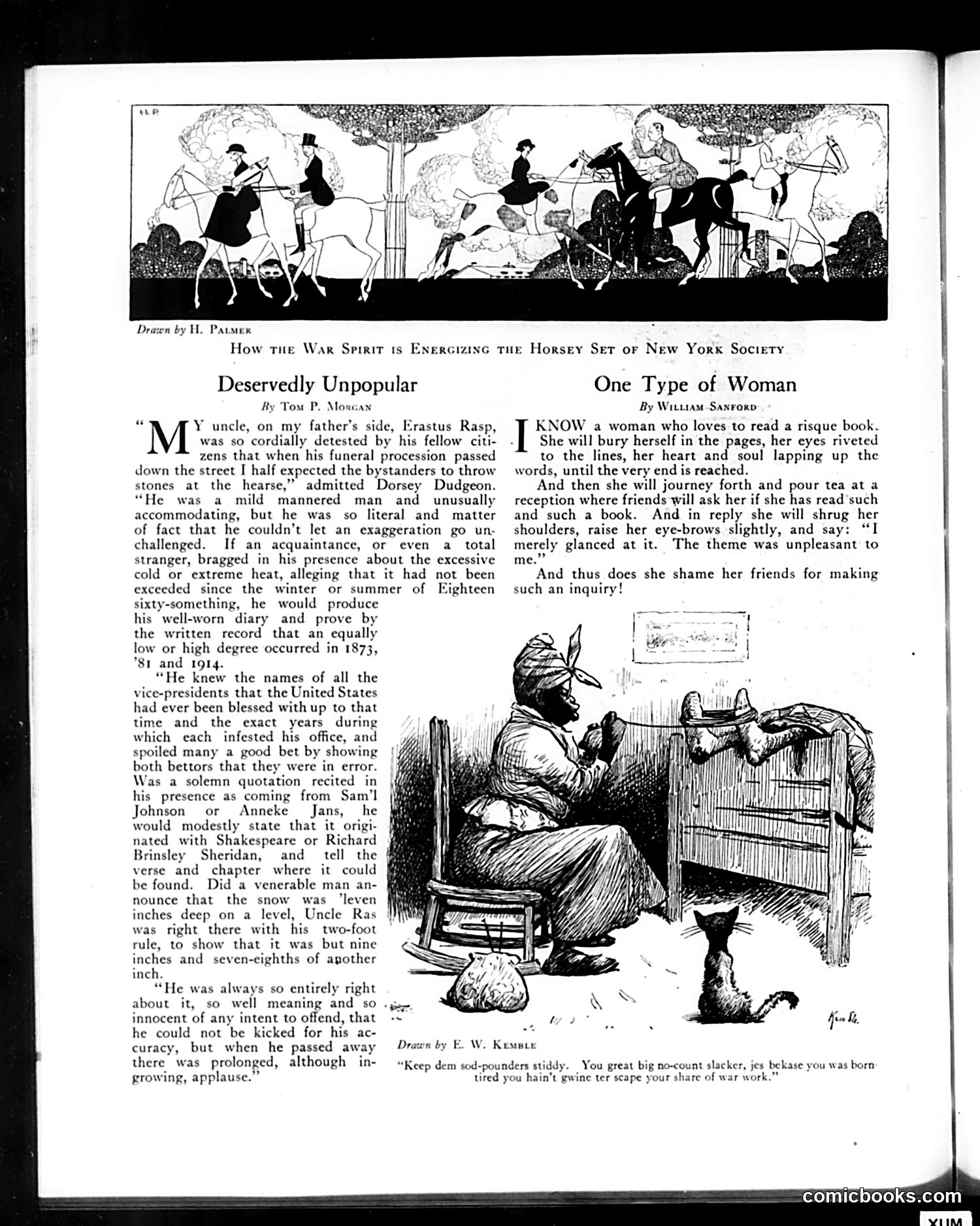
**Top Cartoon** ("How the War Spirit is Energizing the Horsey Set of New York Society"): Silhouette illustration by H. Palmer shows wealthy New Yorkers on horseback, apparently engaged in war-related activities or patriotic pursuits. The satire appears to mock how the upper class's equestrian social circle adapted to WWI—likely referencing volunteering, fundraising, or performative patriotism by the leisure class during the war era. **"Deservedly Unpopular"** (left): Story by Tom P. Moxgan satirizes Uncle Erastus Rasp, a pedantic man despised for compulsively correcting others' exaggerations with factual accuracy—proving claims about weather via old diaries, correcting literary attributions, measuring snow precisely. The joke: his literal-minded honesty, though well-intentioned, makes him socially unbearable. **"One Type of Woman"** (right): William Sanford's piece mocks women who secretly read "risque" (sexually suggestive) books but publicly deny it, claiming disinterest to avoid shame. The illustration by E.W. Kemble shows the hypocrisy of concealing enjoyment.
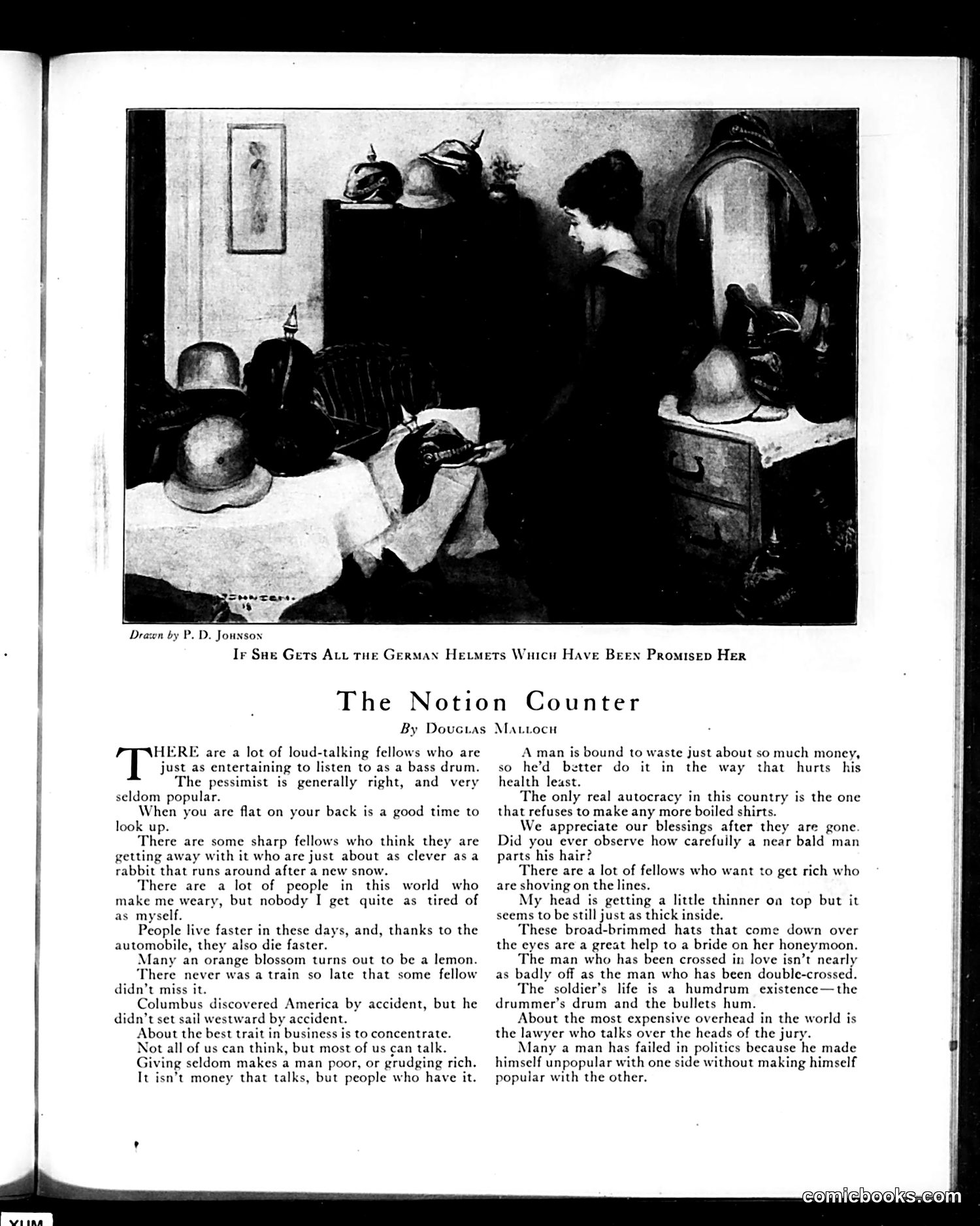
The illustration depicts a woman examining German military helmets, captioned "If She Gets All the German Helmets Which Have Been Promised Her"—a wartime joke referencing the popular expectation that Allied victory would yield German war trophies as souvenirs. The accompanying text by Douglas Malloch is a collection of aphoristic observations ("notion counter" likely meaning a repository of witty thoughts). These are largely generic observations about human nature, business, love, and society—typical of Judge magazine's satirical commentary. References to soldiers, drummers, and the "soldier's life" subtly acknowledge the WWI context without directly politicizing it. The humor relies on mild cynicism about modern life: vanity, talkativeness, automobile culture, and romantic disappointment. The page represents Judge's characteristic blend of visual satire and philosophical humor aimed at educated American readers during the wartime period.
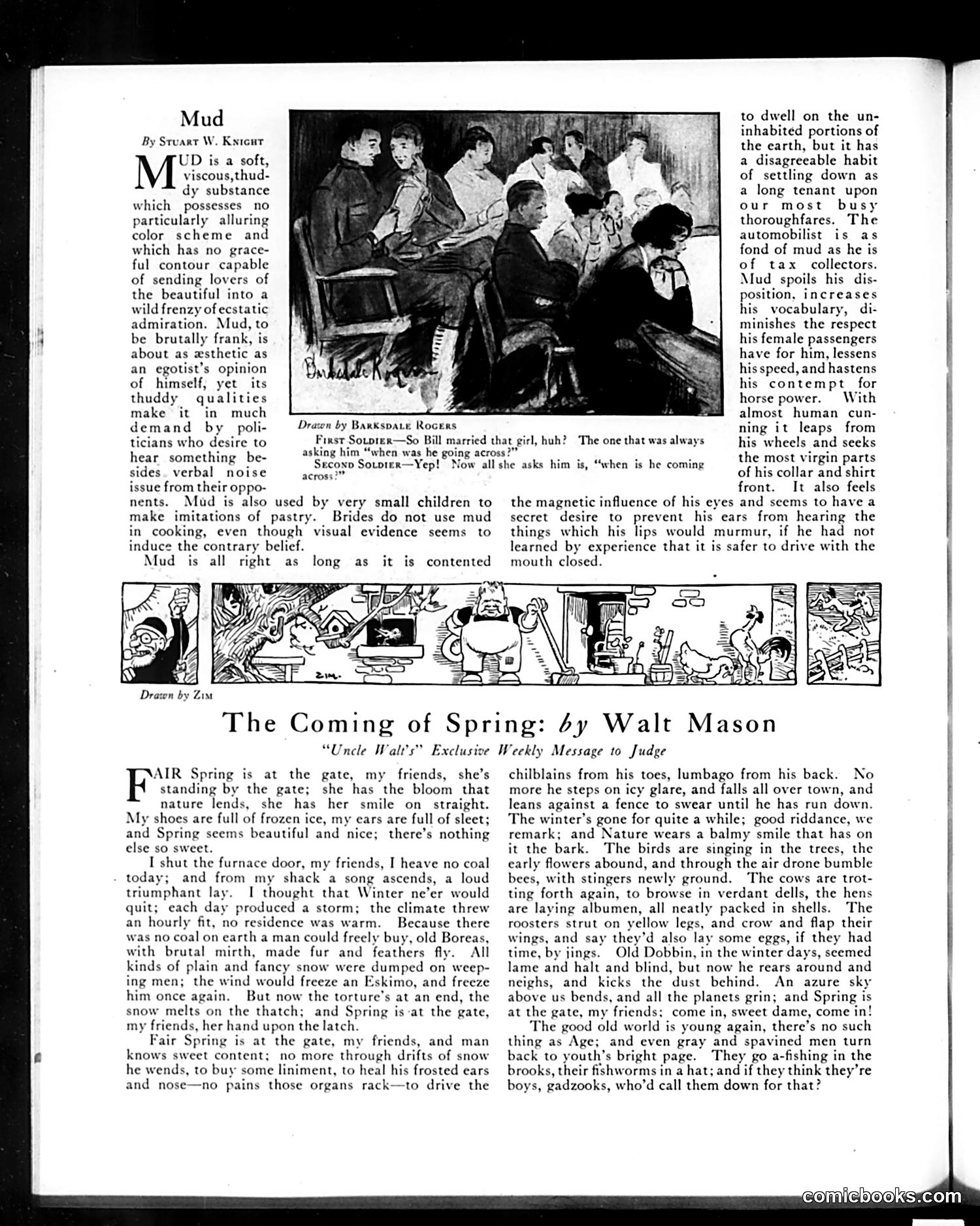
**"Mud" (by Stuart W. Knight):** A humorous essay-cartoon mocking mud as an aesthetic disaster, yet notes its paradoxical usefulness to politicians who "desire to hear something besides verbal noise" from opponents—a joke suggesting politicians fling mud (insults/attacks) at each other. The cartoon illustration shows soldiers in a trench, likely referencing WWI mud, making the political mockery darkly timely. The piece also jokes about mud ruining automobiles and motorists' moods, reflecting early-1900s concerns about cars as luxury items. **"The Coming of Spring" (by Walt Mason):** A cheerful seasonal poem celebrating winter's end. References frozen ears, sleet, coal shortages, and general winter misery ("Old Boreas"—the winter wind god). Spring brings relief: birds sing, cows return to pasture, hens lay eggs. The tone is sentimental nostalgia for simpler agricultural life, with comic relief in personifying spring as a welcoming woman "standing by the gate."
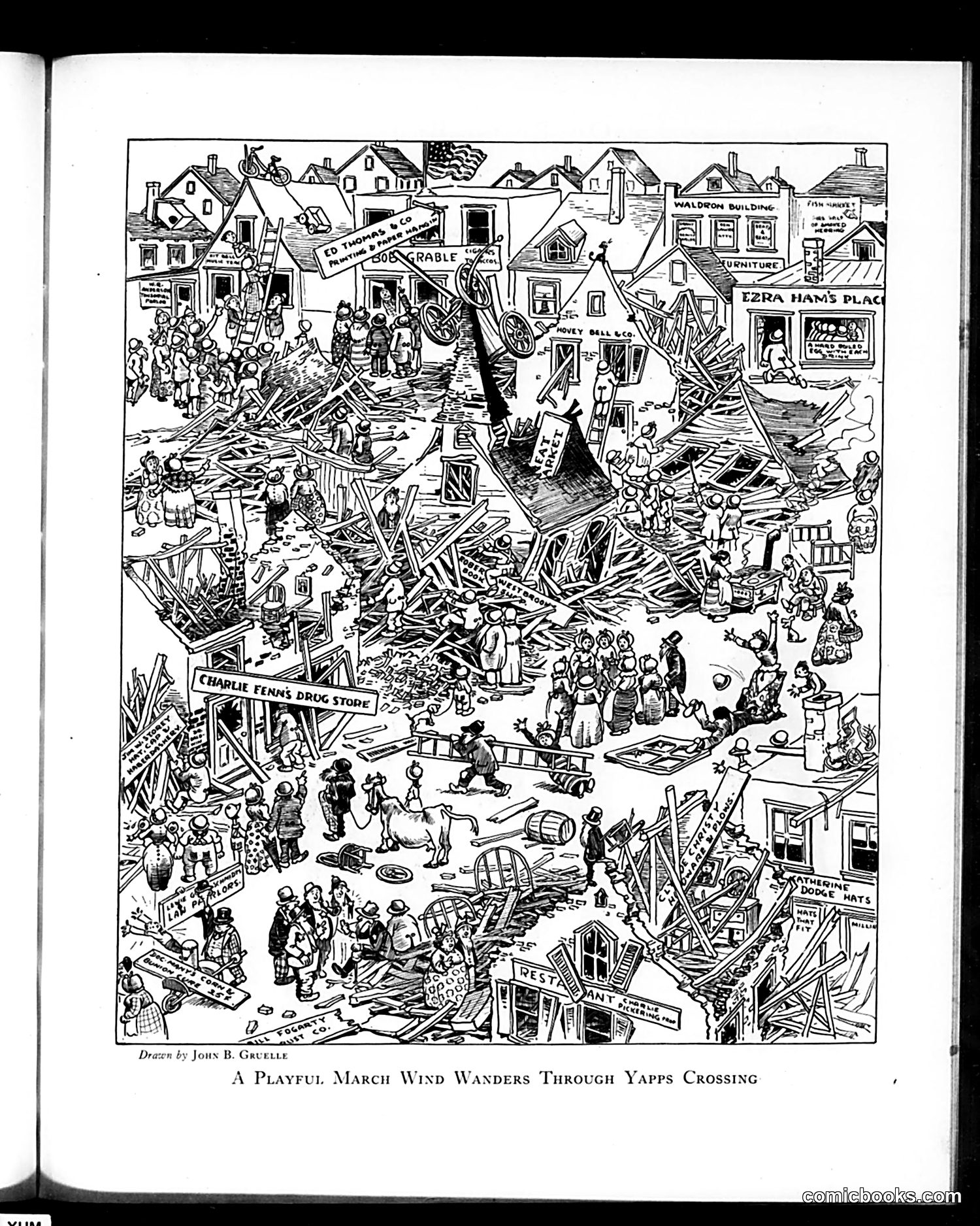
This illustration by John B. Gruells depicts a chaotic scene in a small town during windy weather. The "March wind" is personified as a mischievous force causing destruction—buildings damaged, debris scattered, people's clothing and possessions blown about. The cartoon satirizes the helplessness of ordinary citizens against natural forces beyond their control. Visible business signs include "Charlie Fenn's Drug Store," "Waldron's Building," and "Ezra Ham's Place," suggesting this represents a generic American small town rather than a specific location. The humor derives from the universal, relatable experience of spring weather chaos—the wind as an impish trickster disrupting everyday community life. It's gentle social satire about human vulnerability to nature's whims.
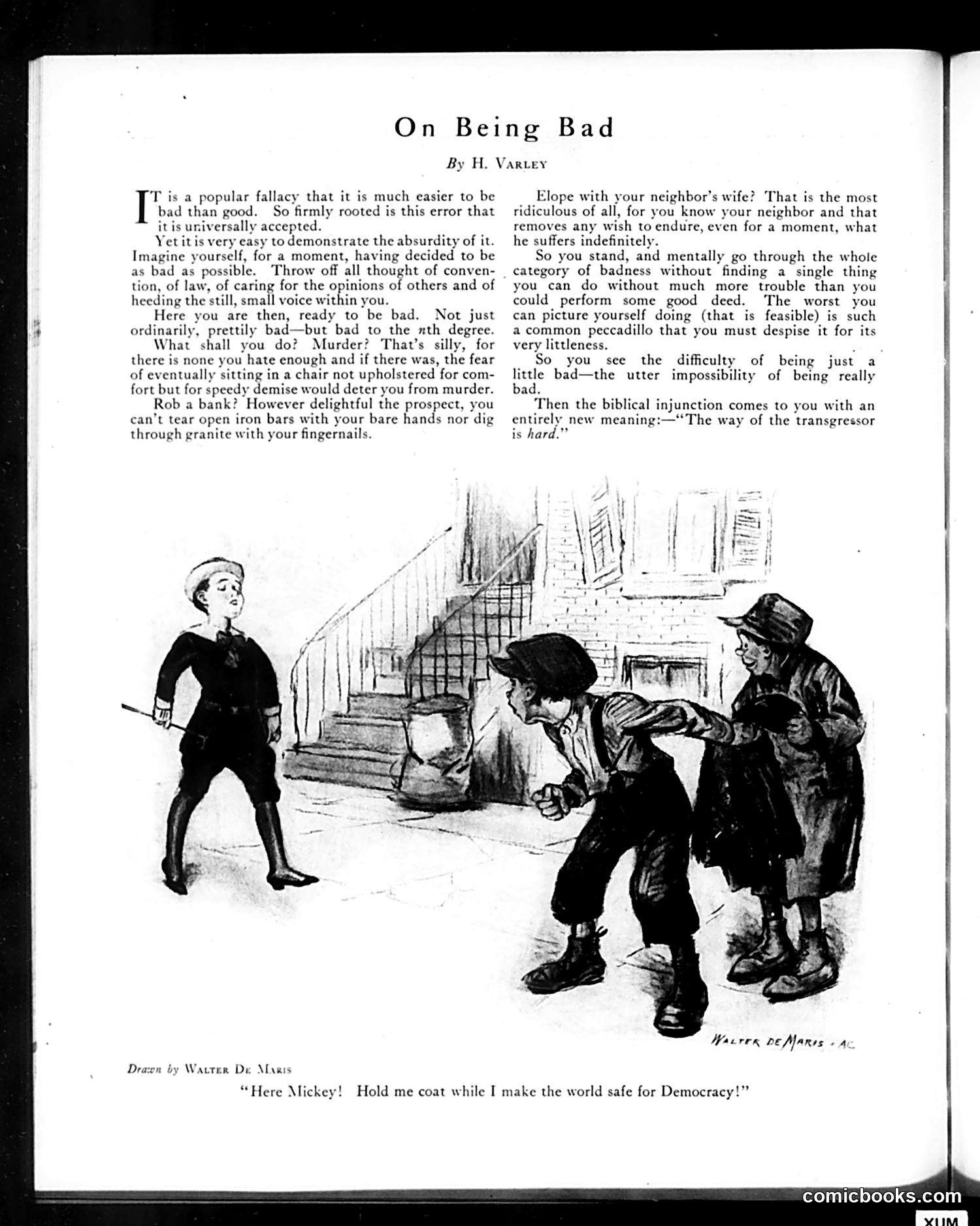
This page presents a philosophical essay by H. Varley arguing that being truly "bad" is actually *harder* than being good, because genuinely wicked acts require either immense effort or entail worse consequences than their perpetrator can endure. The accompanying cartoon by Walter De Maris satirizes this idea through a street scene where a young ruffian asks his friend to "hold my coat while I make the world safe for Democracy!" The humor lies in the contrast: the boy adopts grandiose, patriotic rhetoric ("make the world safe for Democracy"—likely referencing WWI-era propaganda) while preparing for what appears to be petty street violence. It mocks how people dress up minor misbehavior in lofty language, and suggests that even would-be troublemakers can't escape invoking noble ideals—supporting the essay's point that true, unvarnished badness is practically impossible.
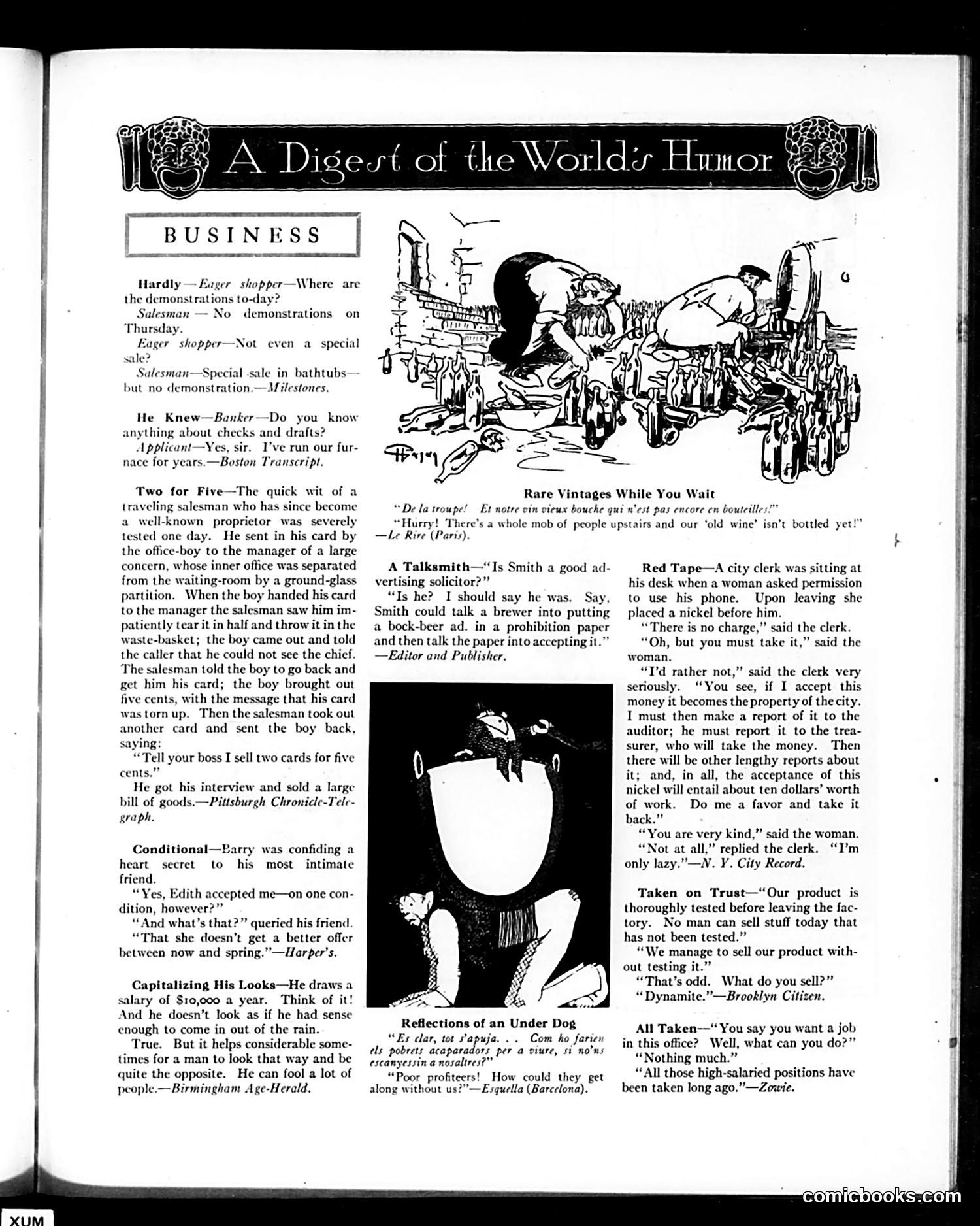
This page from Judge magazine presents business-themed humor satirizing early 20th-century commercial practices and workplace absurdities. The cartoons mock various business scenarios: a salesman's persistence (selling damaged business cards for five cents each to secure an interview), a banker's ignorance (confusing furnace operation with financial knowledge), and bureaucratic inefficiency (a city clerk explaining how accepting a nickel would trigger ten dollars' worth of paperwork). The "Red Tape" section particularly skewers government red tape—the clerk's elaborate explanation reveals how minor transactions create cascading administrative burdens, a timeless critique of bureaucracy. Other jokes target advertising solicitation, employee qualifications, and product testing claims. The foreign-language captions ("Rare Vintages While You Wait," references to Paris and Barcelona papers) suggest Judge's cosmopolitan readership appreciated international business humor. The central cartoon shows an exaggerated figure amid bottles, likely illustrating the wine-related humor in the French caption. Overall, the page satirizes commercial dishonesty, bureaucratic absurdity, and the gap between appearance and competence in business.
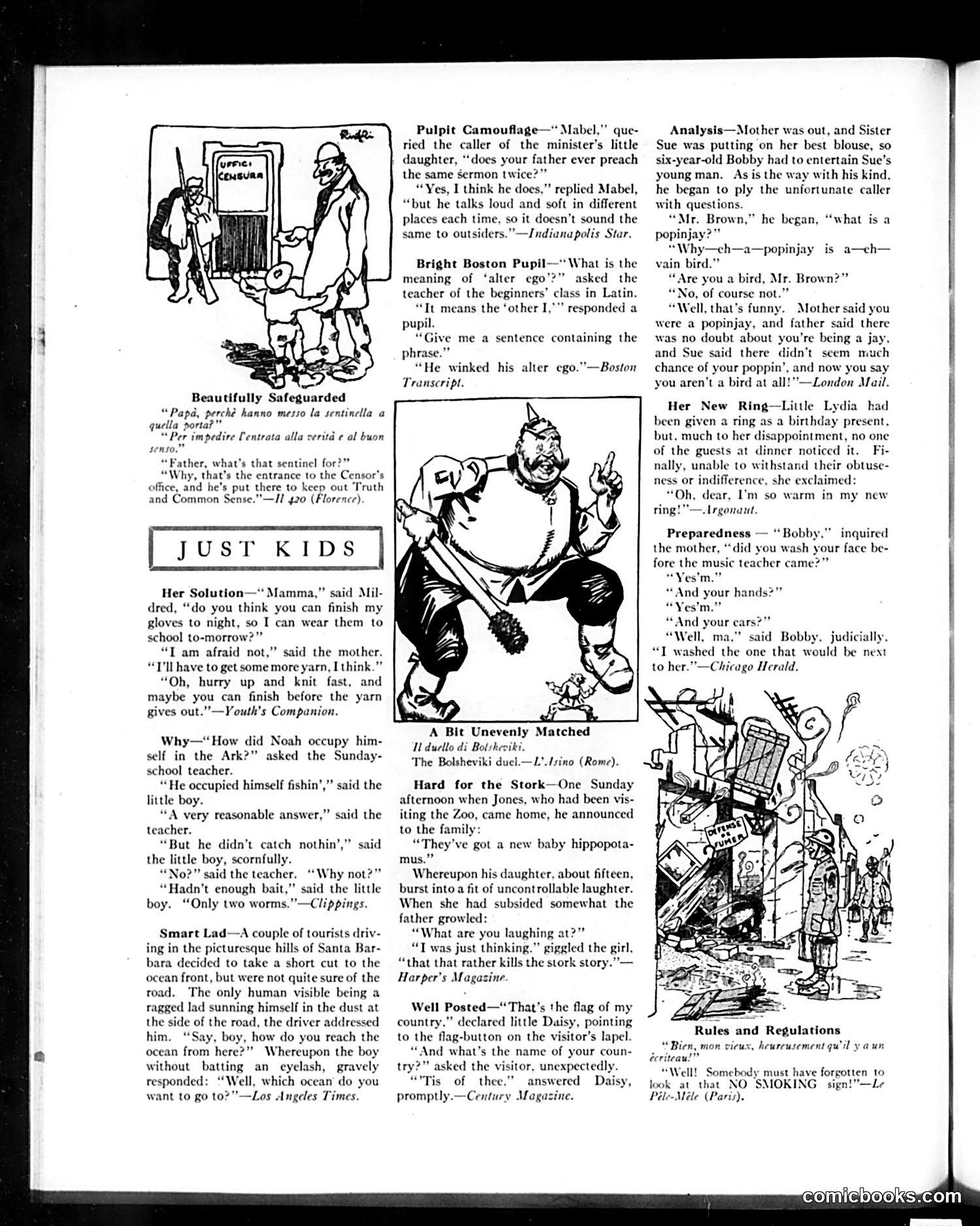
This page from the satirical magazine *Judge* contains multiple short humorous anecdotes aimed at early-20th-century American readers. **Key content:** - **"Beautifully Safeguarded"**: A reprinted Italian cartoon criticizing censorship, depicting a sentinel blocking Truth and Common Sense from entering a Censor's office—commentary on government suppression of information. - **"Just Kids" section**: A series of children's jokes playing on innocent misunderstandings and literal interpretations (Noah fishing in the Ark with only two worms as bait; a boy's clever non-answer about which ocean to reach). - **"Pulpit Camouflage"**: A joke about a minister recycling sermons but varying his delivery to disguise repetition—poking fun at clergy dishonesty. - **"A Bit Unevenly Matched"**: References a Bolshevik duel, likely alluding to post-Russian Revolution violence and instability. - **Other anecdotes**: Include wordplay (Latin "alter ego"), family humor about courtship ("popinjay"), and observational jokes about social etiquette. The page reflects early-20th-century American satirical humor targeting religion, politics, and domestic life.
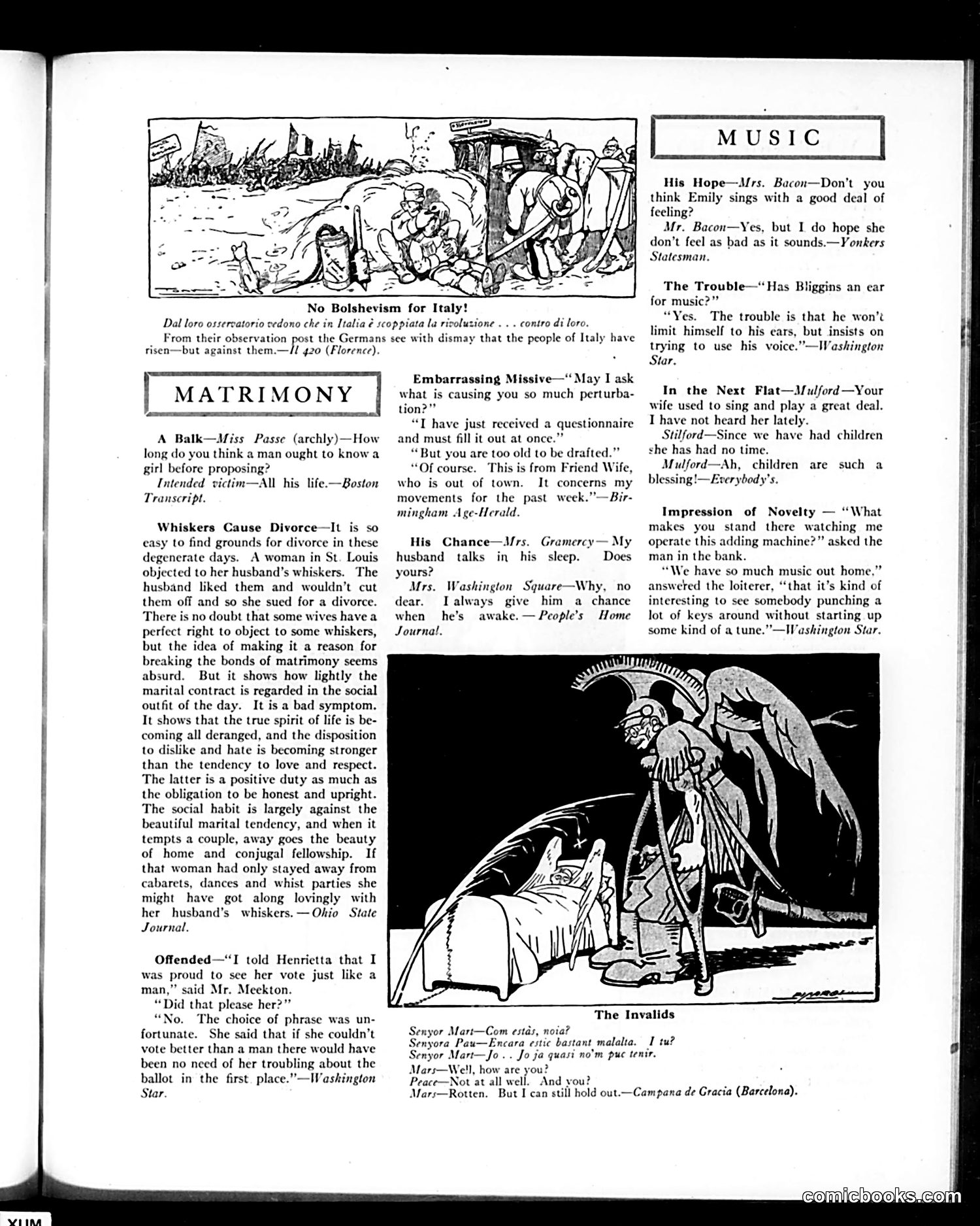
## Top Cartoon: "No Bolshevism for Italy!" This wartime cartoon depicts German military observers dismayed to see Italy rising in revolt—**against Germany**, not embracing Bolshevism as feared. The caption, quoted from a Florence source (II 420), suggests Germans worried Italian unrest meant communist revolution, but were relieved (or chagrined) to discover Italian dissent targeted German occupation instead. This likely references Italy's 1917-1918 military situation during WWI. ## "The Invalids" Cartoon (bottom) Shows two bedridden figures in what appears to be a Spanish dialogue (Barcelona source). One claims near-total incapacity ("I can barely hold myself together"), while the other insists "I can still hold out." The satire appears to mock exaggerated complaints about health or hardship—a commentary on wartime complaints or dramatic self-pity. ## Text Sections The "Matrimony" and "Music" sections contain brief humor items about marital discord, women's voting rights, and poor singing—social commentary typical of Judge's satirical format.
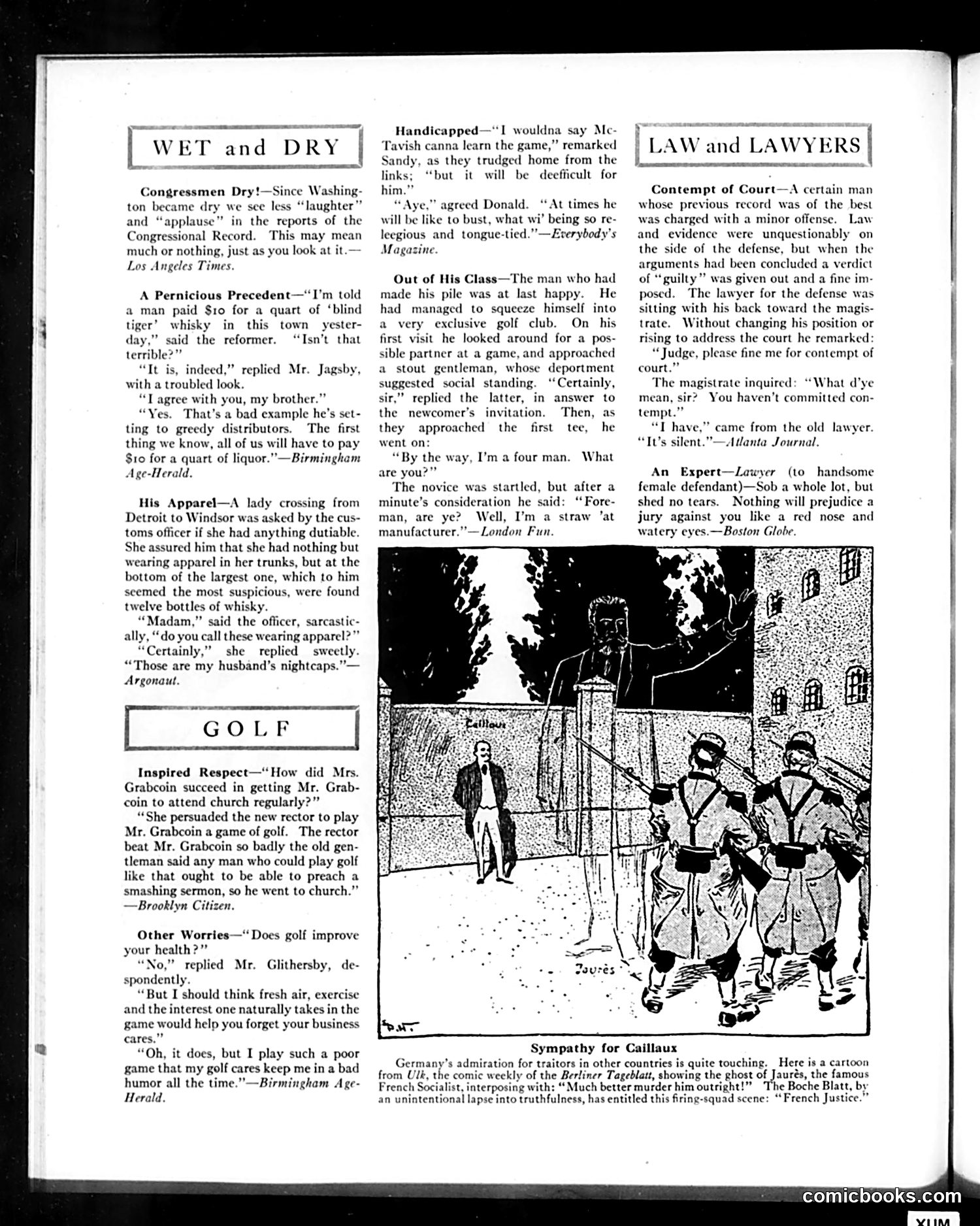
This satirical page from *Judge* magazine uses humor to mock Prohibition's effects and social hypocrisy circa the 1920s. **"Wet and Dry" section**: Jokes about Washington becoming "dry" (Prohibition-era) reducing Congressional laughter and applause—suggesting lawmakers are less jovial without alcohol. **Prohibition smuggling jokes**: Stories mock both Prohibition enforcement and evasion. One anecdote involves a Detroit woman smuggling whisky across the Canadian border, claiming twelve whisky bottles are her husband's "nightcaps"—a play on the double meaning of "cap" (hat vs. drink). **Golf section**: Multiple jokes use golf as social commentary. One notes that wealthy men desperate for respectability attend church if the rector plays golf well—satirizing superficial piety. Another mocks a nouveau-riche businessman trying to join an exclusive club but misunderstanding golf terminology ("four man" = golf handicap, which he confuses with "foreman"). **Law section**: Dry courtroom humor about legal procedure and lawyer tactics, including one about a lawyer expressing silent contempt of court. The overall tone ridicules Prohibition enforcement, class pretension, and social climbing during this era.
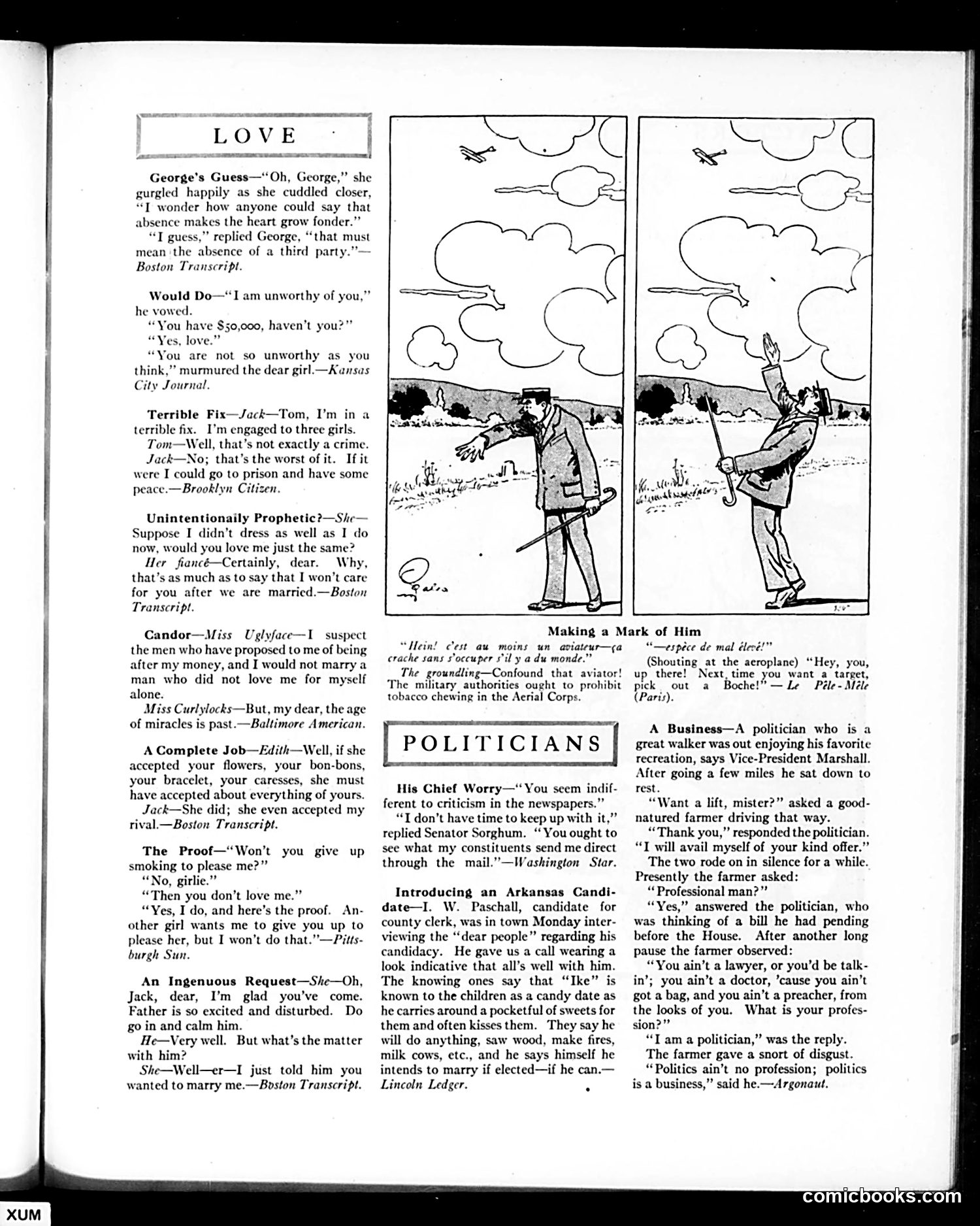
This Judge magazine page contains brief humorous anecdotes about romance and politics, plus two cartoons. The **"Making a Mark of Him"** cartoon shows a French aviator dropping something while flying, with a ground observer shouting at him in French—essentially calling him rude and suggesting he aim at German soldiers ("Boche") instead of civilians. The **"A Business"** section satirizes a politician's evasiveness: a farmer offers a ride to a walking politician, then asks if he's a professional man. The politician responds affirmatively but clearly isn't a lawyer (who would "talk" more). The joke implies politicians are their own profession—characterized by vagueness and unwillingness to communicate clearly. The brief love anecdotes use stock humor about courtship, money, infidelity, and engagement—typical early 20th-century magazine filler. The Arkansas candidate story mocks a local politician who bribes children with candy to win votes and promises to marry if elected (implying desperation).
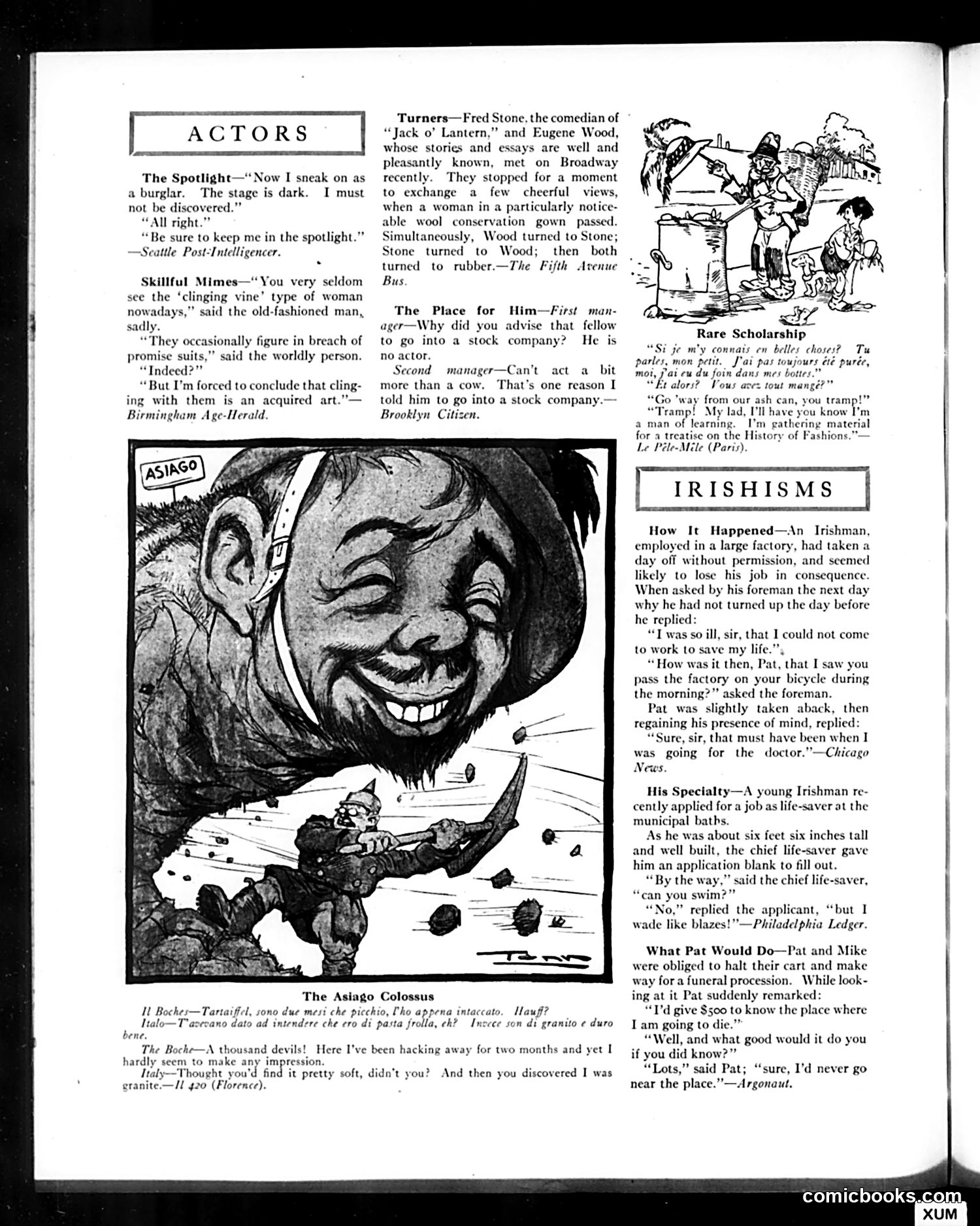
**The Main Cartoon: "The Asiago Colossus"** This depicts a WWI-era caricature conflict. An Italian soldier (labeled "Italo") hammers away at a granite figure labeled "The Boche" (German slur). The Italian complains he's been attacking for two months with barely an impact, having expected soft material ("pasta frolla"—soft pastry). The Boche responds that the Italian thought he was made of soft stuff, but discovered he's granite—hard and durable. **Context:** This satirizes the Italian front's brutal stalemate during World War I. Italy entered in 1915 and faced unexpectedly fierce German/Austrian resistance, particularly in mountainous terrain. The joke mocks Italian military struggles against entrenched Germanic forces. **Other Sections:** The page also contains brief theatrical anecdotes and "Irishisms"—ethnic humor stereotyping Irish workers as dim-witted, featuring mishaps involving excuses and malapropisms. This was standard Judge content of the era.
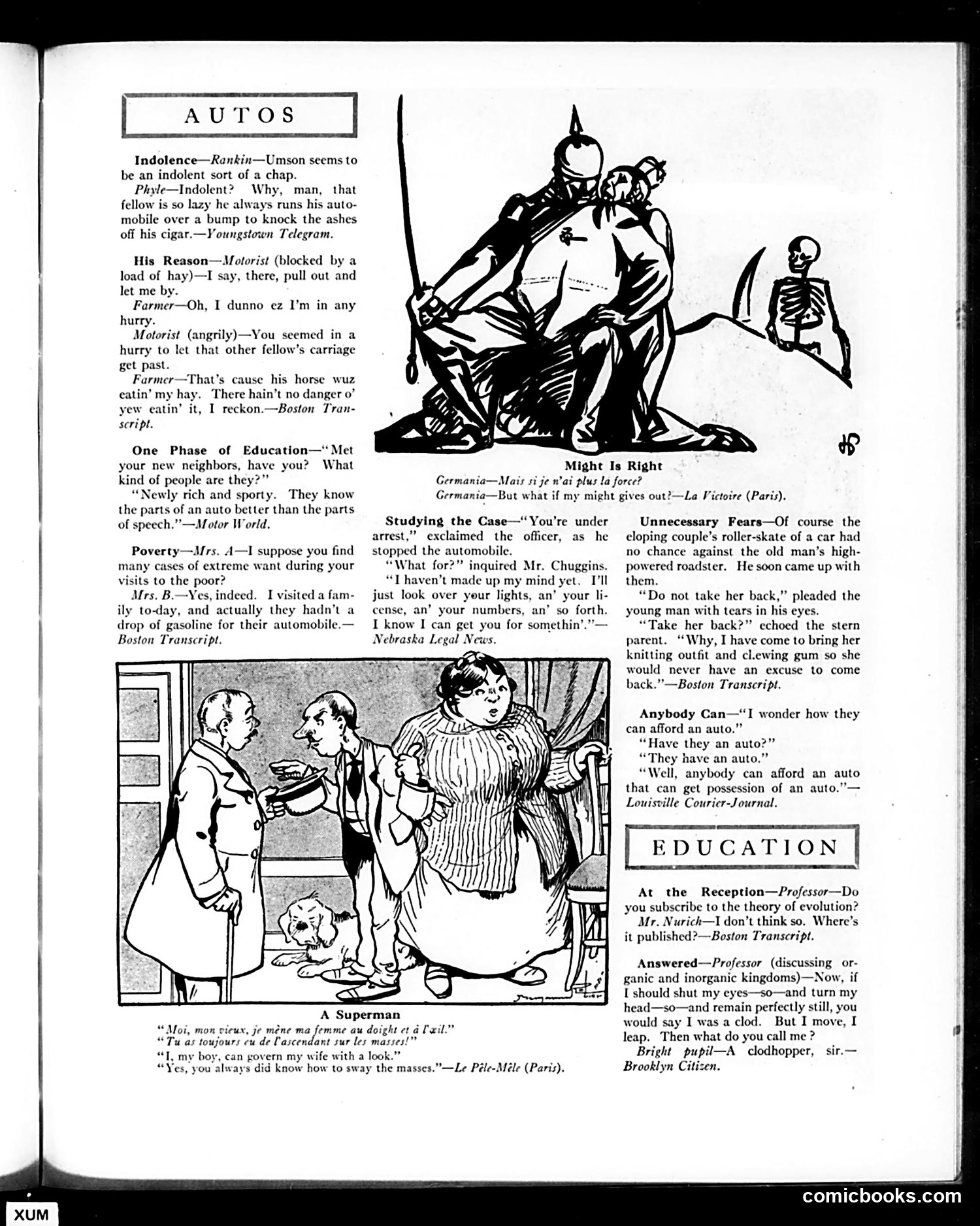
This page collects humorous short anecdotes about automobiles and education, typical of Judge's satirical format. **"AUTOS" section:** These jokes mock early 20th-century automobile culture—the newfound obsession with cars among the wealthy and newly prosperous. They satirize: - Lazy rich people ("runs his automobile over a bump to knock ashes off his cigar") - Class anxiety: poor families sacrificing essentials for gasoline - Auto-related arrogance and pretension - The "newly rich" who understand cars better than basic education **"Might Is Right"** cartoon references WWI-era politics, showing Germania (Germany personified) asking if her power will fail—likely commentary on German military strength during the conflict. **"A Superman"** is a French domestic humor piece about a man claiming to control his wife—a pun on "masses" (crowds vs. wives). **"EDUCATION" section:** Light jokes mocking academia and student responses, including wordplay about evolution and a clever pun on "clodhopper" (farm laborer vs. clod that hops/moves). The overall tone reflects pre-1920s American middle-class anxieties about technology, class mobility, and education.
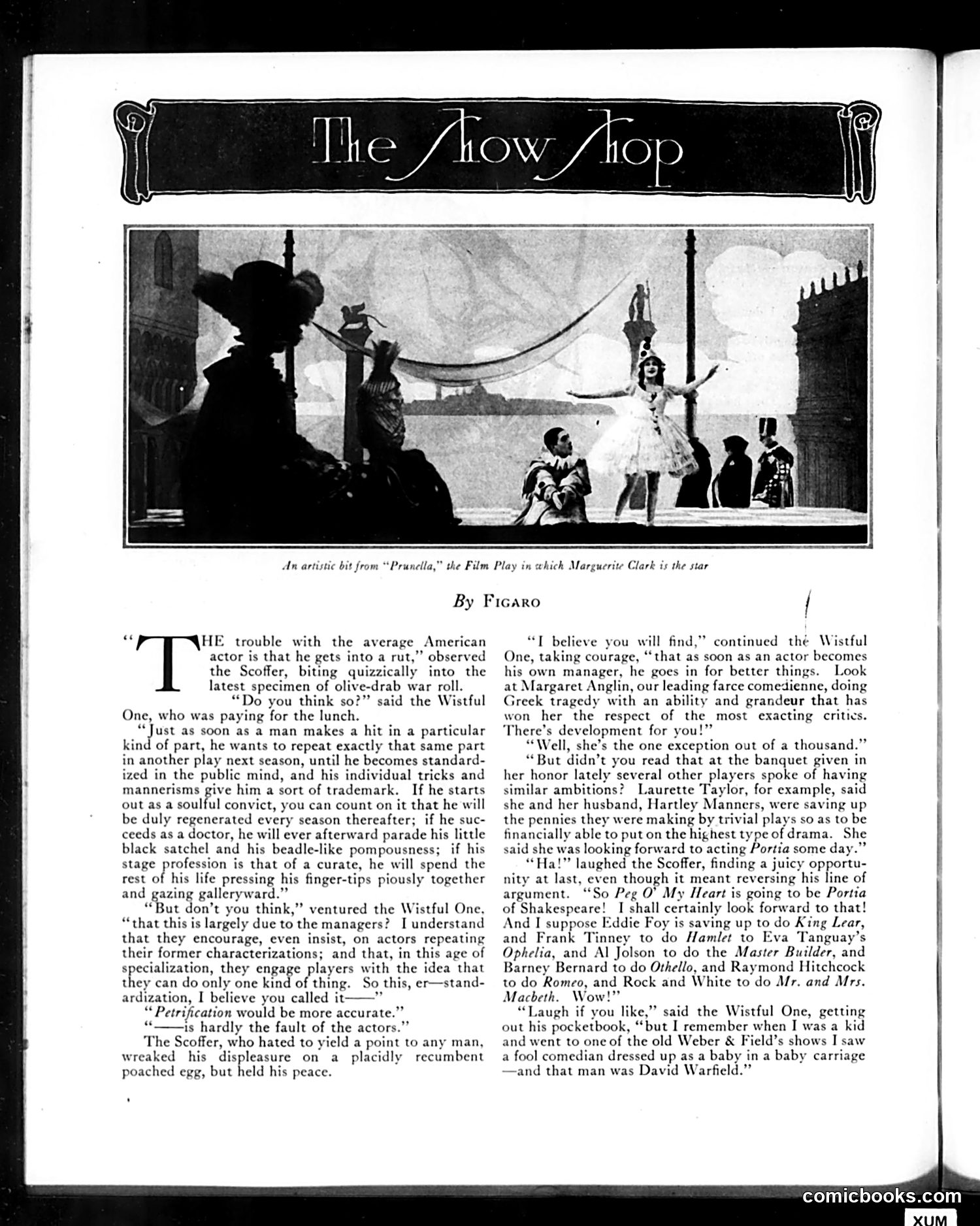
This page from *Judge* presents a dialogue between two characters—the Scoffer and the Wistful One—debating whether American actors become typecast and standardized in their roles. The illustration at top shows a scene from "Prunella," a contemporary theatrical production starring Marguerite Clark, establishing the theatrical context. The Scoffer argues actors repeat successful character types endlessly, becoming walking trademarks. The Wistful One counters that managers enforce this limitation, and cites **Margaret Anglin** as proof: a farce comedienne who successfully transitioned to serious Greek tragedy, earning critical respect. He mentions **Laurette Taylor** and **Hartley Manners** saving money to produce quality drama. The Scoffer ridicules this optimism by listing low-comedy performers (Eddie Foy, Frank Tinney, Al Jolson, Barney Bernard, Raymond Hitchcock) attempting Shakespeare—absurd propositions that mock the Wistful One's faith in actors' development. The Wistful One's final trump: **David Warfield**, once a comedic fool in Weber & Field's shows, became a serious dramatic actor—proving career transformation possible. The satire targets both artistic pretension and the entertainment industry's rigid conventions.
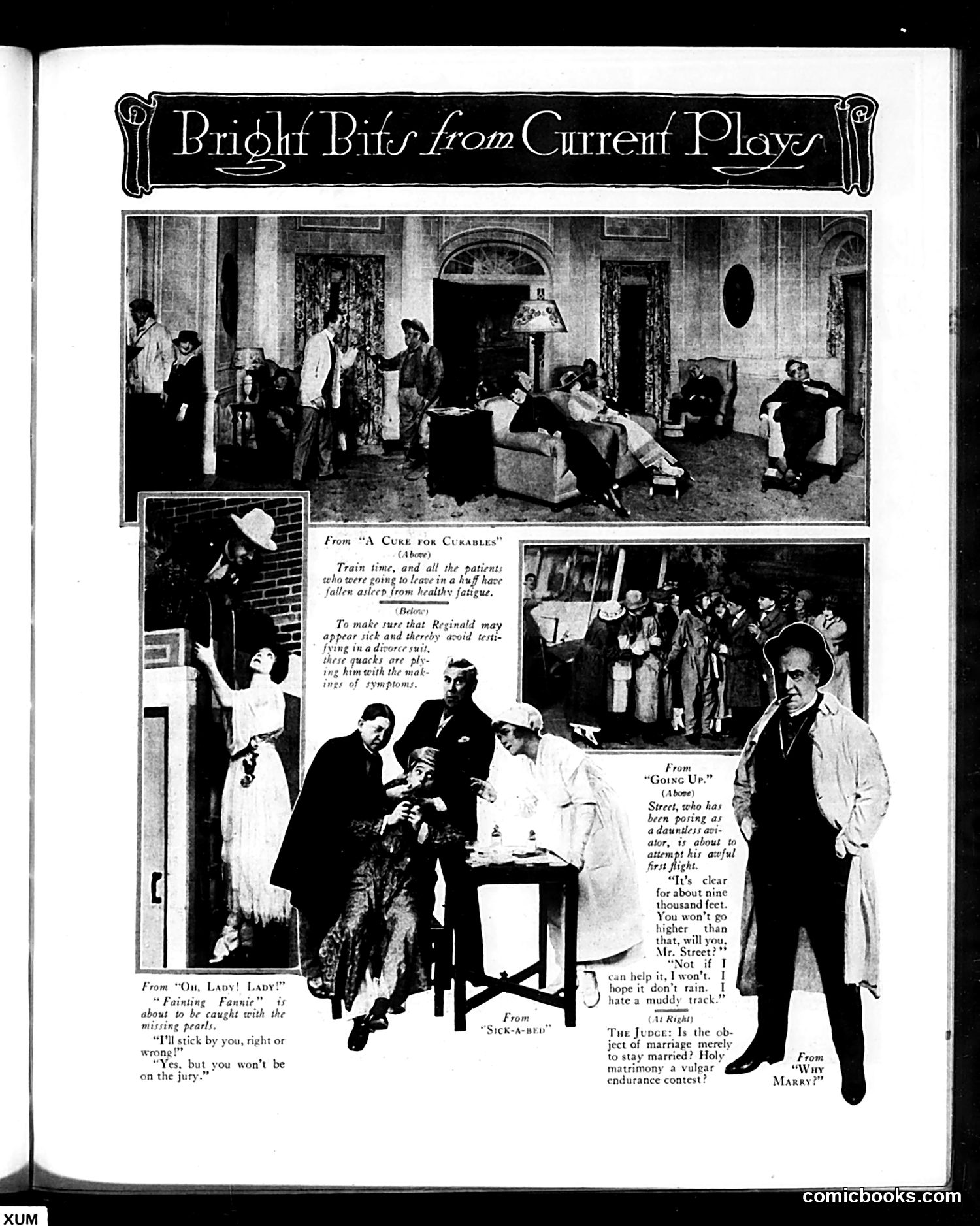
This page presents satirical scenes from contemporary theatrical productions. The layout shows multiple vignettes with accompanying dialogue snippets: **"A Cure for Curates"** (top): Depicts a domestic interior where characters discuss a patient suffering from "healthy fatigue," with medical intervention implied. **"Oh, Lady! Lady!"** (left): Shows a couple, with dialogue about being "caught with the missing pearls"—apparently a theft plot device, with a jury reference suggesting legal consequences. **"Going Up"** (center-right): Features a character posed as an aviator about to attempt flight, with nervous reassurances about altitude limits and weather concerns—likely comedic because early aviation stunts were genuinely dangerous. **"Sick-a-bed"** (lower center): A brief scene in an unspecified scenario. **"Why Marry?"** (right): Shows a man, with text questioning whether marriage is merely "a vulgar endurance contest." These appear to be promotional materials highlighting comedic moments from Broadway plays of the era, designed to entertain readers while advertising current theatrical productions.
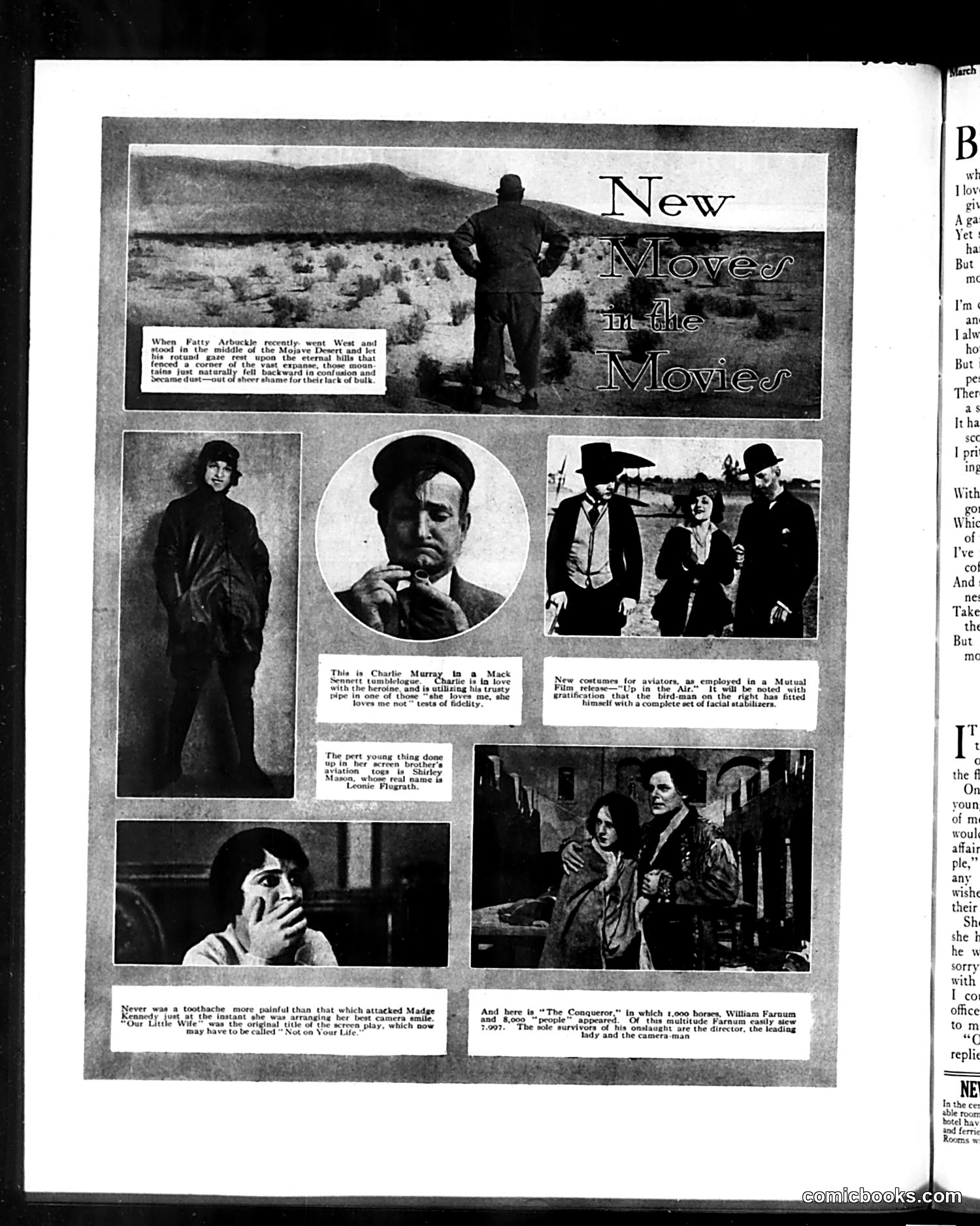
This page surveys recent film productions and their innovations. The headline references Fatty Arbuckle's recent western shoot in the Mojave Desert, where he employed new filmmaking techniques—described humorously as "she loves me not" tests of fidelity with the heroine. Other films highlighted include one featuring Charlie Murray in a dramatic role, and "The Conqueror" starring William Farnum, which used 1,000 horses and elaborate facial makeup/costumes for aviators. The page celebrates what appear to be technical or narrative innovations in silent cinema—larger-scale productions, new makeup techniques, and stunt work. The tone is lighthearted promotion of emerging film industry practices rather than political satire. This reflects Judge's coverage of contemporary popular entertainment during the early silent film era.
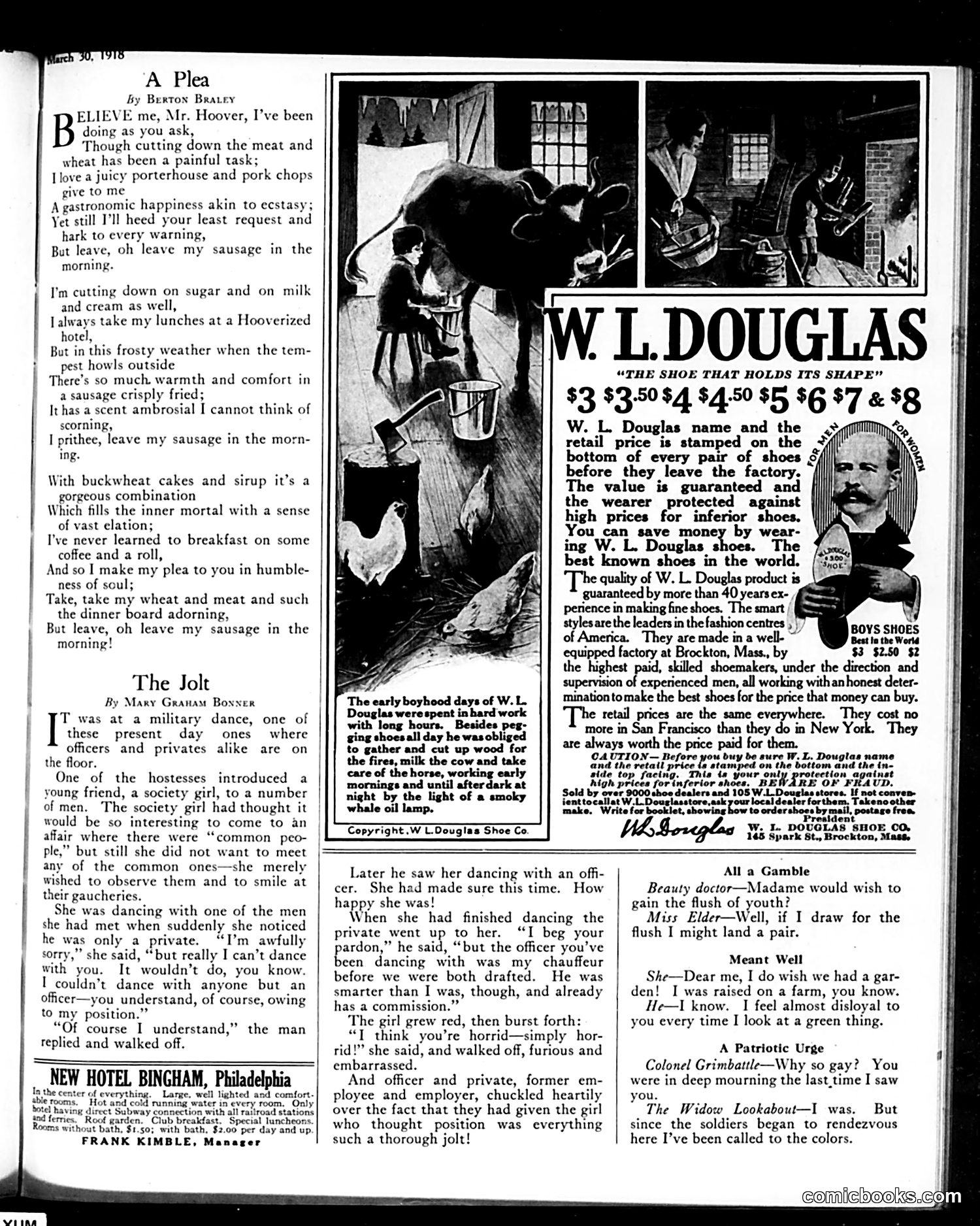
This page contains two satirical pieces about wartime rationing and social class, plus advertising. **"A Plea" by Berton Braley** addresses Herbert Hoover, the Food Administrator directing voluntary rationing during World War I. The poem pleads to maintain sausage for breakfast while accepting cuts to meat, sugar, milk, and cream—mocking Americans' selective compliance with patriotic sacrifice. The joke: citizens will endure significant deprivation but draw the line at losing comfort foods. **"The Jolt" by Mary Graham Bonner** satirizes class pretension. A society woman attends a military dance to observe "common people" but refuses to dance with an enlisted man, claiming her social position forbids it. When he agrees she's right and walks away unperturbed, she experiences the humbling "jolt" of discovering a working-class soldier won't pursue her—deflating her snobbery. The W.L. Douglas shoe advertisement occupies the right column with vintage testimonial marketing about the founder's humble origins and product quality guarantees. The page reflects 1918 wartime attitudes: civilian sacrifice, military-civilian social friction, and class anxiety.
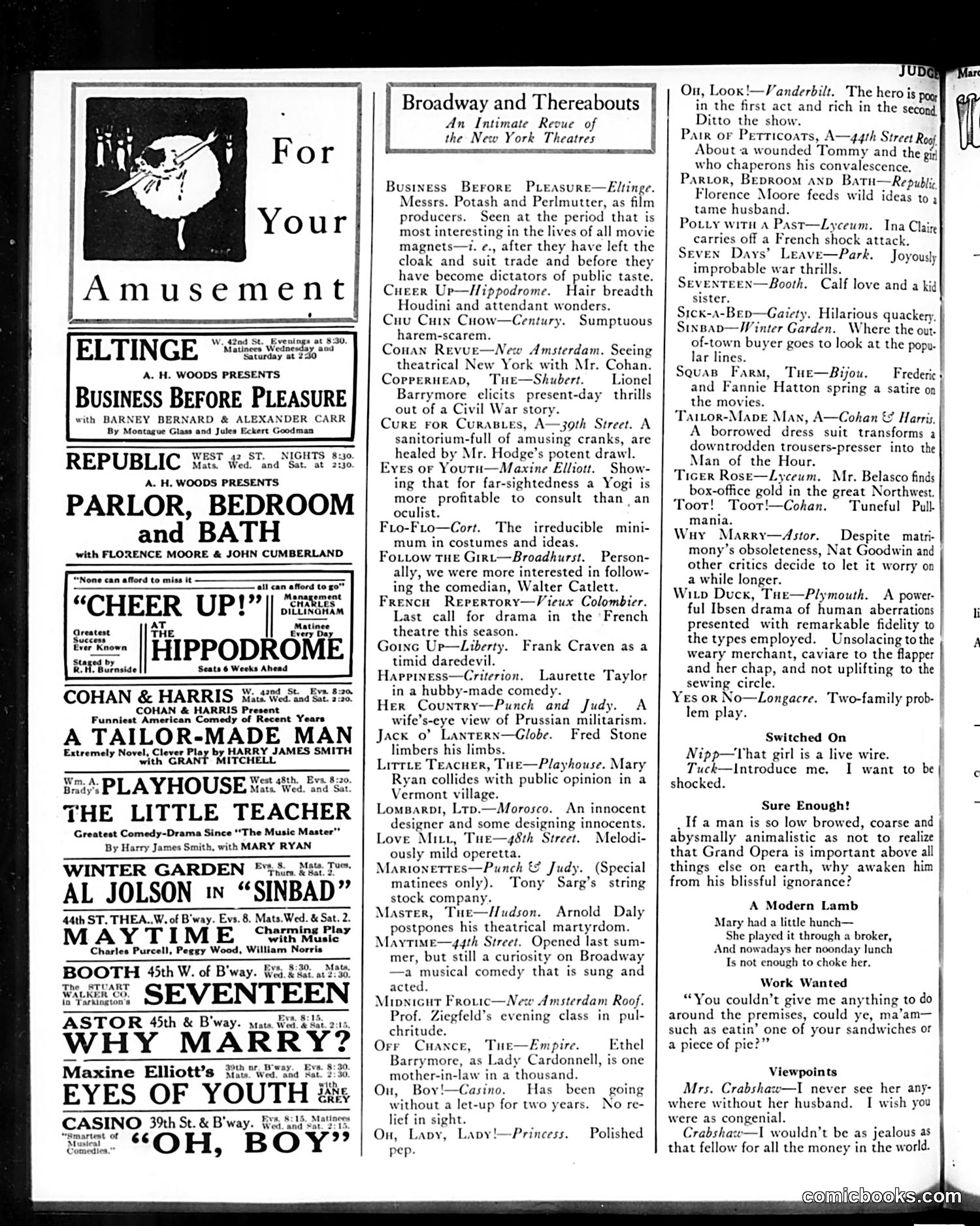
This is primarily a **theater listings and review page** from Judge magazine, not a political cartoon. The dominant content is advertising for Broadway shows (circa 1918, based on titles like "Sinbad" with Al Jolson and "Oh, Boy!"). The small illustrated header reading "For Your Amusement" features a stylized figure in classical dress—likely representing theatrical entertainment itself rather than a specific political figure or caricature. The text consists of brief, witty capsule reviews of current Broadway productions. The humor is theatrical rather than political—for example, mocking a show about movie producers who've "left the cloak and suit trade" (immigrant Jewish garment workers becoming film moguls), or noting that "Eyes of Youth" suggests "a Yogi is more profitable to consult than an oculist." This reflects Judge's role as a cultural commentary magazine covering New York's entertainment scene, not primarily political satire.
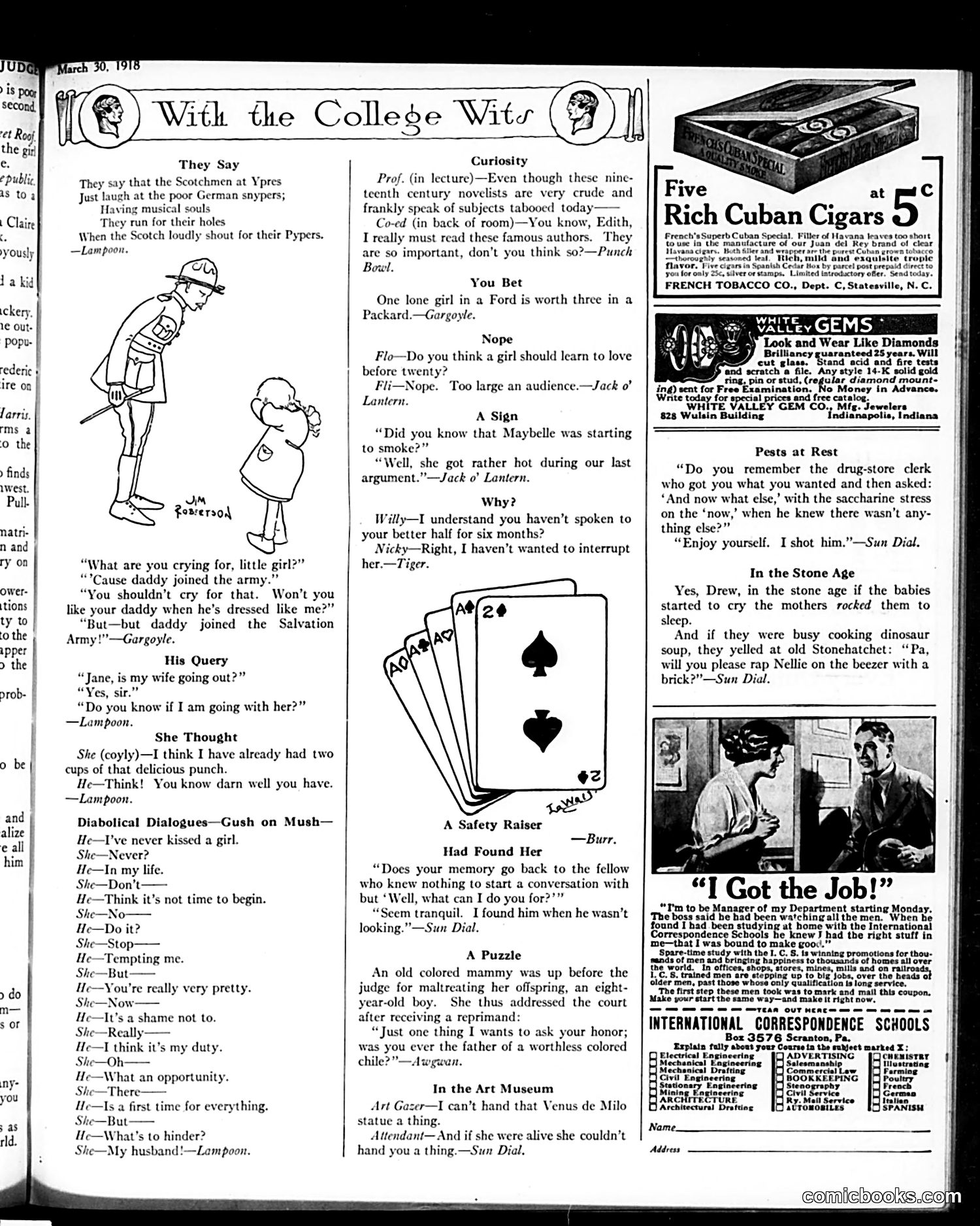
This page collects brief humorous anecdotes from college humor magazines (Lampoon, Gargoyle, Punch Bowl, etc.), typical of Judge's format. The jokes reflect early 20th-century college life and gender dynamics: **Key themes:** - **Military references**: A Scotsman joke about WWI trenches at Ypres (topical—America entered the war in 1917) - **Gender/courtship humor**: Multiple dialogues about kissing, romance, and marriage—often depicting women as coy or marriage-averse - **Class commentary**: A joke where a Black woman questions a judge's parenting authority, inverting expected power dynamics through humor **The cartoons** (by Robertson) show simple domestic scenes emphasizing sentimental or absurd moments. The advertisements (Cuban cigars, costume jewelry, correspondence schools) are typical period commercial content. The overall tone reflects pre-modern attitudes toward women, race, and relationships that would seem dated or offensive today.
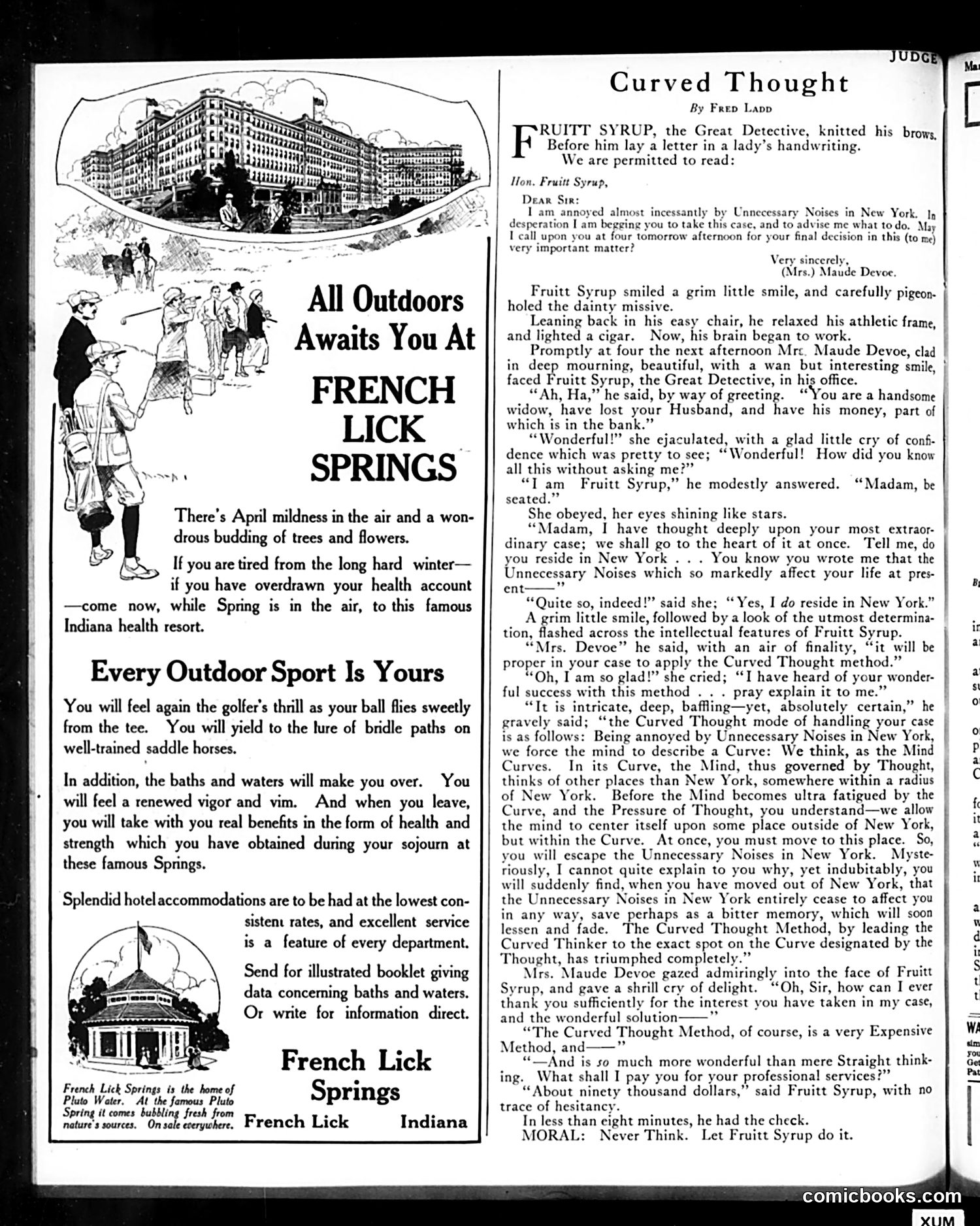
This page contains two distinct elements: a **health resort advertisement** (left) and a **satirical detective story** (right). The left side advertises French Lick Springs, an Indiana spa promising health restoration through mineral waters and outdoor activities—typical early 20th-century wellness marketing. The right side parodies detective fiction through "Fruitt Syrup, the Great Detective." A widow complains of "Unnecessary Noises in New York" and seeks his help. Syrup's absurd solution is the "Curved Thought Method"—a pseudo-scientific technique involving mental exercises to redirect one's mind away from the problem by thinking in "curves." The satire mocks both detective fiction's contrived plotting and the era's pseudo-scientific self-help solutions. The joke is that Syrup's elaborate "method" is essentially useless nonsense dressed in intellectual language—the detective solves nothing but impresses through sheer confidence and jargon. This reflects Judge magazine's tradition of lampooning contemporary fads and literary clichés.
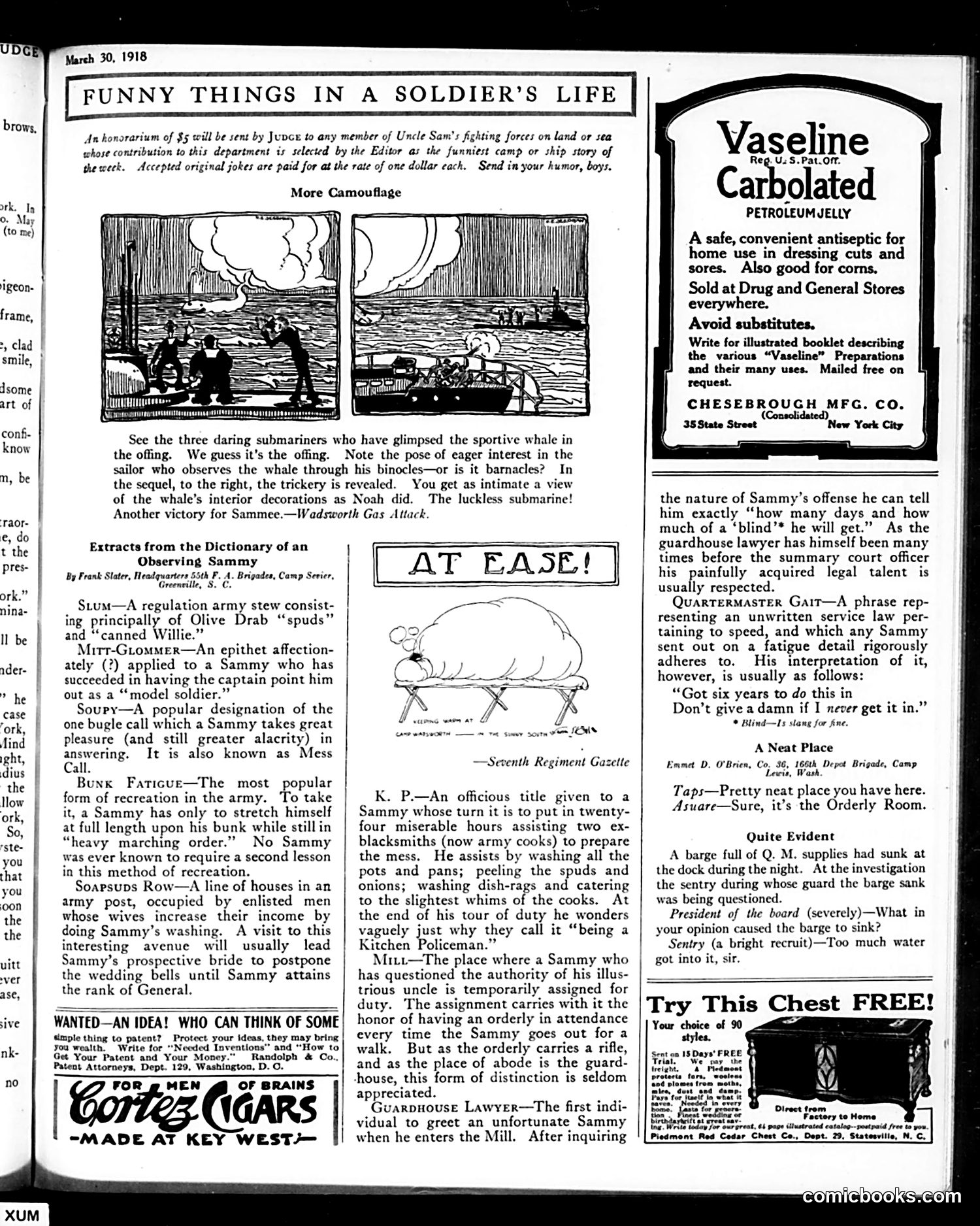
This page consists primarily of military humor submitted by soldiers during World War I, offering $5 rewards for published contributions. **The cartoon ("More Camouflage")** depicts a trickery joke: three submarine sailors observe what they believe is a whale through binoculars, but the "punchline" (right panel) reveals it was actually an optical illusion—the whale's perceived size derives from the submarine's interior. The joke satirizes wartime vigilance and misidentification of enemy threats. **"Dictionary of an Observing Sammy"** provides soldier slang definitions mocking military life: "Stum" (army stew), "Bunk Fatigue" (sleeping in full gear), "K.P." (kitchen duty), and "Guardhouse Lawyer" (a prisoner). These entries humorously capture common soldier complaints—poor food, exhausting work details, and military punishment. The advertisements (Vaseline, cigars, a patent office) are secondary. The page's purpose is morale-building humor for soldiers and folks supporting the war effort through light ridicule of military inconveniences.
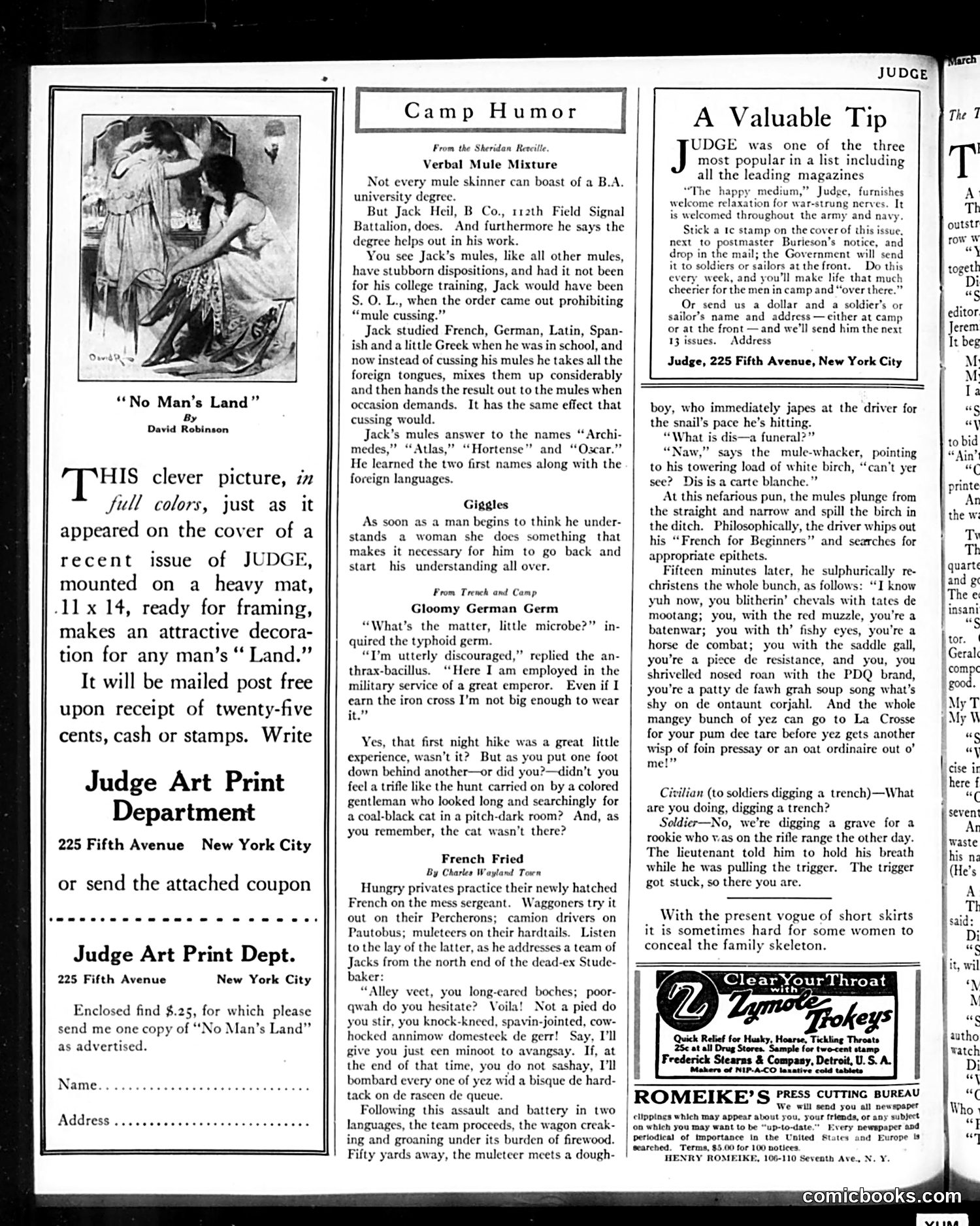
This is primarily an **advertising and humor page** from Judge magazine, likely from WWI era (references to military camps, soldiers, and trench warfare date it). **Main Content:** The large illustration "No Man's Land" by David Robinson depicts a woman in flowing dress—likely representing the concept of "no man's land" (the deadly space between trench lines). Judge is selling framed prints for 25 cents. **Humor Sections:** The page contains three military-themed jokes: 1. **"Verbal Mule Mixture"**: A college-educated mule skinner curses his animals in multiple foreign languages instead of English, since military regulations banned "mule cussing." 2. **"Gloomy German Germ"**: A bacteria laments earning a military medal too small to wear. 3. **"French Fried"**: Soldiers butcher French phrases when commanding army mules and horses. **The Satire:** These pieces mock soldiers attempting to follow military bureaucracy (the profanity ban) and the comic efforts of American troops learning foreign languages during WWI service.
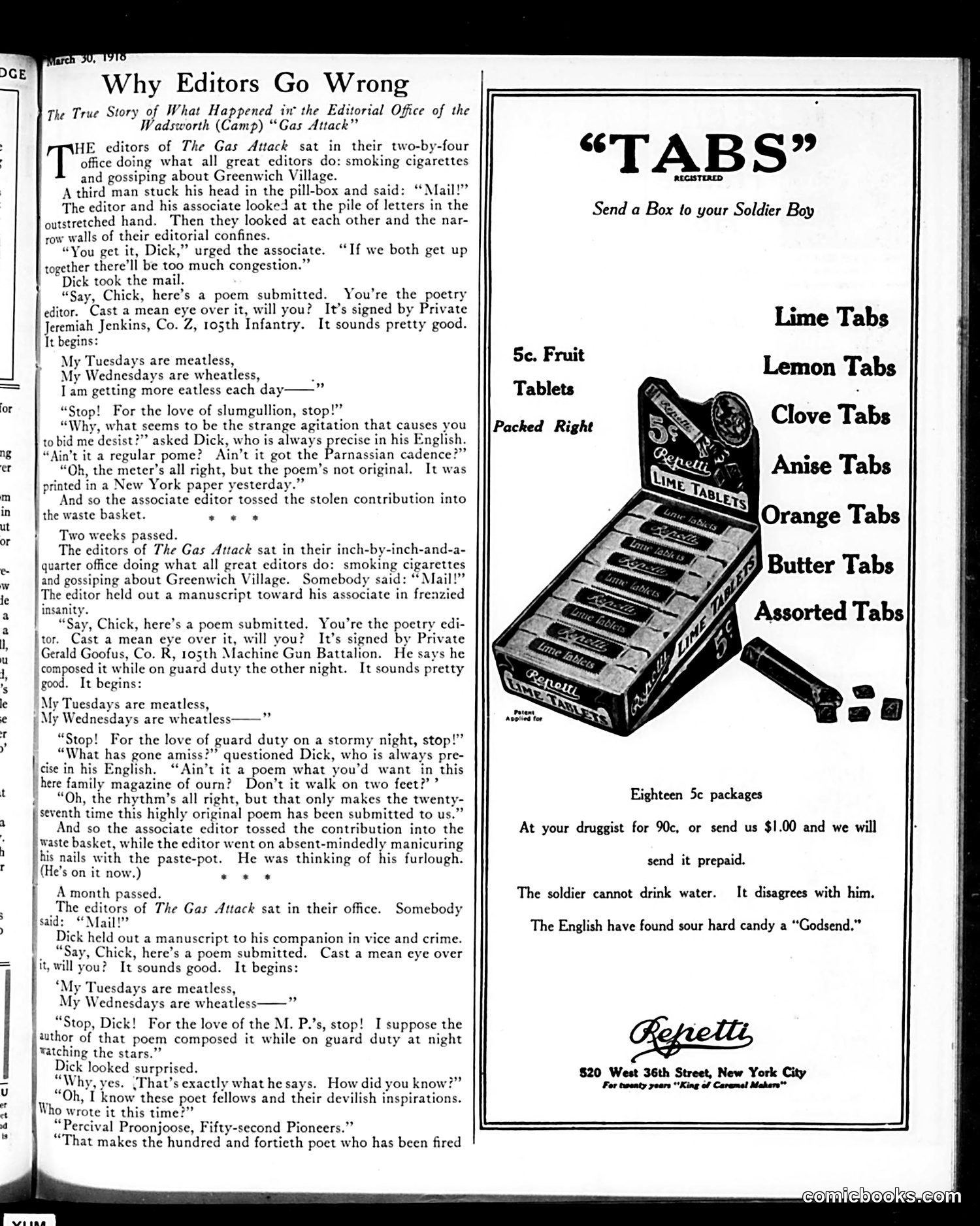
This is a humorous piece about editorial incompetence at *The Gas Attack*, a military camp publication (likely at Camp Wadsworth). The satire depicts editors repeatedly rejecting a banal wartime poem—"My Tuesdays are meatless, / My Wednesdays are wheatless"—as plagiarized or unoriginal, only to receive the identical submission over and over from different soldiers. The joke hinges on irony: the editors' confidence in catching plagiarism is undermined when they realize the poem circulates so widely among soldiers that over 140 different men have independently submitted it, each claiming authorship. The piece mocks both military bureaucracy and editorial pretension, suggesting soldiers are producing identical mediocre verse while editors remain oblivious to the poem's ubiquity. References to "M.P.'s" (military police) and "Pioneers" ground it in WWI-era army structure.
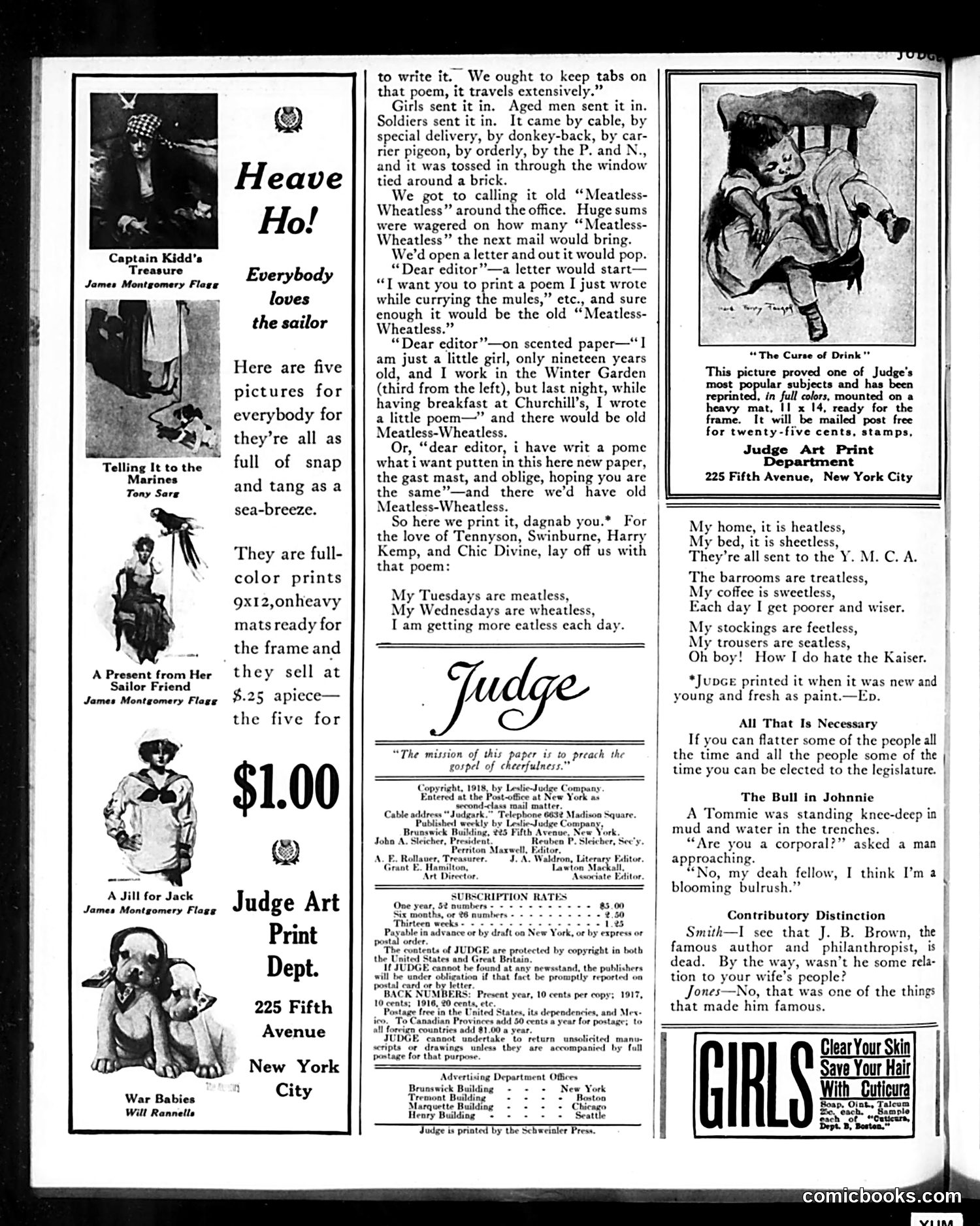
This page from Judge magazine (1918) satirizes Americans' response to World War I rationing. The central humor involves an overused poem about "Meatless-Wheatless" days—wartime food restrictions where citizens avoided meat on certain days and wheat on others to support the war effort. The editorial describes how this doggerel poem flooded the magazine's mailbox from soldiers, office workers, and civilians, becoming an annoying cultural phenomenon. The satire mocks both the poem's poor quality and the public's earnest participation in rationing sacrifice. The reprinted verses parody the original, extending the complaint to include "heatless," "sheetless," and "seatless" days—expanding wartime deprivation into absurdity. The final couplet references the Kaiser (German emperor), linking domestic sacrifice to anti-German sentiment. The page also advertises Judge's art prints, exploiting the magazine's popularity during this patriotic moment.
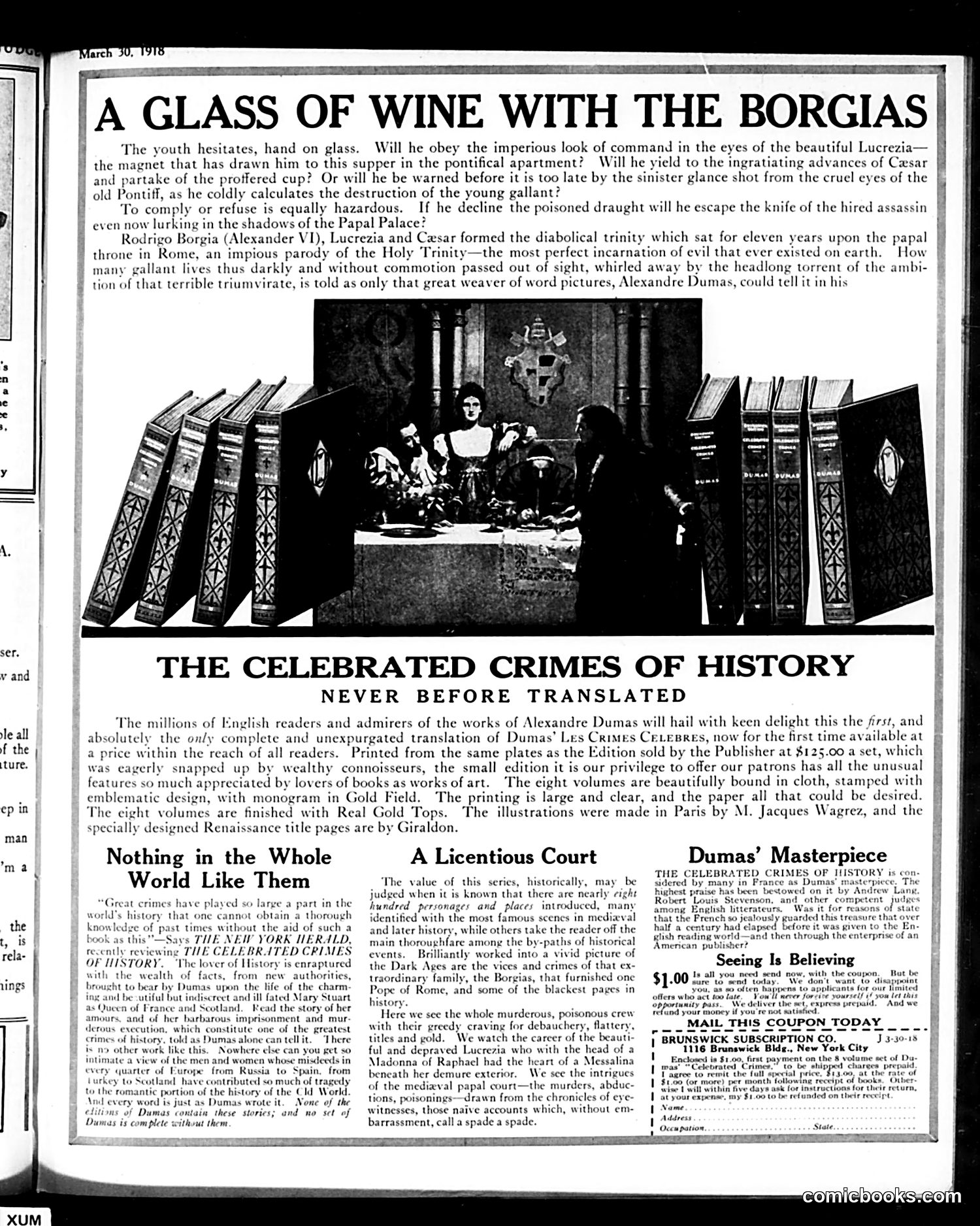
This page is primarily **advertising** for a book subscription rather than political satire. It promotes Alexandre Dumas's *Les Crimes Célèbres* (The Celebrated Crimes of History), specifically a new English translation focusing on the Borgia family. The header illustration depicts a famous historical scenario: a young man hesitating whether to drink poisoned wine offered by **Lucrezia Borgia** (the beautiful woman), while her father **Pope Alexander VI** (the elderly man) watches coldly, and danger lurks nearby. This dramatizes the Borgia family's historical reputation for murder and poisoning during their rule in Renaissance Rome. The advertisement emphasizes this as the "first" complete English translation at an affordable price (previously only available in expensive $125 sets). It appeals to readers' fascination with historical crime and danger, positioning Dumas as the definitive storyteller of these "celebrated crimes." The elaborate binding and gold-topped pages suggest a luxury product marketed to educated, affluent readers who appreciated fine books and sensational history.
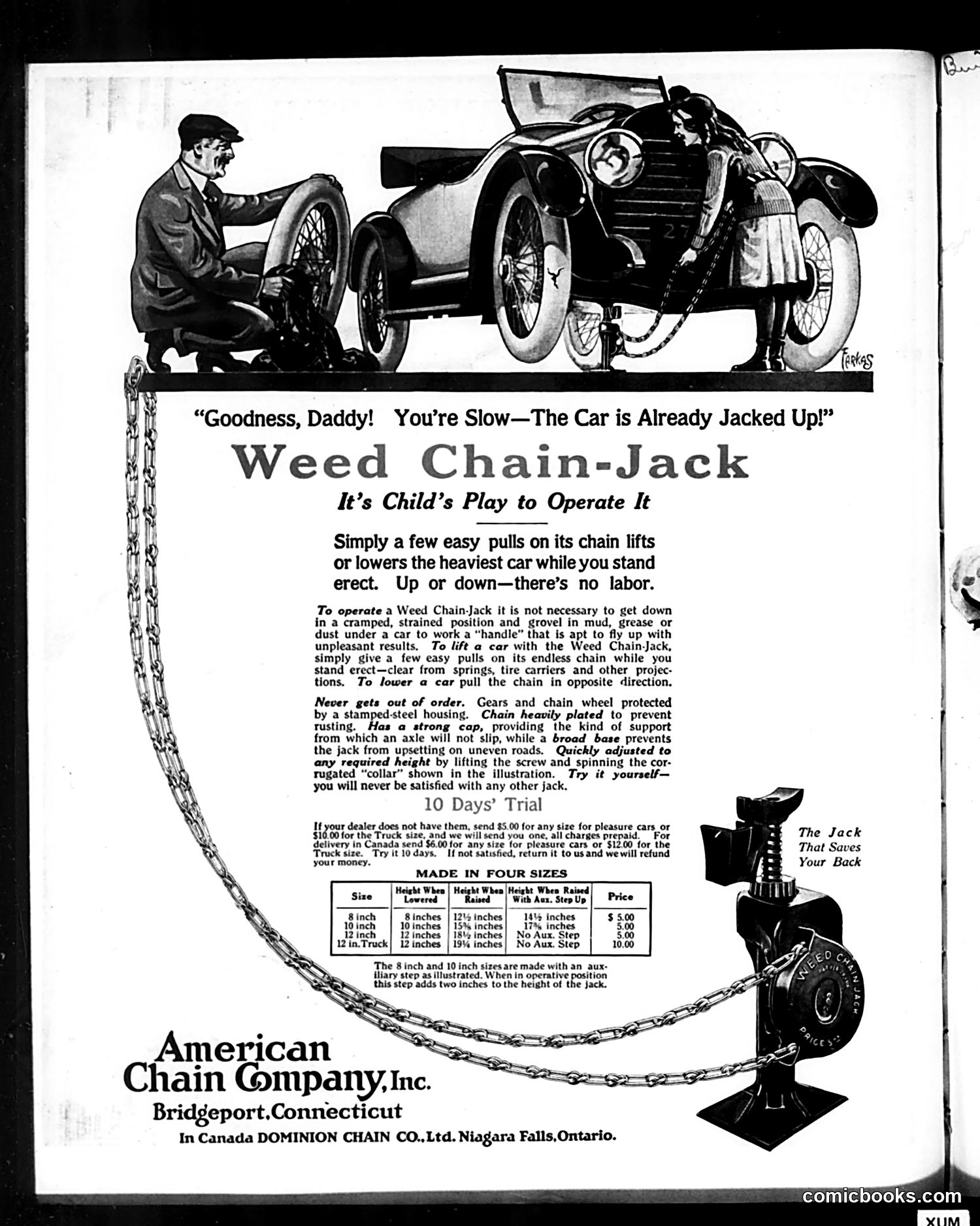
This is primarily a **product advertisement**, not political satire. It promotes the Weed Chain-Jack, an early automotive lifting device made by American Chain Company. The cartoon illustration shows a father slowly changing a tire while his son impatiently exclaims the car is "already jacked up"—humorously suggesting the father is working too slowly compared to how quickly this modern device operates. The joke plays on the contrast between old manual labor (crawling under cars with traditional jacks) and new mechanical convenience. The advertisement emphasizes ease of use: "It's Child's Play to Operate It." Rather than cramped, dirty work under a vehicle, users simply pull a chain while standing upright. The copy stresses safety features—the jack won't slip or tip—and offers a 10-day trial period. This represents early-20th-century marketing targeting car owners during the rapid expansion of automobile ownership and the appeal of labor-saving devices.