
Judge, 1918-03-30 · page 14 of 36
Judge — March 30, 1918 — page 14: what you’re looking at
What you’re looking at
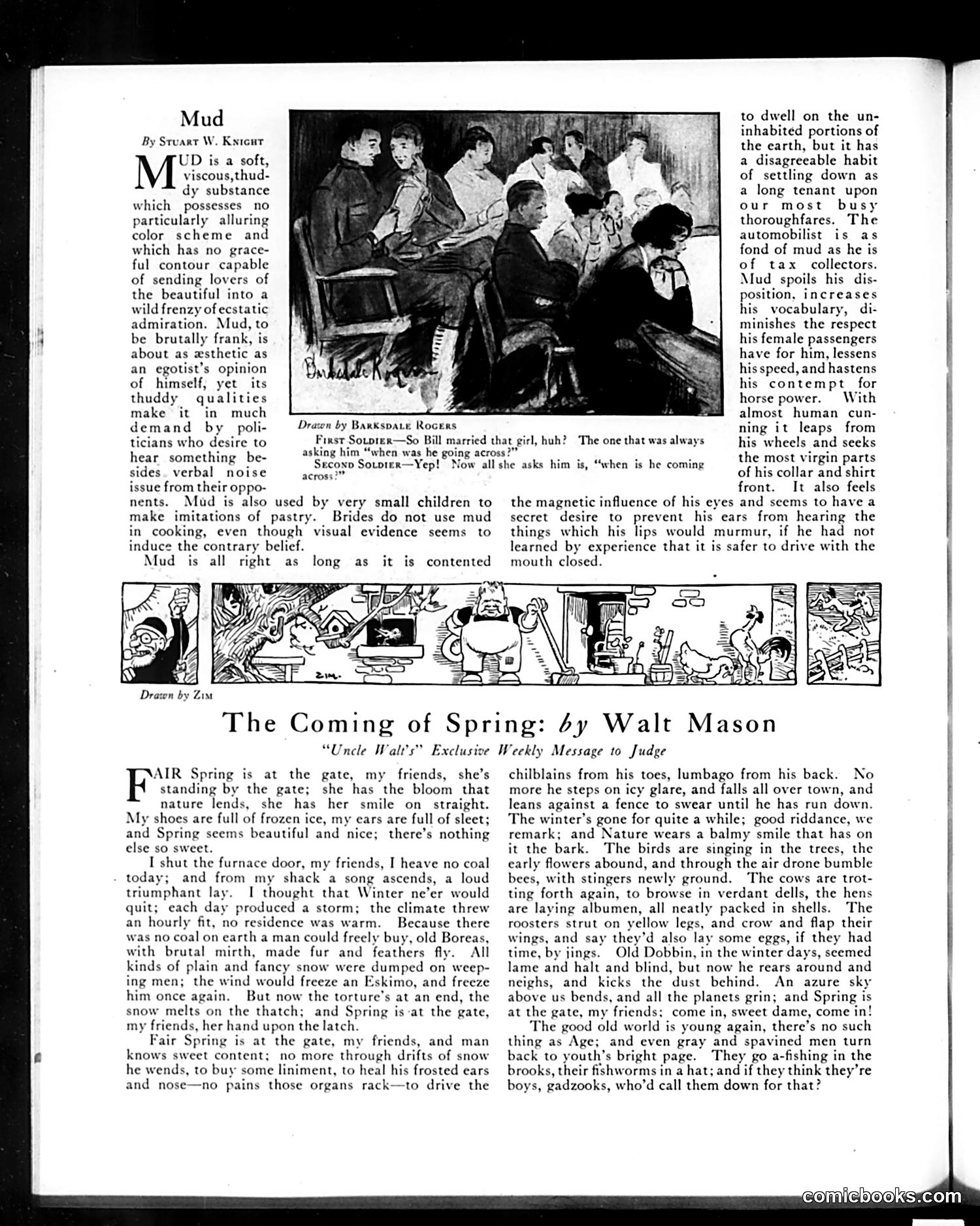
**"Mud" (by Stuart W. Knight):** A humorous essay-cartoon mocking mud as an aesthetic disaster, yet notes its paradoxical usefulness to politicians who "desire to hear something besides verbal noise" from opponents—a joke suggesting politicians fling mud (insults/attacks) at each other. The cartoon illustration shows soldiers in a trench, likely referencing WWI mud, making the political mockery darkly timely. The piece also jokes about mud ruining automobiles and motorists' moods, reflecting early-1900s concerns about cars as luxury items. **"The Coming of Spring" (by Walt Mason):** A cheerful seasonal poem celebrating winter's end. References frozen ears, sleet, coal shortages, and general winter misery ("Old Boreas"—the winter wind god). Spring brings relief: birds sing, cows return to pasture, hens lay eggs. The tone is sentimental nostalgia for simpler agricultural life, with comic relief in personifying spring as a welcoming woman "standing by the gate."
📄 Transcribed text from this page (OCR, searchable)
Machine-transcribed from the original scan — historical spelling and the odd misread are preserved.
Mud By Stvaxt W. Kxtcut UD is a soft, M viscous,thud- dy substance which possesses no particularly alluring color scheme and which has no grace- ful contour capable of sending lovers of the beautiful into a wild frenzy of ecstatic admiration. Mud, to be brutally frank, is about as wsthetic as an egotist’s opinion of himself, yet its thuddy qualities make it in much demand by poli- Drawn by Bankspate Rocens ticians who desire to hear something be- s sides. verbal noise atroes issue from their oppo- nents. Mud is also used by very small children to make imitations of pastry. Brides do not use mud in cooking, even though visual evidence seems to induce the contrary belief. Mud is all right as long as it is contented Drazen by Zim Fixst Soupter—So Bill married that girl, huh? ‘The one that was always asking him “when was he going across?” Secoxp Soupier—Yep! Now all she asks him is, “when is he coming to dwell on the un- inhabited portions of the earth, but it has a disagreeable habit of settling down as a long tenant upon our most busy thoroughfares. The automobilist is as fond of mud as he is of tax collectors. Mud spoils his dis- position, increases his vocabulary, di- minishes the respect his female passengers have for him, lessens his speed, and hastens his contempt for horse power. With almost human cun- ning it leaps from his wheels and seeks the most virgin parts of his collar and shirt front. It also feels the magnetic influence of his eyes and seems to have a secret desire to prevent his ears from hearing the things which his lips would murmur, if he had not learned by experience that it is safer to drive with the mouth closed. The Coming of Spring: 6y Walt Mason “Uncle Walt’ AIR Spring is at the gate, my friends, she’s standing by the gate; she has the bloom that nature lends, she has her smile on straight. My shoes are full of frozen ice, my ears are full of sleet; and Spring seems beautiful and nice; there’s nothing else so sweet. I shut the furnace door, my friends, I heave no coal toda and from my shack a song ascends, a loud triumphant lay. I thought that Winter ne’er would quit; each day produced a storm; the climate threw an hourly fit, no residence was warm. Because there was no coal on earth a man could freely buy, old Boreas, h brutal mirth, made fur and feathers fly. All kinds of plain and fancy snow were dumped on weep- ing men; the wind would freeze an imo, and freeze him once again. But now the torture’s at an end, the snow melts on the thatch; and Spring is-at the gate, my friends, her hand upon the latch. Fair Spring is at the gate, my friends, and man knows sweet content; no more through drifts of snow he wends, to buy some liniment, to heal his frosted ears and nose—no pains those organs rack—to drive the exclusive Weekly Message to Judge chilblains from his toes, lumbago from his back. No more he steps on icy glare, and falls all over town, and leans against a fence to swear until he has run down. The winter's gone for quite a while; good riddance, we remark; and Nature wears a balmy smile that has on it the bark. The birds are singing in the trees, the early flowers abound, and through the air drone bumble bees, with stingers newly ground. The cows are trot- ting forth again, to browse in verdant dells, the hens are laying albumen, all neatly packed in shells. The roosters strut on yellow legs, and crow and flap their wings, and say they’d also lay some eggs, if they had time, by jings. Old Dobbin, in the winter days, seemed lame and halt and blind, but now he rears around and neighs, and kicks the dust behind. An azure sky above us bends, and all the planets grin; and Spring is at the gate, my friends; come in, sweet dame, come in! The good old world is young again, there’s no such thing as Age; and even gray and spavined men turn back to youth’s bright page. They go a-fishing in the brooks, their fishworms in a hat; and if they think they’re boys, gadzooks, who'd call them down for that?