
Judge, 1918-03-30 · page 19 of 36
Judge — March 30, 1918 — page 19: what you’re looking at
What you’re looking at
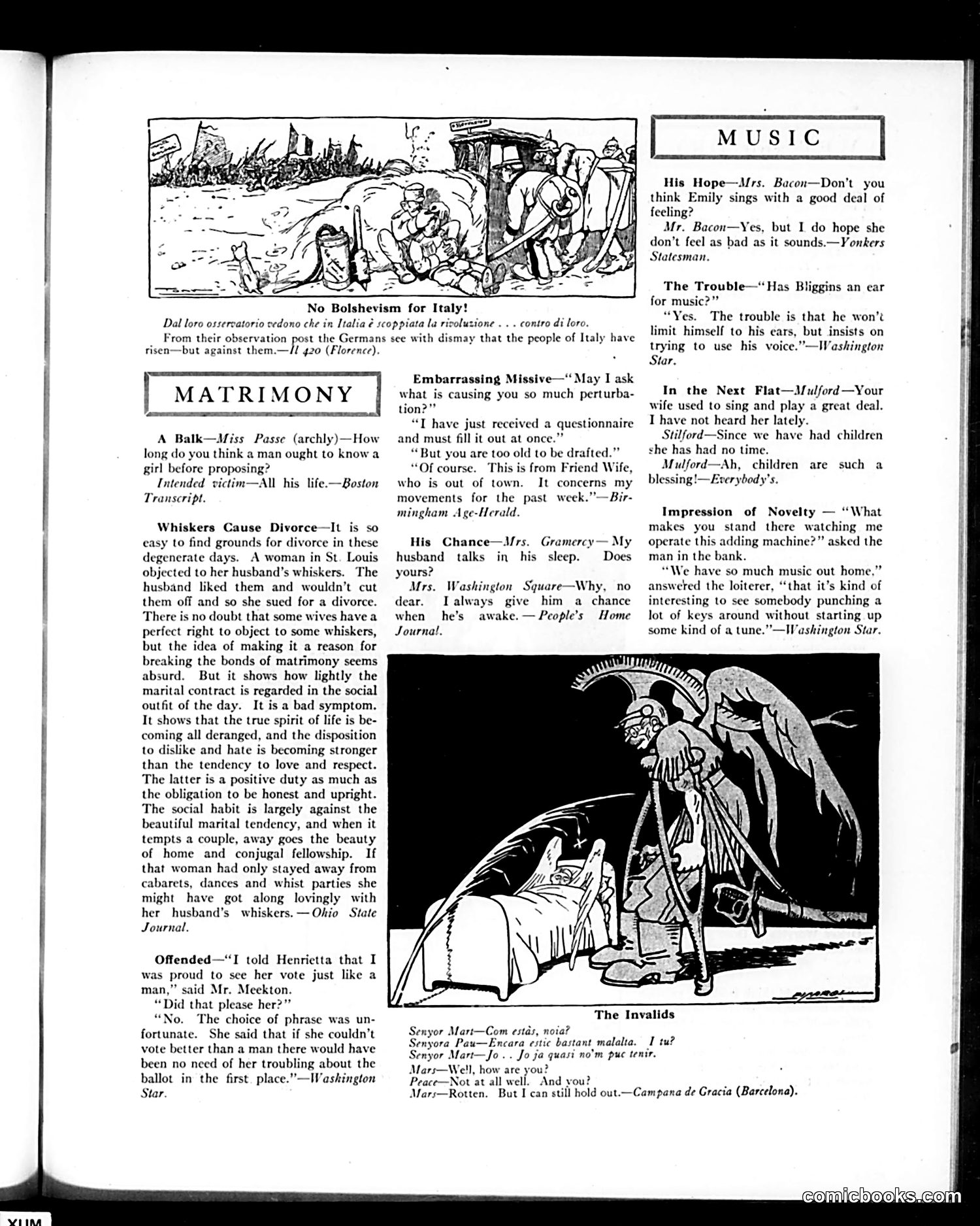
## Top Cartoon: "No Bolshevism for Italy!" This wartime cartoon depicts German military observers dismayed to see Italy rising in revolt—**against Germany**, not embracing Bolshevism as feared. The caption, quoted from a Florence source (II 420), suggests Germans worried Italian unrest meant communist revolution, but were relieved (or chagrined) to discover Italian dissent targeted German occupation instead. This likely references Italy's 1917-1918 military situation during WWI. ## "The Invalids" Cartoon (bottom) Shows two bedridden figures in what appears to be a Spanish dialogue (Barcelona source). One claims near-total incapacity ("I can barely hold myself together"), while the other insists "I can still hold out." The satire appears to mock exaggerated complaints about health or hardship—a commentary on wartime complaints or dramatic self-pity. ## Text Sections The "Matrimony" and "Music" sections contain brief humor items about marital discord, women's voting rights, and poor singing—social commentary typical of Judge's satirical format.
📄 Transcribed text from this page (OCR, searchable)
Machine-transcribed from the original scan — historical spelling and the odd misread are preserved.
| | | No Bolshevism for Italy! Dal loro ossercatorio vedono che in Italia é scoppiata la rivolusione . . . contro di loro. From their observation post the Germans sce with dismay that the people of Italy have risen—but against them.—// 420 (Florence). | ATRIMONY A Balk—Miss Passe (archly)—How long do you think a man ought to know a girl before proposing? Intended victim—All his life.—Boston Transcript. Whiskers Cause Divorce—It is so easy to find grounds for divorce in these degenerate days. A woman in St. Louis objected to her husband’s whiskers. The husband liked them and wouldn’t cut them off and so she sued for a divorce. There is no doubt that some wives have a perfect right to object to some whiskers, but the idea of making it a reason for breaking the bonds of matrimony seems absurd. But it shows how lightly the marital contract is regarded in the social outfit of the day. It is a bad symptom. It shows that the true spirit of life is be- coming all deranged, and the disposition to dislike and hate is becoming stronger than the tendency to love and respect. The latter is a positive duty as much as the obligation to be honest and upright. The social habit is largely against the beautiful marital tendency, and when it tempts a couple, away goes the beauty of home and conjugal fellowship. If that woman had only stayed away from cabarets, dances and whist parties she might have got along lovingly with her husband’s whiskers. —Ohio State Journal. Offended—“I told Henrietta that I was proud to sce her vote just like a man,” said Mr. Meekton. “Did that please her?” “No. The choice of phrase was un- fortunate. She said that if she couldn’t vote better than a man there would have been no need of her troubling about the ballot in the first. place.”—Washington Star Embarrassing Missive—“ May I ask what is causing you so much perturba- tion?” “T have just received a questionnaire and must fill it out at once.” “But you are too old to be drafted.” “Of course. This is from Friend Wife, who is out of town. It concerns movements for the past week.”—Bir- mingham Age-Herald. His Chance—Mrs. Gramercy — My husband talks in his sleep. Does yours? Mrs. Washington Square—Why, no dear. Talways give him a chance when he’s awake. — People’s Home Journal. USIC His Hope—Mrs. Bacon—Don’t you think Emily sings with a good deal of feeling? Mr. Bacon—Yes, but I do hope she don’t feel as bad as it sounds.—Yonkers Statesman. The Trouble—“Has Bliggins an ear for music?” “Yes, The trouble is that he won’t limit himself to his ears, but insists on trying to use his voice.”—Washington Star. In the Next Flat—Mulford—Your wife used to sing and play a great deal. I have not heard her lately. Stilford—Since we have had children she has had no time. Mulford—Ah, children are such a Impression of Novelty — “What makes you stand there watching me operate this adding machine?” asked the man in the bank. “We have so much music out home,” answered the loiterer, “that it’s kind of interesting to see somebody punching a lot of s around without starting up some kind of a tune.” —Washington Star. The Invalids ‘or Mart—Com estas, noia? Mars—Well, how are you? Peace—Not at all well. And you? ora Pau—Encara estic bastant malalta. | or Mart—Jo.. Jo ja quasi no'm puc tenir. Tu? Mars—Rotten. But I can still hold out.—Campana de Gracia (Barcelona).