
Judge, 1918-03-30 · page 6 of 36
Judge — March 30, 1918 — page 6: what you’re looking at
What you’re looking at
The page contains three separate satirical pieces: 1. **Left column**: Untitled critique mocking an "Unappreciated Person"—likely a struggling artist or performer. The satire ridicules someone whose mediocre talents go unrecognized, blaming their lack of success on others' jealousy rather than merit. References to a "tenor," "Caruso," and "Hanging Committee" suggest criticism of someone in music or visual arts. 2. **"The Make-It-Do Propaganda"** (center/right): Satirizes wartime thrift messaging encouraging Americans to repair and reuse items rather than buy new ones. The humor targets how such propaganda lists increasingly absurd luxuries as things to sacrifice. 3. **"Rent"** (bottom right): A brief philosophical piece playing on the fact that rent, unlike gravity, must be actively paid—making it uniquely human burden. The page reflects WWI-era American concerns about waste, appreciation, and economic hardship.
📄 Transcribed text from this page (OCR, searchable)
Machine-transcribed from the original scan — historical spelling and the odd misread are preserved.
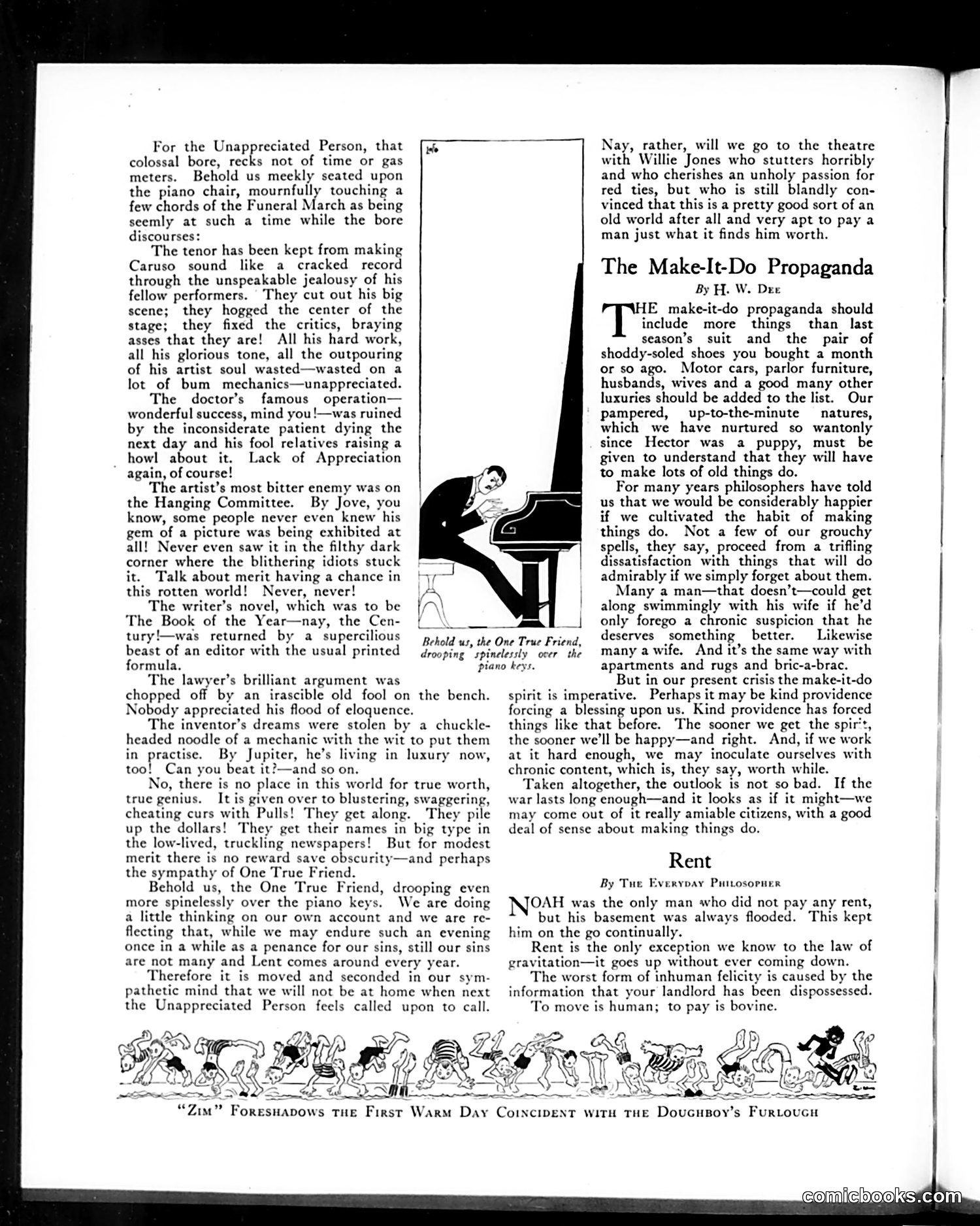
For the Unappreciated Person, that colossal bore, recks not of time or gas meters. Behold us meekly seated upon the piano chair, mournfully touching a few chords of the Funeral March as being seemly at such a time while the bore discourses: The tenor has been kept from making Caruso sound like a cracked record through the unspeakable jealousy of his fellow performers. They cut out his big scene; they hogged the center of the stage; they fixed the critics, braying asses that they are! All his hard work, all his glorious tone, all the outpouring of his artist soul wasted—wasted on a lot of bum mechanics—unappreciated. The doctor’s famous operation— wonderful success, mind you!—was ruined by the inconsiderate patient dying the next day and his fool relatives raising a howl about it. Lack of Appreciation again, of course! The artist’s most bitter enemy was on the Hanging Committee. By Jove, you know, some people never even knew his gem of a picture was being exhibited at all! Never even saw it in the filthy dark corner where the blithering idiots stuck it. Talk about merit having a chance in this rotten world! Never, never! The writer’s novel, which was to be The Book of the Year—nay, the Cen- tury!—was returned by a supercilious beast of an editor with the usual printed formula. The lawyer’s brilliant argument was chopped off by an irascible old fool on the bench. Nobody appreciated his flood of eloquence. The inventor’s dreams were stolen by a chuckle- headed noodle of a mechanic with the wit to put them in practise. By Jupiter, he’s living in luxury now, too! Can you beat it?—and so on. No, there is no place in this world for true worth, true genius. It is given over to blustering, swaggering, cheating curs with Pulls! They get along. They pile up the dollars! They get their names in big type in the low-lived, truckling newspapers! But for modest merit there is no reward save obscurity—and perhaps the sympathy of One True Friend. Behold us, the One True Friend, drooping even more spinelessly over the piano keys. We are doing a little thinking on our own account and we are re- flecting that, while we may endure such an evening once in a while as a penance for our sins, still our sins are not many and Lent comes around every year. Therefore it is moved and seconded in our sym- pathetic mind that we will not be at home when next the Unappreciated Person feels called upon to call. Behold us, the One True Friend, drooping spinelessly over the piano keys. Nay, rather, will we go to the theatre with Willie Jones who stutters horribly and who cherishes an unholy passion for red ties, but who is still blandly con- vinced that this is a pretty good sort of an old world after all and very apt to pay a man just what it finds him worth. The Make-It-Do Propaganda By H.W. Dee E_ make-it-do propaganda should include more things than last season’s suit and the pair of shoddy-soled shoes you bought a month or so ago. Motor cars, parlor furniture, husbands, wives and a good many other luxuries should be added to the list. Our pampered, up-to-the-minute _ natures, which we have nurtured so wantonly since Hector was a puppy, must be given to understand that they will have to make lots of old things do. For many years philosophers have told us that we would be considerably happier if we cultivated the habit of making things do. Not a few of our grouchy spells, they say, proceed from a trifling dissatisfaction with things that will do admirably if we simply forget about them. Many a man—that doesn’t—could get along swimmingly with his wife if he’d only forego a chronic suspicion that he deserves something better. Likewise many a wife. And it’s the same way with apartments and rugs and bric-a-brac. But in our present crisis the make-it-do spirit is imperative. Perhaps it may be kind providence forcing a blessing upon us. Kind providence has forced things like that before. The sooner we get the spir't, the sooner we'll be happy—and right. And, if we work at it hard enough, we may inoculate ourselves with chronic content, which is, they say, worth while. Taken altogether, the outlook is not so bad. If the war lasts long enough—and it looks as if it might—we may come out of it really amiable citizens, with a good deal of sense about making things do. Rent By Tue Everyoay Pitrosopaer NOAH was the only man who did not pay any rent, but his basement was always flooded. This kept him on the go continually. Rent is the only exception we know to the law of gravitation—it goes up without ever coming down. The worst form of inhuman felicity is caused by the information that your landlord has been dispossessed. To move is human; to pay is bovine. ~~ N J