
Judge, 1918-03-30 · page 8 of 36
Judge — March 30, 1918 — page 8: what you’re looking at
What you’re looking at
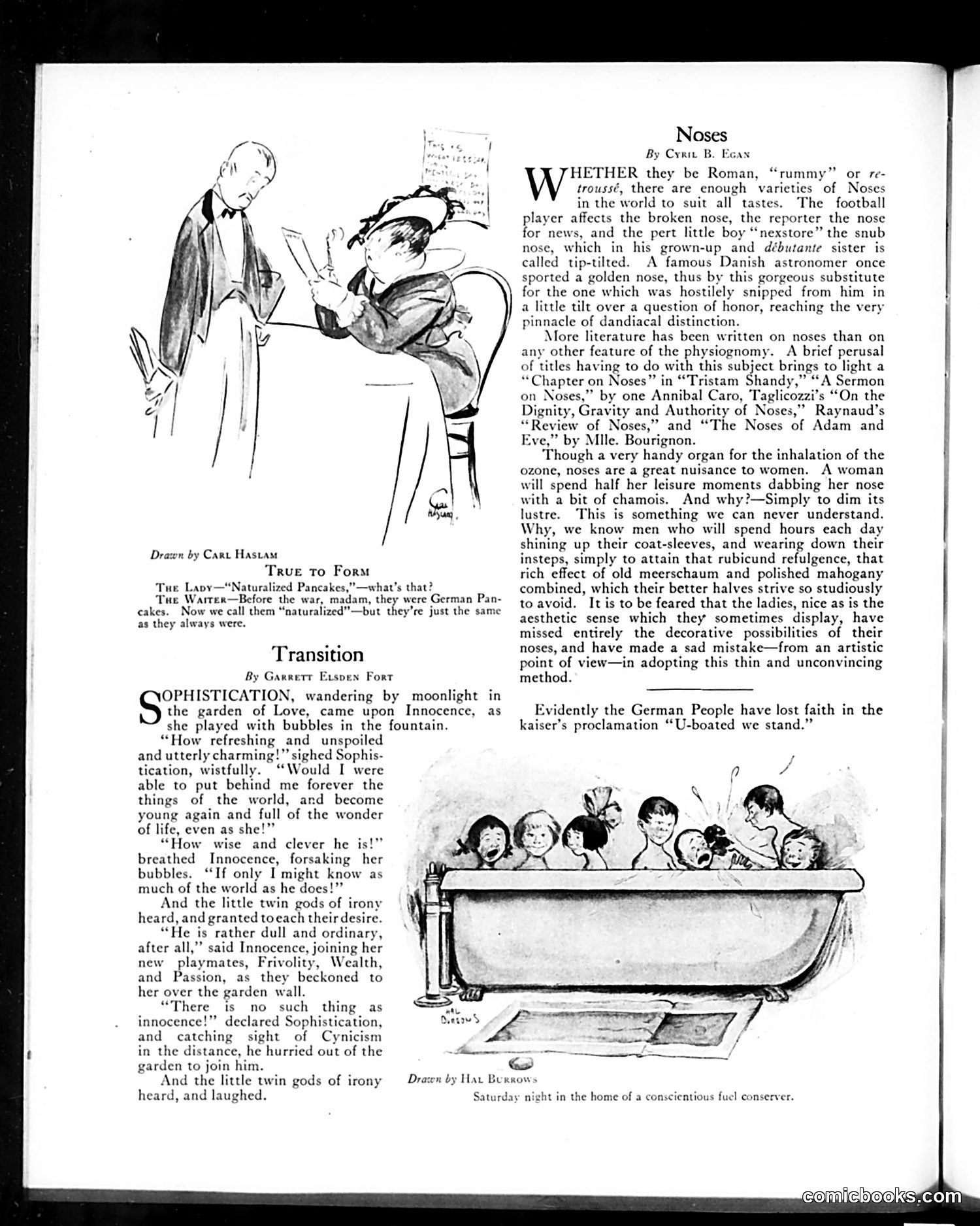
This page contains three distinct pieces of satirical content: **"True to Form"** (top cartoon by Carl Haslam): A waiter explains "naturalized pancakes" to a lady customer—they were called "German Pancakes" before the war but remain unchanged. This mocks the WWI-era practice of renaming German-origin products with patriotic alternatives (similar to how "sauerkraut" became "liberty cabbage"), satirizing the superficiality of such rebranding when the actual product is identical. **"Transition"** (poem by Garrett Elsden Fort): An allegorical tale where Sophistication and Innocence meet, each envying the other. After the "twin gods of irony" grant their wishes, both become corrupted—Innocence becomes frivolous and worldly; Sophistication becomes cynical. It's a commentary on how desire for what we lack inevitably leads to disappointment and moral compromise. **"Noses"** (essay by Cyril B. Egan): A humorous essay on nose varieties and literature about noses, concluding with criticism of women for dimming their nose's shine while men obsess over polishing theirs—social commentary on gendered beauty standards and vanity. The final cartoon references German U-boat submarines, suggesting lost faith in Germany's naval strategy.
📄 Transcribed text from this page (OCR, searchable)
Machine-transcribed from the original scan — historical spelling and the odd misread are preserved.
Drawn by Cart Hasta True To Form Tue Lavy—“Naturalized Pancakes,”—what’s that? Tue Warrer—Before the war, madam, they were German Pan- cakes. Now we call them “naturalized”—but they’re just the same as they always were. Transition By Garrett Exsven Fort OPHISTICATION, wandering by moonlight in Site garden of Love, came upon Innocence, as she played with bubbles in the fountain. “How refreshing and unspoiled and utterly charming!” sighed Sophis- tication, wistfully. ‘Would I were able to put behind me forever the things of the world, and become young again and full of the wonder of life, even as she!” “How wise and clever he is!” breathed Innocence, forsaking her bubbles. “If only I might know as much of the world as he does!” And the little twin gods of irony heard, and granted toeach their desire. “He is rather dull and ordinary, after all,” said Innocence, joining her new playmates, Frivolity, Wealth, and Passion, as they beckoned to her over the garden wall. “There is no such thing as innocence!” declared Sophistication, and catching sight of Cynicism in the distance, he hurried out of the garden to join him. And the little twin gods of irony heard, and laughed. Saturday Noses By Cyr B. Ecax HETHER they be Roman, “rummy” or re- troussé, there are enough varieties of Noses in the world to suit all tastes. The football player affects the broken nose, the reporter the nose for news, and the pert little boy “‘nexstore” the snub nose, which in his grown-up and débutante sister is called tip-tilted. A famous Danish astronomer once sported a golden nose, thus by this gorgeous substitute for the one which was hostilely snipped from him in a little tilt over a question of honor, reaching the very pinnacle of dandiacal distinction. More literature has been written on noses than on any other feature of the physiognomy. A brief perusal of titles having to do with this subject brings to light a “Chapter on Noses” in “Tristam Shandy,” “A Sermon on ”* by one Annibal Caro, Taglicozzi’s “On the Dignity, Gravity and Authority of Noses,” Raynaud's “Review of Noses,” and “The Noses of Adam and Eve,” by Mlle. Bourignon. ‘Though a very handy organ for the inhalation of the ozone, noses are a great nuisance to women. A woman rill spend half her leisure moments dabbing her nose with a bit of chamois. And why?—Simply to dim its lustre. This is something we can never understand. Why, we know men who will spend hours each day shining up their coat-sleeves, and wearing down their insteps, simply to attain that rubicund refulgence, that rich effect of old meerschaum and polished mahogany combined, which their better halves strive so studiously to avoid. It is to be feared that the ladies, nice as is the aesthetic sense which they sometimes display, have missed entirely the decorative possibilities of their noses, and have made a sad mistake—from an artistic point of view—in adopting this thin and unconvincing method. idently the German People have lost faith in the kaiser’s proclamation “U-boated we stand.” Draven by Har Burrows in the home of a conscientious fuel conserver. | | | |