
Judge, 1918-03-30 · page 3 of 36
Judge — March 30, 1918 — page 3: what you’re looking at
What you’re looking at
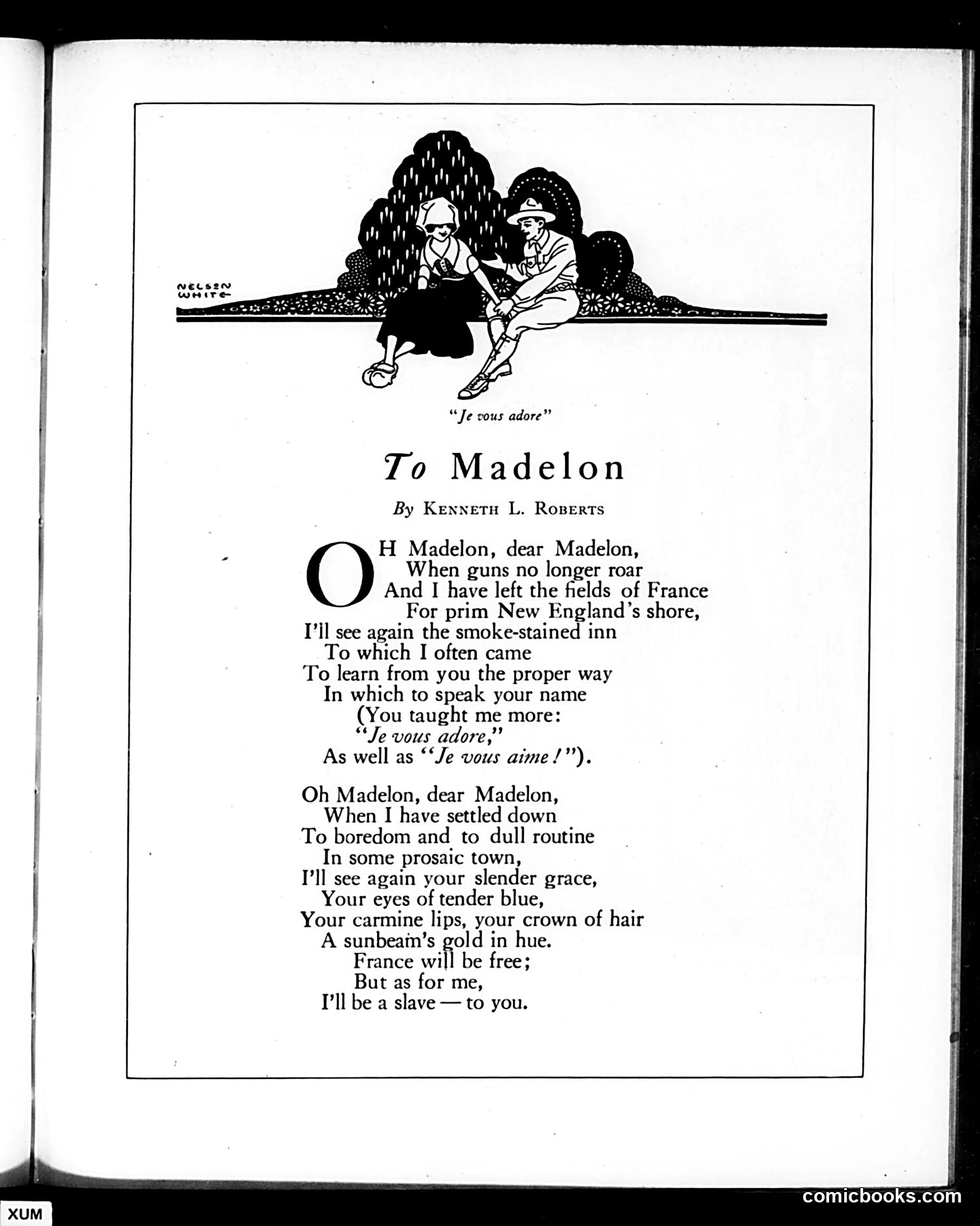
This page reproduces a romantic poem rather than satire. The illustration shows two soldiers in a trench during wartime, with one teaching the other French phrases—specifically "Je vous adore" ("I adore you"). The poem itself appears to reference World War I, mentioning "guns no longer roar" and leaving "fields of France" for "New England's shore." It's a sentimental piece about a soldier's memory of a French woman named Madelon and his longing for her after returning home. "Madelon" likely references the famous French WWI song "La Madelon," which became a cultural touchstone of the war. Roberts's poem transforms this into a personal love story, blending wartime experience with romantic nostalgia.
📄 Transcribed text from this page (OCR, searchable)
Machine-transcribed from the original scan — historical spelling and the odd misread are preserved.
“Je cous adore” To Madelon By Kennetu L. Roserts . H Madelon, dear Madelon, When guns no longer roar And I have left the fields of France For prim New England’s shore, I’il see again the smoke-stained inn | To which I often came To learn from you the proper way In which to speak your name (You taught me more: “Je vous adore,” As well as ‘Je vous aime!”). Oh Madelon, dear Madelon, When I have settled down To boredom and to dull routine | In some prosaic town, I’ll see again your slender grace, Your eyes of tender blue, Your carmine lips, your crown of hair A sunbeain’s gold in hue. | France will be free; But as for me, I'll be a slave — to you. , comicbooks.com XUM