
Judge, 1918-03-30 · page 12 of 36
Judge — March 30, 1918 — page 12: what you’re looking at
What you’re looking at
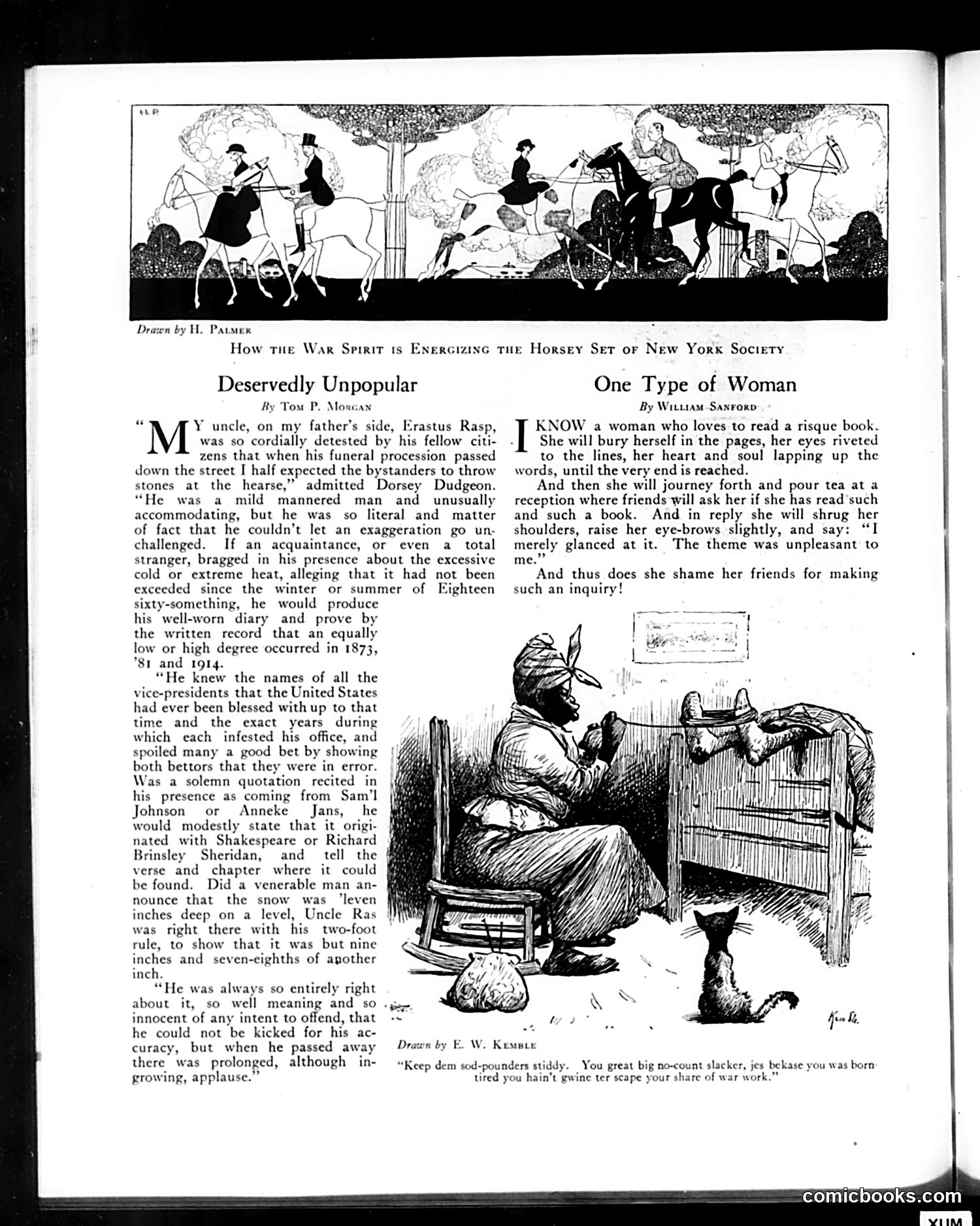
**Top Cartoon** ("How the War Spirit is Energizing the Horsey Set of New York Society"): Silhouette illustration by H. Palmer shows wealthy New Yorkers on horseback, apparently engaged in war-related activities or patriotic pursuits. The satire appears to mock how the upper class's equestrian social circle adapted to WWI—likely referencing volunteering, fundraising, or performative patriotism by the leisure class during the war era. **"Deservedly Unpopular"** (left): Story by Tom P. Moxgan satirizes Uncle Erastus Rasp, a pedantic man despised for compulsively correcting others' exaggerations with factual accuracy—proving claims about weather via old diaries, correcting literary attributions, measuring snow precisely. The joke: his literal-minded honesty, though well-intentioned, makes him socially unbearable. **"One Type of Woman"** (right): William Sanford's piece mocks women who secretly read "risque" (sexually suggestive) books but publicly deny it, claiming disinterest to avoid shame. The illustration by E.W. Kemble shows the hypocrisy of concealing enjoyment.
📄 Transcribed text from this page (OCR, searchable)
Machine-transcribed from the original scan — historical spelling and the odd misread are preserved.
Draven by H. Patten How tie War Sptrit is Exercizinc tut Horsey Set or New York Society Deservedly Unpopular By Tom P. Moxcan Y uncle, on my father’s side, Erastus Rasp, was so cordially detested by his fellow citi- zens that when his funeral procession passed down the street I half expected the bystanders to throw stones at the hearse,” admitted Dorsey Dudgeon. “He was a mild mannered man and_ unusually accommodating, but he was so literal and matter of fact that he couldn’t let an exaggeration go un- challenged. If an acquaintance, or even a_ total stranger, bragged in his presence about the excessive cold or extreme heat, alleging that it had not been exceeded since the winter or summer of Eighteen y-something, he would produce his well-worn diary and prove by the written record that an equally low or high degree occurred in 1873, 81 and 1914. “He knew the names of all the vice-presidents that the United States had ever been blessed with up to that time and the exact years during which each infested his office, and spoiled many a good bet by showing both bettors that they were in error. Was a solemn quotation recited in his presence as coming from Sam’l Johnson or Anneke Jans, he would modestly state that it origi- nated with Shakespeare or Richard Brinsley Sheridan, and_ tell the verse and chapter where it could be found. Did a venerable man an- nounce that the snow was ‘leven inches deep on a level, Uncle Ras was right there with his two-foot rule, to show that it was but nine inches and seven-eighths of apother inch. “He was always so entirely right about it, so well meaning and so .g innocent of any intent to offend, that he could not be kicked for his ac- curacy, but when he passed away there was prolonged, although in- growing, applause.” Drawn by E. W. Kespre One Type of Woman By Witta- Sanrorv KNOW a woman who loves to read a risque book. She will bury herself in the pages, her eyes riveted to the lines, her heart and soul lapping up the words, until the very end is reached. And then she will journey forth and pour tea at a reception where friends will ask her if she has read’such and such a book. And in reply she will shrug her shoulders, raise her eye-brows slightly, and say: “I merely glanced at it. The theme was unpleasant to me.” And thus does she shame her friends for making such an inquiry! fon la “Keep dem sod-pounders stiddy. You great big no-count slacker, jes bekase you was born tired you hain’t gwine ter scape your share of war work.” ——— ET comicbooks.com