
Judge, 1918-03-30 · page 17 of 36
Judge — March 30, 1918 — page 17: what you’re looking at
What you’re looking at
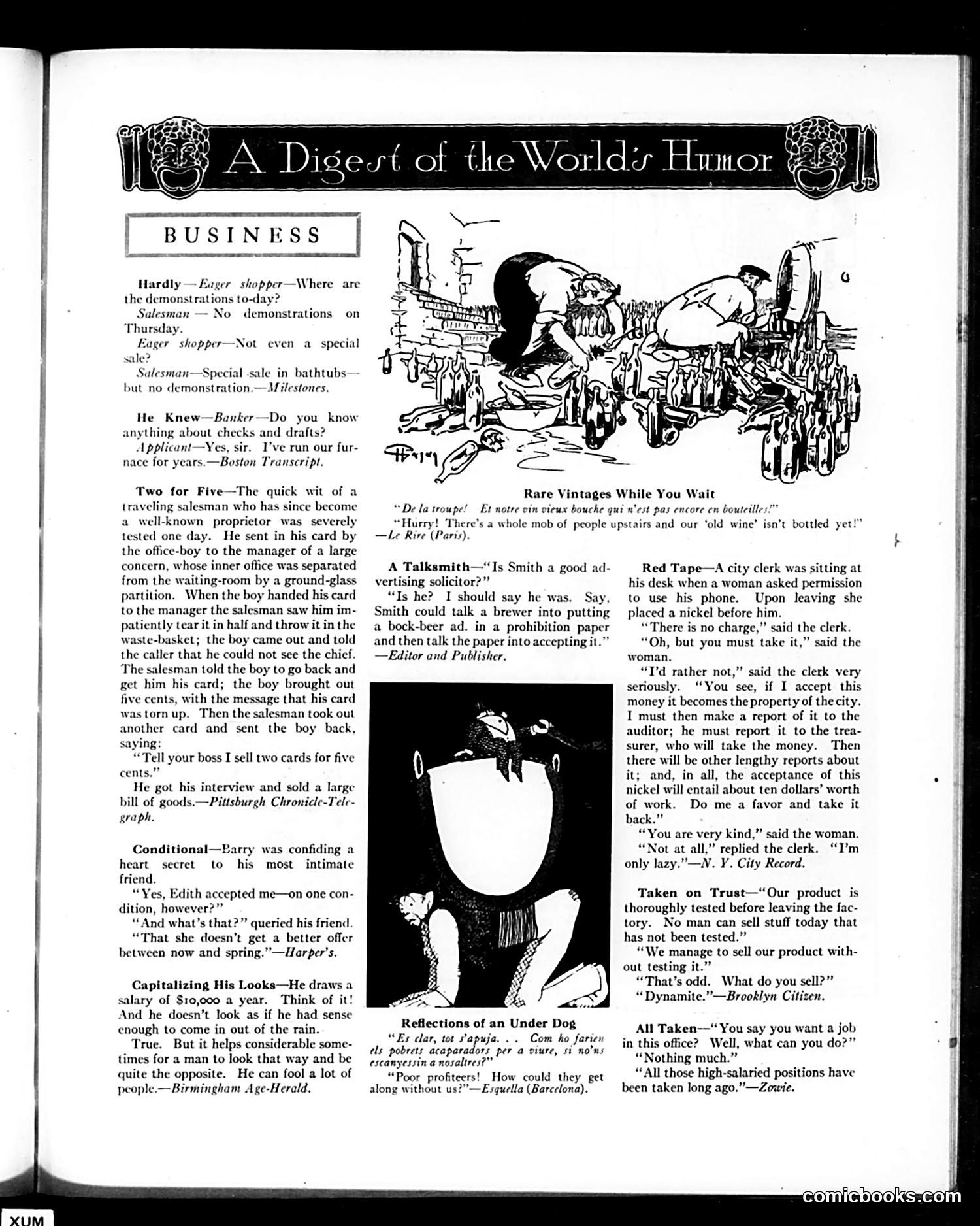
This page from Judge magazine presents business-themed humor satirizing early 20th-century commercial practices and workplace absurdities. The cartoons mock various business scenarios: a salesman's persistence (selling damaged business cards for five cents each to secure an interview), a banker's ignorance (confusing furnace operation with financial knowledge), and bureaucratic inefficiency (a city clerk explaining how accepting a nickel would trigger ten dollars' worth of paperwork). The "Red Tape" section particularly skewers government red tape—the clerk's elaborate explanation reveals how minor transactions create cascading administrative burdens, a timeless critique of bureaucracy. Other jokes target advertising solicitation, employee qualifications, and product testing claims. The foreign-language captions ("Rare Vintages While You Wait," references to Paris and Barcelona papers) suggest Judge's cosmopolitan readership appreciated international business humor. The central cartoon shows an exaggerated figure amid bottles, likely illustrating the wine-related humor in the French caption. Overall, the page satirizes commercial dishonesty, bureaucratic absurdity, and the gap between appearance and competence in business.
📄 Transcribed text from this page (OCR, searchable)
Machine-transcribed from the original scan — historical spelling and the odd misread are preserved.
XUM A Dises | BUSINESS Hardly — Eager shopper—Where are the demonstrations to-day? Salesman — No demonstrations on shopper—Not even a_ special Sulesman—Special sale in bathtubs but no demonstration —Milestones. He Knew—Banker—Do you know anything about checks and drafts? Applicant—Yes, sir. I’ve run our fur- nace for years.—Boston Transcript. Two for Five—The quick wit of a traveling salesman who has since become a well-known proprietor was severely tested one day. He sent in his card by the office-boy to the manager of a large concern, whose inner office was separated from the waiting-room by a ground-glass partition. When the boy handed his card to the manager the salesman saw him im- patiently tear it in half and throw it in the waste-basket; the boy came out and told the caller that he could not see the chief. The salesman told the boy to go back and get him his card; the boy brought out five cents, with the message that his card was torn up. Then the salesman took out another card and sent the boy back, ing: ell your boss I sell two cards for five cents.” He got his interview and sold a large bill of goods.—Pittsburgh Chronicle-Tele- graph. Conditional—Parry was confiding a heart secret to his most intimate friend. “Yes, Edith dition, howeve “And what’s that?” queried his friend. “That she doesn’t get a better offer between now and spring.” —Harper’s. pted me—on one con- Capitalizing His Looks—He draws a salary of $10,000 a year. Think of it! And he doesn’t look as if he had sense cnough to come in out of the rain. True. But it helps considerable some- times for a man to look that way and be quite the opposite. He can fool a lot of people.—Birmingham A ge-Herald. ee eee Sinan A f of the Worlds Hamor Rare Vintages While You Wait “Dela troupe! Et notre vin vieux boucke qui n'est pas encore en bouteil sa whole mob of people upstairs and our ‘old wine “Hurry! The! —Le Rire (Paris). A Talksmith—“Is Smith a good ad- vertising solicitor?” “Is he? I should say he was. Say, Smith could talk a brewer into putting a bock-beer ad. in a prohibition pap and then talk the paper into accepting it.” —Editor and Publisher. Reflections of an Under Dog “Es clar, tot sapuja. .. Com ho farien ls pobrets acaparadors per a viure, si no'ns escanyessin a nosaltres?” “Poor profiteers! How could they get along without us?”"—Esquella (Barcelona). isn’t bottled yet!” Red Tape—A city clerk was sitting at his desk when a woman asked permission to use his phone. Upon leaving she placed a nickel before him. “There is no charge,” said the clerk. “Oh, but you must take it,” said the woman. “T’d rather not,” said the clerk very seriously. “You see, if I accept. thi: money it becomes the property of the city. I must then make a report of it to the auditor; he must report it to the trea- surer, who will take the money. Then there will be other lengthy reports about it; and, in all, the acceptance of this nickel will entail about ten dollars’ worth of work. Do me a favor and take it back.” “You are very kind,” said the woman. “Not at all,” replied the clerk. “I’m only lazy.”—N. Y. City Record. Taken on Trust—“Our product is thoroughly tested before leaving the fac- tory. No man can sell stuff today that has not been tested.” “We manage to sell our product with- out testing it.” “That's odd. What do you sell?” “Dynamite.” —Brooklyn Citizen. All Taken—“ You say you want a job in this office? Well, what can you do?” “Nothing much.” “All those high-salaried positions have been taken long ago.” —Zowie.