
Judge, 1918-03-30 · page 24 of 36
Judge — March 30, 1918 — page 24: what you’re looking at
What you’re looking at
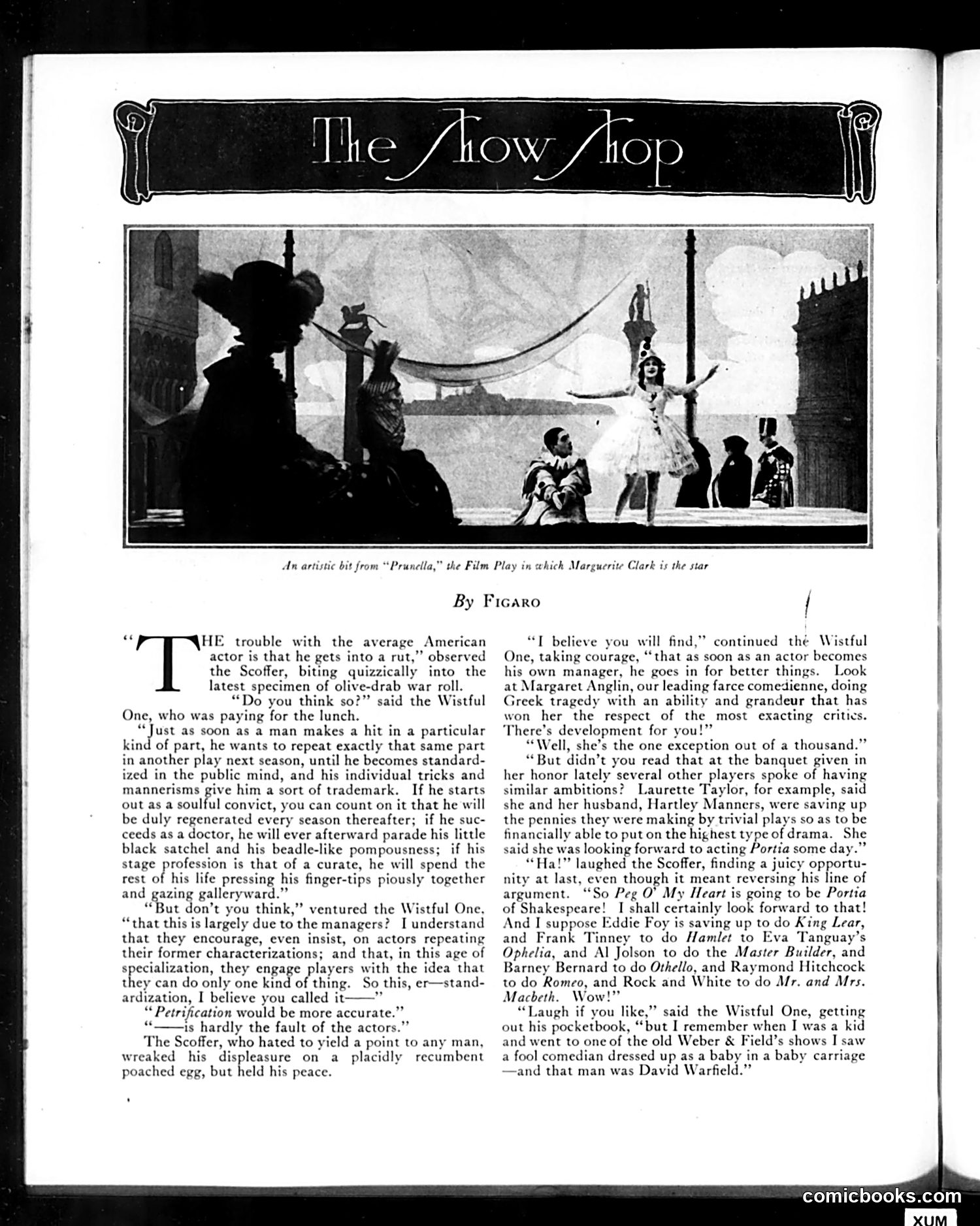
This page from *Judge* presents a dialogue between two characters—the Scoffer and the Wistful One—debating whether American actors become typecast and standardized in their roles. The illustration at top shows a scene from "Prunella," a contemporary theatrical production starring Marguerite Clark, establishing the theatrical context. The Scoffer argues actors repeat successful character types endlessly, becoming walking trademarks. The Wistful One counters that managers enforce this limitation, and cites **Margaret Anglin** as proof: a farce comedienne who successfully transitioned to serious Greek tragedy, earning critical respect. He mentions **Laurette Taylor** and **Hartley Manners** saving money to produce quality drama. The Scoffer ridicules this optimism by listing low-comedy performers (Eddie Foy, Frank Tinney, Al Jolson, Barney Bernard, Raymond Hitchcock) attempting Shakespeare—absurd propositions that mock the Wistful One's faith in actors' development. The Wistful One's final trump: **David Warfield**, once a comedic fool in Weber & Field's shows, became a serious dramatic actor—proving career transformation possible. The satire targets both artistic pretension and the entertainment industry's rigid conventions.
📄 Transcribed text from this page (OCR, searchable)
Machine-transcribed from the original scan — historical spelling and the odd misread are preserved.
or An artistic bit from “Prunella,” By Fi HE trouble with the average American actor is that he gets into a rut,” observed the Scoffer, biting quizzically into the latest specimen of olive-drab war roll. “Do you think so?” said the Wistful One, who was paying for the lunch. “Just as soon as a man makes a hit in a particular kind of part, he wants to repeat exactly that same part in another play next season, until he becomes standard- ized in the public mind, and his individual tricks and mannerisms give him a sort of trademark. If he starts out as a soulful convict, you can count on it that he will be duly regenerated every season thereafter; if he suc- ceeds as a doctor, he will ever afterward parade his little black satchel and his beadle-like pompousness; if his stage profession is that of a curate, he will spend the rest of his life pressing his finger-tips piously together and gazing galleryward.” “But don’t you think,” ventured the Wistful One, “that this is largely due to the managers? I understand that they encourage, even insist, on actors repeating their former characterizations; and that, in this age of specialization, they engage players with the idea that they can do only one kind of thing. So this, er—stand- ardization, I believe you called it - “ Petrification would be more accurate.” ee is hardly the fault of the actors.” The Scoffer, who hated to yield a point to any man, wreaked his displeasure on a placidly recumbent poached egg, but held his peace. " the Film Play Clark is the star in which Marguerit ARO { “T believe you will find,” continued thé Wistful One, taking courage, “that as soon as an actor becomes his own manager, he goes in for better things. Look at Margaret Anglin, our leading farce comedienne, doing Greek tragedy with an ability and grandeur that has won her the respect of the most exacting critics. There’s development for you!” “Well, she’s the one exception out of a thousand.” “But didn’t you read that at the banquet given in her honor lately several other players spoke of having similar ambitions? Laurette Taylor, for example, said she and her husband, Hartley Manners, were saving up the pennies they were making by trivial plays so as to be financially able to put on the highest type of drama. She said she was looking forward to acting Portia some day.” “Ha!” laughed the Scoffer, finding a juicy opportu- nity at last, even though it meant reversing his line of argument. “So Peg O° My Heart is going to be Portia of Shakespeare! I shall certainly look forward to that! And I suppose Eddie Foy is saving up to do King Lear, and Frank Tinney to do Hamlet to Eva Tanguay’s Ophelia, and Al Jolson to do the Master Builder, and Barney Bernard to do Othello, and Raymond Hitchcock to do Romeo, and Rock and White to do Mr. and Mrs. Macbeth. Wow!” “Laugh if you like,” said the Wistful One, getting out his pocketbook, “but I remember when I was a kid and went to one of the old Weber & Field’s shows I saw a fool comedian dressed up as a baby in a baby carriage —and that man was David Warfield.” comicbooks.com