
A complete issue · 40 pages · 1928
Life — August 9, 1928

This is primarily a **magazine cover featuring advertising**, not political satire. The dominant image shows a small pilot in an airplane silhouetted against an enormous fabric wing or parachute, emphasizing the scale of aviation technology. The cover advertises "Life" magazine (15 cents) with sections for "Amusement News," "Personalities," and "Sport." The airplane imagery likely references the era's fascination with aviation—1928 was the height of early aircraft enthusiasm, shortly after Lindbergh's famous 1927 transatlantic flight. The tagline "Kodak As You Go" (bottom right) is an advertisement, suggesting the magazine promoted capturing these modern technological moments photographically. The library stamp dates it August 21, 1928.
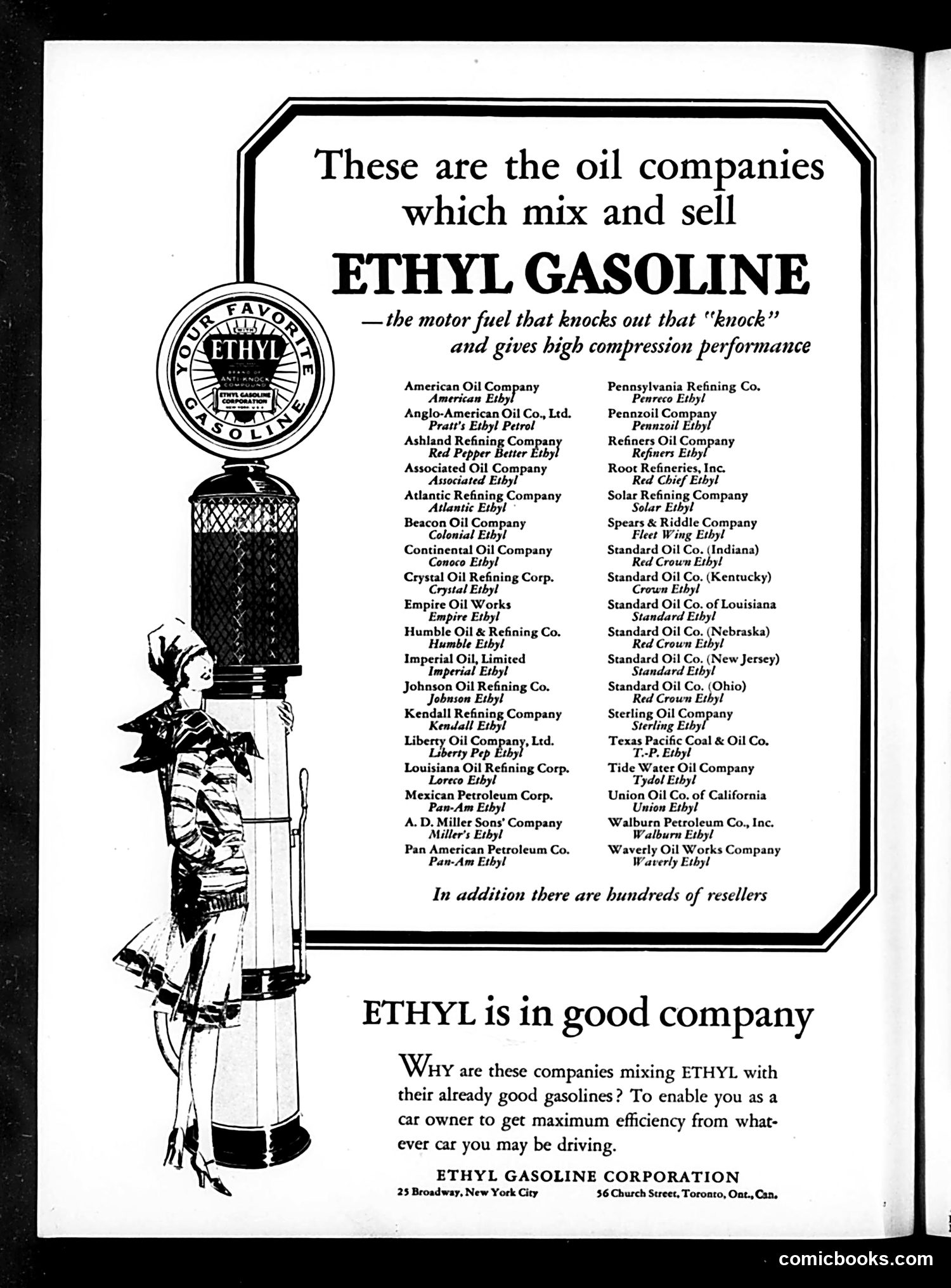
This appears to be a **straightforward advertisement**, not satire. The Ethyl Gasoline Corporation is promoting their product by listing dozens of oil companies that mix and sell ethyl gasoline. The illustration shows a stylized woman in 1920s-era dress standing next to a gas pump bearing the Ethyl logo. The headline "ETHYL is in good company" uses a pun—literally listing prestigious oil company names, while claiming ethyl gasoline provides "maximum efficiency" and eliminates engine knock through "high compression performance." This reflects the historical period when tetraethyl lead was added to gasoline as an anti-knock additive (before its health dangers became widely known). The ad targets car owners seeking better engine performance, not political satire.
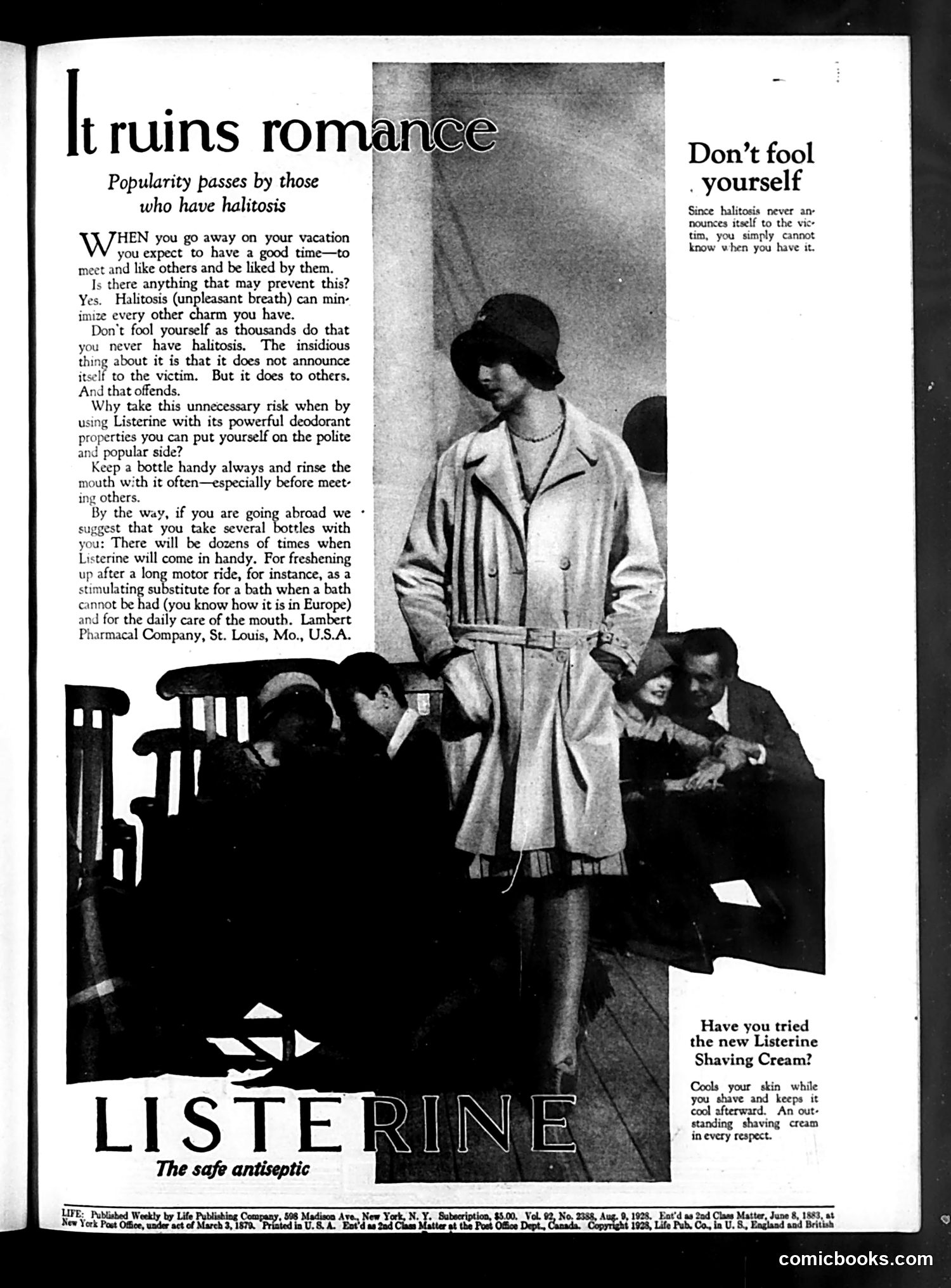
This page is primarily **advertising for Listerine mouthwash**, not political satire. The left column titled "It ruins romance" uses social anxiety as a sales pitch, warning that halitosis (bad breath) will damage one's social standing and romantic prospects. The headline "Popularity passes by those who have halitosis" reflects 1920s advertising's use of shame and fear to drive product sales. The central image shows a woman appearing uncomfortable around social companions, illustrating the supposed social consequence of bad breath. The ad promises Listerine as the solution. The right column promotes Listerine Shaving Cream as a bonus product. This exemplifies early 20th-century advertising strategy: creating insecurity about bodily functions to motivate consumer purchases.
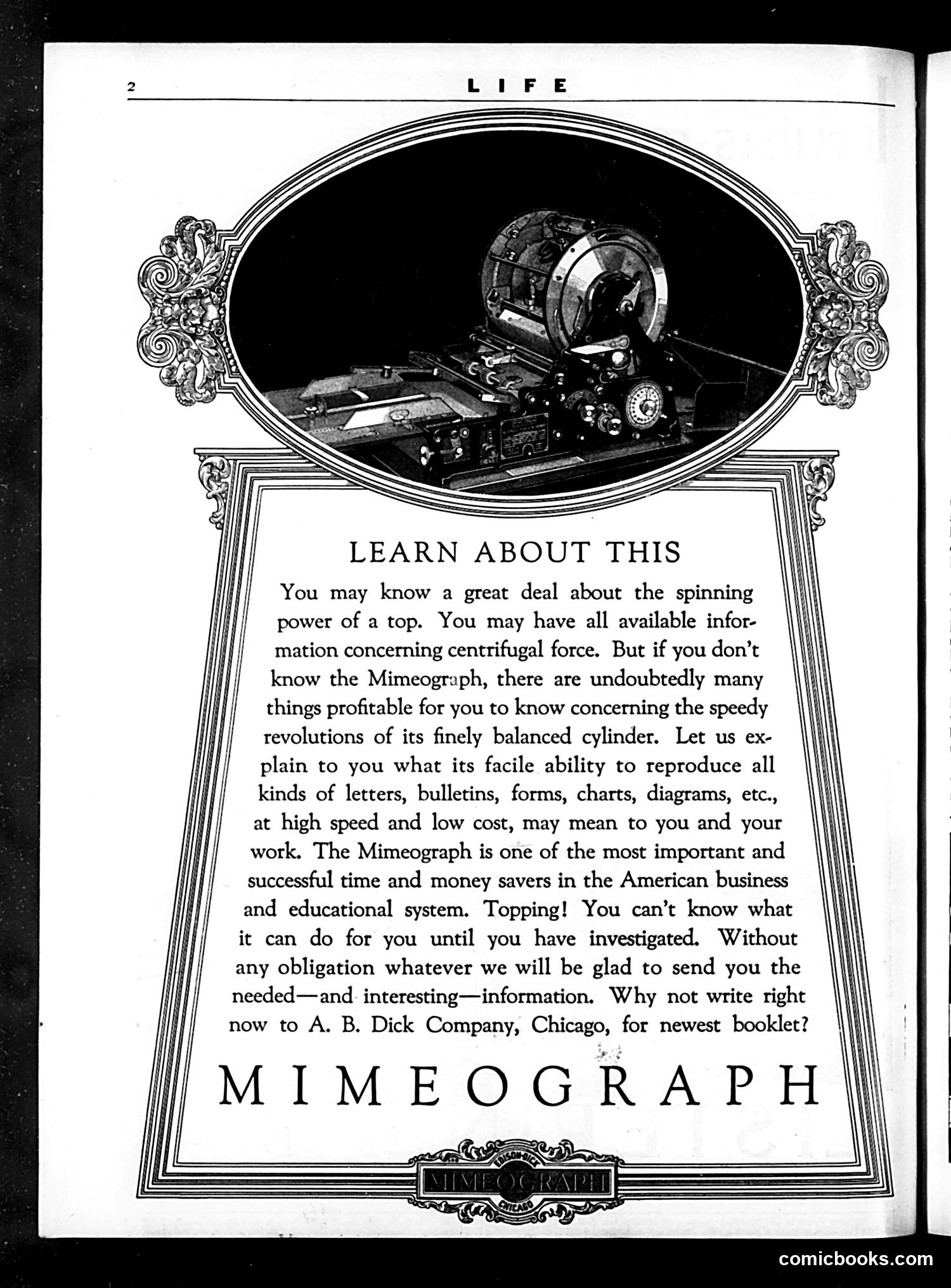
This is primarily an **advertisement, not political satire**. The page features a Mimeograph machine—a document reproduction device common in early-to-mid 20th century offices. The ad employs playful language ("Topping!") and rhetorical persuasion typical of the era, positioning the Mimeograph as an essential business tool for reproducing documents "at high speed and low cost." The ornate decorative frame and presence in *Life* magazine suggests this was pitched to educated, business-minded readers. There is no political cartoon or satirical commentary here—rather, this is straightforward product marketing disguised with period charm and promotional copy encouraging readers to request information from A.B. Dick Company in Chicago. The device itself appears in the oval photograph at top.
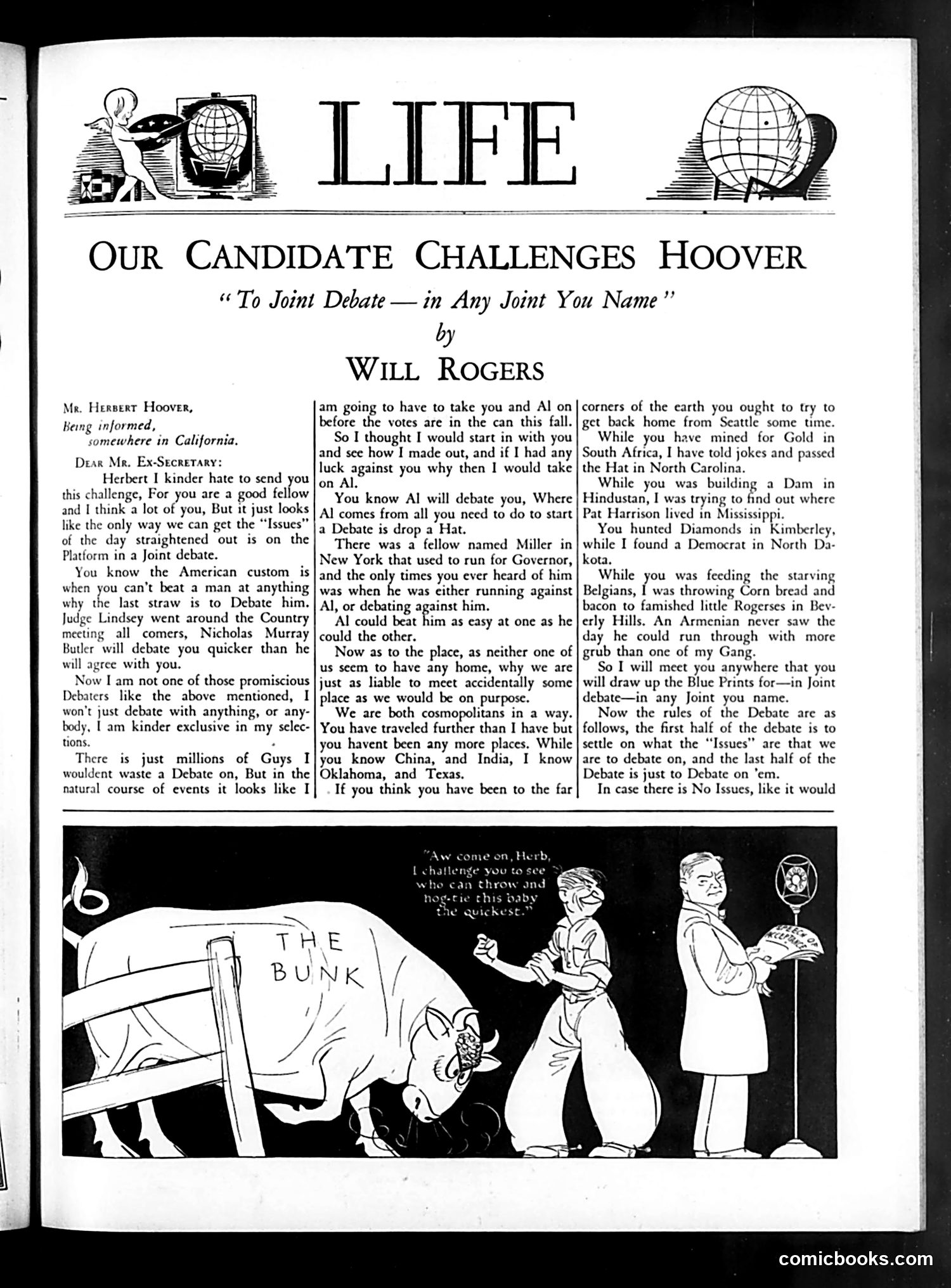
This is a **satirical open letter** from humorist Will Rogers to President Herbert Hoover, published in *Life* magazine. Rogers challenges Hoover to a public debate, using humor to mock the president's reluctance to engage directly with opponents. The satire works through **contrast**: Rogers catalogs his own modest accomplishments (traveling, telling jokes, observing politics) against Hoover's grander achievements (building dams, international diplomacy), then argues that despite these differences, Hoover should still debate him—suggesting Hoover is *avoiding* direct confrontation. The **cartoon below** depicts this challenge visually: a figure labeled "THE BUNK" lies in a bunk bed while two figures (likely representing Rogers and Hoover) discuss throwing things at a target, humorously illustrating the debate challenge. The piece lampoons Hoover's public persona as evasive and overly cautious during what was likely the **Great Depression era** (when public confidence in leadership was low).
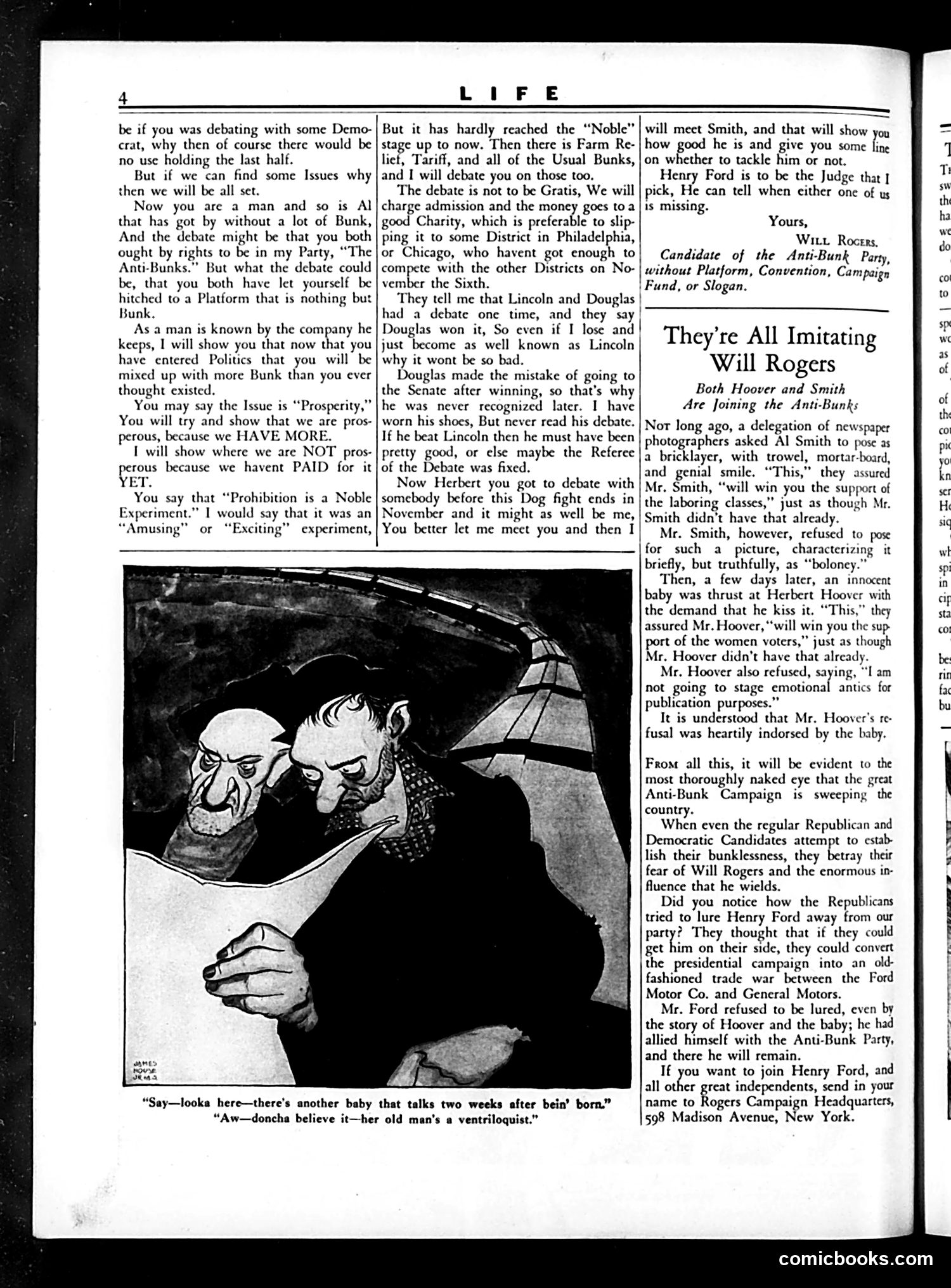
This 1920s *Life* magazine page satirizes the "Anti-Bunk Party" campaign supporting Henry Ford for president. The grotesque caricature depicts two men in an umbrella during rain, with the caption mocking someone who "talks two weeks after bein' born"—a ventriloquist's dummy joke. The accompanying text, attributed to Will Rogers, ridicules both Smith (likely Al Smith, Democratic candidate) and Herbert Hoover. Rogers mocks attempts by regular Republicans and Democrats to lure Ford away from the Anti-Bunk platform by invoking the baby/woman voter strategy. The satire targets how politicians exploit emotional appeals and manufactured endorsements. Ford, allied with the Anti-Bunk Party, refused such theatrical tactics, positioning himself as genuinely independent and above traditional campaign manipulation.
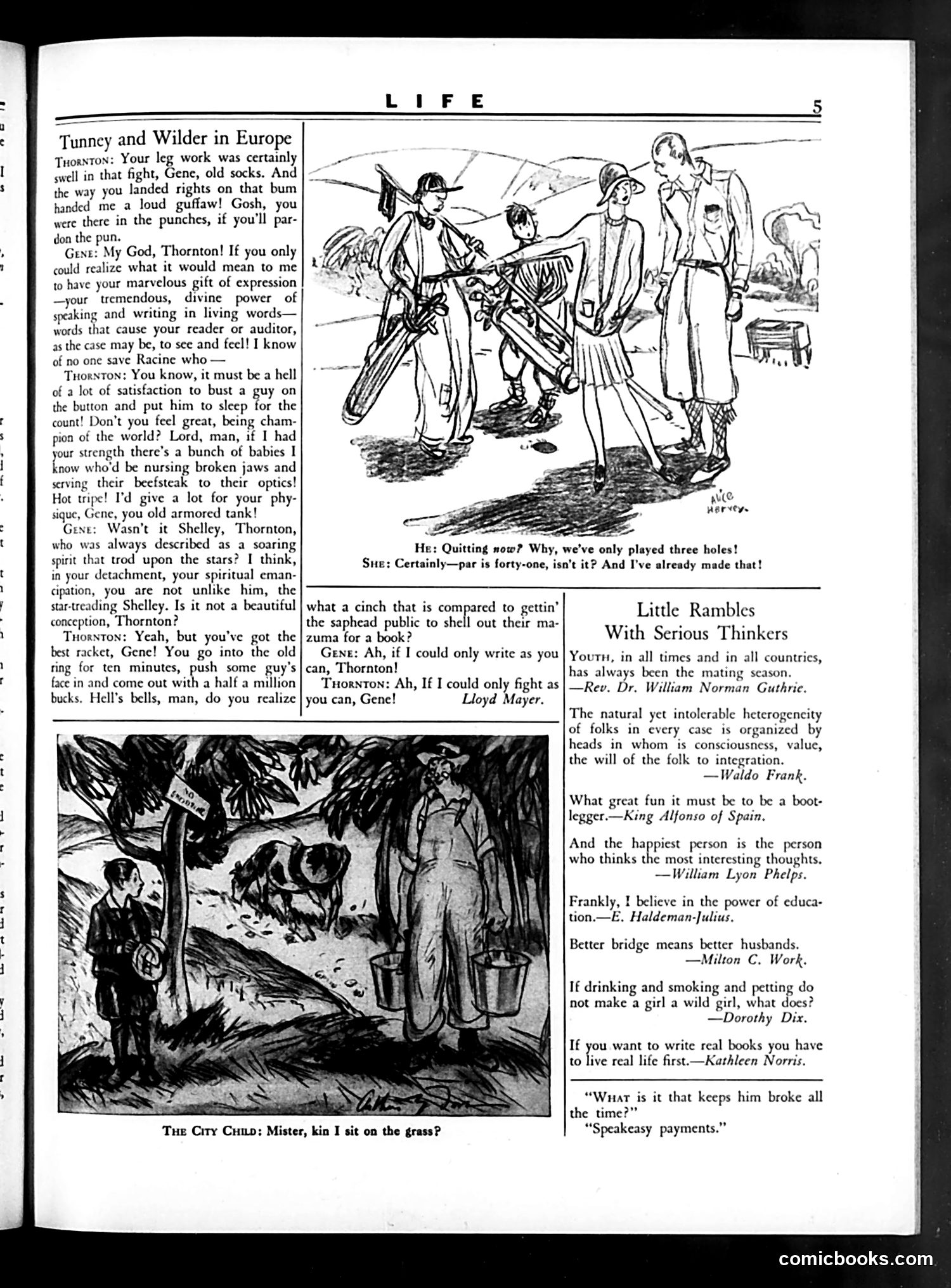
**Top Cartoon ("Tunney and Wilder in Europe"):** This appears to be a humorous dialogue between Gene Tunney (likely the heavyweight boxing champion) and Thornton Wilder (the playwright), with exchanges praising each other's professions. Tunney admires Wilder's literary gift; Wilder envies Tunney's fighting prowess. The satire gently mocks intellectual and athletic celebrity cultures by having each figure express envy of the other's accomplishments—suggesting both fields command public admiration and significant earning potential. **Bottom Cartoon ("The City Child"):** A dark, expressionistic sketch depicting an urban street scene with a child and figures in shadows. The caption "Mister, kin I sit on the grass?" satirizes industrial city life, highlighting the deprivation of nature and play space for poor urban children. Both pieces reflect 1920s-30s American social commentary on class, celebrity, and urban conditions.
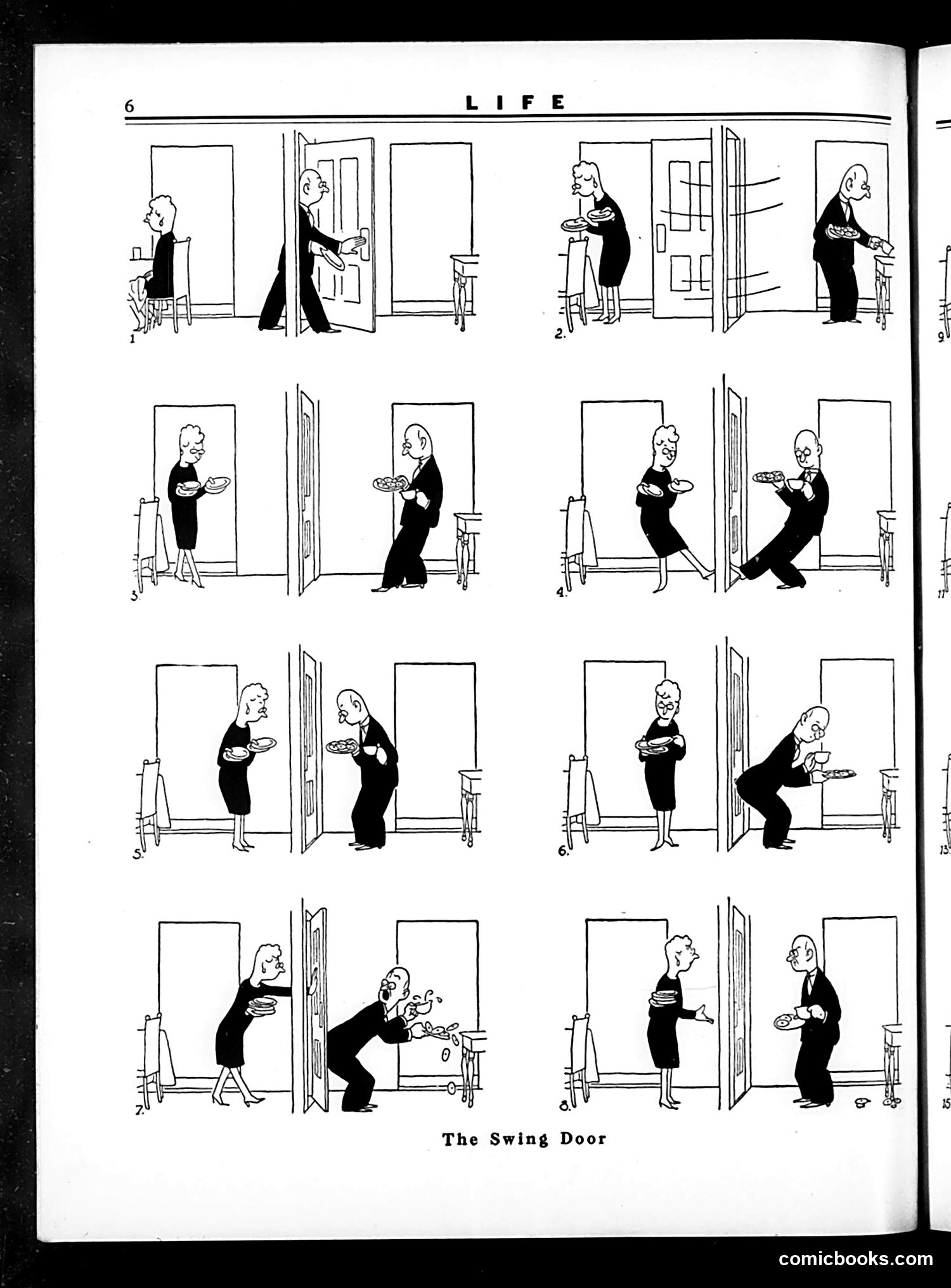
This comic strip satirizes the behavior of dinner guests at a formal social occasion. The sequence shows a man and woman repeatedly using a swing door between rooms—ostensibly to fetch food or move between spaces, but with increasing chaos and physical comedy. The joke satirizes poor etiquette and lack of consideration: the guests keep swinging the door, nearly colliding with each other, dropping food, and creating general disruption. By the final panels, they're actively getting in each other's way and making messes. The satire targets social pretension—people attempting to appear refined at a formal dinner while actually behaving chaotically and inconsiderately. It's physical comedy highlighting how social gatherings often devolve into undignified behavior beneath the surface of politeness.
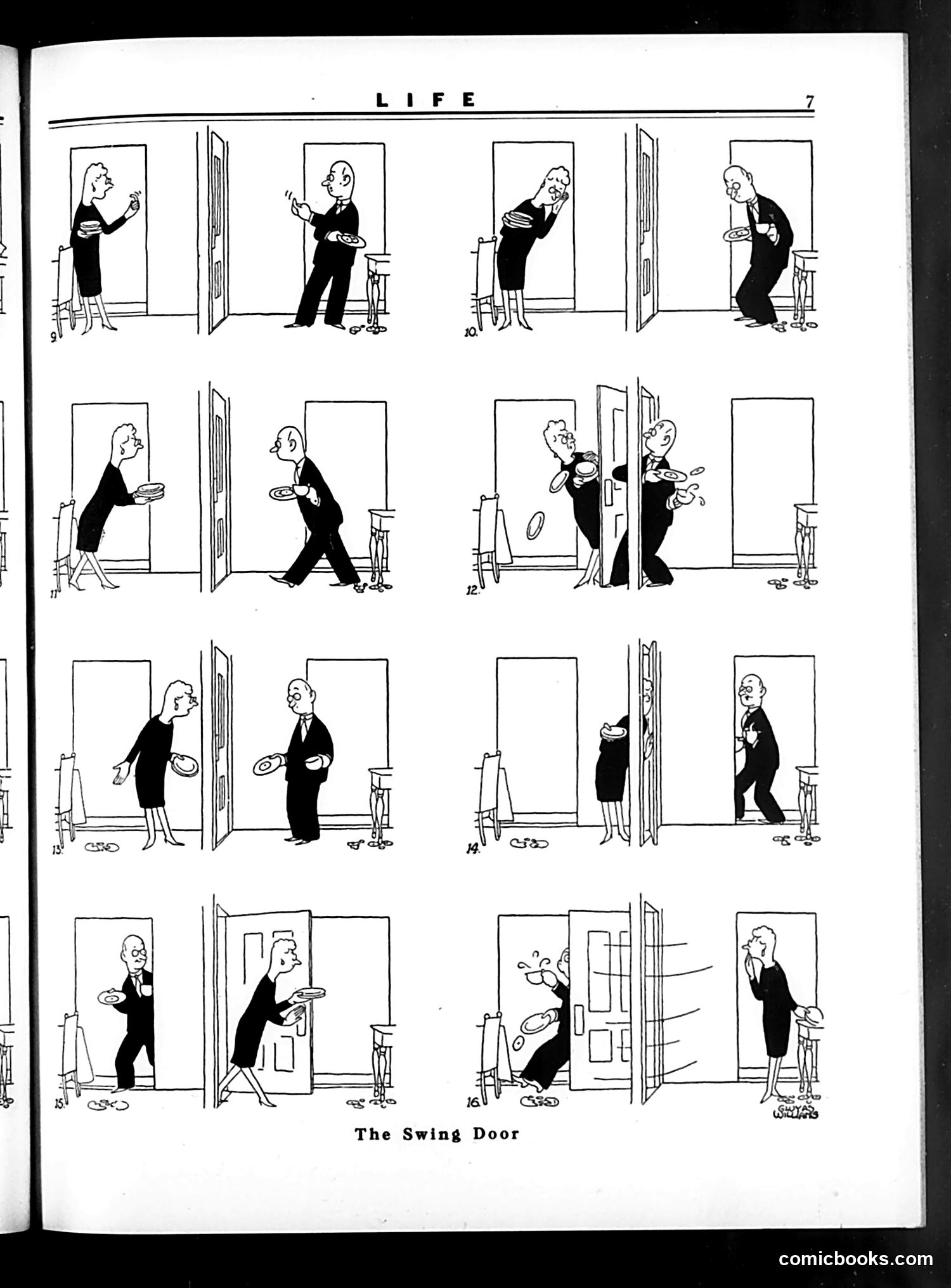
This is a wordless comic strip titled "The Swing Door" depicting a domestic interaction between a man and woman at their home entrance. The sequence shows: 1. The woman attempts to enter while the man blocks the doorway 2. They engage in a physical struggle over passage through the swing door 3. The man eventually gains control, pushing the door shut 4. The woman is left outside, appearing frustrated or defeated The satire appears to comment on **domestic power dynamics and marital control**, likely reflecting early-20th-century anxieties about household authority. The "swing door" serves as a literal battleground for household dominance. Without additional context about Life magazine's specific political stance during this period, the exact satirical target remains unclear, though the humor derives from the physical comedy and gender-role struggle depicted.
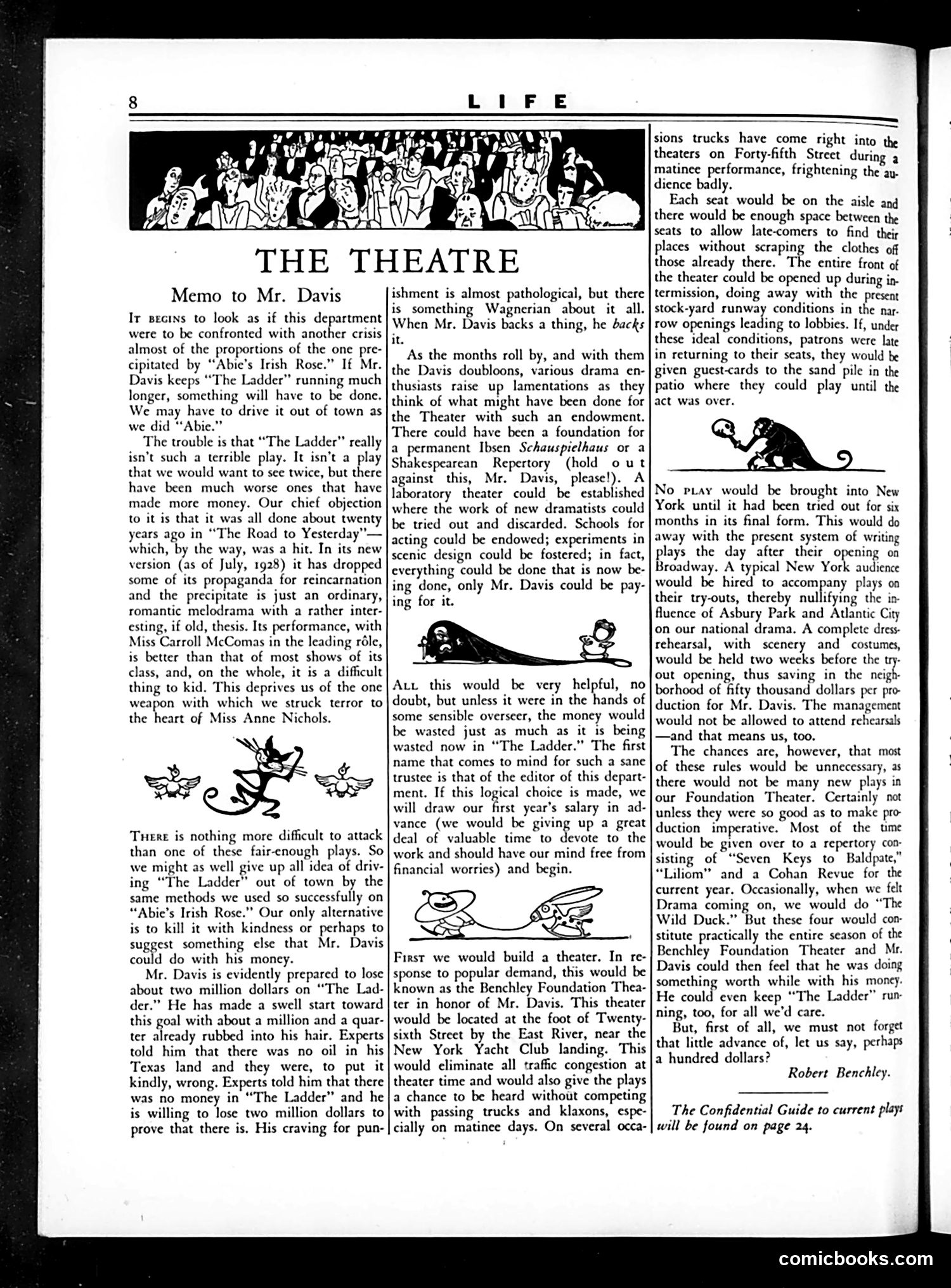
This page is a satirical memo to Mr. Davis (likely a theater producer/manager) criticizing the play "The Ladder." The text argues the play, despite making money, is artistically poor and represents a crisis in American theater. The small cartoon illustrations (monkeys/apes with various objects) appear to be decorative flourishes mocking theatrical pretension, though their specific meaning is unclear without additional context. The author proposes establishing a permanent experimental theater where new plays could be tested before Broadway production—with proper funding, rehearsal time, and scenery. This would improve American drama's quality by filtering out mediocre works before they reach mainstream audiences. The tone is one of frustrated exasperation: even commercially successful theater can be artistically worthless, and systemic change is needed.
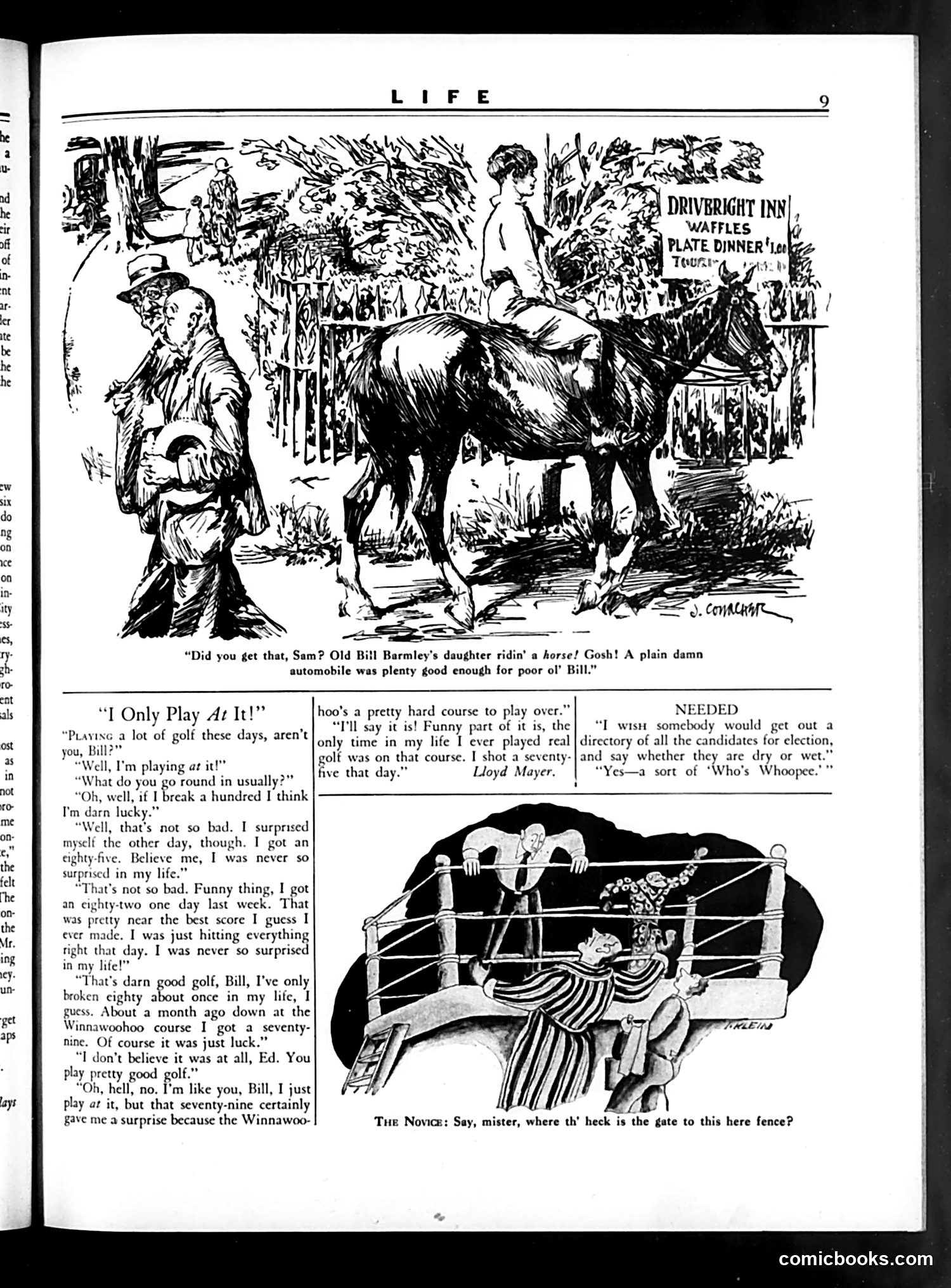
This page contains two separate cartoons from *Life* magazine: **Top cartoon** depicts a man expressing shock that "Old Bill Barmley's daughter" is riding a horse rather than driving an automobile. The joke satirizes the rapid shift from horse transportation to automobiles in early 20th-century America—what was once normal (horseback riding) now seems shockingly old-fashioned, while automobiles have become the expected modern standard so quickly that traditional modes of transport appear antiquated. **Bottom cartoon** shows a novice asking for directions to a fence gate, apparently confused about basic rural features. This is likely a "city slicker" joke, mocking urbanites' unfamiliarity with rural life and farm infrastructure. Both cartoons reflect early automotive-era class and cultural divisions between urban and rural America.
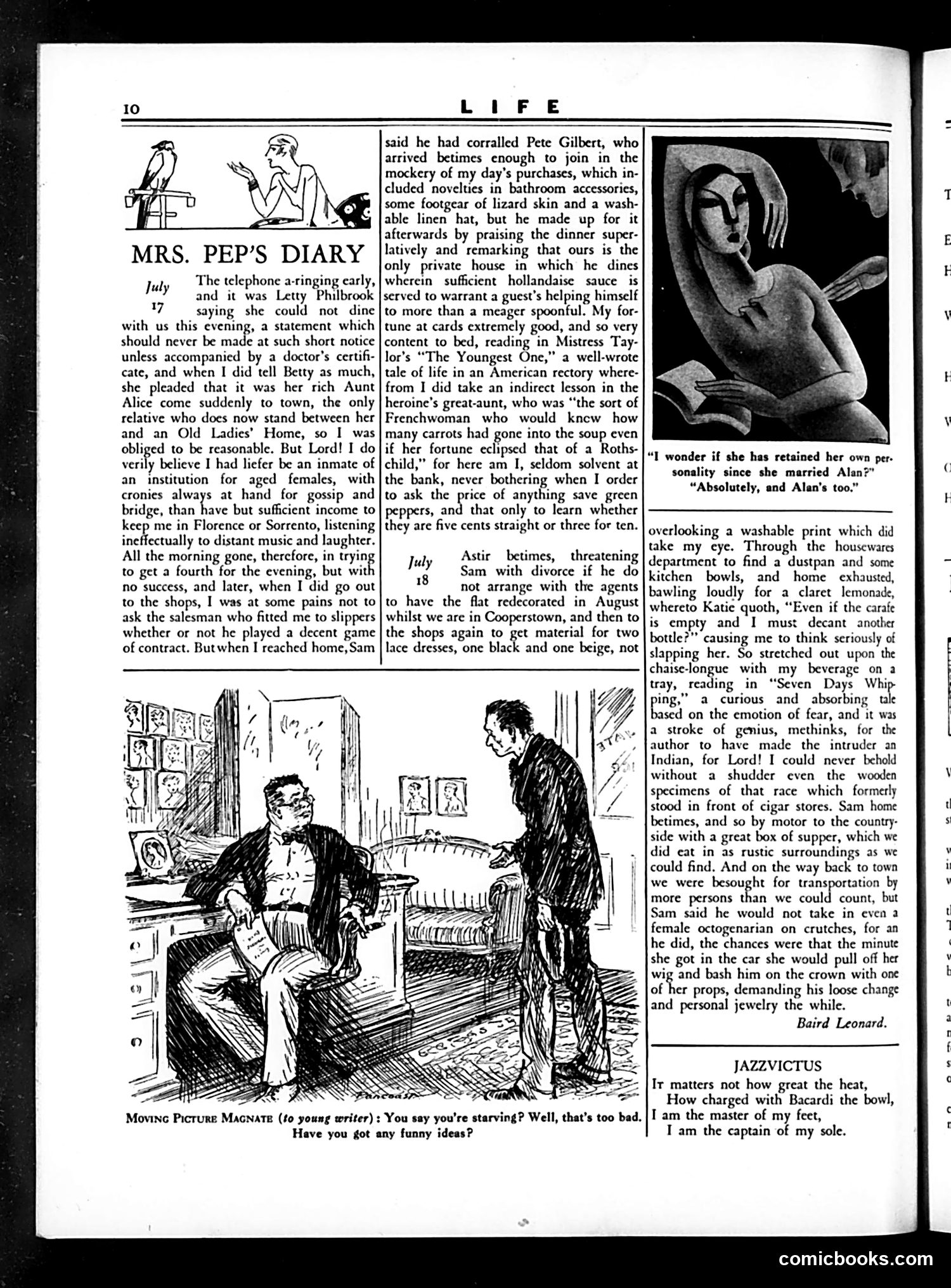
This page from *Life* magazine contains a diary column and an illustration titled "Moving Picture Magnate (To young writer): You say you're starving? Well, that's too bad. Have you got any funny ideas?" The cartoon satirizes Hollywood's ruthless treatment of struggling writers. A well-dressed movie executive dismisses a clearly impoverished young writer, suggesting that studio heads only value creative output ("funny ideas") rather than caring about artists' actual welfare or hardship. The diary entries above record mundane social observations—cancelled dinner plans, household mishaps, marital tensions—typical of satirical domestic humor common to early 20th-century *Life* magazine. The overall page mocks both Hollywood's callousness and middle-class social pretensions through contrasting narratives of glamour and disillusionment.
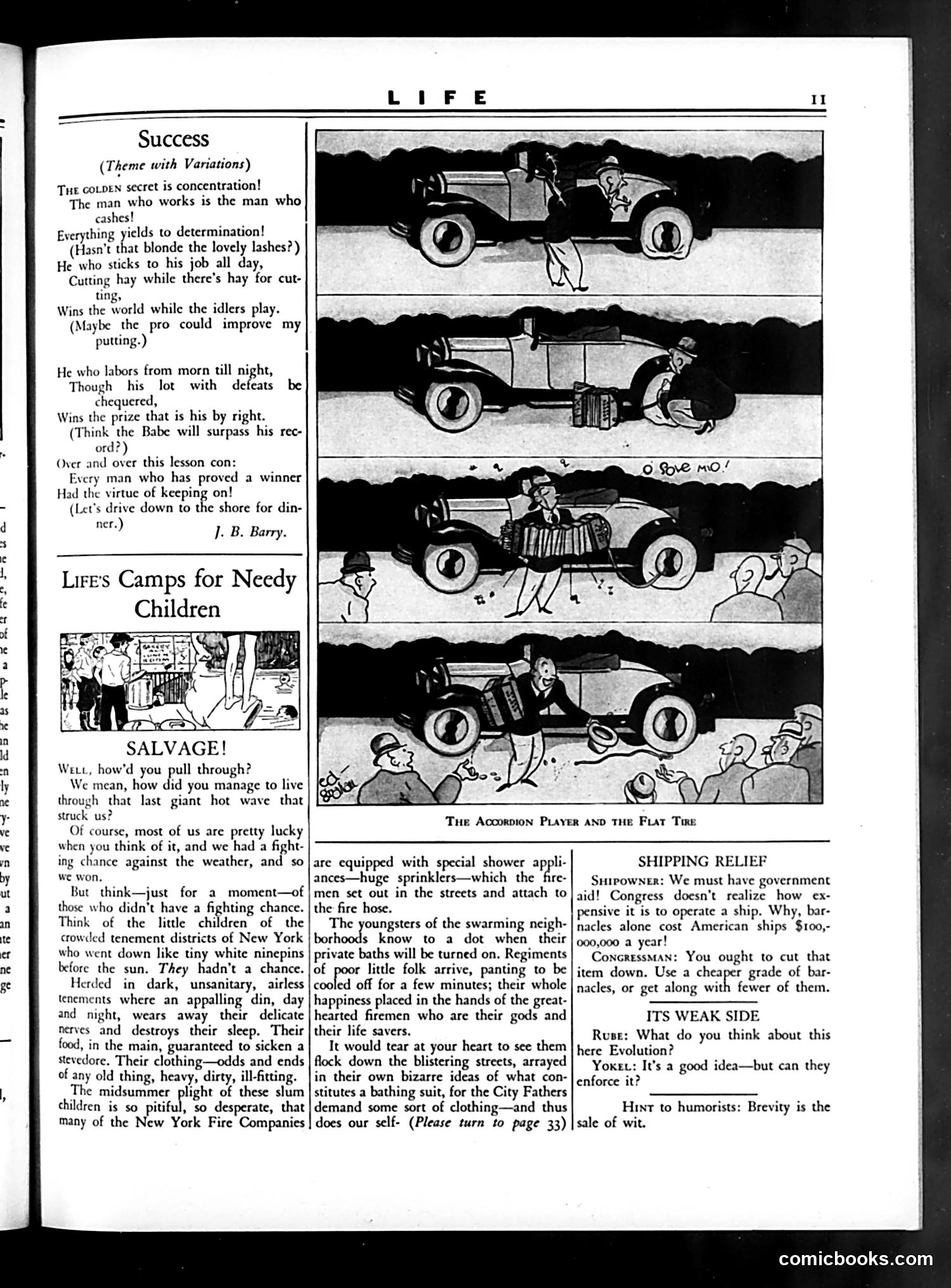
This four-panel comic satirizes street musicians during economic hardship. A man plays accordion while standing near a car with a flat tire. In successive panels, his music apparently causes the tire to deflate further, the car to sink, and finally collapse entirely—presented as if his playing is literally destructive. The joke relies on the period stereotype of accordion music as unbearably bad or annoying. The satire likely targets both struggling street performers (common during economic depression) and the public's disdain for them. The exaggerated physical destruction suggests the visceral irritation his music causes observers, making it a commentary on class attitudes toward impoverished musicians seeking survival income.
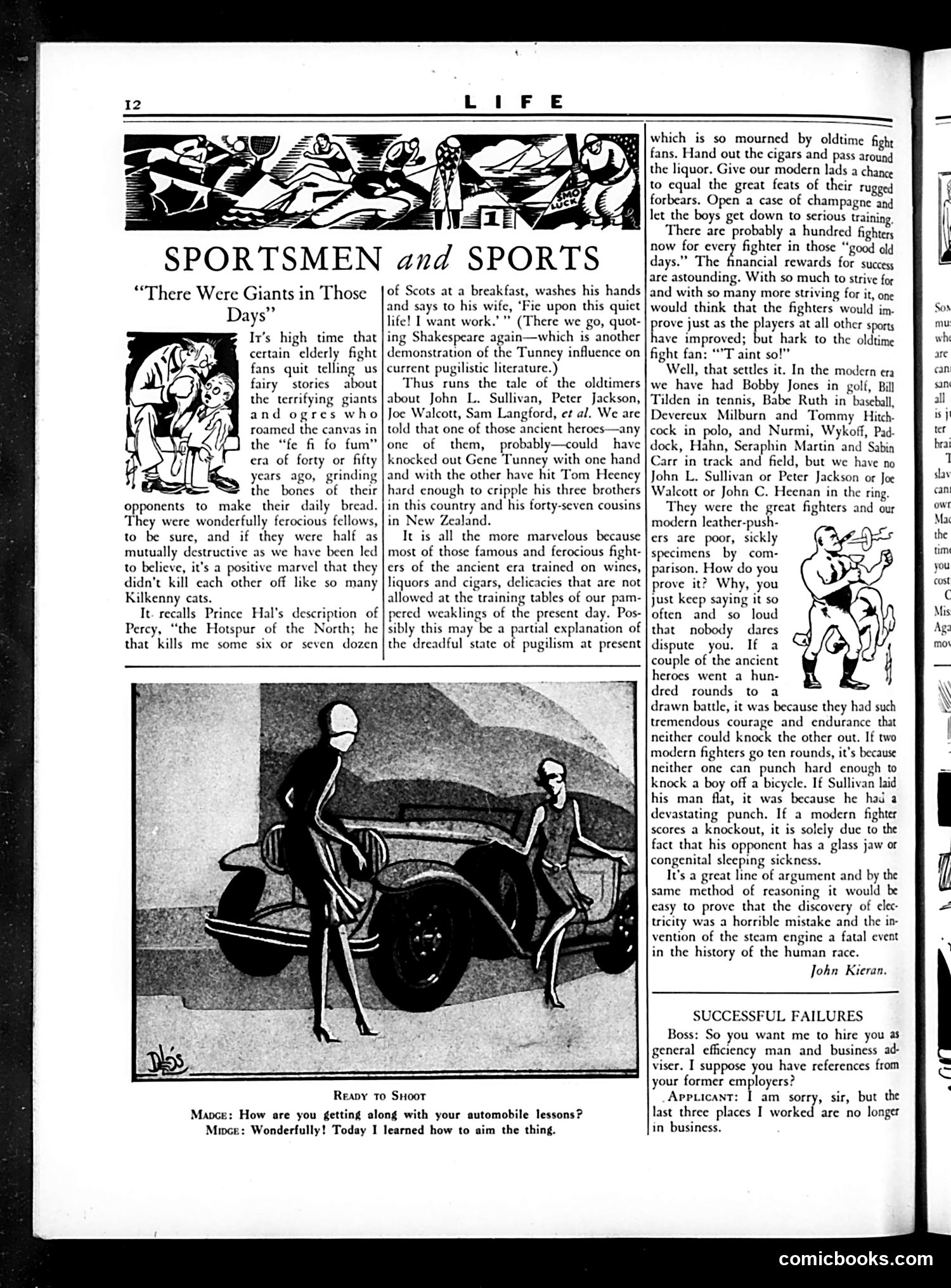
This page contains two distinct items: **"There Were Giants in Those Days"** — An article comparing old-time fighters (mentioning John L. Sullivan, Peter Jackson, Gene Tunney, Tom Heeney) to modern boxers. The author argues that historical fighters were tougher because they trained on wine and rich food rather than modern scientific methods, and questions whether modern fighters could match their endurance. It's a nostalgic critique of modern athletic training versus older, supposedly harder traditions. **"Ready to Shoot"** — A cartoon showing two women with an automobile, captioned with dialogue about learning to "aim the thing" during driving lessons. It satirizes women learning to drive, treating automobile operation as if it were shooting a gun—poking fun at both women drivers and the novelty of automobiles themselves.
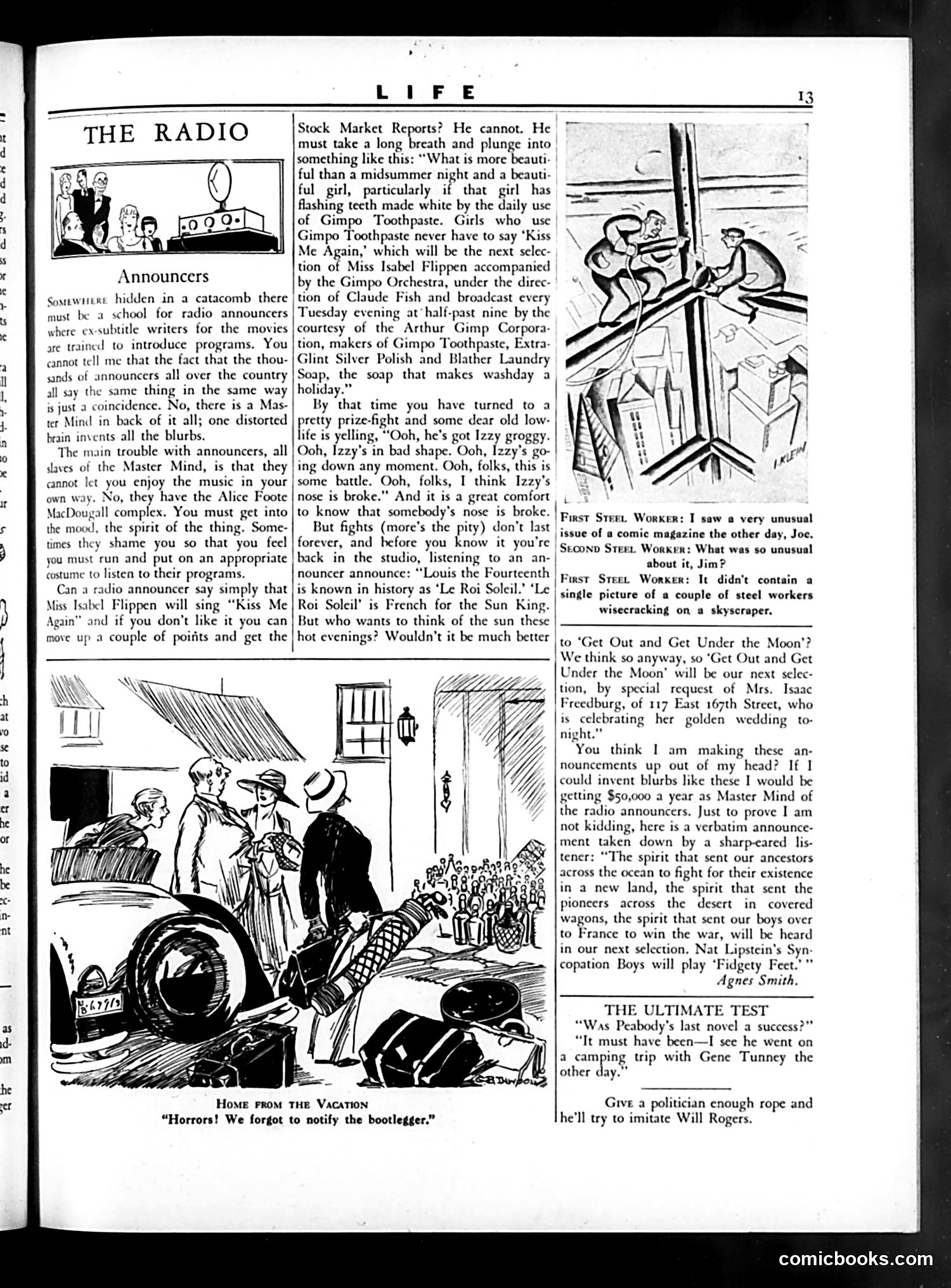
This page from *Life* magazine contains humorous commentary on 1920s-30s radio broadcasting and advertising. **"The Radio" section** satirizes radio announcers' affected diction and their inability to maintain consistent tone when reading commercial copy. The joke is that announcers must artificially switch between dramatic delivery for programs and sales-pitch enthusiasm for sponsor advertisements—creating jarring, inauthentic performances. **"Home from the Vacation" cartoon** shows a family returning home and a bootlegger approaching their door. The caption "Horrors! We forgot to notify the bootlegger" is a Prohibition-era joke: despite alcohol being illegal, wealthy families maintained ongoing relationships with bootleggers who supplied their liquor, treating them like regular service providers. Both items mock the absurdities of contemporary American life and commercial culture.
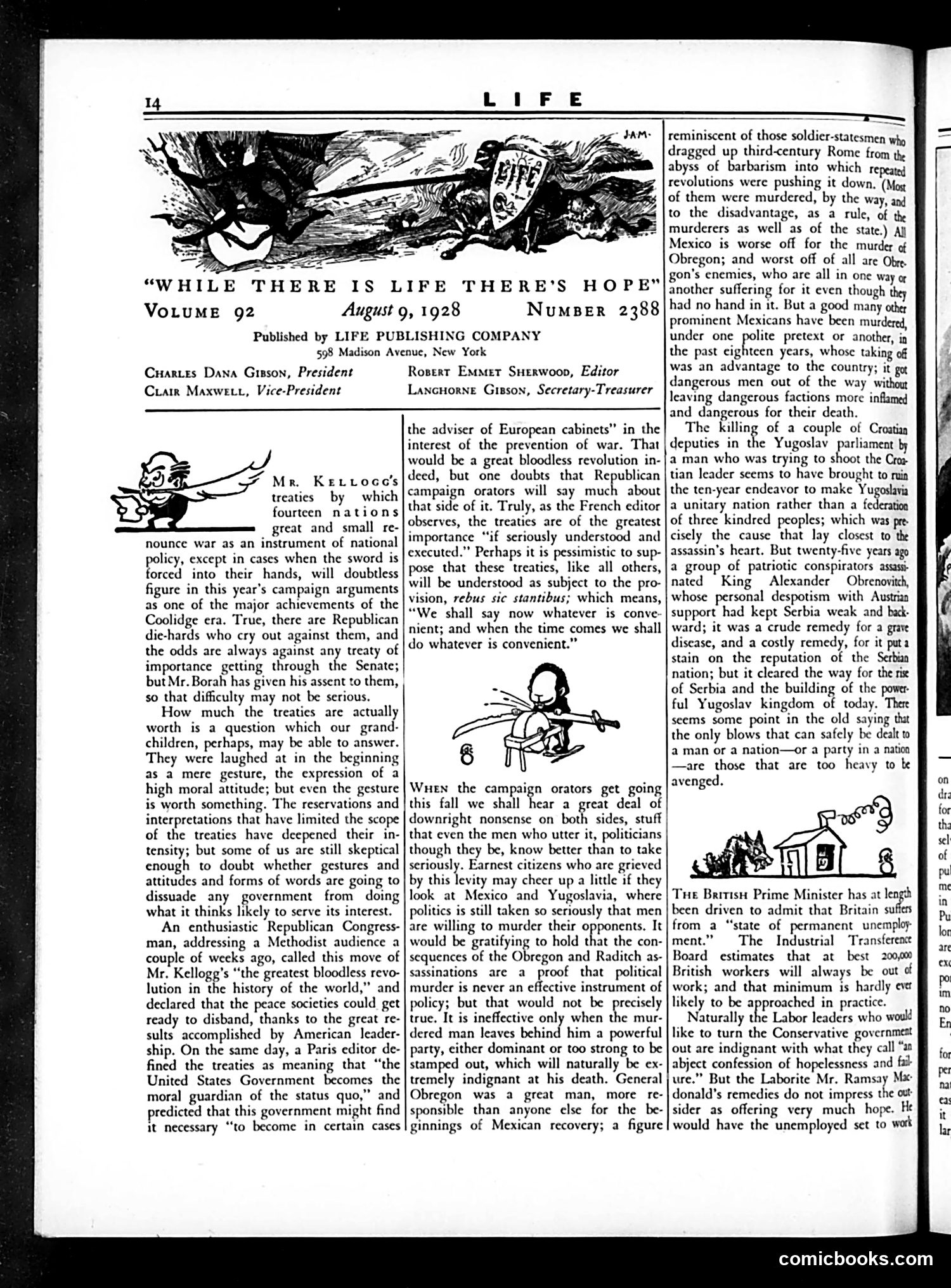
This *Life* magazine page (August 9, 1928) contains editorial commentary on international politics rather than traditional cartoons. The text discusses Republican campaign arguments about treaties, referencing the Kellogg-Briand Pact ("treaties are of the greatest importance"). The piece critiques both political parties' positions on Mexico and Yugoslavia, where political assassinations occurred. It argues that while gestures of moral disapproval matter, only decisive action—such as supporting Yugoslavia's new kingdom or addressing Mexico's instability—proves effective. The final section addresses British unemployment and Labor Party critiques of Conservative governance, suggesting Labour's remedies offer little practical hope to the jobless. The small illustrations appear decorative rather than satirical, complementing the text-heavy political analysis typical of *Life*'s editorial format.
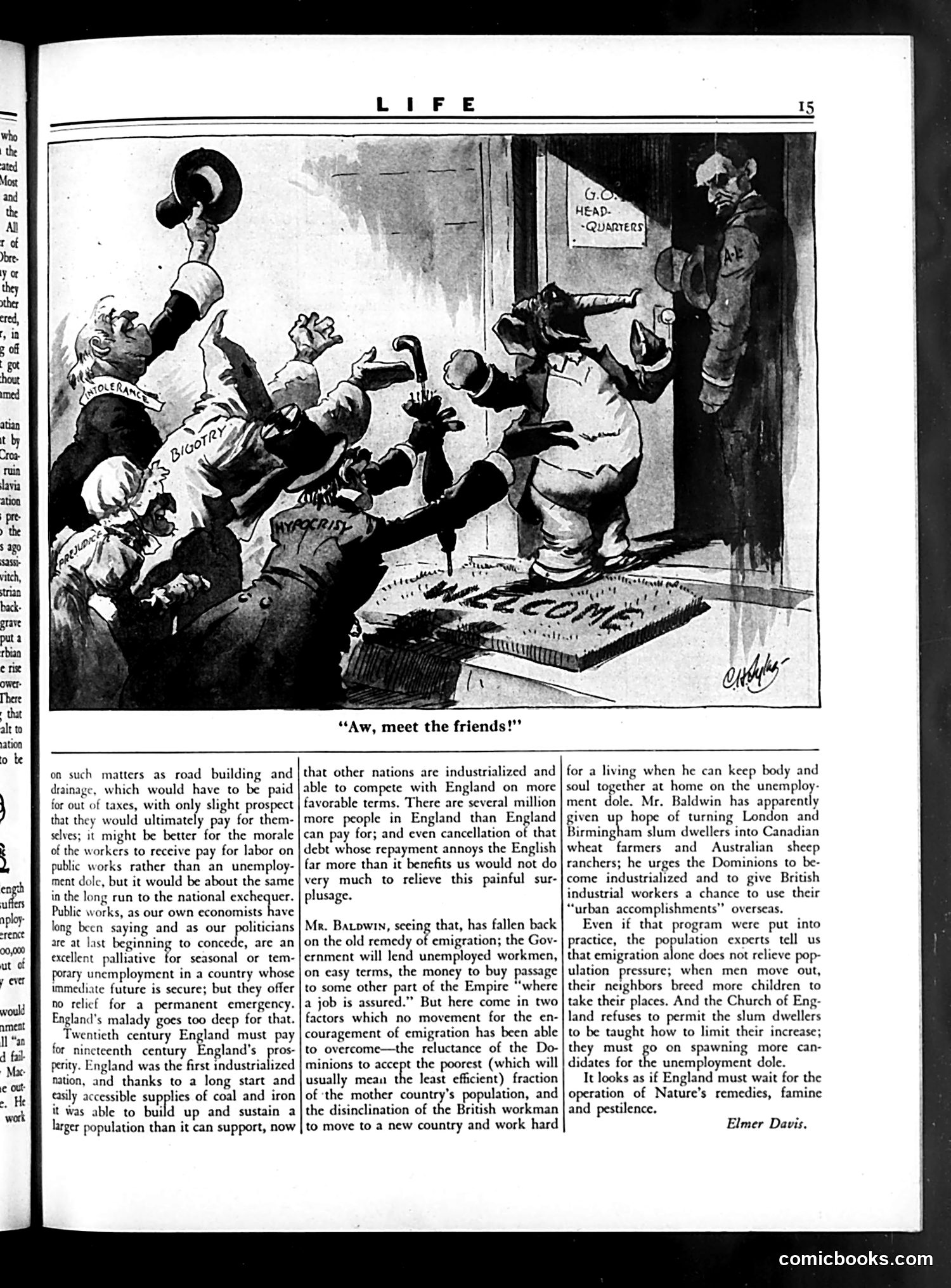
This cartoon satirizes British emigration policy during economic hardship. The figure on the left (labeled with text suggesting unemployment and bigotry) is being forcibly ejected from "G.O. Head-Quarters" by officials. The expelled figure's friends—depicted as various social problems (unemployment, bigotry, and other ills)—are shown waiting outside, ready to enter. The accompanying article by Elmer Davis criticizes the British government's emigration encouragement as a solution to unemployment. Rather than genuinely addressing England's economic problems, the government apparently hoped to export its unemployed population to other Empire territories. The cartoon mocks this approach, suggesting such policies merely spread problems elsewhere rather than solving them at home.
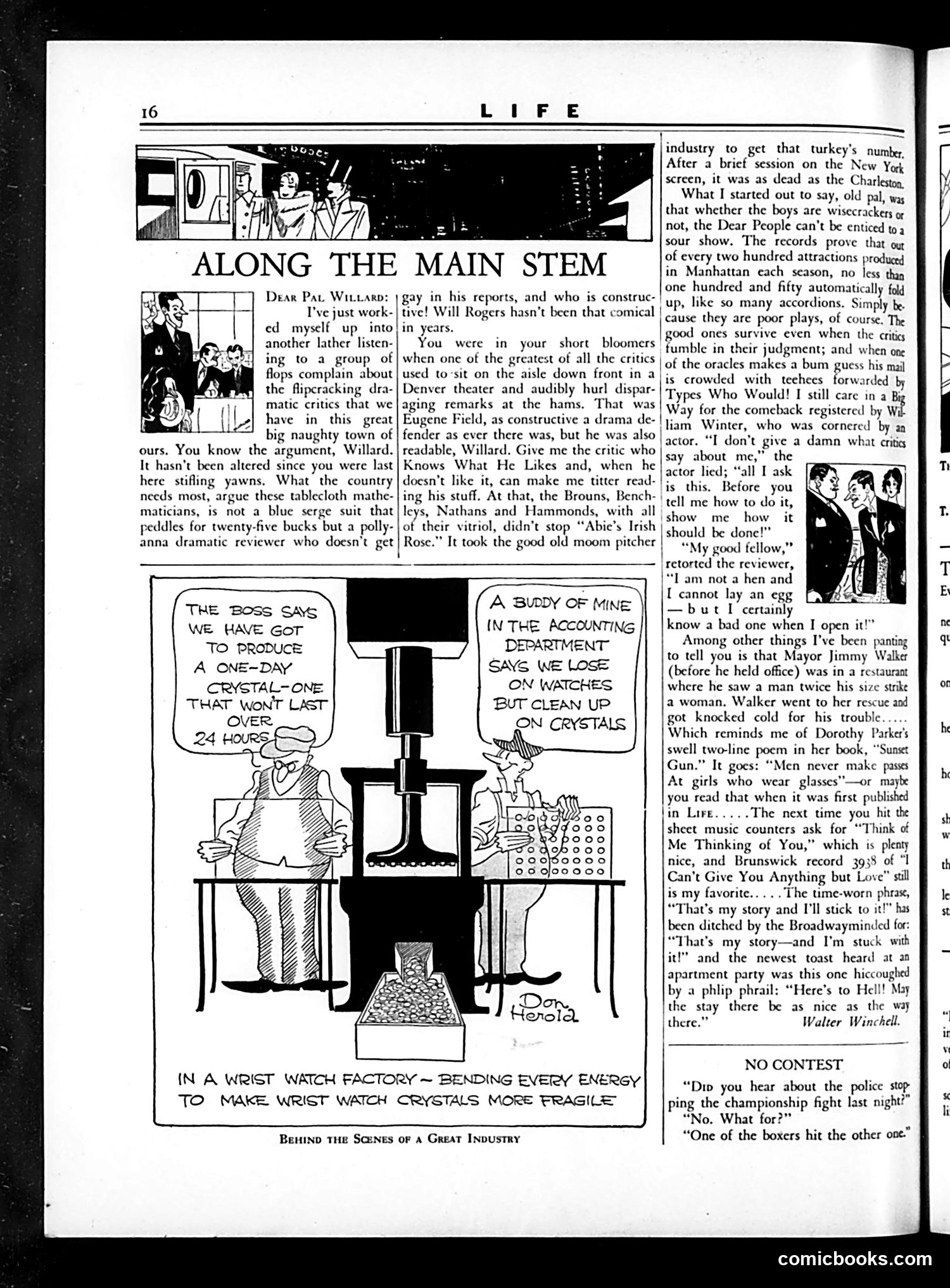
This page contains a humorous column and cartoon about theater criticism and industrial manufacturing. The main cartoon depicts a wrist watch factory where workers are deliberately making watch crystals fragile to ensure frequent replacements—a satirical jab at planned obsolescence and corporate waste. One worker tells his boss they've "got to produce a crystal that won't last over 24 hours," while an accountant notes they "lose on watches but clean up on crystals." The accompanying column discusses theater critics and playwrights (mentioning Will Rogers and Eugene Field), criticizing how Broadway reviews can unfairly damage productions. The satire targets both shoddy manufacturing practices and harsh critical reviewing as wasteful industries that profit from built-in failure rather than quality products or fair assessment.
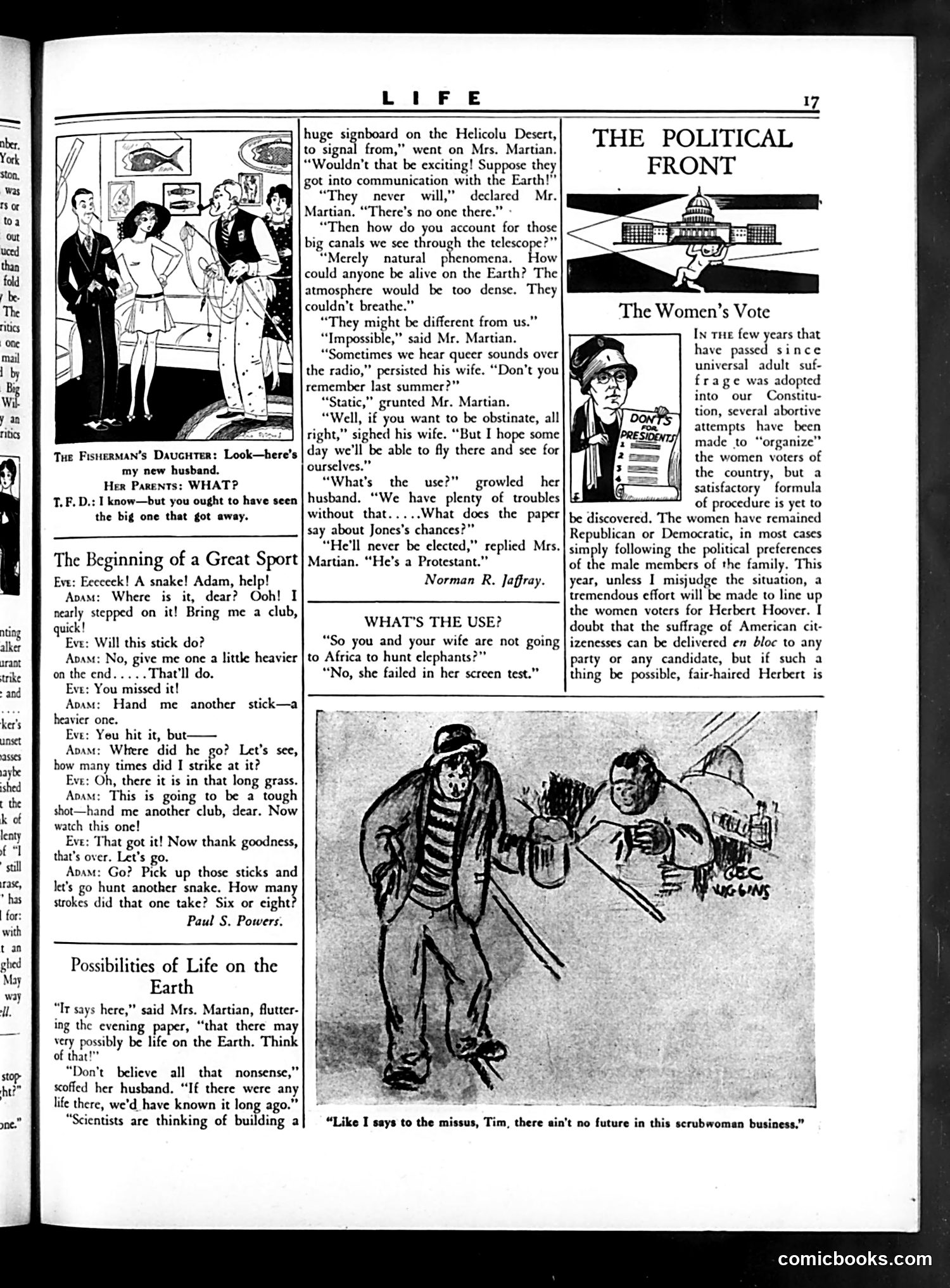
This page from *Life* magazine satirizes women's suffrage through multiple pieces. "The Women's Vote" section discusses the challenge of organizing female voters after women gained the constitutional right to vote, noting that Republican and Democratic parties struggled to predict women's voting patterns—they didn't simply follow their husbands' preferences. The cartoon at bottom depicts a man telling another, "Like I says to the missus, Tim, there ain't no future in this scrubwoman business"—likely mocking working-class anxieties that women's employment and voting rights threatened traditional male economic dominance. The other sketches humorously contrast domestic life with fantastical scenarios, reflecting period anxieties about changing gender roles following women's enfranchisement.
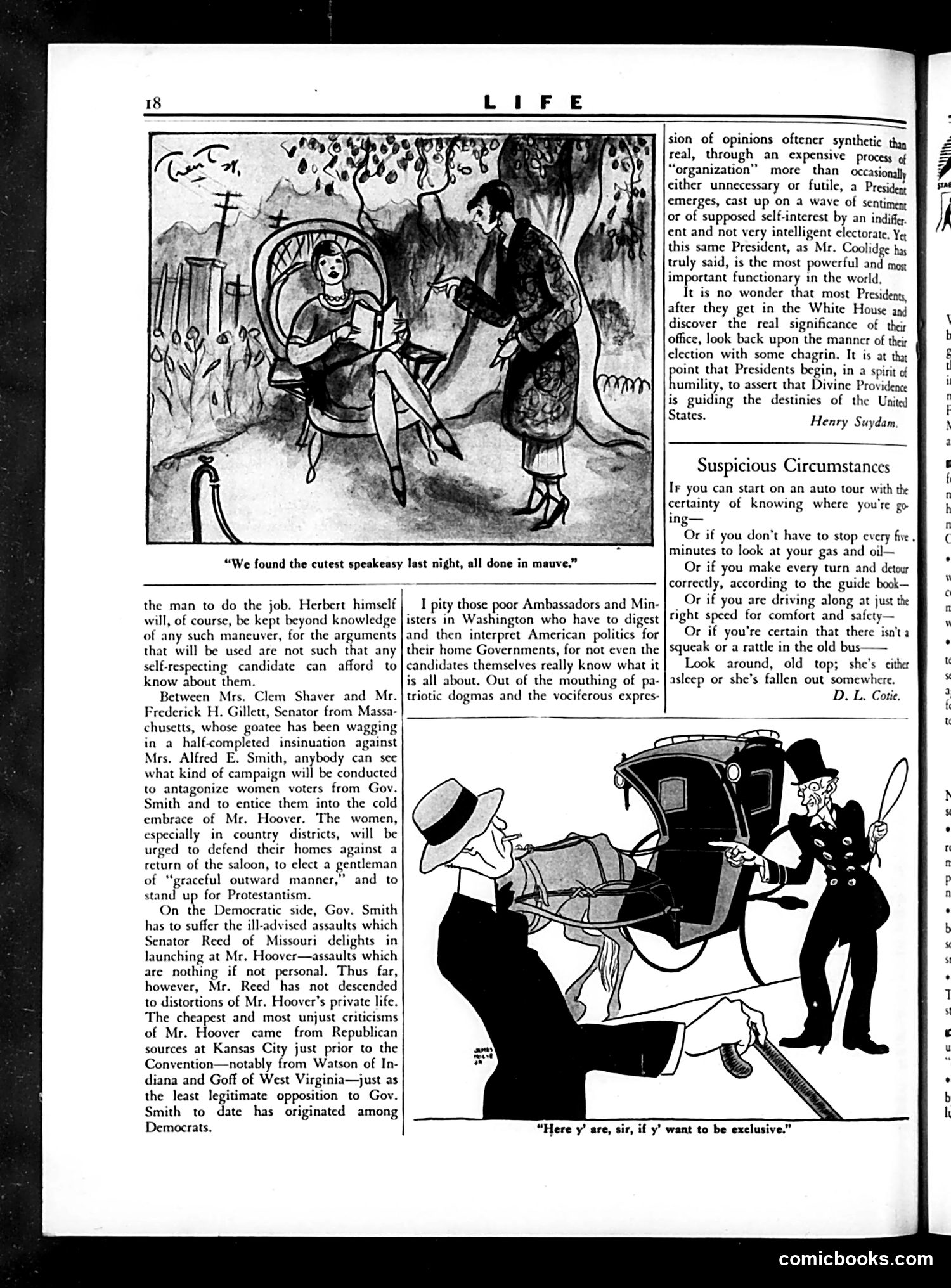
The top cartoon depicts a woman in a circular mirror being shown by a man, with crosses visible in the background—likely satirizing the 1928 presidential campaign's exploitation of Prohibition and religious anxiety to attract women voters, particularly against Democratic candidate Al Smith (a Catholic who opposed Prohibition). The text criticizes how both parties conduct campaigns through "expensive Process of 'organization'" and "synthetic" patriotic messaging rather than genuine issues. It mocks the hypocrisy: candidates emerge through sentiment and poorly-informed voters, yet become "the most powerful" figure in government—leading them to later claim "Divine Providence" guided their election. The bottom cartoon about an auto tour is a humorous sidebar about suspicious circumstances—if everything goes perfectly smoothly on a drive, something's wrong (the driver is asleep or absent). The overall message: American presidential campaigns rely on manipulation of uninformed voters rather than substantive debate, despite electing the world's most important leader.
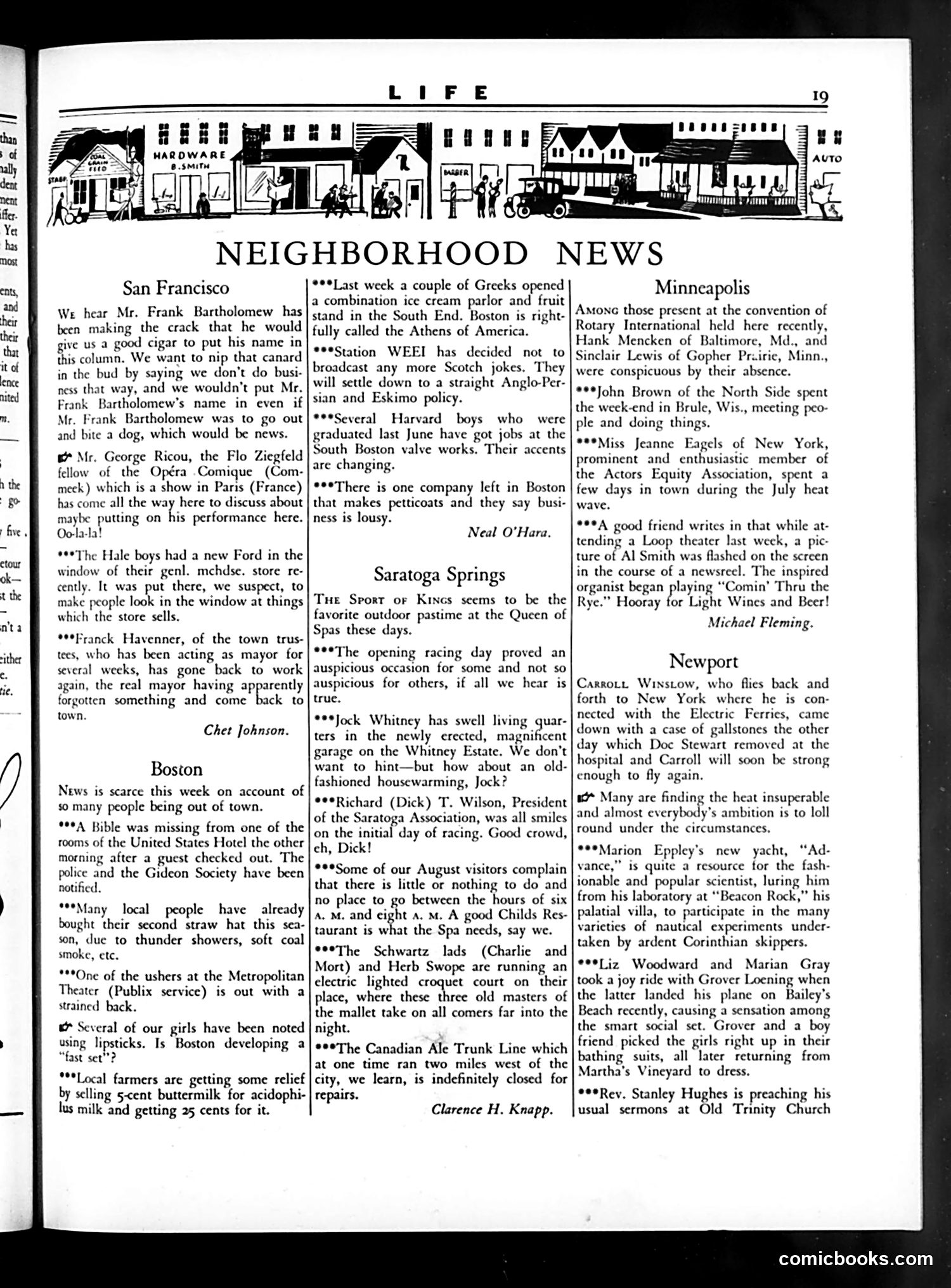
This page is **not a political cartoon** but rather a **gossip/humor column** titled "Neighborhood News," organized by city (San Francisco, Boston, Saratoga Springs, Minneapolis, Newport). The humor is **social satire** targeting local society and behavior: - **San Francisco**: Mocks Frank Bartholomew's attempt to get his name in the column through gifts; jokes about a Ford displayed to lure window shoppers - **Boston**: Gentle mockery of Boston's pretensions ("Athens of America"), the emerging "fast set" using lipsticks, farmers adulterating buttermilk, and Harvard graduates' accents changing at factory jobs - **Saratoga Springs**: Focuses on the wealthy (Jock Whitney's new garage), horse racing, and idle visitors - **Newport**: References yachting and high-society activities The tone is **light, gossipy, and class-conscious**, aimed at magazine readers amused by wealthy people's foibles and changing social mores (lipstick use, new automobiles). This reflects 1920s-era attitudes about propriety and social change.
This page contains **social gossip and humor columns** from five American cities (Philadelphia, Chicago, Portland, Cleveland, Houston, Detroit), not political cartoons. The content reflects **1920s-30s upper-class social life**: brief, witty observations about local personalities—businessmen, actors, lawyers—and their summer travels, engagements, and activities. The tone is satirical through gentle mockery: a lawyer "hiking through France," radio manufacturer Atwater Kent's two yachts, schoolteachers demanding marriage rights, and repeated mentions of various Manfords vacationing at San Marcos. The humor targets **wealthy leisure activities** and social conventions. A running joke suggests the Willamette River flooding caused more chaos than the local baseball team's poor performance. References to the "1935 World's Fair" and "flagpole sitters" (a Depression-era stunt fad) date this material. These aren't cartoons—they're **witty social commentary in column form**, mocking the preoccupations and pretensions of America's leisure class during an era of economic uncertainty.
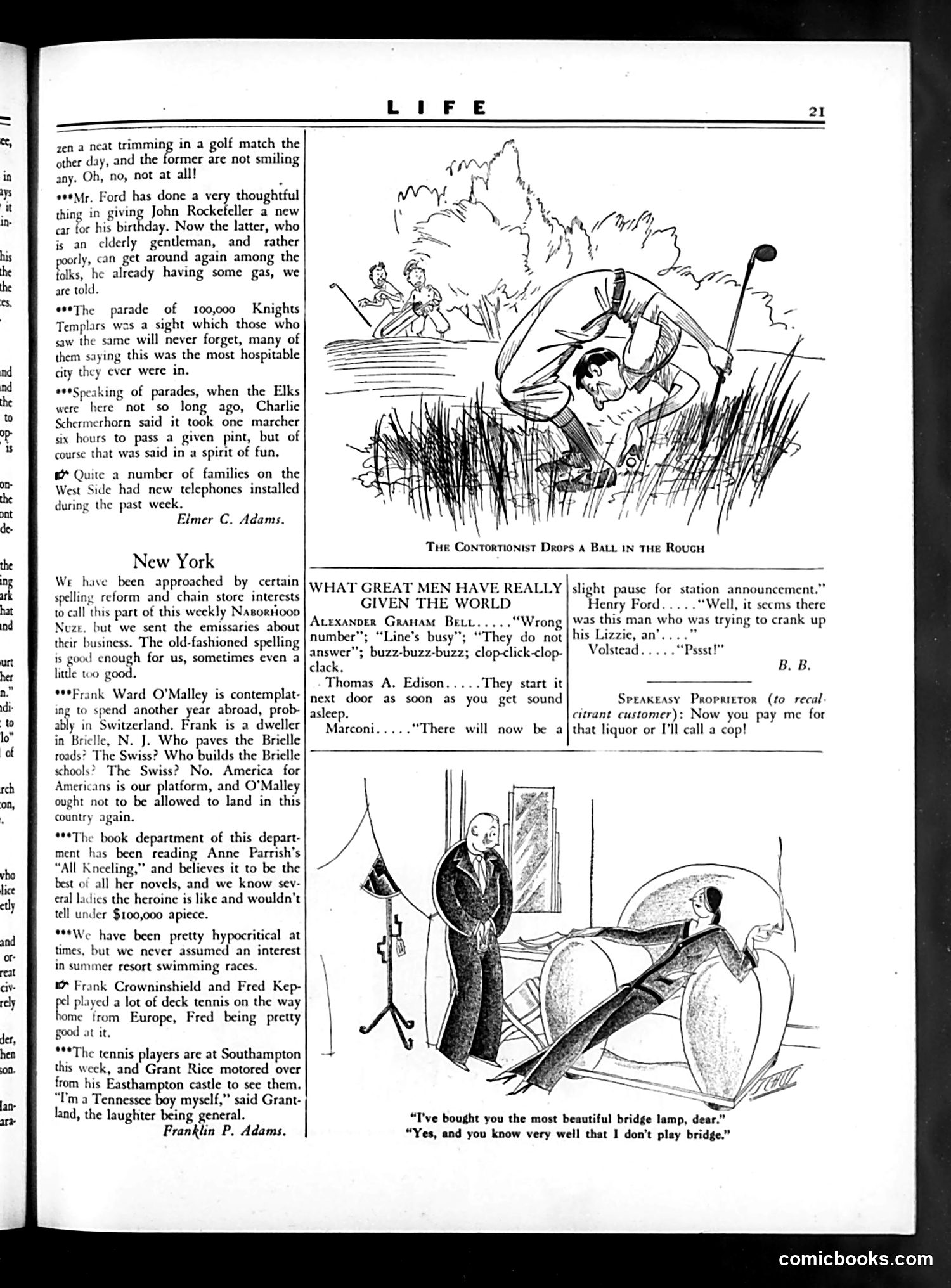
This page contains satirical commentary on recent news and celebrity culture, plus two cartoons. **Main Cartoon (top):** "The Contortionist Drops a Ball in the Rough" depicts a golfer in an awkward contorted position, satirizing poor golf performance. **Lower Cartoon:** A couple discusses a decorative bridge lamp he's purchased. Her response—"you know very well that I don't play bridge"—is a gentle marital joke about impractical gift-giving; he bought an ornament named after an activity she doesn't engage in. **Text Content:** The column mocks recent New York events (Knights Templar parade, Elks parade, new West Side telephones) with tongue-in-cheek commentary. A "What Great Men Have Really Given the World" section satirizes inventors' problematic creations: Bell gave "wrong number" phone calls, Edison gave noisy neighbors, Marconi gave radio announcements, Ford gave car-starting difficulties, and Volstead (Prohibition's author) gave speakeasies—all contemporary frustrations.
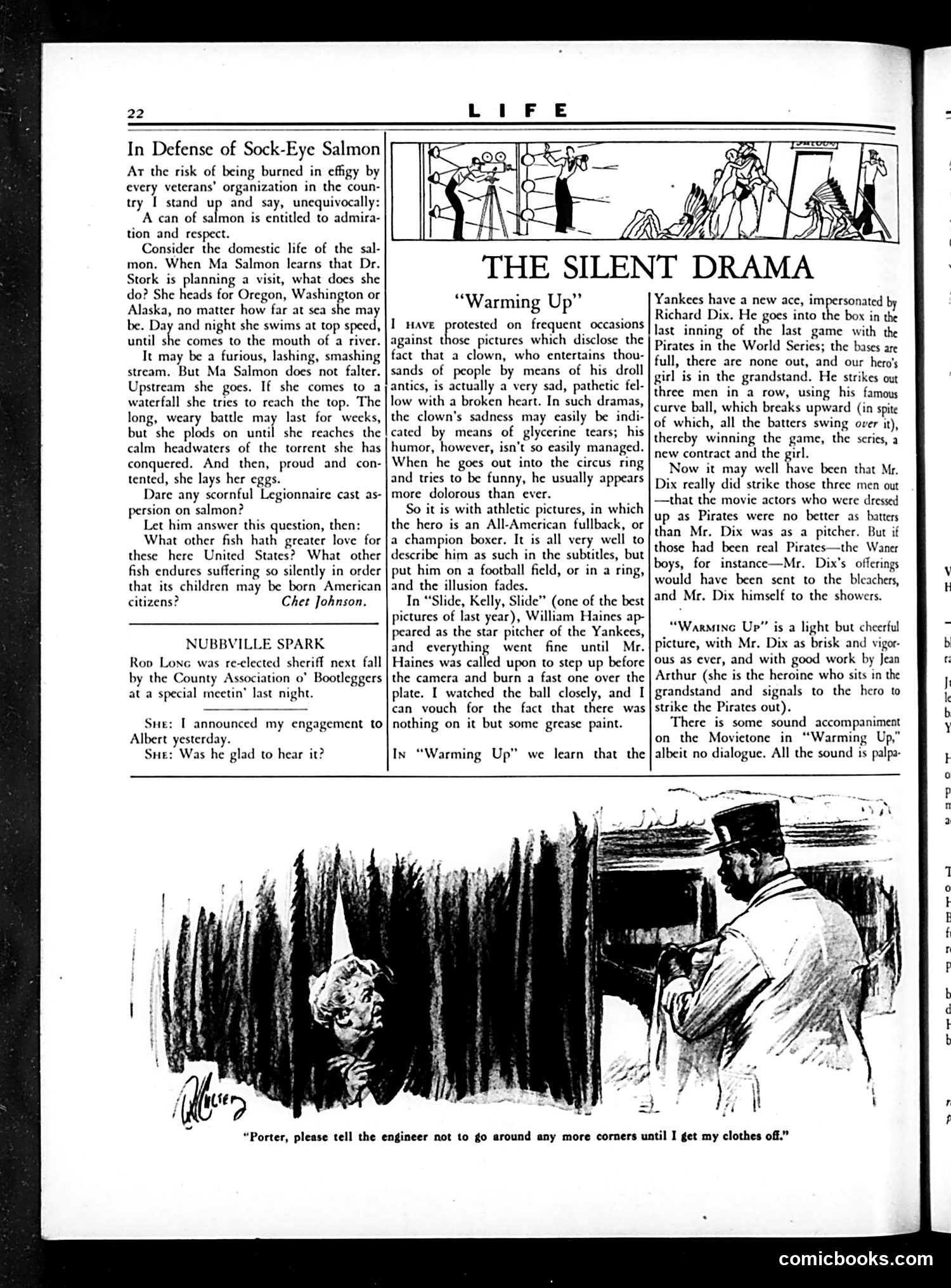
This page contains three distinct pieces of humor: **"In Defense of Sock-Eye Salmon"** (top left): A tongue-in-cheek essay praising salmon for their dedication to spawning in American rivers, sarcastically framing their biological drive as patriotic sacrifice. It mocks veterans' organizations by comparing fish endurance to military service. **"The Silent Drama" (center)**: A film critique noting that silent movies struggle depicting athletes authentically. The author discusses the baseball film "Warming Up" starring Richard Dix, pointing out that while the movie shows Dix striking out Pirates batters, the filmed action looks unconvincing—particularly the pitched ball, which appears to have "nothing on it but some grease paint." The satire targets how cinema can't convincingly portray athletic skill. **Bottom cartoon**: A humorous sketch of a train passenger asking the porter to tell the engineer to stop taking corners so sharply until they've dressed. The joke relies on slapstick physical comedy. The page reflects 1920s American popular culture, particularly cinema's emerging conventions and limitations in the silent film era.
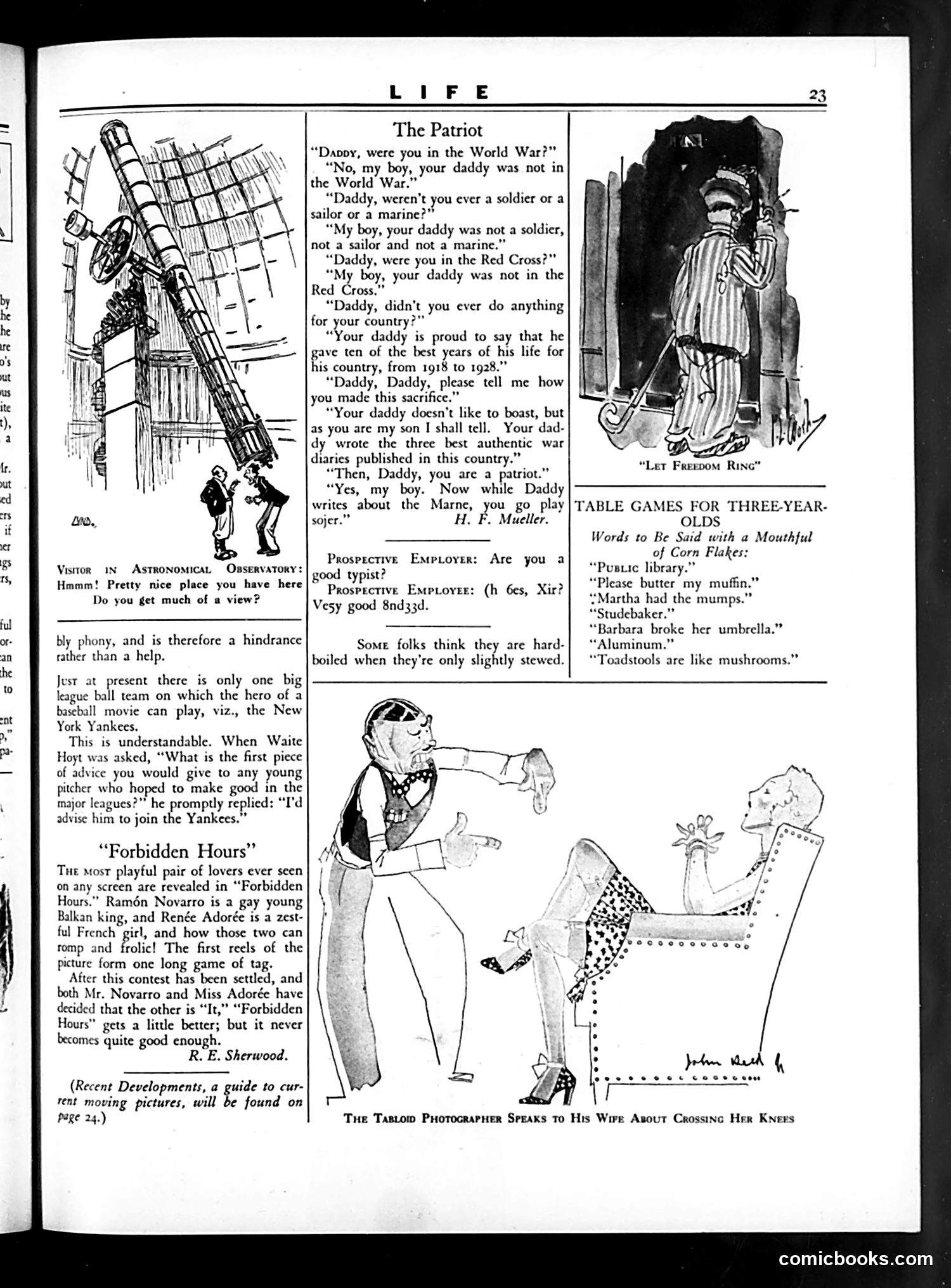
**"The Patriot"** mocks a father who claims patriotic service to his country from 1918-1928, but reveals his "sacrifice" was merely *writing war diaries*—not actual military service. The joke satirizes civilian writers who profited from publishing war accounts while presenting themselves as patriots. The father's reluctance to "boast" while simultaneously boasting underscores the hypocrisy. During the 1920s (when this appears), numerous popular war memoirs and diaries were published by non-combatants, so this likely targets that publishing trend and false patriotic claims. **Other content** includes brief movie reviews (noting the New York Yankees as baseball cinema's only subject), wordplay humor, and observational jokes about phoniness and pretense—typical of Life's satirical approach to American culture and society.
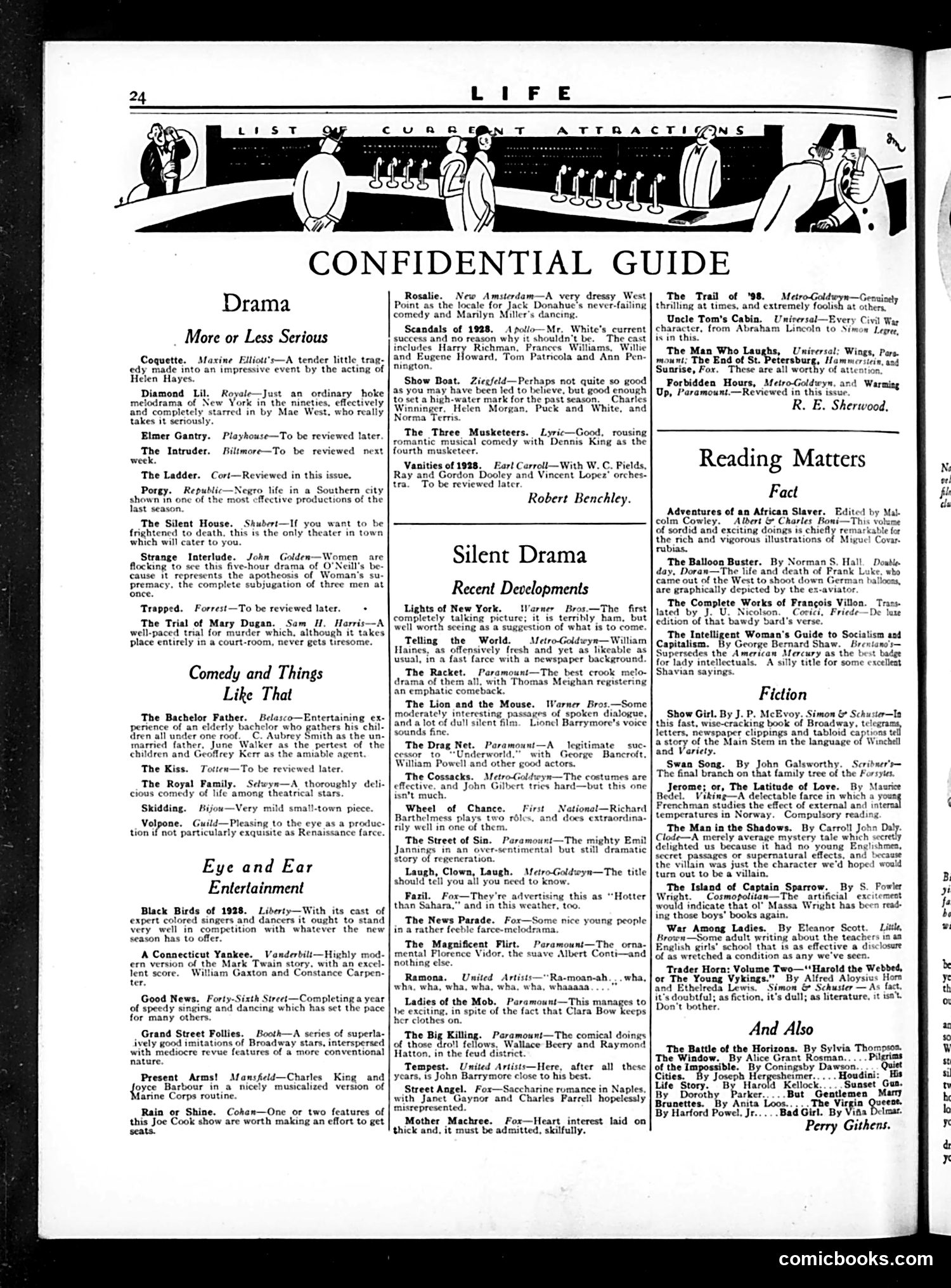
This page is a **theater and entertainment review guide** — not a political cartoon. It's a "Confidential Guide" listing Broadway shows, musical revues, and early talking pictures currently playing in New York. The content reflects **1920s entertainment culture**: references to stars like Mae West, Helen Hayes, and Charles Chaplin adaptations; musicals with elaborate production numbers; and notably, the earliest "talking pictures" (sound films), including "Lights of New York" — described as "the first completely talking picture." The tone is witty and dismissive: reviews use satirical shorthand to mock mediocre productions ("hoke melodrama," "mild small-town piece") while praising successful ones. The guide assumes readers know theatrical personalities and want insider gossip about what's worth attending. This is essentially **1920s Entertainment Weekly** — a snapshot of contemporary Broadway and early Hollywood for sophisticated New York audiences.
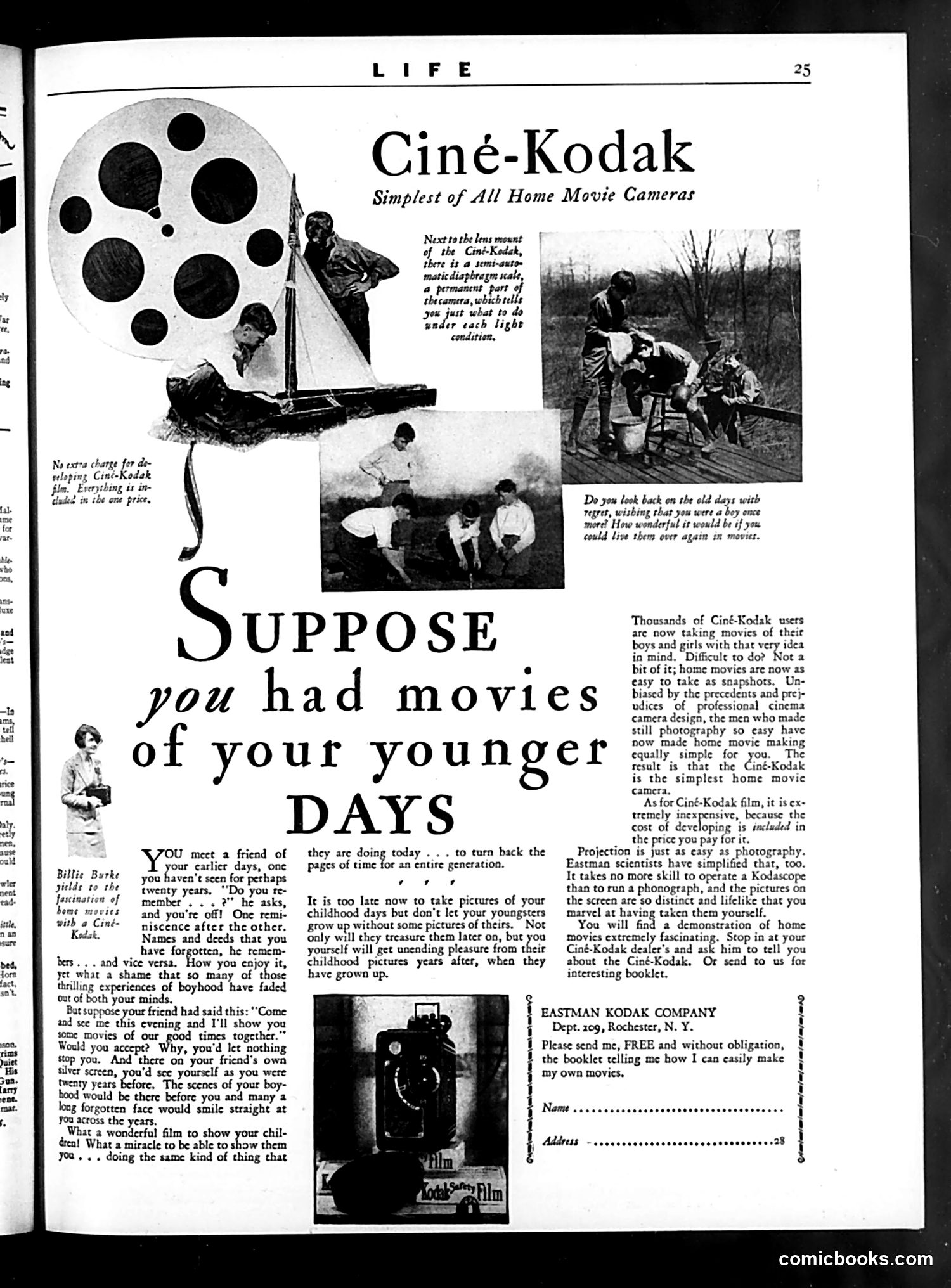
This page is primarily a **product advertisement** for the Ciné-Kodak home movie camera, not political satire. The "cartoon" element is minimal—mostly illustrative photography showing families using the camera. **The pitch**: The ad uses nostalgia as its selling tool. It invites readers to imagine showing their *children* home movies decades later, just as they might enjoy old photographs of themselves. The hypothetical scenario features meeting an old friend and reminiscing about shared youth—then pivots to: wouldn't it be wonderful to have *movies* of those moments to relive? **The social context**: This targets middle-class families in what appears to be the 1920s-30s, when home movie cameras were becoming accessible consumer products. The ad emphasizes ease ("as easy to take as snapshots") and affordability (development costs included in film price). **The appeal**: Emotional rather than rational—capturing childhood memories for posterity, creating family legacy, nostalgia, and the promise that technology makes this effortless. Actress **Billie Burke** appears to endorse the product, lending celebrity credibility.
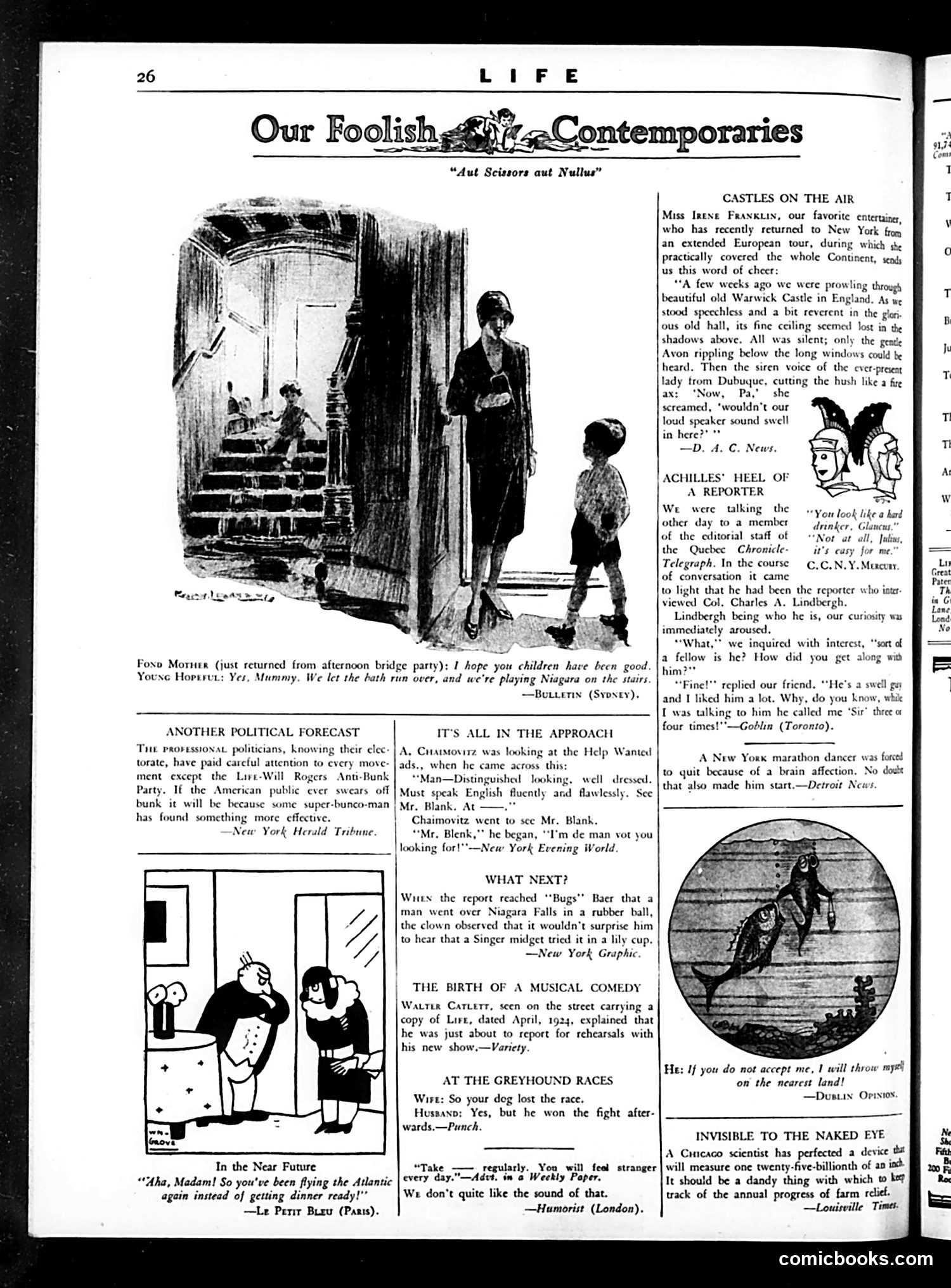
This page collects brief satirical observations about contemporary society and public figures (circa 1924, based on Lindbergh reference). The humor targets: **Social pretension**: A woman returning from bridge announces children played "Niagara on the stairs"—mocking upper-class obliviousness to domestic chaos. **American optimism**: A cartoon mocks a woman who flew the Atlantic instead of making dinner, reversing gender expectations. **Immigrant humor**: A Yiddish-accented job applicant ("Chaimovitz") demonstrates how accent and appearance matter more than qualification—social commentary on discrimination. **Celebrity culture**: A reporter interviewing Lindbergh was thrilled when the famous aviator called him "Sir"—satirizing Americans' deference to celebrities. **Tourist tackiness**: An American woman at historic Warwick Castle wants to install a loudspeaker—mocking American commercialism and cultural insensitivity abroad. The page exemplifies *Life*'s satirical style: brief, urbane jabs at contemporary American society, class, immigration, and the Jazz Age's cultural anxieties.
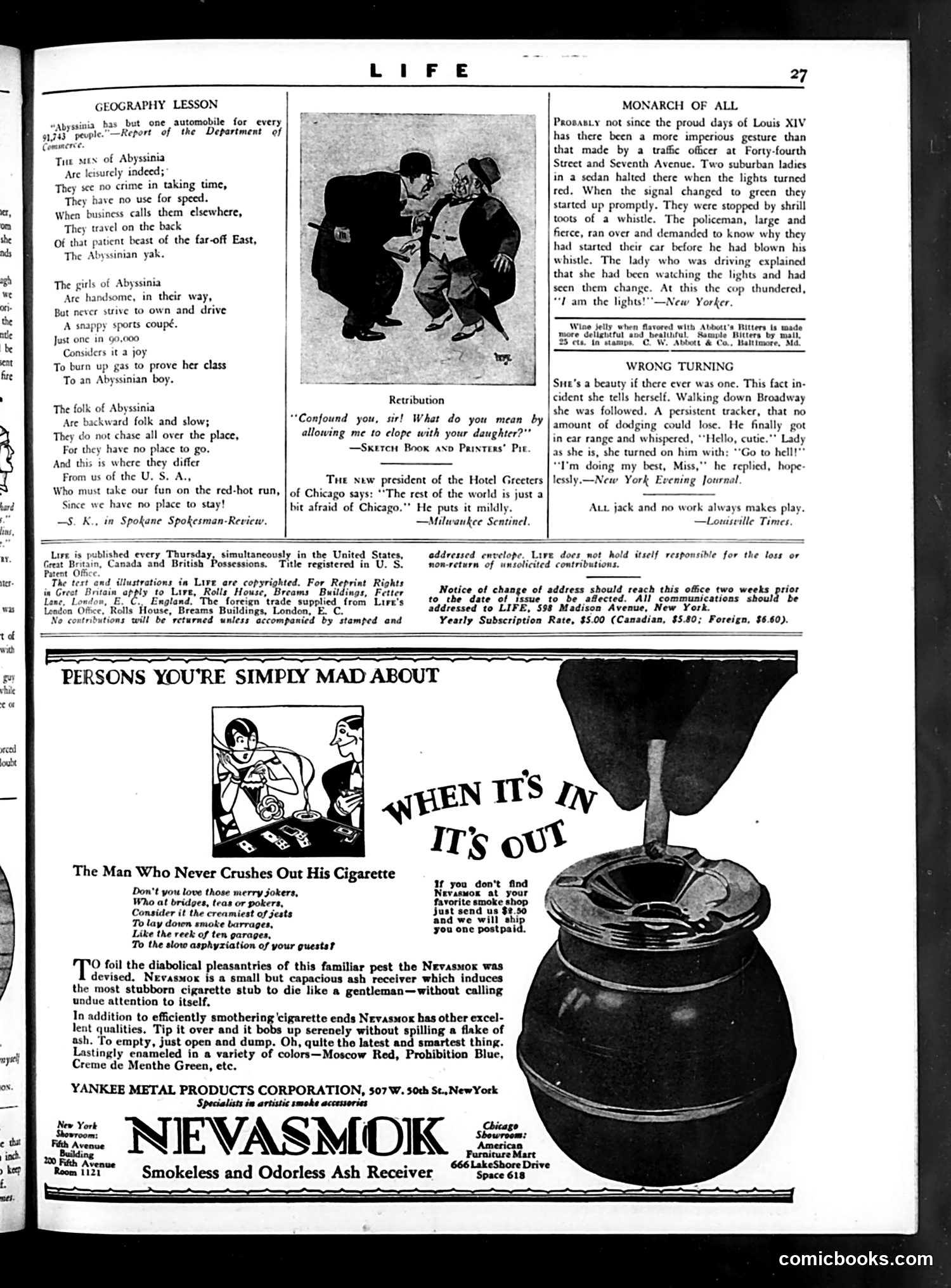
This page contains three separate satirical pieces typical of 1920s Life magazine humor: **"Geography Lesson"** mocks Abyssinian (Ethiopian) culture, contrasting their leisurely pace and lack of automobiles with American car-obsessed culture. The satire targets American materialism—Americans "must take our fun on the red-hot run" because they have nowhere to stay, implying restless consumerism. **"Wrong Turning"** and **"Monarch of All"** are short anecdotes satirizing American social dynamics: one about street harassment, another about a traffic officer's absolute authority over drivers. **"The Man Who Never Crushes Out His Cigarette"** ridicules a social type—someone who demonstrates poor etiquette by leaving lit cigarettes unextinguished, creating smoke and ash around guests. This reflects 1920s social anxieties about smoking behavior in shared spaces. The page also contains period advertising for the Nevasmok ash receiver, a decorative container for cigarette disposal. The humor relies on recognizing social types and behavioral quirks familiar to contemporary readers.
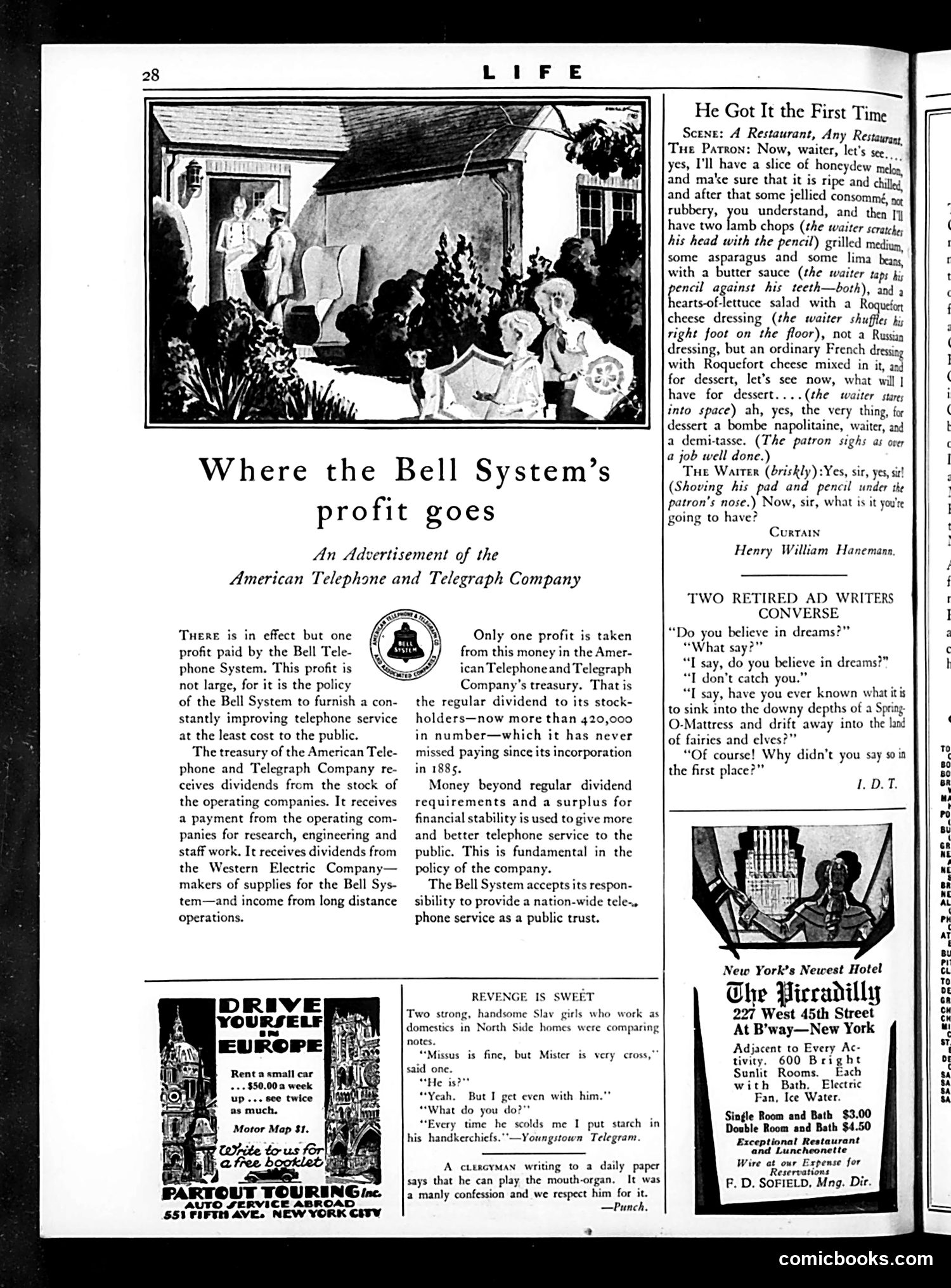
This page is primarily an **advertisement for AT&T's Bell Telephone System**, presented as editorial content to explain how company profits are distributed. The ad argues that Bell reinvests earnings beyond dividends back into improving service—a public-relations message emphasizing corporate responsibility. The cartoons and humor pieces are filler content typical of Life magazine: 1. **"He Got It the First Time"** satirizes overly demanding restaurant patrons who give complicated orders. The joke: the patron recites an elaborate, detailed meal request while the waiter struggles to keep up (scratching his head, tapping his pencil nervously), yet somehow the waiter memorizes it perfectly—contradicting the patron's assumption that elaborate instructions are necessary. 2. **"Two Retired Ad Writers Converse"** features wordplay where two former advertising writers mishear each other's words, creating absurdist confusion about "dreams" vs. mattresses. 3. **"Revenue is Sweet"** describes a domestic worker's petty revenge against her cross employer by starching his handkerchiefs. The remaining items are typical magazine advertisements for hotels, car rentals, and tourism services.
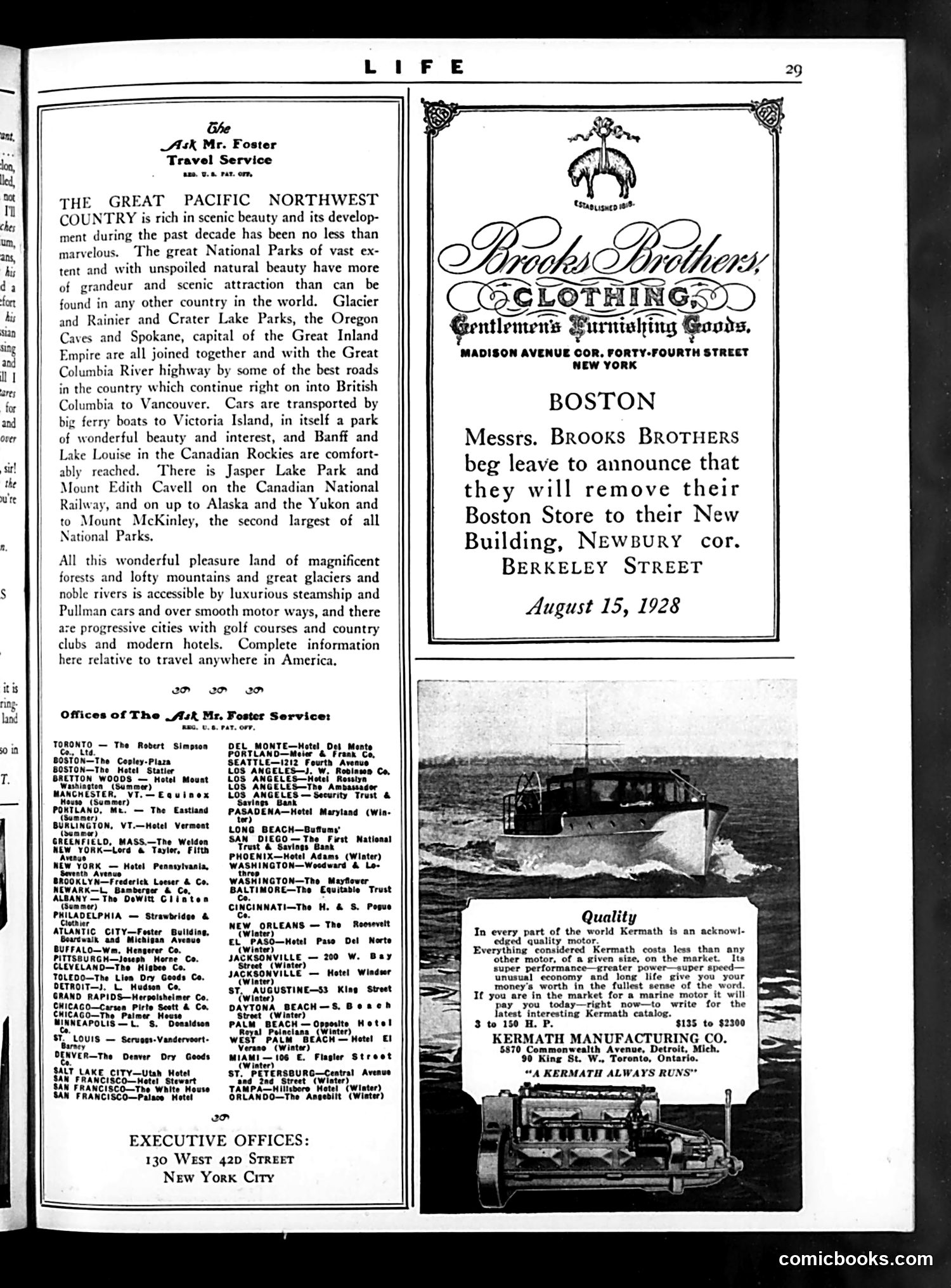
This page is **primarily advertising**, not satirical content. It contains: **Left side:** A travel service advertisement for the Ask Mr. Foster Travel Service, promoting scenic attractions in the Pacific Northwest (national parks, British Columbia, Alaska) accessible by steamship and automobile. Below is a directory of their offices across North America. **Right side:** Two advertisements— 1. **Brooks Brothers** announcement (dated August 15, 1928) that their Boston clothing store is relocating to a new building at Newbury and Berkeley Streets. Brooks Brothers was an established menswear retailer. 2. **Kermath Manufacturing Company** advertisement for marine motors, emphasizing quality and value ($135 to $2300 price range), with images of boats and an engine. There are **no political cartoons or satirical commentary** on this page. It represents typical 1920s magazine advertising: travel promotion, retail relocation notice, and industrial products.
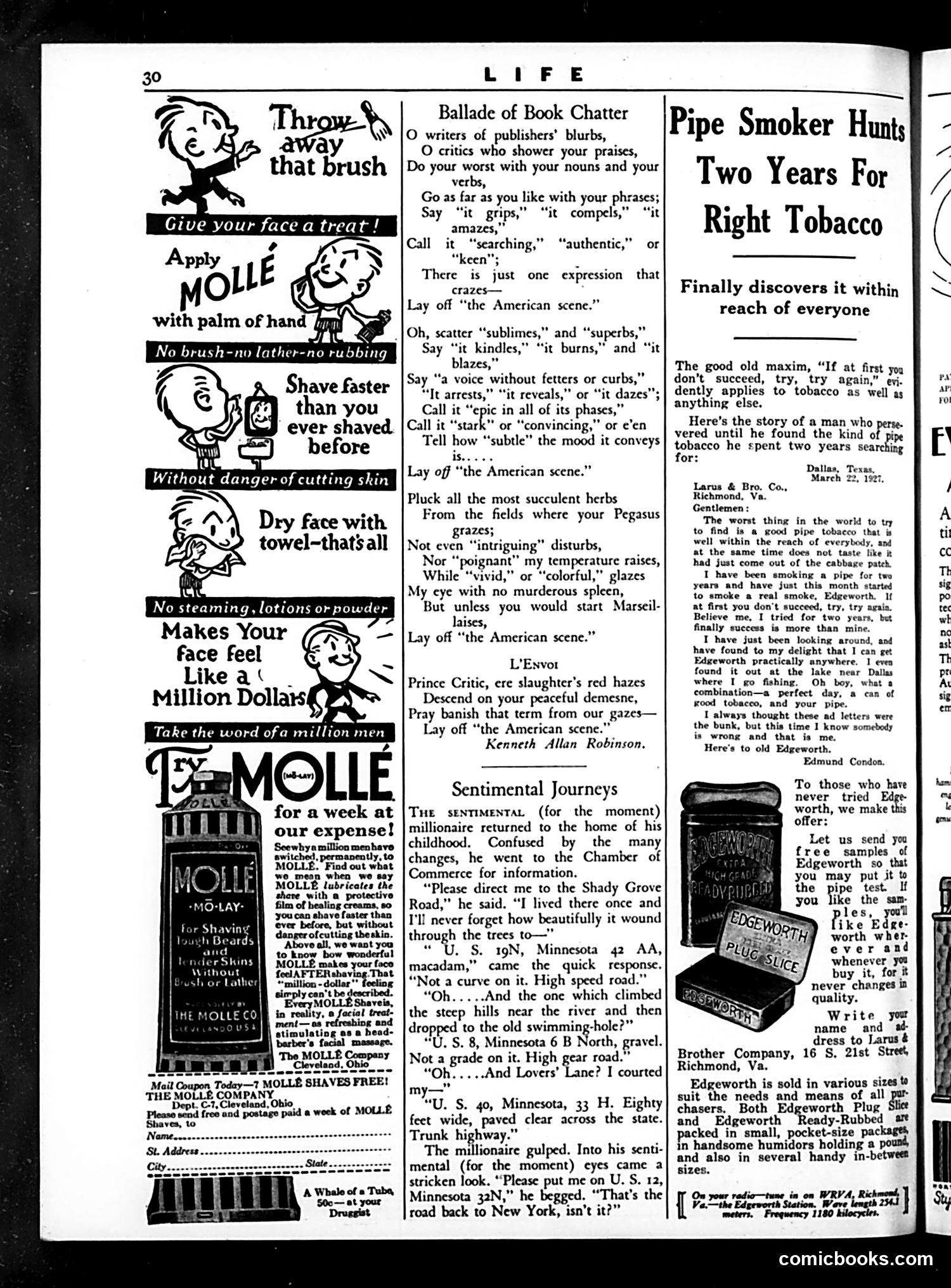
This page contains primarily **advertising and light satirical poetry**, not political cartoons. The **Mollé shaving cream ads** (left) use cartoon mascots to promote the product's ease and speed, claiming superior results without cutting skin—typical early-20th-century cosmetics marketing. The center features a satirical **poem titled "Ballad of Book Chatter"** mocking publishers' blurbs and book critics. The satire targets overused literary clichés—particularly the phrase "the American scene"—which the poet pleads critics abandon. It's a lighthearted jab at pretentious publishing language. The right side contains a humorous piece called **"Sentimental Journeys"** about a wealthy man nostalgically returning to his childhood hometown, only to discover all the charming, winding roads have been replaced by modern, straight, numbered highways. The satire critiques how modernization and progress have erased romantic nostalgia. Below is a **testimonial advertisement for Edgeworth pipe tobacco**, presenting a customer's letter claiming he searched two years for quality affordable tobacco. The page is primarily commercial and entertainment-focused rather than political.
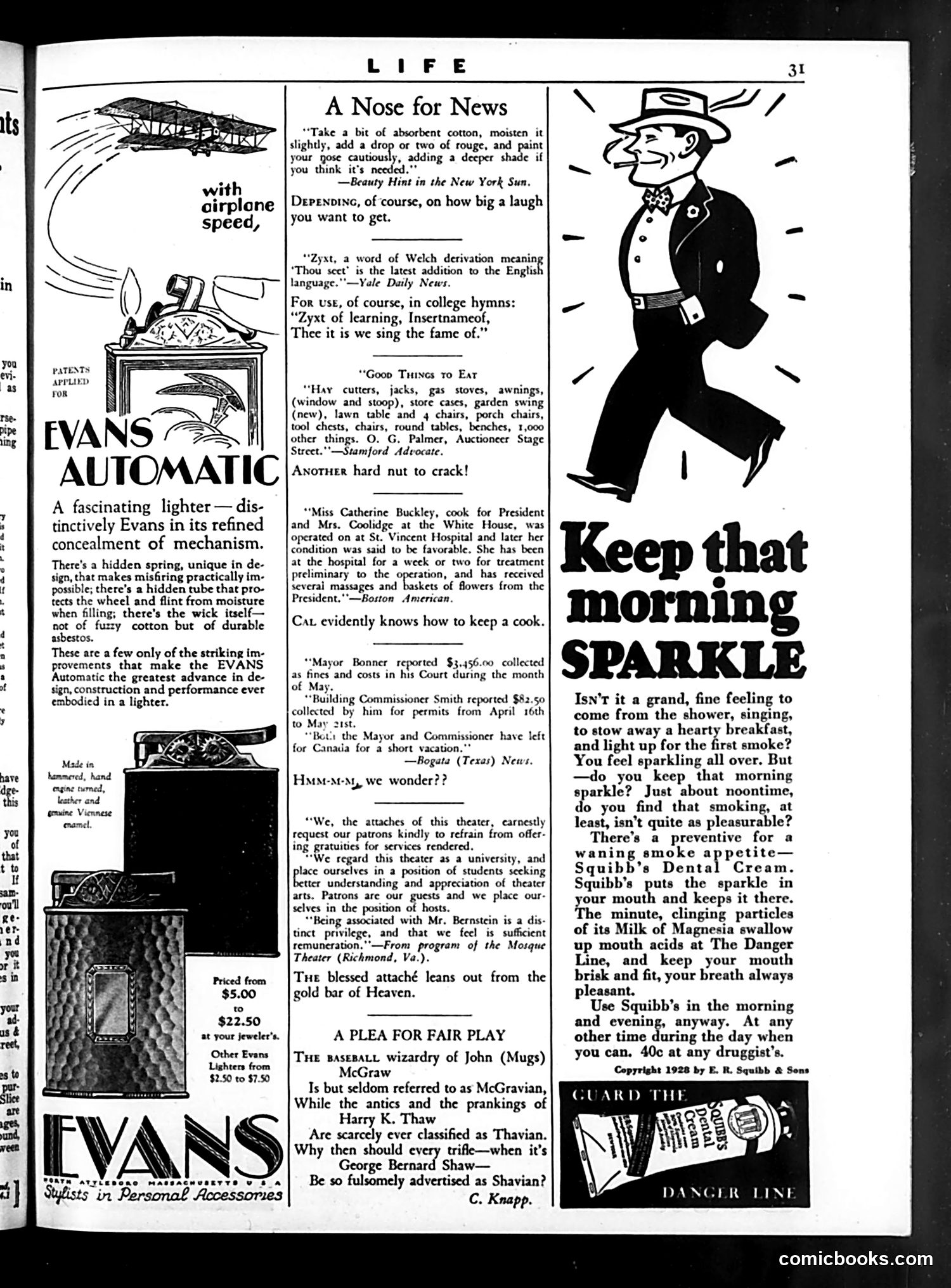
This is primarily a **satirical humor and news commentary page** from Life magazine, interspersed with advertisements. The main content consists of short jokes and observations on current events: - A mock beauty tip about painting one's nose with rouge - A joke about the word "zyxt" newly added to English - Humorous news briefs, including one about President Coolidge's cook receiving flowers after surgery (satirizing excessive attention to minor White House staff matters) - A poem by C. Knapp criticizing unfair use of "-ian" suffixes: why is George Bernard Shaw's work called "Shavian" while baseball manager John McGraw's isn't called "McGravian"? This is satire of literary pretension and inconsistent terminology. The cartoons include a caricatured gentleman (right side) promoting morning dental care. The Evans lighter advertisement (left) showcases a mechanical product with technical specifications. The page reflects 1920s-era satirical humor targeting bureaucratic absurdity, media excess, and social pretension rather than explicit political commentary.
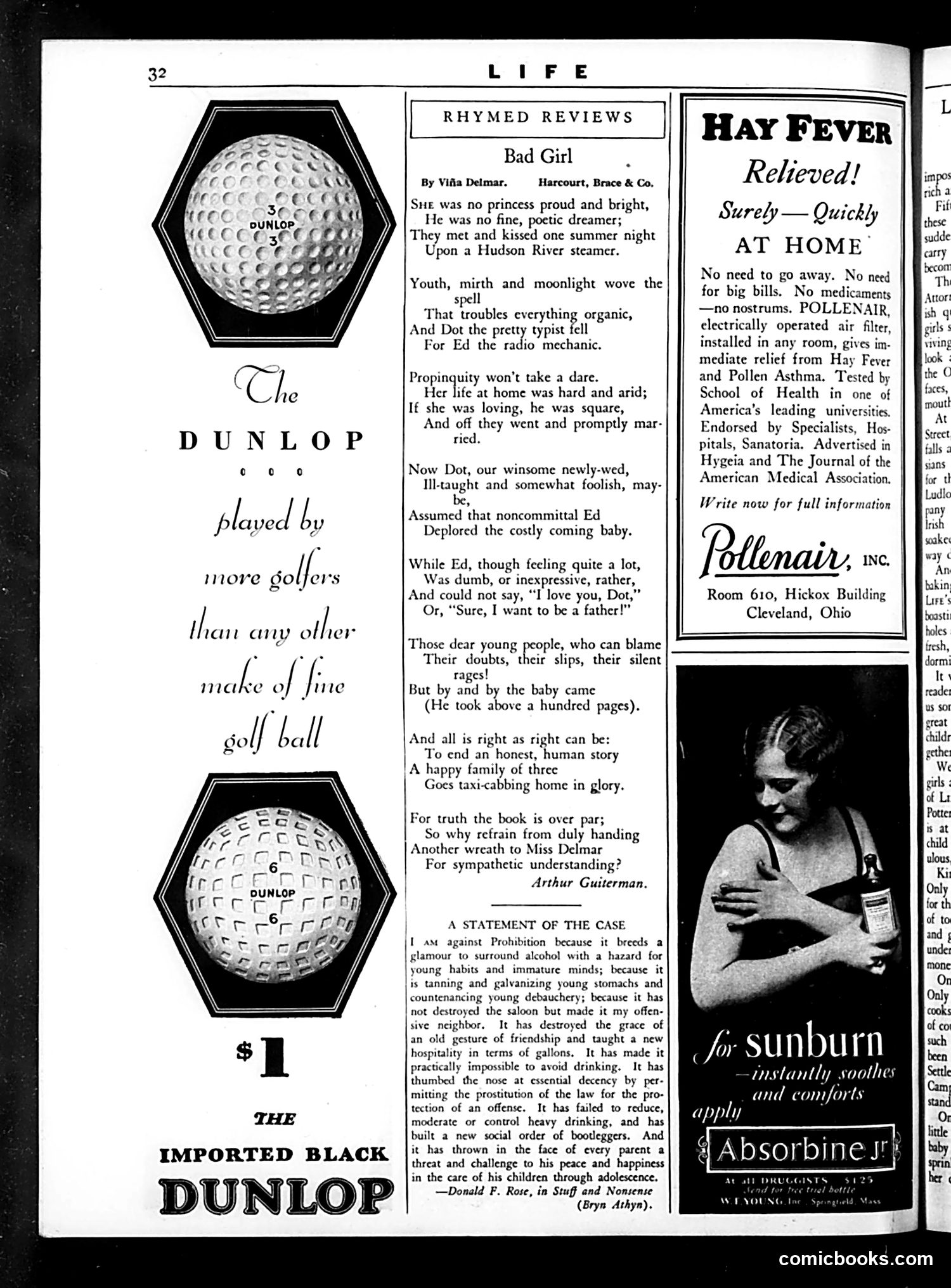
This page primarily contains **advertising and book reviews** rather than political cartoons. **The Dunlop Golf Ball Advertisement** (left side): Shows two golf balls in hexagonal frames, promoting Dunlop as superior to competitors. The text claims more golfers use Dunlop than any other golf ball brand. This is straightforward commercial advertising. **"Bad Girl" Book Review** (center): A humorous rhymed review by Arthur Guiterman of Viña Delmar's novel about working-class romance. The satire mocks the predictable plot: a pretty typist (Dot) and radio mechanic (Ed) meet, fall in love despite incompatibility, have an unplanned baby, and end happily. Guiterman gently ridicules both the sentimental story and Delmar's "sympathetic understanding," suggesting the narrative is formulaic sentiment rather than genuine insight. **Medical Advertisements** (right): Two ads for hay fever relief (Pollenair) and sunburn treatment (Absorbine Jr.)—period remedies typical of 1920s-30s magazines. The page reflects 1920s-30s concerns: consumer products, changing social attitudes toward working-class romance, and emerging medical anxieties.
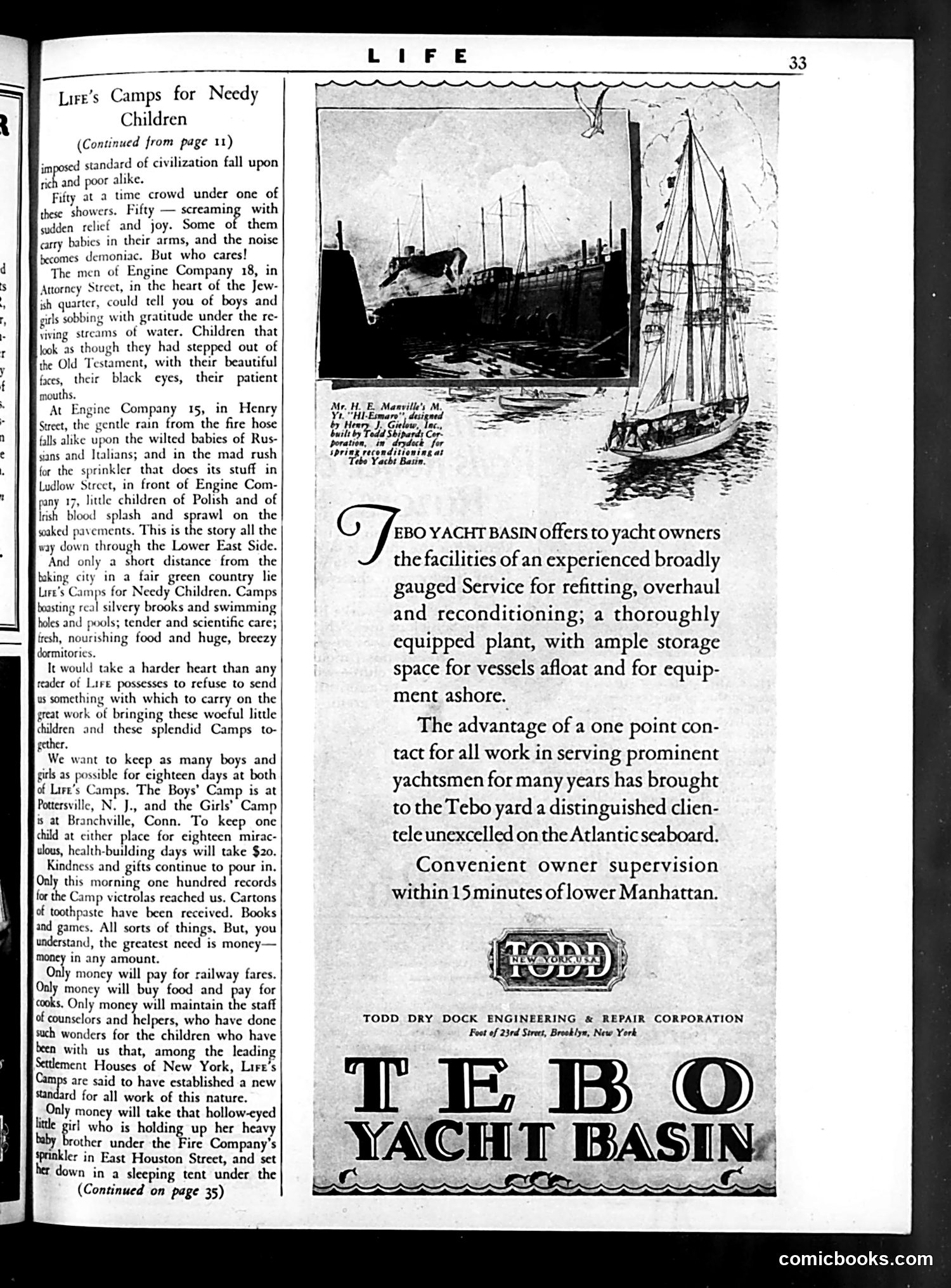
This page combines two distinct elements: a charitable appeal and a yacht service advertisement. **Left side:** Article advocating for Life magazine's camps for poor children, specifically targeting immigrant communities on New York's Lower East Side (Jewish, Italian, Russian, Polish, Irish populations). The text emotionally describes children from tenement neighborhoods experiencing relief under fire department water sprinklers, then contrasts this with Life's rural camps offering clean water, fresh air, and nutrition. The piece solicits donations ($20 keeps one child at camp for 18 days), emphasizing that money—not goods—is needed for railways, food, and staff. **Right side:** A full-page advertisement for Tebo Yacht Basin, offering yacht refitting and repair services to wealthy yachtsmen near Manhattan. **The implicit satire:** Juxtaposing desperate poor children needing $20 for basic camp care against luxury yacht services for the wealthy creates an unspoken critique of class inequality—highlighting the vast gap between those who can afford yacht maintenance and those who cannot afford clean water for their children.
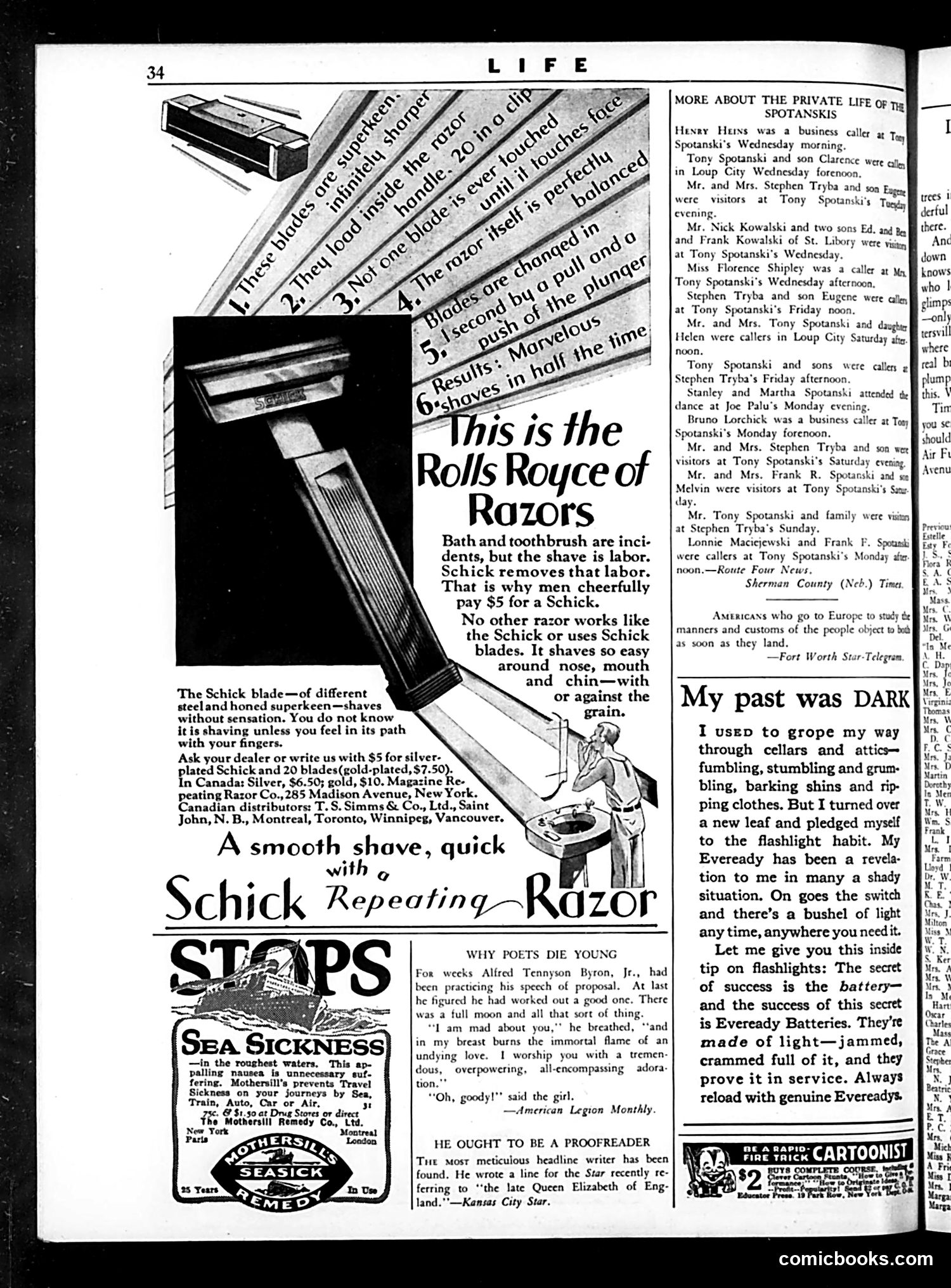
This page primarily consists of **advertisements**, not political satire. The main content includes: **Schick Razor Ad**: Describes the Schick repeating razor as the "Rolls Royce of Razors," emphasizing its smooth shave and ease of use around facial contours. The ad positions premium shaving as worth the $5 cost. **Humor Columns**: Brief comedic pieces, including "Why Poets Die Young"—a joke about a romantic suitor's elaborate proposal being deflated when his beloved simply responds "Oh, goody!" It's gentle satire on overwrought romantic conventions. **Small-town Social Announcements**: The "Private Life of the Spotanskis" appears to be genuine rural social notices, listing local visitors and activities—typical small-town newspaper filler. **Product Ads**: Mothersill's seasickness remedy and Eveready flashlights round out the page. The page reflects typical 1920s-30s magazine content: luxury product marketing mixed with light humor and community notices, rather than serious political commentary.
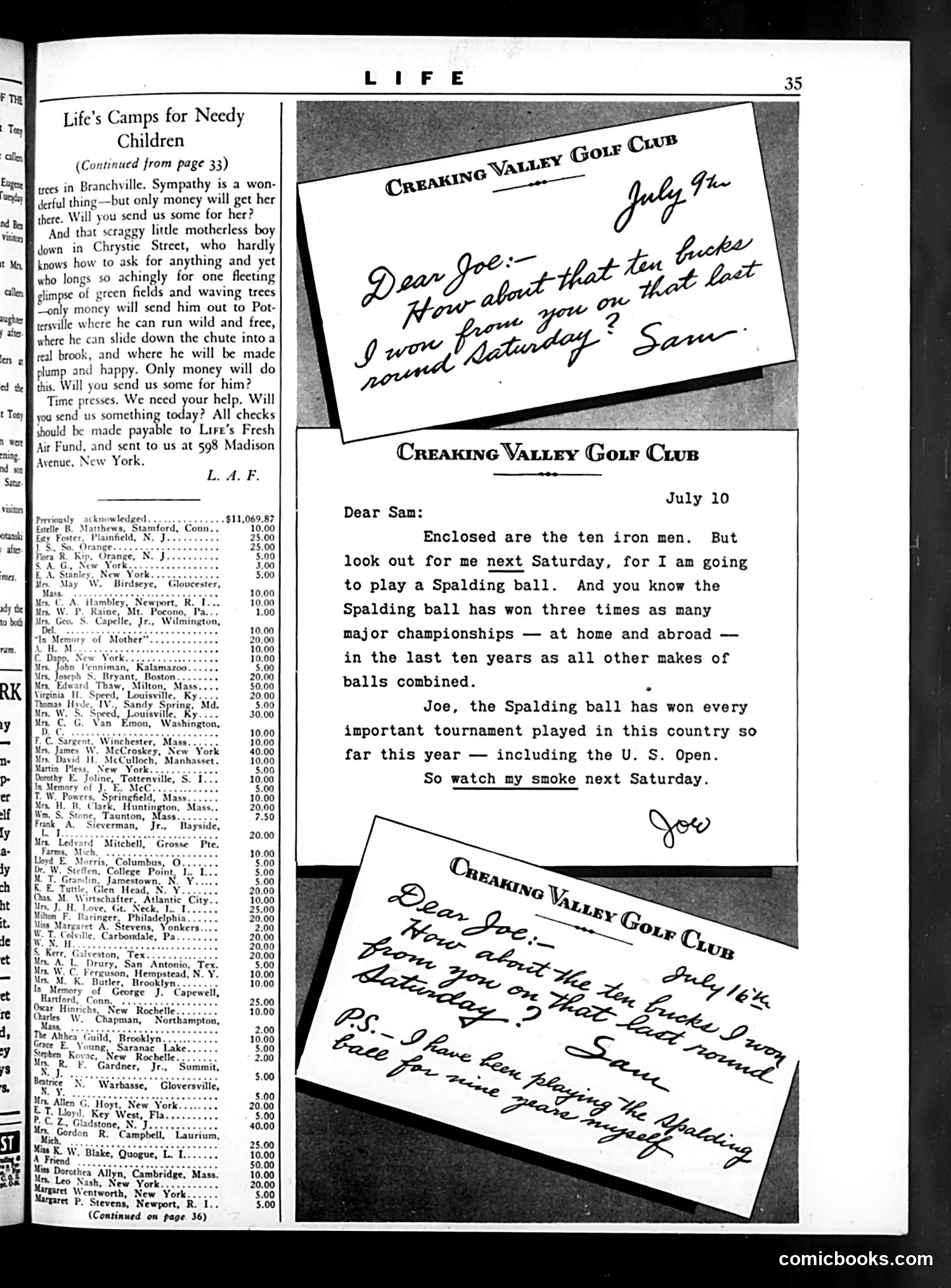
This page combines a charitable appeal with golf-themed advertisements disguised as personal correspondence. **Left side:** Life's Fresh Air Fund solicits donations for poor urban children—a girl in Branchville and a "scraggy little motherless boy" on Chrystie Street—who need money for camp experiences. The tone emphasizes sympathy paired with practical need ("only money will..."). A donation list follows. **Right side:** Three letters from "Creaking Valley Golf Club" appear to be personal correspondence but are actually *advertisements for Spalding sporting goods*. The sender brags about ten "iron men" (golf clubs) and boasts that Spalding balls dominate tournament play, including the U.S. Open. The handwritten style creates false intimacy to sell products. **The satire:** The juxtaposition highlights the era's class contrasts—desperate children needing aid versus affluent golfers casually discussing expensive equipment and tournament victories. The fake "personal letters" mock advertising's deceptive techniques.
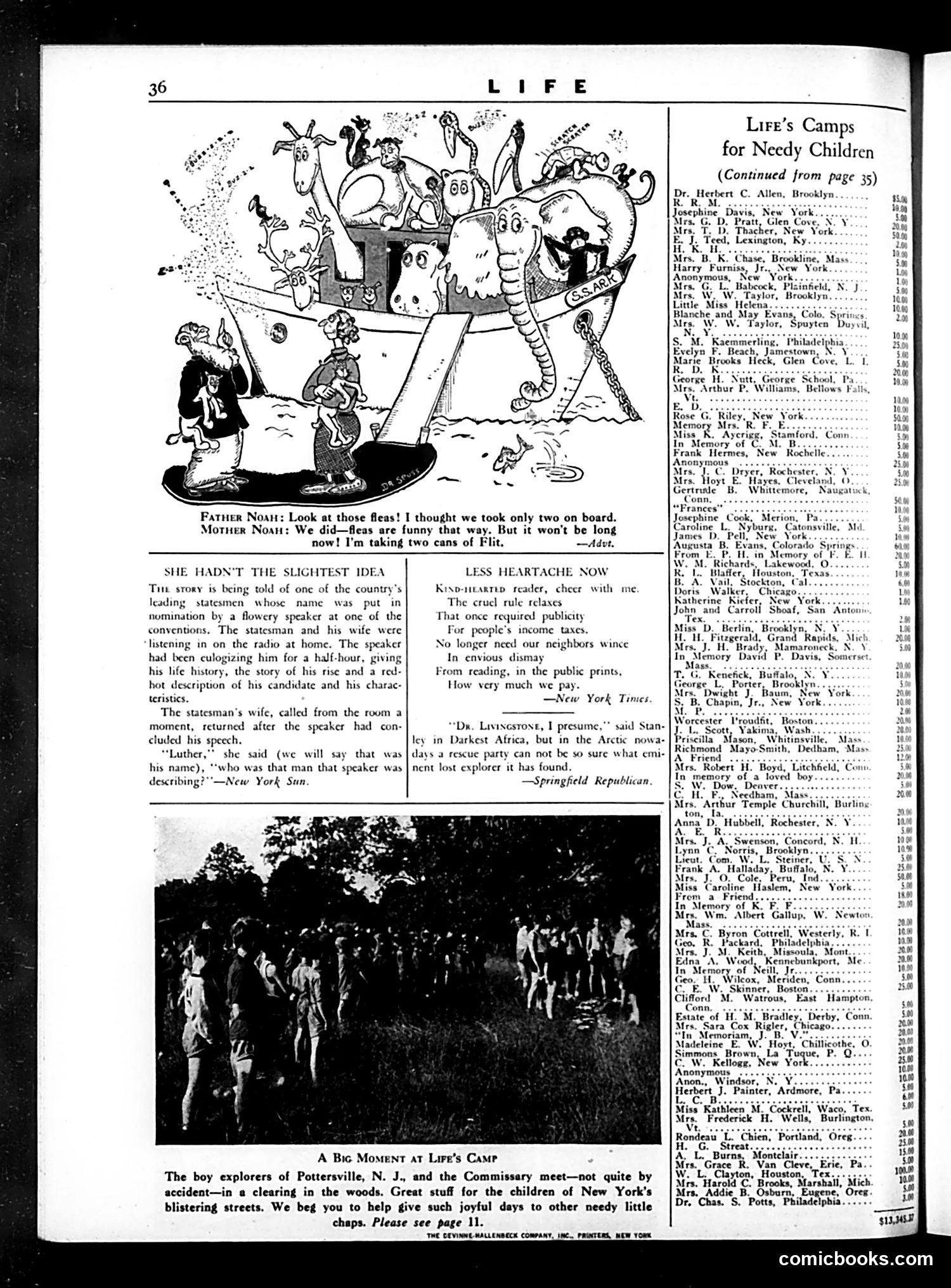
This page contains two distinct satirical pieces framed around a charitable fundraising campaign for Life's camps serving poor children. **Top cartoon**: A domestic scene mocking marital dynamics. Father Noah complains about unexpected fleas aboard their vessel; Mother Noah reveals she smuggled two extra animals aboard. The joke—fleas reproduce rapidly—serves as a segue to an advertisement for Flit insecticide, blending humor with product placement. **Middle anecdote**: A satirical story about an unnamed prominent statesman. A flowery convention speaker delivers an elaborate eulogy about the man's achievements and taxes paid. The statesman's wife, listening at home, asks her husband who this person is—implying the speaker's description bore no resemblance to reality. This mocks the gap between political rhetoric and truth. **Bottom section**: A photograph of Life's actual summer camp in Pottersville, New Jersey, with a fundraising appeal for needy New York City children. The page lists donors by name, establishing credibility for the charitable cause. The satire undercuts political pretension while the camp imagery demonstrates the magazine's claimed social responsibility.
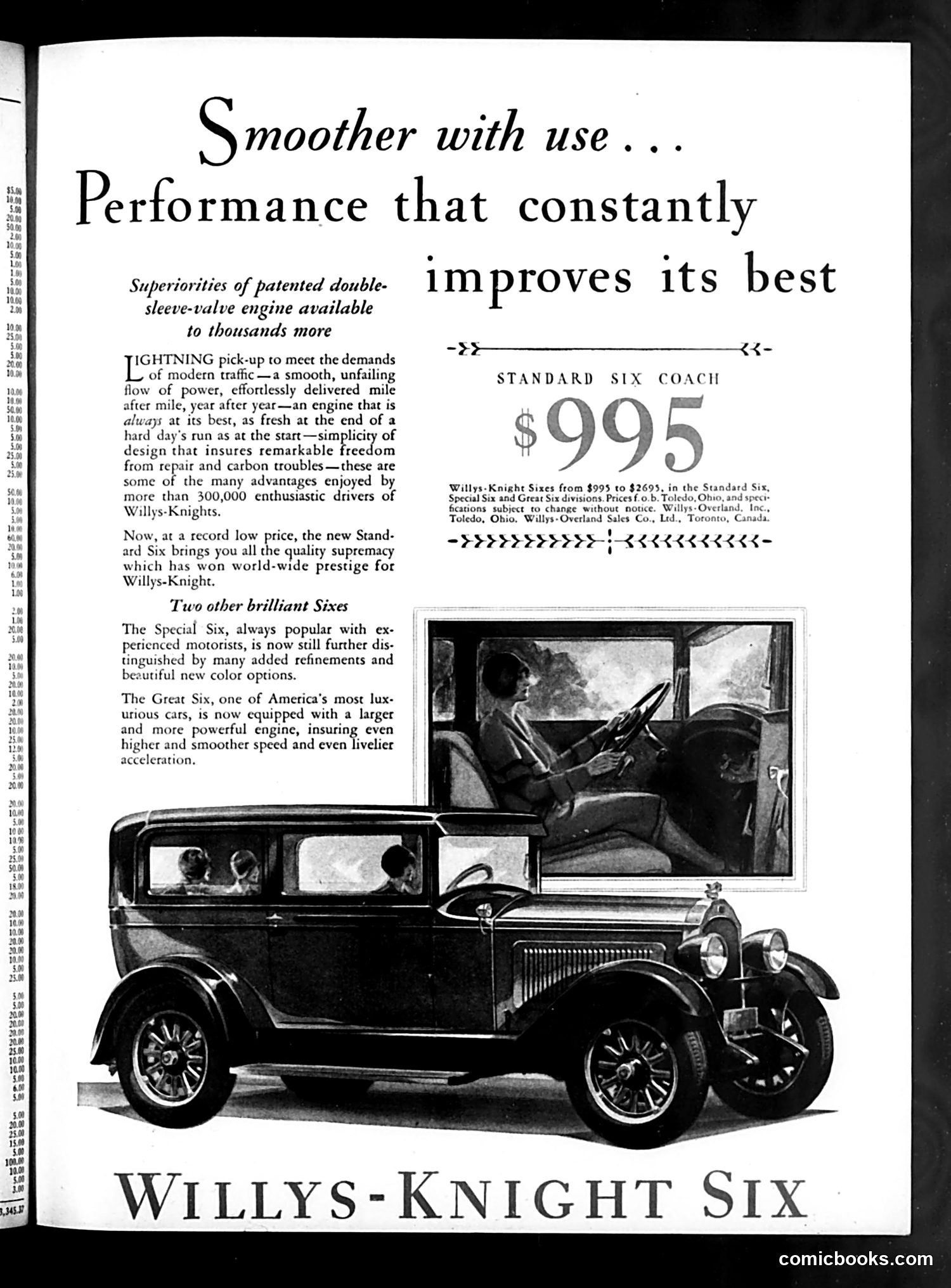
This is **not a cartoon or satire**—it's a straightforward automobile advertisement for the Willys-Knight Six, likely from the 1920s. The page promotes three models: the Standard Six Coach ($995), the Special Six, and the Great Six, emphasizing their "patented double-sleeve-valve engine" and reliability. The ad highlights that over 300,000 drivers already own Willys-Knights, positioning the brand as established and trustworthy. The inset photograph shows a man driving, presumably demonstrating the car's ease of operation and comfort. The main illustration displays the coach-style body with multiple windows—a practical family vehicle of the era. The tagline "Smoother with use...Performance that constantly improves its best" suggests the engine performs better as it breaks in, a selling point for that mechanical generation. This represents typical automotive advertising of the pre-Depression era, aimed at middle-class consumers seeking reliable, affordable transportation during America's automobile boom.
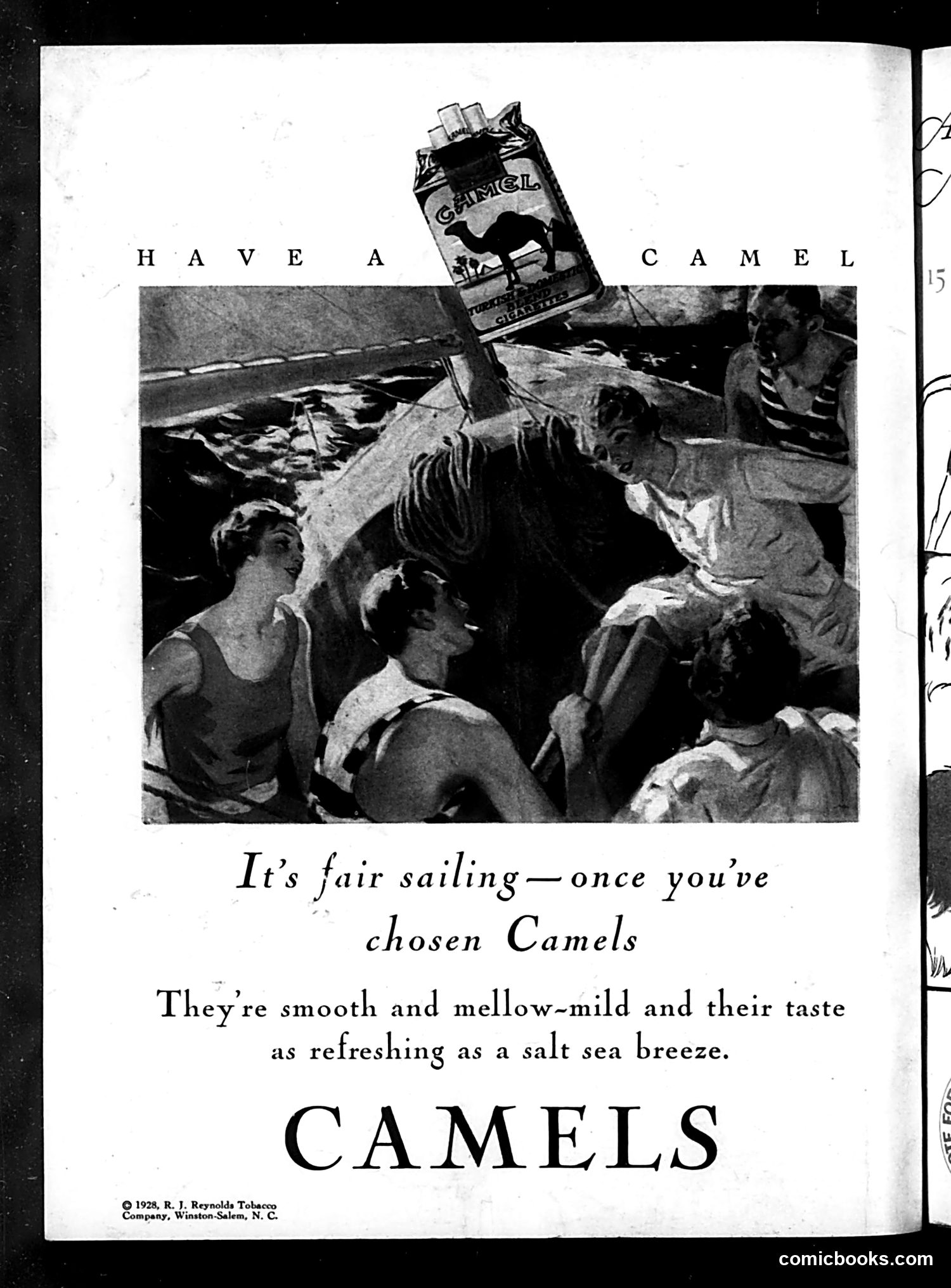
This is a **cigarette advertisement**, not political satire. The 1928 Camel ad uses a sailing/nautical theme to market cigarettes to what appears to be a group of young people on a boat. The "joke" or sales pitch relies on nautical metaphor: choosing Camel cigarettes makes leisure activities like sailing enjoyable ("fair sailing"), and the product is described as "smooth and mellow-mild" with taste like "a salt sea breeze." The photograph shows people in casual summer clothing aboard what appears to be a pleasure vessel, establishing an aspirational lifestyle association—a common advertising strategy of the era. The tagline promises that selecting the "right" cigarette brand enhances leisure experiences. There is no political commentary or social satire present. This is straightforward product marketing typical of 1920s magazine advertising.