
Life, 1928-08-09 · page 10 of 40
Life — August 9, 1928 — page 10: what you’re looking at
What you’re looking at
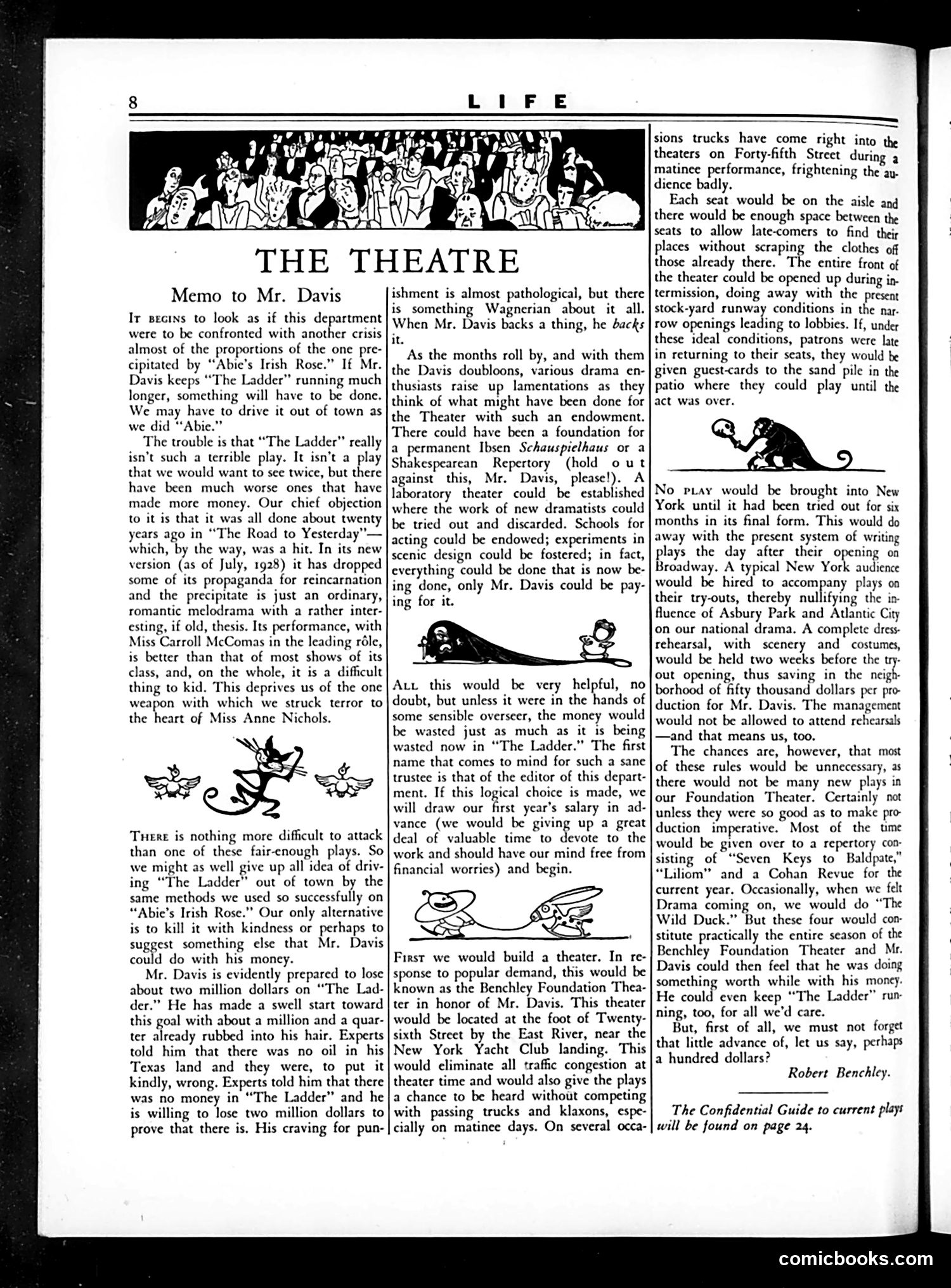
This page is a satirical memo to Mr. Davis (likely a theater producer/manager) criticizing the play "The Ladder." The text argues the play, despite making money, is artistically poor and represents a crisis in American theater. The small cartoon illustrations (monkeys/apes with various objects) appear to be decorative flourishes mocking theatrical pretension, though their specific meaning is unclear without additional context. The author proposes establishing a permanent experimental theater where new plays could be tested before Broadway production—with proper funding, rehearsal time, and scenery. This would improve American drama's quality by filtering out mediocre works before they reach mainstream audiences. The tone is one of frustrated exasperation: even commercially successful theater can be artistically worthless, and systemic change is needed.
📄 Transcribed text from this page (OCR, searchable)
Machine-transcribed from the original scan — historical spelling and the odd misread are preserved.
tg i. a nevi sas & nel THE THEATRE Memo to Mr. Davis It secins to look as if this department were to be confronted with another crisis almost of the proportions of the one pre- cipitated by “‘Abie’s Irish Rose.” If Mr. Davis keeps “The Ladder” running much longer, something will have to be done. We may have to drive it out of town as we did “Abie.” The trouble is that “The Ladder” really isn’t such a terrible play. It isn’t a play that we would want to see twice, but there have been much worse ones that have made more money. Our chief objection to it is that it was all done about twent years ago in “The Road to Yesterday"— which, by the way, was a hit. In its new version (as of July, 1928) it has dropped some of its propaganda for reincarnation and the precipitate is just an ordinary, romantic melodrama with a rather inter- esting, if old, thesis. Its performance, with Miss Carroll McComas in the leading réle, is better than that of most shows of its class, and, on the whole, it is a difficult thing to kid. This deprives us of the one weapon with which we struck terror to the heart of Miss Anne Nichols. Ture is nothing more difficult to attack than one of these fair-enough plays. So we might as well give up all idea of driv- ing “The Ladder” out of town by the same methods we used so successfully on “Abie’s Irish Rose.” Our only alternative is to kill it with kindness or perhaps to suggest something else that Mr. Davis could do with his money. Mr. Davis is evidently prepared to lose about two million dollars on “The Lad- der.” He has made a swell start toward this goal with about a million and a quar- ter already rubbed into his hair. Experts told him that there was no oil in his Texas land and they were, to put it kindly, wrong. Experts told him that there was no money in “The Ladder’ and he is willing to lose two million dollars to prove that there is, His craving for pun- ishment is almost pathological, but there is something Wagnerian about it all. When Mr. Davis backs a thing, he backs it. As the months roll by, and with them the Davis doubloons, various drama en- thusiasts raise up lamentations as they think of what might have been done for the Theater with such an endowment. There could have been a foundation for a permanent Ibsen Schauspielhaus or a Shakespearean Repertory (hold out against this, Mr. Davis, please!). A laboratory theater could be established where the work of new dramatists could Y|be tried out and discarded. Schools for acting could be endowed; experiments in scenic design could be fostered; in fact, everything could be done that is now be- ing done, only Mr. Davis could be pay- ing for it. B & Att this would be very helpful, no doubt, but unless it were in the hands of some sensible overseer, the money would be wasted just as much as it is being wasted now in “The Ladder.” The first name that comes to mind for such a sane trustee is that of the editor of this depart- ment. If this logical choice is made, we will draw our first year’s salary in ad- vance (we would be giving up a great deal of valuable time to devote to the work and should have our mind free from financial worries) and begin. First we would build a theater. In re- sponse to popular demand, this would be known as the Benchley Foundation Thea- ter in honor of Mr. Davis. This theater would be located at the foot of Twenty- sixth Street by the East River, near the New York Yacht Club landing. This would eliminate all traffic congestion at theater time and would also give the plays a chance to be heard without competing with passing trucks and klaxons, espe- cially on matinee days. On several occa- sions trucks have come right into the theaters on Forty-fifth Street during a matinee performance, frightening the au- dience badly. Each seat would be on the aisle and there would be enough space between the seats to allow late-comers to find their places without scraping the clothes of those already there. The entire front of the theater could be opened up during in- termission, doing away with the present stock-yard runway conditions in the nar- row openings leading to lobbies. If, under these ideal conditions, patrons were late in returning to their seats, they would be given guest-cards to the sand pile in the patio where they could play until the act was over. No pray would be brought into New York until it had been tried out for six months in its final form. This would do away with the present system of writing plays the day after their opening on Broadway. A typical New York audience would be hired to accompany plays on their try-outs, thereby nullifyiog the in- fluence of Asbury Park and Atlantic City on our national drama. A complete dress- rehearsal, with scenery and costumes, would be held two weeks before the ty- out opening, thus saving in the pag borhood of fifty thousand dollars per pro- duction for Mr. Davis. The management would not be allowed to attend rehearsals —and that means us, too. The chances are, however, that most of these rules would be unnecessary, as there would not be many new plays in our Foundation Theater. Certainly not unless they were so good as to make pro duction imperative. Most of the ume would be given over to a repertory con- sisting of “Seven Keys to Baldpate,” “Liliom” and a Cohan Revue for the current year. Occasionally, when we felt Drama coming on, we would do “The Wild Duck.” But these four would con- stitute practically the entire season of the Benchley Foundation Theater and Mr. Davis could then feel that he was doing something worth while with his moncy. He could even keep “The Ladder” run- ning, too, for all we'd care. But, first of all, we must not forget that little advance of, let us say, perhaps a hundred dollars? Robert Benchley. The Confidential Guide to current plays will be found on page 24. comicbooks.com