
Life, 1928-08-09 · page 26 of 40
Life — August 9, 1928 — page 26: what you’re looking at
What you’re looking at
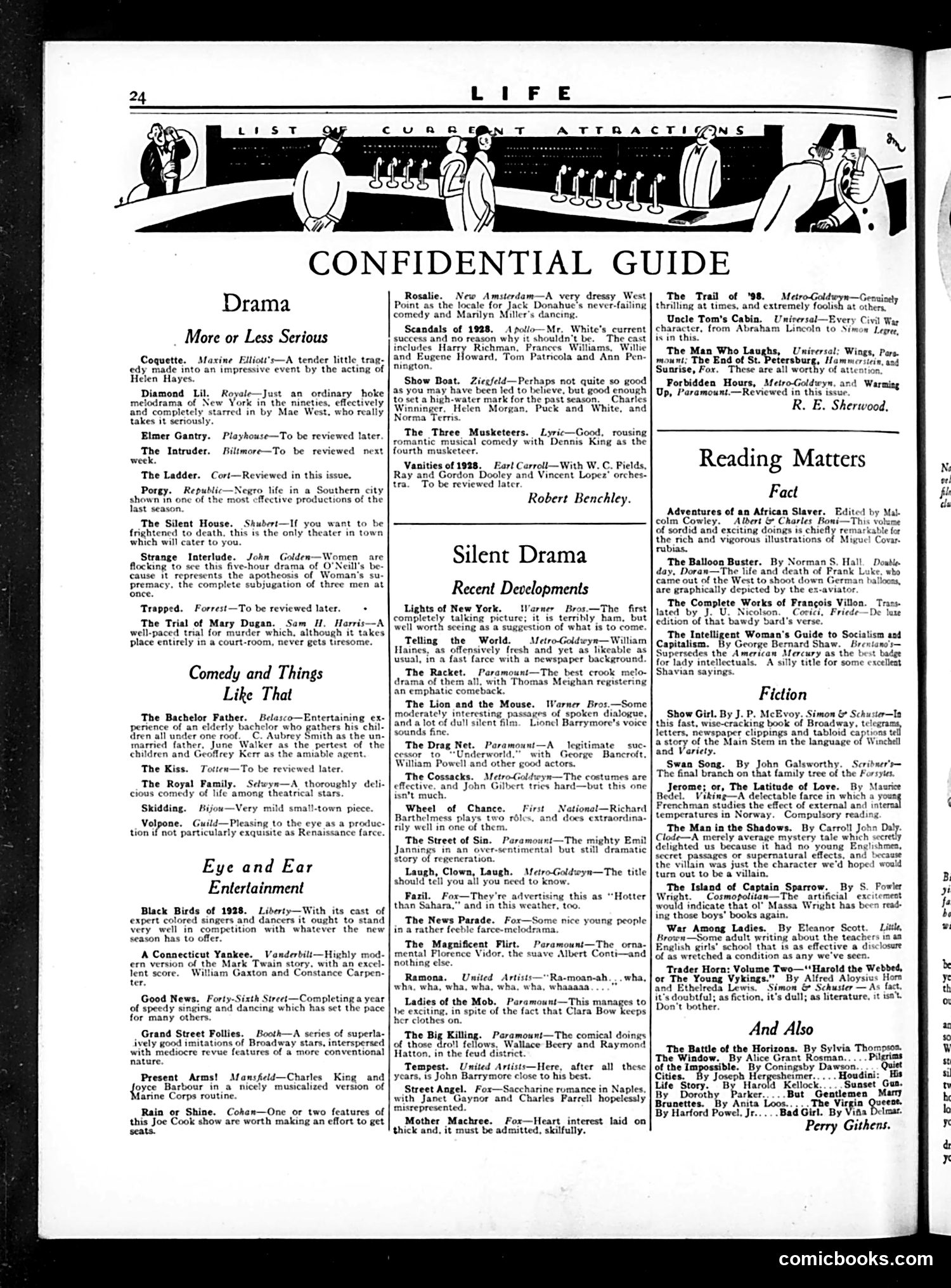
This page is a **theater and entertainment review guide** — not a political cartoon. It's a "Confidential Guide" listing Broadway shows, musical revues, and early talking pictures currently playing in New York. The content reflects **1920s entertainment culture**: references to stars like Mae West, Helen Hayes, and Charles Chaplin adaptations; musicals with elaborate production numbers; and notably, the earliest "talking pictures" (sound films), including "Lights of New York" — described as "the first completely talking picture." The tone is witty and dismissive: reviews use satirical shorthand to mock mediocre productions ("hoke melodrama," "mild small-town piece") while praising successful ones. The guide assumes readers know theatrical personalities and want insider gossip about what's worth attending. This is essentially **1920s Entertainment Weekly** — a snapshot of contemporary Broadway and early Hollywood for sophisticated New York audiences.
📄 Transcribed text from this page (OCR, searchable)
Machine-transcribed from the original scan — historical spelling and the odd misread are preserved.
CONFIDENTIAL GUIDE Drama More or Less Serious Coquette. Maxine Elliott's—A tender little trag- edy made into an impressive event by the acting of Helen Hayes. Diamond Lil. Royale—Just an ordinary hoke melodrama of New York in the nineties, effectively and completely starred in by Mae West, who really takes it seriously. Elmer Gantry. The Intruder. week. The Ladder. Porgy. Republic—Negro life in a Southern city shown in one the most effective productions of the last season. The Silent House. Shuberi—If you want to be frightened to death, this is the only theater in town which will cater to you. Strange Interlude. John Golden—Women are flocking to sce this five-hour drama of O'Neill's be- cause it represents the apotheosis of Woman's su- Premacy, the complete subjugation of three men at once. Trapped. Forrest—To be reviewed later. « The Trial of Mary Dugan. Sam H. Harris—A well-paced trial for murder which, although it takes place entirely in a court-room, never gets tiresome. Comedy and Things Like That The Bachelor Father. Belasco—Entertaining ex- perience of an elderly bachelor who gathers his chil- dren all under one roof. C. Aubrey Smith as the un- married father, June Walker as the pertest of the children and Geoflrey Kerr as the amiable agent The Kiss. The Royal Family. Selwyn—A thoroughly deli- cious comedy of life among theatrical stars Skidding. Vol; tion Playhouse—To be reviewed later. Biltmore—To be reviewed ne: Cort—Reviewed in this issue. Totten—To be reviewed later. Bijow—Very mild small-town piece. ne. Guild—Pleasing to the eye as a produc- not particularly exquisite as Renaissance farce. Eye and Ear Entertainment Black Birds of 1928. Liberty—With its cast of expert colored singers and dancers it ought to stand very well in competition with whatever the new season has to offe A Connecticut Yankee. Vanderbili—Highly mod- ern version of the Mark Twain story, with an excel- lent score. William Gaxton and Constance Carpen- ter. Good News. Forty-Sixth Street—Completing a year of speedy singing and dancing which has set the pace for many others, Grand Street Follies. _Booth—A series of superla- ively good imitations of Broadway stars, interspersed with mediocre revue features of a more conventional nature. Present Arms! AMansfield—Charles King and foyce Barbour in a nicely musicalized version of Marine Corps routine. Rain or Shine. Cohen—One or two features of this Joe Cook show are worth making an effort to get seats. Rosalie. New Amsterdam—A very dressy W: Point as the locale for Jack Donahue's never-failing comedy and Marilyn Miller's dancing. Scandals of 1928. A pollo—Mr. White's current ess and no reason why it shouldn't The cast Richman, Prances Williams, Willie and Eugene Howard, Tom Patricola and Ann Pen- nington. Show Boat. Ziesfeld—Perhaps not quite so good as you may have been led to beheve, but good enough to set a high-water mark for the past season. Charles Winninger, Helen Morgan, Puck and White, and Norma Terris The Three Musketeers. Lyric—Good, rousing romantic musical comedy with Dennis King as the fourth musketeer. Vanities of 1928. Eart Carroll—With W. Pields, Ray and Gordon Dooley and Vincent Lopez’ orches- Robert Benchley. tra. To be reviewed later. Silent Drama Recent Developments Lights of New York. Warner Bros—The first completely talking picture; it is terribly ham, but well worth seeing as a suggestion of what is to come. Telling the World. — Metro-Goldwyn—William Haines, as offensively fresh and yet as likeable as usual, in a fast farce with a newspaper background. The Racket. Paramount—The best crook melo- drama of them all, with Thomas Meighan registering an emphatic comeback. The Lion and the Mouse. Warner Bro: moderately interesting passages of spoken di and a lot of dull silent film. Lionel Barrymore's voice sounds fine. The Drag Net. Poramount—A legitimate _suc- cessor to “Underworld.” with George Bancroft, William Powell and other good actors. The Cossacks. Metro-Goldweyn—The costumes are effective. and John Gilbert tries hard—but this one isn't much. Wheel of Chance. First Barthelmess plays two rdles. rily well in one of them, The Street of Sin. Paramount—The mighty Emit Jannings in an over-sentimental but still dramatic Story of regeneration. Laugh, Clown, Laugh. Metro-Goldwyn—The title should tell you all you need to know. Fail. Fox—They're advertising this as “Hotter than Sahara,” and in this weather, too. The News Parade. Fox—Some nice young people in a rather feeble farce-melodrama. The Magnificent Flirt. Paramount—The orna- mental Florence Vidor. the suave Albert Conti—and nothing else. Ramona. United wha, wha, wha, wha, w! Ladies of the Mob. Paramount—This manages to he exciting, in spite of the fact that Clara Bow keeps her clothes on. The Big Killing. Paramount—The comical doings of those droit fellows, Wallace Beery and Raymond Hatton, in the feud district. Tempest. United Artists—Here, after all years, is John Barrymore close to his best. Street Angel. Fox—Saccharine romance in Naples, with Janet Gaynor and Charles Parrell hopelessly misrepresented. Mother Machree. Fox—Heart interest laid on thick and, it must be admitted, skilfully. National—Richard . wha, Artists—"Ra-moan-ah wha, whaaaaa these The Trail of "98. MetroGold thrilling at times, and extremely foolish at others, Uncle Tom's Cabin, Unirersal—Every Civil Wer character, from Abraham Lincoln to Simon Legree is in this. “4 The Man Who Laughs, Unirersal: Wings, P mount: The Bnd of St. Petersburg, Hammenicin sal Sunrise, Fox. These are all worthy of a Forbidden Hours, MetroGoldwyn. and Warmi Up, Paramount.—Reviewed in this issue _ R. E. Sherwood, m—Geruinely Reading Matters Fact Adventures of an African Slaver. colm Cowley. Albert & Charles Boni—This volume of sordid and exciting doings is chiefly remarkable for the rich and vigorous illustrations of Miguel Covar. rubias. The Balloon Buster. By Norman S. Hal! day, Doran—The life and death of Prank L: came out of the West to shoot down German t are graphically depicted by the ex-aviator. The Complete Works of Francois Villon. lated by J. U. Nicolson. Corici, Friede edition of that bawdy bard’s verse. The Intelligent Woman's Guide to Socialism and Capitalism. By George Bernard Shaw. Breniano's— Supersedes the American Mercury as the best badge for lady intellectuals. A silly title for some excelleat Shavian sayings. Edited by M Fiction Show Girl. By J. P. McEvoy, Simon & Schuster—Ia this fast, wise-cracking book of Broadway, telegrams, letters, newspaper clippings and tabloid captions tell a story of the Main Stem in the language of Winchell and Variety. Swan Song. By John Galsworthy. Scribner's The final branch on that family tree of the Forsyte. Jerome; or, The Latitude of Love. By Maurice Bedel. Viking—A delectable farce in which a youn Frenchman studies the effect of external and int temperatures in Norway. Compulsory rea The Man in the Shadows. By Carroll John Daly. Clode—A merely average mystery tale whic delighted us because it had no young E: secret passages or supernatural effects, an the villain was just the character we'd hoped would turn out to be a villain. The Island of Captain Sparrow. By Wright. Cosmopolita would indicate that ol’ Massa Wright has be ing those boys’ books again. War Among Ladies. By Eleanor Scott Browen—Some adult writing about the teachers English girls’ school that is as effective a of as wretched a condition as any we've seen. Trader Horn: Volume Two—''Harold the Webbed, or The Young Vykings.” By Alfred Aloysius Hom and Ethelreda Lewis. Simon & Schuster — it's doubtful; as fiction, it’s dull; as literature, Don't bother. And Also The Battle of the Horizons. By Sylvia Thompso2. The Window. By Alice Grant Rosman... . . Pilgrims of the Impossible. By Coningsby Dawson... Quiet Cities. By Joseph Hergesheimer,..-- Houdini: | His Life Story.” By Harold Kellock... . Sunset Gua. By Dorothy Parker.....But Gentlemen Mary Brunettes. By Anita Loos... The Virgin Queent. By Harford Powel, Jr.....Bad Girl. By Vita Delmat. Perry Githens. comicbooks.com