
Life, 1928-08-09 · page 25 of 40
Life — August 9, 1928 — page 25: what you’re looking at
What you’re looking at
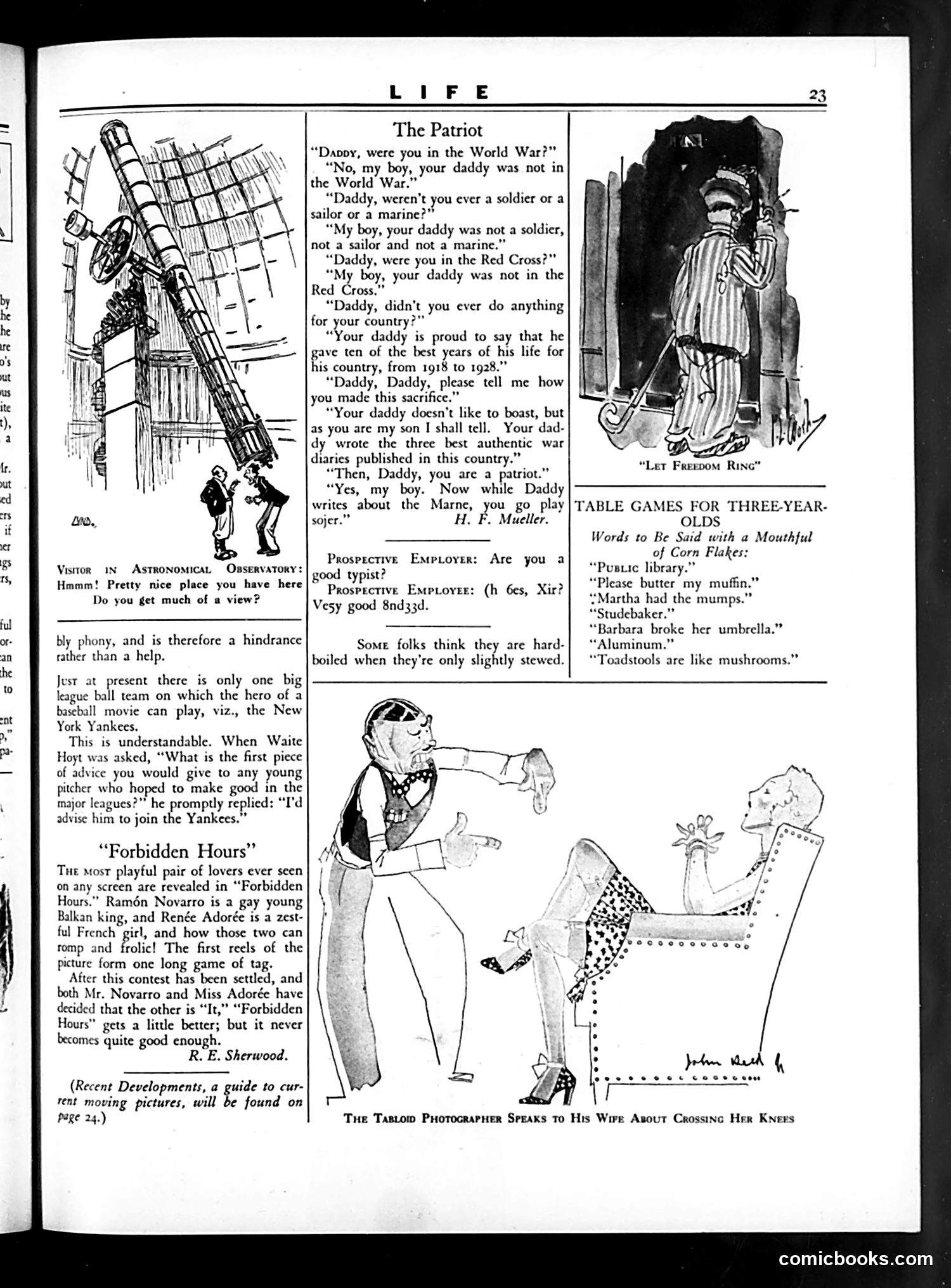
**"The Patriot"** mocks a father who claims patriotic service to his country from 1918-1928, but reveals his "sacrifice" was merely *writing war diaries*—not actual military service. The joke satirizes civilian writers who profited from publishing war accounts while presenting themselves as patriots. The father's reluctance to "boast" while simultaneously boasting underscores the hypocrisy. During the 1920s (when this appears), numerous popular war memoirs and diaries were published by non-combatants, so this likely targets that publishing trend and false patriotic claims. **Other content** includes brief movie reviews (noting the New York Yankees as baseball cinema's only subject), wordplay humor, and observational jokes about phoniness and pretense—typical of Life's satirical approach to American culture and society.
📄 Transcribed text from this page (OCR, searchable)
Machine-transcribed from the original scan — historical spelling and the odd misread are preserved.
LIFE Visrrorn iN AsTRONOMICAL OBSERVATORY: Hmmm! Pretty nice place you have here Do you get much of a view? bly phony, and is therefore a hindrance rather than a help. Just at present there is only one big league ball team on which the hero of a baseball movie can play, viz., the New York Yankees. This is understandable. When Waite Hoyt was asked, “What is the first piece of advice you would give to any young pitcher who hoped to make good in the major leagues?” he promptly replied: “I'd advise him to join the Yankees.” “Forbidden Hours” Tue ost playful pair of lovers ever seen on any screen are revealed in “Forbidden Hours.” Ramén Novarro is a gay young Balkan king, and Renée Adorée is a zest- ful French girl, and how those two can romp and frolicl The first reels of the picture form one long game of tag. After this contest has been settled, and both Mr. Novarro and Miss Adorée have decided that the other is “It,” “Forbidden Hours” gets a little better; but it never becomes quite good enough. R. E. Sherwood. uide to cur- (Recent Developments, a rent moving pictures, will be found on page 24.) The Patriot “Dappy, were you in the World War?” “No, my boy, your daddy was not in the World War.” “Daddy, weren't you ever a soldier or a sailor or a marine?” “My boy, your daddy was not a soldier, not a sailor and not a marine.” “Daddy, were you in the Red Cross?” “My boy, your daddy was not in the Red Cross,” “Daddy, didn’t you ever do anything for your country?” “Your daddy is proud to say that he gave ten of the best years of his life for his country, from 1918 to 1928.” “Daddy, Daddy, please tell me how you made this sacrifice.” “Your daddy doesn’t like to boast, but as you are my son I shall tell. Your dad- dy wrote the three best authentic war diaries published in this country.” “Then, Daddy, you are a patriot.” “Yes, my boy. Now while Daddy writes about the Marne, Pi go play] TABLE GAMES FOR THREE-YEAR- sojer.”” H. Mueller. Prospective Emptoyer: Are you a good typist? Prospective Emptoyee: (h 6es, Xir? Vesy good 8nd33d. Some folks think they are hard- boiled when they're only slightly stewed. OLDS Words to Be Said with a Mouthful of Corn Flakes: “Pustic library.” “Please butter my muffin.” ‘Martha had the mumps.” “Studebaker.” “Barbara broke her umbrella.” “Aluminum.” “Toadstools are like mushrooms.” Tue Taso Pxotocrarner Sreaxs to His Wire Asout Crossinc Her Knees comicbooks.com