
Life, 1928-08-09 · page 7 of 40
Life — August 9, 1928 — page 7: what you’re looking at
What you’re looking at
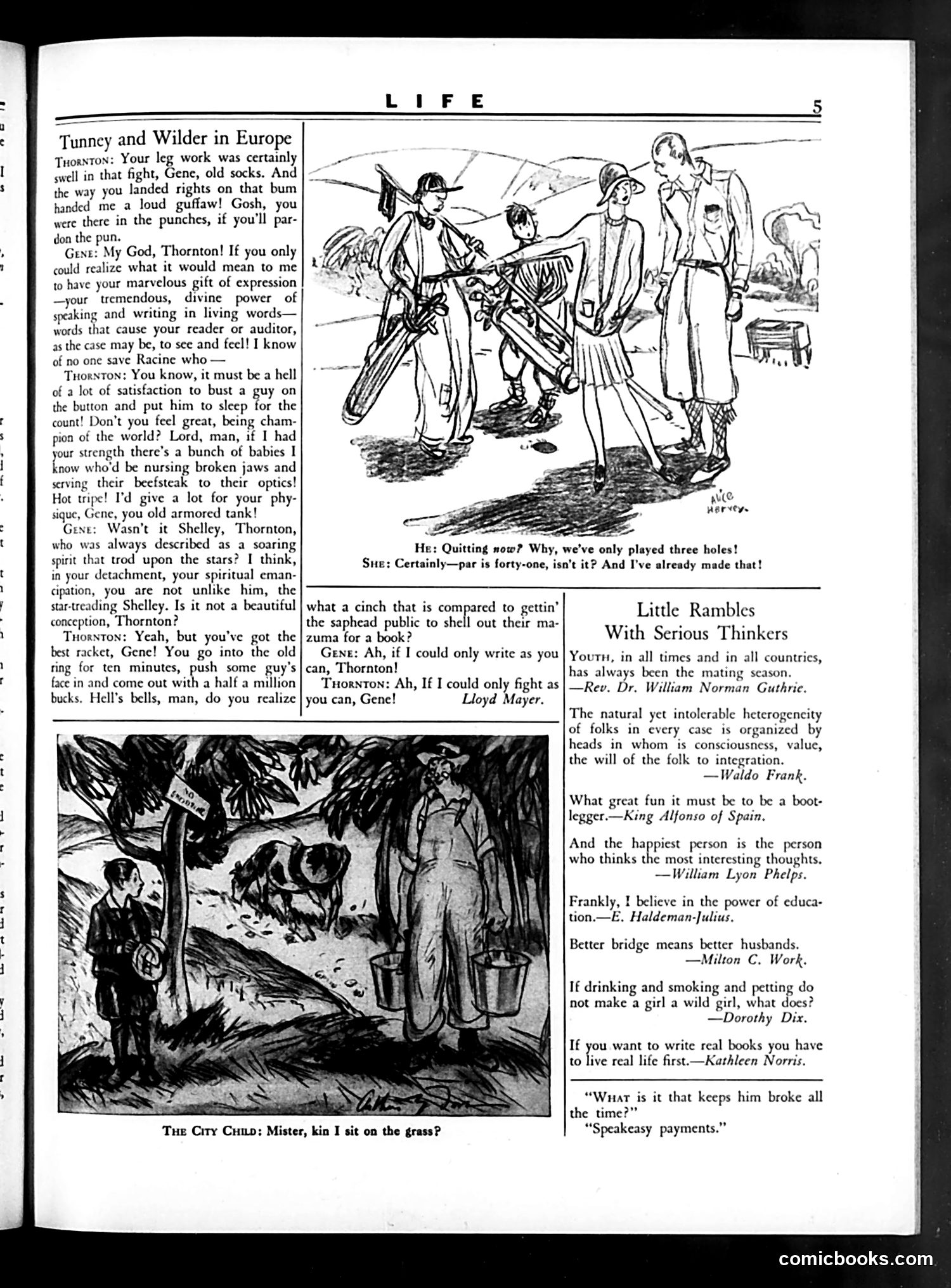
**Top Cartoon ("Tunney and Wilder in Europe"):** This appears to be a humorous dialogue between Gene Tunney (likely the heavyweight boxing champion) and Thornton Wilder (the playwright), with exchanges praising each other's professions. Tunney admires Wilder's literary gift; Wilder envies Tunney's fighting prowess. The satire gently mocks intellectual and athletic celebrity cultures by having each figure express envy of the other's accomplishments—suggesting both fields command public admiration and significant earning potential. **Bottom Cartoon ("The City Child"):** A dark, expressionistic sketch depicting an urban street scene with a child and figures in shadows. The caption "Mister, kin I sit on the grass?" satirizes industrial city life, highlighting the deprivation of nature and play space for poor urban children. Both pieces reflect 1920s-30s American social commentary on class, celebrity, and urban conditions.
📄 Transcribed text from this page (OCR, searchable)
Machine-transcribed from the original scan — historical spelling and the odd misread are preserved.
‘unney and Wilder in Europe Tuornton: Your leg work was certainly swell in that fight, Gene, old socks. And the way you landed rights on that bum handed me a loud guffaw! Gosh, you were there in the punches, if you'll par- don the pun. Gene: My God, Thornton! If you only could realize what it would mean to me to have your marvelous gift of expression —your tremendous, divine power of speaking and writing in living words— words that cause your reader or auditor, as the case may be, to see and feel! I know of no one save Racine who — Tuornton: You know, it must be a hell of a lot of satisfaction to bust a guy on the button and put him to sleep for the count! Don’t you feel great, being cham- pion of the world? Lord, man, if I had your strength there’s a bunch of babies I know who'd be nursing broken jaws and serving their beefsteak to their optics! Hot tripe! I'd give a lot for your phy- sique, Gene, you old armored tank! Gene: Wasn’t it Shelley, Thornton, who was always described as a soaring spirit that trod upon the stars? I think, in your detachment, your spiritual eman- cipation, you are not unlike him, the star-treading Shelley. Is it not a beautiful conception, Thornton? Tuornton: Yeah, but you've got the best racket, Gene! You go into the old ring for ten minutes, push some guy's face in and come out with a half a million bucks. Hell’s bells, man, do you realize We Wervey. = He: Quitting now? Why, we've only played three holes! Sue: Certainly—par is forty-one, isn’t it? And I've already made that! what a cinch that is compared to gettin’ the saphead public to shel out their ma- zuma for a book? Gene: Ah, if I could only write as you can, Thornton! Tuornton: Ah, If I could only fight as you can, Gene! Lloyd Mayer. Tue Crty Cup: Mister, kin I sit on the grassP Little Rambles With Serious Thinkers Yourn, in all times and in all countries, has always been the mating season. —Rev. Dr. William Norman Guthrie. The natural yet intolerable heterogencity of folks in every case is organized by heads in whom is consciousness, value, the will of the folk to integration. —Waldo Frank. What great fun it must be to be a boot- legger.—King Alfonso of Spain. And the happiest person is the person who thinks the most interesting thoughts. —William Lyon Phelps. Frankly, I believe in the power of educa- tion.—E, Haldeman-Julius. Better bridge means better husbands. —Milton C, Work. If drinking and smoking and petting do not make a girl a wild girl, what does? —Dorothy Dix. If re want to write real books you have to live real life first.—Kathleen Norris. “Wuar is it that keeps him broke all the time?” “Speakeasy payments.” comicbooks.com