
Life, 1928-08-09 · page 17 of 40
Life — August 9, 1928 — page 17: what you’re looking at
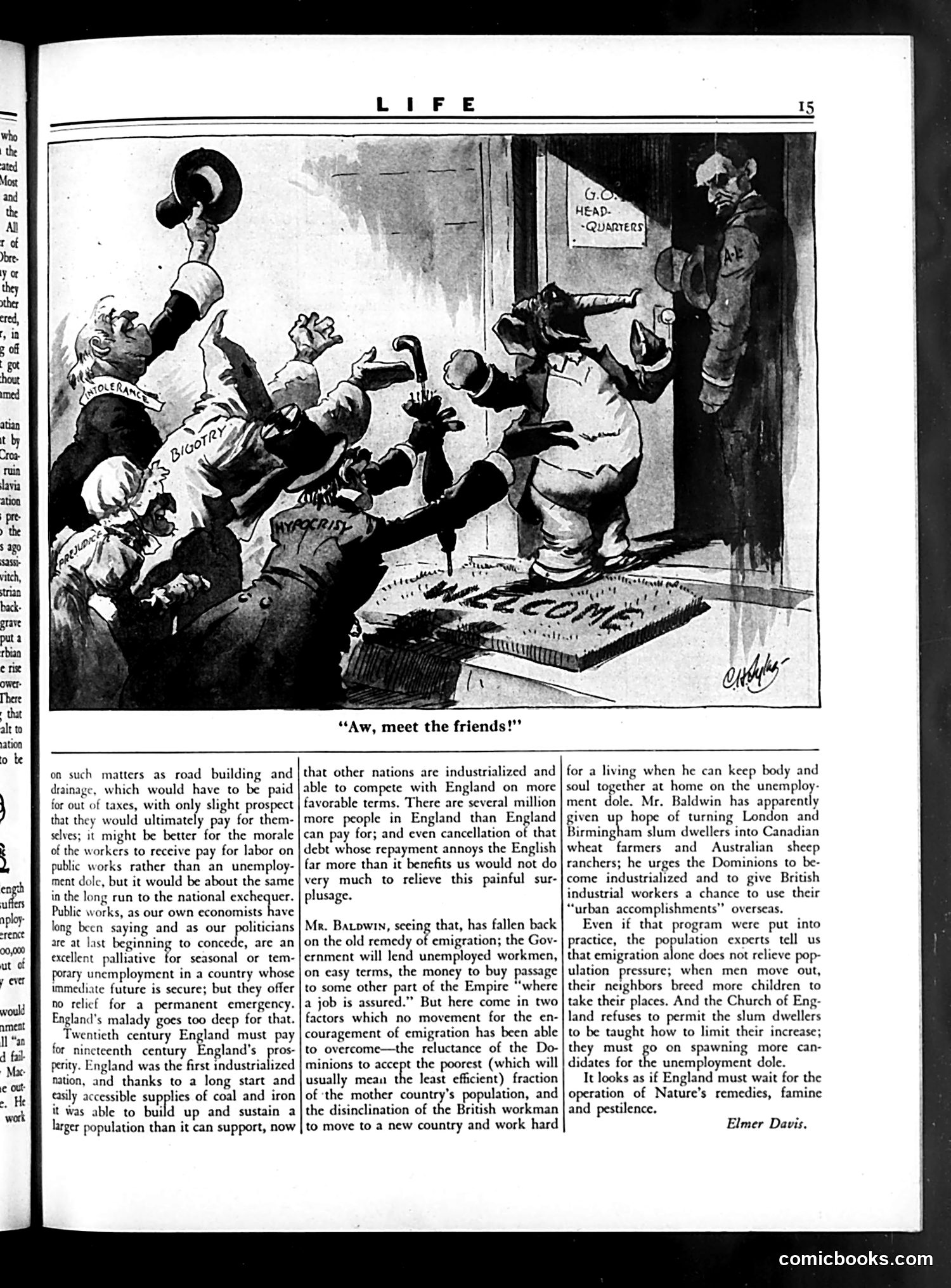
What you’re looking at
This cartoon satirizes British emigration policy during economic hardship. The figure on the left (labeled with text suggesting unemployment and bigotry) is being forcibly ejected from "G.O. Head-Quarters" by officials. The expelled figure's friends—depicted as various social problems (unemployment, bigotry, and other ills)—are shown waiting outside, ready to enter. The accompanying article by Elmer Davis criticizes the British government's emigration encouragement as a solution to unemployment. Rather than genuinely addressing England's economic problems, the government apparently hoped to export its unemployed population to other Empire territories. The cartoon mocks this approach, suggesting such policies merely spread problems elsewhere rather than solving them at home.
📄 Transcribed text from this page (OCR, searchable)
Machine-transcribed from the original scan — historical spelling and the odd misread are preserved.
Toee Rg Riaacke yt oF Crow ruin on such matters as road building and drainage, which would have to be paid for out of taxes, with only slight prospect that they would ultimately pay for them- selves; it might be better for the morale of the workers to receive pay for labor on public works rather than an unemploy- ment dole, but it would be about the same in the long run to the national exchequer. Public works, as our own economists have long been saying and as our politicians are at last beginning to concede, are an excellent palliative for seasonal or tem- porary unemployment in a country whose immediate future is secure; but they offer no relicf for a permanent emergency. England's malady goes too deep for that. _ Twentieth century England must pay for nineteenth century England's pros- perity. England was the first industrialized nation, and thanks to a long start and easily accessible supplies of coal and iron it was able to build up and sustain a larger population than it can support, now “Aw, meet the friends!” that other nations are industrialized and able to compete with England on more favorable terms. There are several million more people in England than England can pay for; and even cancellation of that debt whose repayment annoys the English far more than it benefits us would not do very much to relieve this painful sur- plusage. Mr. Bacowin, seeing that, has fallen back on the old remedy of emigration; the Gov- ernment will lend unemployed workmen, on easy terms, the money to buy passage to some other part of the Empire “where a job is assured.” But here come in two factors which no movement for the en- couragement of emigration has been able to overcome—the reluctance of the Do- minions to accept the poorest (which will usually mean the least efficient) fraction of ‘the mother country’s population, and the disinclination of the British workman to move to a new country and work hard for a living when he can keep body and soul together at home on the unemploy- ment dole. Mr. Baldwin has apparently given up hope of turning London and Birmingham slum dwellers into Canadian wheat farmers and Australian sheep ranchers; he urges the Dominions to be- come industrialized and to give British industrial workers a chance to use their “urban accomplishments” overseas. Even if that program were put into practice, the population experts tell us that emigration alone does not relieve pop- ulation pressure; when men move out, their neighbors breed more children to take their places. And the Church of Eng- land refuses to permit the slum dwellers to be taught how to limit their increase; they must go on spawning more can- didates for the unemployment dole. It looks as if England must wait for the operation of Nature’s remedies, famine and pestilence. Elmer Davis. comicbooks.com