
A complete issue · 50 pages · 1928
Life — July 5, 1928
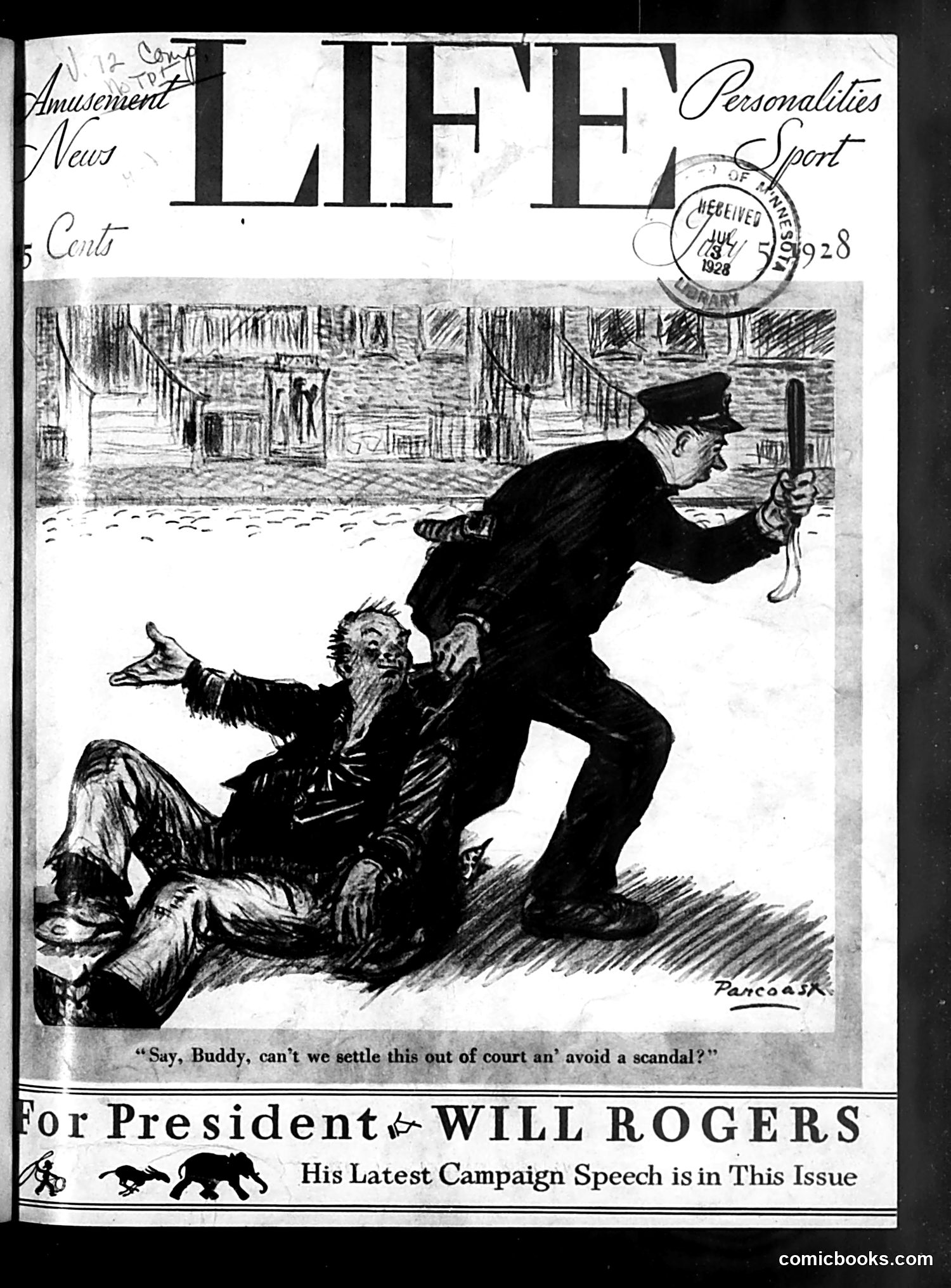
This 1928 political cartoon satirizes legal/political maneuvering, likely related to a scandal. A uniformed officer (possibly a cop or bailiff) physically drags away a disheveled man with an exaggerated, wild appearance, while the dragged figure protests: "Say, Buddy, can't we settle this out of court an' avoid a scandal?" The caption suggests the cartoon criticizes attempts to suppress legal proceedings through backroom deals rather than public trial. The figure being removed appears caricatured as disreputable or criminal. The page promotes Will Rogers as a presidential candidate, framing him as someone who would address such corruption directly. The satire attacks the practice of settling matters quietly to avoid public embarrassment—implying transparency and proper legal process are preferable.
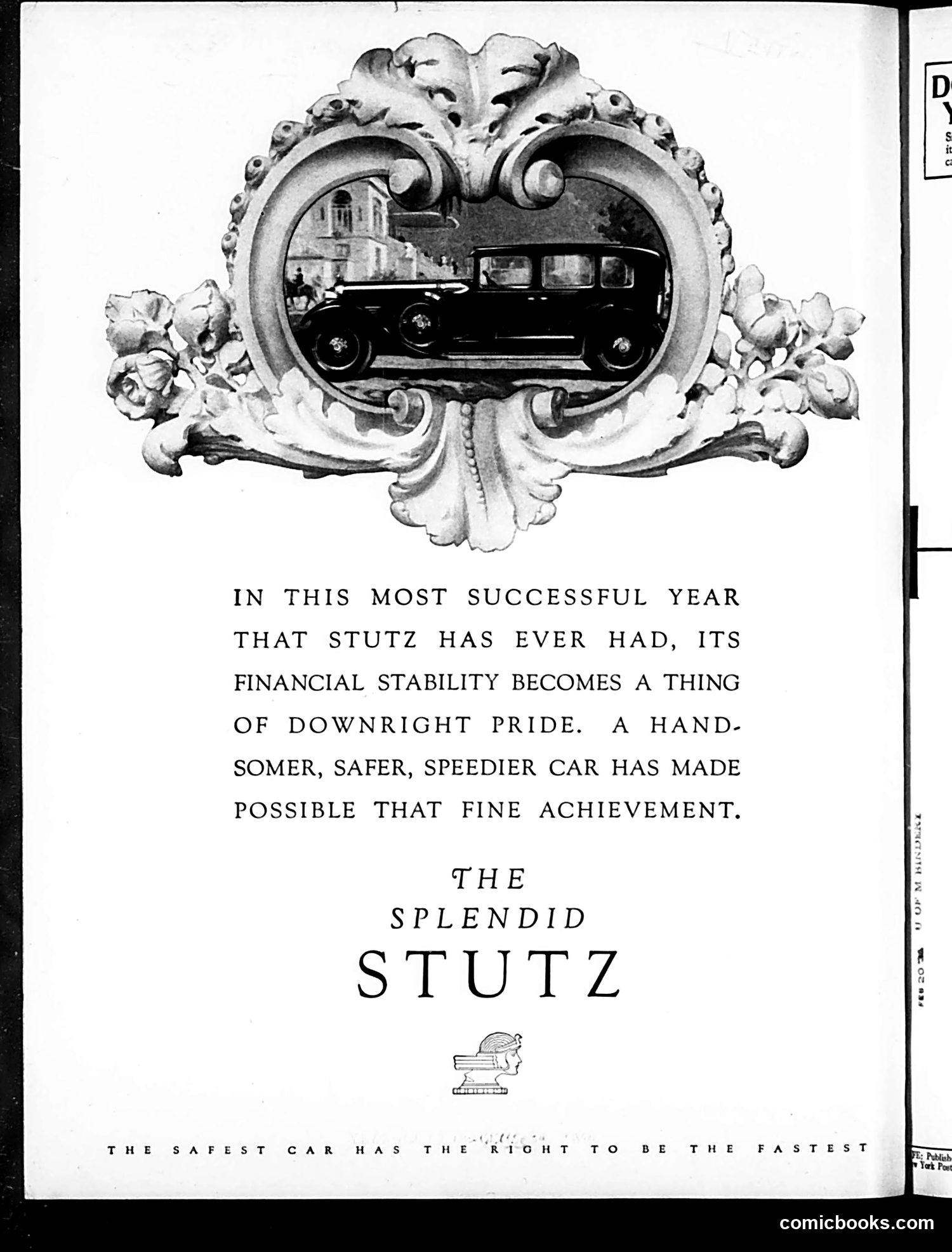
This is a **Stutz automobile advertisement**, not satire or political content. The ornate baroque frame contains an image of a 1920s-era automobile, presented as a luxury product. The text celebrates Stutz's "most successful year," claiming financial stability and superior engineering ("handsomer, safer, speedier"). The decorative border—featuring classical scrollwork and cherub-like figures—is typical of period automotive advertising, designed to associate the car with elegance and prestige. The tagline "The safest car has the right to be the fastest" is a marketing claim about performance and safety. This represents **early automotive marketing**, when cars were luxury goods promoted through ornamental design language borrowed from fine art and classical decoration.
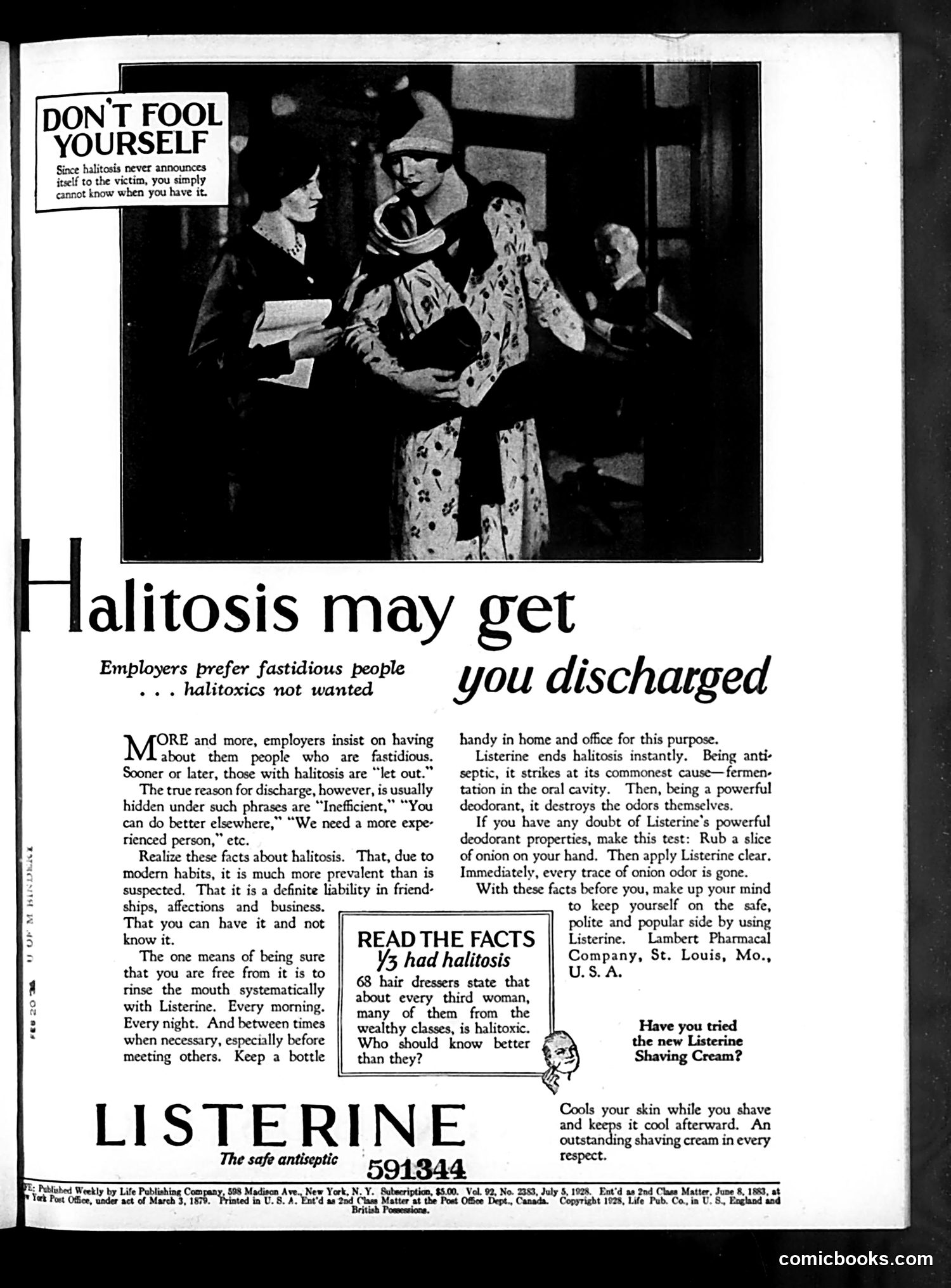
This is primarily a **Listerine advertisement** disguised as editorial content—a common advertising strategy of the era. The "DON'T FOOL YOURSELF" headline warns readers about **halitosis** (bad breath), which Listerine claimed to cure. The accompanying photograph shows what appears to be a social situation where bad breath might cause embarrassment or job loss. The satirical angle targets **employment discrimination**: the ad claims employers reject workers for halitosis, using fake "facts" (citing "68 hair dressers" as evidence). This exploits workplace anxiety and social shame to sell mouthwash. The subheading "Employers prefer fastidious people... halitoxics not wanted" reinforces fear-based marketing—a hallmark of 1920s-30s advertising that manufactured insecurities to drive sales.
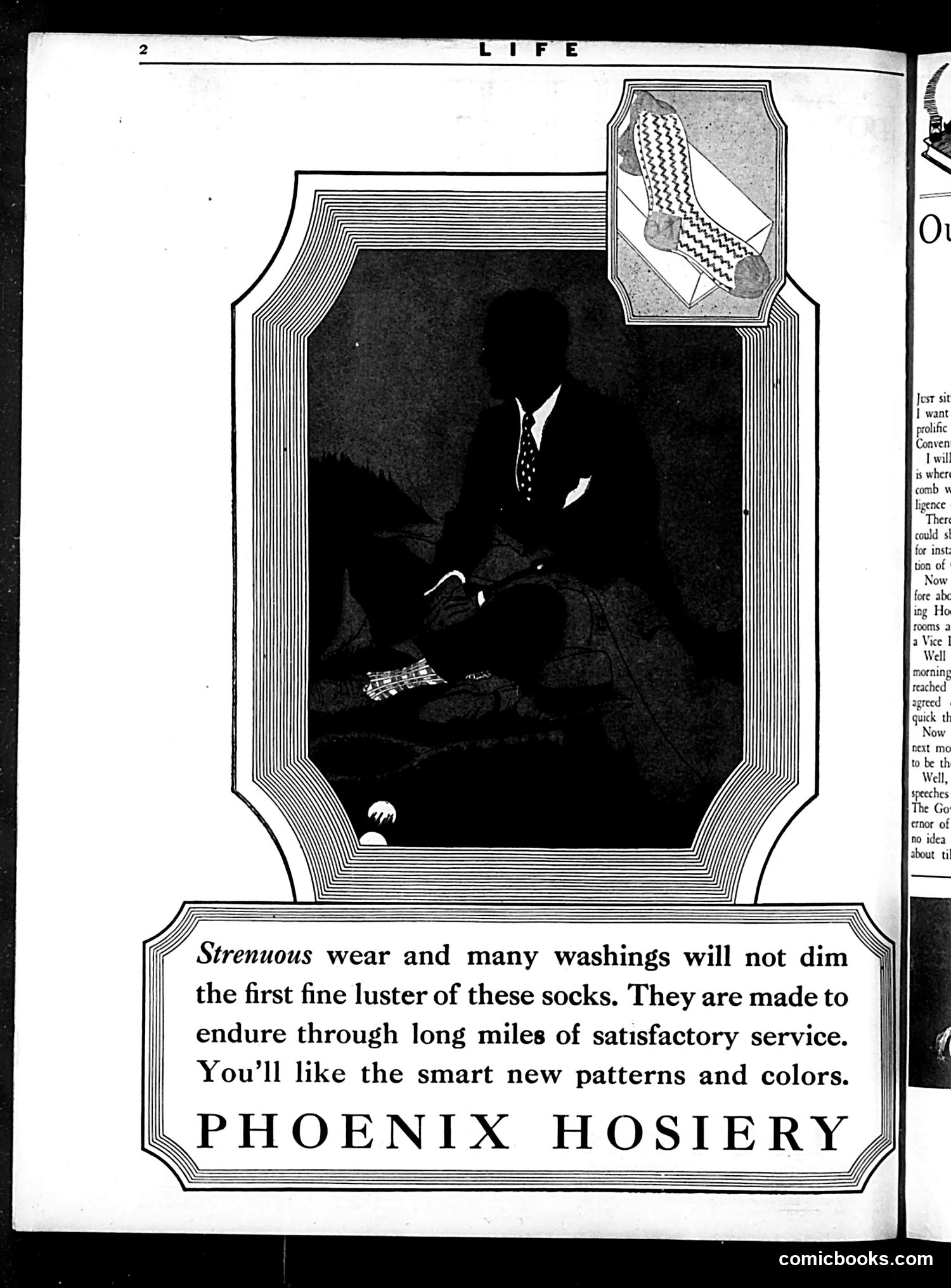
This page is primarily **advertising**, not political satire. The main image shows a silhouetted businessman in formal attire (suit and patterned tie), seated and examining socks. An inset illustration displays the socks' checkered pattern. The advertisement is for **Phoenix Hosiery**, emphasizing durability and style. The sales pitch claims the socks will maintain their "fine luster" despite "strenuous wear and many washings" and highlights "smart new patterns and colors." There is **no political cartoon or satire** on this page. It's a straightforward vintage advertisement using professional photography and decorative framing typical of early-to-mid 20th century magazine advertising. The silhouetted figure is simply a generic businessman meant to appeal to male readers as the target consumer.
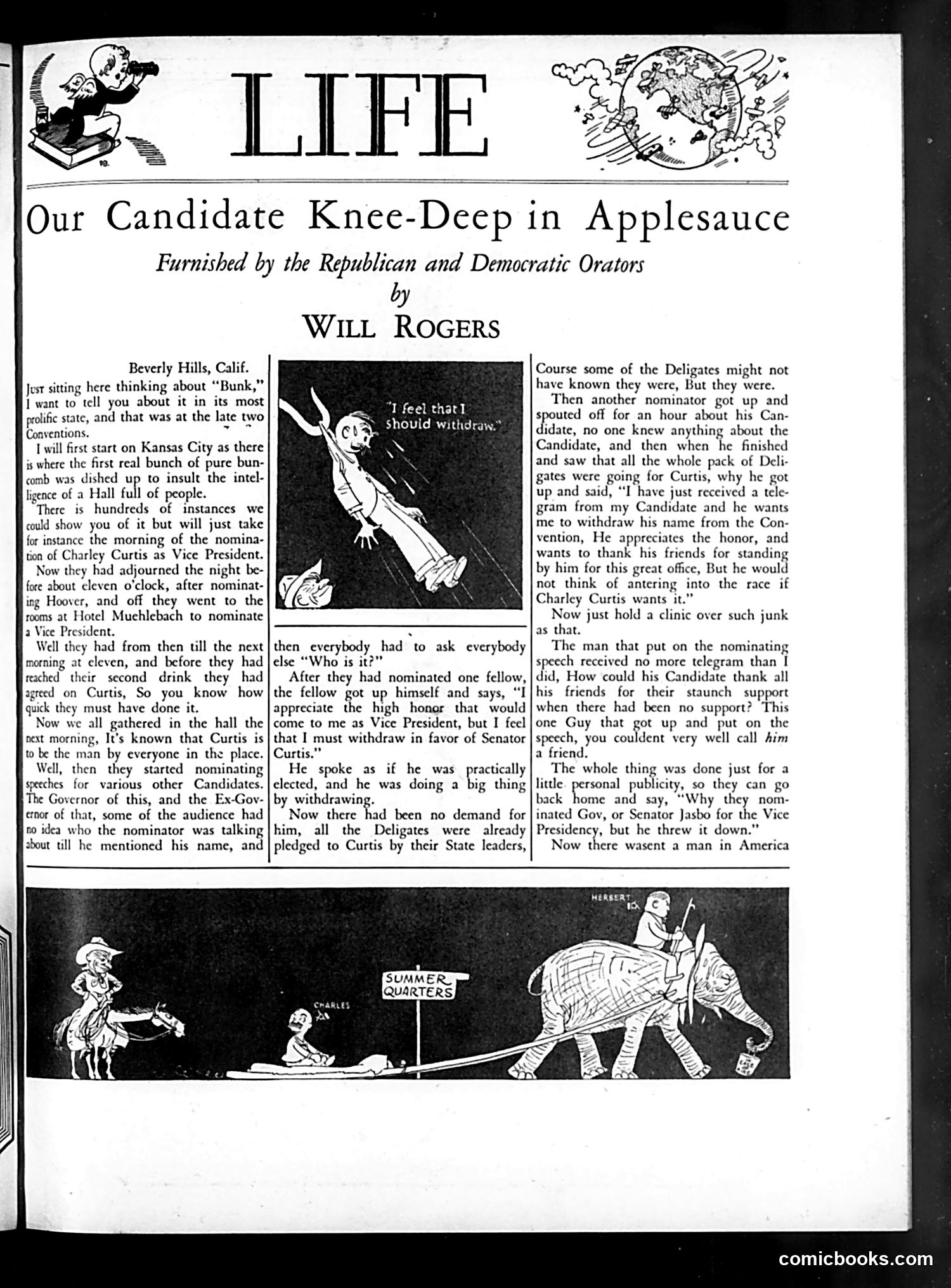
This satirical piece by Will Rogers mocks the 1928 Democratic and Republican conventions' vice-presidential nomination process. The main cartoon shows a candidate literally "knee-deep in applesauce"—drowning in empty political rhetoric. Rogers describes how a largely unknown nominee received telegrams of support from party leaders, only to have another delegate demand his withdrawal in favor of Senator Curtis. The nominee then fabricated a gracious withdrawal speech for publicity purposes. The bottom cartoon depicts the chaotic nomination process as a circus—with figures herding an elephant (the Republican symbol) toward "Summer Quarters," suggesting the political machinery was merely moving candidates around for show rather than serious deliberation. The satire targets the hollowness and cynicism of party politics and manufactured enthusiasm.
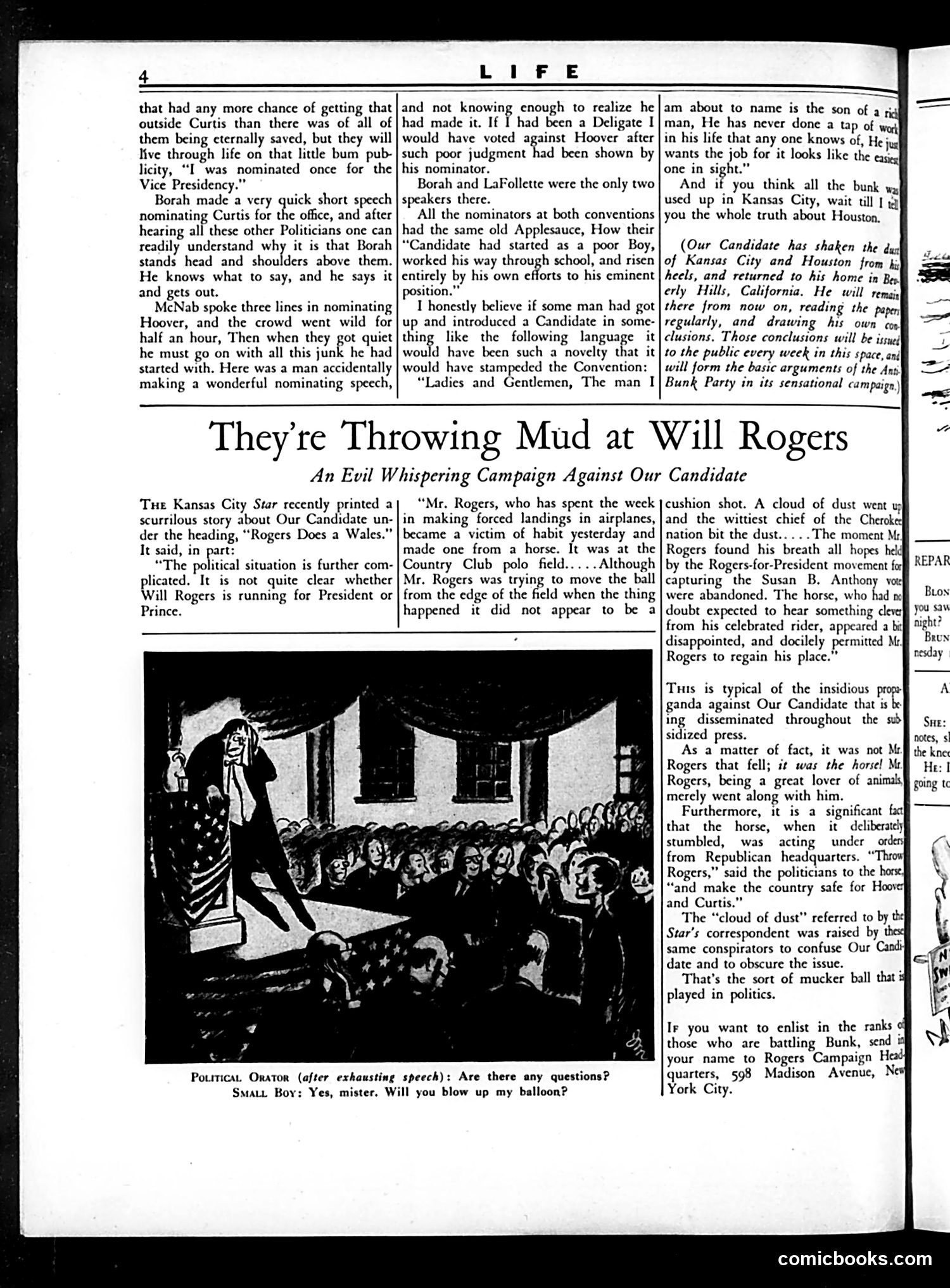
This page satirizes negative campaigning against Will Rogers, who was apparently running for President. The article dismisses attacks published in the Kansas City Star, including a fabricated story about Rogers falling from a horse at a polo match—which never happened. The cartoon depicts a political orator addressing a crowd, with the caption asking if there are questions, and a small boy asking "Will you blow up my balloon?"—a visual pun suggesting the speaker is full of hot air. The page's point: Rogers' opponents are spreading false rumors and propaganda to smear him. The editors frame this as typical "mucker ball" politics, urging readers to support Rogers by sending their names to his campaign headquarters in New York City.
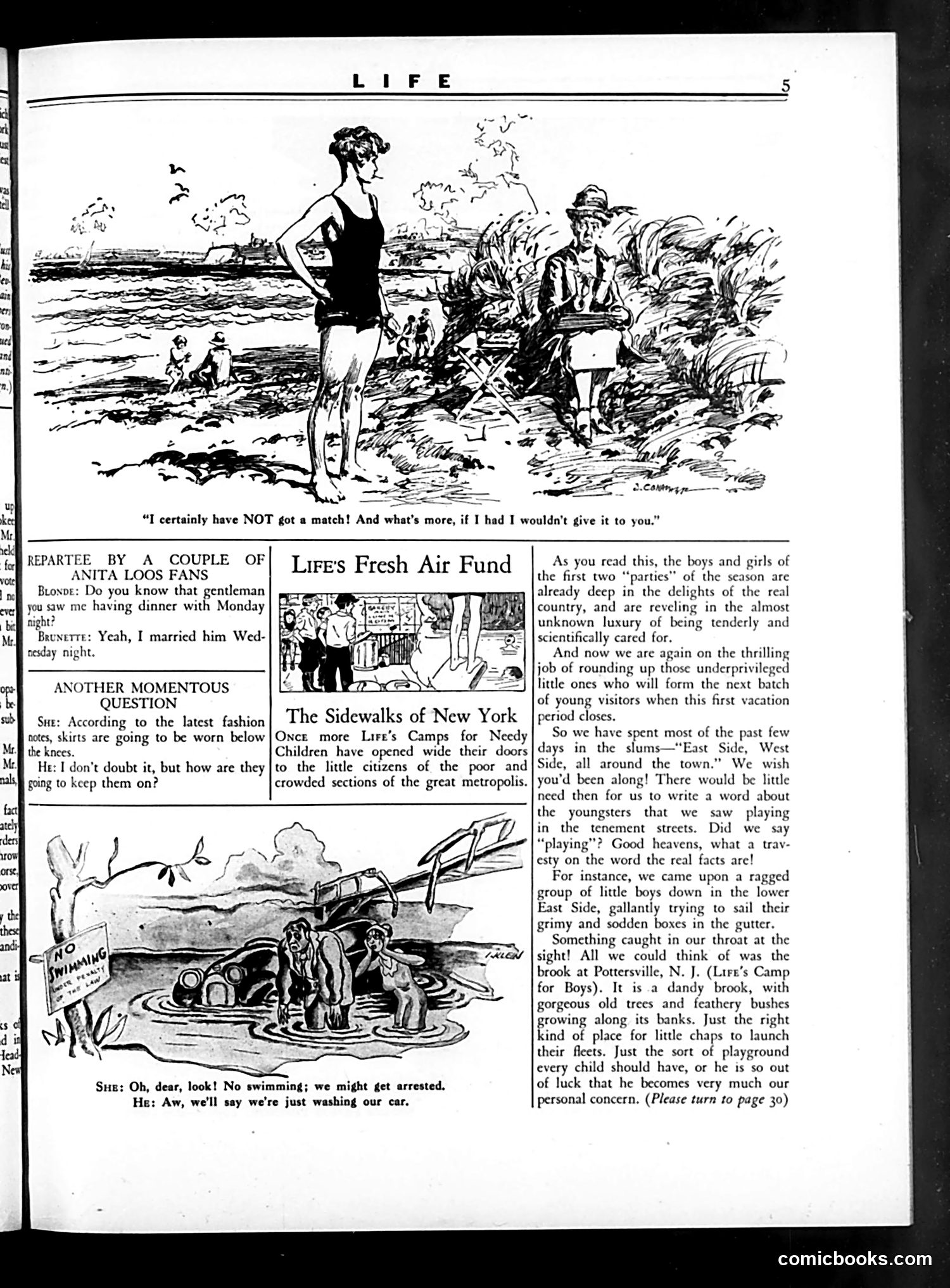
This page contains humorous cartoons and social commentary typical of Life's satirical style. **Top cartoon**: A woman in a bathing suit confronts a man, declaring she has "NOT got a match" and wouldn't give it to him anyway—a witty double meaning about romantic compatibility versus actual matchsticks. **Middle section**: Two brief Q&A jokes mock contemporary social conventions: one about a gentleman caller arriving on Monday night (implying courtship customs), and another about fashionable shorter skirts and how women keep them from slipping. **Bottom cartoon**: A couple caught in water claim they're "just washing our car"—a humorous excuse for improper behavior (unmarried couples in water together). **Right column**: "Life's Fresh Air Fund" describes the magazine's charitable camps for underprivileged children in New York City tenements, emphasizing wholesome outdoor recreation and moral improvement.
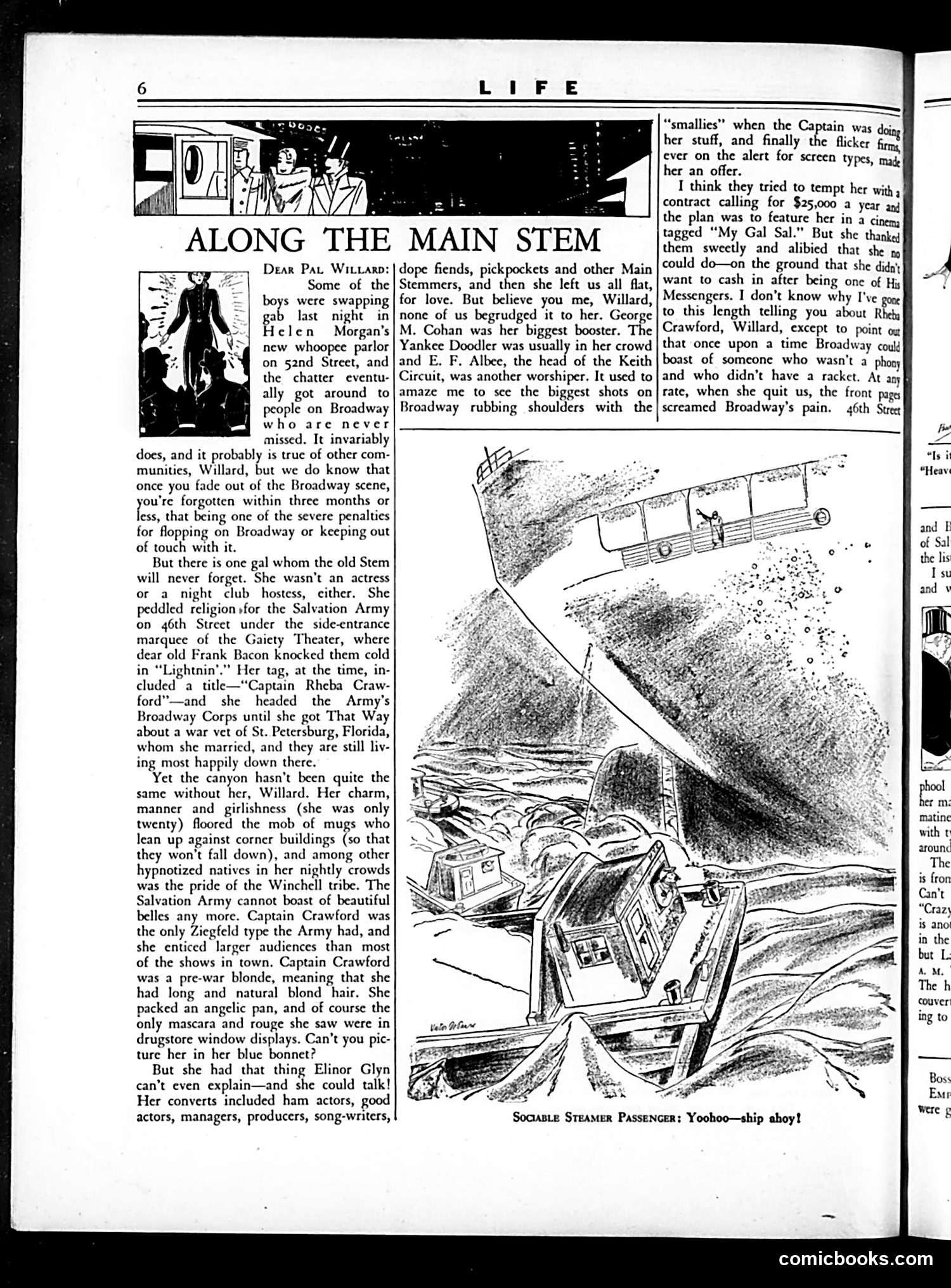
This is a gossip column by Pal Willard about Broadway performers and venues. The text discusses various actors and entertainers around New York's theater district (the "Main Stem"), including references to specific Broadway theaters and performers like Captain Rheba Crawford, who led the Salvation Army's Broadway Corps. The accompanying illustration shows a steamship labeled "Sociable Steamer Passenger: Yoohoo-ship ahoy!" - likely a satirical reference to theatrical life or perhaps a touring production. The column's tone is lighthearted insider gossip, documenting Broadway personalities, their movements between shows, and romantic entanglements. It represents Life magazine's typical satirical coverage of New York entertainment culture during the early 20th century.
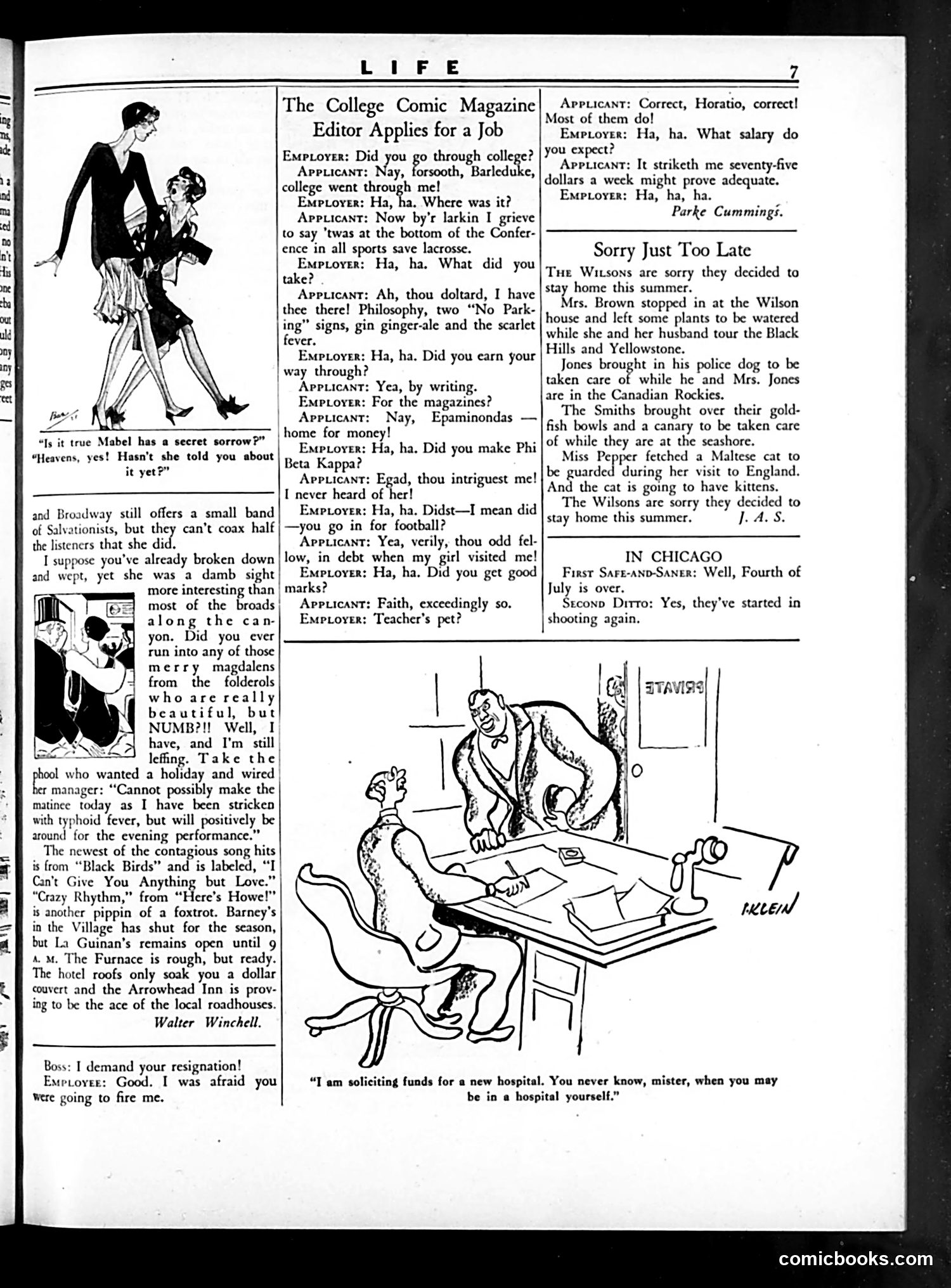
This page contains three satirical humor pieces typical of 1920s Life magazine: 1. **"The College Comic Magazine Editor Applies for a Job"**: A dialogue mocking inexperienced college graduates seeking employment. The applicant claims extensive extracurricular activities but lacks actual skills, embodying the stereotype of privileged but unqualified youth entering the workforce. 2. **"Sorry Just Too Late"**: A brief anecdote about the Wilson family's absent-minded summer plans—people and pets scattered across various locations while they're delayed. It's light domestic humor. 3. **"In Chicago" section**: Brief gossip about film productions resuming. The bottom cartoon shows a figure soliciting hospital funds with dark humor: "You never know, mister, when you may be in a hospital yourself"—playing on self-interested charity pitches.
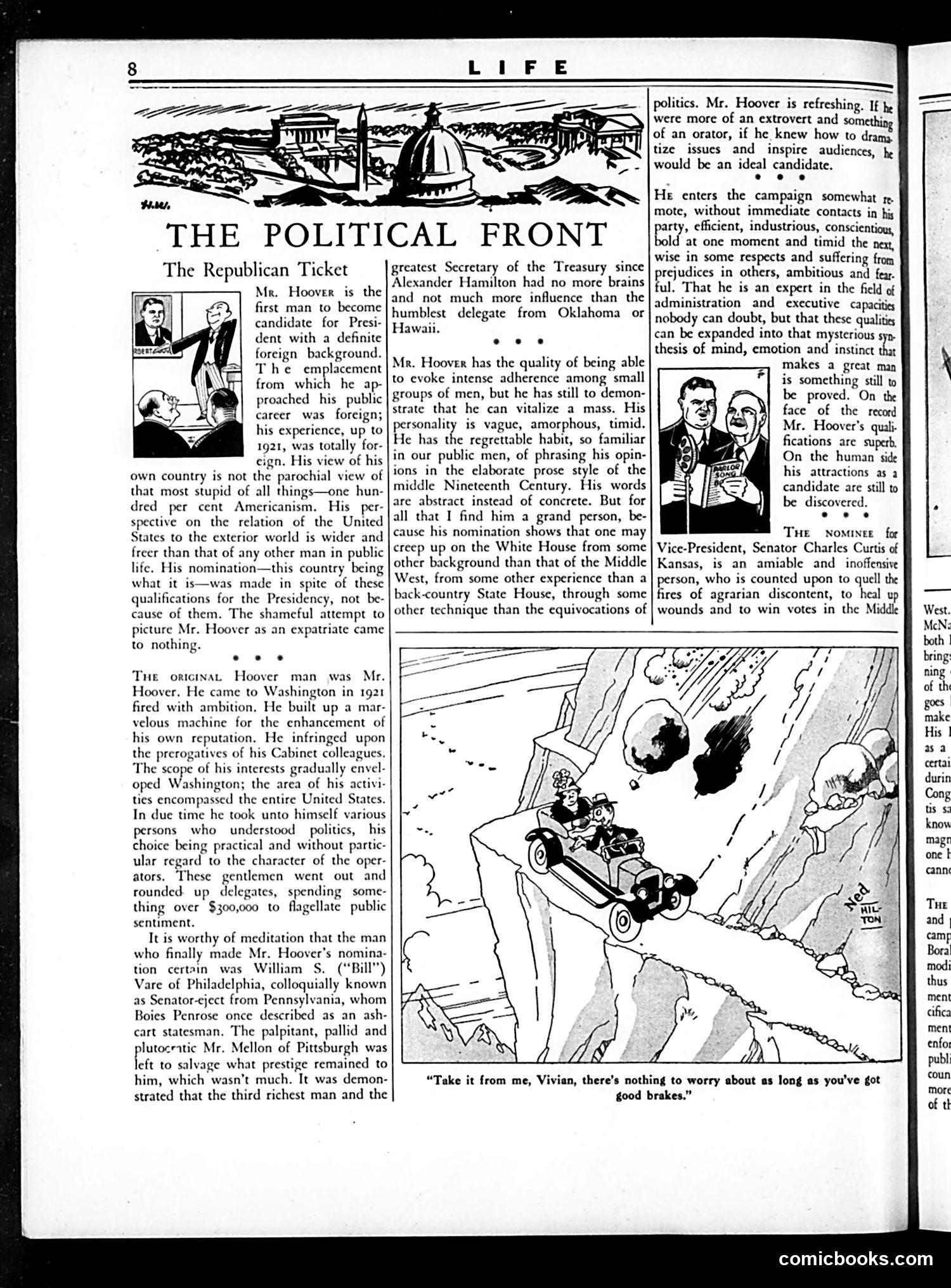
This page from *Life* magazine analyzes Herbert Hoover's 1928 Republican presidential campaign. The text critiques Hoover as an introverted, abstract thinker unsuited to public campaigning—his speeches invoke "middle Nineteenth Century" prose rather than concrete, relatable language. The lower cartoon satirizes campaign safety concerns. A driver navigates a treacherous mountain road while passengers in falling boulders remain calm, reassured that they have "good brakes." This mocks voter confidence in Hoover's economic expertise and Republican fiscal management, suggesting people are blindly trusting leadership despite obvious dangers ahead—likely referencing post-1920s economic instability concerns.
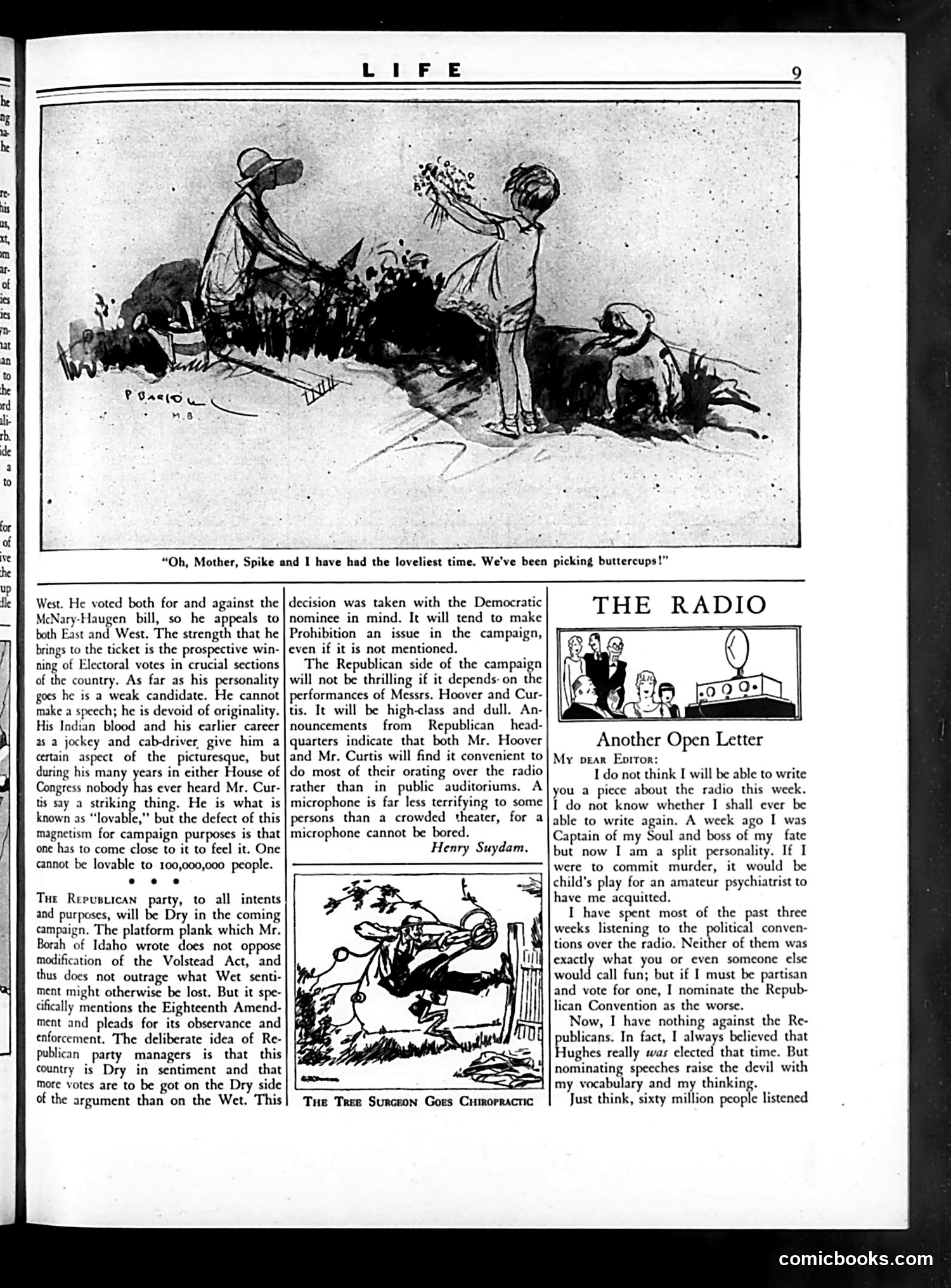
**Top Cartoon:** Shows two children picking buttercups in a field, captioned "Oh, Mother, Spike and I have had the loveliest time. We've been picking buttercups!" This is a gentle, nostalgic domestic scene with no apparent political content—likely chosen to provide visual contrast or relief amid the political commentary. **Middle Cartoon:** Titled "The Tree Surgeon Goes Chiropractic," depicts a figure (appears to be a tree surgeon) manipulating a bent tree. This is a visual pun satirizing chiropractors' practices by comparing spinal adjustment to tree straightening—mocking chiropractic medicine as pseudoscience. **Text:** The political commentary discusses 1920s campaign issues, Prohibition, and Republican/Democratic positions, particularly regarding Hoover and Curtis as candidates.
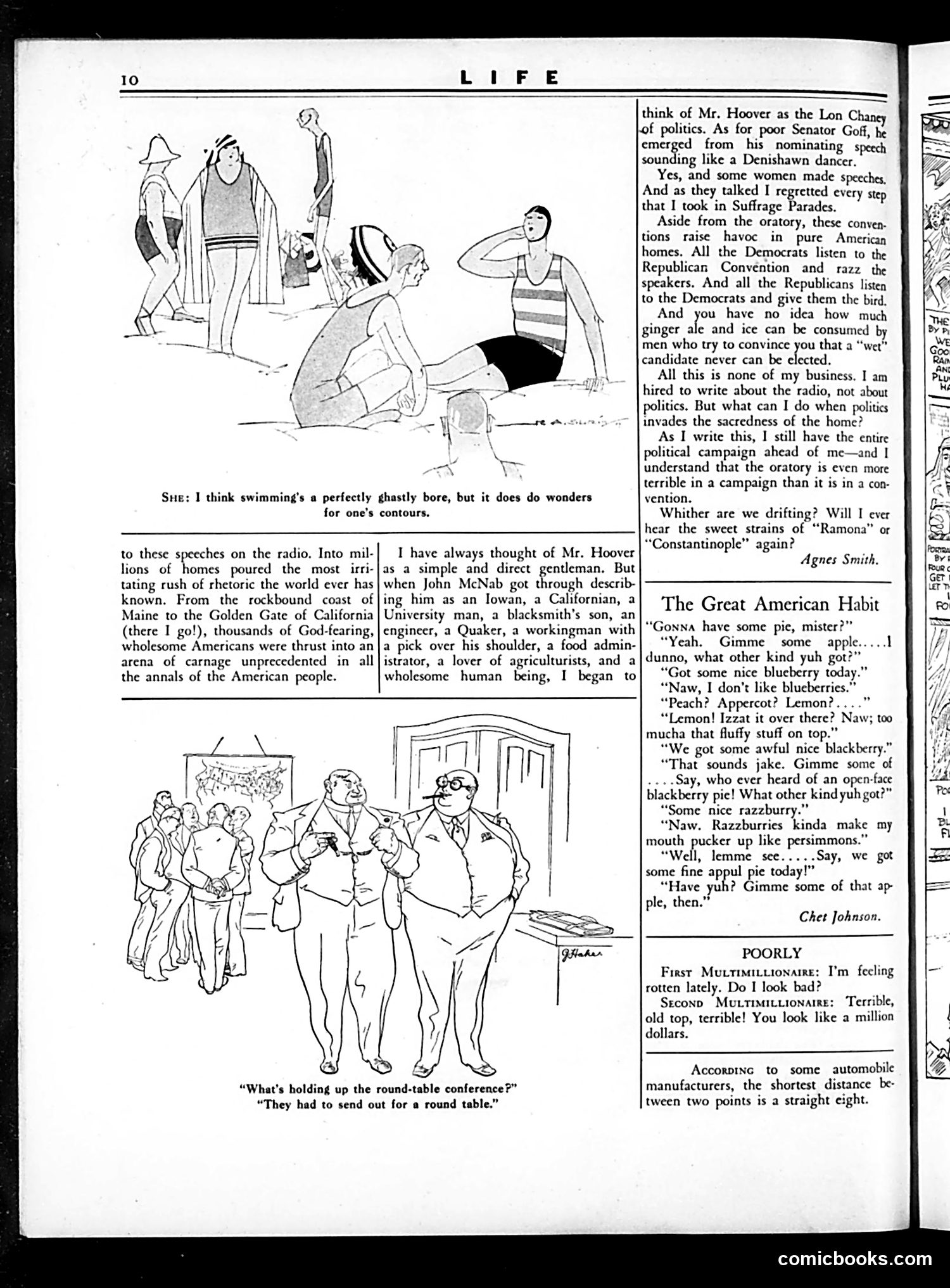
This page contains political and social satire from an era when radio was a major medium for political campaigns. The top cartoon mocks swimming attire's unflattering effect on body contours. The main article criticizes how political conventions and campaign rhetoric have invaded American homes via radio broadcasts. The author (Agnes Smith) expresses frustration that even personal entertainment spaces are now saturated with political speeches from both Democratic and Republican candidates, mentioning Mr. Hoover specifically—likely Herbert Hoover's 1928 or 1932 presidential campaign. The lower cartoon jokes about a "round-table conference" requiring a literal round table, satirizing bureaucratic inefficiency. The "Great American Habit" section presents humorous dialogue about pie preferences, unrelated to politics.
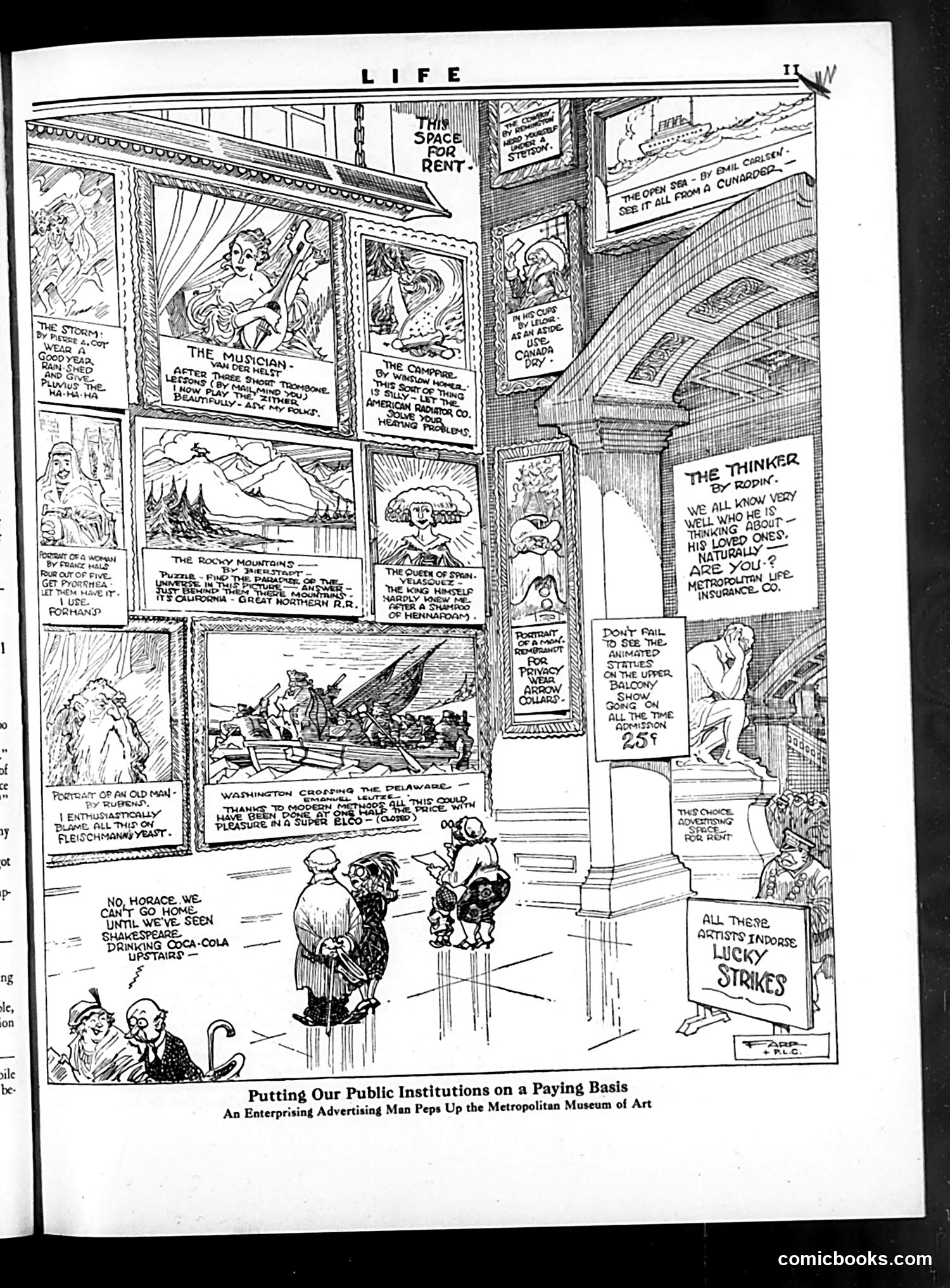
This satirical cartoon critiques commercialization of cultural institutions, specifically the Metropolitan Museum of Art. The main scene shows a museum transformed into a storefront hawking reproductions and merchandise—paintings are displayed like shop windows with price tags (25¢). The satire targets an unnamed "enterprising advertising man" (referenced in the subtitle) who proposes monetizing the museum through commercial products and displays. Various smaller panels show art and historical images being commodified, including "Washington Crossing the Delaware" and classical works. The joke: cultural institutions, meant to serve the public, are becoming mere retail operations prioritizing profit over artistic merit. Two figures at bottom discuss this trend sardonically. The cartoon warns against treating art as disposable consumer goods rather than treasured cultural assets.
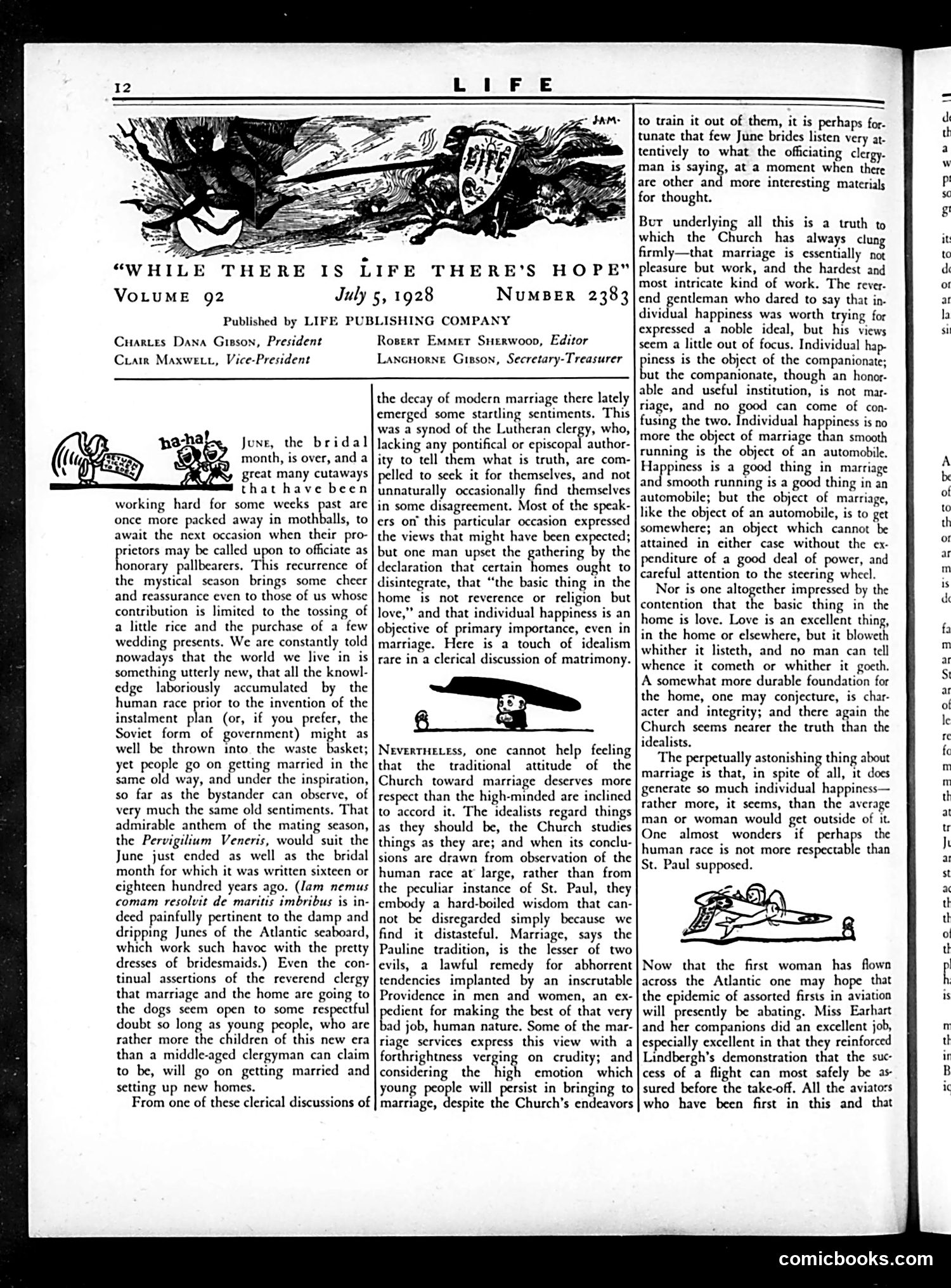
This page contains editorial text about marriage and the Church's role in it, alongside small illustrations rather than a full political cartoon. The top illustration shows a couple in an intimate moment—likely satirizing the "bridal month" referenced in the text. The article critiques clergy who presume to lecture couples on marriage while the Church's traditional stance may not align with modern views. The lower illustration depicts a woman piloting an aircraft, referencing Miss Earhart (Amelia Earhart), the pioneering aviator. The text notes her recent transatlantic flight and suggests her accomplishment proves women's capabilities—an implicit argument for women's equality and independence, contrasting with restrictive marital traditions the article questions. Both images support the article's broader theme: challenging outdated institutional authority over personal happiness.
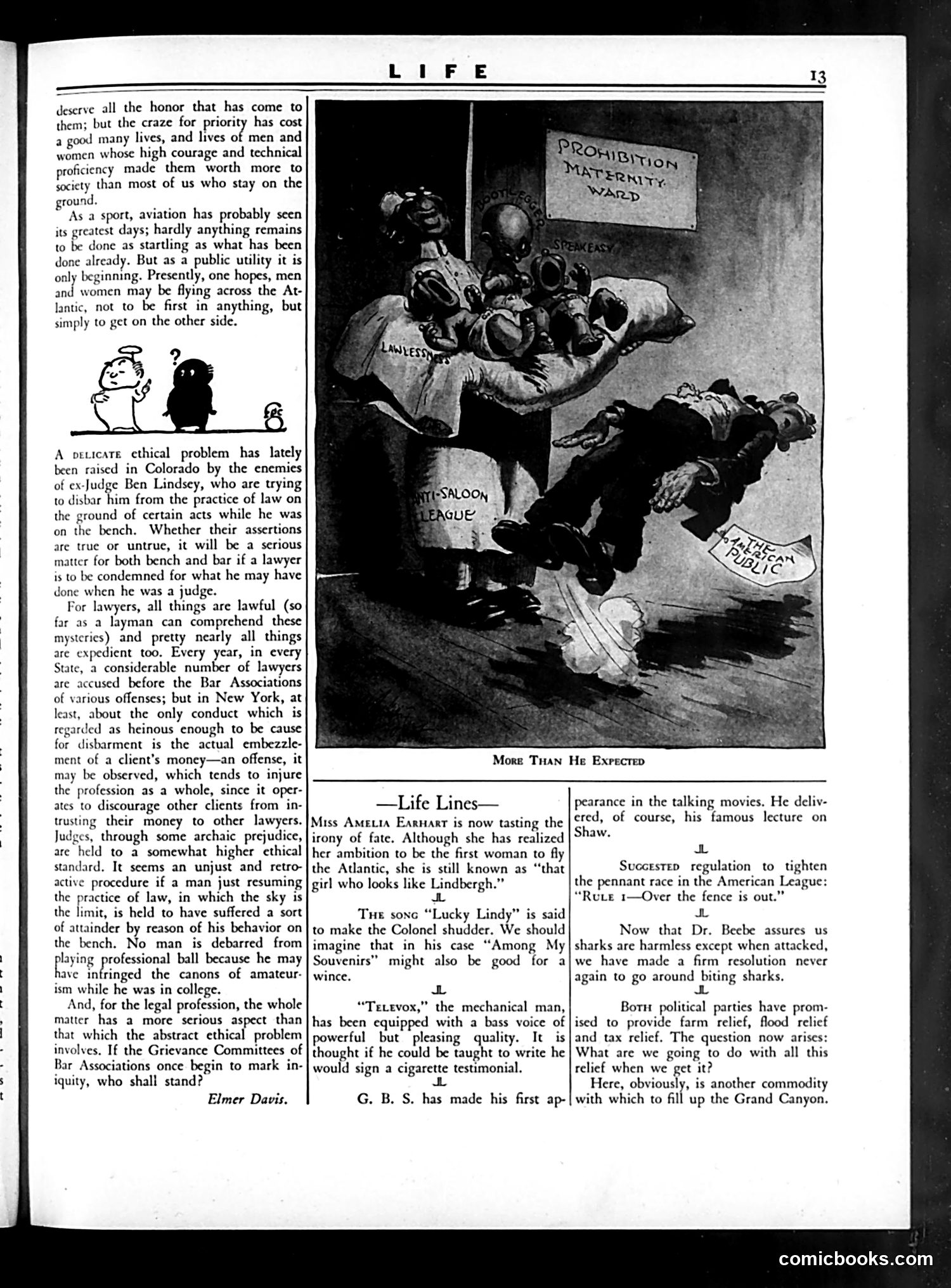
This political cartoon satirizes **Prohibition and its enforcement**, which was law in America at the time. The image shows what appears to be alcohol-related organizations or enforcement agencies ("Prohibition Maternity Ward," "Anti-Saloon League," "Patriotic Public") struggling to manage unintended consequences—depicted as multiple babies or problems they've created. The title "More Than He Expected" suggests that Prohibition's supporters anticipated simple success, but instead faced chaos: bootlegging, organized crime, and public resistance. The cartoon mocks the idealistic reformers who pushed this policy, showing them overwhelmed by the messy reality of their own creation. This reflects genuine 1920s-era skepticism about whether Prohibition could actually work as intended.
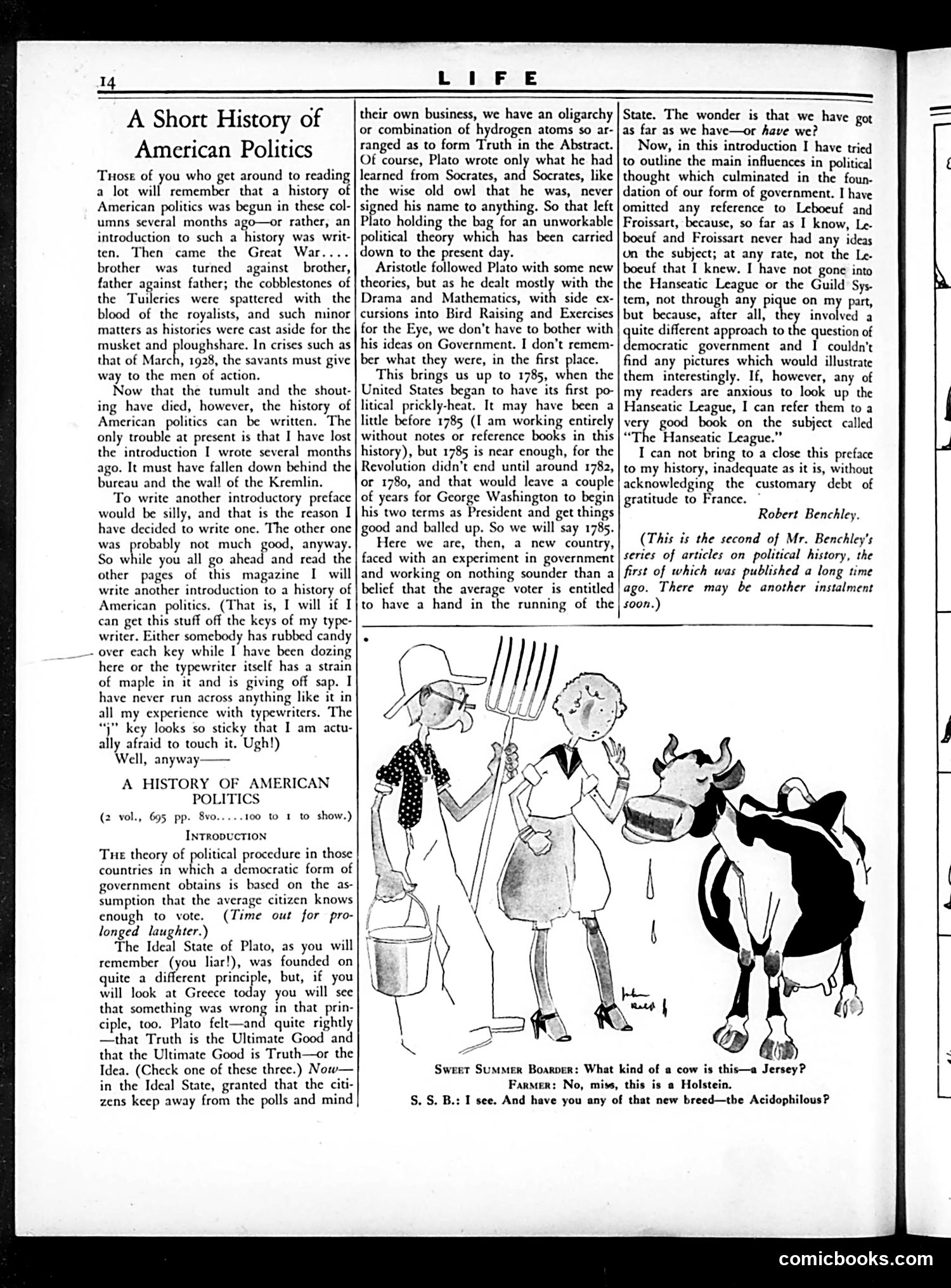
This cartoon illustrates urban-rural cultural friction, likely from the 1920s-30s. A fashionable city woman (the "Sweet Summer Boarder") encounters a farmer with his cow, asking what breed it is. The farmer, unfamiliar with her urban sophistication, doesn't recognize the Jersey breed she mentions. When she asks if he has the "new breed—the Acidophilus," he's bewildered. The satire mocks both parties: the city visitor's pretentious knowledge of trendy topics (acidophilus milk was a health fad), and the rural farmer's supposed ignorance. It reflects period anxieties about widening gaps between urban and rural America—urban sophistication versus rural simplicity—a recurring theme in 1920s-30s American humor magazines.
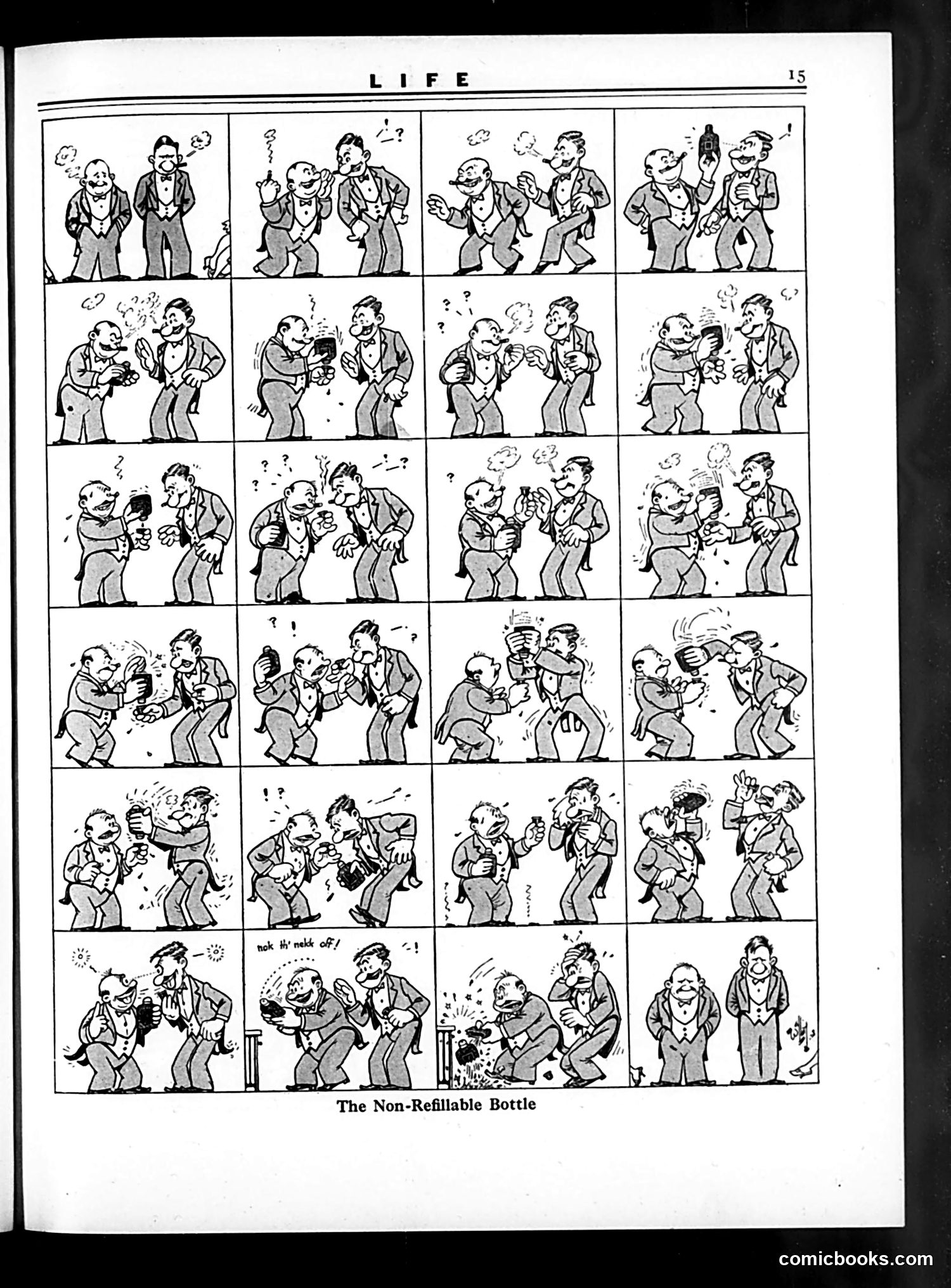
This comic strip satirizes a business dispute, likely between a beverage company and a distributor or retailer. The narrative shows two men in suits repeatedly trying to refill or reuse a bottle, encountering escalating frustration and conflict through each panel. The title's reference to a "non-refillable bottle" suggests commentary on commercial practices—possibly criticizing either a company's attempt to prevent bottle reuse (to increase sales) or a customer's attempt to circumvent such restrictions. The physical comedy escalates from confusion to heated argument to apparent violence by the final panels. The satire likely mocks either corporate rigidity around profit margins or consumers attempting to work around new business policies during what appears to be an early 20th-century industrial period.
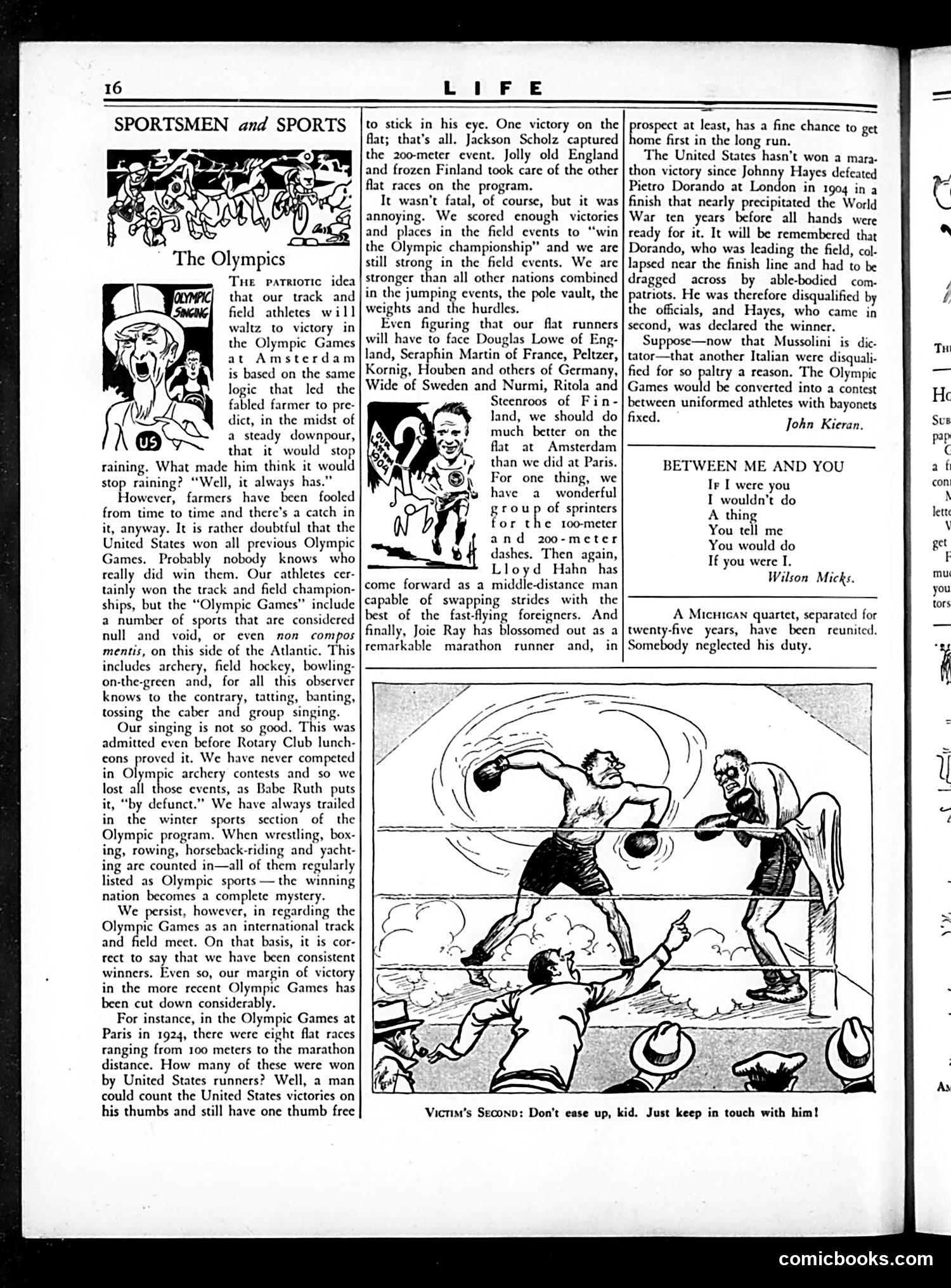
This page satirizes American Olympic performance through commentary and cartoons. The text criticizes the U.S. track and field team's underwhelming showing at recent Olympic Games, noting that despite America's historical dominance, foreign competitors—particularly from Germany, Finland, France, and Sweden—now excel in middle-distance running, flat races, and field events. The cartoon "Victim's Second" depicts boxing or athletic competition, showing a coach encouraging a struggling competitor to "keep in touch" with his opponent. The satire's point: American athletic supremacy cannot be assumed; international competition has intensified, and complacency threatens future Olympic victories. The text expresses concern about losing traditional American dominance in sports.
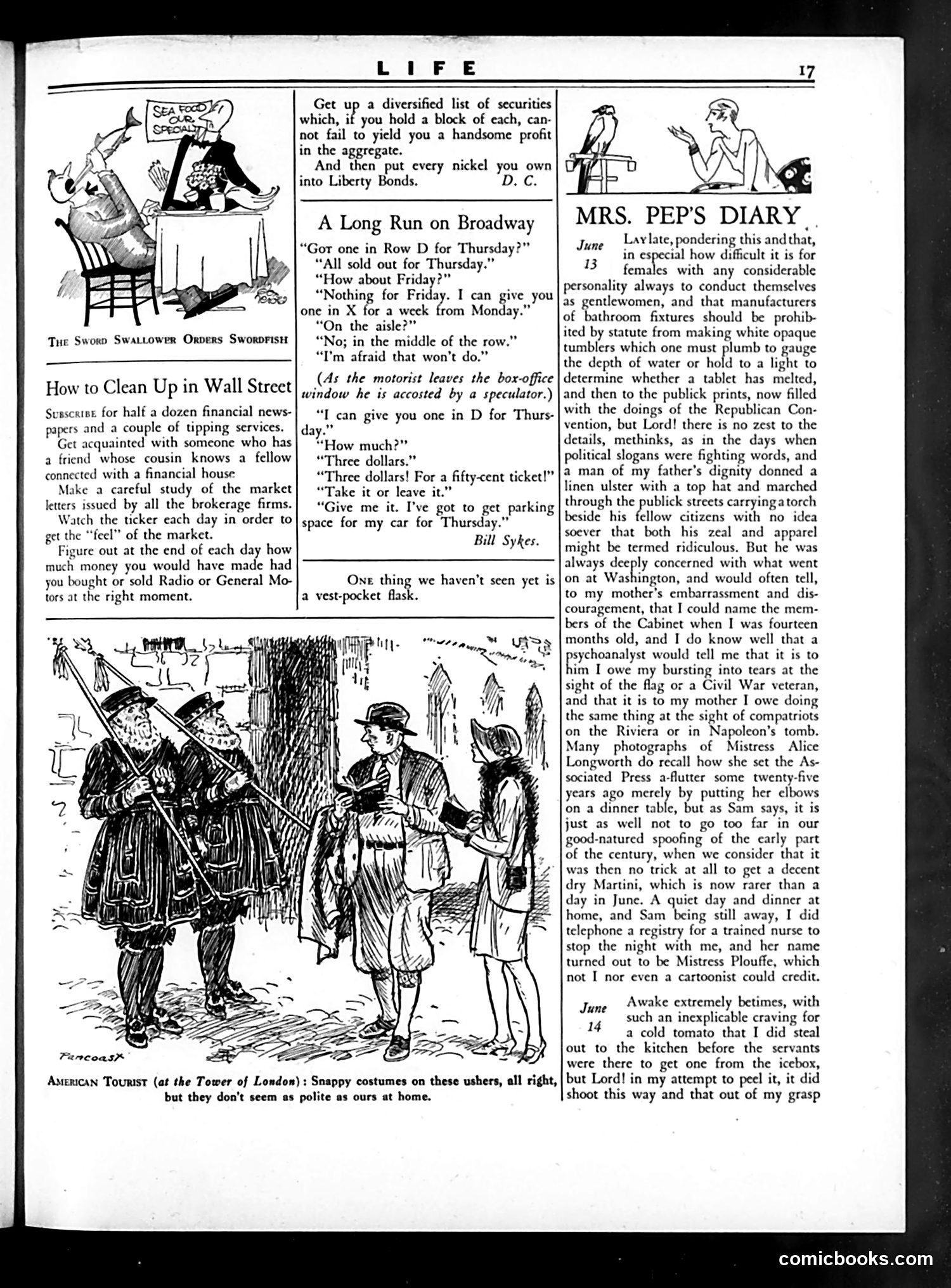
This page contains three satirical pieces: 1. **"The Sword Swallower Orders Swordfish"** — A visual gag showing a man at a restaurant table unable to handle eating swordfish, presumably because his profession (sword-swallowing) makes him uncomfortable with the irony. 2. **"How to Clean Up in Wall Street"** — Financial advice satire suggesting investors study market letters from brokerages and time their purchases based on broker recommendations to maximize profits. 3. **"American Tourist at the Tower of London"** — A cartoon mocking American tourists for their loud, informal behavior and "snappy costumes," contrasting unfavorably with British politeness. **"Mrs. Pep's Diary"** is a personal column discussing household management concerns and emotional reflections, unrelated to the cartoons above. The humor targets Wall Street speculation, American cultural rudeness abroad, and everyday domestic anxieties.
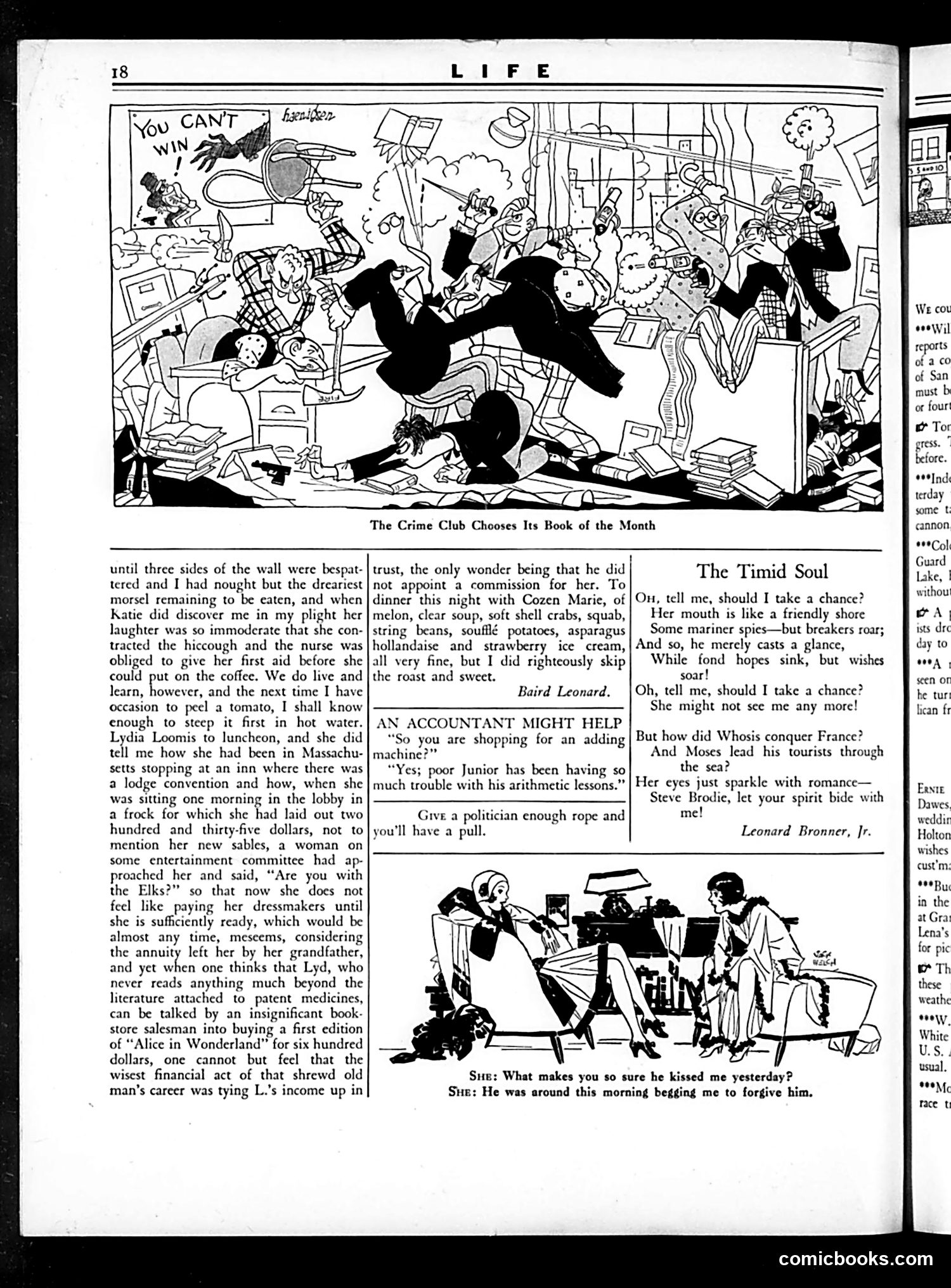
The top cartoon, "The Crime Club Chooses Its Book of the Month," satirizes chaotic intellectual pretension. It depicts well-dressed people in violent disarray—fighting, falling, throwing books and furniture—while supposedly selecting literature. The joke mocks book clubs of the era as pretentious social gatherings masquerading as serious literary discussion, where members engage in absurd behavior rather than genuine intellectual engagement. Below are three lighter humor pieces: an "Accountant Might Help" joke about a father buying an adding machine to help his son with arithmetic (implying the machine will solve the problem rather than the boy learning); "The Timid Soul," romantic poetry about romantic hesitation; and a marital joke where a husband's morning apology for a kiss proves he actually kissed someone—exposing infidelity through his guilt. These pieces represent typical Life magazine humor: social satire, domestic comedy, and whimsical verse reflecting 1920s-30s middle-class anxieties and relationships.
This page features "Neighborhood News," a humorous gossip column covering small-town happenings from Spokane, Montreal, Minneapolis, and Chicago. The cartoon strip at the top depicts a generic American Main Street with shops and buildings. The satire operates through gentle mockery of local affairs: a bookseller excited about selling multiple copies of "The Bridge of San Luis Rey" (implying it's surprisingly popular); a political candidate whose congressional runs are routine; and drought complaints in Spokane. The Chicago section contains sharper political satire: a Sears executive donates $10,000 to Hoover's presidential campaign, while the editor receives only fifteen cents for "Rogers" (likely a local candidate). The editor jokes about needing Senate advice on how to explain such a paltry donation—mocking both campaign finance disparities and the ongoing political investigations of the era. The tone throughout is affectionate small-town ribbing rather than hard-hitting critique.
This page from LIFE magazine contains no political cartoons—it's a **gossip/humor column** organized by U.S. cities (Boston, Cincinnati, Omaha, Detroit, Philadelphia, Newport). The "satire" consists of **local zingers and puns** mocking prominent citizens and minor civic situations. Examples include: - **Boston**: Actor Tom Mix visited with a horse; the mayor "chopped down elm trees" and is compared to Lincoln (mockery of overpraise) - **Cincinnati**: A dramatic critic named Russ Wilson is entering politics; the joke is he's so good at puns, other candidates should worry - **Omaha**: Police Chief Pszanowski's name is "a terror to evil-doers" (pun on the name itself) - **Detroit**: A gossip columnist flirts with "pretty pedestrianess" via his column The humor is lightweight, provincial, and relies on readers knowing local figures. References to Tom Mix (silent film star) and Peggy Joyce (society figure) date the piece to the 1920s. This format was LIFE's regular feature—gentle mockery of small-town life and recognizable personalities.
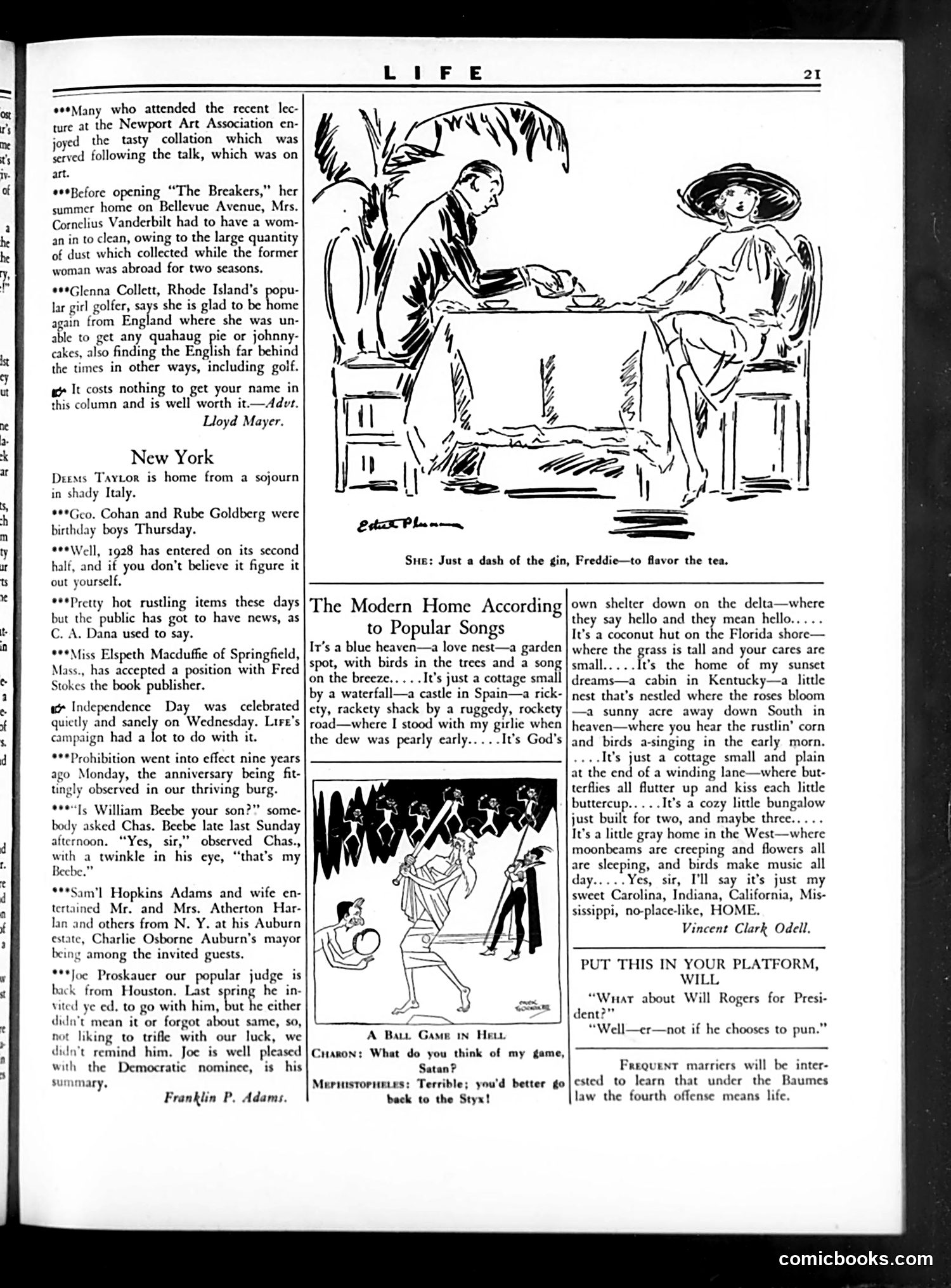
This page from Life magazine contains social gossip, a satirical cartoon, and song parody. **The Main Cartoon** ("A Ball Game in Hell") depicts a dialogue between Charon (ferryman of the dead) and Mephistopheles (a devil figure). Charon asks the devil's opinion of his "game," to which Mephistopheles responds "Terrible; you'd better go back to the Styx!"—a classical underworld reference. This is a mild joke about incompetence, likely without specific political targeting. **"The Modern Home According to Popular Songs"** is a humorous compilation of song lyrics (by Vincent Clark Odell) describing idealized homes—cottages, nests, humble dwellings—that collage together sentimental popular music clichés. It satirizes how 1920s popular songs romanticized simple, domestic life. **The opening sketch** ("Just a dash of the gin, Freddie") depicts Prohibition-era drinking, showing people disguising alcohol consumption as tea—commentary on the 1928 enforcement of Prohibition laws mentioned in the text. The page is primarily social commentary and lighthearted satire rather than hard political critique.
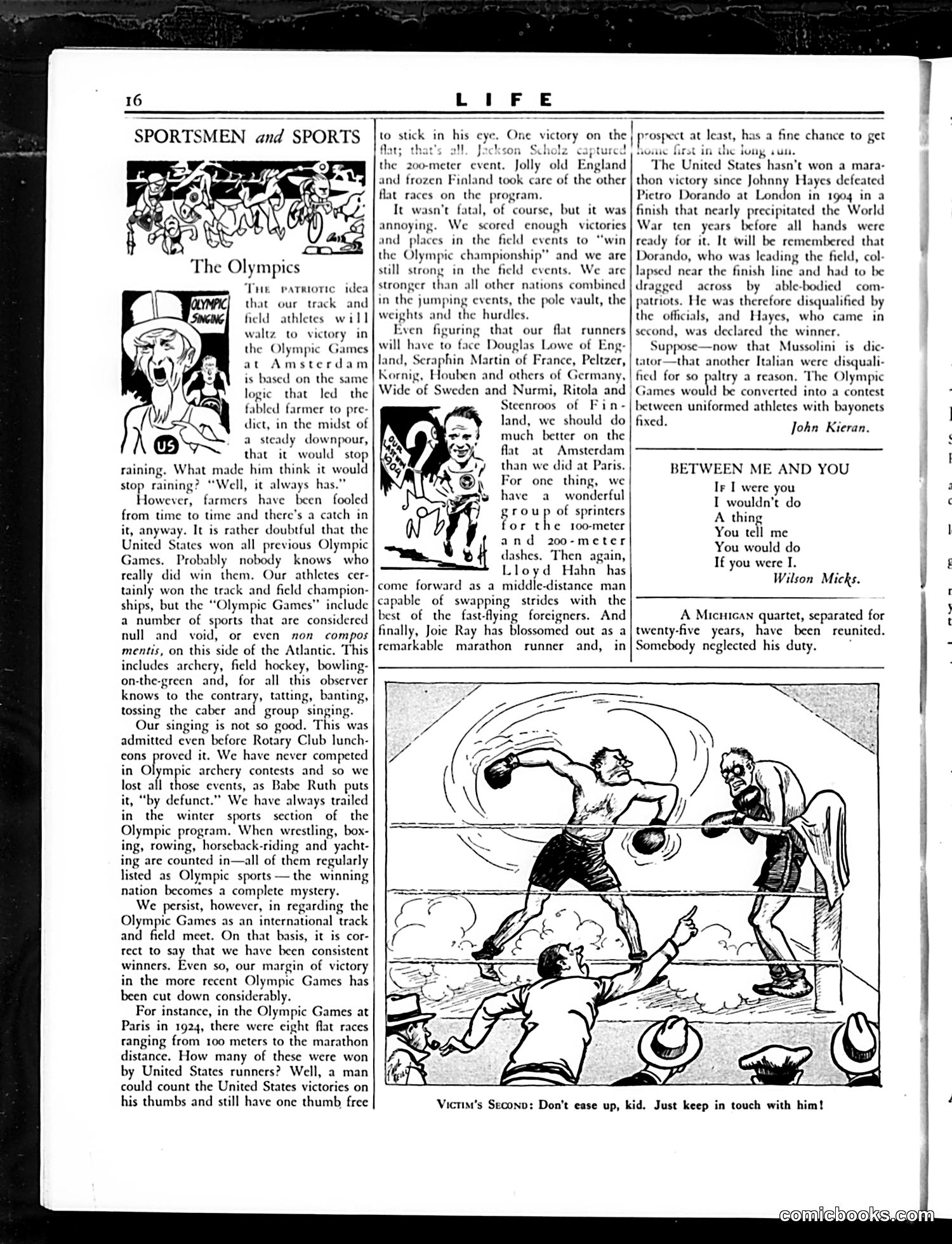
This page critiques American overconfidence about the 1928 Amsterdam Olympics. The main article sardonically debunks the assumption that the U.S. will dominate, using a farmer's faulty logic ("it always has rained, so it will stop"). The satire points out that Americans only count track-and-field events as "real" Olympic sports, dismissing others (archery, field hockey, etc.) as foreign oddities. The author notes the U.S. barely won flat races at the 1924 Paris Olympics—citing specific European competitors like Finland's Nurmi and Sweden's Wide as threats. The cartoon below depicts a boxing match with spectators, illustrating Olympic athletic competition humorously. A final dig references the 1904 marathon controversy where Italian Pietro Dorando collapsed but was disqualified, while American Johnny Hayes won. The author quips darkly that under Mussolini, such a decision might start a war—a topical jab at rising Italian fascism and international tension. The page deflates American athletic exceptionalism while mocking provincial attitudes toward "foreign" Olympic sports.
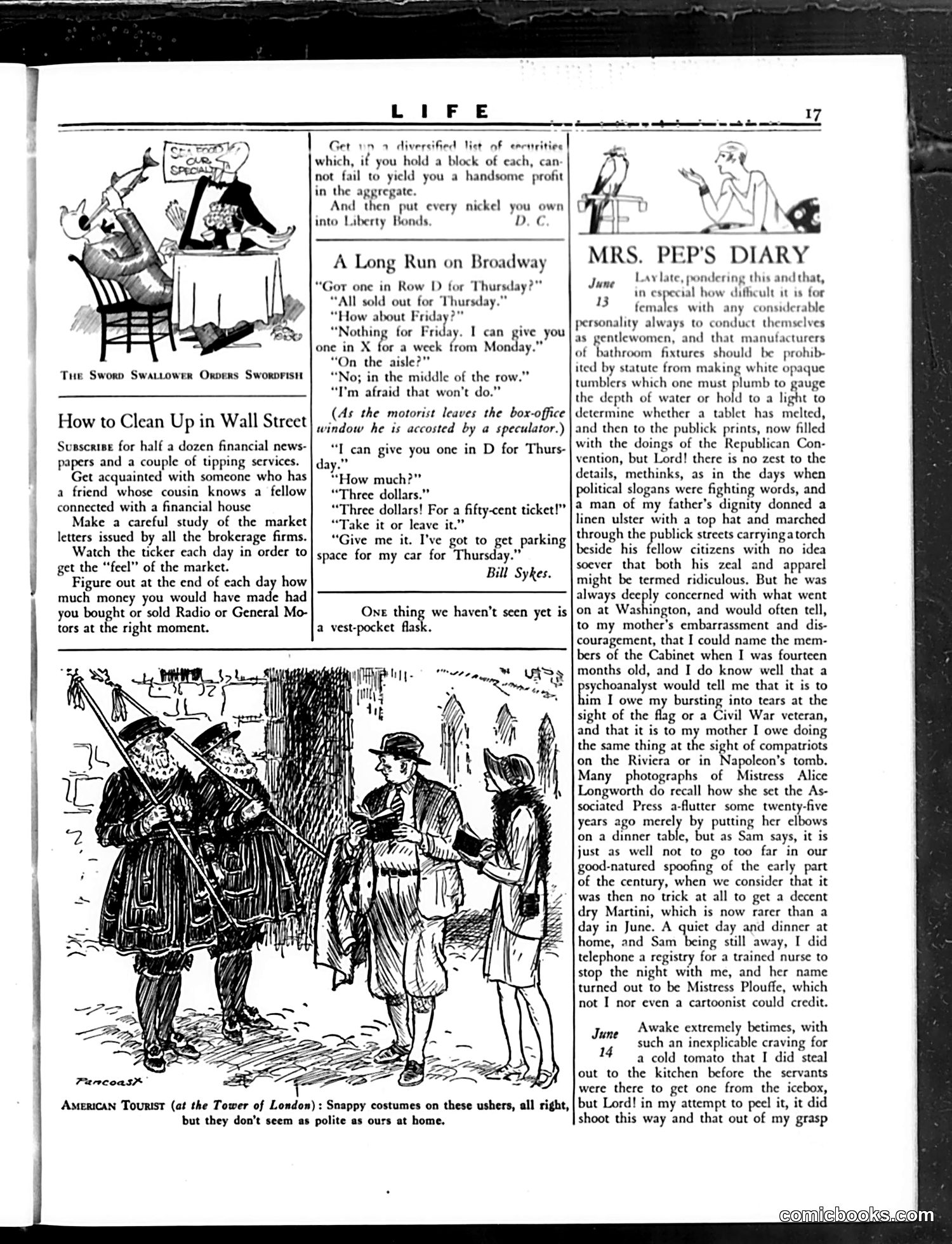
This page from *Life* magazine contains satirical commentary on 1920s American life: **"How to Clean Up in Wall Street"** mocks get-rich-quick schemes. The advice escalates from studying financial papers and insider connections to simply buying Liberty Bonds—suggesting that all the complex research yields the same result as straightforward investing. It satirizes both Wall Street speculators and the naive public chasing investment tips. **"A Long Run on Broadway"** lampoons Broadway ticket scalping. A theatergoer cannot buy seats at face value; a speculator intercepts him outside, charging triple the fifty-cent ticket price ($3). The buyer accepts the gouging merely to secure parking—absurd prioritization that highlights how scalping exploited audiences. **"Mrs. Pep's Diary"** is a society column complaining about bathroom fixtures, Republican politics, and nostalgic reflections on her father's Civil War enthusiasm versus modern cynicism. It's gentle satire of upper-class concerns and changing patriotic fervor. The cartoons and content collectively mock financial speculation, commercial exploitation, and social pretension in 1920s America.
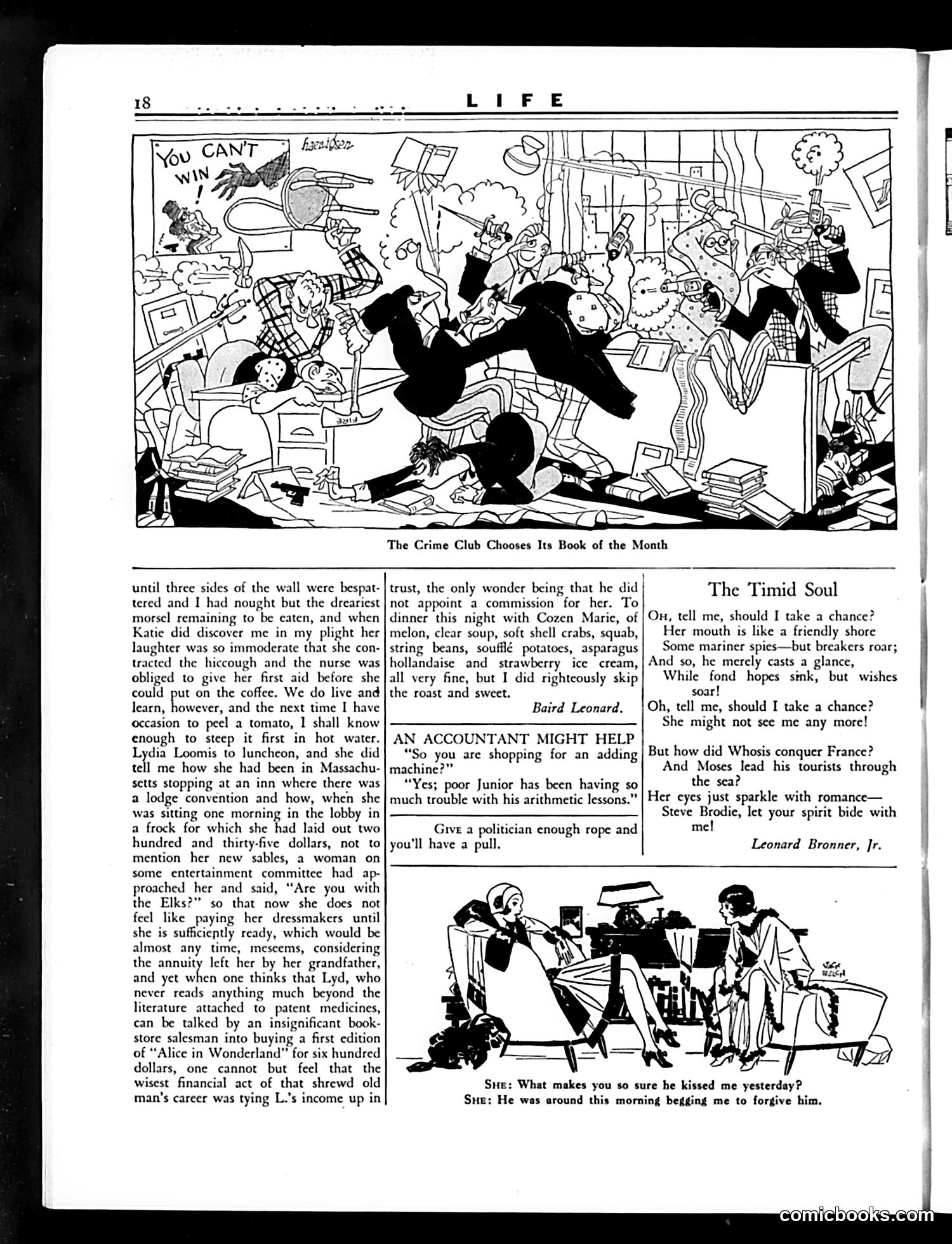
**Top Cartoon:** "The Crime Club Chooses Its Book of the Month" depicts a chaotic office scene where multiple people are engaged in physical conflict over a book selection. The chaos satirizes the supposedly intellectual "Crime Club" - likely a reading group or literary society - reducing them to brawling absurdity, mocking pretentious book clubs and their members' inability to conduct civilized discussion. **Text Content:** The page contains humorous anecdotes mocking social pretension: a woman spending $235 on a dress at a lodge convention; another woman duped into buying a first edition of "Alice in Wonderland" for $600; and commentary on frivolous spending despite having trust funds. The satire targets wealthy people's poor financial judgment and social insecurity. **Bottom Cartoon:** "The Timid Soul" shows a timid man hesitating to approach a woman, torn between romantic hope and fear of rejection - a recurring Life character type representing masculine indecision and cowardice in courtship. The page satirizes American middle-to-upper-class social behavior: pretentiousness, conspicuous consumption, and gender anxiety.
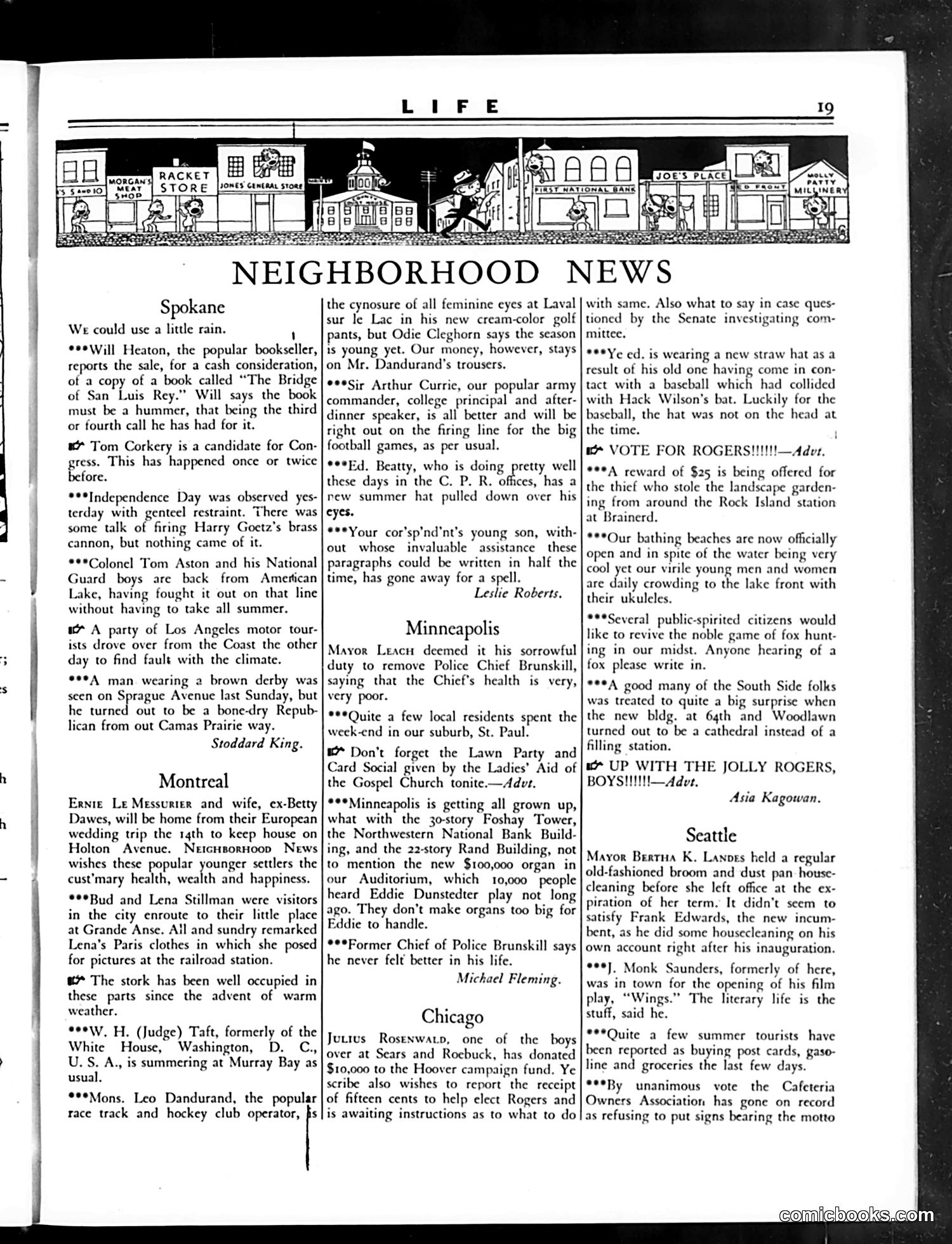
This is a "Neighborhood News" humor column featuring brief, gossipy anecdotes from various American cities (Spokane, Montreal, Minneapolis, Chicago, Seattle). Rather than a political cartoon, it's satirical commentary on local happenings. Key humor includes: **Political references**: A mention of someone donating $10,000 to the Hoover campaign fund versus a mere fifteen cents for Rogers (likely Will Rogers), with a joke about needing Senate instructions on the smaller donation—satirizing 1920s campaign finance absurdity and Senate investigations into political corruption. **Local color jokes**: A "bone-dry Republican" visiting from rural areas; references to Judge Taft summering in Montreal; mentions of popular local figures and their fashion choices. **General satire**: Gentle mockery of small-town life, including births, social events, and petty local drama. The humor is mild and observational rather than biting—typical of Life magazine's "neighborhood gossip" format of this era.
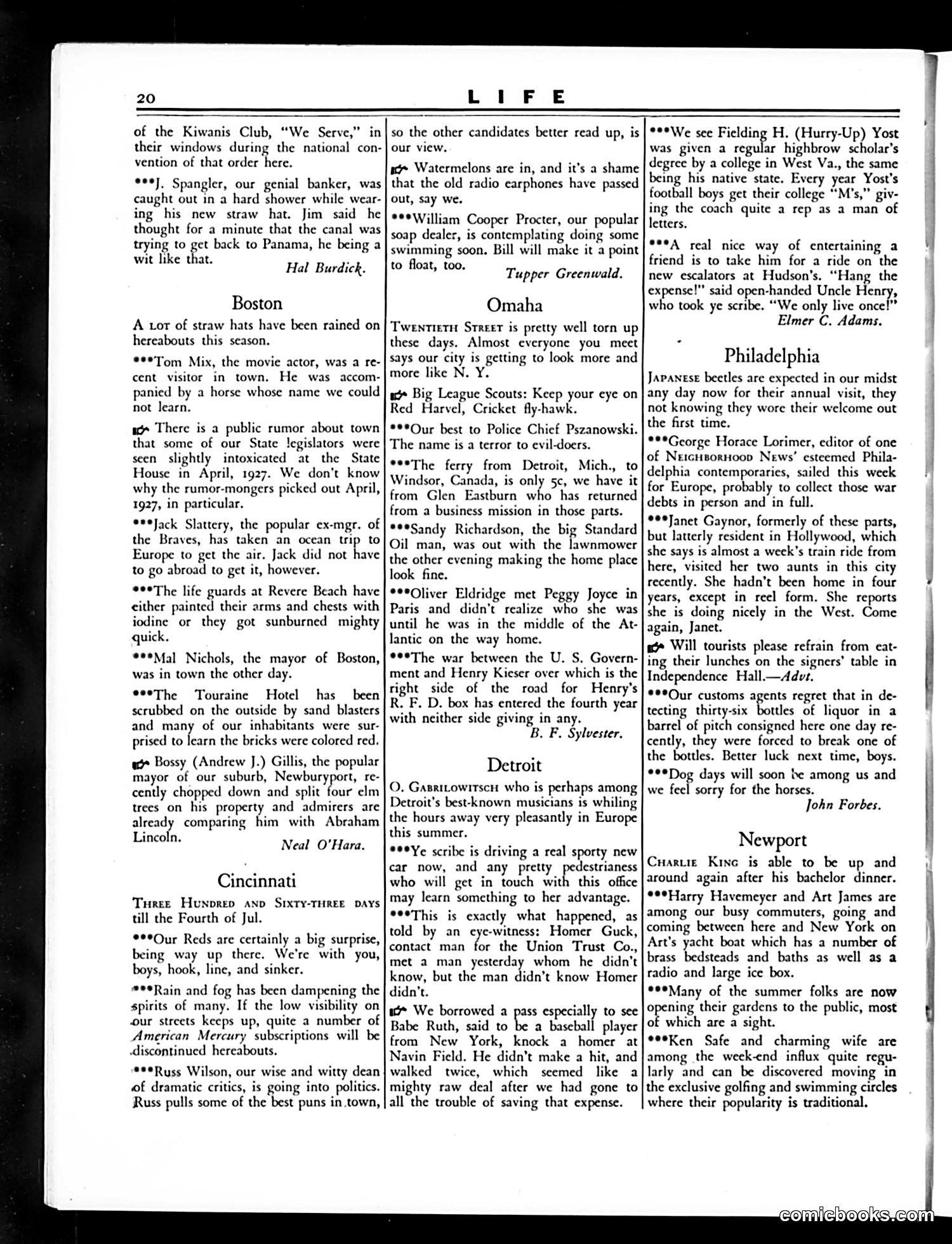
This page from Life magazine (undated, but likely 1920s based on references) consists of short humorous local gossip and observations submitted from various American cities—Boston, Cincinnati, Omaha, Detroit, and Philadelphia. The content is satirical Americana: editors mock small-town happenings and local figures with gentle wit. Examples include jabs at Boston politicians allegedly seen drunk in 1927, a quip about a straw hat dissolving in rain (compared to Panama Canal erosion), and amusement that Omaha's main street increasingly resembles New York. The satire targets civic pride and provincial life—noting a local mayor compared to Lincoln merely for chopping down trees, or remarking that watermelons arriving is notable enough for comment. References to minor local celebrities (mayors, soap manufacturers, dramatic critics) emphasize small-town preoccupations. This represents Life's core formula: using provincial American life as gentle comedy fodder for urban, educated readers.
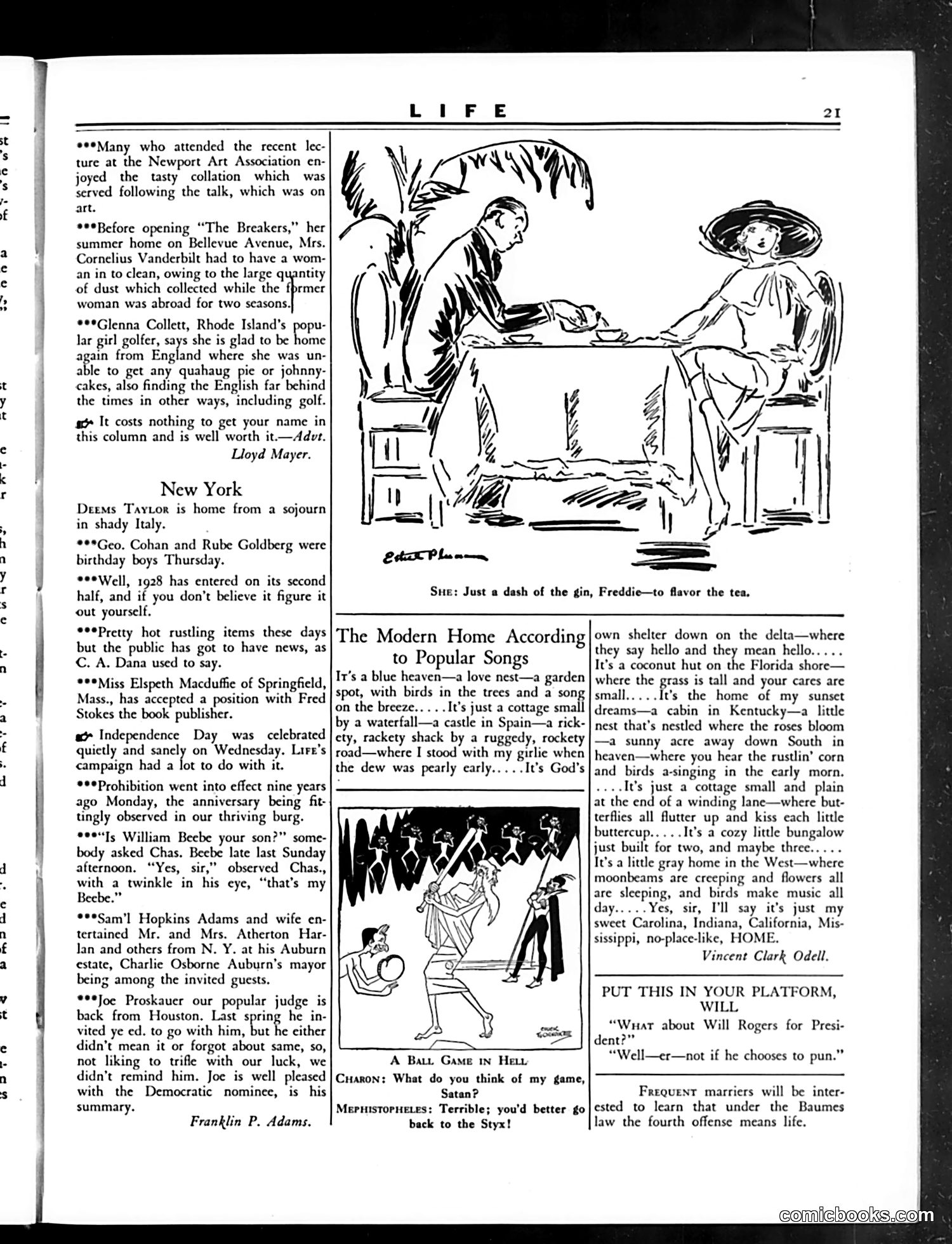
This 1928 *Life* magazine page contains social gossip and satirical commentary. The main cartoon shows a domestic scene captioned "Just a dash of the gin, Freddie—to flavor the tea," mocking Prohibition-era hypocrisy. Despite the 1919 alcohol ban (mentioned in the text as nine years in effect), wealthy Americans openly consumed gin during tea. The cartoon satirizes this widespread flouting of Prohibition laws among the upper class. The "Modern Home According to Popular Songs" feature lists song lyrics romanticizing idealized domestic life—cottages, gardens, loved ones—contrasting sharply with reality. The smaller cartoon titled "A Bat Game in Hell" shows Satan criticizing someone's "game," likely referencing 1920s slang and popular culture's casual blasphemy. The gossip column mentions prominent figures like Cornelius Vanderbilt and golfer Glenna Collett, reflecting *Life*'s focus on high society.
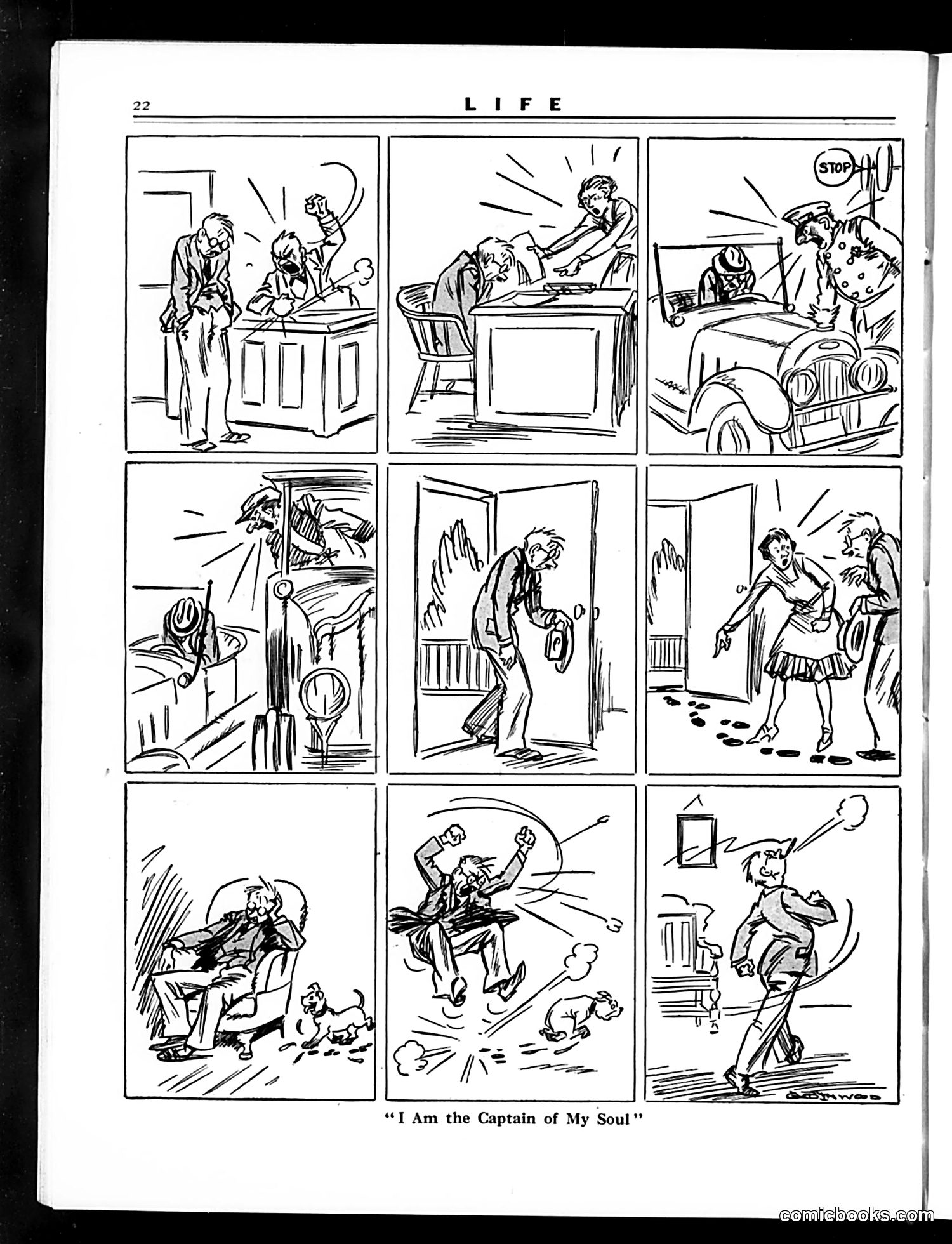
This nine-panel comic strip satirizes a man's grandiose self-perception versus reality. The title, from William Ernest Henley's famous poem about willpower and self-determination, sets up ironic contrast. The narrative shows a businessman imagining himself as commanding and authoritative—literally "captaining" situations at work and home. However, each panel reveals he's actually chaotic, accident-prone, and ineffectual: crashing his car, creating workplace disasters, and being physically clumsy. Children and adults around him react with alarm or exasperation. The satire mocks the gap between men's self-image (especially during the period when Henley's individualism was popular) and their actual competence. It's gentle humor about masculine pretension and self-delusion—the everyman who believes he controls his destiny while stumbling through life.
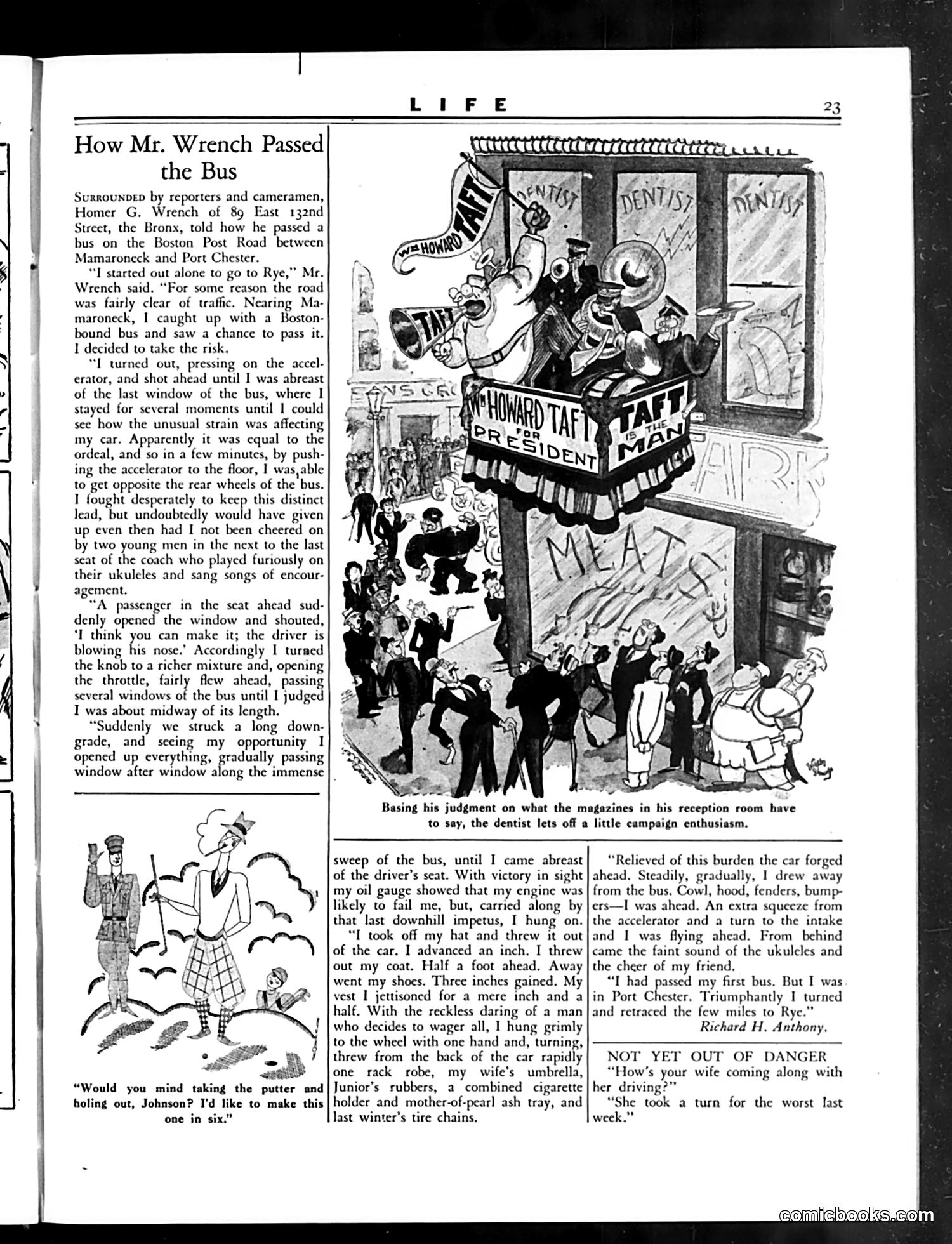
This is a satirical piece mocking the obsession with passing other vehicles on the road—a then-contemporary driving fad. Homer G. Wrench, a Bronx resident, recounts dramatically how he passed a bus on the Boston Post Road, treating this mundane feat as an epic adventure worthy of press coverage. The humor lies in the absurd escalation: he throws increasingly valuable possessions overboard (shoes, vest, coat, wife's umbrella, tire chains) to lighten his car and gain inches of advantage—treating reckless driving as a matter of honor. Passengers cheer him on; a stranger shouts encouragement when the bus driver sneezes. The accompanying cartoon shows a dentist's campaign poster floating above chaotic street scenes, satirizing political self-promotion (likely referencing a real campaign, unclear which). The satire critiques both dangerous driving behavior and the media sensationalism surrounding it—turning a risky, foolish act into celebrity news.
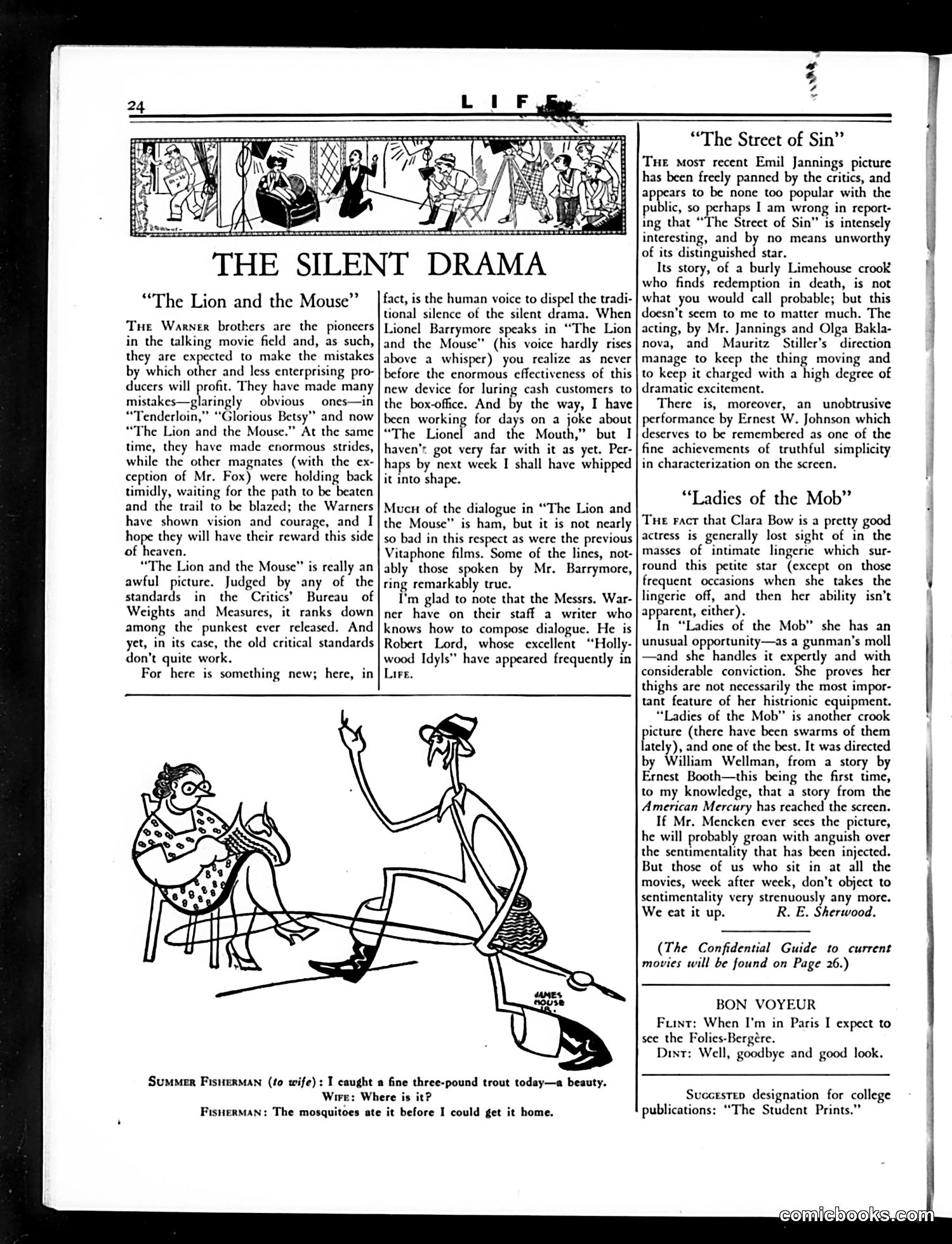
This page from *Life* magazine reviews early "talking pictures" (talkies). The main cartoon depicts a fisherman's joke: he caught a large trout but mosquitoes ate it before he could bring it home—a humorous exaggeration about insect pests. The articles critique recent films by Warner Brothers and others. The critic praises the novelty of dialogue in *The Lion and the Mouse* (featuring actor Lionel Barrymore), noting that hearing actors' voices revolutionizes silent cinema's impact. He also reviews *The Street of Sin* (with Emil Jannings) favorably, and *Ladies of the Mob* starring Clara Bow—noting that while Bow is primarily known for her appearance and "lingerie," this role lets her demonstrate actual acting ability. The reviews reflect Hollywood's transition from silent to sound film in the late 1920s.
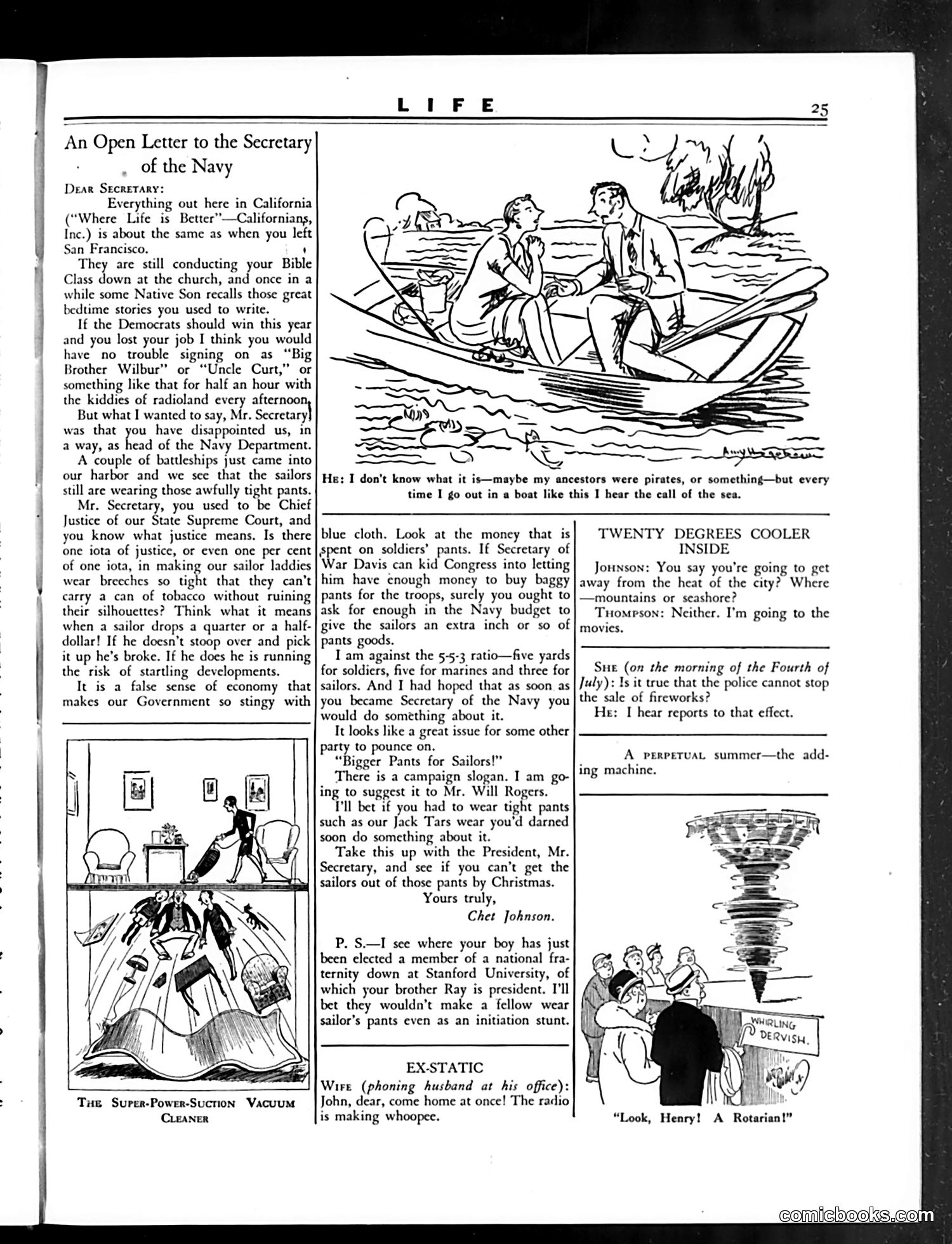
This Life magazine page contains satirical letters and cartoons from the 1920s era. **"Open Letter to the Secretary of the Navy"**: A humorous complaint to the Navy Secretary (identified in text as formerly Chief Justice) about sailors' absurdly tight-fitting pants. The writer argues this is wasteful and impractical—sailors can't bend over to pick up dropped money or carry tobacco. He compares unfavorably to the Army Secretary's success getting Congress to fund baggy trousers for soldiers, and suggests "Bigger Pants for Sailors!" as a campaign slogan. The humor derives from treating an absurd uniform complaint with mock-serious political rhetoric. **Small cartoons**: Include a boat scene about hearing "the call of the sea," a conversation about summer heat and movies, and a Rotarian Club joke. **"The Super-Power-Suction Vacuum Cleaner"**: A cartoon showing domestic vacuum cleaner design, likely satirizing modern appliances. The overall tone mocks bureaucratic inefficiency and takes humorous jabs at contemporary political figures and social institutions.
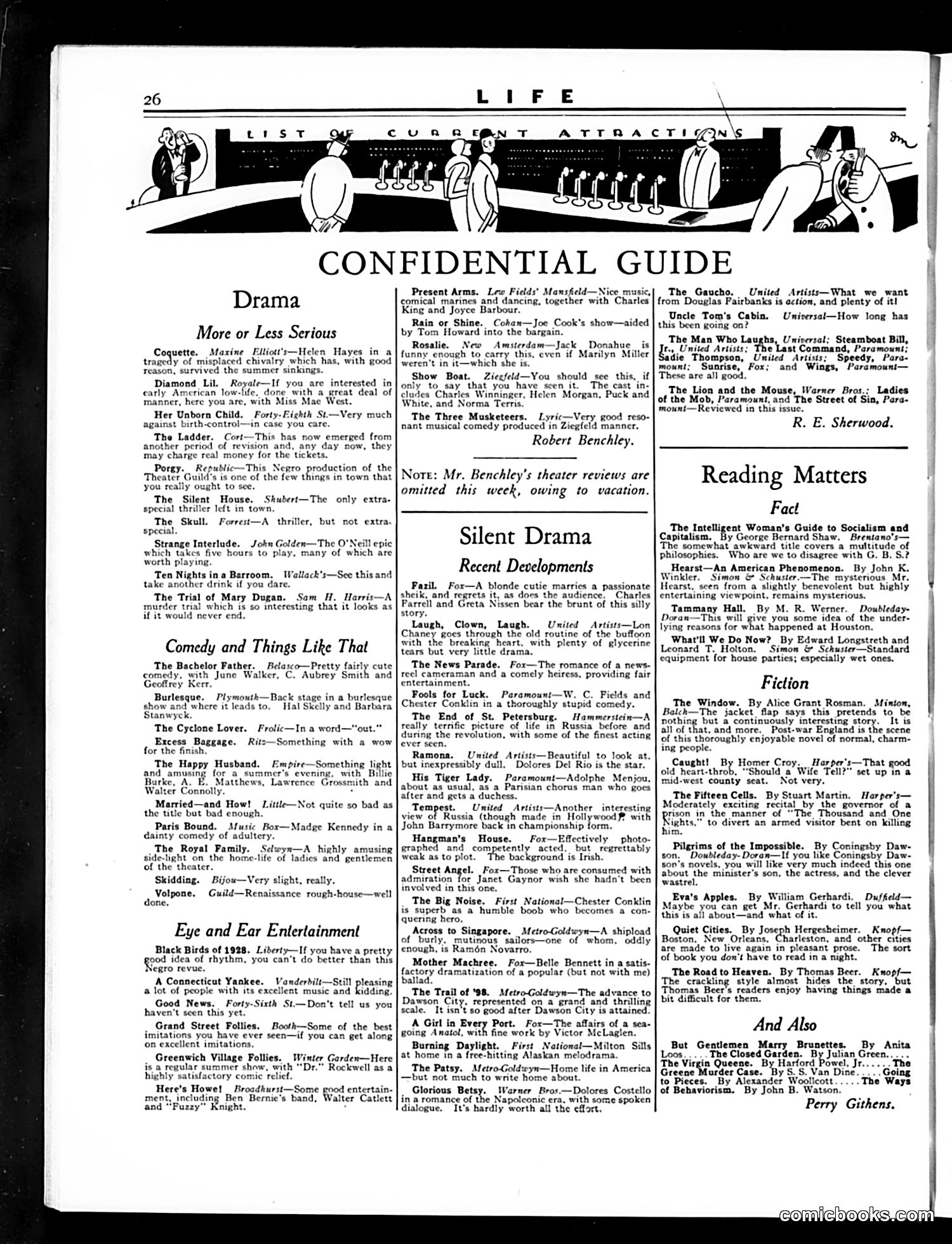
This page is primarily a **theater review column**, not a political cartoon. It's a "Confidential Guide" listing current Broadway shows and films with brief critical assessments—typical of Life magazine's entertainment coverage from the 1920s. The header illustration shows stylized figures in a theater or nightclub setting, representing entertainment venues of the era. **Notable context for modern readers:** This appears to be from 1928, when Broadway was flourishing and silent films were still dominant (the page separates "Drama" for stage plays from "Silent Drama" for cinema). References like *Show Boat*, *Porgy*, and *Strange Interlude* were major theatrical events. Reviewer Robert Benchley was a famous humorist. The casual dismissals ("In a word—'out'") and the mix of serious and comedic evaluations reflect period entertainment journalism rather than political satire.
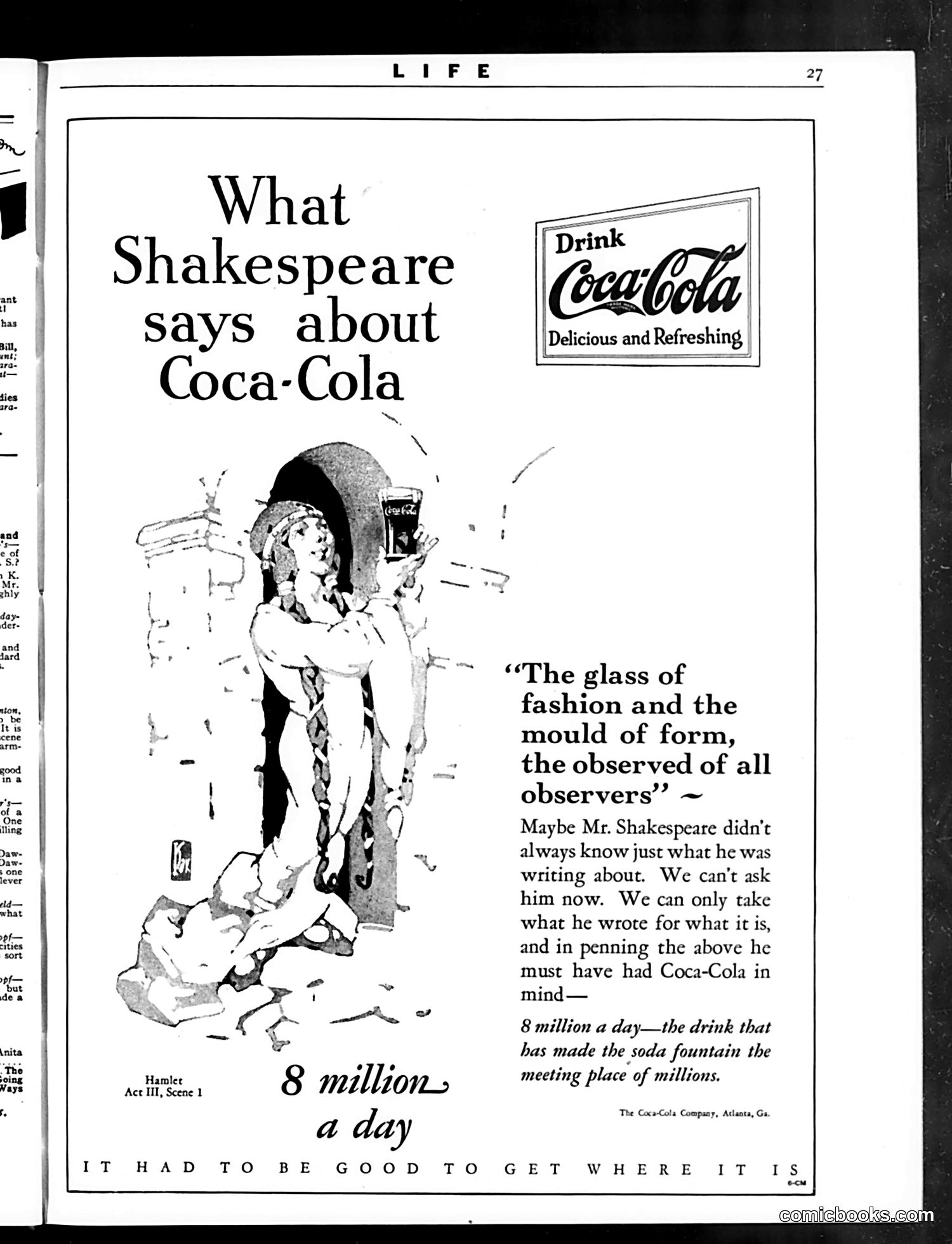
This is a **Coca-Cola advertisement** masquerading as editorial content in *Life* magazine. The "satire" is tongue-in-cheek advertising rather than genuine political commentary. The ad takes a famous quote from Shakespeare's *Hamlet* (Act III, Scene 1)—originally describing a fashionable, observed person—and claims Shakespeare must have been unknowingly describing Coca-Cola. The joke is absurdist: a 17th-century playwright couldn't possibly have referenced a modern soft drink, yet the ad playfully pretends he did. The illustrated figure appears to be Hamlet himself, depicted holding a Coca-Cola bottle. The ad then pivots to marketing claims: 8 million drinks sold daily, soda fountains as social gathering places. This represents early-20th-century advertising strategy: leveraging high culture and humor to make products seem sophisticated and inevitable rather than merely commercial.
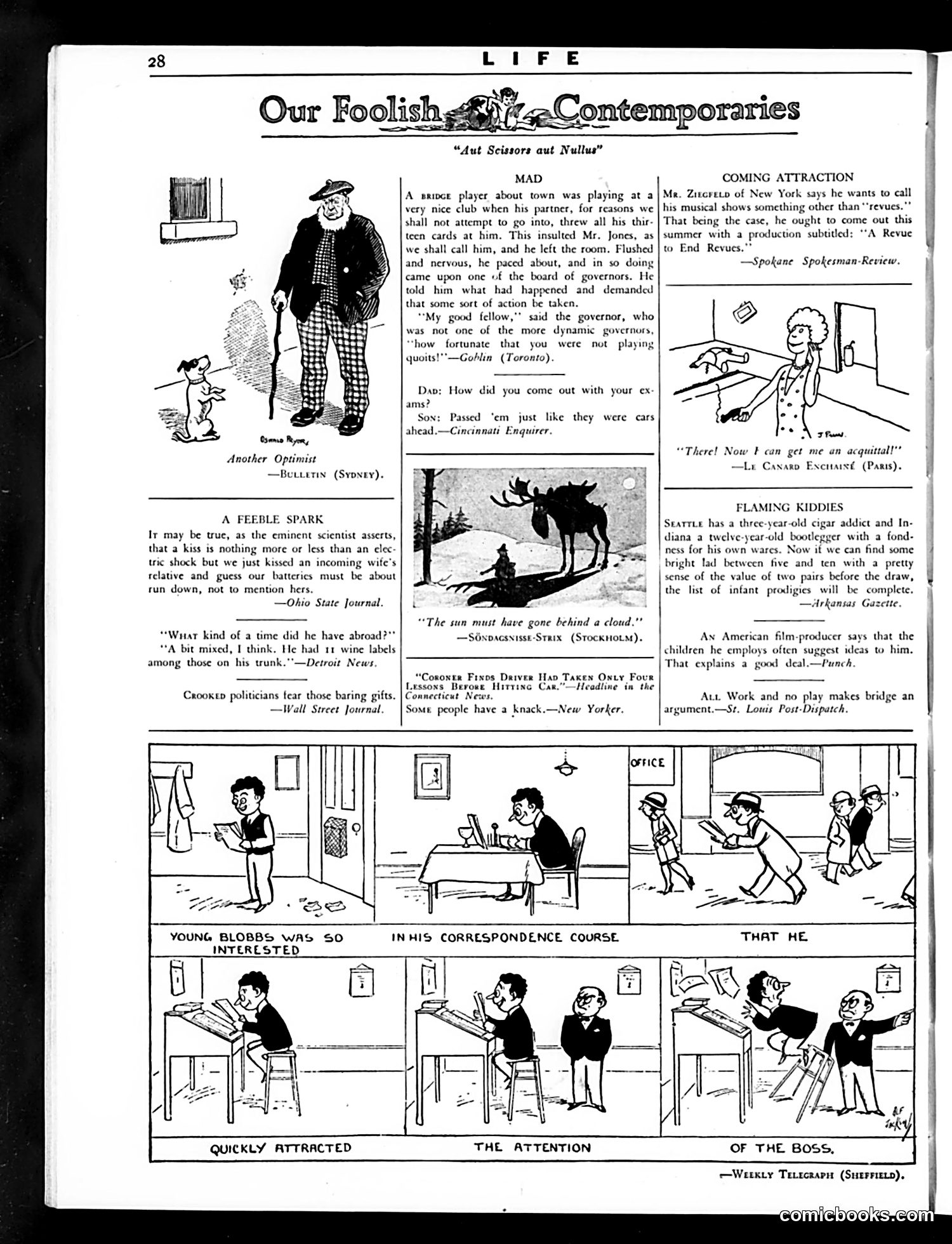
This page collects satirical one-liners and comic strips mocking contemporary social absurdities, drawn from newspapers and magazines worldwide. **Top section** features brief humorous quips about modern life: a man playing bridge whose partner throws cards at him (mocking the game's intensity); someone whose drunk father accumulated wine labels; politicians giving "gifts" with hidden motives. **The main comic strip** shows "Young Blobbs" so absorbed in a correspondence course that he ignores the office environment, ultimately attracting the boss's attention—satirizing how home-study programs distracted workers, or how obsessive self-improvement schemes backfired. **Right-side items** mock Prohibition-era absurdities (children becoming bootleggers and cigar addicts) and exaggerated film production claims. The page's title references Juvenal's *Satires*, positioning this as classical satire. It's essentially a joke compilation, typical of Life's format mocking contemporary follies through reprinted wit.
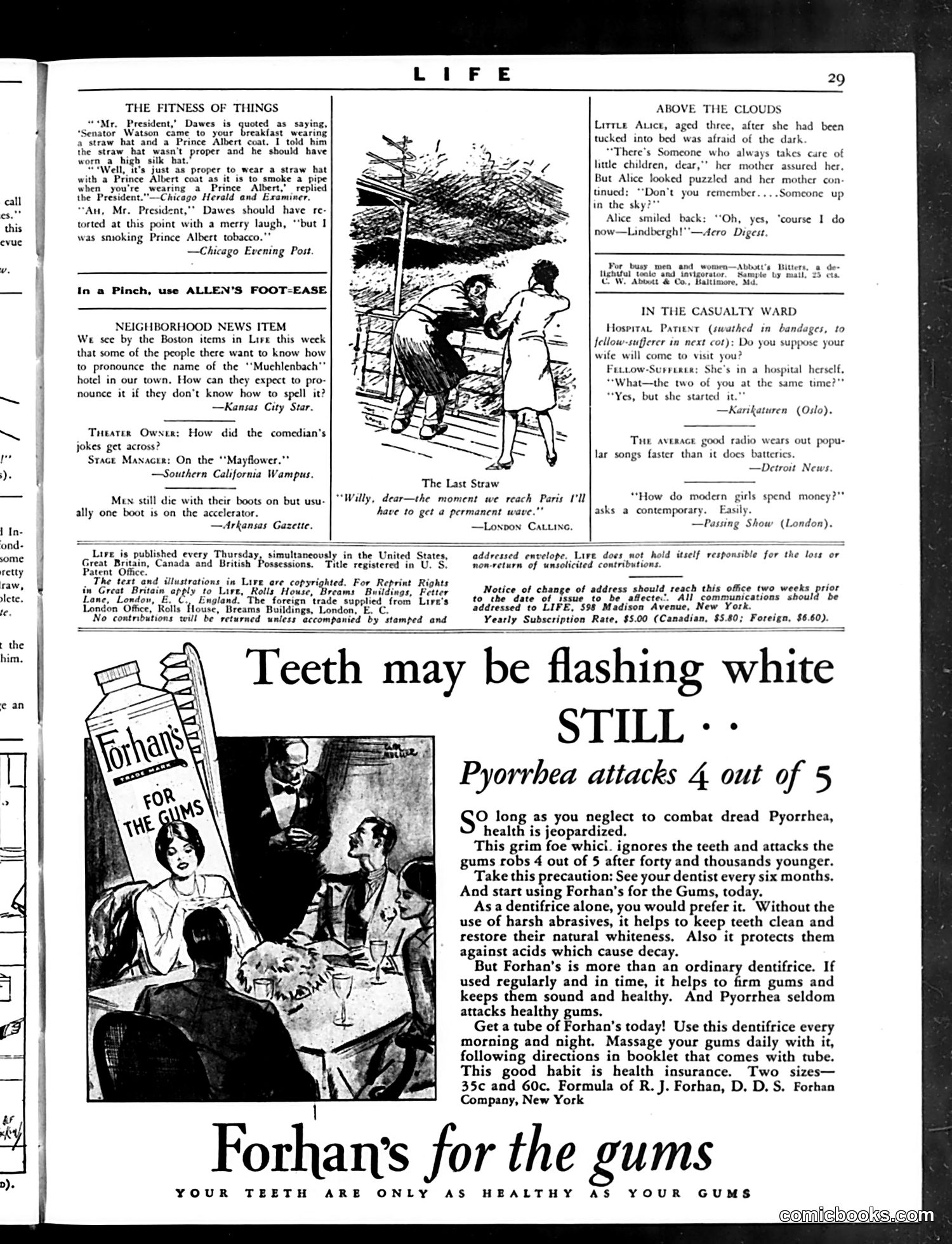
This page contains several brief satirical items and advertisements typical of Life's humor format circa the 1920s. **"The Fitness of Things"** mocks President Coolidge's pedantic response to Charles Dawes (his Vice President) about proper formal dress. The joke points out Coolidge's illogical reasoning—he defends wearing a straw hat with a Prince Albert coat by comparing it to smoking a pipe (a tobacco brand) while wearing formal wear. The Post's punchline suggests Dawes should have retorted that he was smoking "Prince Albert" tobacco, exposing the absurdity. **"Above the Clouds"** is a light humor item where a three-year-old girl, when told someone "up in the sky" watches over children, assumes it's Charles Lindbergh—the famous aviator whose 1927 transatlantic flight made him a contemporary celebrity and cultural icon. **Other items** include brief jokes about mispronounced hotel names and modern dating customs. The bulk of the page features a **Forhan's toothpaste advertisement** about preventing pyorrhea (gum disease), typical of period dental care marketing.
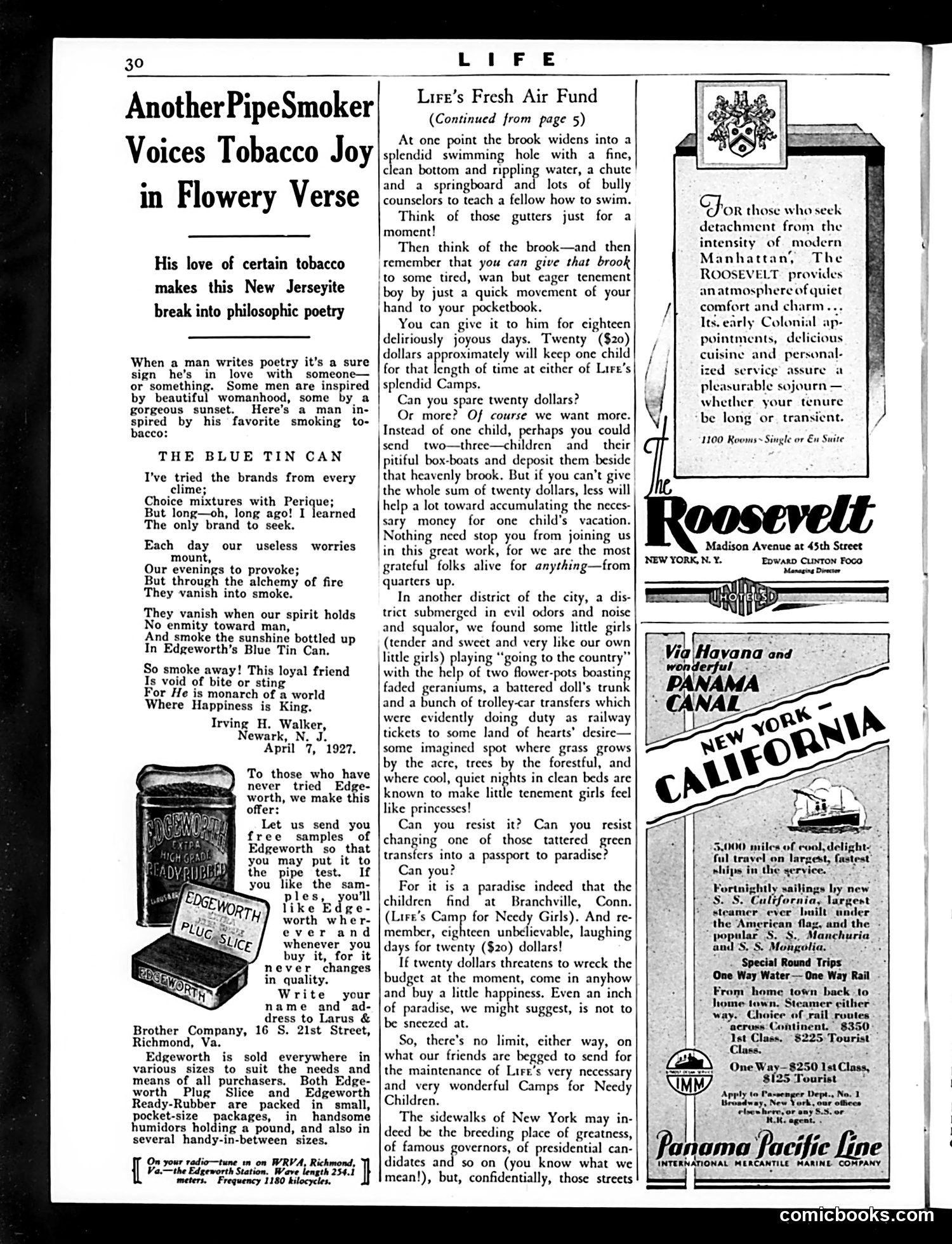
This page combines **advertising with charitable fundraising**, typical of 1920s Life magazine. The left column features a **tobacco advertisement** for Edgeworth pipe tobacco, presented as poetry by "Irving H. Walker" of Newark. The poem romanticizes smoking as an escape from daily worries—a common marketing trope of the era when tobacco was uncontroversially advertised. The right column continues **Life's Fresh Air Fund appeal**, a legitimate charitable program sending poor urban children to camps. The writing uses vivid contrasts: tenement children playing "country" with flower-pots and trolley transfers versus actual access to brooks and fresh air. The rhetoric appeals to middle-class guilt and sentimentality, asking readers to donate $20 to send one child to camp. **The satirical point**: Life magazine—ostensibly progressive—juxtaposes frivolous tobacco marketing alongside genuine social need. The juxtaposition itself critiques consumer culture's priorities versus charitable obligations.
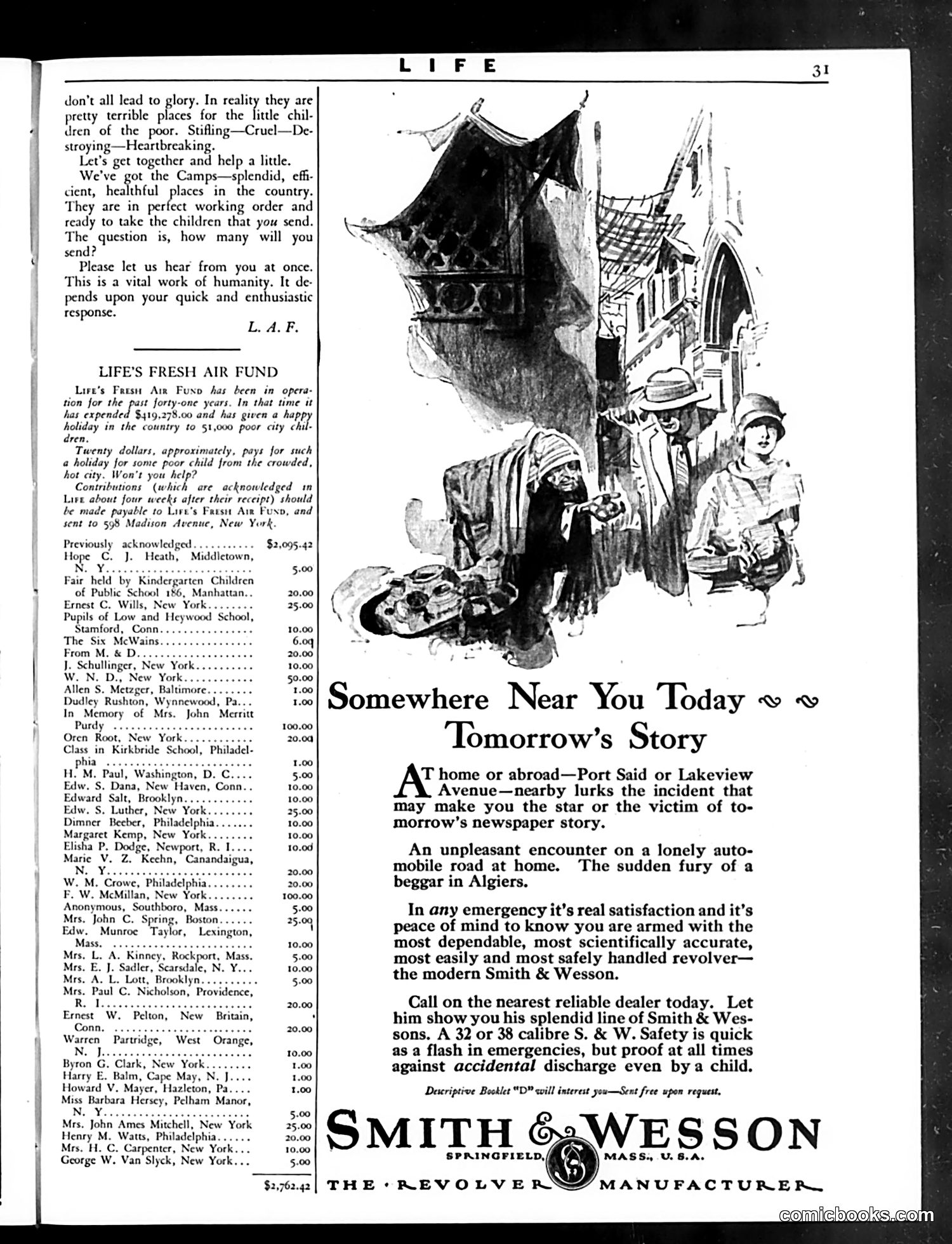
This page combines two distinct items: a charitable fundraising appeal and a firearm advertisement. **Left side:** Life's Fresh Air Fund solicits donations ($20 sends poor city children to country camps for holidays). The accompanying illustration shows urban street children—ragged, poor kids near tenement housing—depicting the "stifling," "cruel" conditions the fund aims to alleviate. This was a genuine Progressive Era charity program (41 years old at publication). **Right side:** A Smith & Wesson revolver advertisement uses fear-mongering to sell guns. It conjures scenarios—"lonely automobile road," "beggar in Algiers"—suggesting armed self-defense is necessary. Notably, it emphasizes the revolver is "proof against accidental discharge even by a child," revealing safety concerns about firearms in homes. The jarring juxtaposition is striking: asking readers to help poor children while simultaneously marketing weapons. This reflects early 20th-century class anxieties—fears of urban crime and disorder coexisted with genuine charitable impulses.
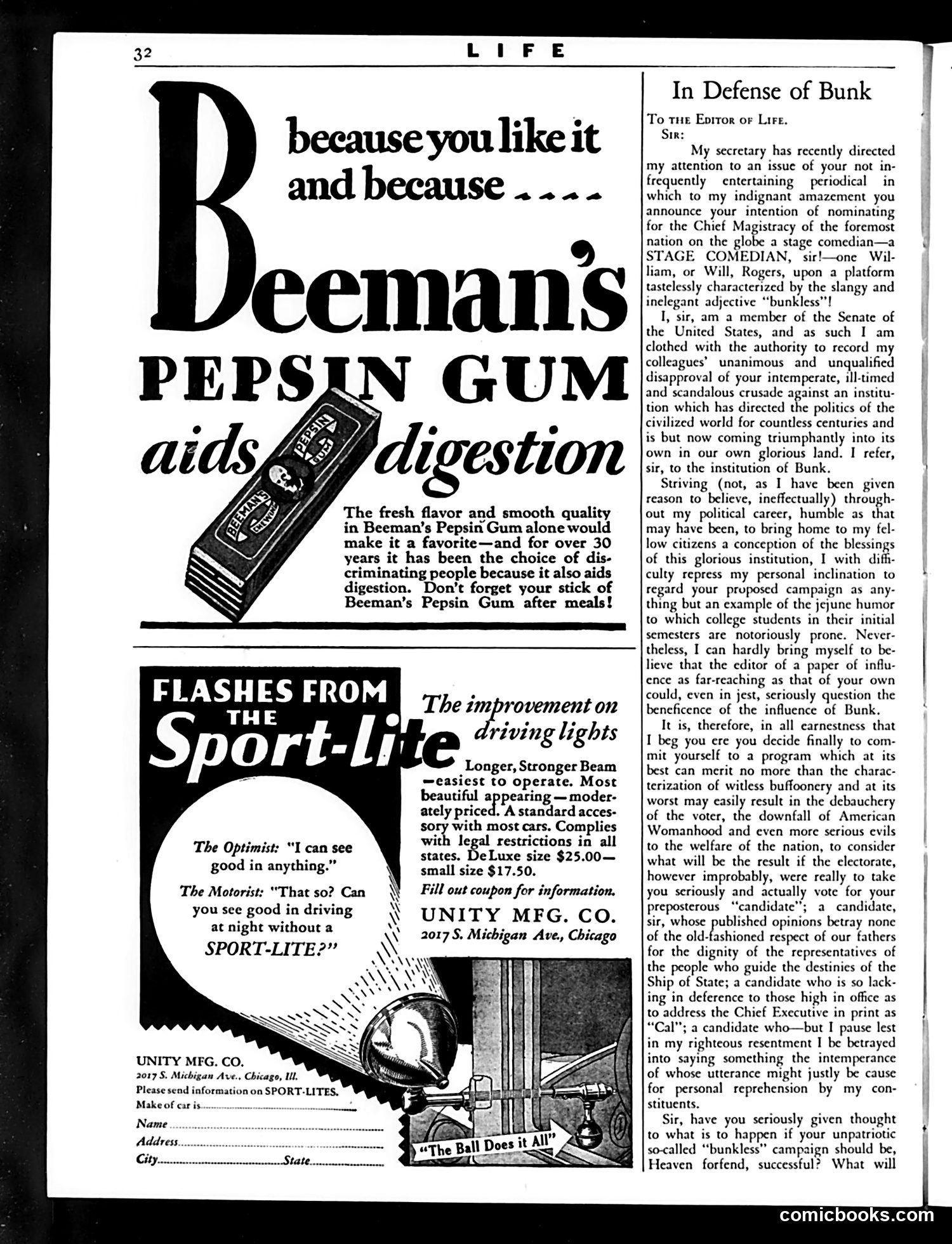
This page contains two advertisements and a satirical letter defending "Bunk" against Life magazine's apparent endorsement of Will Rogers for president. **The Letter**: A U.S. Senator writes indignantly that Life is nominating a stage comedian (Rogers) on a "bunkless" platform. The senator defends "Bunk"—political nonsense and empty rhetoric—as a glorious institution that has guided civilization for centuries. He warns that voting for Rogers would cause voter debauchery, the downfall of American womanhood, and national ruin. He's particularly offended that Rogers addresses President Calvin Coolidge casually as "Cal." **The Satire**: The letter satirizes pompous politicians who defend corrupt, meaningless political speech. By having a senator eloquently advocate for "Bunk" itself, Life mocks how politicians value empty rhetoric over substance. Will Rogers was a famous humorist and social critic known for sharp political commentary—the opposite of "bunk." Life is suggesting Rogers's honesty threatens the establishment. **Historical Context**: This likely dates to the 1920s when Rogers was humorously discussed as a political figure. The satire targets political hypocrisy and the Senate's resistance to outsider candidates.
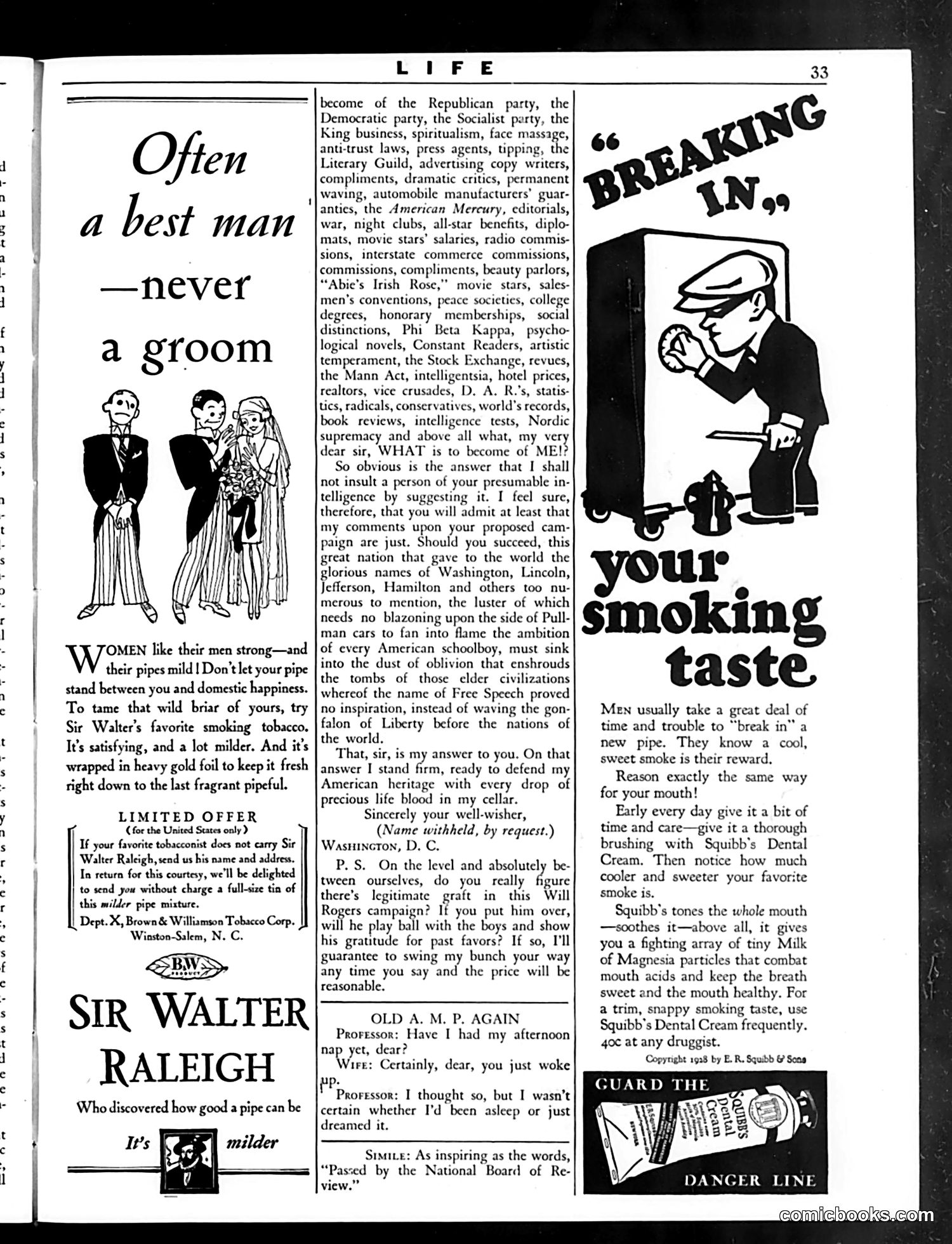
This page contains two distinct elements: **Left side:** A Sir Walter Raleigh pipe tobacco advertisement disguised as satirical commentary. It mocks the anxiety of a best man worried his pipe-smoking will damage domestic happiness, then pivots to selling "milder" tobacco as the solution. The visual shows three men in formal wear, reinforcing the "best man" scenario. **Center:** A lengthy satirical letter, apparently to a political candidate (possibly Will Rogers, mentioned in the P.S.), mockingly listing everything that will supposedly be destroyed if the candidate wins—from political parties to hotel prices to "ME!" The writer sarcastically claims to support the candidate while the postscript cynically asks about corruption opportunities, mocking both political ambition and backroom dealing. **Right side:** A "Breaking In Your Smoking Taste" advertisement for Squibb's Dental Cream as a pipe accessory, with practical advice about seasoning new pipes. The page blends advertising with social/political satire typical of Life magazine's era—using humor to comment on 1920s-30s American politics and consumer culture.
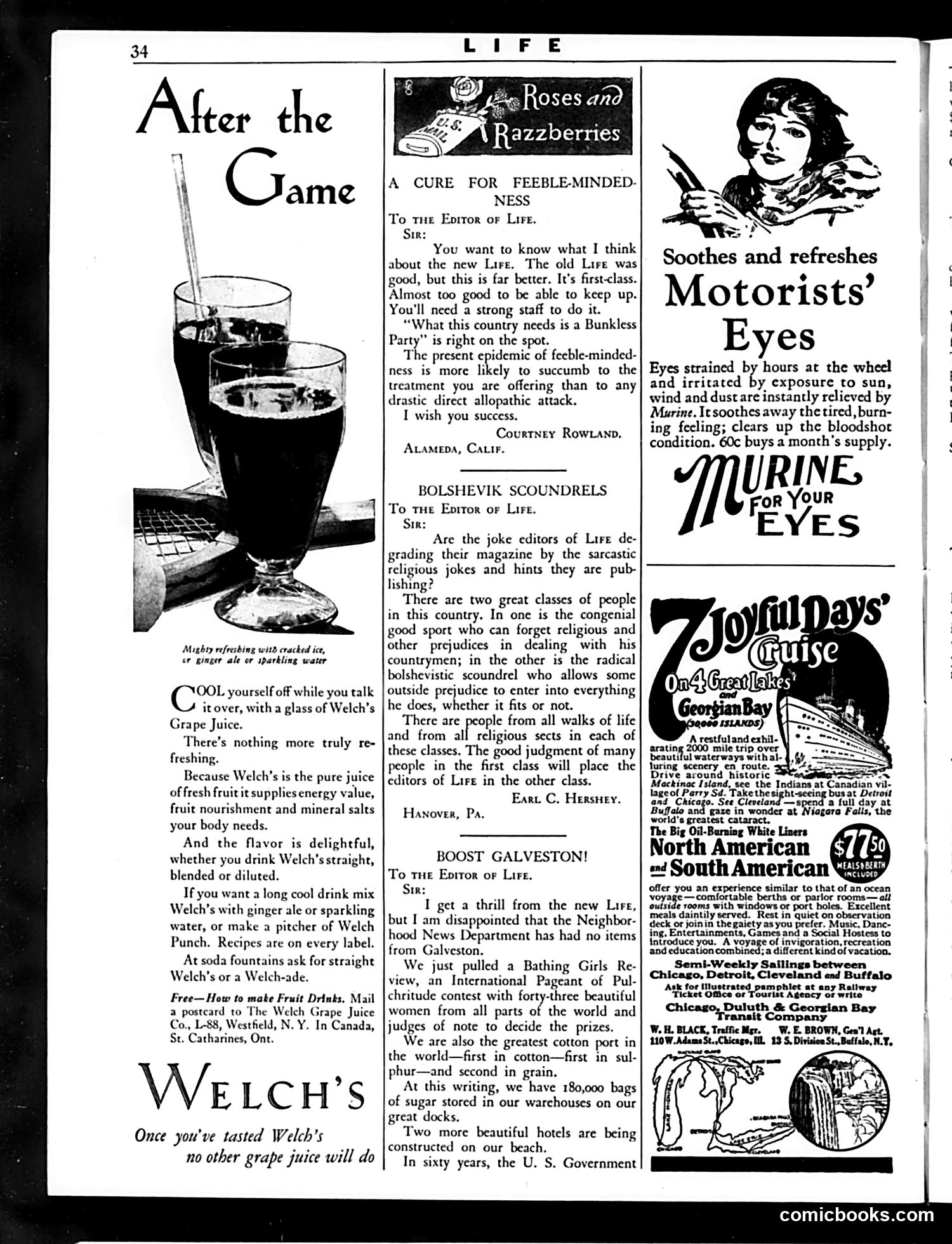
This page consists primarily of **advertisements and reader letters**, not political satire. The main content includes: **Advertisements:** Welch's Grape Juice (large, left side), Murine eye drops, and a 7-day Great Lakes cruise promoting Galveston and Great Lakes tourism. **Reader Letters:** Three letters to the editor discuss the magazine itself: 1. Praising the *new* Life magazine as superior to the old version 2. Complaining that Life's religious humor is divisive and attacks readers who take faith seriously (calling such readers "bolshevistic scoundrels") 3. Promoting Galveston's attractions (cotton port, sugar warehouses, new hotels, bathing beauty pageant) The "satire" appears limited to the magazine's editorial content itself—implied to include religious jokes that some readers found offensive. The letters reveal contemporary tensions between those comfortable with irreverent humor and those viewing it as disrespectful to religious values.
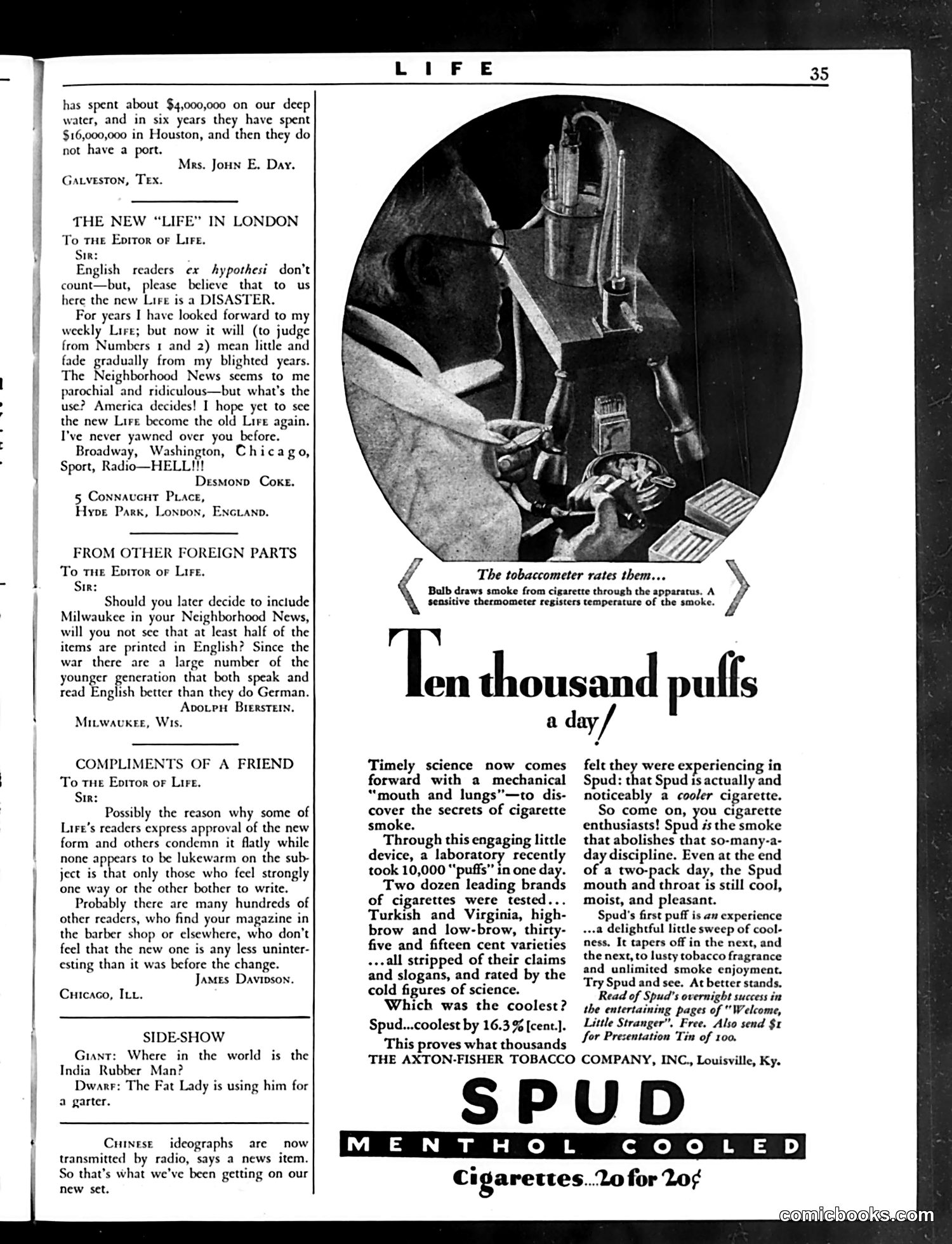
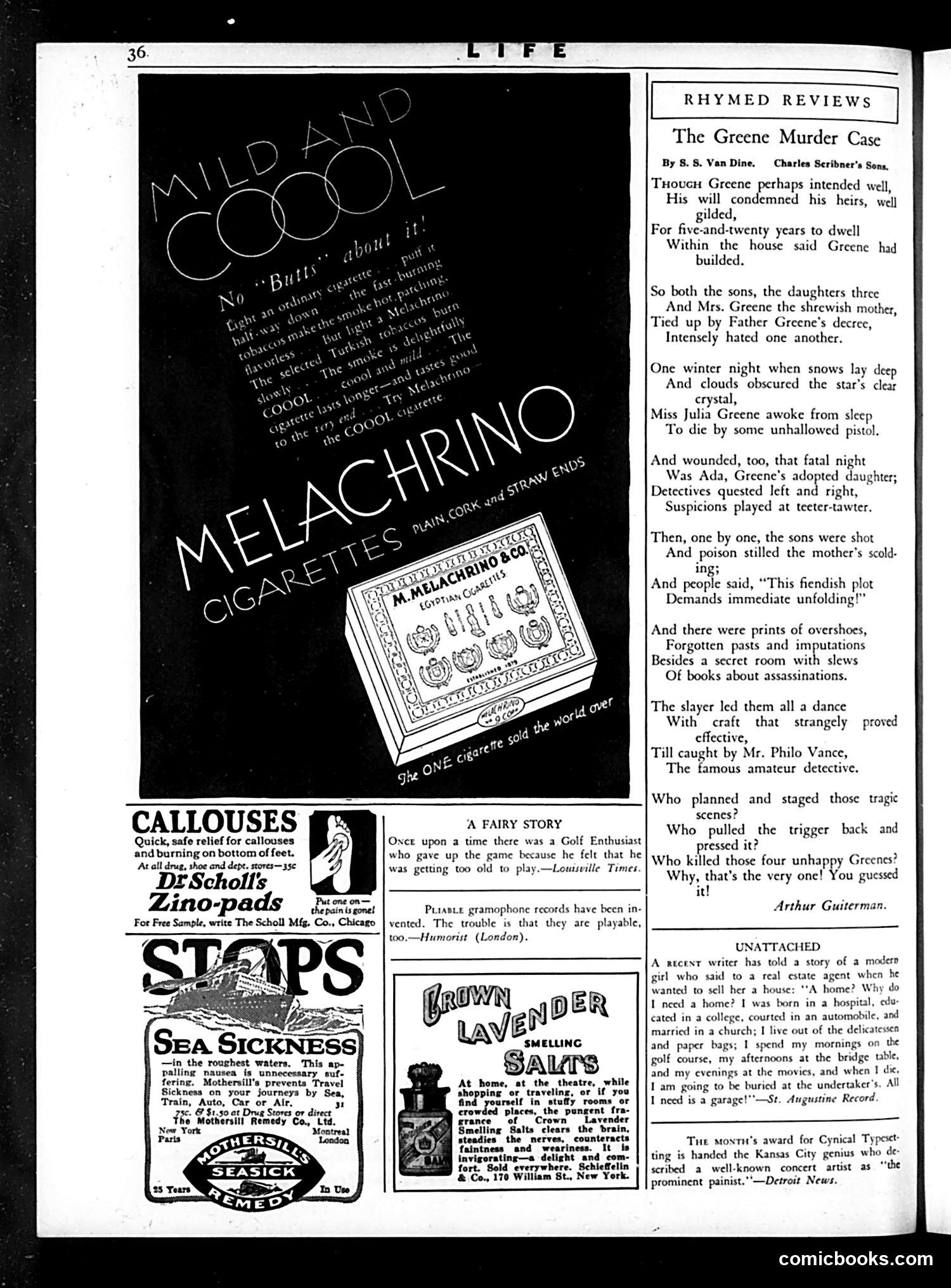
This page from *Life* magazine contains mostly advertisements and literary content rather than political satire. The main items are: **"The Greene Murder Case"** — a book review in verse by Arthur Guiterman, summarizing S.S. Van Dine's mystery novel. The poem humorously reveals the plot twist: the murderer is caught by fictional detective Philo Vance. The joke is the final couplet's anticlimactic answer ("Why, that's the very one! You guessed it!") — likely poking fun at mystery conventions where readers never successfully predict the culprit. **"Unattached"** and **"Cynical Typesetting"** — brief humorous anecdotes about modern life and printing errors, not political commentary. The page is dominated by period advertisements for Dr. Scholl's foot pads, Mothersill's anti-nausea remedy, Crown Lavender Salts, and other products — typical magazine revenue. No significant political satire or caricatures appear on this page.
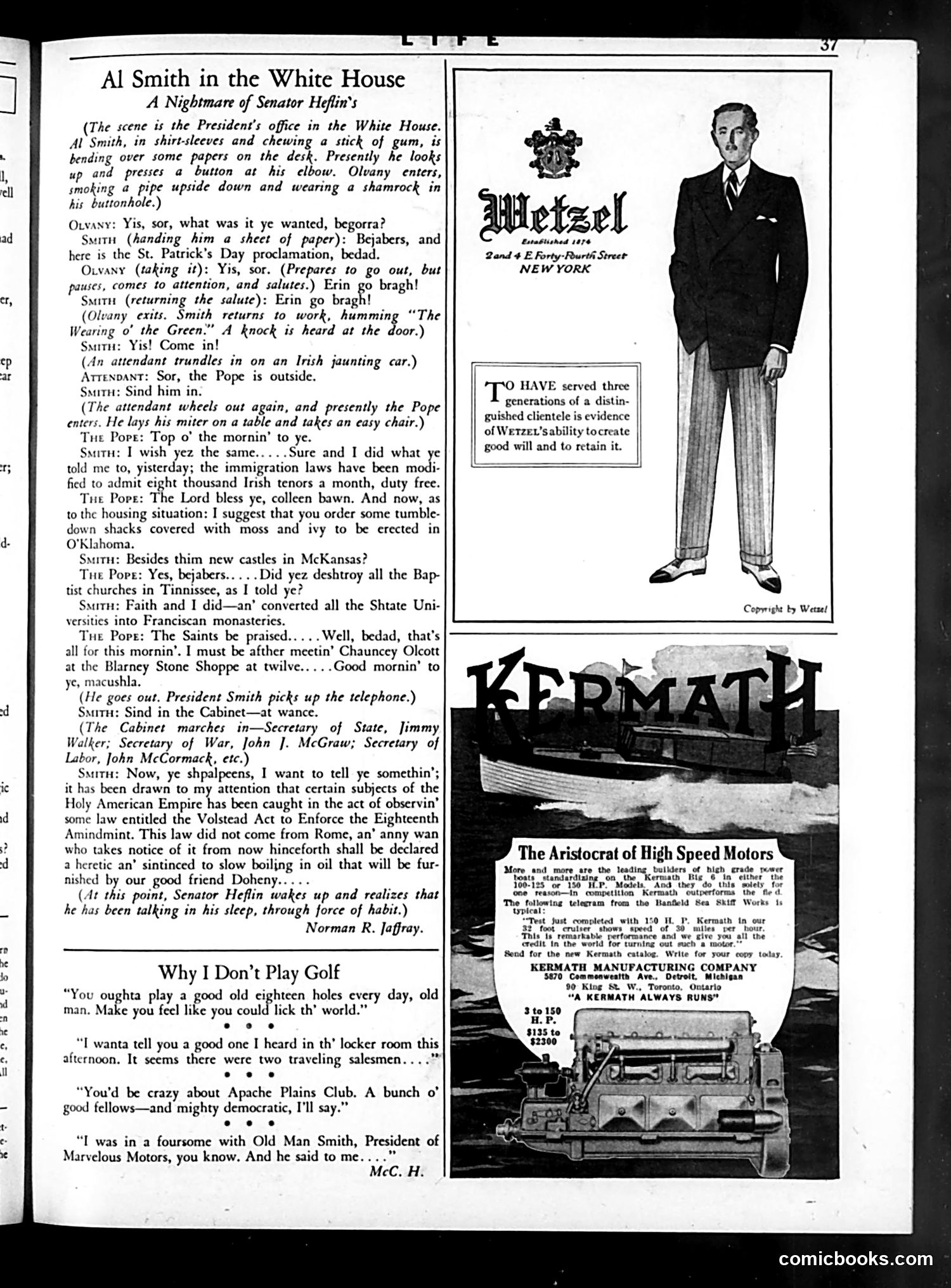
This is a satirical nightmare scenario imagining Al Smith—a prominent Irish-Catholic politician and Democratic presidential candidate—as U.S. President. The cartoon exaggerates anti-Catholic and anti-immigrant fears circulating in 1920s America. The satire depicts Smith allegedly: - Admitting thousands of Irish immigrants monthly - Accepting direct orders from the Pope - Converting Baptist churches to monasteries - Appointing Irish-American allies (Jimmy Walker, John McCormack) to Cabinet positions - Ignoring Prohibition (the Volstead Act) Senator Heflin, a staunch Protestant and Prohibitionist, apparently dreamed this nightmare, reflecting genuine contemporary anxieties about Catholic political influence and Irish-American power. The exaggerated dialect and caricatures mock both Smith's background and the prejudices of his opponents. This reflects the real religious and nativist controversies surrounding Smith's 1928 presidential campaign.
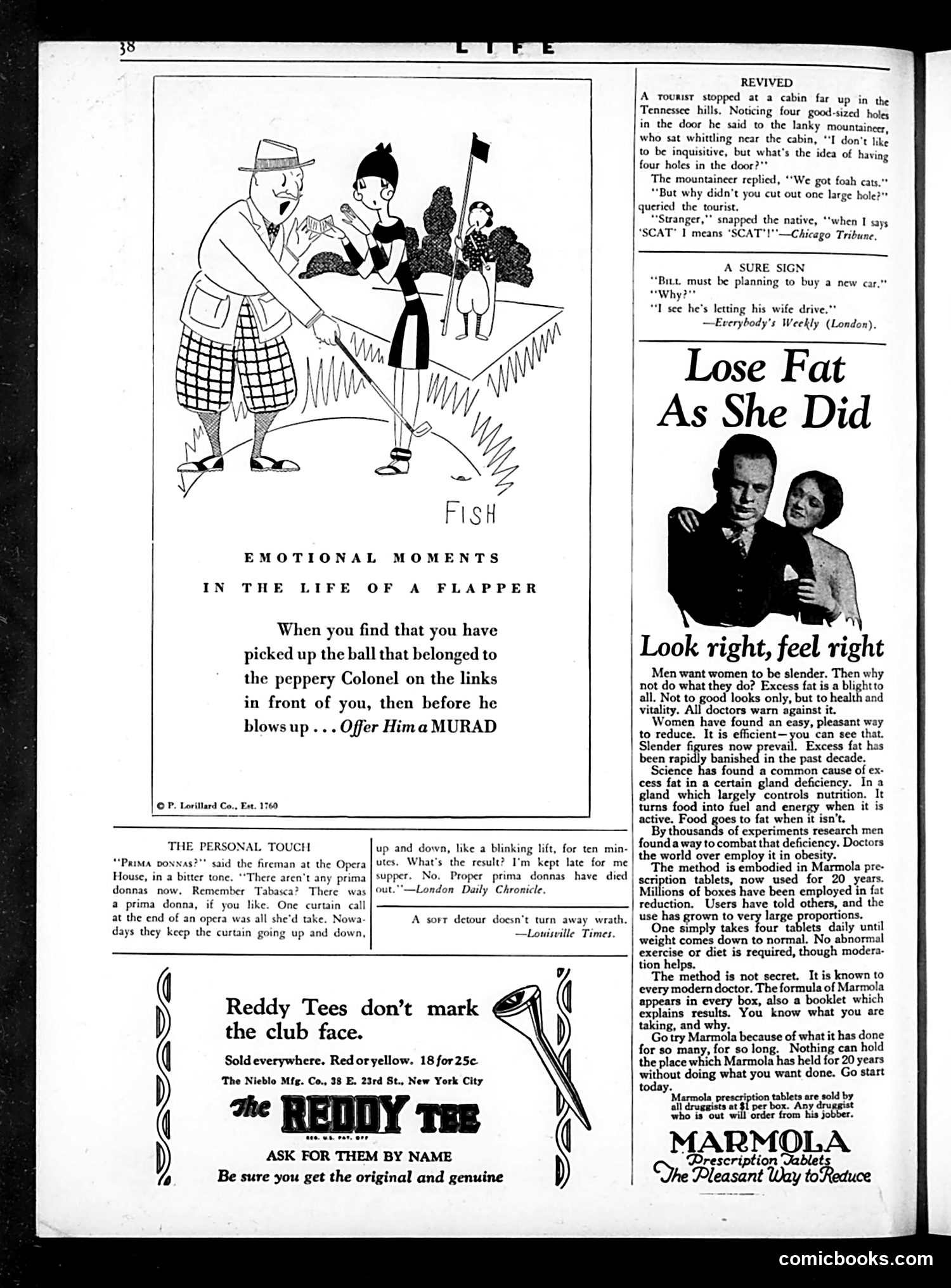
This page contains several distinct satirical pieces typical of 1920s Life magazine humor: **"Emotional Moments in the Life of a Flapper"** (main cartoon): Shows a golfer who has accidentally hit a "Colonel's" golf ball. The joke plays on social etiquette—the golfer is advised to offer the angry Colonel a Murad cigar as a peace offering, treating it as essential damage control in upper-class society. **"The Personal Touch"**: A fireman complains that opera prima donnas no longer exist—modern singers demand endless curtain calls rather than accepting single bows, keeping him late for supper. It's satirizing changing entertainment standards and loss of dignity. **Other brief jokes** mock marital dynamics ("wife driving" as a sign of car-buying plans) and Tennessee hillbilly culture. **Lower half**: Marmola weight-loss tablets advertisement—the page shifts to commercials claiming scientific obesity treatment. This reflects 1920s attitudes toward women's appearance and unfounded "glandular" weight-loss claims. The page reflects Jazz Age concerns: social class navigation, changing entertainment values, and emerging consumer culture around beauty standards.
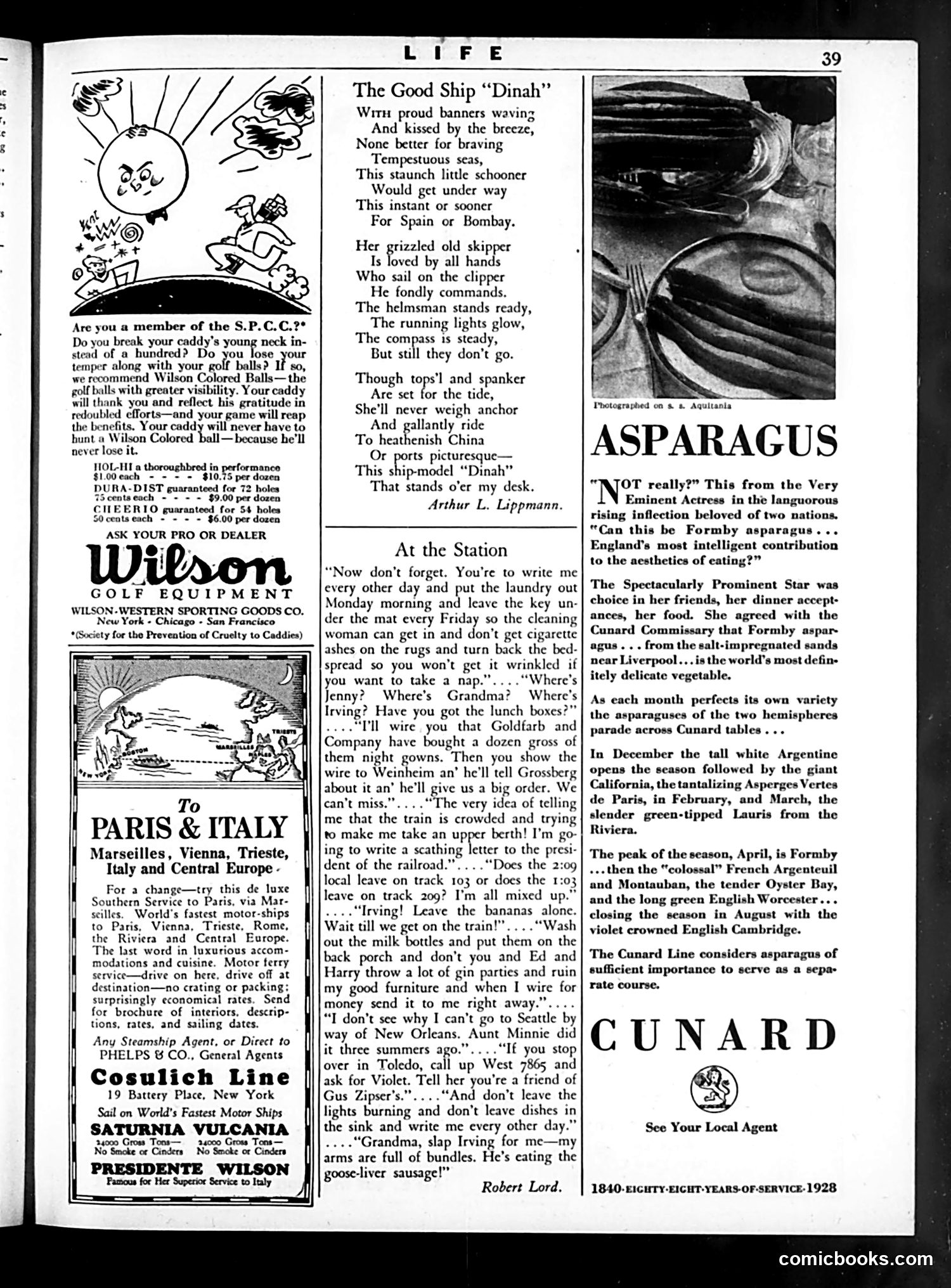
This page combines humor and advertising typical of 1920s *Life* magazine. **Top Left Cartoon:** A humorous Wilson golf ball advertisement with a sardonic footnote: "S.P.C.C." (Society for the Prevention of Cruelty to Caddies). The joke satirizes golfers' notoriously poor treatment of caddies—young boys who carried their clubs. The ad humorously suggests that using Wilson's visible colored balls prevents golfers from losing their temper with caddies, since the balls won't get lost. **Center Content:** "The Good Ship 'Dinah'" is a whimsical poem about a model ship on someone's desk that never actually sails—a gentle joke about decorative objects versus reality. **"At the Station":** A humorous monologue capturing the chaotic, contradictory instructions a traveler gives before departure—forgetting what they've already said, mixing up train details, issuing conflicting orders. It's gentle satire on travel anxiety and absent-minded instructions. The remainder is cruise line and shipping company advertising typical of the era.
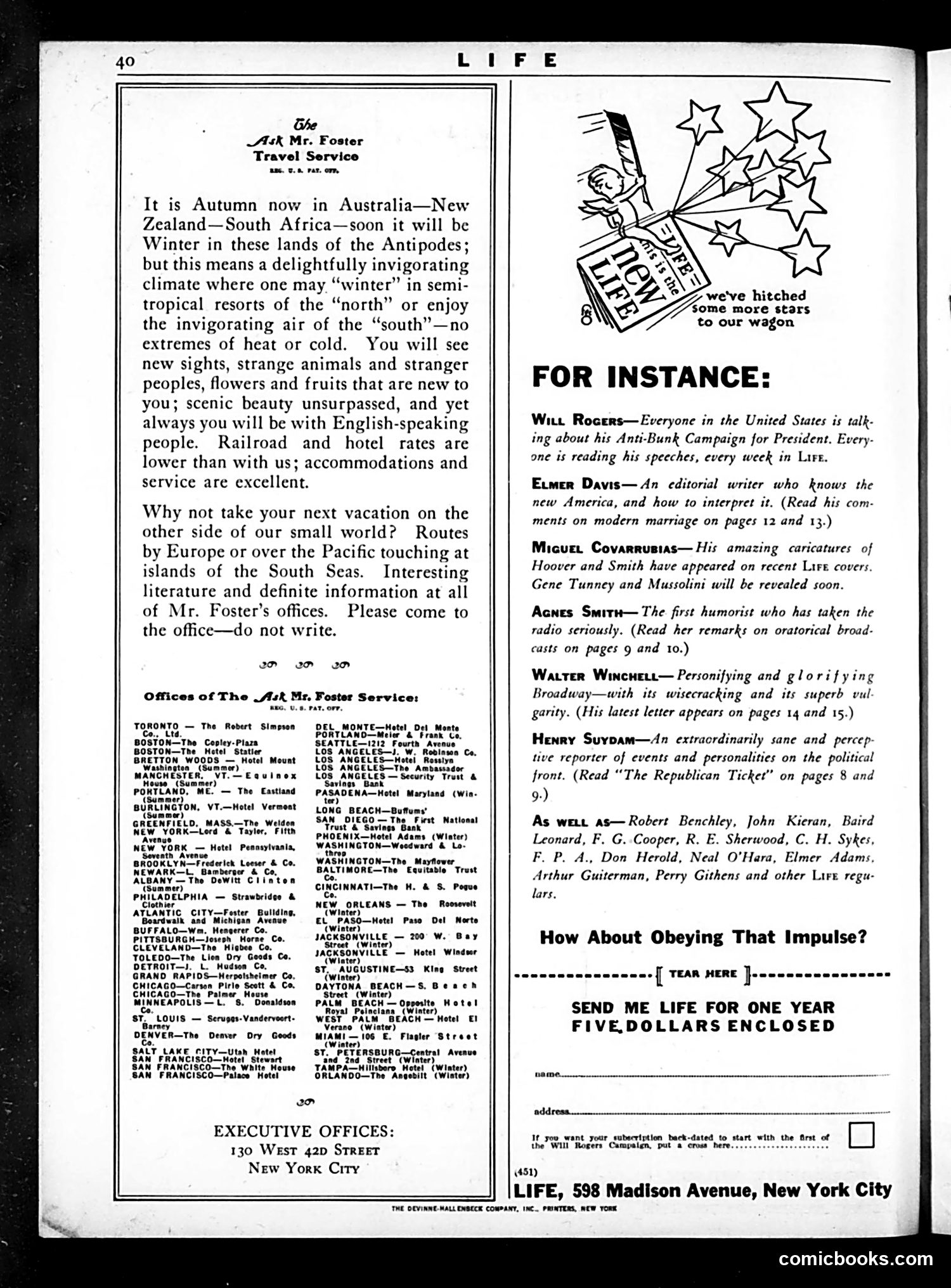
This page is primarily **advertising and editorial content**, not political satire. The dominant element is an "Ask Mr. Foster Travel Service" advertisement promoting vacations to Australia, New Zealand, and South Africa during their winter season—positioned as appealing destinations offering English-speaking hospitality and good value. The cartoon at top-right is a simple visual joke: a cherub labeled "LIFE" is shown hitching "more stars to our wagon," illustrating the magazine's claim to feature prominent contributors. The "FOR INSTANCE:" section lists Life's current writers and illustrators, including **Will Rogers** (conducting an "Anti-Bunk Campaign"), **Miguel Covarrubias** (caricaturist who recently drew **Hoover and Smith**—the 1928 presidential candidates), and **Henry Suydam** (political reporter). This section functions as promotional content highlighting the magazine's editorial appeal and contemporary relevance during an election year. The page demonstrates Life's dual purpose as both humor magazine and serious commentary on 1920s American politics and culture.
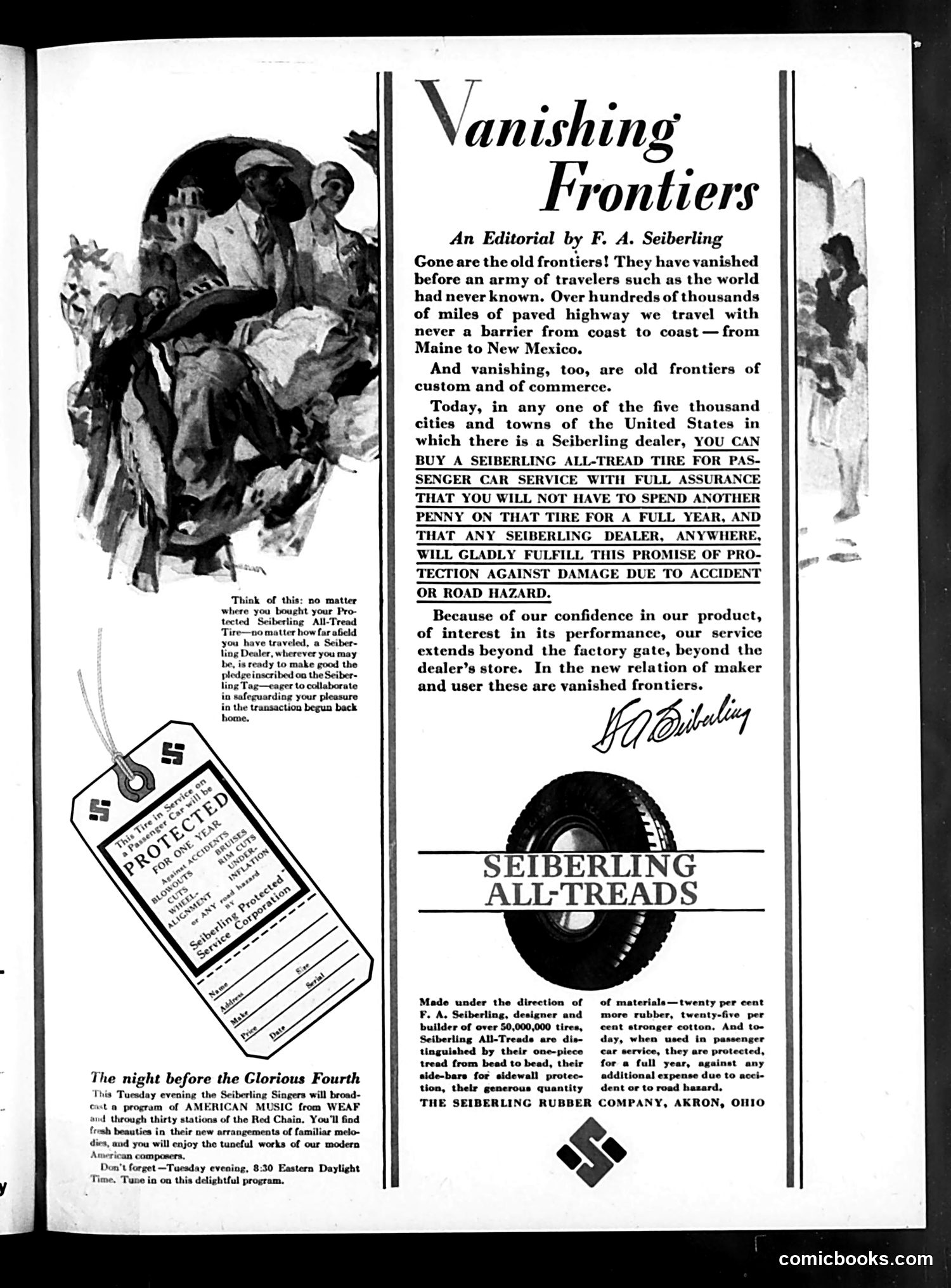
This is primarily a **tire company advertisement**, not political satire. F. A. Seiberling, founder of Seiberling Rubber Company, uses the metaphor of America's "vanishing frontiers" to market all-tread tires. The editorial argues that literal frontiers (unexplored wilderness) have disappeared due to extensive paved highways enabling coast-to-coast travel. It then pivots to commercial "frontiers"—suggesting that Seiberling dealers nationwide eliminate the traditional divide between manufacturer and consumer by guaranteeing tire protection nationwide for one full year. The illustration shows frontier/pioneer imagery (left panel) contrasted with modern commerce (right panel), visualizing this transition from old to new America. The "Protected" tag shown ensures any Seiberling dealer anywhere will honor the warranty. This reflects 1920s-30s optimism about **national infrastructure, mass production, and consumer protection warranties** as markers of progress replacing westward expansion.
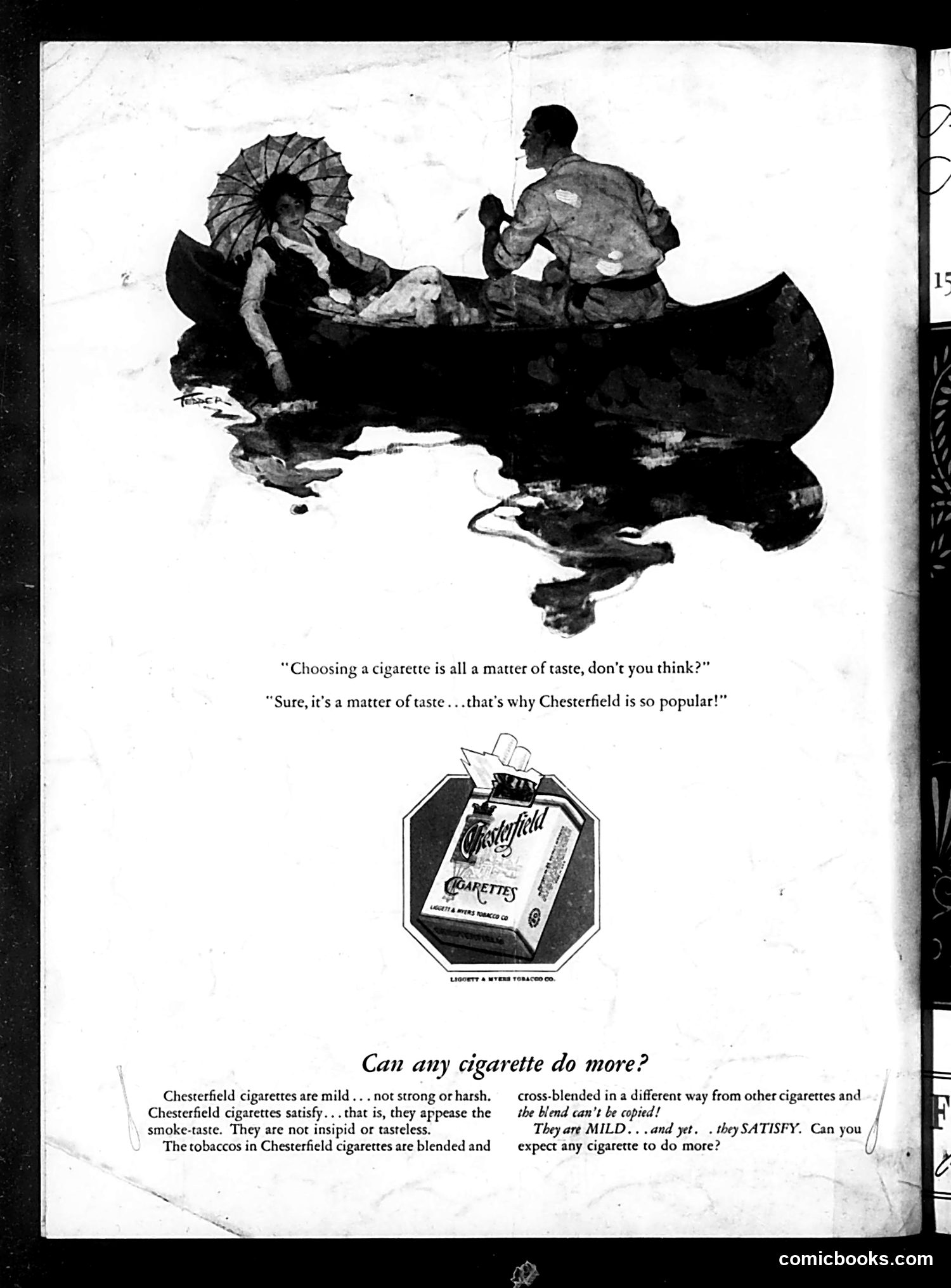
This is a **cigarette advertisement**, not satire. The page depicts two people in a gondola (likely Venice, suggesting leisure and sophistication) discussing cigarette choice. Their dialogue frames the pitch: selecting cigarettes is about "taste," and Chesterfield's popularity supposedly proves its superior taste. The ad emphasizes that Chesterfield cigarettes are "mild" yet "satisfy"—a marketing paradox claiming to offer both gentleness and satisfaction. The text stresses unique cross-blending that "can't be copied," positioning the product as distinctly superior. **For modern readers**: This represents mid-20th-century tobacco marketing before health warnings. The casual, conversational tone and romantic setting were standard advertising techniques. The claim that cigarettes could be objectively ranked by "taste" and "satisfaction" would be legally prohibited in contemporary advertising. This is purely commercial messaging, not political commentary.