
Life, 1928-07-05 · page 16 of 50
Life — July 5, 1928 — page 16: what you’re looking at
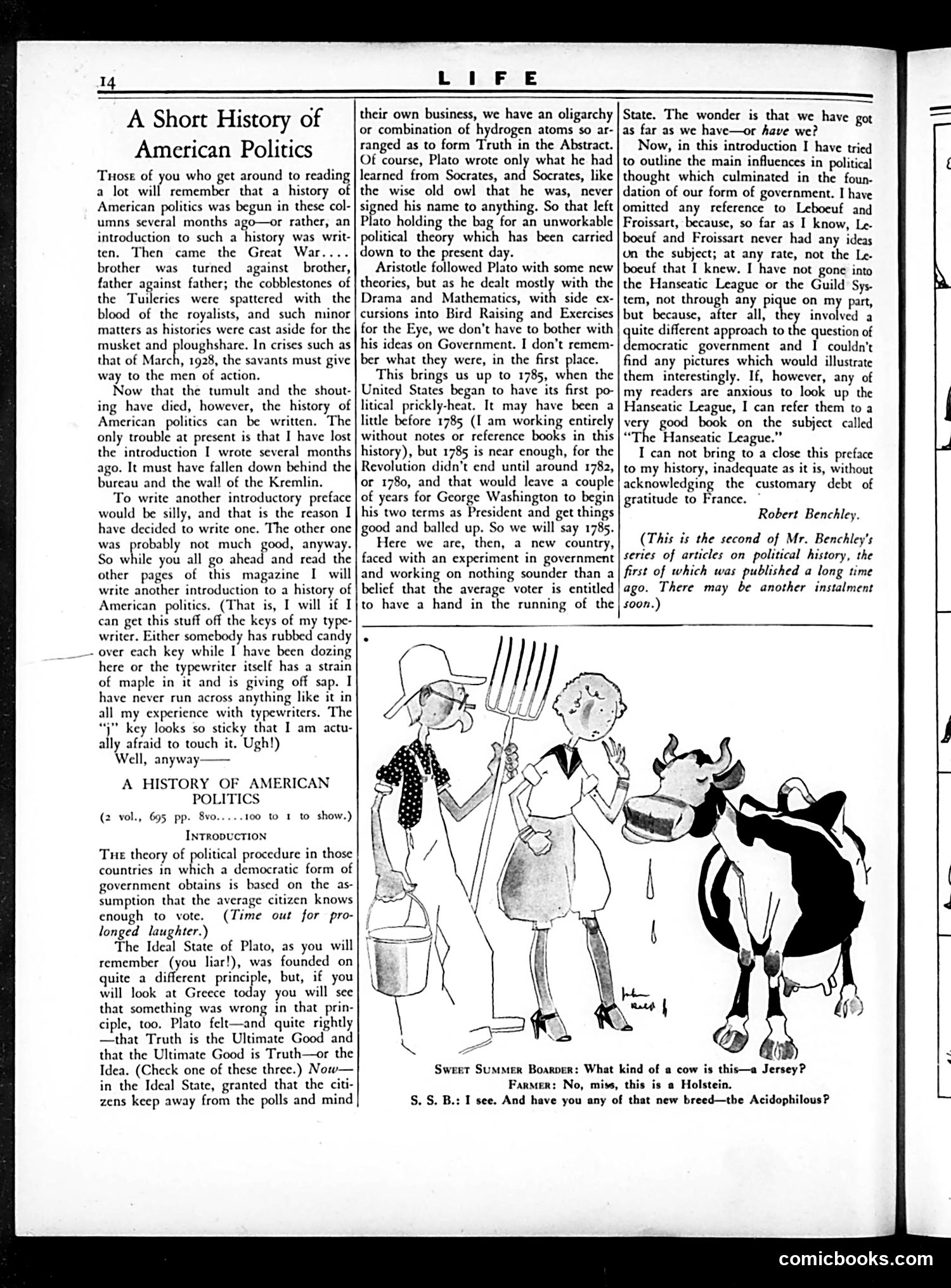
What you’re looking at
This cartoon illustrates urban-rural cultural friction, likely from the 1920s-30s. A fashionable city woman (the "Sweet Summer Boarder") encounters a farmer with his cow, asking what breed it is. The farmer, unfamiliar with her urban sophistication, doesn't recognize the Jersey breed she mentions. When she asks if he has the "new breed—the Acidophilus," he's bewildered. The satire mocks both parties: the city visitor's pretentious knowledge of trendy topics (acidophilus milk was a health fad), and the rural farmer's supposed ignorance. It reflects period anxieties about widening gaps between urban and rural America—urban sophistication versus rural simplicity—a recurring theme in 1920s-30s American humor magazines.
📄 Transcribed text from this page (OCR, searchable)
Machine-transcribed from the original scan — historical spelling and the odd misread are preserved.
14 LIFE A Short History of American Politics Tuose of you who get around to reading a lot will remember that a history of American politics was begun in these col- umns several months ago—or rather, an introduction to such a history was writ- ten, Then came the Great War.... brother was turned against _ brother, father against father; the cobblestones of the Tuileries were spattered with the blood of the royalists, and such minor matters as histories were cast aside for the musket and ploughshare. In crises such as that of March, 1928, the savants must give way to the men of action. Now that the tumult and the shout- ing have died, however, the history of American politics can be written. The only trouble at present is that I have lost the introduction I wrote several months ago. It must have fallen down behind the bureau and the wall of the Kremlin. To write another introductory preface would be silly, and that is the reason I have decided to write one. The other one was probably not much good, anyway. So while you all go ahead and read the other pages of this magazine I will write another introduction to a history of American politics. (That is, I will if I can get this stuff off the keys of my type- writer. Either somebody has rubbed candy - over each key while I have been dozing here or the typewriter itself has a strain of maple in it and is giving off sap. I have never run across anything like it in all my experience with typewriters, The “y"" key looks so sticky that I am actu- ally afraid to touch it. Ugh!) Well, anyway. A HISTORY OF AMERICAN POLITICS (2 vol., 695 pp. 8vo.....100 to 1 to show.) IntRoDUCTION Tue theory of political procedure in those countries in which a democratic form of government obtains is based on the as- sumption that the average citizen knows enough to vote. (Time out for pro- longed laughter.) The Ideal State of Plato, as you will remember (you liar!), was founded on quite a different principle, but, if you will look at Greece today you will see that something was wrong in that prin- ciple, too. Plato felt—and quite rightly —that Truth is the Ultimate Good and that the Ultimate Good is Truth—or the Idea. (Check one of these three.) Now— in the Ideal State, granted that the citi- zens keep away from the polls and mind their own business, we have an oligarchy or combination of hydrogen atoms so ar- ranged as to form Truth in the Abstract. Of course, Plato wrote only what he had learned from Socrates, and Socrates, like the wise old owl that he was, never signe his name to anything. So that left Plato holding the bag for an unworkable political theory which has been carried down to the present day. Aristotle followed Plato with some new theories, but as he dealt mostly with the Drama and Mathematics, with side ex- cursions into Bird Raising and Exercises for the Eye, we don’t have to bother with his ideas on Government. I don’t remem- ber what they were, in the first place. This brings us up to 1785, abe the United States began to have its first po- litical prickly-heat. It may have been a little before 1785 (I am working entirely without notes or reference books in this history), but 1785 is near enough, for the Revolution didn’t end until around 1782, or 1780, and that would leave a couple of years for George Washington to begin his two terms as President and get things good and balled up. So we will say 1785. Here we are, then, a new country, faced with an experiment in government and working on nothing sounder than a belief that the average voter is entitled to have a hand in the running of the State. The wonder is that we have got as far as we have—or have we? Now, in this introduction I have tried to outline the main influences in political thought which culminated in the foun- dation of our form of government. I have omitted any reference to Leboeuf and Froissart, because, so far as I know, Le- boeuf and Froissart never had any ideas on the subject; at any rate, not the Le- boeuf that I knew. I have not gone into the Hanseatic League or the Guild Sys- tem, not through any pique on m part, but because, after all, they involved a que different approach to the question of lemocratic government and I couldn't find any pictures which would illustrate them interestingly. If, however, any of my readers are anxious to look up the Hanseatic League, I can refer them to a very good book on the subject called “The Hanseatic League.” I can not bring to a close this preface to my history, inadequate as it is, without acknowledging the customary debt of gratitude to France. Robert Benchley. (This is the second of Mr. Benchley's series of articles on political history, the first of which was published a long time ago. There may be another instalment soon.) \ C2 Sweet SumMer Boarper: What kind of a cow is this—a Jersey? Farmer: No, miss, this is a Holstein. S. S. B.: I see. And have you any of that new breed—the Acidophilous? comicbooks.com