
Life, 1928-07-05 · page 34 of 50
Life — July 5, 1928 — page 34: what you’re looking at
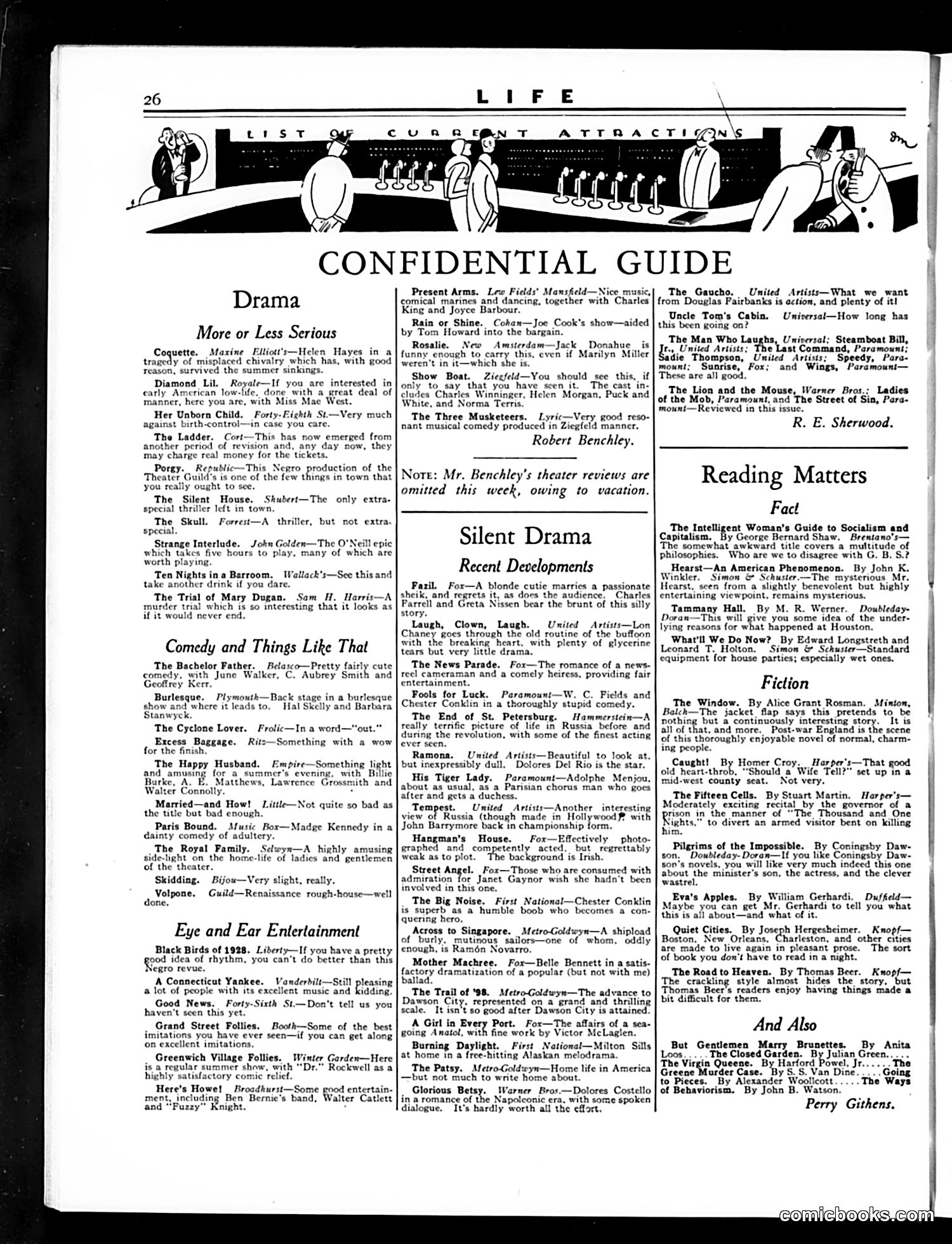
What you’re looking at
This page is primarily a **theater review column**, not a political cartoon. It's a "Confidential Guide" listing current Broadway shows and films with brief critical assessments—typical of Life magazine's entertainment coverage from the 1920s. The header illustration shows stylized figures in a theater or nightclub setting, representing entertainment venues of the era. **Notable context for modern readers:** This appears to be from 1928, when Broadway was flourishing and silent films were still dominant (the page separates "Drama" for stage plays from "Silent Drama" for cinema). References like *Show Boat*, *Porgy*, and *Strange Interlude* were major theatrical events. Reviewer Robert Benchley was a famous humorist. The casual dismissals ("In a word—'out'") and the mix of serious and comedic evaluations reflect period entertainment journalism rather than political satire.
📄 Transcribed text from this page (OCR, searchable)
Machine-transcribed from the original scan — historical spelling and the odd misread are preserved.
Drama More or Less Serious Coquette. y of mis survive Maxine Fitiott's—Helen Hayes in a laced chivalry which has, with good the summer sinkings. Diamond Lil, Royale—If you are interested in carly A low-life, done with a great deal of manner, here you are, with Miss Mac West. Her Unborn Child. Forty-Fighth St—Very much against birth-control—in case you care. The Ladder. Cort—Thi period of revision a may charge real money for the tick Porgy. Republic—This, Negro production of the Theater Guild’s is one of the few things in town that you really ought to see. The Silent House. Shubert—The only extra- special thriller left in town. The Skull. Forrest—A thriller, but not extra, special. Strange Interlude. Jokn Golden—The O'N: which takes five hours to play, y worth playin Ten Nights in a Barroom. take another drink if you The Trial of Mary Dugan. Sam H. Harris—A murder trial which is so interesting that it looks as if it would never end. Comedy and Things Like That The Bachelor Father. Belasco—Pretty fairly cute Wellack's—See this and are. comedy, with June Walker, C. Aubrey Smith and Geoffrey Kerr. Burlesque. Plymouth—Back stage in a burlesque show where it leads to. Hal ly and Barbara Stanwyck. The Cyclone Lover. Excess Baggage. for the finish. Frolic—In a word—"‘out.” Rits—Something with a wow The Happy Husband. Something light 7] z for a summer's e with Billie Matthews, Lawrence Grossmith and and How! Littl—Not quite so bad as the title but bad enough, Paris Bound. Music Box—Madge Kennedy in a dainty comedy of adultery. The Royal Family. side-light on the hoi of the theater. yn—A highly amusing f ladies and gentlemen Skidding. Bijou—Very slight, really. Volpone. Guild—Renaissance rough-house—well done, Eye and Ear Entertainment Black Birds of 1928. Liberty—If you have a pretty od idea of rhythm, you can’t do better than this Negro revue. A Connecticut Yankee. Vanderbilt—Still pleasing a lot of people with its excellent music and Lidding. Good News. Forty-Sixth St.—Don't tell us you haven't seen this yet. _ Grand Street Follies. Booth—Some of the best imitations you have ever seen—if you can get along on excellent imitations, Greenwich Village Follies. Winter Gorden—Here is a regular summer show, with “Dr.” Rockwell as a highly satisfactory comic relief. Here's Howet | Brosdhurst—Some good entertain- ment, including Ben Bernie's band, Walter Catlett and “Fuzzy Knight. CONFIDENTIAL GUIDE Present Arms, Lew Fields’ Mansfeld—Nice music, comical marines and dancing, together with Charles King and Joyce Barbour. Rain or Shine. Cohan—Joe Cook's show—aided by Tom Howard into the bargain. Rosalie. New Amsterdam—Jack Donahue is funny enough to carry this, even if Marilyn Miller weren't in it—which she is. Show Boat. Ziegfeld—You should see this, if only to,say that you have scen it. The cast in- cludes Charles Winninger, Helen Morgan, Puck and White, and Norma Terris. The Three Musketeers. Lyric—Very good reso- nant musical comedy produced in Ziegfeld manner, Robert Benchley. Note: Mr. Benchley’s theater reviews are omitted this week, owing to vacation. Silent Drama Recent Developments Fox—A blonde cutie marries a passionate ind regrets it, as does the audience, Charles and Greta Nissen bear the brunt of this silly Laugh, Clown, Laugh. United Artists—Lon Chaney goes through the old routine of the buffoon with the breaking heart, with plenty of glycerine tears but very little drama. The News Parade. Fox—The romance of a news- n and a comely heiress, providing fair Faz Chester Conklin in a thoroughly stupid comedy, The End of St. Petersburg. Hammerstcin—A really terrific picture of life in Russia before and during the revolution, with some of the finest acting ever seen. Ramona. United Artists—Beautiful to look at, but inexpressibly dull. Dolores Del Rio is the star. His Tiger Lady. Paramount—Adolphe Menjou, about as usual, asa Parisian chorus man who goes after and gets a duchess. Tempest. United Artists—Another interesting yiew of Russia (though made in Hollywood? with John Barrymore back in championship form. Hangman's House. For—Effectively photo- graphed and competently acted, but regrettably weak as to plot. The background is Irish. Street Angel. Fox—Those who are consumed with admiration for Janet Gaynor wish she hadn't been involved in this ‘on The Big Noise. First National—Chester Conklin is superb as a humble boob who becomes a con- quering hero. Across to Singapore. Metro-Goldwyn—A shipload of burly, mutinous sailors—one of whom, oddly enough, is Ramén Novarro. Mother Machree. For—Belle Bennett in a satis- factory dramatization of a popular (but not with me) ballad. The Trail of °98. Metro-Goldwyn—The advance to Dawson City, represented on a grand and thrilling scale. It isn't so good after Dawson City is attained. A Girl in Every Port. Fox—The affairs of a sea- going Anatol, with fine work by Victor McLaglen. Burning Daylight. First National—Milton Sills at home in a free-hitting Alaskan melodrama. The Patsy. Metro-Goldwyn—Home life in America —but not much to write home about. Glorious Betsy. Bros.—Dolores Costello Warner in a romance of the Napolconic era, with some spoken dialogue. It’s hardly worth all the effort. \ The Gaucho. United Artists—What we want from Douglas Pairbanks is action, and plenty of it! Uncle Tom's Cabin. this been going on? The Man Who Laughs, Unizersal; Steamboat Bill, r., United Artists; The Last Command, Paramount! die Thompson, United Artists; Speedy, Para- mount; Sunrise, Fox; and Wings, Paramount— These are all good. The Lion and the Mouse, Warner Bros: Ladies of the Mob, Paramount, and The Street of Sin, Para mount—Reviewed in this issue. R. E. Sherwood. Universal—How long has Reading Matters Fact The Intelligent Woman's Guide to Socialism and Capitalism. By George Bernard Shaw. Brentano's— The somewhat awkward title covers a multitude of philosophies. Who are we to disagree with G. B. S.? Hearst—An American Phenomenon. By John K. Winkler. Simon & Schuster—The mysterious Mr. Hearst, seen from a slightly benevolent but highly entertaining viewpoint, remains mysterious. Tammany Hall. By M. R. Werner. Doubleday- Doran—This will give you some idea of the under- lying reasons for what happened at Houston. What'll We Do Now? By Edward Longstreth and Leonard T. Holton. Simon & Schuster—Standard equipment for house parties; especially wet ones. Fiction The Window. By Alice Grant Rosman. Minton, Balch—The jacket flap says this pretends to be nothing but a continuously interesting story. It is all of that, and more. Post-war England is the scene of this thoroughly enjoyable novel of normal, charm- ing people. Caught! By Homer Croy. Harper's—That good old heart-throb, “Should a Wife Tell?” set up in a mid-west county seat. Not very. The Fifteen Cells. By Stuart Martin. Harper's— Moderately exciting recital by the governor of a ison in the manner of “The Thousand and One A ‘ights,” to divert an armed visitor bent on killing ira. Pilgrims of the Impossible. By Coningsby Daw- son, Doubleday- Doran—If you like Coningsby Daw- son’s novels, you will like very much indeed this one about the minister's son, the actress, and the clever wastrel. Eva's Apples. By William Gerhardi. Duffeld— Maybe you can get Mr. Gerhardi to tell you what this is all about—and what of it. Quiet Cities. By Joseph Hergesheimer. Boston, New Orleans, Charleston, and other cities are made to live again in pleasant prose. The sort of book you don’t have to read in a night. The Road to Heaven. By Thomas Beer. Knopf— The crackling style almost hides the story, but Thomas Beer's readers enjoy having things made a bit difficult for them. And Also But Gentlemen Marry Brunettes. By Anita Loos The Closed Garden. By Julian Green... .. The Virgin Queene. By Harford Powel, Jr. . Greene Murder Case. By S. S. Van Di to Pieces. By Alexander Woollcott.. Behaviorism. By John B. Watson. Perry Githens, Knopf— | |