
Life, 1928-07-05 · page 10 of 50
Life — July 5, 1928 — page 10: what you’re looking at
What you’re looking at
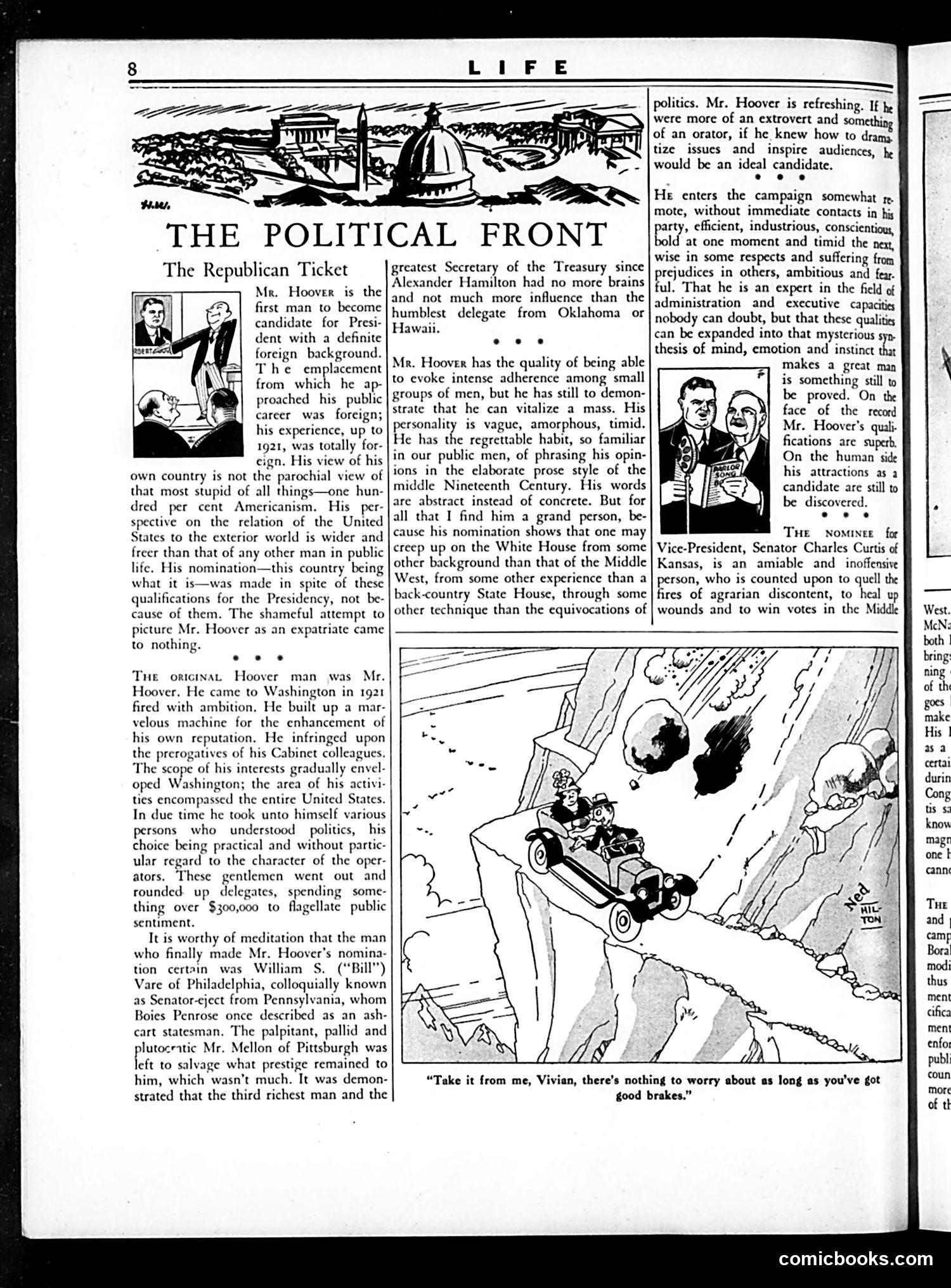
This page from *Life* magazine analyzes Herbert Hoover's 1928 Republican presidential campaign. The text critiques Hoover as an introverted, abstract thinker unsuited to public campaigning—his speeches invoke "middle Nineteenth Century" prose rather than concrete, relatable language. The lower cartoon satirizes campaign safety concerns. A driver navigates a treacherous mountain road while passengers in falling boulders remain calm, reassured that they have "good brakes." This mocks voter confidence in Hoover's economic expertise and Republican fiscal management, suggesting people are blindly trusting leadership despite obvious dangers ahead—likely referencing post-1920s economic instability concerns.
📄 Transcribed text from this page (OCR, searchable)
Machine-transcribed from the original scan — historical spelling and the odd misread are preserved.
les, The Republican Ticket Mr. Hoover is the first_ man to become candidate for Presi- dent with a definite foreign background. The emplacement from which he ap- proached his public career was foreign; his experience, up to 1921, was totally for- cign. His view of his own country is not the parochial view of that most stupid of all things—one hun- dred per cent Americanism, His per- spective on the relation of the United States to the exterior world is wider and freer than that of any other man in public life. His nomination—this country being what it is—was made in spite of these * —asasas THE POLITICAL FRONT greatest Secretary of the Treasury since Alexander Hamilton had no more brains and not much more influence than the humblest delegate from Oklahoma or Hawaii. eee Mr. Hoover has the quality of being able to evoke intense adherence among small groups of men, but he has still to demon- strate that he can vitalize a mass. His personality is vague, amorphous, timid. He has the regrettable habit, so familiar in our public men, of phrasing his opin- ions in the elaborate prose style of the middle Nineteenth Century. His words are abstract instead of concrete. But for all that I find him a grand person, be- cause his nomination shows that one may creep up on the White House from some other background than that of the Middle West, from some other experience than a politics. Mr. Hoover is refreshing. If he were more of an extrovert and somethin, of an orator, if he knew how to dram. tize issues and inspire audiences, be would be an ideal candidate. eee He enters the campaign somewhat re. mote, without immediate contacts in his arty, efficient, industrious, conscientious, Id at one moment and timid the next, wise in some respects and suffering from prejudices in others, ambitious and fear. ful. That he is an expert in the field of administration and executive capacities nobody can doubt, but that these qualities can be expanded into that mysterious 5 thesis of mind, emotion and instinct that makes a great man is something still to be proved. On the face of the record Mr. Hoover's quali- fications are superb, On the human side his attractions as a candidate are still to be discovered. ewe THE Nominee for Vice-President, Senator Charles Curtis of Kansas, is an amiable and_ inoffensive person, who is counted upon to quell the back-country State House, through some | fires of agrarian discontent, to heal up qualifications for the Presidency, not be- ) : i 7 f z other technique than the equivocations of | wounds and to win votes in the Middle cause of them. The shameful attempt to picture Mr. Hoover as an expatriate came to nothing. Tue oricinaL Hoover man was Mr. Hoover. He came to Washington in 1921 fired with ambition, He built up a mar- velous machine for the enhancement of his own reputation, He infringed upon the prerogatives of his Cabinet colleagues. The scope of his interests gradually envel- oped Washington; the area of his activi- ties encompassed the entire United States. In due time he took unto himself various persons who understood politics, his choice being practical and without partic- ular regard to the character of the oper- ators. These gentlemen went out and rounded up delegates, spending some- thing over $300,000 to flagellate public senument. It is worthy of meditation that the man who finally made Mr. Hoover's nomina- tion certain was William S. (“Bill”) Vare of Philadelphia, colloquially known as Senator-eject from Pennsylvania, whom Boies Penrose once described as an ash- cart statesman. The palpitant, pallid and lutoceatic Mr. Mellon of Pittsburgh was fee to salvage what prestige remained to him, which wasn’t much. It was demon- strated that the third richest man and the “Take it from me, Vivian, there’s nothing to worry about as long as you've got good brakes.” comicbooks.com