
Life, 1928-07-05 · page 24 of 50
Life — July 5, 1928 — page 24: what you’re looking at
What you’re looking at
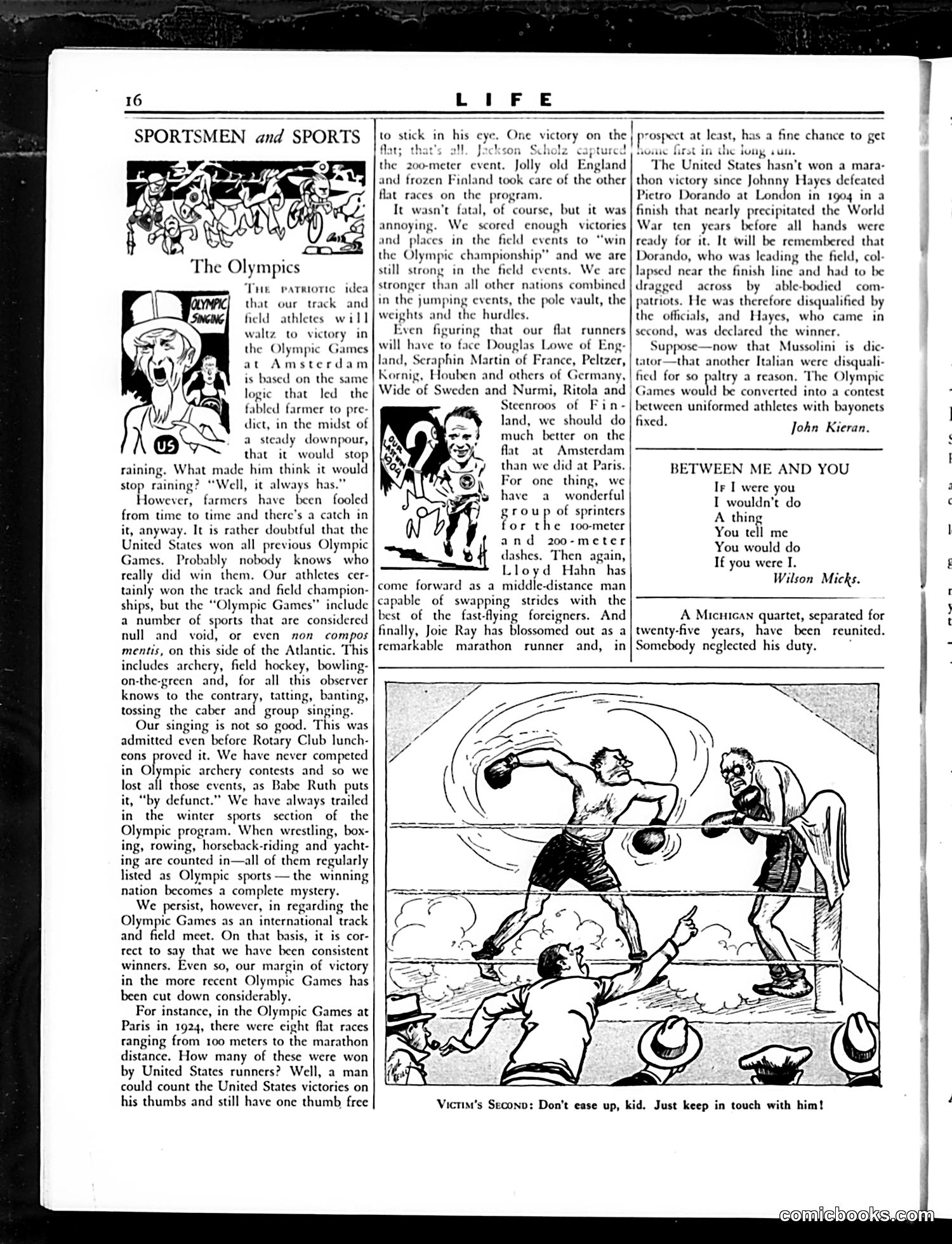
This page critiques American overconfidence about the 1928 Amsterdam Olympics. The main article sardonically debunks the assumption that the U.S. will dominate, using a farmer's faulty logic ("it always has rained, so it will stop"). The satire points out that Americans only count track-and-field events as "real" Olympic sports, dismissing others (archery, field hockey, etc.) as foreign oddities. The author notes the U.S. barely won flat races at the 1924 Paris Olympics—citing specific European competitors like Finland's Nurmi and Sweden's Wide as threats. The cartoon below depicts a boxing match with spectators, illustrating Olympic athletic competition humorously. A final dig references the 1904 marathon controversy where Italian Pietro Dorando collapsed but was disqualified, while American Johnny Hayes won. The author quips darkly that under Mussolini, such a decision might start a war—a topical jab at rising Italian fascism and international tension. The page deflates American athletic exceptionalism while mocking provincial attitudes toward "foreign" Olympic sports.
📄 Transcribed text from this page (OCR, searchable)
Machine-transcribed from the original scan — historical spelling and the odd misread are preserved.
SPORTSMEN and SPORTS The Olympics The parriortc idea that our track and ficld athletes will waltz to victory in the Olympic Games at Amsterdam is based on the same logic that led the fabled farmer to pre- dict, in the midst of a steady downpour, that it would stop raining. What made him think it would stop raining? “Well, it always has.” However, farmers have been fooled from time to time and there’s a catch in it, anyway. It is rather doubtful that the United States won all previous Olympic Games. Probably nobody knows who really did win them. Our athletes cer- tainly won the track and field champion- ships, but the “Olympic Games” include a number of sports that are considered null and void, or even non compos mentis, on this side of the Atlantic. This includes archery, field hockey, bowling- on-the-green and, for all this observer knows to the contrary, tatting, banting, tossing the caber and group singing. Our singing is not so good. This was admitted even before Rotary Club lunch- cons proved it. We have never competed in Ob ic archery contests and so we lost all those events, as Babe Ruth puts it, “by defunct.” We have always trailed in the winter sports section of the Olympic program. When wrestling, box- ing, rowing, horscback-riding and yacht- ing are counted in—all of them regularly listed as Olympic sports — the winning nation becomes a complete mystery. We persist, however, in regarding the Olympic Games as an international track and field meet. On that basis, it is cor- rect to say that we have been consistent winners, Even so, our margin of victory in the more recent Olympic Games has been cut down considerably. For instance, in the Olympic Games at Paris in 1924, there were eight flat races ranging from 100 meters to the marathon distance. How many of these were won by United States runners? Well, a man could count the United States victories on his thumbs and still have one thumb free One victory on the Scholz rod the 200-meter event. Jolly old Eng! and frozen Finland took care of the other flat races on the program. Tt wasn't fatal, of course, but it was annoying. We scored enough victories and places in the field events to “win the Olympic championship” and we are sull strong in the field events, We are stronger than all other nations combined in the jumping events, the pole vault, the weights and the hurdles. Even figuring that our flat’ runners will have to face Douglas Lowe of Eng- land, Seraphin Martin of France, Peltzer, Kornig, Houben and others of Germany, Wide of Sweden and Nurmi, Ritola and | prospect at least, has a fine chance to get some first in the Jong sun. The United States hasn't won a mara- thon victory since Johnoy Hayes defeated Pietro Dorando at London in 1904 in a finish that nearly precipitated the World War ten years before all hands were ready for it. It will be remembered that | Dorando, who was leading the field, col- lapsed near the finish line and had to be dragged across by able-bodied — com- patriots. He was therefore disqualified by the officials, and Hayes, who came in second, was declared the winner. Suppose—now that Mussolini is dic- -that another Italian were disquali- fied for so pale a reason. The Olympic | Games would be converted into a contest Steenroos of Fin-| between uniformed athletes with bayonets land, we should do | fixed. John Kieran. much better on the ‘ flat at Amsterdam | than we did at Paris. BETWEEN ME AND YOU avs a wrth IT wouldn't do ¢ group of sprinters A thing dashes. Then again ouiwould ido ee are If you were I. Ez: Lloyd Hahn has 5 5 zs . Wilson Micks. come forward as a middle-distance man F apable of swapping strides with the ; best of the fast-flying foreigners. And A Micnican quartet, separated for t finally, Joie Ray has blossomed out as a| twenty-five years, have been reunited. remarkable marathon runner and, in| Somebody neglected his duty. - ] y Vicrim’s Secon: Don't ease up, kid. Just keep in touch with him!