
Life, 1928-07-05 · page 31 of 50
Life — July 5, 1928 — page 31: what you’re looking at
What you’re looking at
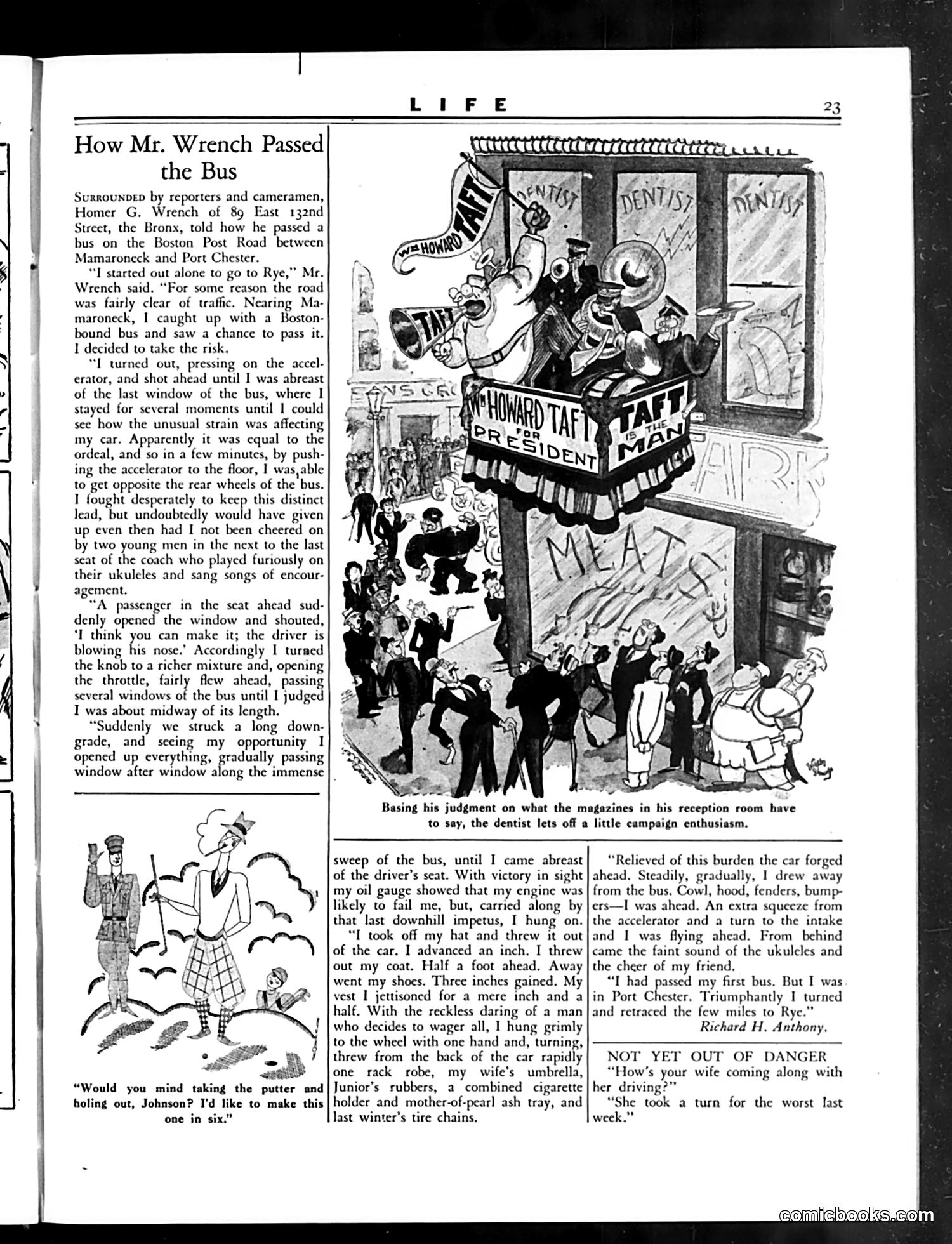
This is a satirical piece mocking the obsession with passing other vehicles on the road—a then-contemporary driving fad. Homer G. Wrench, a Bronx resident, recounts dramatically how he passed a bus on the Boston Post Road, treating this mundane feat as an epic adventure worthy of press coverage. The humor lies in the absurd escalation: he throws increasingly valuable possessions overboard (shoes, vest, coat, wife's umbrella, tire chains) to lighten his car and gain inches of advantage—treating reckless driving as a matter of honor. Passengers cheer him on; a stranger shouts encouragement when the bus driver sneezes. The accompanying cartoon shows a dentist's campaign poster floating above chaotic street scenes, satirizing political self-promotion (likely referencing a real campaign, unclear which). The satire critiques both dangerous driving behavior and the media sensationalism surrounding it—turning a risky, foolish act into celebrity news.
📄 Transcribed text from this page (OCR, searchable)
Machine-transcribed from the original scan — historical spelling and the odd misread are preserved.
is How Mr. Wrench Passed the Bus SURROUNDED by reporters and cameramen, Homer G. Wrench of 89 East 132nd Street, the Bronx, told how he passed a bus on the Boston Post Road between Mamaroneck and Port Chester. “I started out alone to go to Rye,” Mr. Wrench said. “For some reason the road was fairly clear of traffic. Nearing Ma- maroneck, I caught up with a Boston- bound bus and saw a chance to pass it. I decided to take the risk. “I turned out, pressing on the accel- erator, and shot ahead untl I was abreast of the last window of the bus, where I stayed for several moments until I could see how the unusual strain was affecting my car. Apparently it was equal to the ordeal, and so in a few minutes, by push- ing the accelerator to the floor, I was,able to get opposite the rear wheels of the bus. 1 fought desperately to keep this distinct lead, but undoubtedly would have given up even then had I not been cheered on by two young men in the next to the last seat of the coach who played furiously on their ukuleles and sang songs of encour- agement. “A passenger in the seat ahead sud- denly opened the window and shouted, ‘I think you can make it; the driver is blowing his nose.’ Accordingly I turaed the knob to a richer mixture and, opening the throttle, fairly flew ahead, passing several windows of the bus until I judged 1 was about midway of its length. “Suddenly we struck a long down- grade, and seeing my opportunity I opened up everything, gradually passing window after window long the immense _— waa “Would you mind taking the putter and holing out, Johnson? I'd like to make this one in six.” sweep of the bus, until I came abreast of the driver's seat. With victory in sight my oil gauge showed that my engine was likely to fail me, but, carried along by that last downhill impetus, I hung on. “I took off my hat and threw it out of the car. I advanced an inch. I threw out my coat. Half a foot ahead. Away went my shoes. Three inches gained. My vest I jettisoned for a mere inch and a half. With the reckless daring of a man who decides to wager all, I hung grimly to the wheel with one hand and, turning, threw from the back of the car rapidly one rack robe, my wife’s umbrella, Junior's rubbers, a combined cigarette holder and mother-of-pearl ash tray, and last winter's tire chains. judgment on what the magazines in his reception room have y, the dentist lets off a little campaign enthusiasm. “Relieved of this burden the car forged ahead. Steadily, gradually, 1 drew away from the bus. Cowl, hood, fenders, bump- ers—I was ahead. An extra squeeze from the accelerator and a turn to the intake and I was flying ahead. From behind came the faint sound of the ukuleles and the cheer of my friend. “I had passed my first bus. But I was in Port Chester. Triumphantly I turned and retraced the few miles to Rye.” Richard H. Anthony. NOT YET OUT OF DANGER “How's your wife coming along with her driving?” “She took a turn for the worst [ast week.”