
Life, 1928-07-05 · page 14 of 50
Life — July 5, 1928 — page 14: what you’re looking at
What you’re looking at
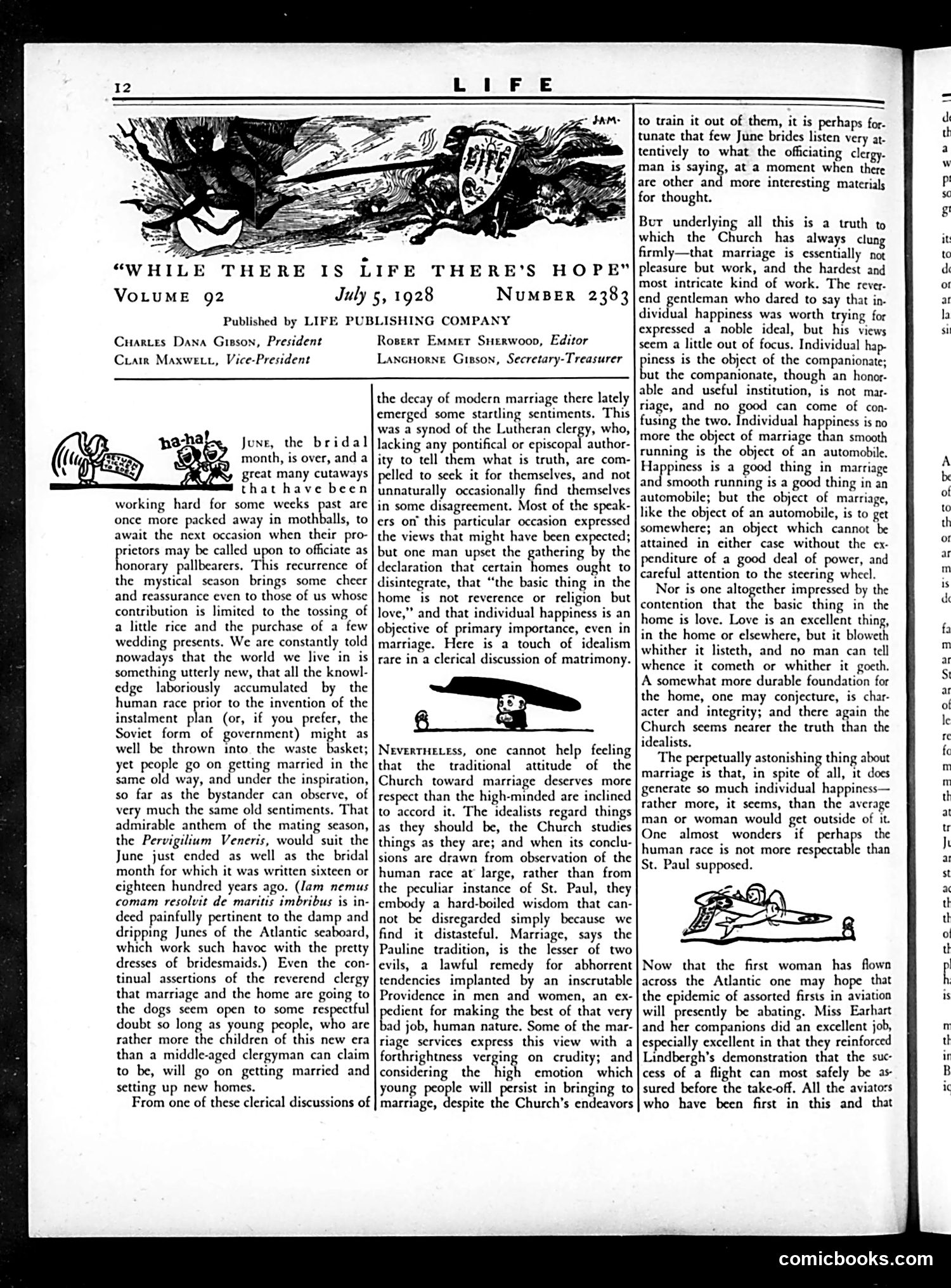
This page contains editorial text about marriage and the Church's role in it, alongside small illustrations rather than a full political cartoon. The top illustration shows a couple in an intimate moment—likely satirizing the "bridal month" referenced in the text. The article critiques clergy who presume to lecture couples on marriage while the Church's traditional stance may not align with modern views. The lower illustration depicts a woman piloting an aircraft, referencing Miss Earhart (Amelia Earhart), the pioneering aviator. The text notes her recent transatlantic flight and suggests her accomplishment proves women's capabilities—an implicit argument for women's equality and independence, contrasting with restrictive marital traditions the article questions. Both images support the article's broader theme: challenging outdated institutional authority over personal happiness.
📄 Transcribed text from this page (OCR, searchable)
Machine-transcribed from the original scan — historical spelling and the odd misread are preserved.
VOLUME 92 July 5, 1928 NuMBER 2383 Published by LIFE PUBLISHING COMPANY Cuartes Dana Gisson, President Cratn Maxwett, Vice-President June, the bridal month, is over, and a great many cutaways that have been working hard for some weeks past are once more packed away in mothballs, to await the next occasion when their pro- prctors may be called upon to officiate as jonorary pallbearers. This recurrence of the mystical season brings some cheer and reassurance even to those of us whose contribution is limited to the tossing of a little rice and the purchase of a few wedding presents. We are constantly told nowadays that the world we live in is something utterly new, that all the knowl- edge laboriously accumulated by the human race prior to the invention of the instalment plan (or, if you prefer, the Soviet form of government) might as well be thrown into the waste Basket, yet people go on getting married in the same old way, and under the inspiration, so far as the bystander can observe, of very much the same old sentiments. That admirable anthem of the mating season, the Pervigilium Veneris, would suit the June just ended as well as the bridal month for which it was written sixteen or cighteen hundred years ago. (lam nemus comam resolvit de maritis imbribus is in- deed painfully pertinent to the damp and dripping Junes of the Adantic seaboard, which work such havoc with the pretty dresses of bridesmaids.) Even the con- tinual assertions of the reverend clergy that marriage and the home are going to the dogs seem open to some respectful doubt so long as young people, who are rather more the children of this new era than a middle-aged clergyman can claim to be, will go on getting married and setting up new homes. From one of these clerical discussions of Rosert Emmet Suerwoon, Editor Lancuorne Gisson, Secretary-Treasurer the decay of modern marriage there lately emerged some startling sentiments. This was a synod of the Lutheran clergy, who, lacking any pontifical or episcopal author- ity to tell them what is truth, are com- pelled to seek it for themselves, and not unnaturally occasionally find themselves in some disagreement. Most of the speak- ers on this particular occasion expressed the views that might have been expected; but one man upset the gathering by the declaration that certain homes Baght to disintegrate, that “the basic thing in the home is not reverence or religion but love,” and that individual happiness is an objective of primary importance, even in marriage. Here is a touch of idealism rare in a clerical discussion of matrimony. NeverTHELEss, one cannot help feeling that the traditional attitude of the Church toward marriage deserves more respect than the high-minded are inclined to accord it. The idealists regard things as they should be, the Church studies things as they are; and when its conclu- sions are drawn from observation of the human race at large, rather than from the peculiar instance of St. Paul, they embody a hard-boiled wisdom that can- not be disregarded simply because we find it distasteful. Marriage, says the Pauline tradition, is the lesser of two evils, a lawful remedy for abhorrent tendencies implanted by an inscrutable Providence in men and women, an ex- pediens for making the best of that very ad job, human nature. Some of the mar- riage services express this view with a forthrightness verging on crudity; and considering the high emotion which young people will persist in bringing to marriage, despite the Church’s endeavors to train it out of them, it is perhaps for- tunate that few June brides listen very at- tentively to what the officiating clergy. man is saying, at a moment when there are other an for thought. more interesting materials Bur underlying all this is a truth to which the Church has always clung firmly—that marriage is essentially not pleasure but work, and the hardest and most intricate kind of work. The rever- end gentleman who dared to say that in- dividual happiness was worth trying for expressed a noble ideal, but his views seem a little out of focus. Individual hap- piness is the object of the companionate; ut the companionate, though an honor- able and useful institution, is not mar- riage, and no good can come of con- fusing the two, Individual happiness is no more the object of marriage than smooth running is the object of an automobile. Happiness is a good thing in marriage and smooth running is a good thing in an automobile; but the object of marriage, like the object of an automobile, is to get somewhere; an object which cannot be attained in either case without the ex- penditure of a good deal of power, and careful attention to the steering wheel. Nor is one altogether impressed by the contention that the basic thing in the home is love. Love is an excellent thing, in the home or elsewhere, but it bloweth whither it listeth, and no man can tell whence it cometh or whither it goeth. A somewhat more durable foundation for the home, one may conjecture, is char- acter and integrity; and there again the Church seems nearer the truth than the idealists. The perpetually astonishing thing about marriage is that, in spite ae all, it does generate so much individual happiness— rather more, it seems, than the average man or woman would get outside of it. One almost wonders if perhaps the human race is not more respectable than St. Paul supposed. Now that the first woman has flown across the Atlantic one may hope that the epidemic of assorted firsts in aviation will presently be abating. Miss Earhart and her companions did an excellent job, especially excellent in that they reinforced Lindbergh's demonstration that the suc- cess of a flight can most safely be as sured before the take-off. All the aviators who have been first in this and that comicbooks.com