
Life, 1928-07-05 · page 32 of 50
Life — July 5, 1928 — page 32: what you’re looking at
What you’re looking at
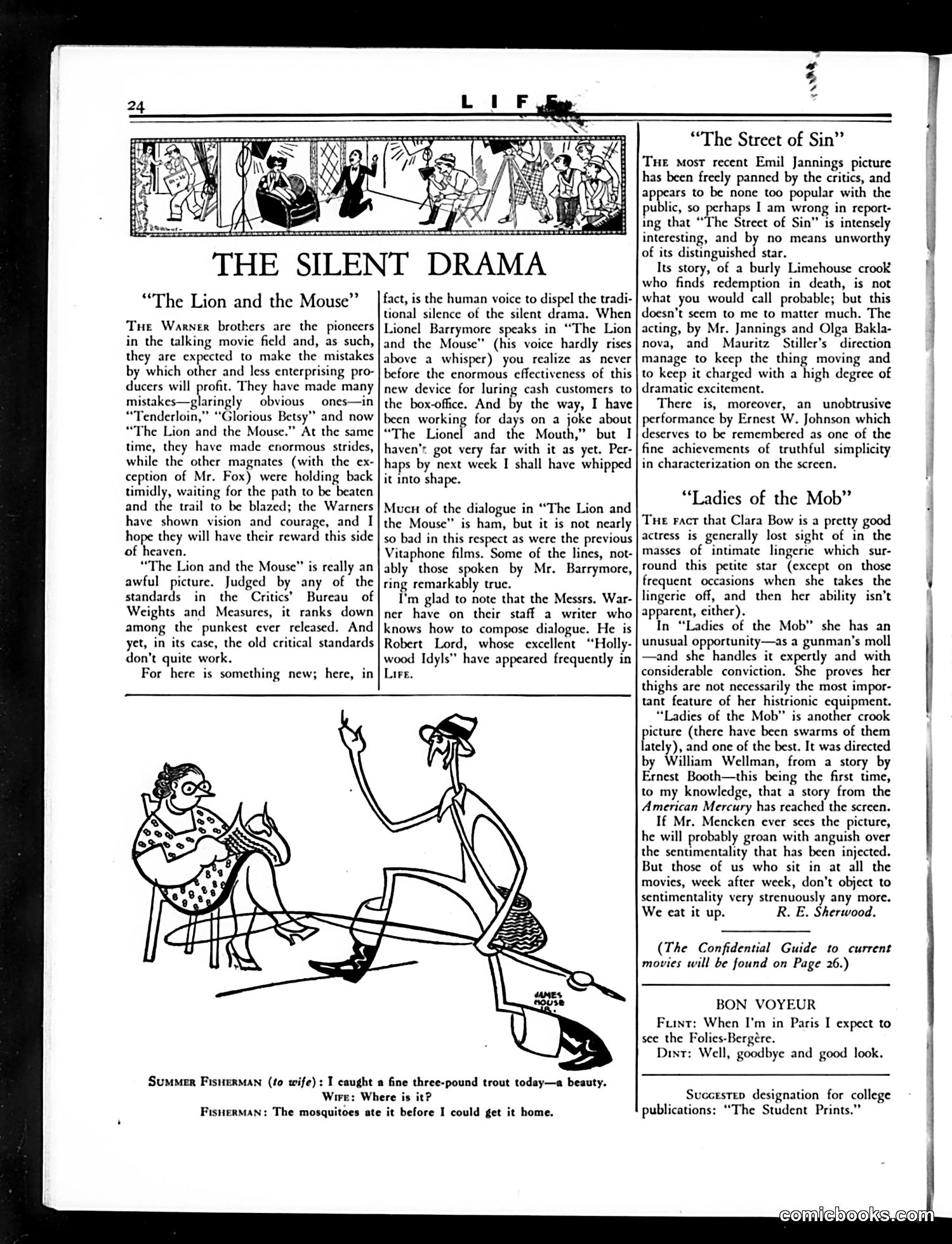
This page from *Life* magazine reviews early "talking pictures" (talkies). The main cartoon depicts a fisherman's joke: he caught a large trout but mosquitoes ate it before he could bring it home—a humorous exaggeration about insect pests. The articles critique recent films by Warner Brothers and others. The critic praises the novelty of dialogue in *The Lion and the Mouse* (featuring actor Lionel Barrymore), noting that hearing actors' voices revolutionizes silent cinema's impact. He also reviews *The Street of Sin* (with Emil Jannings) favorably, and *Ladies of the Mob* starring Clara Bow—noting that while Bow is primarily known for her appearance and "lingerie," this role lets her demonstrate actual acting ability. The reviews reflect Hollywood's transition from silent to sound film in the late 1920s.
📄 Transcribed text from this page (OCR, searchable)
Machine-transcribed from the original scan — historical spelling and the odd misread are preserved.
THE SILENT DRAMA “The Lion and the Mouse” Tue Warner brothers are the pioneers in the talking movie field and, as such, they are expected to make the mistakes by which other and less enterprising pro- ducers will profit. They have made many imistakes— pi ngly obvious — ones—in “Tenderloin,” “Glorious Betsy” and now “The Lion and the Mouse.” At the same time, they have made enormous strides, while the other magnates (with the ex- ception of Mr. Fox) were holding back timidly, waiting for the path to be beaten and the trail to be blazed; the Warners have shown vision and courage, and I hope they will have their reward this side of heaven. “The Lion and the Mouse” is really an awful picture. Judged by any of the standards in the Critics’ Bureau of Weights and Measures, it ranks down among the punkest ever released. And yet, in its case, the old critical standards don’t quite work. For here is something new; here, in Summer FiserMan (to wife): I caught a fine three-pound trout today—a beauty. Wire: Where is it? FisHerMaNn: The mosquitoes ate it before I could get it home. fact, is the human voice to dispel the tradi- tional silence of the silent drama. When Lionel Barrymore speaks in “The Lion and the Mouse” (his voice hardly rises above a whisper) you realize as never before the enormous effectiveness of this new device for luring cash customers to the box-office. And by the way, I have been working for days on a joke about “The Lionel and the Mouth,” but I haven’ got very far with it as yet. Per- haps by next week I shall have whipped it into shape. Mucu of the dialogue in “The Lion and the Mouse” is ham, but it is not nearly so bad in this respect as were the previous Vitaphone films. Some of the lines, not- ably those spoken by Mr. Barrymore, ring remarkably true. I'm glad to note that the Messrs. War- ner have on their staff a writer who knows how to compose dialogue. He is Robert Lord, whose excellent ‘Holly- wood Idyls” have appeared frequently in Lire. “The Street of Sin” Tue Most recent Emil Jannings picture has been freely panned by the critics, and appears to be none too popular with the public, so perhaps I am wrong in report- ing that “The Street of Sin” is intensely interesting, and by no means unworthy of its distinguished star. Its story, of a burly Limehouse crook who finds redemption in death, is not what you would call probable; but this doesn’t seem to me to matter much, The acting, by Mr. Jannings and Olga Bakla- nova, and Mauritz Stiller’s direction manage to keep the thing moving and to keep it charged with a high degree of dramatic excitement. There is, moreover, an unobtrusive performance by Ernest W. Johnson which deserves to be remembered as one of the fine achievements of truthful simplicity in characterization on the screen. “Ladies of the Mob” Tue Fact that Clara Bow is a pretty good actress is generally lost sight of in the masses of intimate lingerie which sur- round this petite star (except on those frequent occasions when she takes the lingerie off, and then her ability isn’t apparent, cither). In “Ladies of the Mob” she has an unusual opportunity—as a gunman’s moll —and she handles it expertly and with considerable conviction. She proves her thighs are not necessarily the most impor- tant feature of her histrionic equipment. “Ladies of the Mob” is another crook picture (there have been swarms of them Intely), and one of the best. It was directed by William Wellman, from a story by Ernest Booth—this being the first time, to my knowledge, that a story from the American Mercury has reached the screen. If Mr. Mencken ever sces the picture, he will probably groan with anguish over the sentimentality that has been injected. But those of us who sit in at all the movies, week after week, don’t object to sentimentality very strenuously any more. We eat it up. R. E. Sherwood. (The Confidential Guide to current movies will be found on Page 26.) BON VOYEUR Funt: When I'm in Paris I expect to see the Folies-Bergére. Dint: Well, goodbye and good look. Succestep designation for college publications: ‘The Student Prints.” = ee