
A complete issue · 42 pages · 1928
Life — June 14, 1928
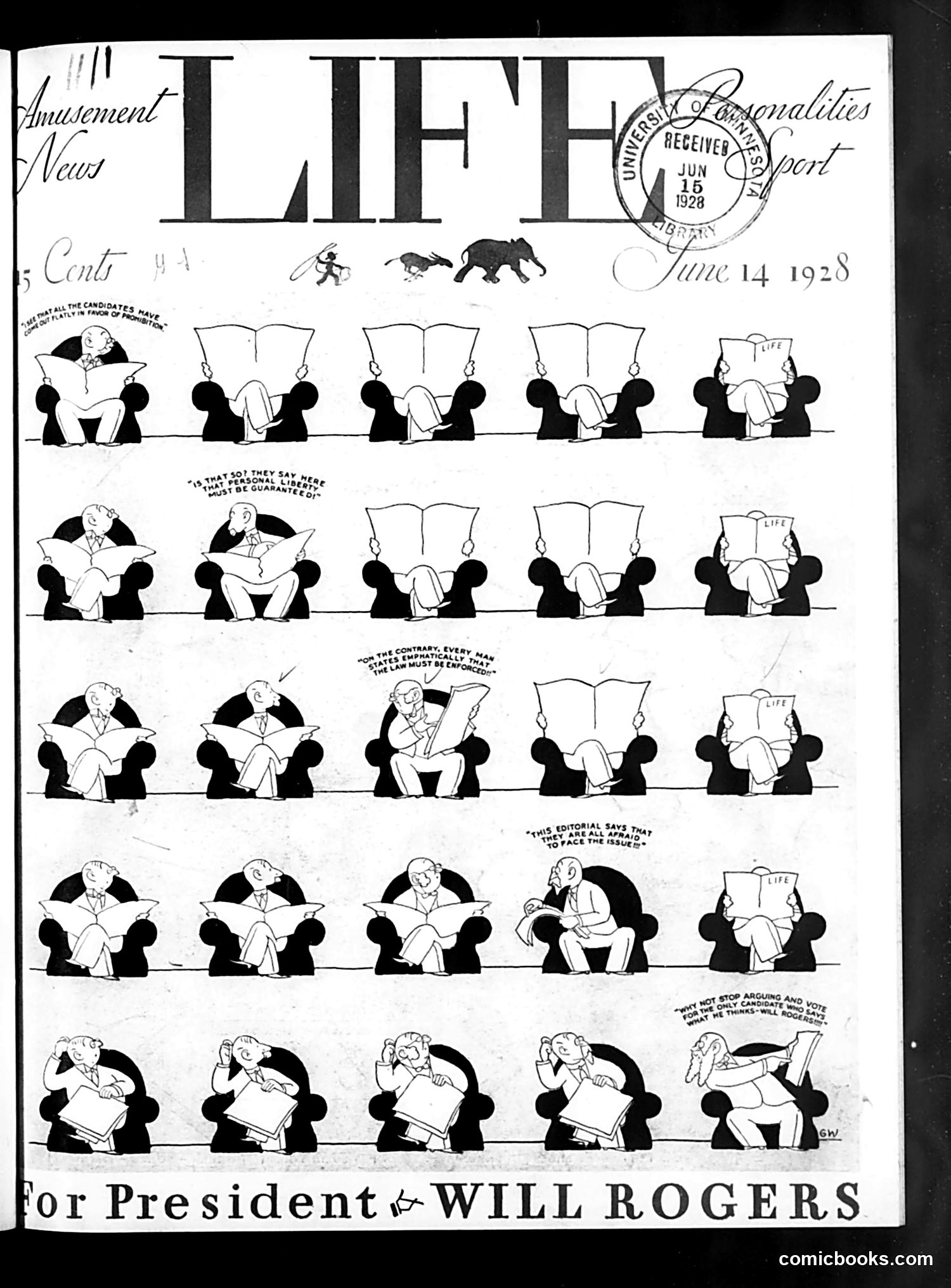
This *Life* magazine page from June 14, 1928 is a satirical campaign advertisement promoting humorist and entertainer Will Rogers for president. The sequential comic panels depict Rogers sitting among what appear to be political operatives or advisors, showing him progressively becoming frustrated or exasperated through various poses—reading documents, gesturing, appearing distressed. The satire suggests that even a witty outsider like Rogers would be driven to despair by the demands and contradictions of American politics and governance. The final panel shows him apparently fleeing or collapsing, implying that no reasonable person could survive the political process intact. This reflects 1928 satirical commentary on political absurdity, using Rogers's well-known populist humor to mock the establishment.
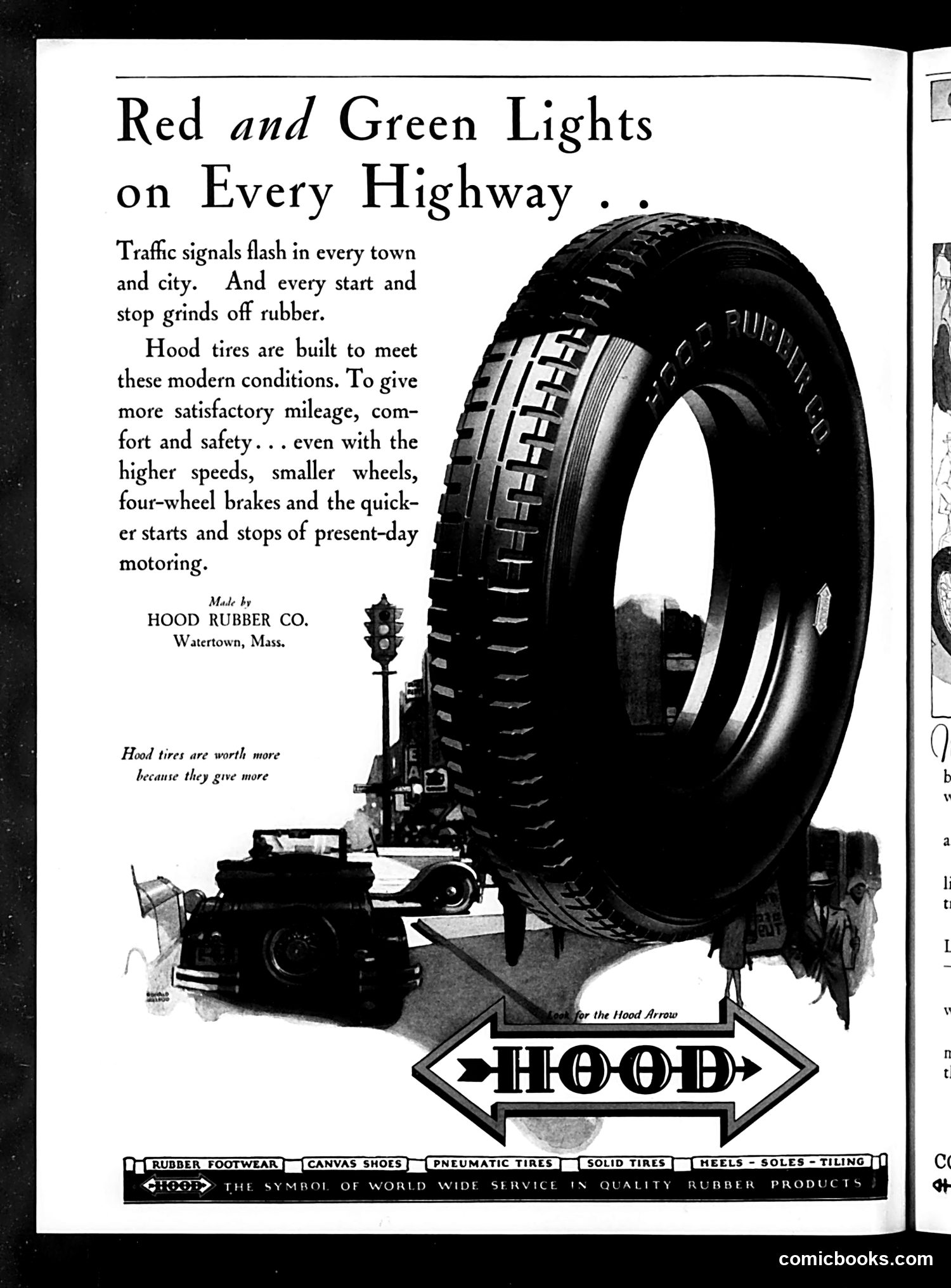
This is **not a satirical cartoon** but rather a **straightforward advertisement** for Hood Rubber Company tires, made in Watertown, Massachusetts. The ad promotes Hood tires as specially engineered for modern driving conditions—specifically the frequent stops and starts caused by traffic signals ("red and green lights on every highway"). The image shows a massive tire next to a tiny car with a traffic light, visually emphasizing the tire's durability and importance. The tagline states "Hood tires are worth more because they give more," positioning the product as superior for contemporary urban and highway driving. The bottom credits rubber products including footwear, canvas shoes, and pneumatic tires. This represents typical early-to-mid 20th century automobile advertising, not political satire.
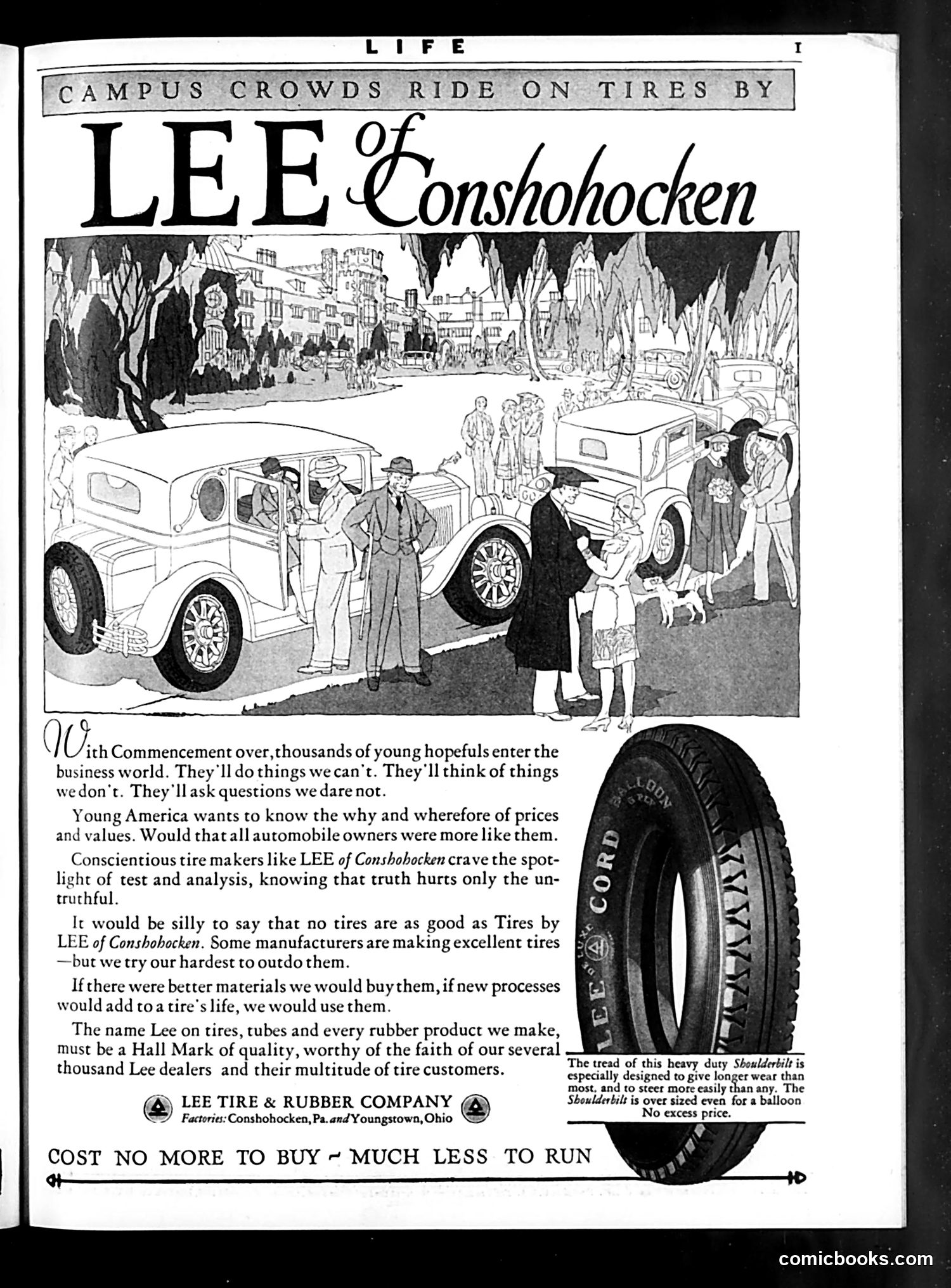
This is primarily **advertising**, not satire. It's a full-page ad for LEE Tire & Rubber Company promoting their "Conshohocken" tire brand (manufactured in Conshohocken, Pennsylvania and Youngstown, Ohio). The illustration shows a campus scene with well-dressed young people arriving by automobile, establishing the product's association with youth and modernity. The accompanying text uses a clever rhetorical strategy: it flatters young people's critical thinking while claiming LEE tires invite "spotlight of test and analysis," positioning the brand as transparent and quality-focused. The ad argues LEE tires offer unmatched value ("Cost no more to buy, much less to run"), and includes an image of the actual tire product on the right. This appears to be from Life magazine's early commercial advertising period.
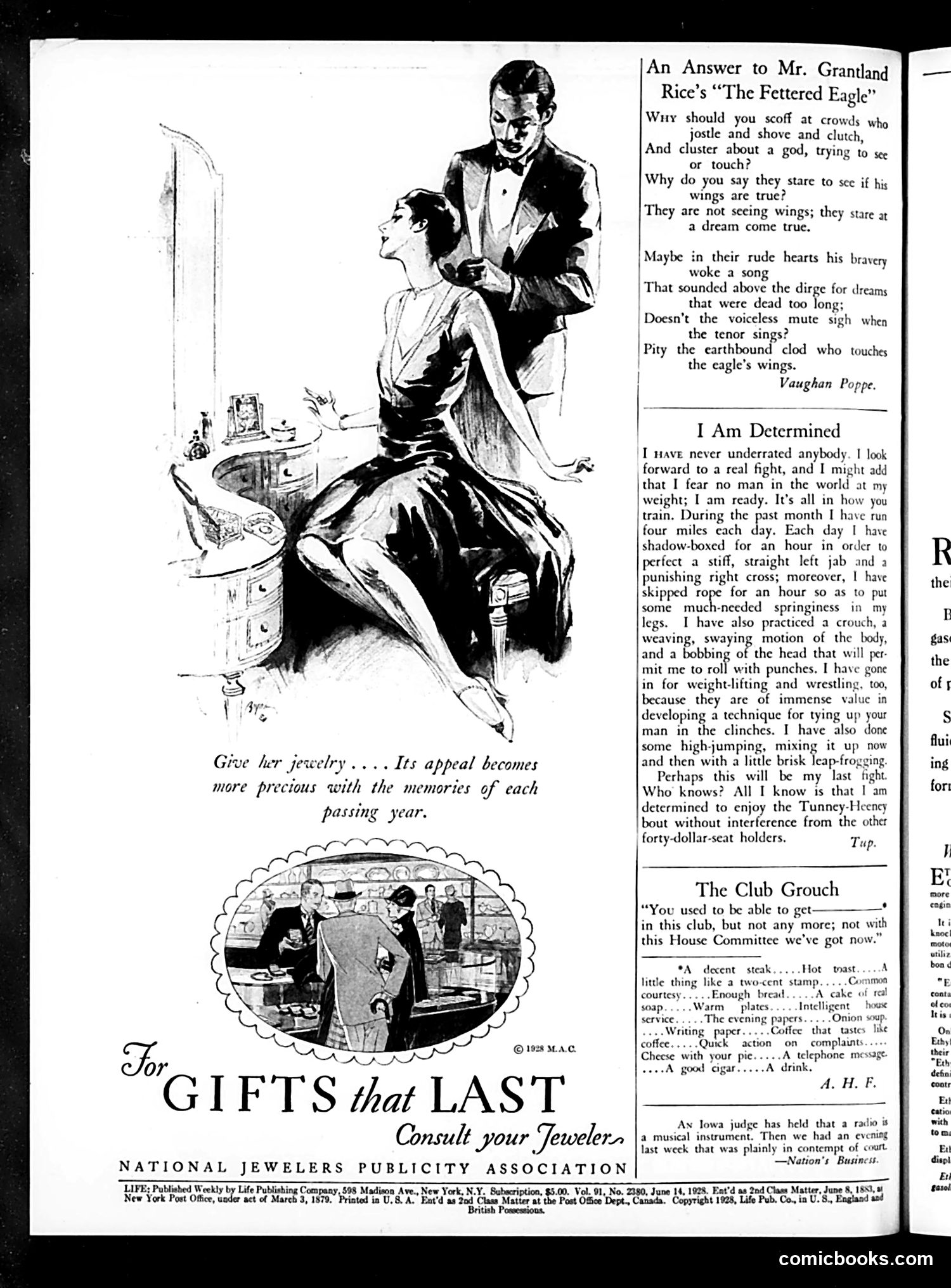
This page (June 11, 1928) contains primarily **advertising and reader content** rather than political satire. The main illustration shows a couple in evening wear with jewelry, accompanying a jewelry advertisement encouraging gift-giving. The caption emphasizes jewelry's sentimental value over time. The right column features reader submissions: "An Answer to Mr. Grantland Rice's 'The Fettered Eagle'" is a poem responding to Rice's sports commentary, "I Am Determined" describes a boxer's training regimen, and "The Club Grouch" lists humorous club complaints using a fill-in-the-blank format. These are typical **Life magazine reader participation features**—lighthearted commentary on contemporary life rather than sharp political satire. The content reflects 1920s concerns: boxing, social clubs, and consumer goods.
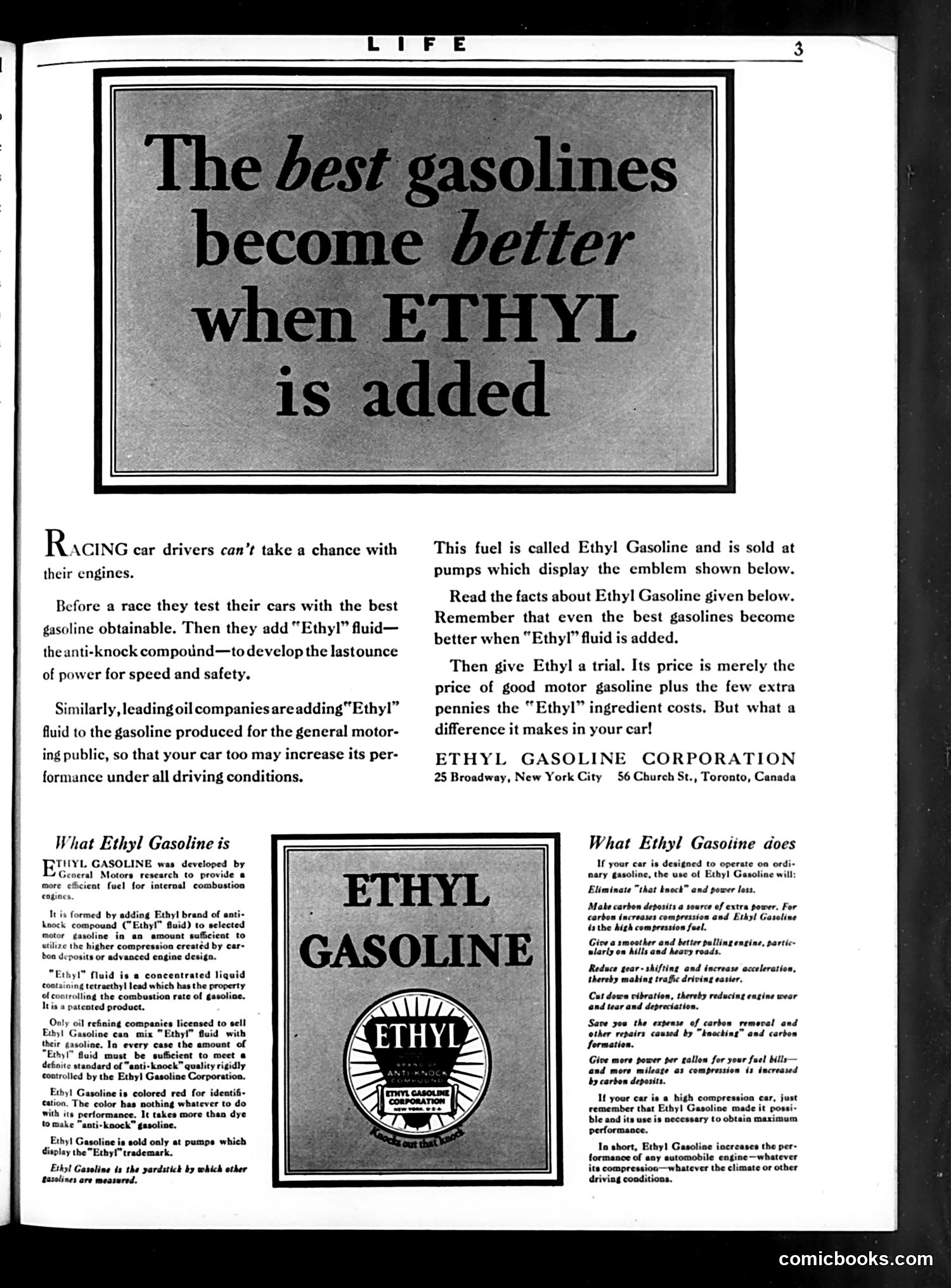
This page is **primarily an advertisement**, not satire or political commentary. It promotes Ethyl Gasoline, a commercial fuel product from the Ethyl Gasoline Corporation (addresses given: New York City and Toronto). The ad uses racing culture as its appeal angle—claiming that race car drivers add "Ethyl" fluid to their engines for better performance, and that oil companies are now adding it to consumer gasoline. The implicit message: if it's good enough for professional racers, it's good enough for you. The circular emblem serves as brand identification rather than satirical commentary. This represents straightforward early-20th-century product marketing leveraging motorsport prestige to sell fuel additives to the general public.
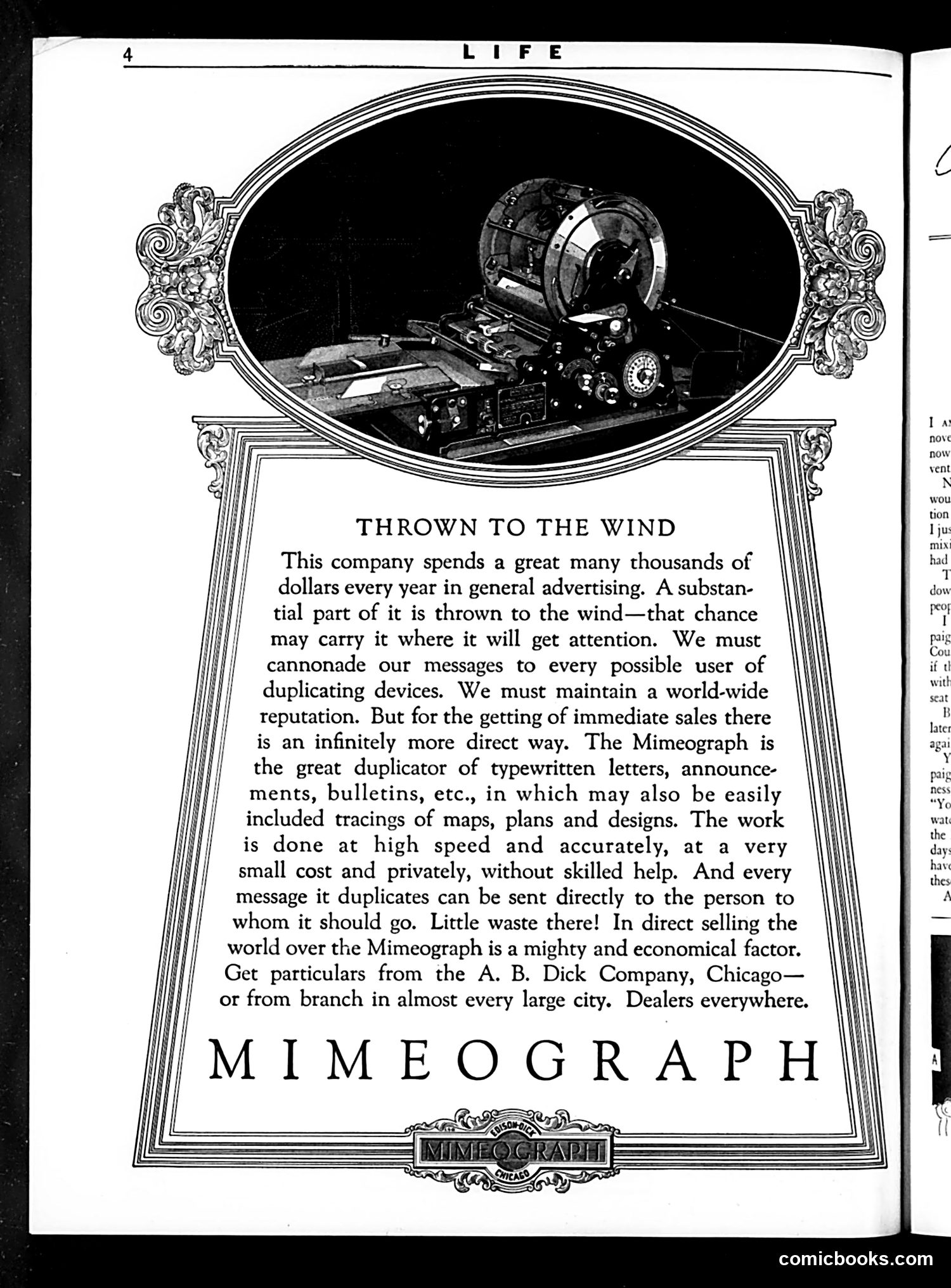
This page is primarily a **advertisement for the Mimeograph machine**, not satire or political commentary. The ornate framed image shows the device itself—a duplicating machine used for copying typed documents. The headline "Thrown to the Wind" uses a metaphorical critique of traditional advertising, contrasting wasteful broad advertising spending with the Mimeograph's efficiency for **direct mail marketing**. The text argues that while companies spend heavily on general advertising (much "thrown to the wind"), the Mimeograph offers a more economical, targeted approach to reaching customers directly. This reflects early 20th-century business thinking about marketing efficiency. The A.B. Dick Company (Chicago manufacturer) is credited as the vendor. The advertisement emphasizes speed, accuracy, low cost, and privacy—selling the Mimeograph as a practical business tool for cost-conscious companies.
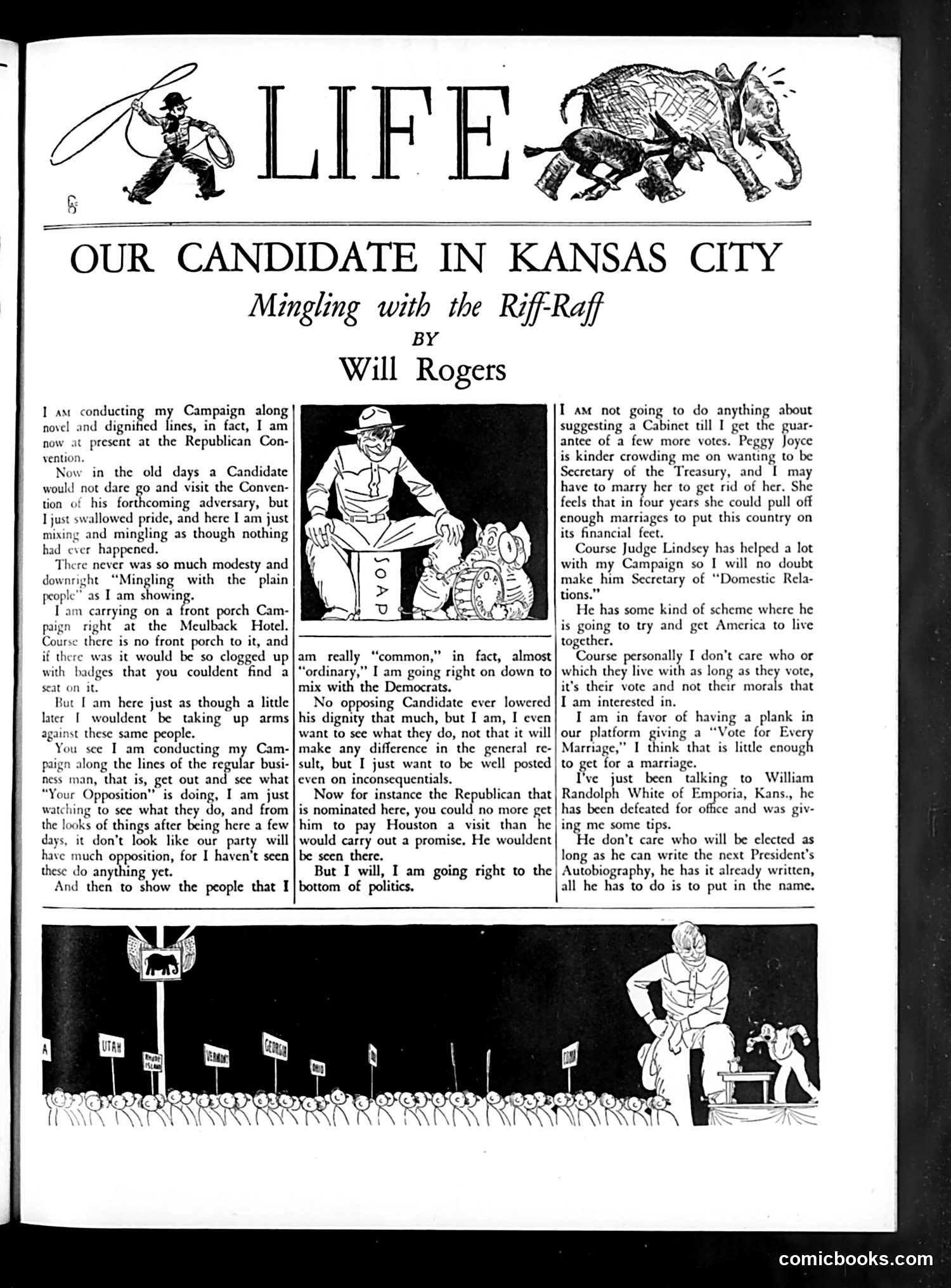
This article presents Will Rogers' humorous commentary on an unnamed Republican presidential candidate attending the Kansas City convention. Rogers adopts a mock-serious tone, claiming to conduct a "novel and dignified" campaign while actually "mixing and mingling" with ordinary people at the Muellback Hotel. Rogers satirizes the candidate's claimed modesty and common touch. He jokes about Peggy Joyce (likely a society figure), Judge Lindsey's involvement, and references William Randolph White of Emporia, Kansas—a defeated candidate whom Rogers mocks for already planning his autobiography. The satire targets both the candidate's performative populism and the political establishment's genuine disconnection from voters, questioning whether opposition candidates will truly differ from the Republican nominee.
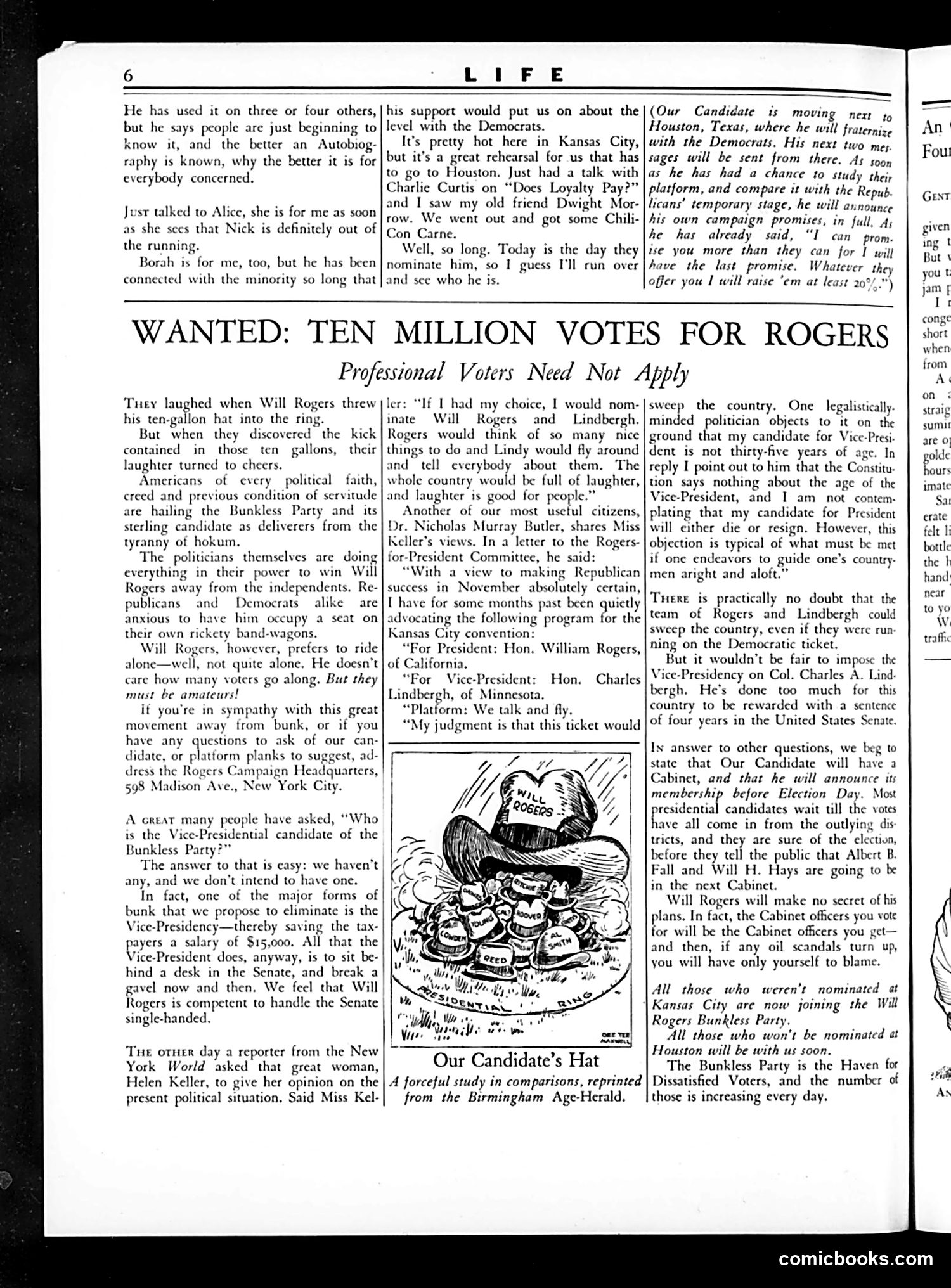
This page satirizes the "Bunkless Party," a fictitious political movement supporting Will Rogers for President. The central cartoon depicts Rogers's cowboy hat overflowing with various items—likely representing the diverse, chaotic collection of supporters and ideas backing this unconventional candidacy. The satire mocks serious politics by proposing Rogers, the famous humorist and entertainer, as a genuine alternative to establishment candidates. The text humorously argues Rogers could outperform traditional politicians, while noting the absurdity that professional voters "need not apply." The cartoon's visual joke—a hat bursting with contents—suggests the campaign is overstuffed with unrealistic promises or mismatched supporters. This represents Life magazine's characteristic use of visual humor to critique American politics and public gullibility toward celebrity candidates.
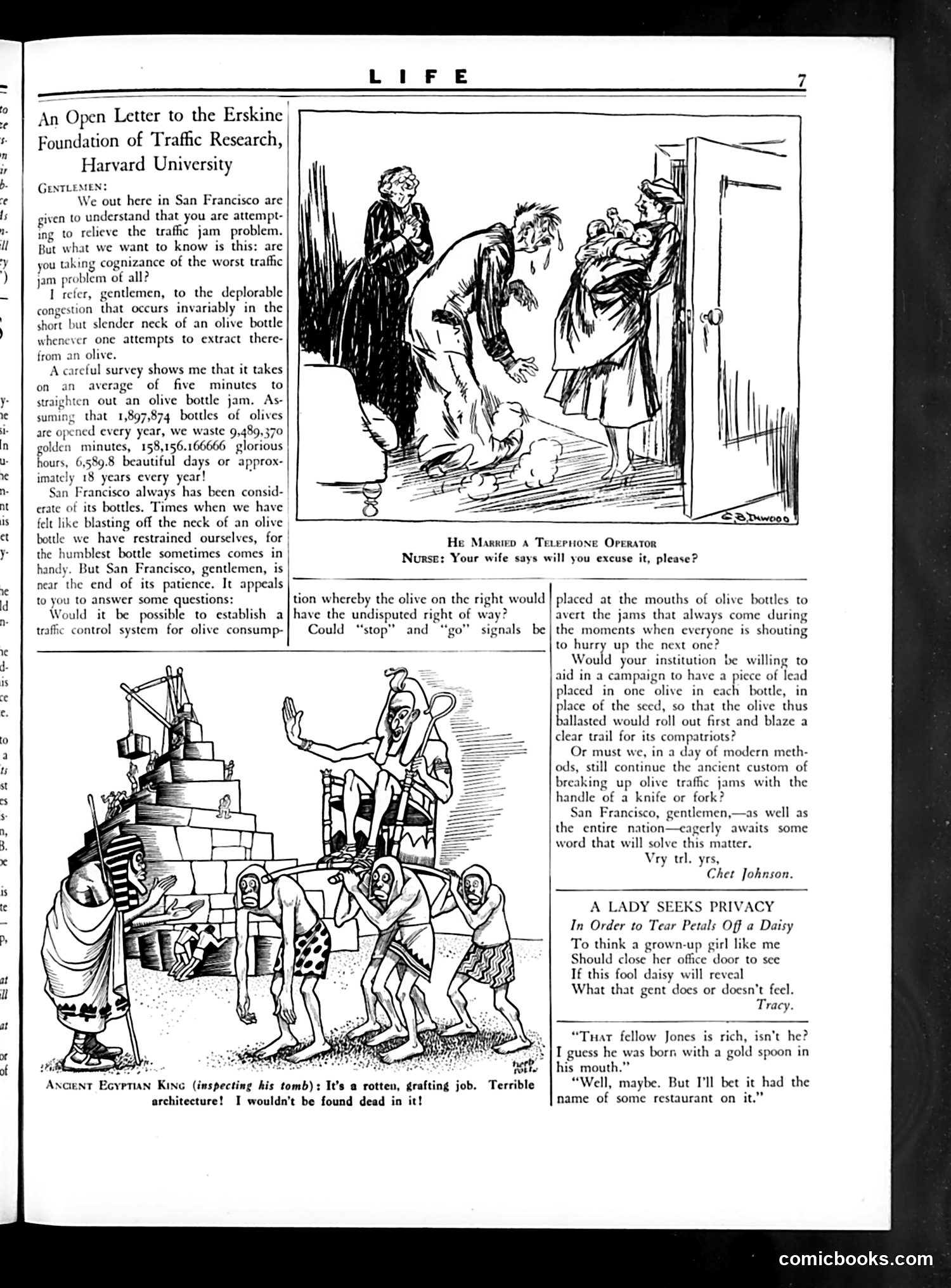
This page contains three separate satirical pieces: 1. **"Open Letter on Olive Bottle Traffic"**: A humorous complaint about San Francisco's traffic congestion caused by olive bottles stuck in the street. The writer calculates wasted time annually and proposes absurd solutions (stop/go signals for olives, lead weights in bottles). It's satire mocking both traffic problems and the tendency to over-engineer trivial issues. 2. **Top cartoon**: Shows a man arriving home late, with his nurse telling him his wife (a telephone operator) will excuse the delay. The joke satirizes the modern phenomenon of wives working in new industries like telephone operation, creating domestic complications. 3. **Bottom cartoon**: Depicts an Egyptian king inspecting his tomb, finding it in poor condition—satirizing ancient Egypt's grand ambitions versus actual decay.
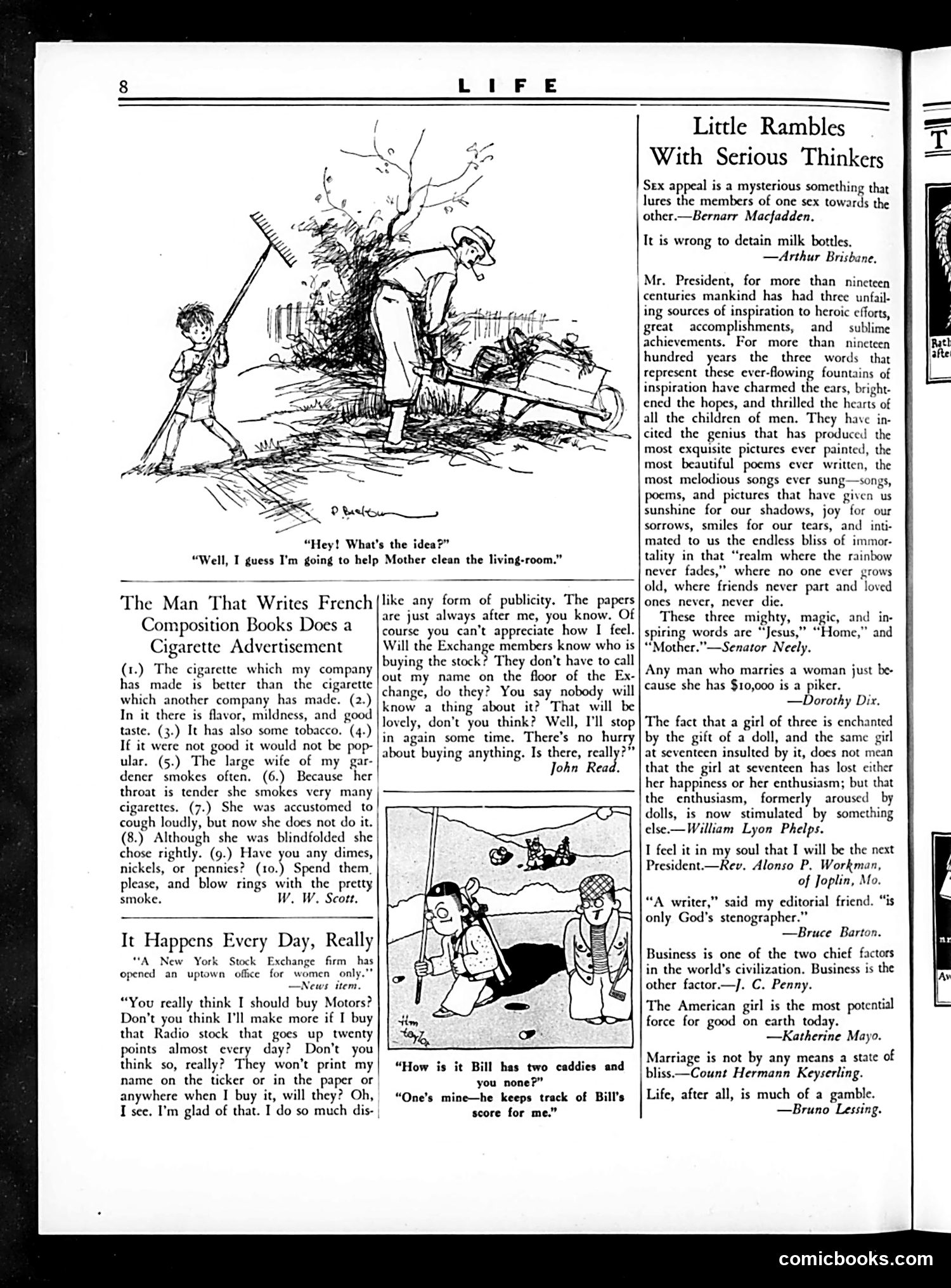
This page contains three separate humorous pieces rather than a unified cartoon: 1. **"Hey! What's the idea?"** - A sketch showing a child proposing to help mother clean the living room, likely satirizing children's reluctant chores. 2. **"The Man That Writes French... Does a Cigarette Advertisement"** - A satirical article mocking a man who boasts about his company's superior cigarettes while paradoxically promoting them through advertising. The numbered points humorously contradict his claims (better taste, yet his wife smokes and coughs). 3. **"It Happens Every Day"** - A brief anecdote about a stock exchange employee suggesting buying Radio stock, satirizing financial overconfidence and the tendency to recommend investments without considering consequences. The page primarily uses written humor rather than visual satire, targeting pretension, consumerism, and financial speculation—common targets of *Life* magazine's satirical approach.
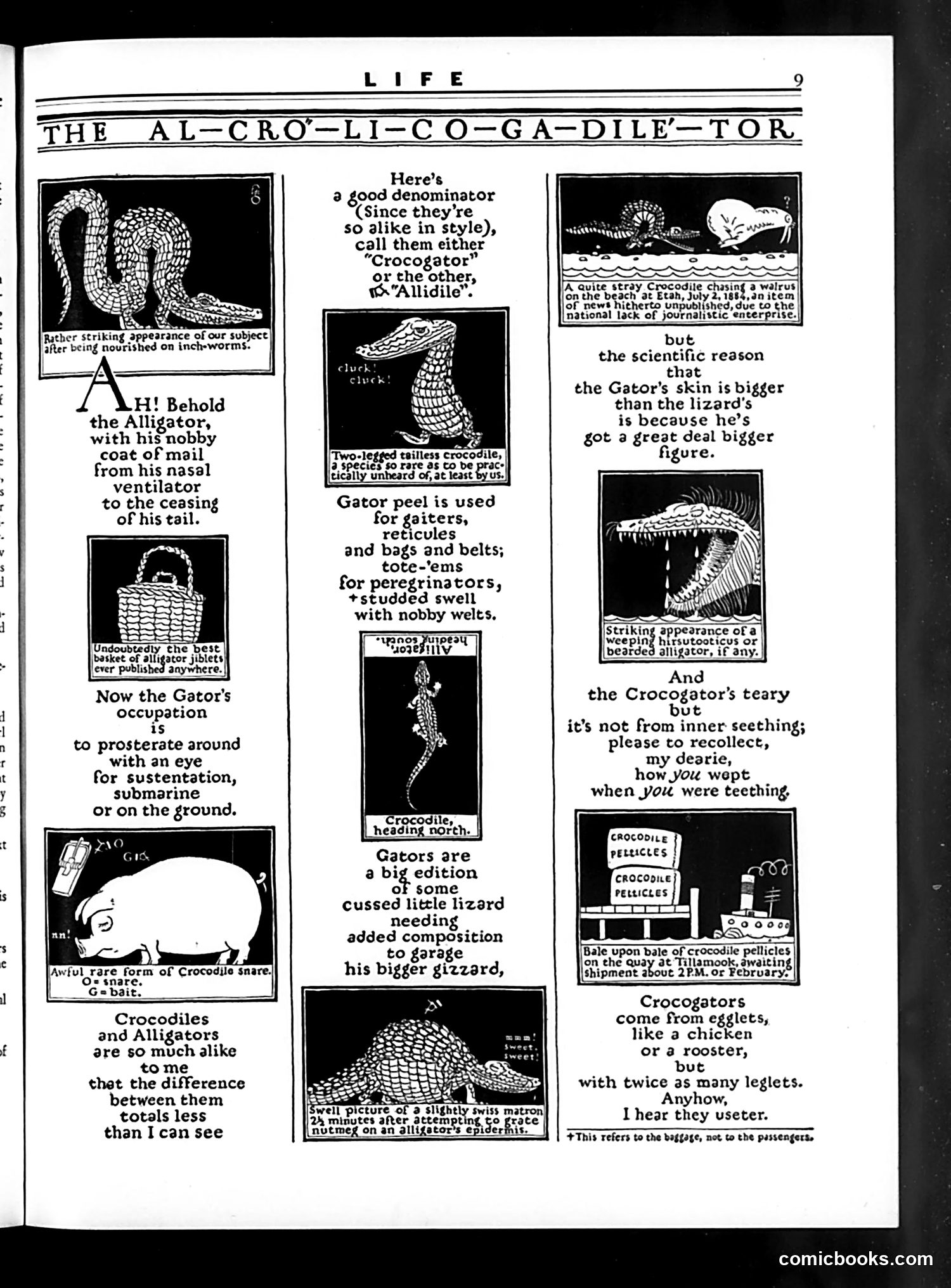
This is a humorous natural history feature about alligators and crocodiles, playing on their similar appearances. The article explains the differences between the two reptiles through illustrations and rhyming verse—notably that alligators have broader snouts and bigger bodies than crocodiles. The satire here appears directed at *journalistic enterprise itself*: one caption mockingly notes "the national lack of journalistic enterprise" regarding a crocodile sighting. The piece pokes fun at sensationalized nature reporting and the obsessive documentation of wildlife trivia. The numerous detailed illustrations of alligator and crocodile anatomy, behavior, and commercial uses (belts, bags, gaiters) underscore how thoroughly—almost absurdly—Life magazine treats this zoological comparison, turning a simple distinction into elaborate entertainment.
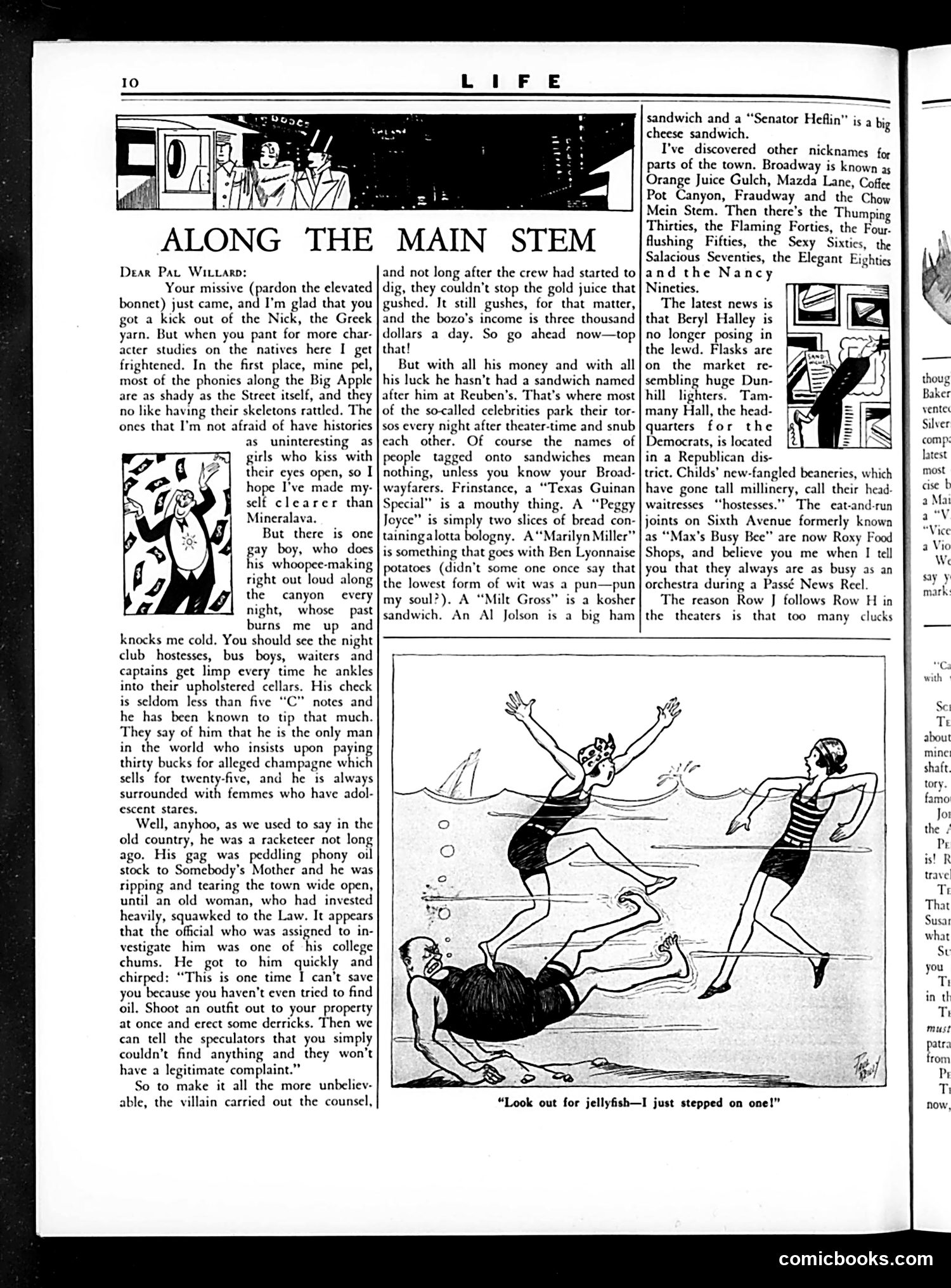
This is a humorous column by "Dear Pal Willard" about Broadway nightlife and entertainment venues. The main text discusses various sandwich names at establishments frequenting Broadway performers and socialites—references like "Senator Heflin," "Texas Guinan Special," and "Marilyn Miller" appear to be named after real celebrities of the era. The accompanying cartoon depicts bathers at what appears to be a public beach, with the caption "Look out for jellyfish—I just stepped on one!" The humor relies on a visual pun: one prone figure on the sand resembles a jellyfish to someone swimming. The column satirizes the interconnected world of Broadway nightlife, celebrity culture, and the absurdities of tipping culture among waiters and club hostesses in 1920s New York.
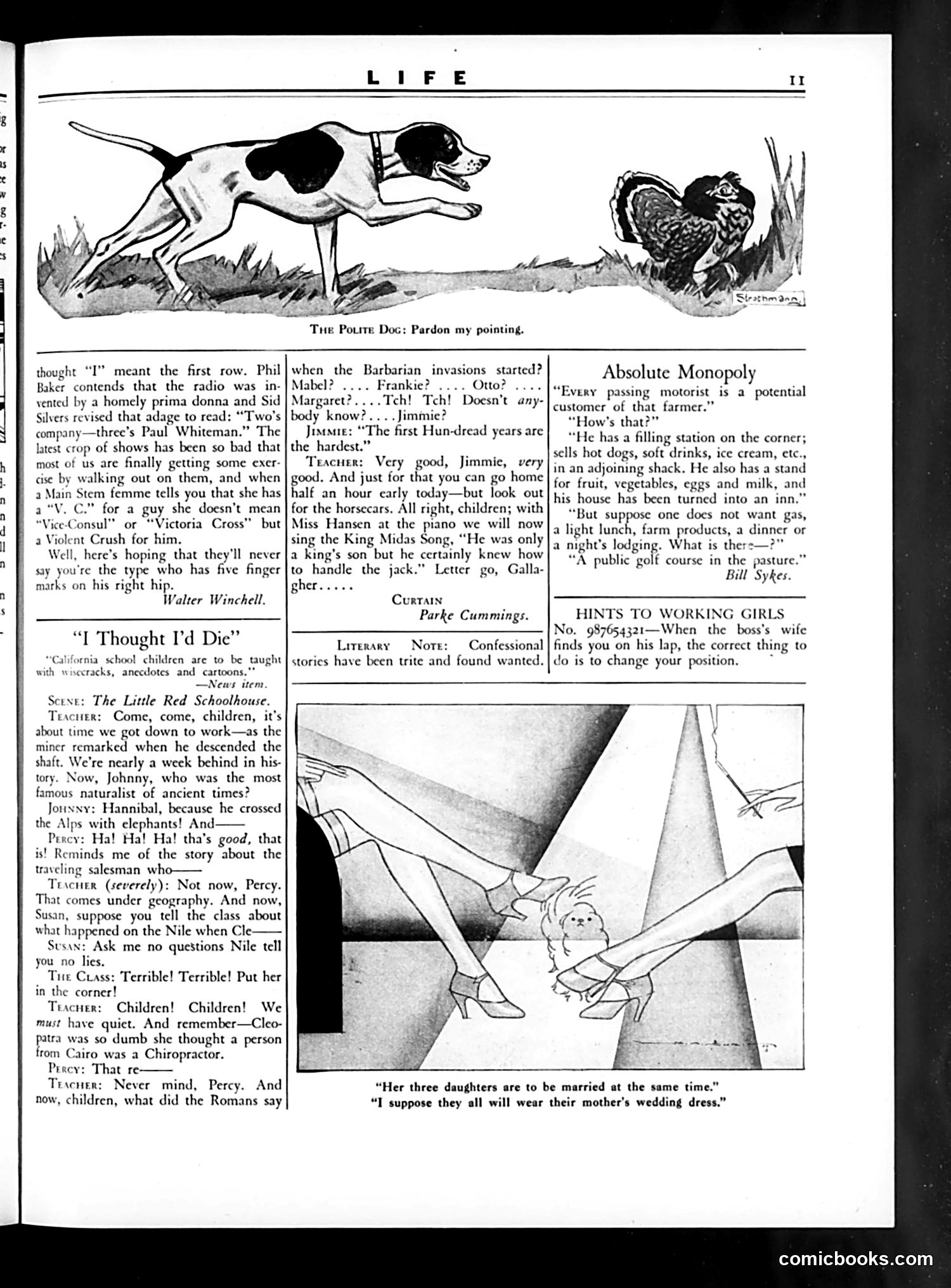
This page contains several unrelated humor pieces typical of Life magazine's format: **Top illustration**: "The Pointe Dog: Pardon my pointing" - a simple gag showing a hunting dog pointing at game, with the joke being a pun on "pointing." **Middle sections**: Dialogue snippets and anecdotes, including a classroom scene from "The Little Red Schoolhouse" where a teacher corrects students' historical knowledge, and a literary note about confessional stories. **Bottom cartoon**: Shows a mother with three daughters, joking that all three will wear "their mother's wedding dress" at their simultaneous weddings—the humor being either about the dress's durability or implications about the daughters' circumstances. **Right column**: Includes "Absolute Monopoly" (about a farmer who sells from his property) and "Hints to Working Girls" advice. The content reflects 1920s-era humor: light domestic comedy, schoolroom farce, and gentle social observation rather than sharp political satire.
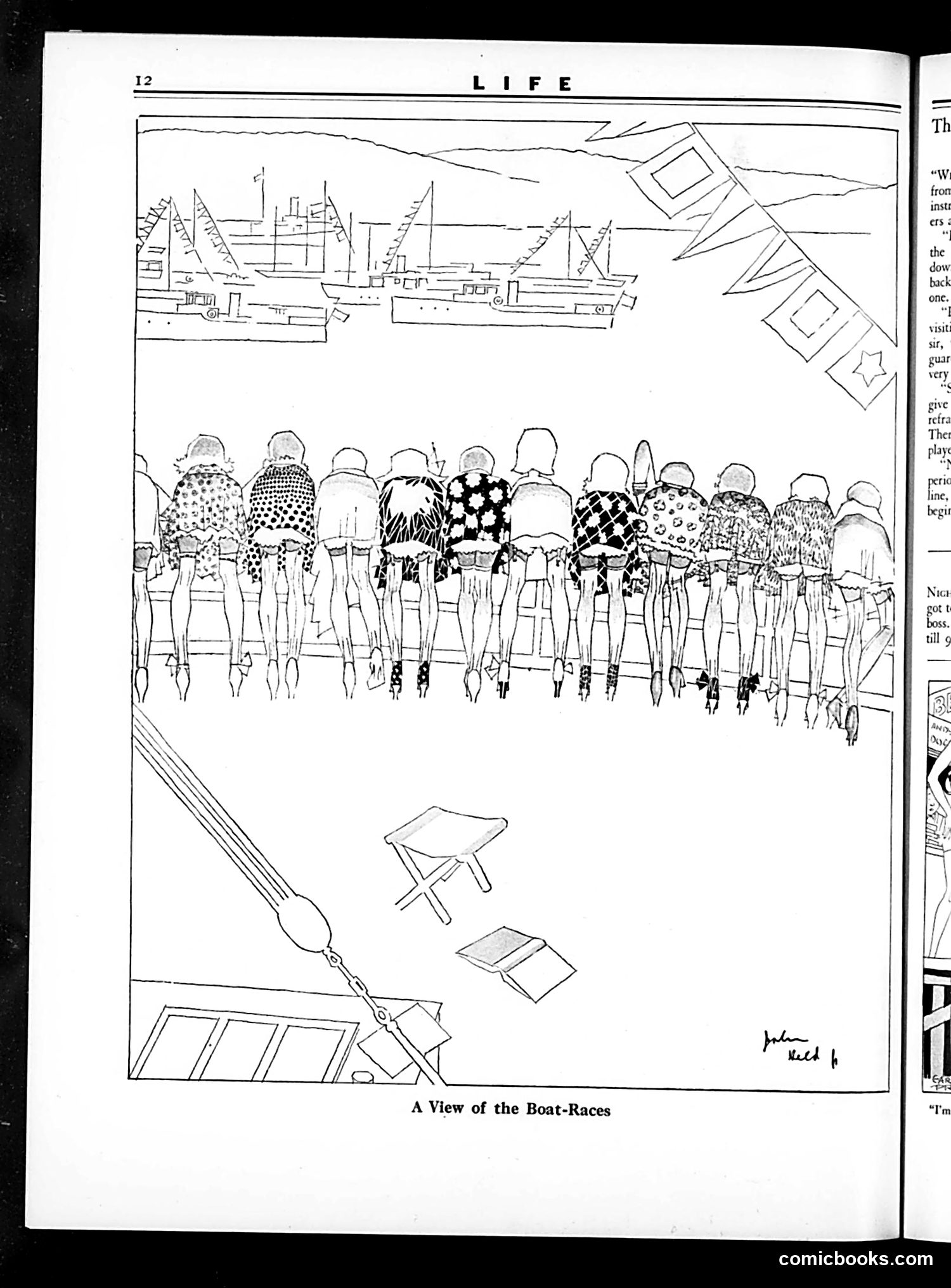
This illustration shows a large group of uniformed figures viewed from behind, standing in a line facing distant boats on water. The figures wear various patterned swimming costumes or bathing suits with different designs (polka dots, checks, stripes, etc.) and caps. In the foreground, beach equipment—a buoy, folding chair, and towels—suggests a seaside setting. The cartoon appears to satirize spectators at a boat race event, likely poking fun at the fashionable variety of beachwear worn by attendees or participants. The uniform positioning and repetitive nature of the figures may mock crowd behavior or the conformity of leisure activities. Without additional context or visible text identifying specific social commentary, the precise satirical target remains unclear, though it likely relates to early 20th-century recreational culture and fashion.
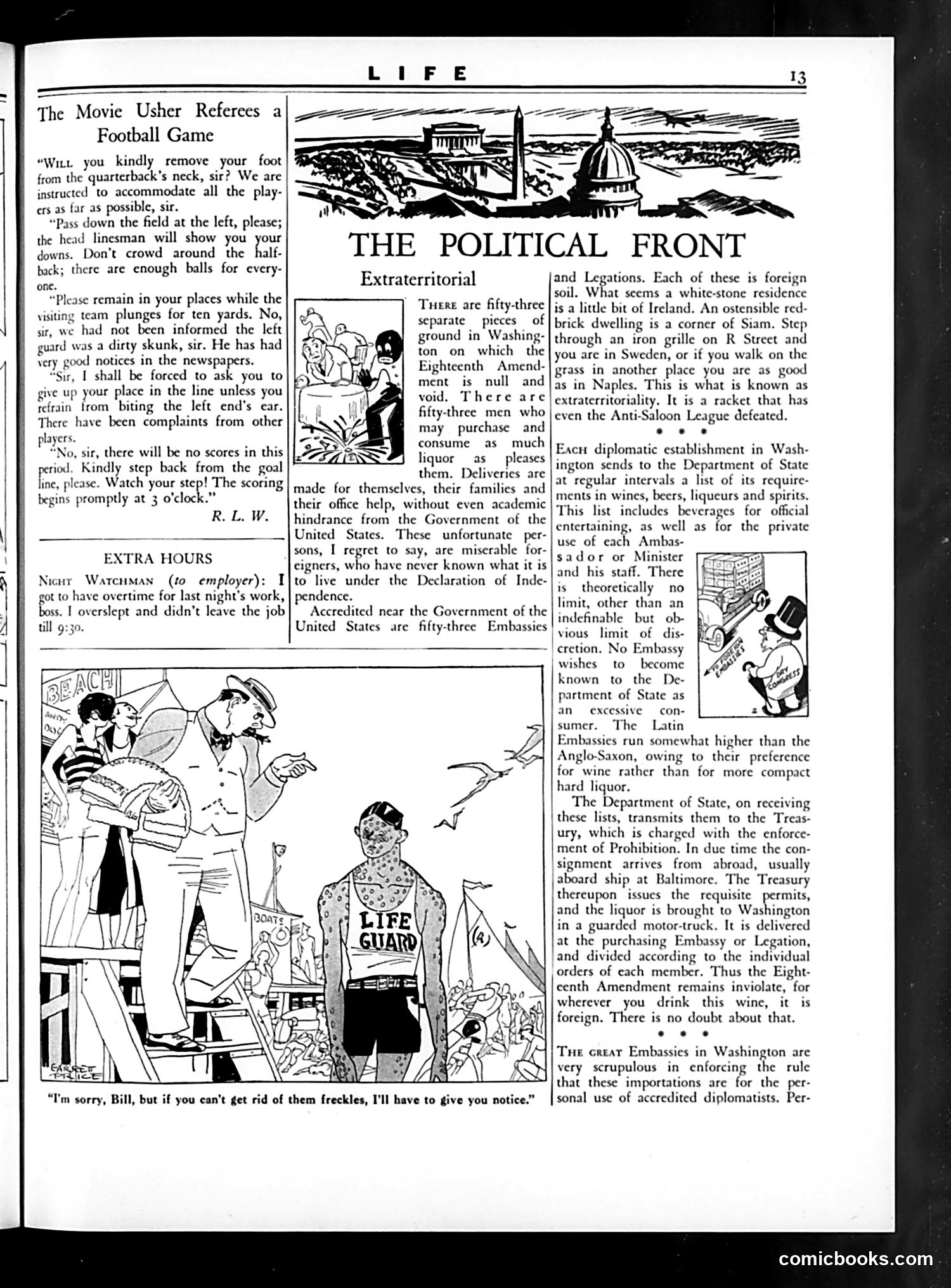
This page contains three distinct humor pieces satirizing American life during Prohibition. **"The Movie Usher Referees a Football Game"** mocks the literal-minded application of usher rules to football, suggesting overzealous enforcement of order. **"The Political Front: Extraterritorial"** article criticizes the 53 foreign embassies in Washington, D.C., which operate outside U.S. law and can legally import alcohol despite Prohibition. The piece notes these diplomatic compounds become centers for drinking, with Latin American embassies preferring wine over "hard liquor." The satire highlights how wealthy foreigners and diplomats exploit legal loopholes while ordinary Americans face enforcement of the Eighteenth Amendment. **The beach cartoon** shows a lifeguard confronting a freckled boy, with the caption joking about removing "freckles"—a lighthearted jab at summer beach culture. The overall theme: Prohibition's selective enforcement based on status and nationality.
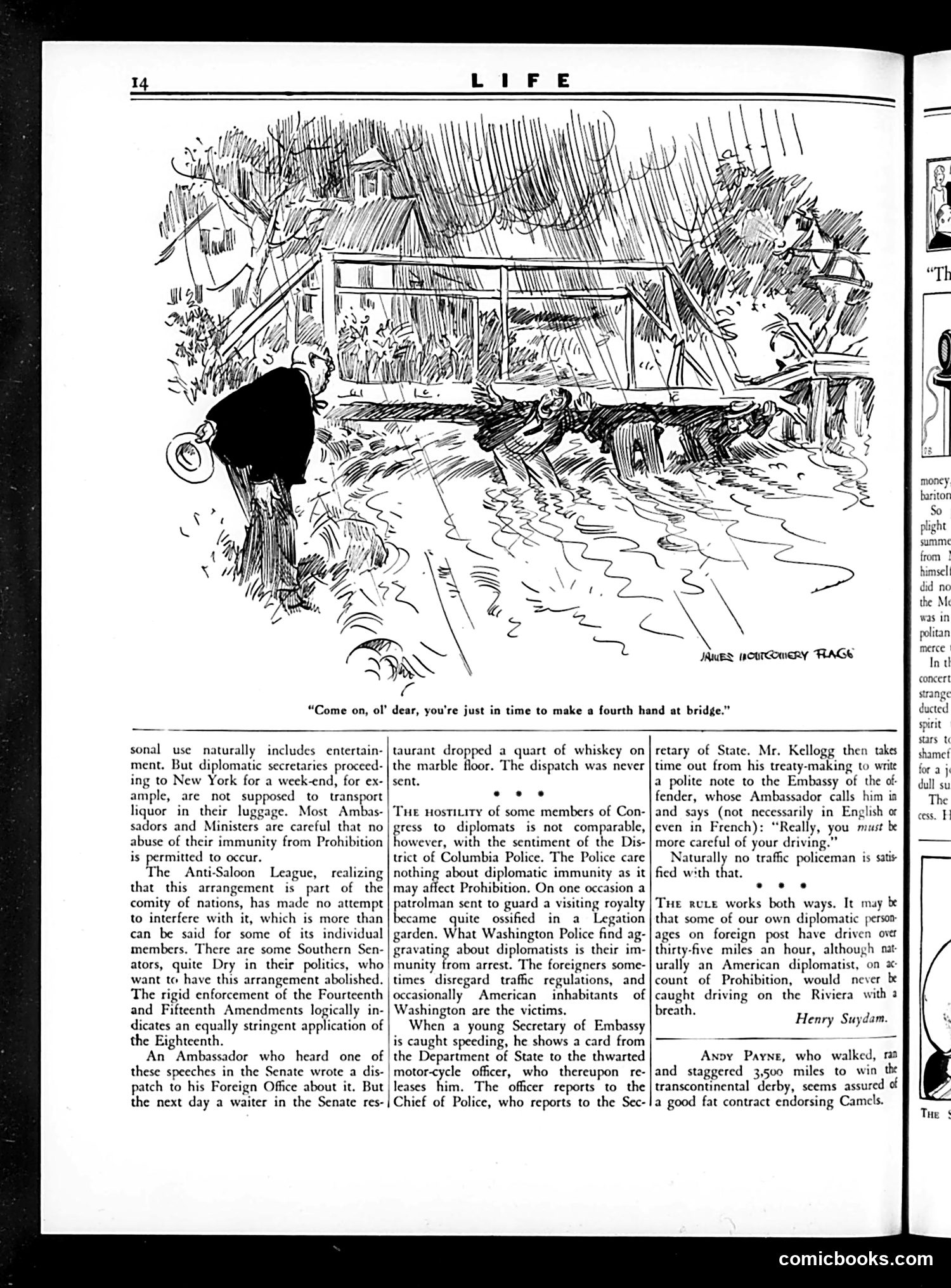
The cartoon by James Montgomery Flagg depicts a rainy scene where a figure in formal attire (likely a diplomat) is being called to play bridge. The caption reads: "Come on, ol' dear, you're just in time to make a fourth hand at bridge." The surrounding text discusses **diplomatic immunity and Prohibition enforcement**. It satirizes how diplomats, protected by immunity, could violate American laws—particularly traffic regulations and Prohibition—without consequence. The cartoon jokes that while diplomats cause serious problems in Washington, they're socially welcomed to leisure activities like bridge. The humor targets the hypocrisy of treating diplomats as both lawbreakers and social equals, highlighting tensions between diplomatic privilege and American law enforcement during the Prohibition era (1920-1933).
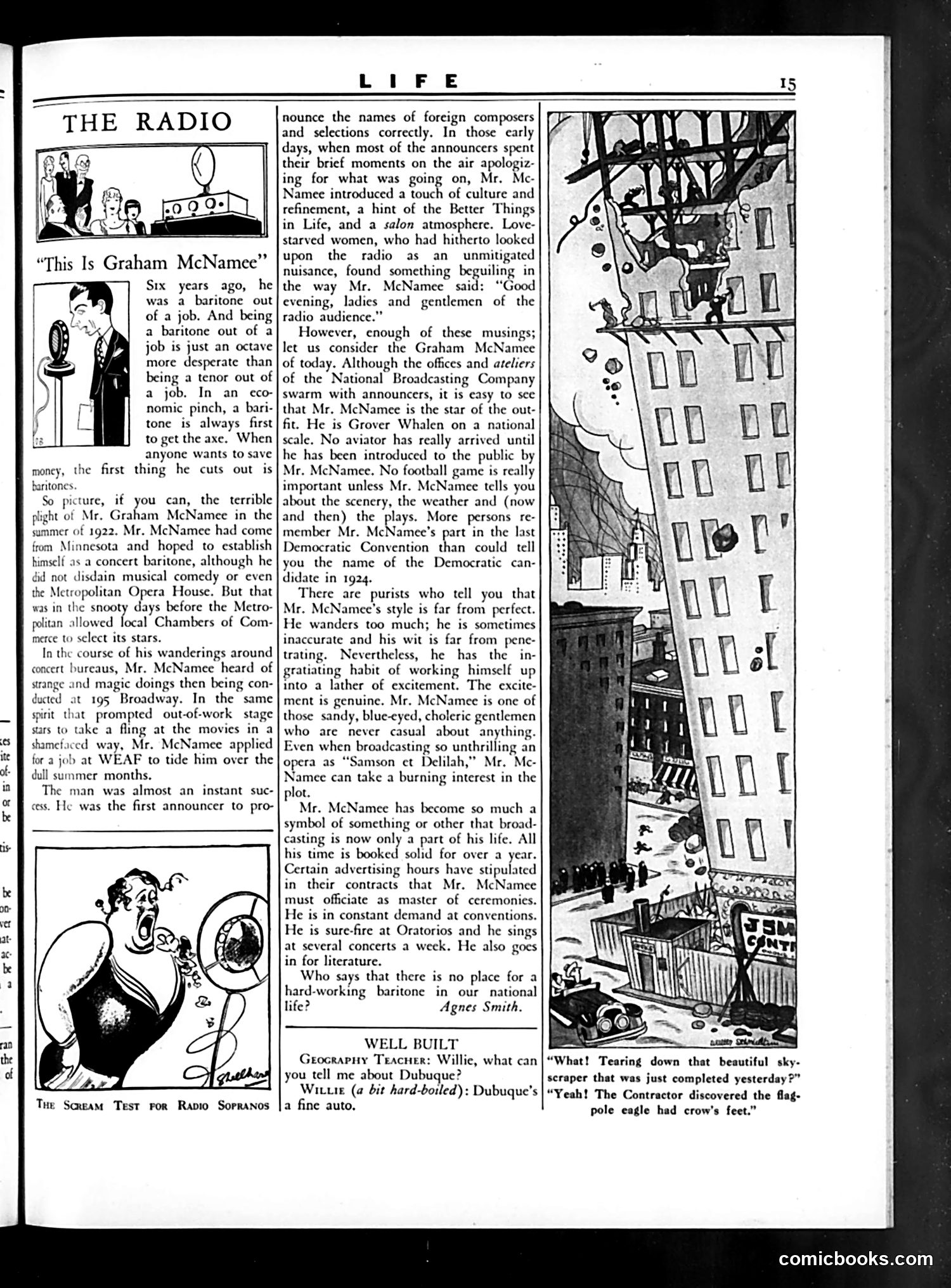
This page celebrates **Graham McNamee**, a pioneering radio announcer of the 1920s. The article describes how McNamee elevated radio broadcasting from mere technical novelty to an art form, introducing culture and refinement to early radio audiences. The cartoons mock radio sopranos—the "Scream Test for Radio Sopranos" shows a woman shrieking into a microphone, satirizing the sometimes-overwrought vocal performances common in early radio broadcasting. The right illustration depicts urban listeners in an apartment building gathering around their radio sets, showing how radio was binding communities together during this era. McNamee is celebrated as radio's first major celebrity personality, having covered major events like the 1924 Democratic Convention.
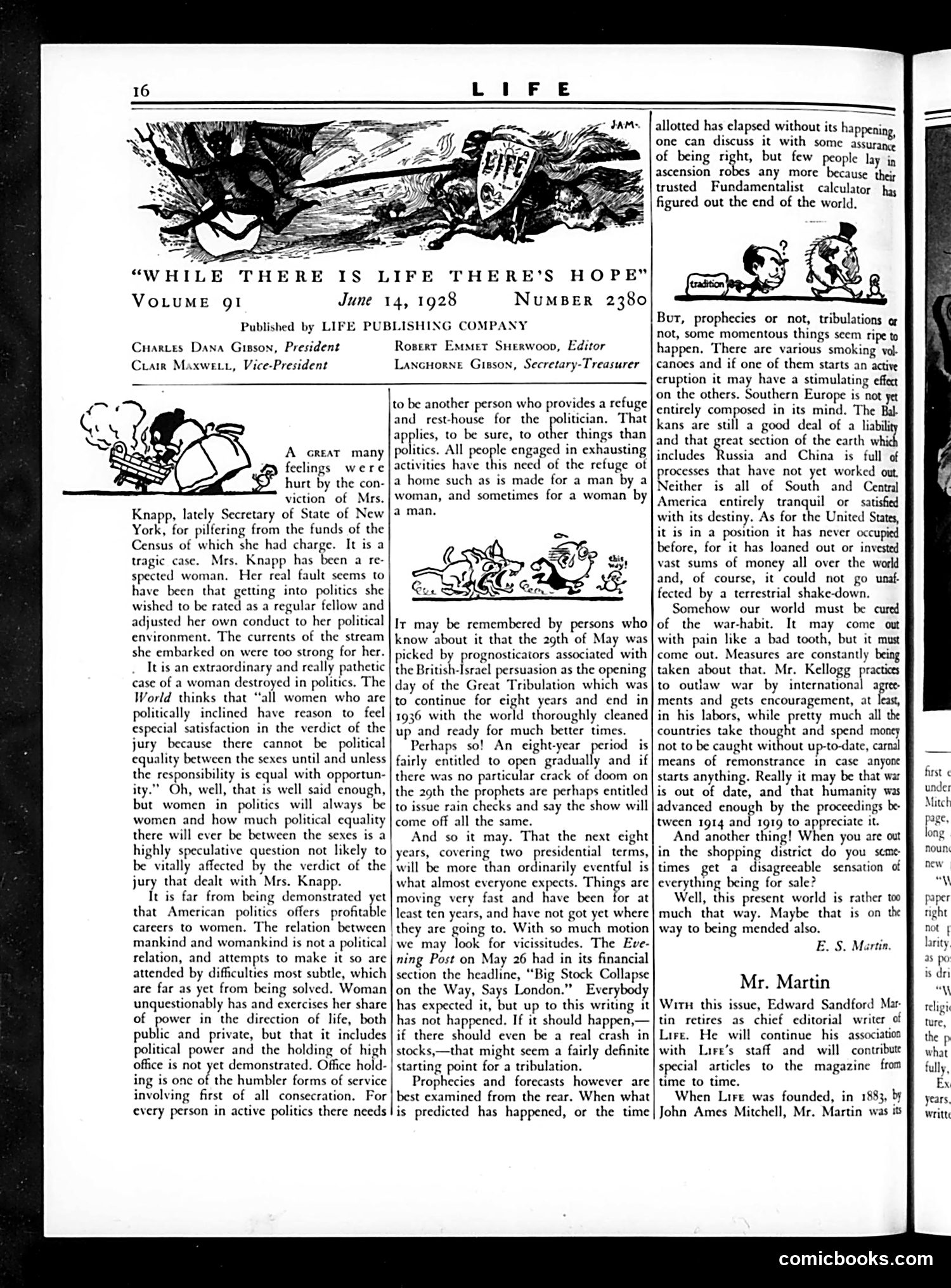
The main cartoon depicts a sleeping figure labeled "LIFE" being guarded or observed. The accompanying article criticizes Mrs. Knapp, formerly Secretary of State of New York, for allegedly misusing Census funds. The text satirizes her attempt to pursue politics while maintaining respectability—suggesting she caused her own political downfall through overzealousness. The piece argues that women in politics face unique challenges and that true political equality remains unrealized. It appears to mock the hypocrisy of women who seek political power while being judged by different standards than men. The cartoon likely represents political complacency or false security—that "Life" magazine (or society generally) sleeps unaware while problems develop. The overall message combines criticism of specific political misconduct with broader commentary on gender inequality in American politics.
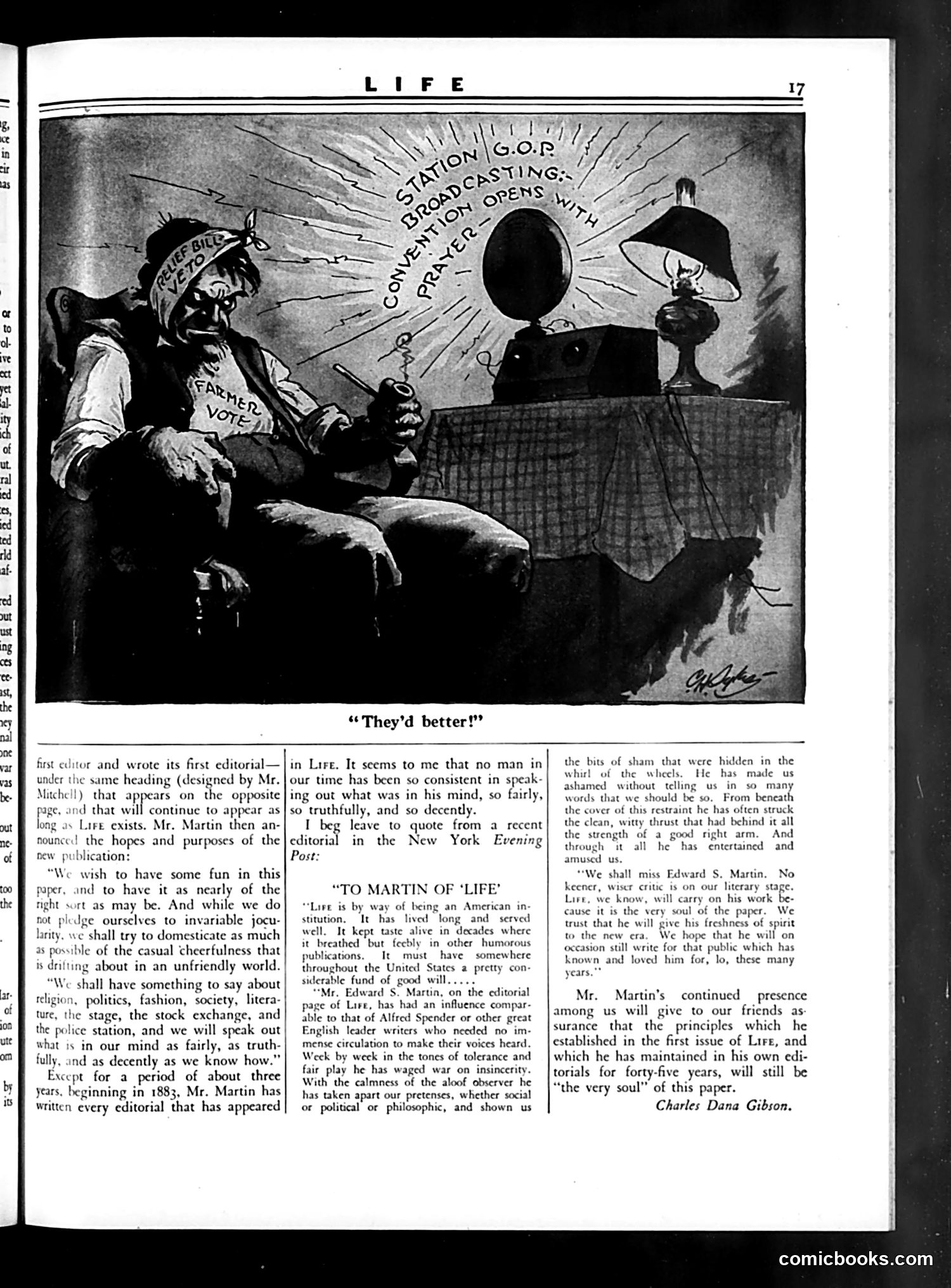
This cartoon satirizes Republican Party (GOP) radio broadcasting during a convention. A farmer labeled "Father Vote" listens to a radio broadcast where an unseen GOP representative speaks from a microphone marked with a large black circle. The burst of radiating lines suggests emphatic, grandiose speech. The cartoon's caption—"They'd better!"—suggests the farmer's skeptical demand that the GOP make good on promises. The satire mocks the GOP's reliance on radio propaganda to reach rural voters while implying their rhetoric is hollow. The farmer's suspicious posture and caption convey voter skepticism about political messaging, a timely critique of emerging mass-media campaign tactics in American politics during the early radio era.
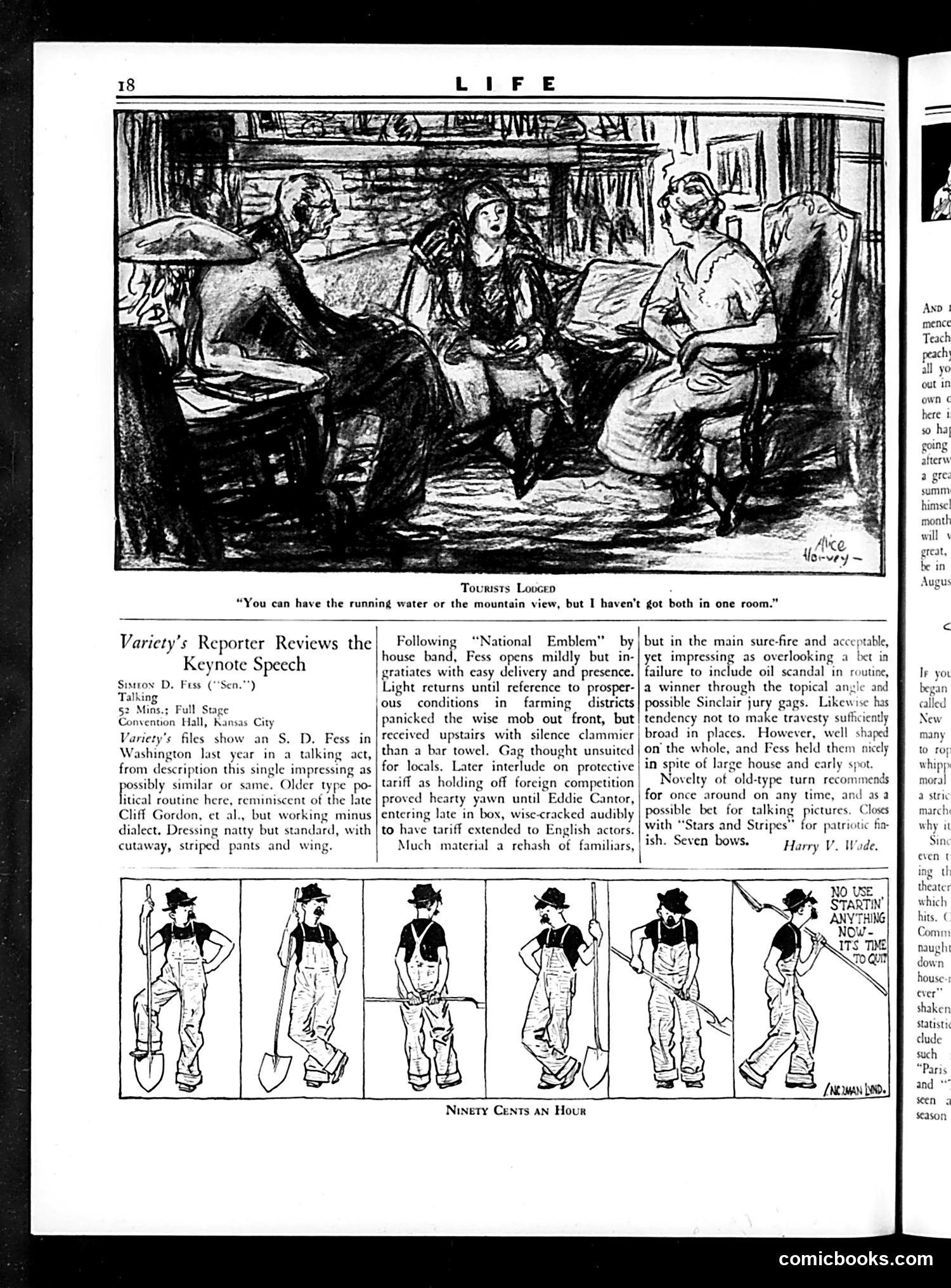
**Top Cartoon ("Tourists Loged")**: A hotel clerk explains to frustrated guests that their room offers either running water OR a mountain view, but not both. This satirizes poor accommodations at tourist lodgings—a common complaint about American hotels of the era. The joke mocks both the inadequacy of facilities and the clerk's matter-of-fact acceptance of substandard conditions. **Middle Section**: A theater review of Senator Simon D. Fess's keynote speech, written in Variety magazine's vaudeville-review style. The critic treats the political speech as entertainment, noting Fess's "easy delivery" but criticizing material as dated. A joke about Eddie Cantor extending tariff protections to English actors gets the only genuine laugh. The review suggests the speech relied on familiar material and avoided controversial topics like oil scandals. **Bottom Cartoon ("Ninety Cents an Hour")**: Six sequential illustrations of a laborer performing various digging/shoveling tasks. This appears to comment on manual labor wages during the period.
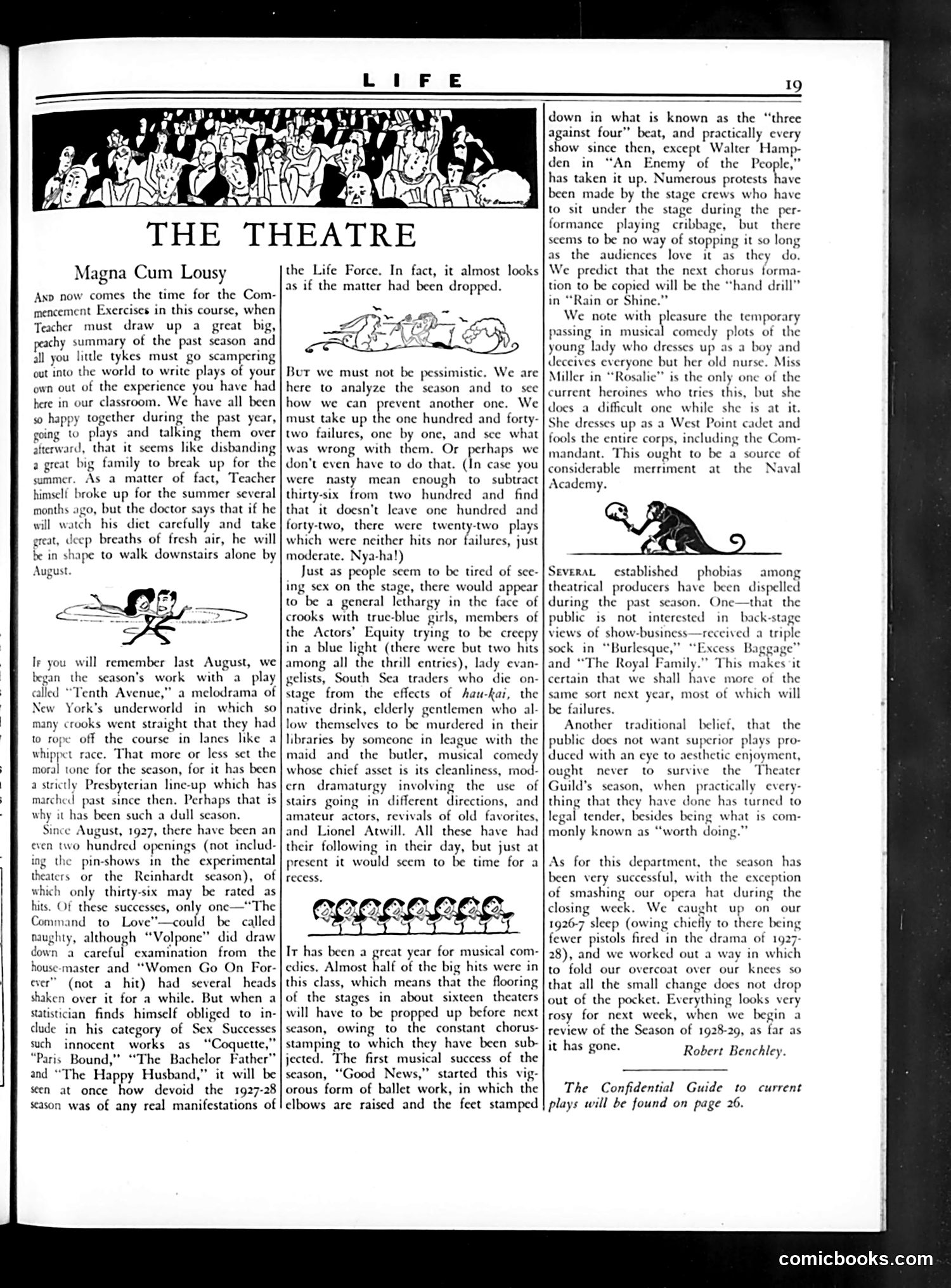
This is a theater review column titled "Magna Cum Lousy" (a Latin pun meaning "with great mediocrity"). The author—using a "teacher summarizing the school year" metaphor—critiques the 1927-28 Broadway season. **The Key Points:** The season had ~200 theatrical openings but only 36 were hits. The author sarcastically notes that because even innocent comedies like "Coquette" got classified as "sex successes," the season was essentially devoid of provocative content—the "Life Force" had apparently dropped out of theater entirely. The review mocks predictable, tired theatrical tropes: melodramas, South Sea island plots, murders in libraries, Lionel Atwill revivals, and "stairs going in different directions" (absurdist staging). **The satire:** Theater audiences had grown weary of conventional formulas. The author suggests that to prevent another such dull season, producers should stop recycling exhausted dramatic devices. The small cartoons punctuating the text appear to show sleeping or exhausted figures—visual metaphors for the season's tedium.
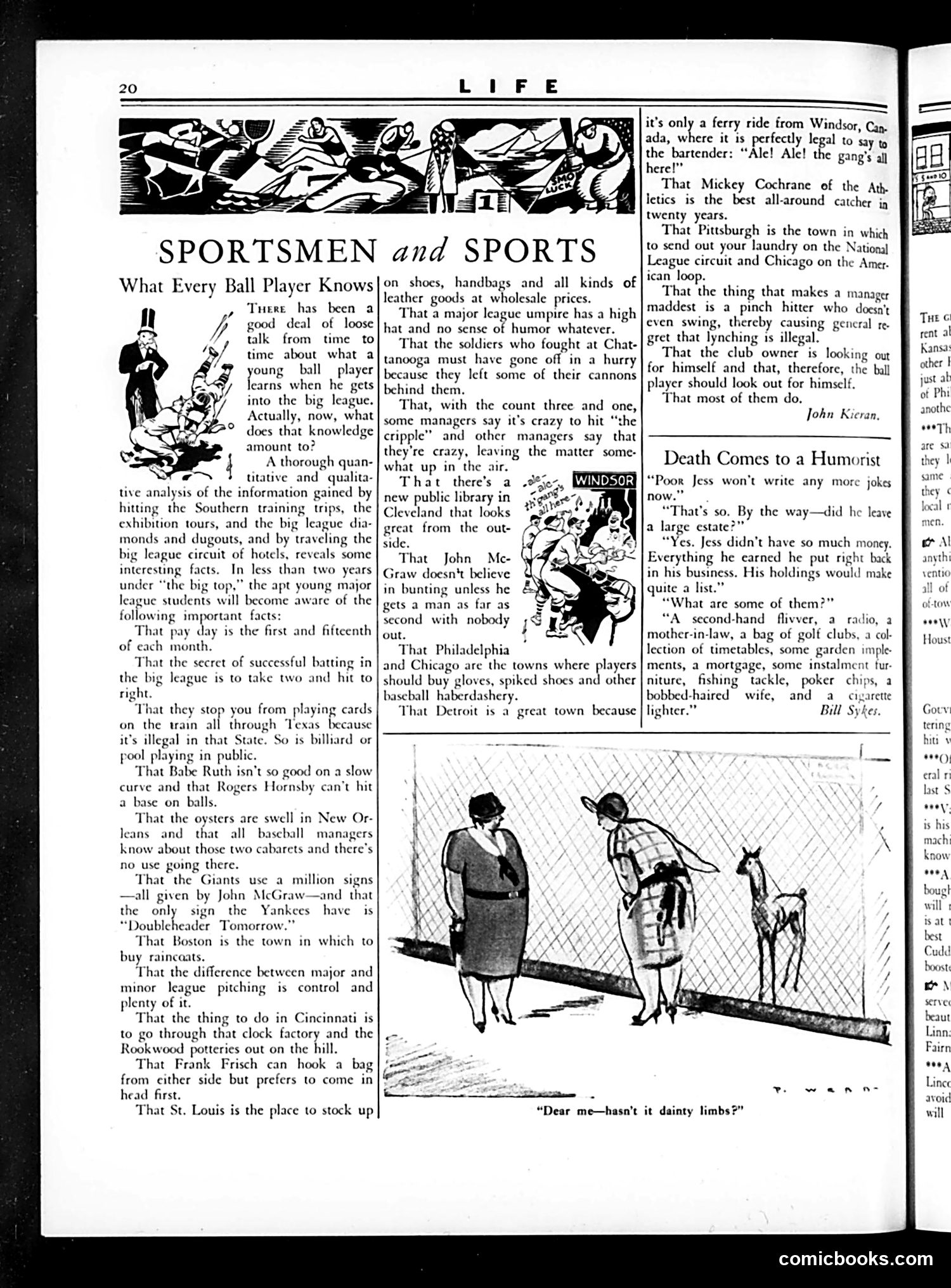
This page contains two distinct pieces from *Life* magazine's sports and humor sections. **"Sportsmen and Sports"** is a humorous essay by John Kieran listing absurd "facts" young baseball players supposedly learn in the majors. It's satirizing baseball culture by mixing genuine observations (pay schedules, batting techniques) with ridiculous ones (oysters in New Orleans, that umpires have no humor). The piece pokes fun at baseball lore and player superstitions. **"Death Comes to a Humorist"** is a dark joke about a deceased humorist named Jess. The humor lies in the ironic contrast: when asked about his estate, we learn he left almost nothing of monetary value—just junk (a used car, a radio, a mother-in-law, golf clubs, timetables). The cruel joke suggests his life's work and earnings amounted to worthless possessions, a commentary on the precarious financial state of Depression-era humorists and entertainers.
This page contains satirical "neighborhood news" sections from several American cities (Kansas City, Boston, San Francisco, Detroit, Asheville, and Dayton). Rather than serious reporting, it's a gossip column mocking local society and politics through brief, humorous items. The Kansas City section satirizes the recent Republican National Convention, joking that wealthy delegates will leave town just as rich as they arrived—only bootleggers profited. The Boston items mock wealthy socialites' leisure activities (vacations, club singing). San Francisco pokes fun at minor local figures and their pretensions. The satire's point: Life magazine ridiculed the self-importance of local elites and their trivial social concerns. The format—brief, cattily observational—mimics genuine society columns while exposing their shallow subject matter. This reflects Life's general editorial mission as a sophisticated humor magazine for educated readers skeptical of American high society.
This page contains **no cartoons**—it's primarily satirical gossip and social commentary organized by city (Milwaukee, Portland, Seattle, New York, Indianapolis, Louisville). The humor relies on **witty jabs at public figures**: - **Orville Wright** (airplane pioneer) visiting Philadelphia while Charlie Lindbergh owes locals letters—mocking the aviation celebrity craze - **President Coolidge** declining an invitation to stay home for Republican radio—sardonic commentary on his legendary passivity - **Mayor Walker** promising to eliminate grafters while living in a fancy St. Luke's Place address—hypocrisy joke - **Samuel Hopkins Adams** touring for antiques, with the aside "Sam is no spring chicken"—ageist humor The column also includes **absurdist local humor**: a traffic officer scaring away lions, jokes about straw hats and divorce, and the Wisconsin museum's African expedition seeking exotic animals (compared to drunken patrons at "Charlie's place"). This represents **Life's signature style**: combining urbane cynicism about politics and celebrity with small-town gossip, assuming a sophisticated readership familiar with current public figures.
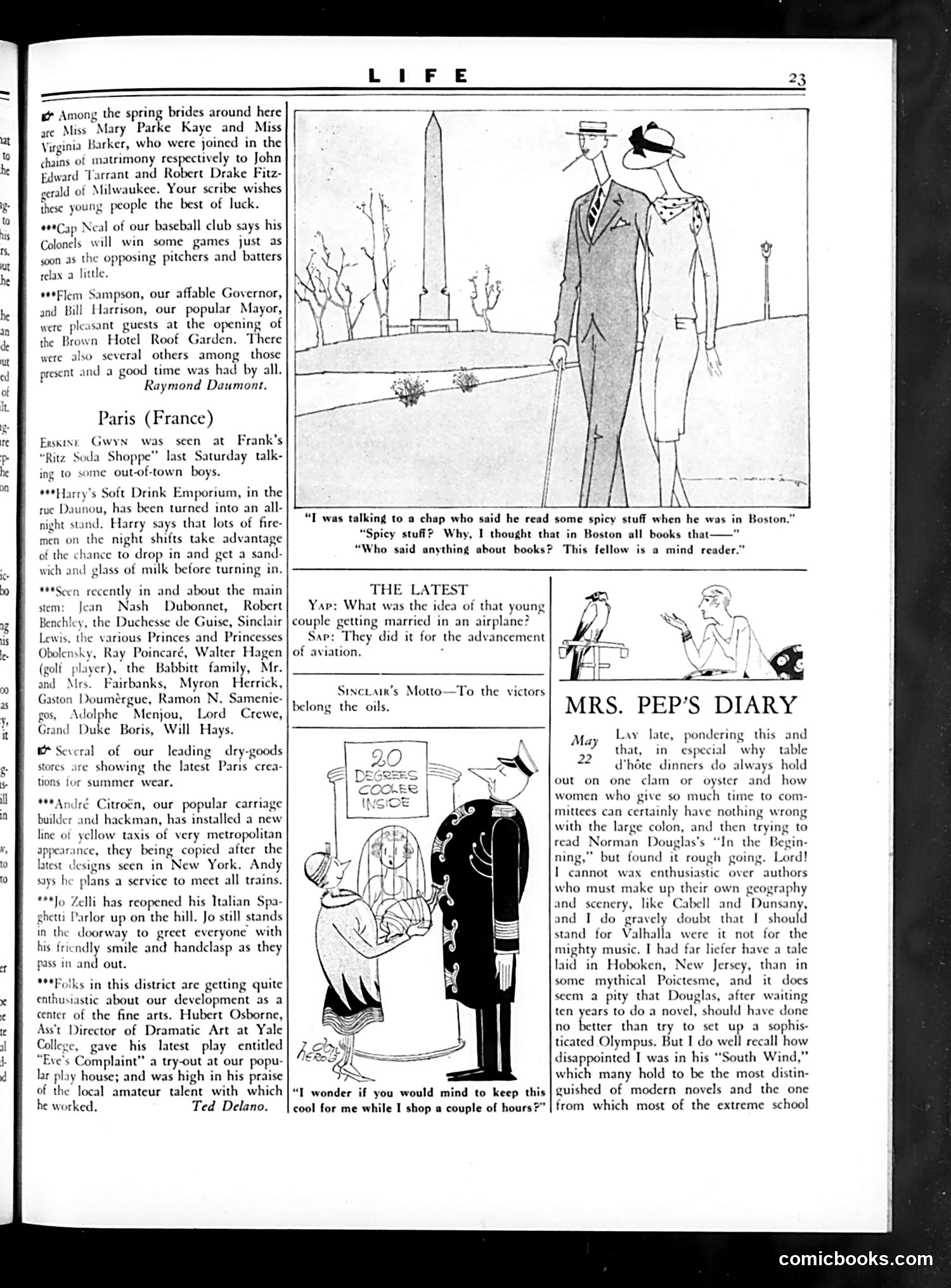
This page from *Life* magazine contains several sections of social commentary and humor typical of the 1920s: **The "Boston Books" joke**: A man claims to have read "spicy stuff" in Boston, but when challenged about books, reveals he means a "mind reader"—a joke about Boston's reputation for intellectual pretension versus actual substance. **"The Latest" cartoon**: Satirizes newlyweds who married in an airplane "for the advancement of aviation"—mocking the era's obsession with aviation as progress and couples seeking novelty. **"Mrs. Pep's Diary"**: A woman's gossipy musings about dinner etiquette and contemporary authors (Norman Douglas, Cabell, Dunsany). She dismisses their invented fantasy worlds as inferior to realistic settings like Hoboken—satirizing both literary pretension and the period's debate over modernist fiction versus realism. The page reflects 1920s sophistication anxiety: mocking both those who affect intellectualism and those who dismiss experimental literature.
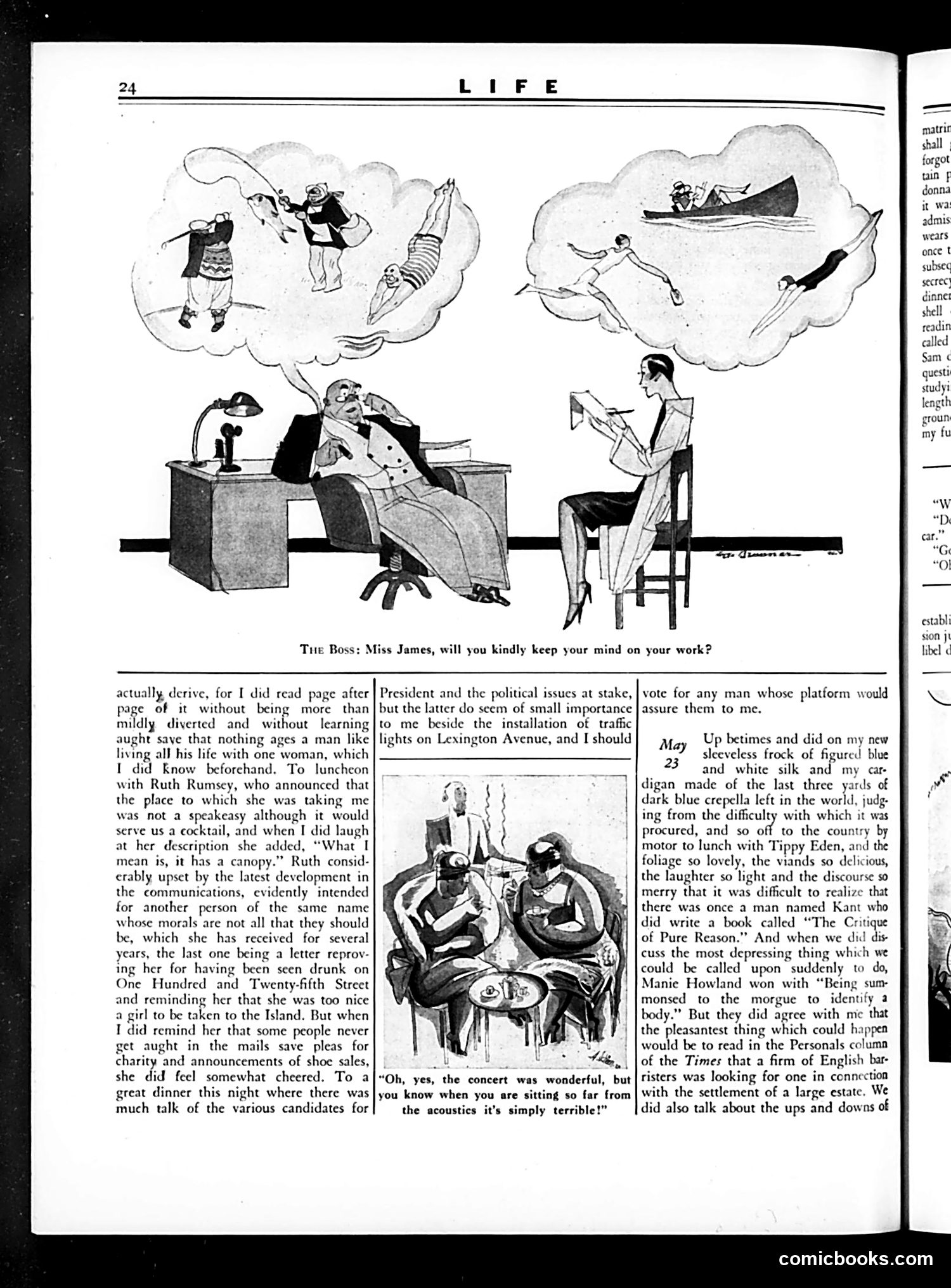
**The Main Cartoon** depicts a distracted boss scolding his secretary, Miss James, whose daydream bubbles show her engaged in leisure activities (fishing, boating, swimming) while he sits at his desk. The caption reads: "The Boss: Miss James, will you kindly keep your mind on your work?" **The Satire**: This is workplace humor mocking the tension between employer demands and employee desires for freedom and pleasure. The 1920s setting (evident from fashion and "speakeasy" references in the text) shows early-modern office dynamics—the boss represents corporate authority; Miss James embodies the working woman's mental escape fantasies. **The Social Context**: The accompanying diary entry references "Ruth Rumsey" visiting a "speakeasy" (illegal bars during Prohibition), dinner party political discussion, and casual name-dropping of philosophers like Kant. This satirizes upper-middle-class social pretensions and the era's social contradictions: discussing serious topics while violating laws, combining intellectual references with frivolous gossip. **The Point**: Gentle mockery of both workplace power imbalances and the era's fashionable but shallow society life.
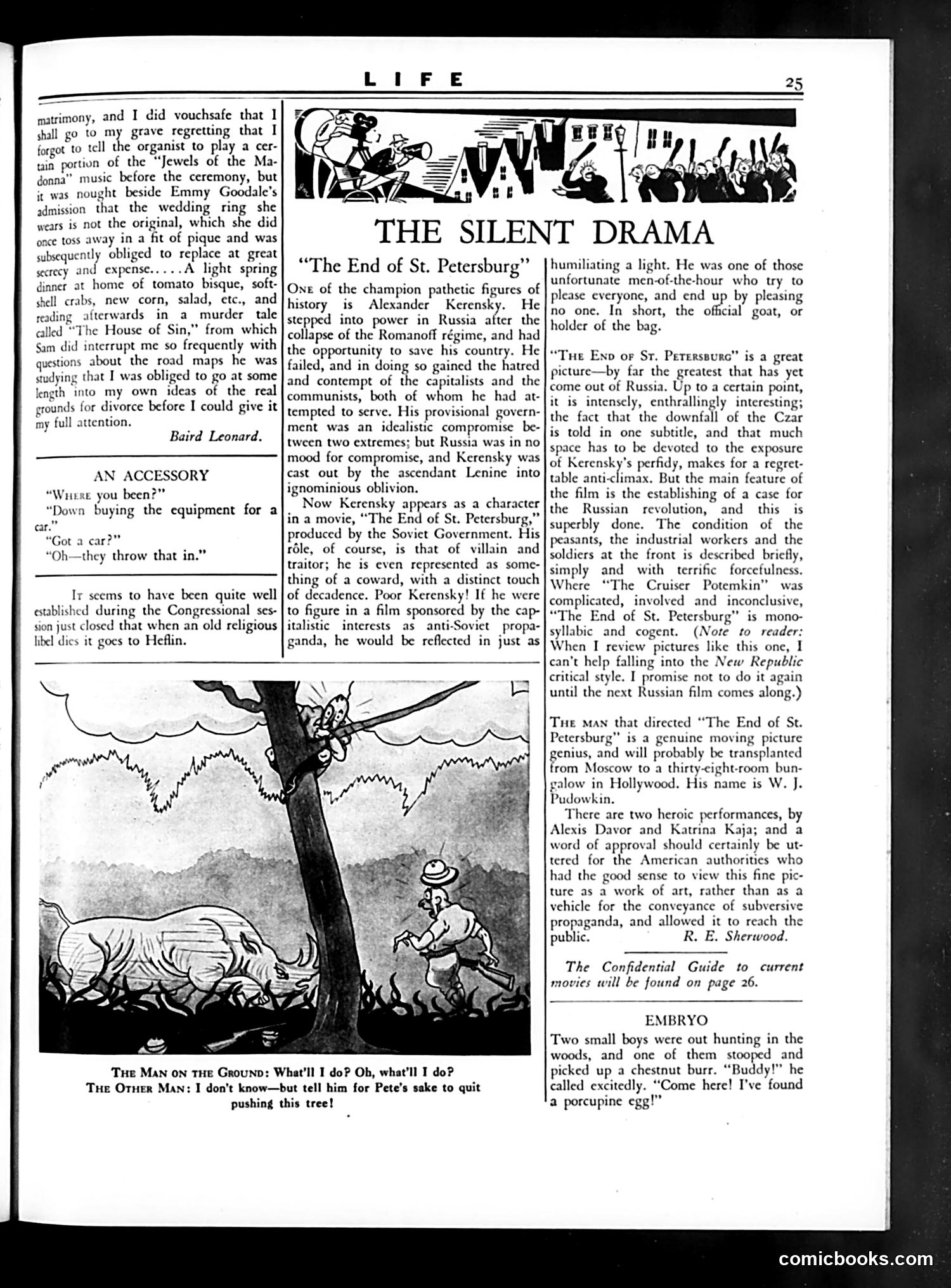
This page contains film criticism and light humor pieces typical of 1920s Life magazine satire. **"The Silent Drama" review** discusses a Soviet film about Alexander Kerensky, the Russian politician who briefly led the Provisional Government (1917) before Lenin's Bolsheviks took power. The critic notes the irony that Kerensky—vilified by both capitalists and communists for his failed compromise position—is portrayed as a villain and coward by the Soviet government. The review praises the film "The End of St. Petersburg" as artistically superior propaganda, commending its depiction of peasant and worker suffering that justified the revolution. **The cartoon** shows two men struggling with a falling tree. One asks desperately what to do; the other tells him to ask "Pete" to stop pushing it—obvious absurdist humor about miscommunication and futility. **The brief jokes** include wordplay about car purchases and a reference to "Heflin"—likely William Heflin, a congressman associated with anti-Catholic rhetoric during this era. The page reflects 1920s American attitudes: grudging respect for Soviet artistic achievement while remaining skeptical of Communist ideology.
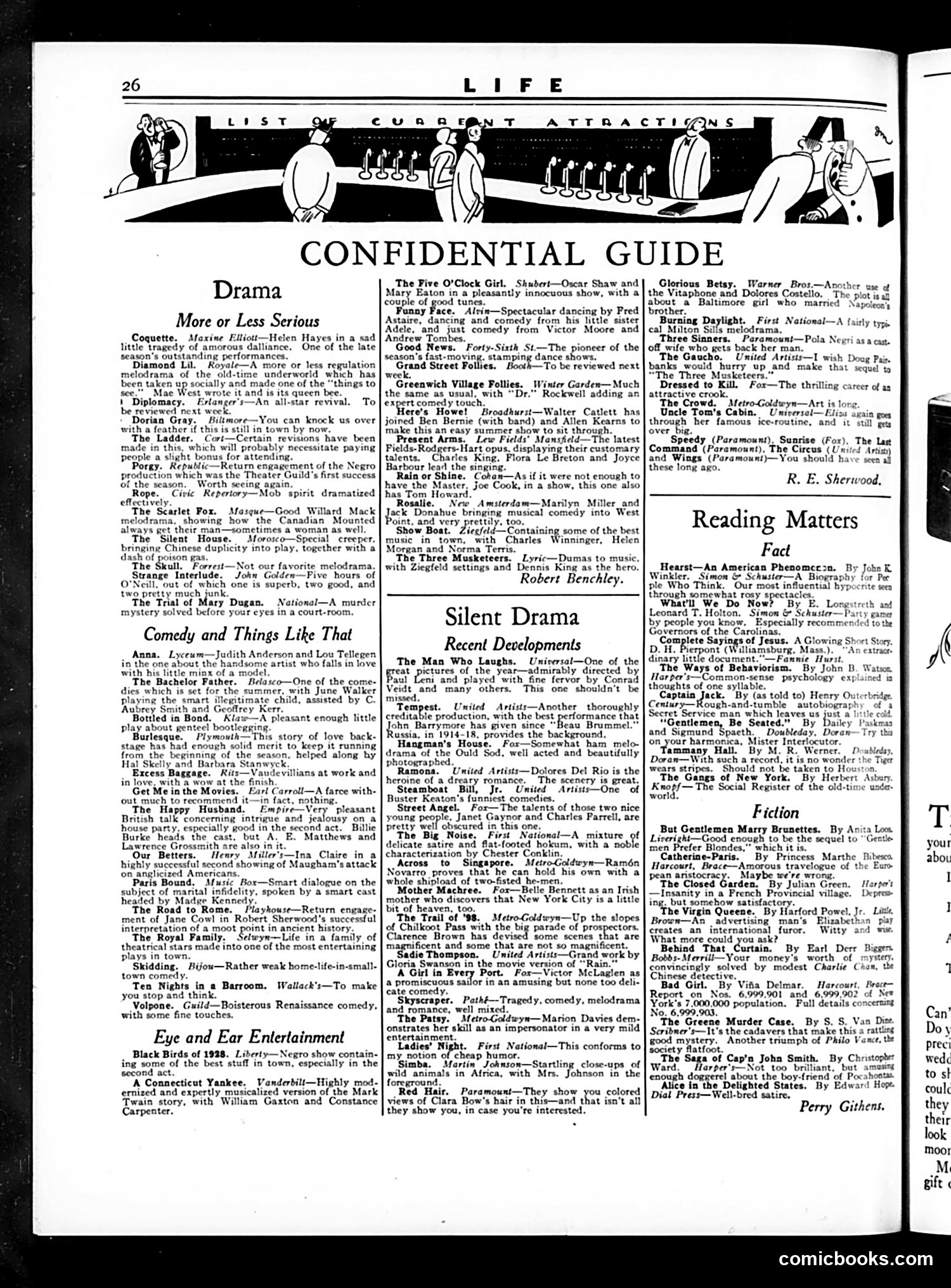
This page is a theater review guide from Life magazine, likely from the late 1920s (based on show titles and performers mentioned). It's not primarily satirical—it's a practical "what's playing now" resource. The top contains a stylized illustration of theater patrons and attractions, serving as decorative header. Below, the guide categorizes current Broadway productions by genre: dramatic plays, comedies, and entertainment/musical shows. The reviews are brief, gossipy, and often sarcastic. For example, "Dorian Gray" receives backhanded praise ("you can knock us over with a feather if this is still in town by now"), while "Mae West wrote it and is its queen bee" about *Diamond Lil* conveys both prominence and mild mockery. Notable: references to "Negro production" *Porgy* and "Black Birds" reflect period terminology and segregated theater practices. The guide treats theater-going as sophisticated entertainment for urbane, wealthy readers—Life's primary audience. This is essentially entertainment journalism, not political satire.
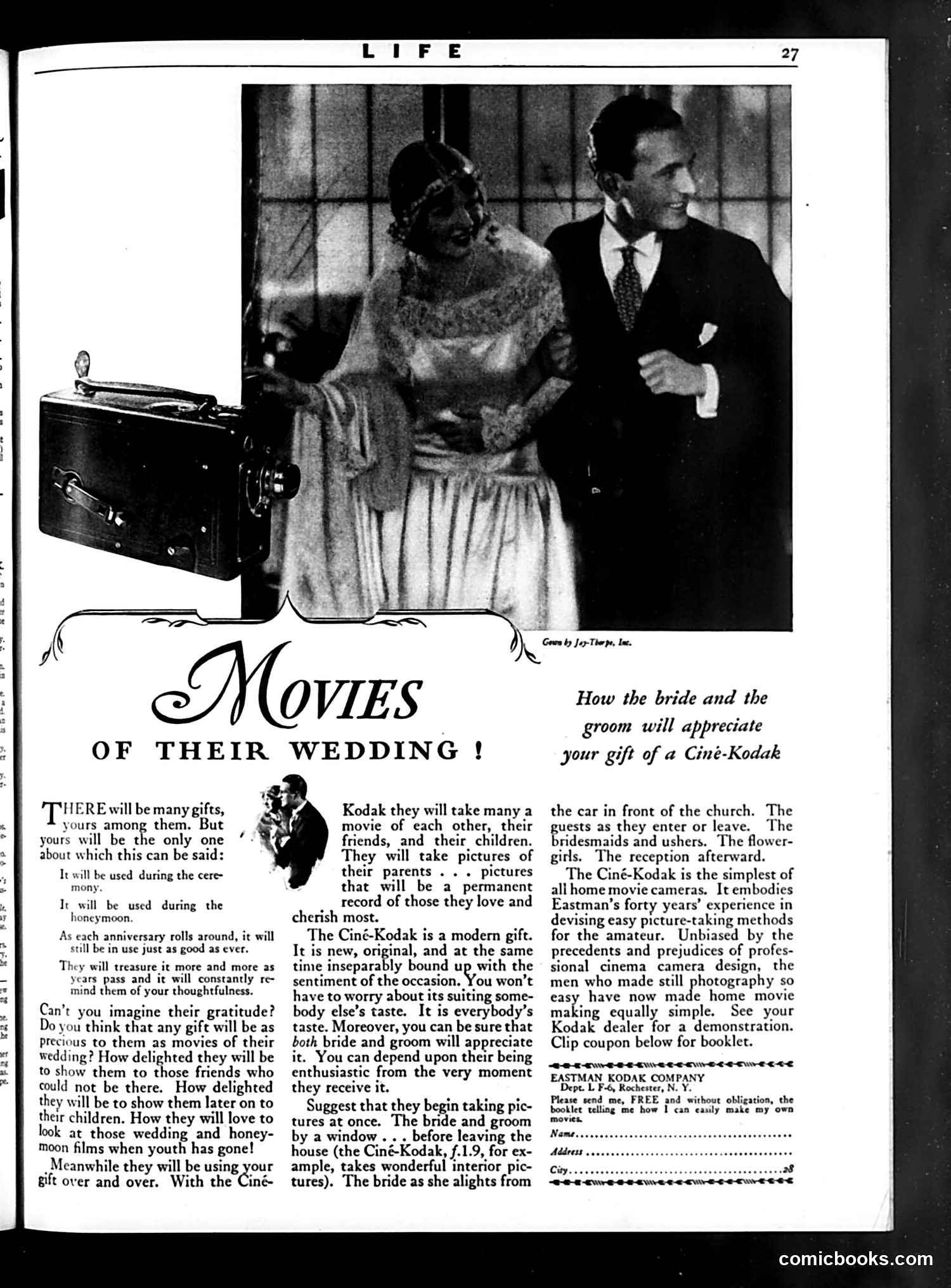
This is a **Kodak advertisement**, not satire or political commentary. It promotes the Ciné-Kodak (a home movie camera) as a wedding gift by appealing to newlyweds' desire to document their special day and future memories. The accompanying illustration shows a couple viewing their wedding film with a projector, establishing the aspirational lifestyle the ad sells. The text argues the camera is uniquely practical—useful during the ceremony, honeymoon, anniversaries, and for showing children later. It emphasizes the camera's simplicity, contrasting Kodak's approach with professional cinema design. The emotional appeal targets gift-givers: recipients will treasure and repeatedly use the camera, constantly remembering the giver's thoughtfulness. For modern readers, this reflects 1920s-30s consumer culture's early embrace of home movie technology as an accessible luxury, marketed by linking it to fundamental human desires: capturing memories, impressing others, and preserving youth.
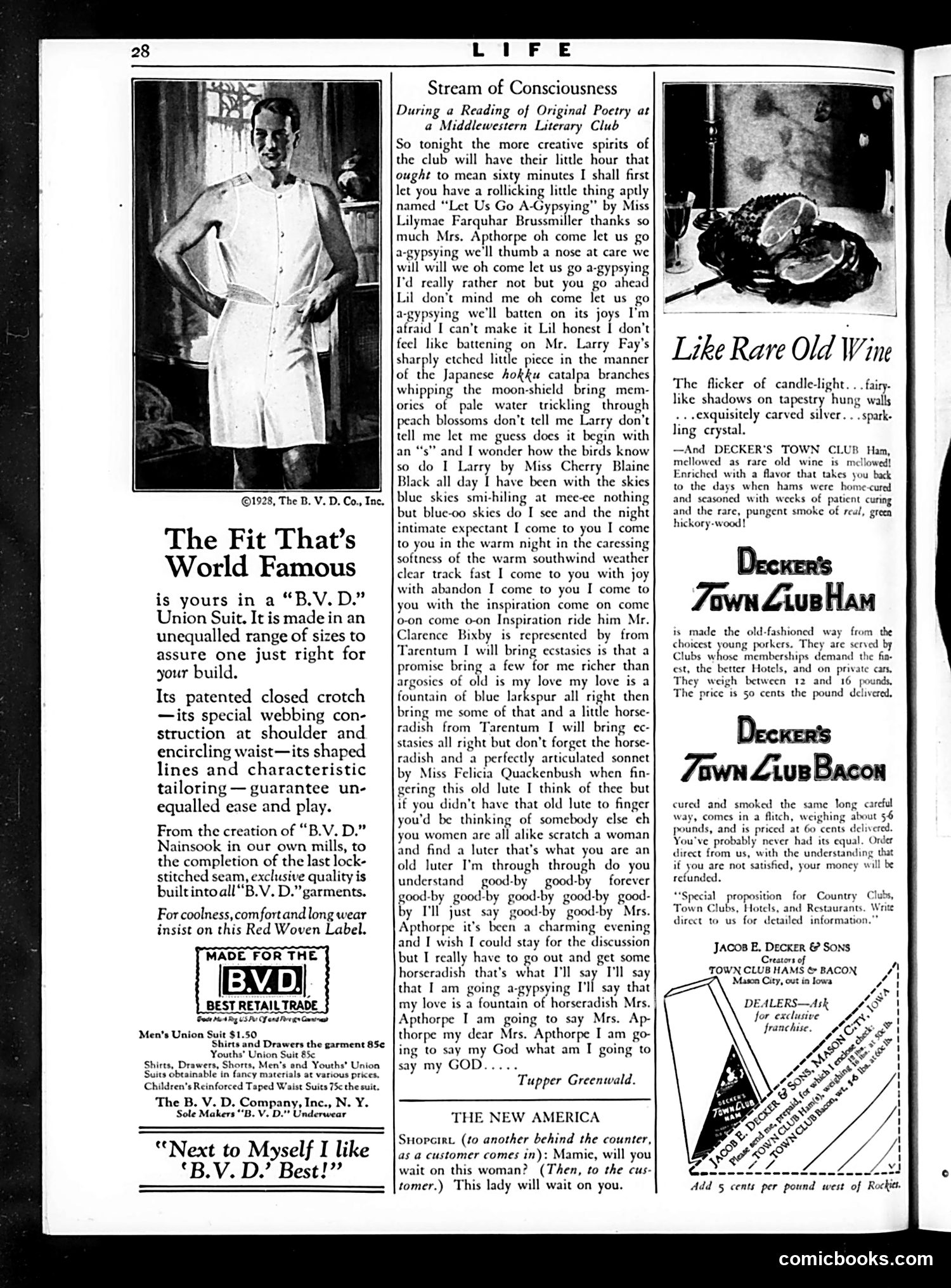
This page combines advertisement and satirical humor typical of Life magazine's format. **The Advertisement:** B.V.D. underwear dominates the left side, featuring a woman modeling a union suit. The copy emphasizes the garment's superior fit, patented construction, and quality—standard marketing language for the era. **The Satire:** The right side's "Stream of Consciousness" piece mocks pretentious Midwestern literary clubs and their poetry readings. It satirizes: - Affected bohemian poets reading earnest, pseudo-profound work - Audience members performing interest while mentally checked-out - The speaker's internal monologue revealing indifference (reluctant to attend, distracted by dinner plans) - Overwrought romantic imagery ("fountain of blue larkspur," "old lute") - The speaker planning to escape by fabricating an excuse about getting horseradish The humor lies in exposing the gap between the cultured pretense of literary gatherings and participants' actual boredom and shallow concerns—a classic Life satirical target.
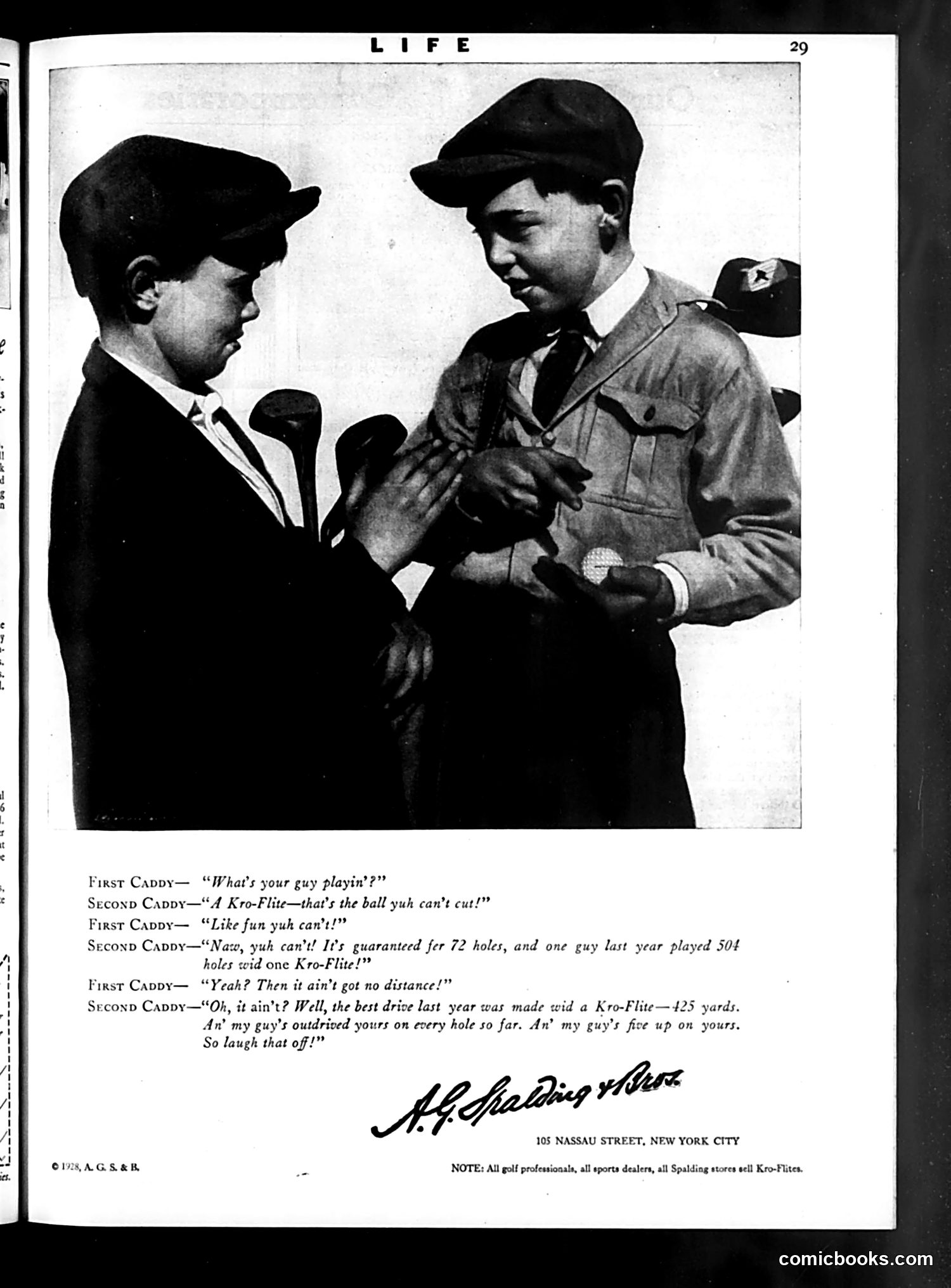
This is a **golf ball advertisement** disguised as comic dialogue, appearing in *Life* magazine (page 29). Two caddies ("First Cappy" and "Second Cappy") debate the merits of the **Kro-Flite** golf ball, a product being promoted. The humor relies on working-class caddy slang and a sales pitch: the second caddy boasts that Kro-Flites are "guaranteed" to last 72 holes (a full golf course round) and even outlasts competitors—one ball allegedly lasted 504 holes. He further claims they deliver superior distance (425 yards mentioned) and help players win games. The joke is that the first caddy's skepticism gets humorously demolished by statistics. This is **advertorial content**—advertising disguised as entertainment—common in early 20th-century magazines. The ad directs readers to purchase Kro-Flites from golf professionals, sports dealers, and Spalding stores.
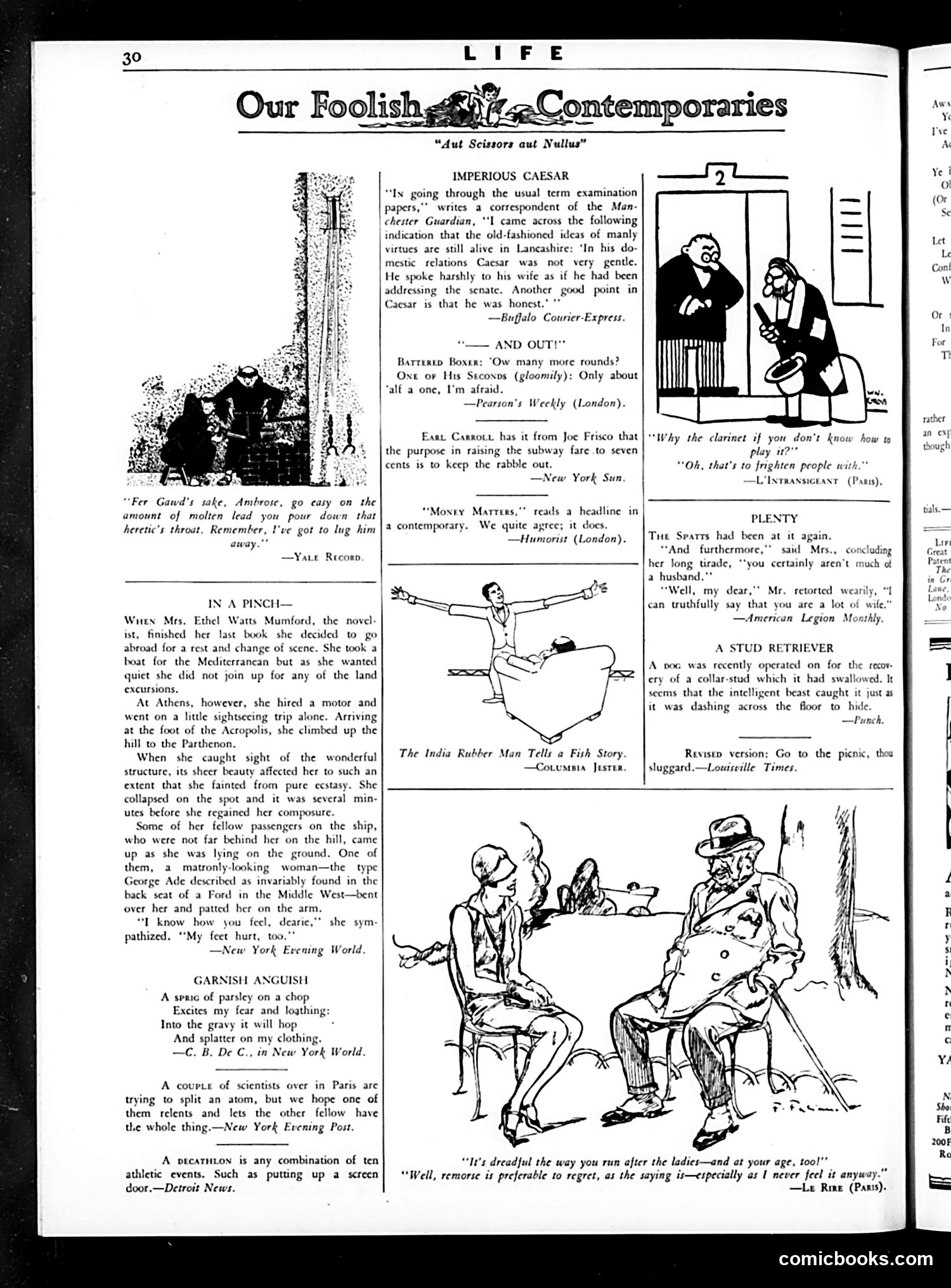
This page collects short humorous anecdotes and jokes mocking contemporary life and human folly. Key items include: **"Imperious Caesar"**: A student exam answer showing that even harsh domestic behavior can be excused if the person is "honest"—satire of misplaced values in education. **"In a Pinch"**: A novelist faints at the Parthenon's beauty, but a fellow tourist—stereotyped as a Midwestern car-trip matron—offers sympathy by comparing it to her own foot pain. The joke: crude practicality meets high culture. **Various one-liners** mock contemporary absurdities: subway fare increases meant to exclude poor people; Paris scientists splitting atoms; the annoyance of parsley garnish. **"A Stud Retriever"**: A dog swallows a collar-stud; doctors retrieve it—playing on the double meaning of "stud retriever." The overall tone satirizes modern manners, education, tourism, and social pretension through brief, punchy observations. The cartoons and quotes are sourced from contemporary newspapers and magazines, presenting them as examples of foolish contemporary thinking worthy of ridicule.
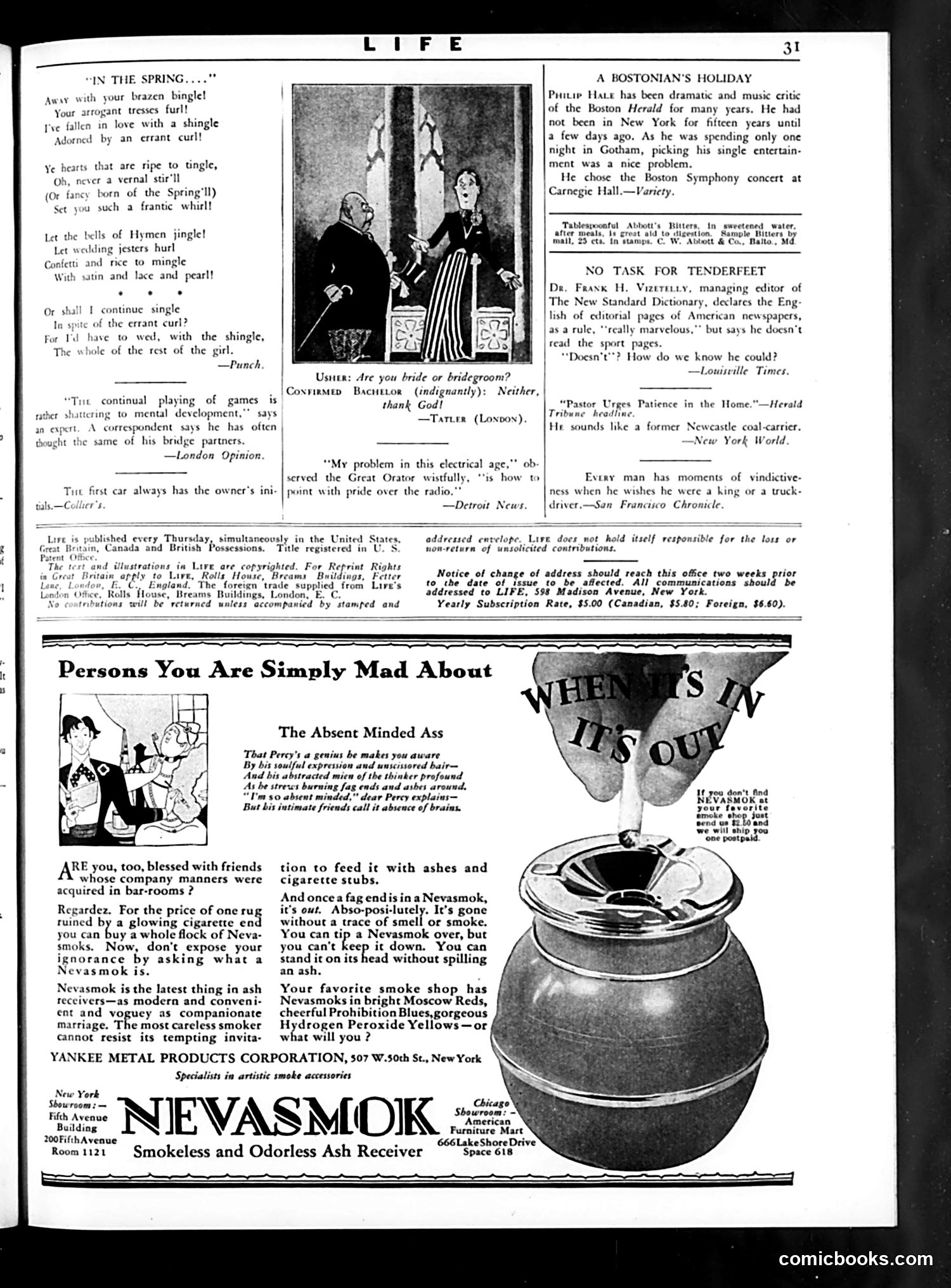
This page contains three distinct satirical sections: **"In the Spring"** (top left): A poem mocking romantic spring sentimentality, concluding with practical cynicism—the speaker won't marry because he'd have to accept "the whole of the rest of the girl" along with her fashionable "shingle" (bobbed) haircut. **Brief witticisms** (center): Short satirical quotes about bridge players, newspaper editors avoiding sports pages, and radio-age politicians. These mock contemporary concerns of the 1920s-30s. **"Persons You Are Simply Mad About"** (bottom): Features "The Absent Minded Ass"—a caricature of intellectuals who affect genius while being genuinely thoughtless (scattering cigarette ash). The accompanying **Nevasmok advertisement** for an ash tray cleverly tie-ins by mocking absent-minded smokers who won't contain their mess. The humor targets social pretension, marital skepticism, and affectation—typical Life magazine satire. The Nevasmok ad uses the caricature as clever product placement, selling solutions to problems the cartoon identifies.
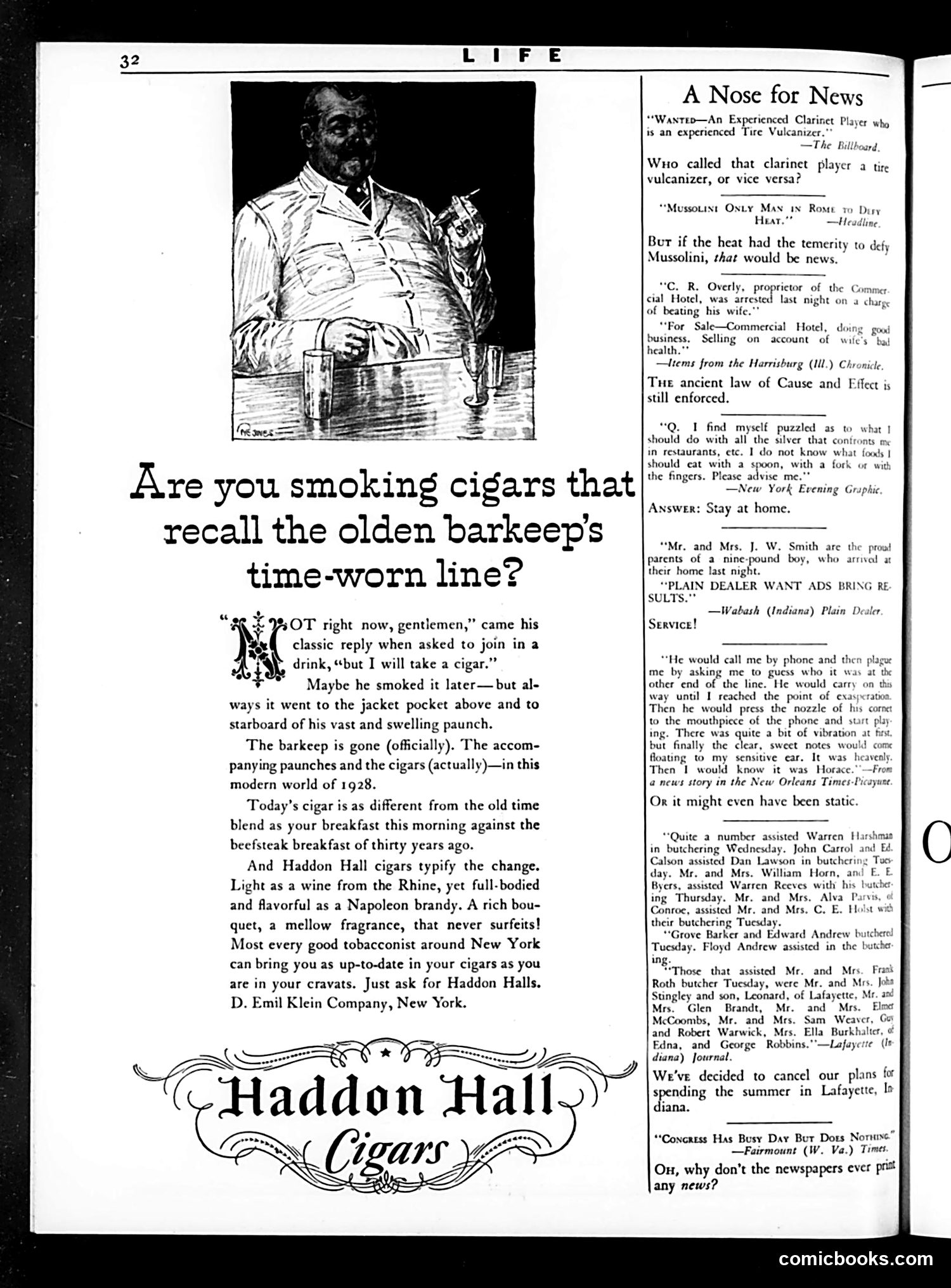
This 1928 Life magazine page contains a Haddon Hall cigars advertisement and a satirical "Nose for News" column. **The Advertisement:** Shows a rotund, well-dressed man with a cigar. It nostalgically references the old barkeeper's excuse ("Not right now, gentlemen, but I will take a cigar") — implying he'd pocket it rather than smoke it immediately. The ad claims modern Haddon Hall cigars differ from old-timey blends, positioning them as contemporary and refined. **The Satire:** The "Nose for News" column mocks newspaper classified ads and human-interest stories for their absurdity. It highlights nonsensical want ads (clarinet player seeking tire vulcanizer experience), contradictory logic (a hotel for sale due to the owner's wife's "health" after he beat her), and overly-detailed local reporting (exhaustive lists of people who helped with butchering). The final quip—"why don't the newspapers ever print any news?"—critiques how papers fill space with trivial filler instead of actual newsworthy content.
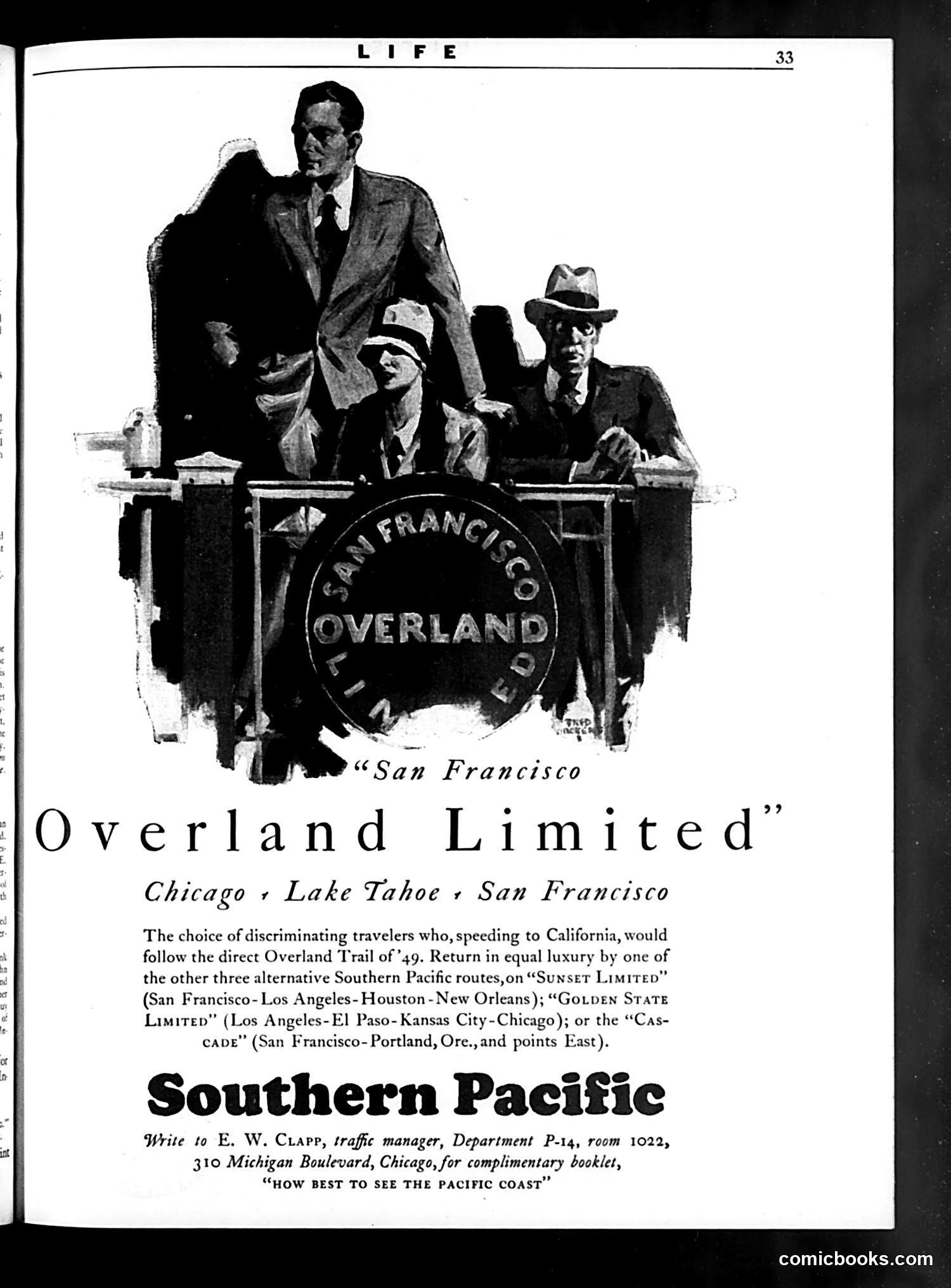
This is a **Southern Pacific Railroad advertisement**, not political satire. The page promotes the "San Francisco Overland Limited" train service. The image shows three men in period costume (hats, suits) posed with a large drum labeled "San Francisco Overland Limited." The advertisement appeals to "discriminating travelers" by invoking the romantic historical reference to the Gold Rush "Overland Trail of '49" — leveraging nostalgia for westward expansion and California's pioneer era. The copy emphasizes luxury travel to California via multiple Southern Pacific routes, positioning train travel as the sophisticated choice for affluent tourists. The Gold Rush reference serves marketing purposes: associating the modern train journey with historic American adventure and prestige. This is straightforward early 20th-century commercial advertising using historical imagery for brand appeal, not editorial commentary or satire.
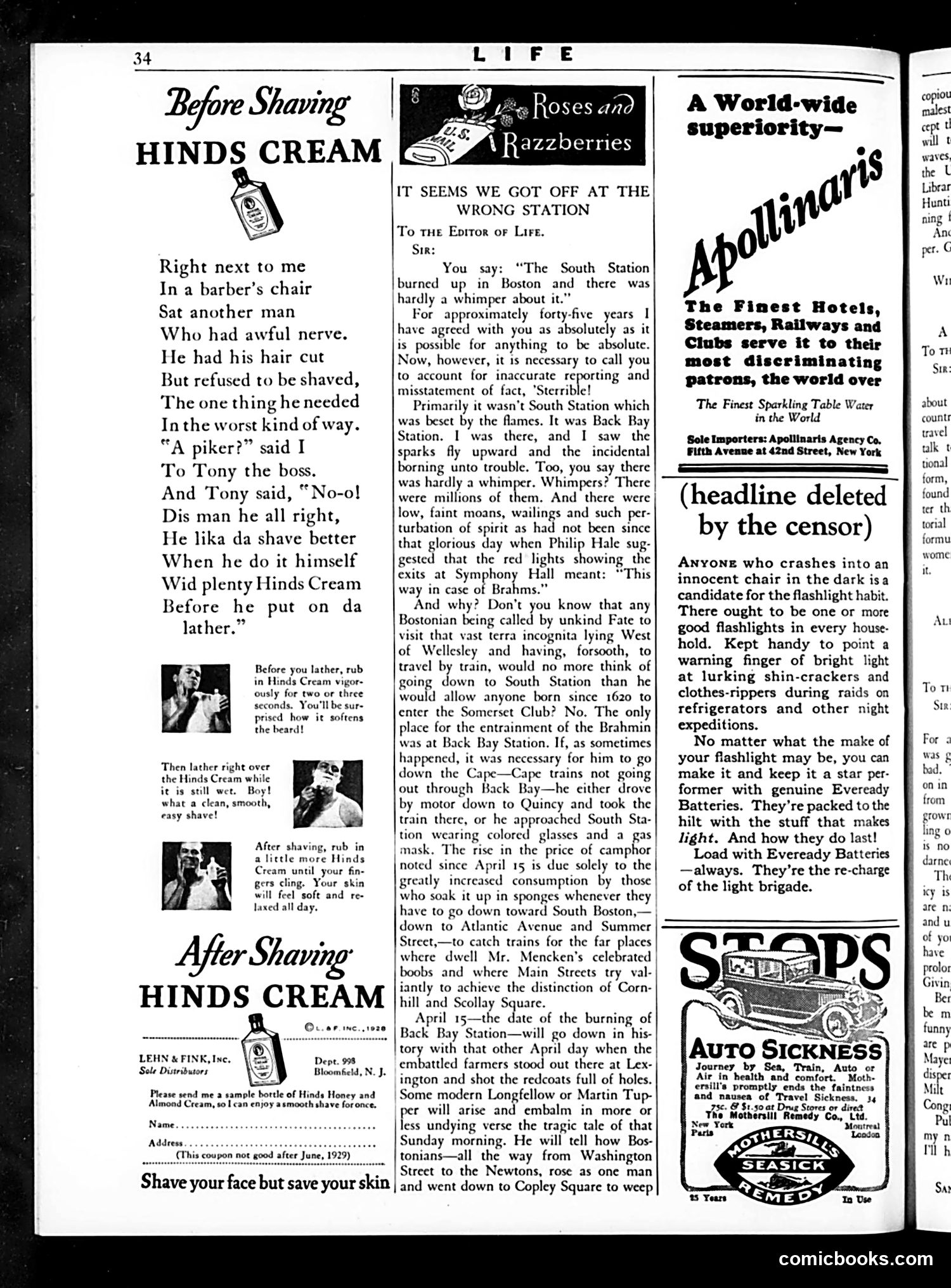
This page is primarily **advertising**, specifically for Hinds Cream shaving product. The dominant content is a humorous narrative advertisement featuring a barber-shop anecdote about a customer who refuses to be shaved but later shaves himself using Hinds Cream—a play on the product's effectiveness. The secondary content is a **satirical reader's letter** mocking Boston's upper-class snobbery. The writer sarcastically chastises *Life* magazine for misidentifying which train station burned (Back Bay, not South Station) and uses this error to launch into exaggerated commentary about Brahmins (Boston's aristocratic elite) being so class-conscious they'd avoid traveling through South Boston's working-class neighborhoods, even wearing gas masks to avoid the area. The humor relies on **regional social hierarchy**—positioning Boston's wealthy as absurdly pretentious and geographically segregationist. The letter's grandiose language ("terra incognita," comparisons to Lexington) amplifies the satire of such snobbery.
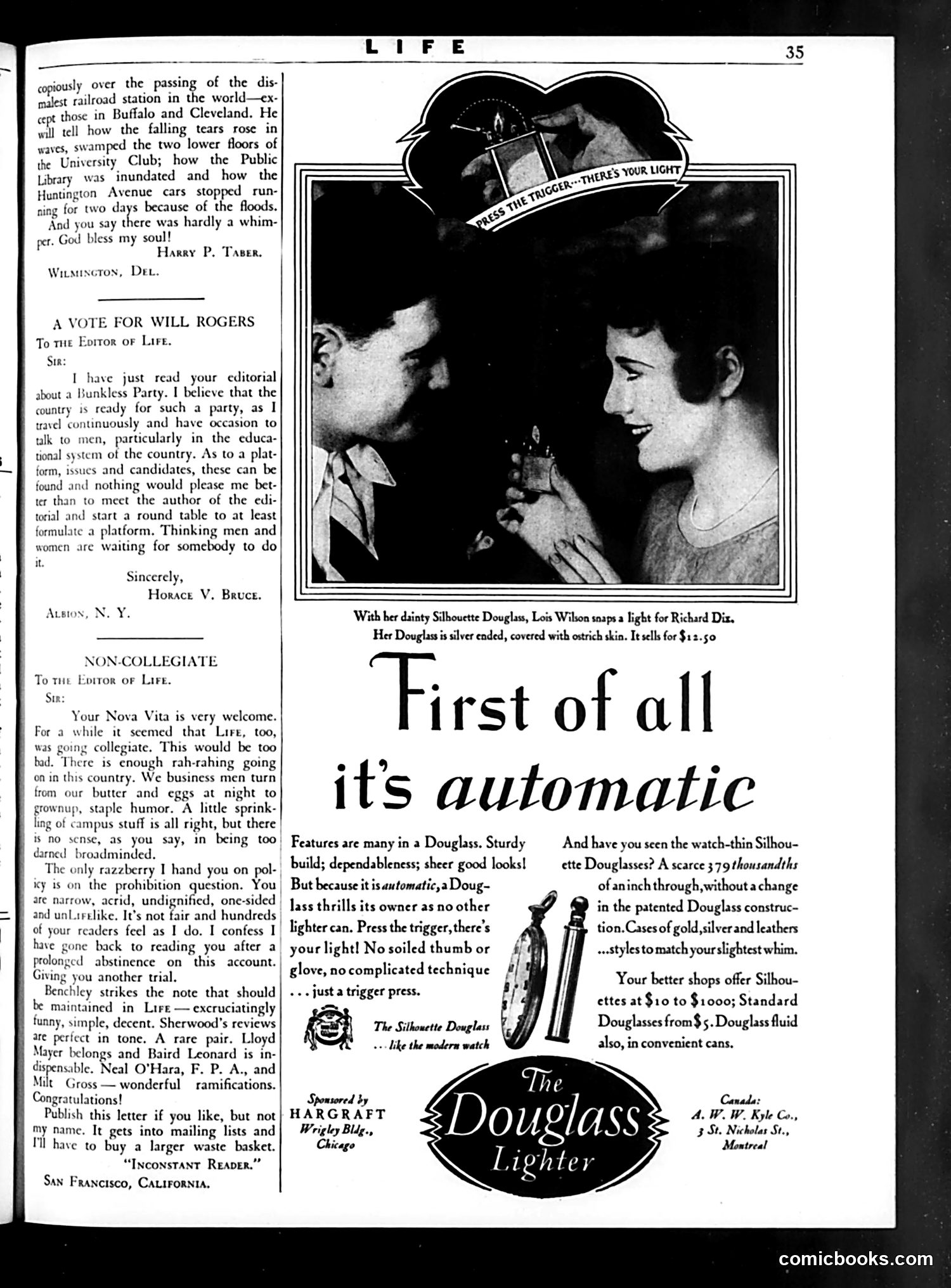
This page consists primarily of **reader letters to the editor** and a **cigarette lighter advertisement**—not political cartoons. The letters discuss Life magazine's editorial direction. One reader endorses creating a "Bunkless Party" platform with Will Rogers. Another complains that Life has become too collegiate and requests it maintain "staple humor" for business readers; this writer also criticizes Life's stance on Prohibition as "narrow" and "undignified." The main visual is an **advertisement for the Silhouette Douglass automatic lighter**, featuring actress Lois Wilson lighting a cigarette for actor Richard Dix. The ad emphasizes the lighter's automatic trigger mechanism—a novelty at the time—and its sleek, modern design in various materials and price points ($5-$1000). There is **no political satire or cartoon content** on this page. It represents typical 1920s magazine content: reader engagement and consumer advertising positioned alongside editorial matter.
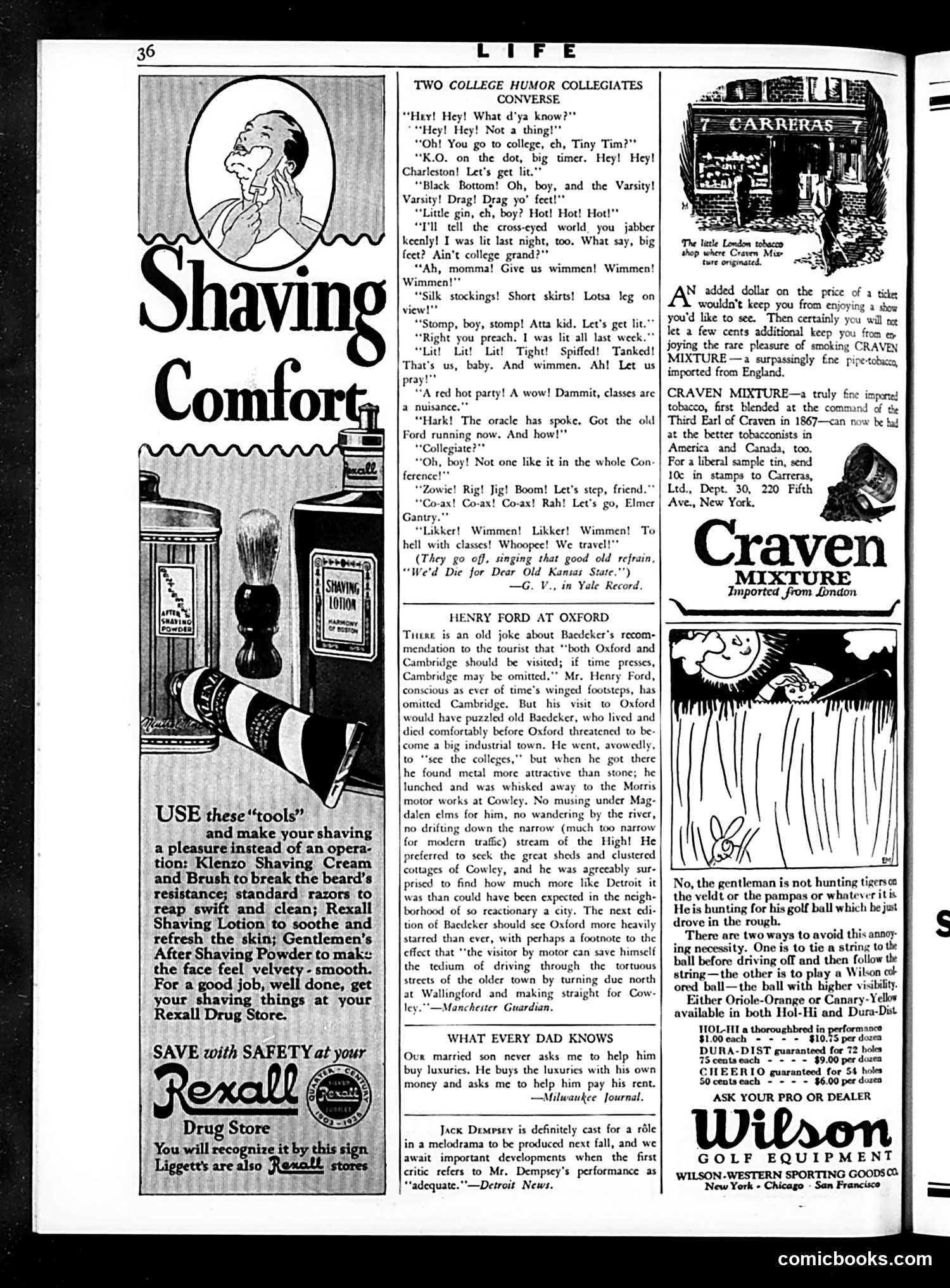
This page is primarily **advertising**, with two satirical pieces interspersed. The main advertisement is for **Rexall Drug Store's shaving products**, featuring an illustrated man's profile and various grooming tools. The copy uses salesmanship typical of the 1920s, promising to transform shaving into a "pleasure." The satirical content includes: 1. **"Two College Humor Collegiates Converse"**—a joke mocking 1920s college culture, featuring slang-heavy dialogue about drinking ("lit," "tanked"), dancing (Charleston, Black Bottom), and partying. The satire targets collegiate excess and anti-intellectualism (classes dismissed as "nuisance"). References to "wimmen" reflect period attitudes. 2. **"Henry Ford at Oxford"**—a humorous anecdote about Ford visiting Oxford University but ignoring historic colleges to tour the Morris motor works at Cowley, preferring industrial factories to traditional architecture. The joke satirizes Ford's utilitarian, modernist mindset versus Oxford's historical significance. Brief jokes about fatherhood and Jack Dempsey fill remaining space, alongside **Craven Mixture tobacco** advertising.
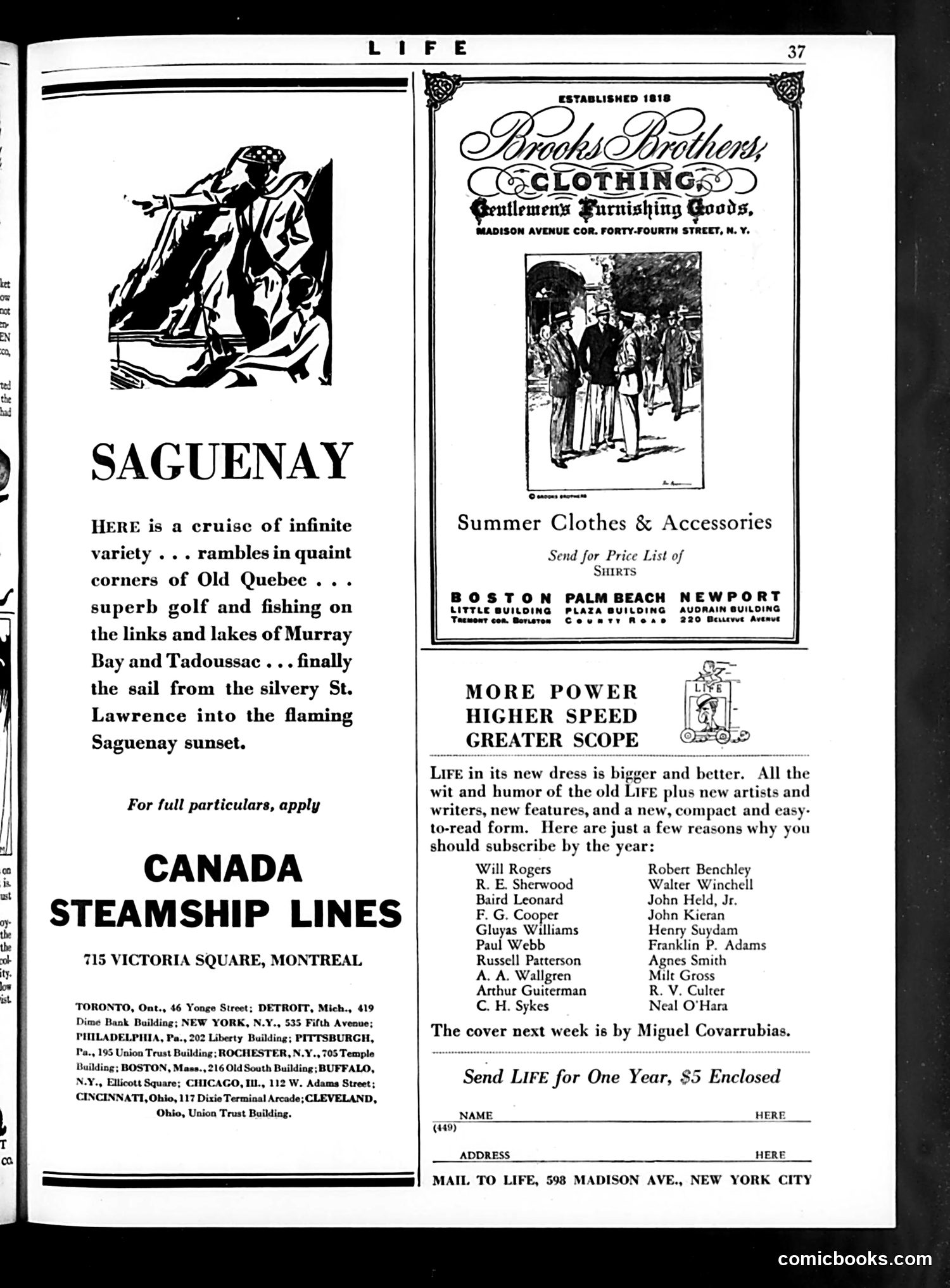
This page is primarily **advertising and subscription promotion**, not editorial content with political satire. The left side features a **travel ad for Canada Steamship Lines**, promoting cruises to Quebec's Saguenay region with romantic imagery of sailing and scenic sunsets—standard tourism marketing. The right side contains two advertisements: **Brooks Brothers clothing** (established 1818) promoting summer wear, and a **Life magazine self-promotion** announcing the publication's expansion and redesign. The Life subscription pitch lists prominent contemporary writers and illustrators (Will Rogers, Robert Benchley, John Held Jr., etc.) as reasons to subscribe for $5/year. This reflects Life's identity as a humor and satire magazine featuring top literary and artistic talent. The modest illustration at top left appears decorative rather than satirical—likely related to the Saguenay travel content. **No significant political cartoon or social satire is present on this page.** It's essentially a commercial/promotional page typical of magazine interiors from this era.
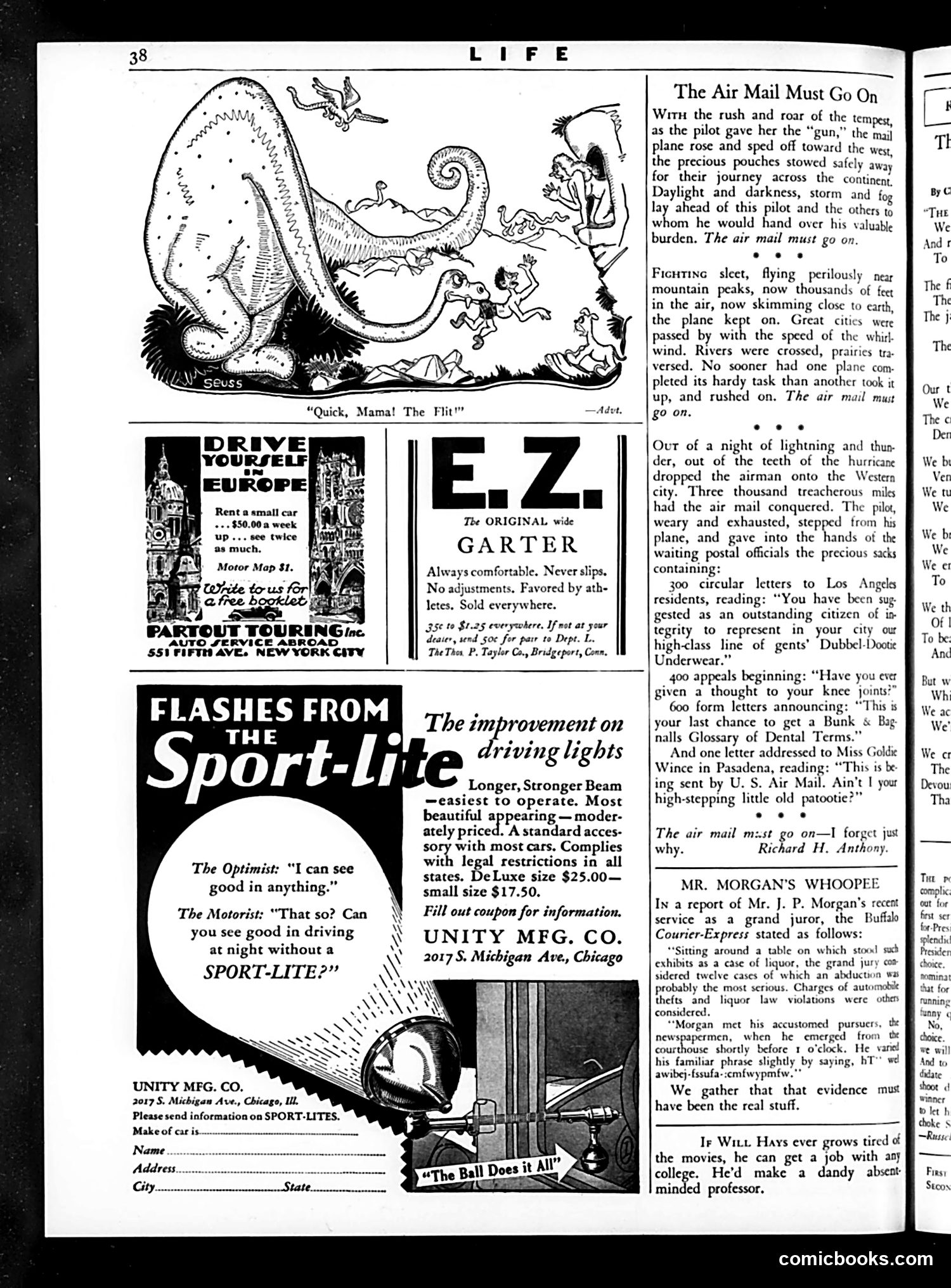
This page's central narrative (with Seuss illustration) satirizes the romanticization of early airmail service. The text dramatically describes a pilot heroically delivering mail across treacherous terrain and weather, but the punchline reveals what actually arrived: 300 form letters advertising "Dubbel-Dootie Underwear," 400 solicitations about knee joints, and 600 dental glossaries. The satire mocks both the inflated rhetoric surrounding aviation technology and the mundane commercial junk mail it actually carried. The final line—"The air mail must go on—I forget just why"—undercuts the entire heroic narrative, suggesting the enterprise's true worthlessness. The page also includes vintage advertisements (car rentals, garters, driving lights) typical of 1920s *Life* magazine, positioning this satire within commentary on American consumer culture and technological boosterism.
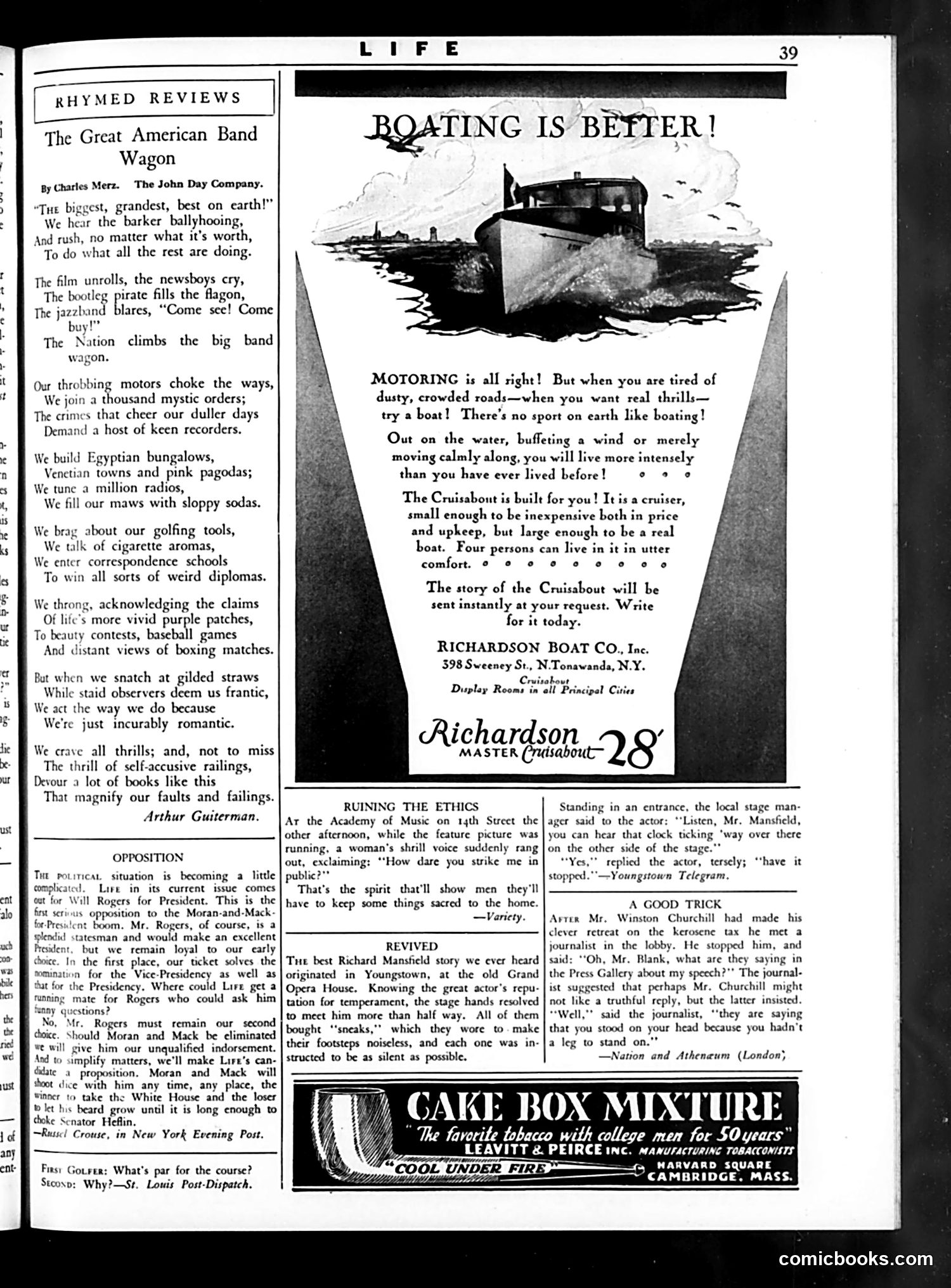
This page contains three distinct elements: **"The Great American Band Wagon" (poem)**: Charles Merz satirizes 1920s consumer culture and mass conformity. Americans blindly follow trends—Egyptian bungalows, radios, correspondence schools, beauty contests—adopting whatever is popular without critical thought. The poem mocks this herd mentality while ironically noting that readers enjoy books *about* their own failings, suggesting self-awareness doesn't prevent the behavior. **"Opposition" (editorial)**: A humorous political piece joking about presidential candidates. It references Will Rogers and "Moran-and-Mack" (a comedy duo) as potential presidents, satirizing the trivialization of politics. The joke about solving the vice-presidency through a dice game between Moran and Mack pokes fun at serious political discourse. **Richardson Boat Company Advertisement**: A straightforward period advertisement promoting recreational boating as superior to motoring—targeting leisure-class consumers. The page reflects 1920s preoccupations: mass consumption, entertainment culture, and political satire during an era of rapid social change.
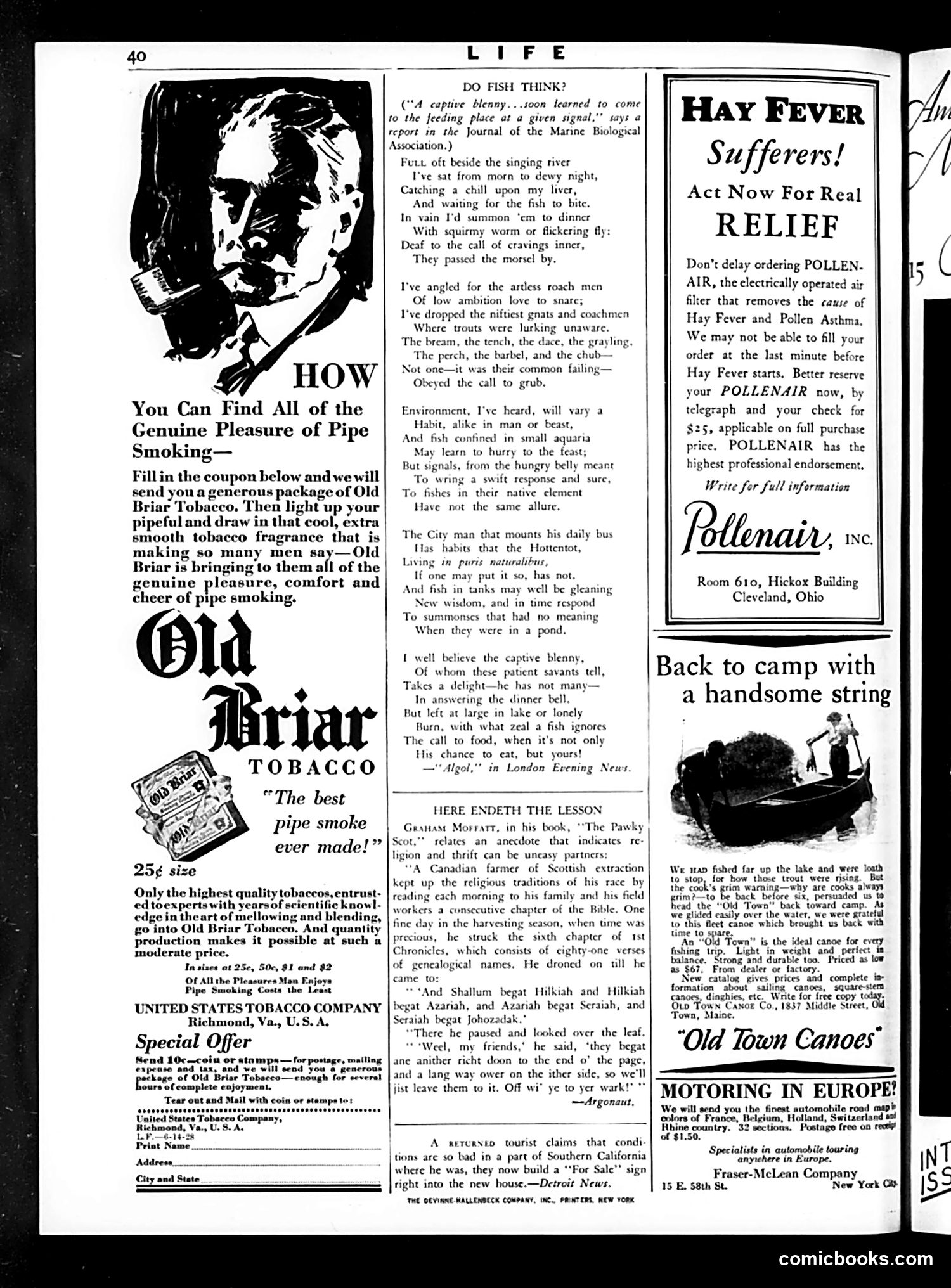
This page is primarily **advertising** for Old Briar Tobacco pipe tobacco, featuring a portrait illustration of an unnamed man smoking a pipe. The main content includes: 1. **A tobacco advertisement** promoting Old Briar as "the best pipe smoke ever made," emphasizing quality, affordability, and the pleasure of pipe smoking. 2. **"Do Fish Think?"** — A humorous poem questioning whether fish confined to aquariums develop intelligence (responding to feeding signals) versus fish in nature, which ignore bait. It's a light satirical commentary on environment shaping behavior. 3. **"Here Endeth the Lesson"** — An anecdote about a Scottish-Canadian farmer who, during Bible readings to workers, skips over a tedious genealogical passage in Chronicles to get workers back to harvesting. The joke satirizes how religious devotion bends to practical necessity and thrift. The page reflects 1920s Life magazine's mix of consumer advertising with humorous short content—no significant political satire is present here.