
Life, 1928-06-14 · page 21 of 42
Life — June 14, 1928 — page 21: what you’re looking at
What you’re looking at
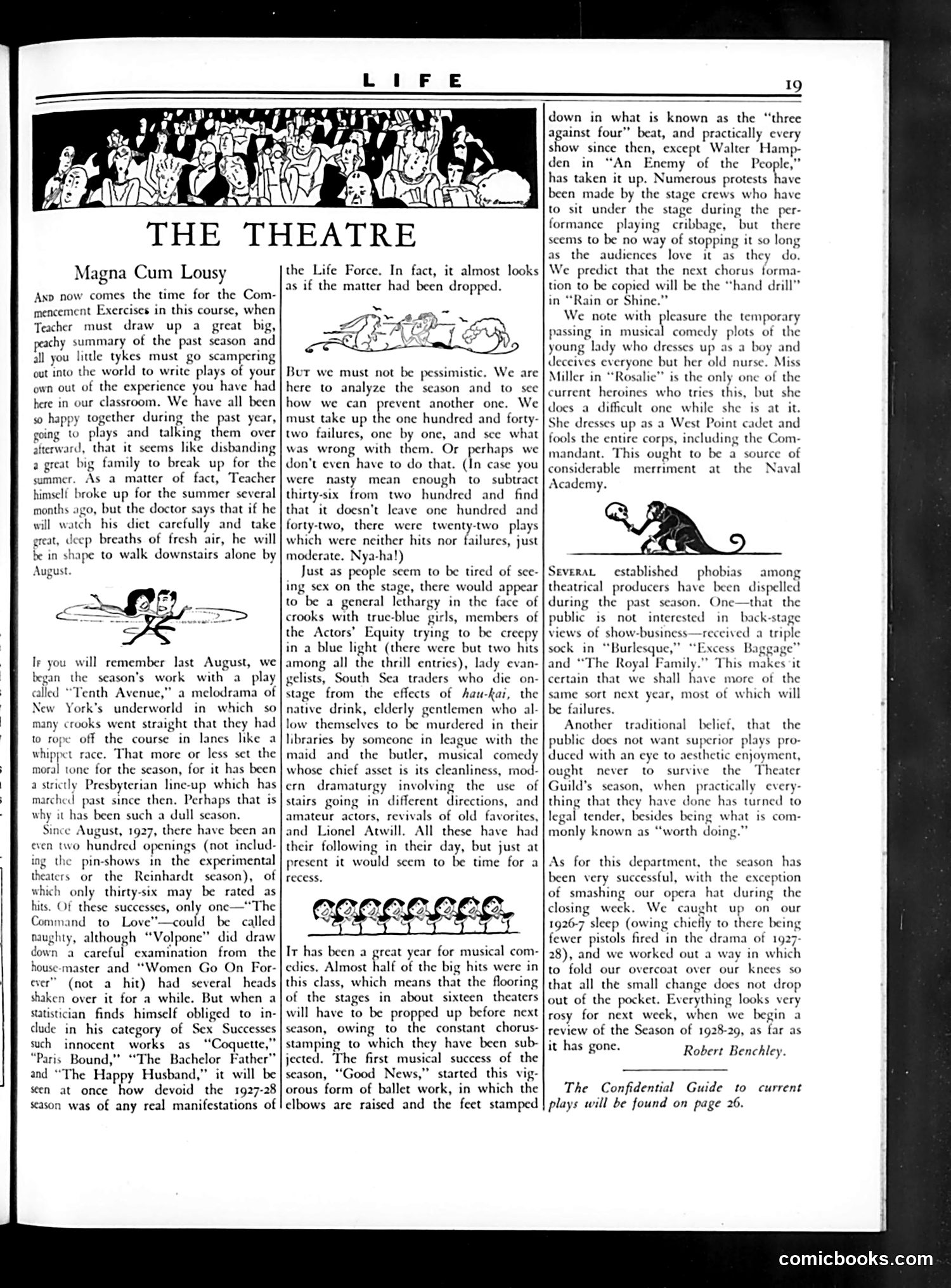
This is a theater review column titled "Magna Cum Lousy" (a Latin pun meaning "with great mediocrity"). The author—using a "teacher summarizing the school year" metaphor—critiques the 1927-28 Broadway season. **The Key Points:** The season had ~200 theatrical openings but only 36 were hits. The author sarcastically notes that because even innocent comedies like "Coquette" got classified as "sex successes," the season was essentially devoid of provocative content—the "Life Force" had apparently dropped out of theater entirely. The review mocks predictable, tired theatrical tropes: melodramas, South Sea island plots, murders in libraries, Lionel Atwill revivals, and "stairs going in different directions" (absurdist staging). **The satire:** Theater audiences had grown weary of conventional formulas. The author suggests that to prevent another such dull season, producers should stop recycling exhausted dramatic devices. The small cartoons punctuating the text appear to show sleeping or exhausted figures—visual metaphors for the season's tedium.
📄 Transcribed text from this page (OCR, searchable)
Machine-transcribed from the original scan — historical spelling and the odd misread are preserved.
THE THEATRE Magna Cum Lousy Axo now comes the time for the Com- mencement Exercises in this course, when Teacher must draw up a great big, chy summary of the past season and all you little tykes must go scampering out into the world to write plays of your own out of the experience you have had here in our classroom. We have all been so happy together during the past year, going to plays and talking them over alterward, that it seems like disbanding a great big family to break up for the summer. As a matter of fact, Teacher himself broke up for the summer several months ago, but the doctor says that if he will watch his diet carefully and take great, deep breaths of fresh air, he will be in shape to walk downstairs alone by August. Ir you will remember last August, we began the season's work with a_ play called “Tenth Avenue,” a melodrama of New York’s underworld in which so many crooks went straight that they had tor off the course in lanes lke a whippet race. That more or less set the moral tone for the season, for it has been a strictly Presbyterian line-up which has marched past since then, Perhaps that is why it has been such a dull season, Since August, 1927, there have been an even two hundred openings (not includ- ing the pin-shows in the experimental theaters or the Reinhardt season), of which only thirty-six may be rated as hits. Of these successes, only onc—“The Command to Love’’—could be called naughty, although “Volpone” did draw down a careful examination from the house-master and “Women Go On For- ever” (not a hit) had several heads shaken over it for a while. But when a statistician finds himself obliged to in- clude in his category of Sex Successes such innocent works as “Coquette, “Paris Bound,” “The Bachelor Father and “The Happy Husband,” it will be seen at once how devoid the 1927-28 season was of any real manifestations of the Life Force. In fact, it almost looks as if the matter had been dropped. But we must not be pessimistic. We are here to analyze the season and to see how we can prevent another one. We must take up the one hundred and forty- two failures, one by one, and sce what was wrong with them. Or perhaps we don’t even have to do that. (In case you were nasty mean enough to subtract thirty-six from two hundred and find that it doesn’t leave one hundred and forty-two, there were twenty-two plays which were neither hits nor failures, just moderate. Nya-ha!) Just as people seem to be tired of see- ing sex on the stage, there would appear to be a general lethargy in the face of crooks with true-blue girls, members of the Actors’ Equity trying to be creepy in a blue light (there were but two hits among all the thrill entries), lady evan- gelists, South Sea traders who die on- stage from the effects of hau-kai, the native drink, elderly gentlemen who al- low themselves to be murdered in their libraries by someone in league with the maid and the butler, musical comedy whose chief asset is its cleanliness, mod- ern dramaturgy involving the use of stairs going in different directions, and amateur actors, revivals of old favorites, and Lionel Atwill. All these have had their following in their day, but just at present it would seem to be time for a recess, Ir has been a great year for musical com- edies. Almost half of the big hits were in this class, which means that the flooring of the stages in about sixteen theaters will have to be propped up before next season, owing to the constant chorus- stamping to which they have been sub- jected. The first musical success of the season, “Good News,” started this vig- orous form of ballet work, in which the elbows are raised and the feet stamped down in what is known as the “three against four” beat, and practically every show since then, except Walter Hamp- den in “An Enemy of the People has taken it up. Numerous protests have been made by the stage crews who have to sit under the stage during the per- formance playing cribbage, but there scems to be no way of stopping it so long the audiences love it they do. We predict that the next chorus forma- tion to be copied will be the “hand drill in “Rain or Shine.” We note with pleasure the temporary passing in jasc comedy plots of the young lady who dresses up as a boy and deceives everyone but her old nurse. Miss Miller in “Rosalie” is the only one of the current heroines who tries this, but she does a difficult one while she is at it. She dresses up as a West Point cadet and fools the entire corps, including the Com- mandant. This ought to be a source of considerable merriment at the Naval Academy. as as Severat established phobias among theatrical producers have been dispelled during the past season, One—that the public is not interested in back-stage views of show-business—received a triple sock in “Burlesque,” “Excess Bs and “The Royal Family.” This makes it certain that we shall have more of the same sort next year, most of which will be failures. Another traditional belief, that the public does not want superior plays pro- duced with an eye to aesthetic enjoyment, ought never to survive the Theater Guild's season, when practically every- thing that they have done has turned to legal tender, besides being what is com- monly known as “worth doing.” As for this department, the season has been very successful, with the exception of smashing our opera hat during the closing w We caught up on our 1926-7 sleep (owing chiefly to there being fewer pistols fired in the drama of 1927 28), and we worked out a way in which to fold our overcoat over our knees so that all the small change does not drop out of the pocket. Everything looks very rosy for next week, when we begin a review of the Season of 1928-29, as far as it has gone. Robert Benchley. The Confidential Guide to current plays will be found on page 26. comicbooks.com