
Life, 1928-06-14 · page 22 of 42
Life — June 14, 1928 — page 22: what you’re looking at
What you’re looking at
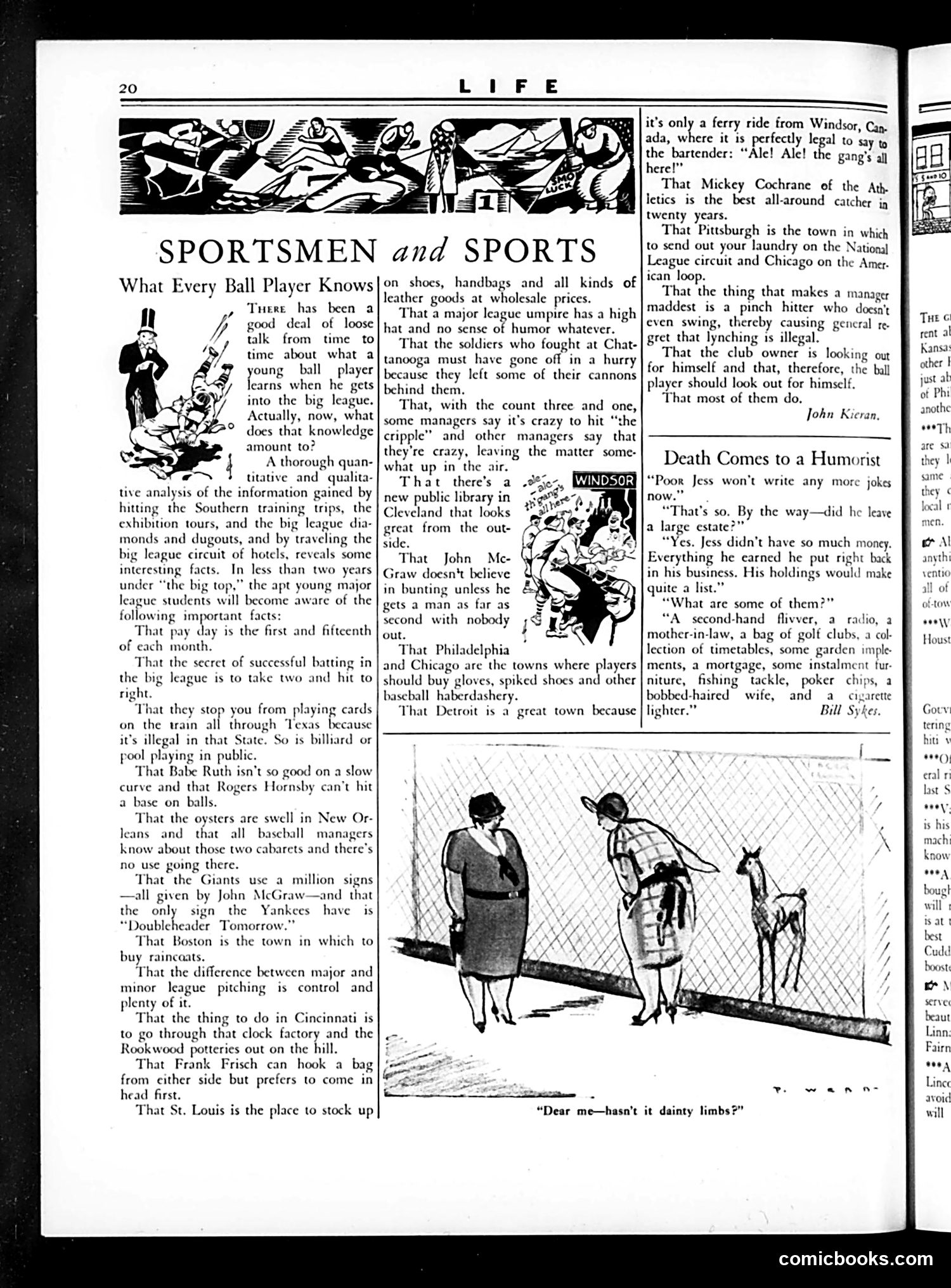
This page contains two distinct pieces from *Life* magazine's sports and humor sections. **"Sportsmen and Sports"** is a humorous essay by John Kieran listing absurd "facts" young baseball players supposedly learn in the majors. It's satirizing baseball culture by mixing genuine observations (pay schedules, batting techniques) with ridiculous ones (oysters in New Orleans, that umpires have no humor). The piece pokes fun at baseball lore and player superstitions. **"Death Comes to a Humorist"** is a dark joke about a deceased humorist named Jess. The humor lies in the ironic contrast: when asked about his estate, we learn he left almost nothing of monetary value—just junk (a used car, a radio, a mother-in-law, golf clubs, timetables). The cruel joke suggests his life's work and earnings amounted to worthless possessions, a commentary on the precarious financial state of Depression-era humorists and entertainers.
📄 Transcribed text from this page (OCR, searchable)
Machine-transcribed from the original scan — historical spelling and the odd misread are preserved.
SPORTSMEN and SPORTS What Every Ball Player Knows Tuere has been a good deal of loose talk from time to time about what a young ball _ player descae when he gets into the big league. Actually, now, what does that knowledge amount to? A thorough quan- titative and qualita- tive analysis of the information gained by hitting the Southern training trips, the exhibition tours, and the big league dia- monds and dugouts, and by traveling the big league circuit of hotels, reveals some interesting facts. In less than two years under “the big top,” the apt young major league students will become aware of the following important facts: That pay day is the first and fifteenth of each month. That the secret of successful batting in the big league is to take two and hit to right. That they stop you from playing cards on the train all through ‘Texas because it’s illegal in that State. So is billiard or pool playing in public. That Babe Ruth isn’t so good on a slow curve and that Rogers Hornsby can’t hit a base on balls. That the oysters are swell in New Or- leans and that all baseball managers know about those two cabarets and there's no use going there. That the Giants use a million signs —all given by John McGraw—and that the only sign the Yankees have is “Doubleheader Tomorrow.” That Boston is the town in which to buy raincaats. That the difference between major and minor league pitching is control and plenty of it. That the thing to do in Cincinnati is to go through that clock factory and the Rookwood potteries out on the hill. That Frank Frisch can hook a bag from cither side but prefers to come in head first. That St. Louis is the place to stock up on shoes, handbags and all kinds of leather goods at wholesale prices. That a major league umpire has a high hat and no sense of humor whatever. That the soldiers who fought at Chat- tanooga must have gone off in a hurry because they left some of their cannons behind them. That, with the count three and one, some managers say it’s crazy to hit “the cripple” and other managers say that they're crazy, leaving the matter some- what up in the air. That there’s a new public library in Cleveland that looks great from the out- side. That John Me- Graw doesn't believe in bunting unless he gets a man as far as second with nobody out. That Philadelphia and Chicago are the towns where players should buy gloves, spiked shoes and other baseball haberdashery. That Detroit is a great town because it’s only a ferry ride from Windsor, Cap. ada, where it is perfectly legal to say to the bartender: “Ale! Ale! the gang's al] here!” That Mickey Cochrane of the Ath. letics is the best all-around catcher ig twenty years. That Pittsburgh is the town in which to send out your laundry on the National League circuit and Chicago on the Amer. ican loop. That the thing that makes a manager maddest is a pinch hitter who doesn't even swing, thereby causing general te. gret that lynching 1s illegal. That the club owner is looking out for himself and that, therefore, the ball player should look out for himself. That most of them do, John Kieran, Death Comes to a Humorist “Poor Jess won't write any more jokes now. “That's so. By the way—did he leave a large estate?” “Yes. Jess didn’t have so much money. Everything he carned he put right back in his business. His holdings would make quite a list.” “What are some of them?” “A second-hand flivver, a radio, a mother-in-law, a bag of golf clubs, a col- lection of timetables, some garden imple- ments, a mortgage, some instalment tur- niture, fishing tackle, poker chips, a bobbed-haired wife, and a arette lighter.” Bill S: “Dear me—hasn’t it dainty limbs?” Tue rent al Kansas other | just at of Phi anothe of-tow Pratt Houst Gocv tering hit v 0) eral last S seey. comicbooks.com