
Life, 1928-06-14 · page 17 of 42
Life — June 14, 1928 — page 17: what you’re looking at
What you’re looking at
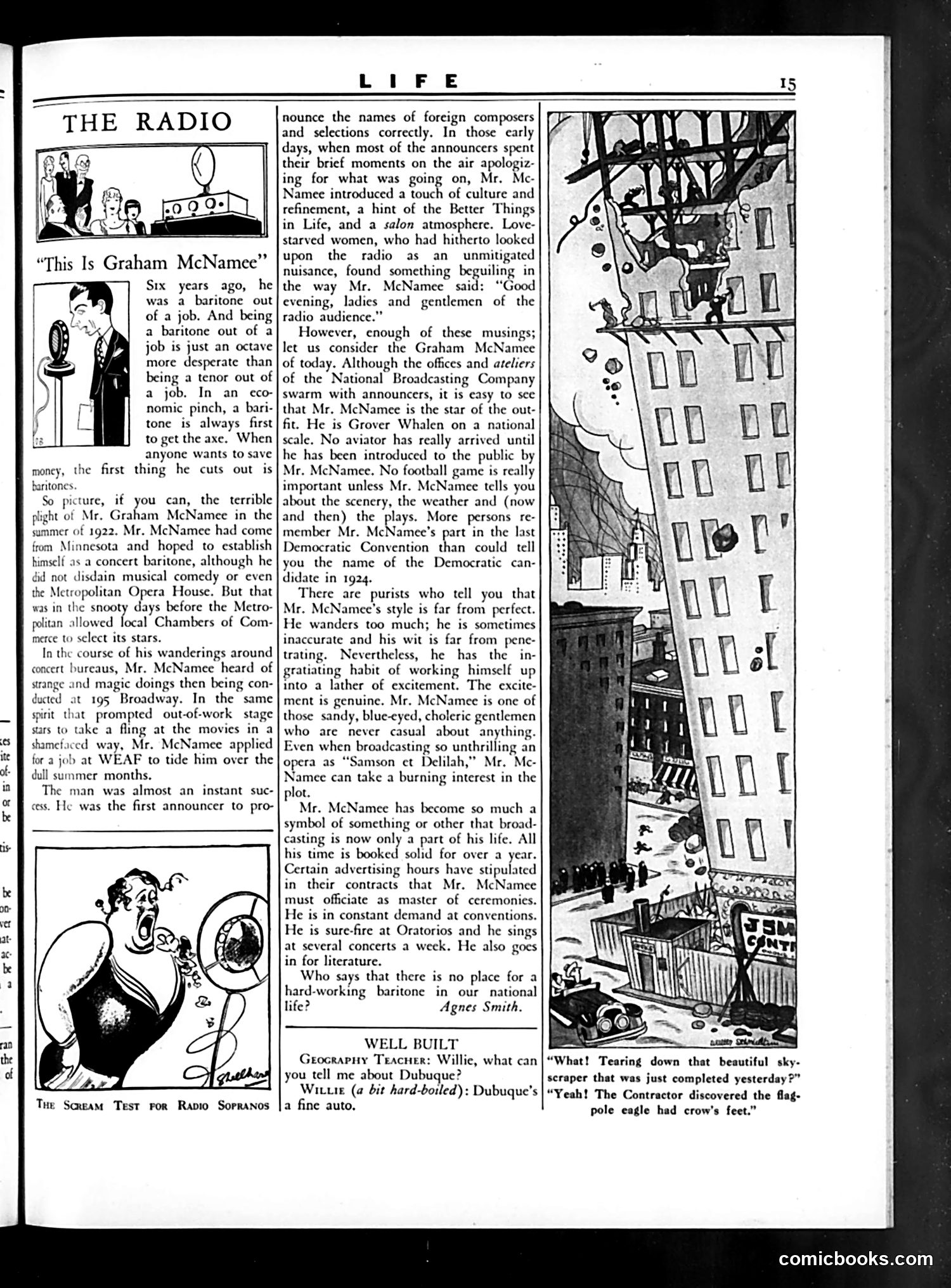
This page celebrates **Graham McNamee**, a pioneering radio announcer of the 1920s. The article describes how McNamee elevated radio broadcasting from mere technical novelty to an art form, introducing culture and refinement to early radio audiences. The cartoons mock radio sopranos—the "Scream Test for Radio Sopranos" shows a woman shrieking into a microphone, satirizing the sometimes-overwrought vocal performances common in early radio broadcasting. The right illustration depicts urban listeners in an apartment building gathering around their radio sets, showing how radio was binding communities together during this era. McNamee is celebrated as radio's first major celebrity personality, having covered major events like the 1924 Democratic Convention.
📄 Transcribed text from this page (OCR, searchable)
Machine-transcribed from the original scan — historical spelling and the odd misread are preserved.
LIFE “This Is Graham McNamee” Six years ago, he was a baritone out of a job. And being a baritone out of a job is just an octave more desperate than being a tenor out of a job. In an cco- nomic pinch, a bari- tone is always first to get the axe. When anyone wants to save money, the first thing he cuts out is baritones: So picture, if you can, the terrible plight of Mr. Graham McNamee in the summer of 1922. Mr. McNamee had come from Minnesota and hoped to establish himself as a concert baritone, although he did not disdain musical comedy or even the Metropolitan Opera House. But that was in the snooty days before the Metro- politan allowed local Chambers of Com- merce to select its stars. In the course of his wanderings around concert bureaus, Mr. McNamee heard of strange and magic doings then being con- ducted at 195 Broadway. In the same spirit that’ prompted out-of-work stage sars to take a fling at the movies in a shamefaced way, Mr. McNamee applied for a job at WEAF to tide him over the dull summer months. The man was almost an instant suc- cess. He was the first announcer to pro- Tue Scream Test ror Rapio Sopranos nounce the names of foreign composers and selections correctly. In those carly days, when most of the announcers spent their brief moments on the air apologiz- ing for what was going on, Mr. Mc- Namee introduced a touch of culture and refinement, a hint of the Better Things in Life, and a salon atmosphere. Love- starved women, who had hitherto looked upon the radio as an unmitigated nuisance, found something beguiling in the way Mr. McNamee said: “Good evening, ladies and gentlemen of the radio audience.” However, enough of these musings; let us consider the Graham McNamee of today. Although the offices and ateliers of the National Broadcasting Company swarm with announcers, it is easy to sce that Mr, McNamee is the star of the out- fit. He is Grover Whalen on a national scale, No aviator has really arrived until he has been introduced to the public by Mr. McNamee. No football game is really important unless Mr. McNamee tells you about the scenery, the weather and (now and then) the plays. More persons re- member Mr. McNamee’s part in the last Democratic Convention than could tell you the name of the Democratic can- didate in 1924. There are purists who tell you that Mr. McNamee’s style is far from perfect. He wanders too much; he is sometimes inaccurate and his wit is far from pene- trating. Nevertheless, he has the in- gratiating habit of working himself up into a lather of excitement. The excite- ment is genuine. Mr. McNamec is one of those sandy, blue-eyed, choleric gentlemen who are never casual about anything. Even when broadcasting so unthrilling an opera as “Samson et Delilah,” Mr. Mc- Namee can take a burning interest in the lot. Mr. McNamee has become so much a symbol of something or other that broad- casting is now only a part of his life. All his time is booked solid for over a year. Certain advertising hours have stipulated in their contracts that Mr. McNamee must officiate as master of ceremonies. He is in constant demand at conventions. He is sure-fire at Oratorios and he sings at several concerts a week. He also goes in for literature. Who says that there is no place for a hard-working baritone in our national life? Agnes Smith. WELL BUILT Geocrapny Teacuer: Willic, what can you tell me about Dubuque? Witte (a bit hard-boiled): Dubuque’s a fine auto. “What! Tearing down that beautiful sky- scraper that was just completed yesterday?” “Yeah! The Contractor discovered the flag- pole eagle had crow’s feet.” comicbooks.com