
Life, 1928-06-14 · page 19 of 42
Life — June 14, 1928 — page 19: what you’re looking at
What you’re looking at
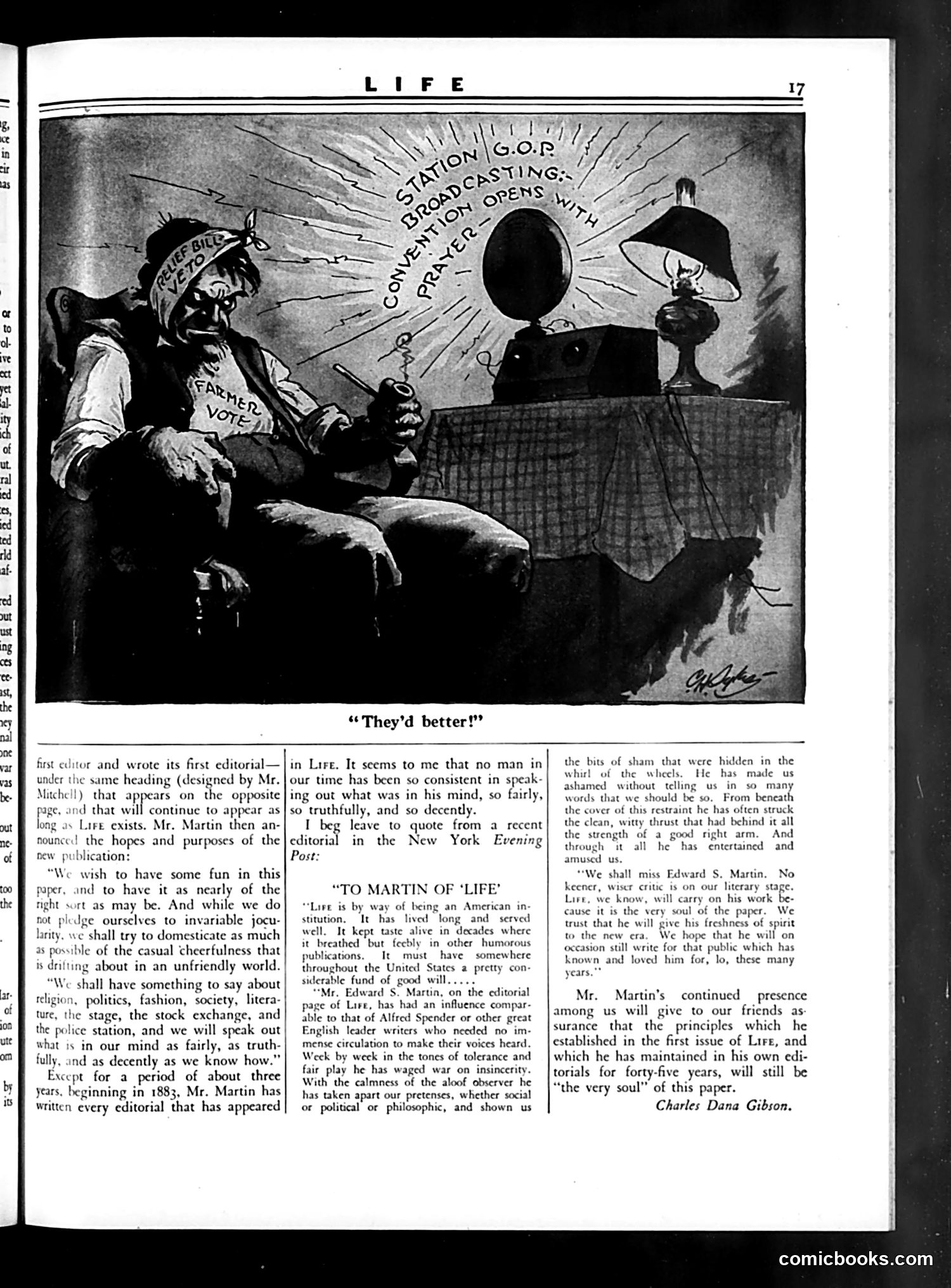
This cartoon satirizes Republican Party (GOP) radio broadcasting during a convention. A farmer labeled "Father Vote" listens to a radio broadcast where an unseen GOP representative speaks from a microphone marked with a large black circle. The burst of radiating lines suggests emphatic, grandiose speech. The cartoon's caption—"They'd better!"—suggests the farmer's skeptical demand that the GOP make good on promises. The satire mocks the GOP's reliance on radio propaganda to reach rural voters while implying their rhetoric is hollow. The farmer's suspicious posture and caption convey voter skepticism about political messaging, a timely critique of emerging mass-media campaign tactics in American politics during the early radio era.
📄 Transcribed text from this page (OCR, searchable)
Machine-transcribed from the original scan — historical spelling and the odd misread are preserved.
um oe BRaR 37 A SRR RRR BRAeAAP RARE RESeARASSR ~ pSTING:. OVENS: AY “They'd better!” first editor and wrote its first editorial— under the same heading (designed by Mr. Mitchell) that appears on the opposite page, and that will continue to appear as long as Lire exists. Mr. Martin then an- nounce! the hopes and purposes of the new publication: “We wish to have some fun in this paper, and to have it as nearly of the night sort as may be. And while we do not pledge ourselves to invariable jocu- larity, we shall try to domesticate as much ble of the casual cheerfulness that is drifting about in an unfriendly world. “We shall have something to say about religion, politics, fashion, society, litera- . the stage, the stock exchange, and lice station, and we will speak out what is in our mind as fairly, as truth- fully, and as decently as we know how.” Except for a period of about three years, beginning in 1883, Mr. Martin has written every editorial that has appeared a8 poss in Lire. It seems to me that no man in our time has been so consistent in speak- ing out what was in his mind, so fairly, so truthfully, and so decently. I beg leave to quote from a recent editorial in the New York Evening Post: “TO MARTIN OF ‘LIFE’ “Lire is by way of being an American in- stitution, It has lived long and served well. It kept taste alive in decades where it breathed but fecbly in other humorous publications, It must have somewhere throughout the United States a pretty con- siderable fund of good will “Mr. Edward S. Martin, on the editorial page of Lire, has had an influence compar- able to that of Alfred Spender or other great English leader writers who needed no im- mense circulation to make their voices heard. Week by week in the tones of tolerance and fair play he has waged war on insincerity. With the calmness of the aloof observer he has taken apart our pretenses, whether social or political or philosophic, and shown us the bits of sham that were hidden in the whirl of the wheels. He has made us ashamed without telling us in so many words that we should be so. From beneath the cover of this restraint he has o the clean, witty thrust that had behi the strength of a good right arm through it all he has entertained amused us. “We shall miss Edward S. Martin, No keener, wiser critic is on our literary stage. Lire, we know, will carry on his work be- cause it is the very soul of the paper. We trust that he will give his freshness of spirit to the new era. We hope that he will on oceasion still write for that public which has known and loved him for, lo, these many years.”* Mr. Martin’s continued _ presence among us will give to our friends as surance that the principles which he established in the first issue of Lire, and which he has maintained in his own edi- torials for forty-five years, will still be “the very soul” of this paper. Charles Dana Gibson. and comicbooks.com