
Life, 1928-06-14 · page 16 of 42
Life — June 14, 1928 — page 16: what you’re looking at
What you’re looking at
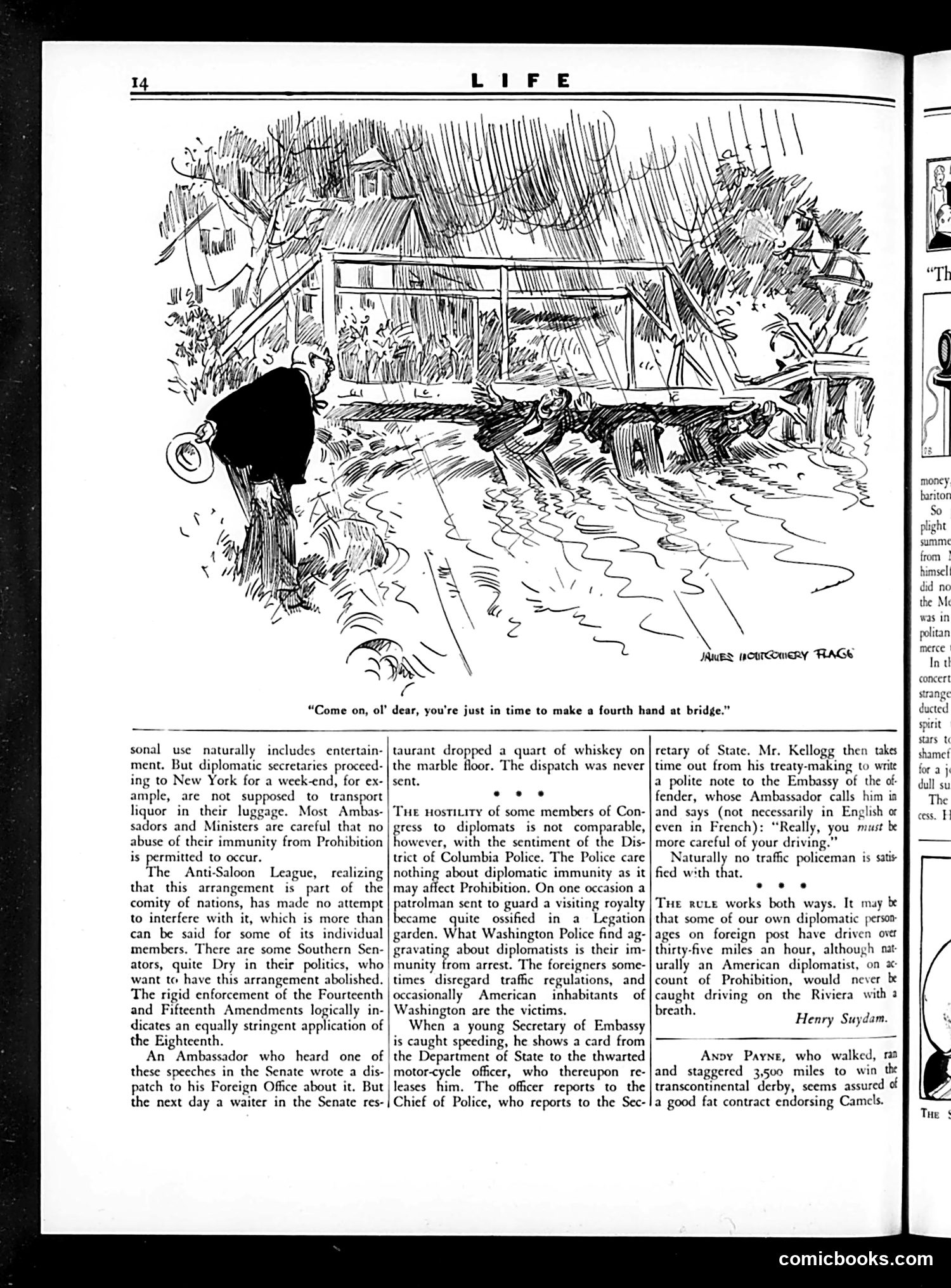
The cartoon by James Montgomery Flagg depicts a rainy scene where a figure in formal attire (likely a diplomat) is being called to play bridge. The caption reads: "Come on, ol' dear, you're just in time to make a fourth hand at bridge." The surrounding text discusses **diplomatic immunity and Prohibition enforcement**. It satirizes how diplomats, protected by immunity, could violate American laws—particularly traffic regulations and Prohibition—without consequence. The cartoon jokes that while diplomats cause serious problems in Washington, they're socially welcomed to leisure activities like bridge. The humor targets the hypocrisy of treating diplomats as both lawbreakers and social equals, highlighting tensions between diplomatic privilege and American law enforcement during the Prohibition era (1920-1933).
📄 Transcribed text from this page (OCR, searchable)
Machine-transcribed from the original scan — historical spelling and the odd misread are preserved.
LM) \ Ye MM \ of N ATS Mai\\\ “Come on, ol’ dear, you're just in time to make a fourth hand at bridge.” sonal use naturally includes entertain- ment. But diplomatic secretaries proceed- ing to New York for a week-end, for ex- ample, are not supposed to transport liquor in their luggage. Most Ambas- sadors and Ministers are careful that no abuse of their immunity from Prohibition is permitted to occur. The Anti-Saloon League, realizing that this arrangement is part of the comity of nations, has made no attempt to interfere with it, which is more than can be said for some of its individual members. There are some Southern Sen- ators, quite Dry in their politics, who | want to have this arrangement abolished. The rigid enforcement of the Fourteenth and Fifteenth Amendments logically in- dicates an equally stringent application of the Eighteenth. An Ambassador who heard one of these speeches in the Senate wrote a dis- patch to his Foreign Office about it. But the next day a waiter in the Senate res- taurant dropped a quart of whiskey on the marble floor. The dispatch was never sent. eee Tue Hostitity of some members of Con- press to diplomats is not comparable, however, with the sentiment of the Dis- trict of Columbia Police. The Police care nothing about diplomatic immunity as it may affect Prohibition. On one occasion a patrolman sent to guard a visiting royalty came quite ossified in a Legation garden. What Washington Police find ag- gravating about diplomatists is their im- munity from arrest. The foreigners some- times disregard traffic regulations, and occasionally American inhabitants of Washington are the victims. When a young Secretary of Embassy is caught speeding, he shows a card from |the Department of State to the thwarted |motor-cycle officer, who thereupon re- leases him. The officer reports to the Chief of Police, who reports to the Sec- retary of State. Mr. Kellogg then takes time out from his treaty-making to write a polite note to the Embassy of the of- fender, whose Ambassador calls him in and says (not necessarily in English o even in French): “Really, you must be more careful of your driving.” Naturally no traffic policeman is satis fied with that. eee Tue rvute works both ways. It may be that some of our own diplomatic persox ages on foreign post have driven over thirty-five miles an hour, although nat- urally an American diplomatist, on 3 count of Prohibition, would never be caught driving on the Riviera with 3 breath Henry Suydam. Anoy Payne, who walked, and staggered 3,500 miles to win th transcontinental derby, seems assured a good fat contract endorsing Camels. money bariton So plight summe from | himsel did no the Mc was in politan merce | Ind concert spirit sars shamet for a j dull su The cess. Tue comicbooks.com