
Life, 1928-06-14 · page 27 of 42
Life — June 14, 1928 — page 27: what you’re looking at
What you’re looking at
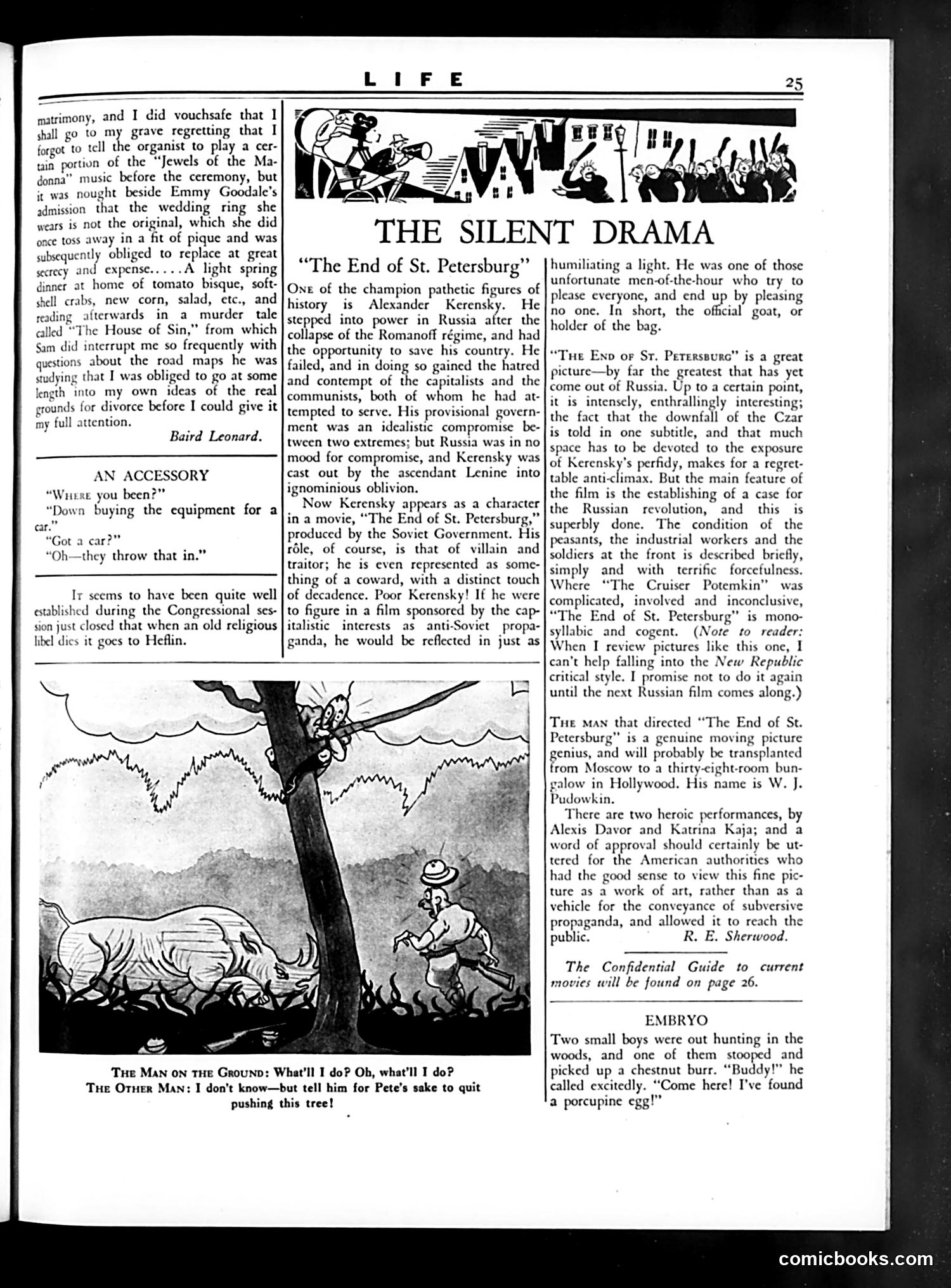
This page contains film criticism and light humor pieces typical of 1920s Life magazine satire. **"The Silent Drama" review** discusses a Soviet film about Alexander Kerensky, the Russian politician who briefly led the Provisional Government (1917) before Lenin's Bolsheviks took power. The critic notes the irony that Kerensky—vilified by both capitalists and communists for his failed compromise position—is portrayed as a villain and coward by the Soviet government. The review praises the film "The End of St. Petersburg" as artistically superior propaganda, commending its depiction of peasant and worker suffering that justified the revolution. **The cartoon** shows two men struggling with a falling tree. One asks desperately what to do; the other tells him to ask "Pete" to stop pushing it—obvious absurdist humor about miscommunication and futility. **The brief jokes** include wordplay about car purchases and a reference to "Heflin"—likely William Heflin, a congressman associated with anti-Catholic rhetoric during this era. The page reflects 1920s American attitudes: grudging respect for Soviet artistic achievement while remaining skeptical of Communist ideology.
📄 Transcribed text from this page (OCR, searchable)
Machine-transcribed from the original scan — historical spelling and the odd misread are preserved.
matrimony, and I did vouchsafe that I shall go to my grave regretting that I forgot to tell the organist to play a cer- tain portion of the “Jewels of the Ma- donna” music before the ceremony, but it was nought beside Emmy Goodale’s admission that the wedding ring she wears is not the original, which she did once toss away in a fit of pique and was subsequently obliged to replace at great secrecy and expense.....A light spring dinner at home of tomato bisque, soft- shell crabs, new corn, salad, etc., and reading afterwards in a murder tale aalled “The House of Sin,” from which Sam did interrupt me so frequently with questions about the road maps he was rudying that I was obliged to go at some length into my own ideas of the real grounds for divorce before I could give it my full attention. Baird Leonard. AN ACCESSORY “Waese you been?” “Down buying the equipment for a car.” “Got a car?” “Oh—they throw that in.” Ir seems to have been quite well established during the Congressional ses- sion just closed that when an old religious libel dies it goes to Heflin. “The End of St. Petersburg” One of the champion pathetic figures of history is Alexander Kerensky. He stepped into power in Russia after the collapse of the Romanoff régime, and had the opportunity to save his country. He failed, and in doing so gained the hatred and contempt of the capitalists and the communists, both of whom he had at- tempted to serve. His provisional govern- ment was an idealistic compromise be- tween two extremes; but Russia was in no mood for compromise, and Kerensky was cast out by the ascendant Lenine into ignominious oblivion. Now Kerensky appears as a character in a movie, “The End of St. Petersburg,” produced by the Soviet Government. His réle, of course, is that of villain and traitor; he is even represented as some- thing of a coward, with a distinct touch of decadence. Poor Kerensky! If he were to figure in a film sponsored by the cap- italistic interests as anti-Soviet propa- ganda, he would be reflected in just as Tue Man on THE Grounp: What’ll I do? Ob, what'll I do? Tue Orner Man: I don't know—but tell him for Pete’s sake to quit pushing this tree! humiliating a light. He was one of those unfortunate men-of-the-hour who try to please everyone, and end up by pleasing no one. In short, the official goat, or holder of the bag. “Tue Eno or Sr. Pererssurc” is a great picture—by far the greatest that has yet come out of Russia. Up to a certain point, it is intensely, enthrallingly interesting; the fact that the downfall of the Czar is told in one subtitle, and that much space has to be devoted to the exposure of erent perfidy, makes for a regret- table anti-climax. But the main feature of the film is the establishing of a case for the Russian revolution, and this is superbly done. The condition of the peasants, the industrial workers and the soldiers at the front is described briefly, simply and with terrific forcefulness. Where “The Cruiser Potemkin” was complicated, involved and_ inconclusive, “The End of St. Petersburg” is mono- syllabic and cogent. (Note to reader: When I review pictures like this one, I can’t help falling into the New Republic critical style. I promise not to do it again until the next Russian film comes along.) Tue Man that directed “The End of St. Petersburg” is a genuine moving picture genius, and will probably be transplanted from Moscow to a thirty-cight-room bun- galow in Hollywood. His name is W. J. Pudowkin. There are two heroic performances, by Alexis Davor and Katrina Kaja; and a word of approval should certainly be ut- tered for the American authorities who had the good sense to view this fine pic- ture as a work of art, rather than as a vehicle for the conveyance of subversive propaganda, and allowed it to reach the public. R. E. Sherwood. The Confidential Guide to current movies will be found on page 26. EMBRYO Two small boys were out hunting in the woods, and one of them stooped and picked up a chestnut burr. “Buddy!” he called excitedly. “Come here! I've found a porcupine egg!” comicbooks.com