
A complete issue · 84 pages · 1923
Life — December 6, 1923
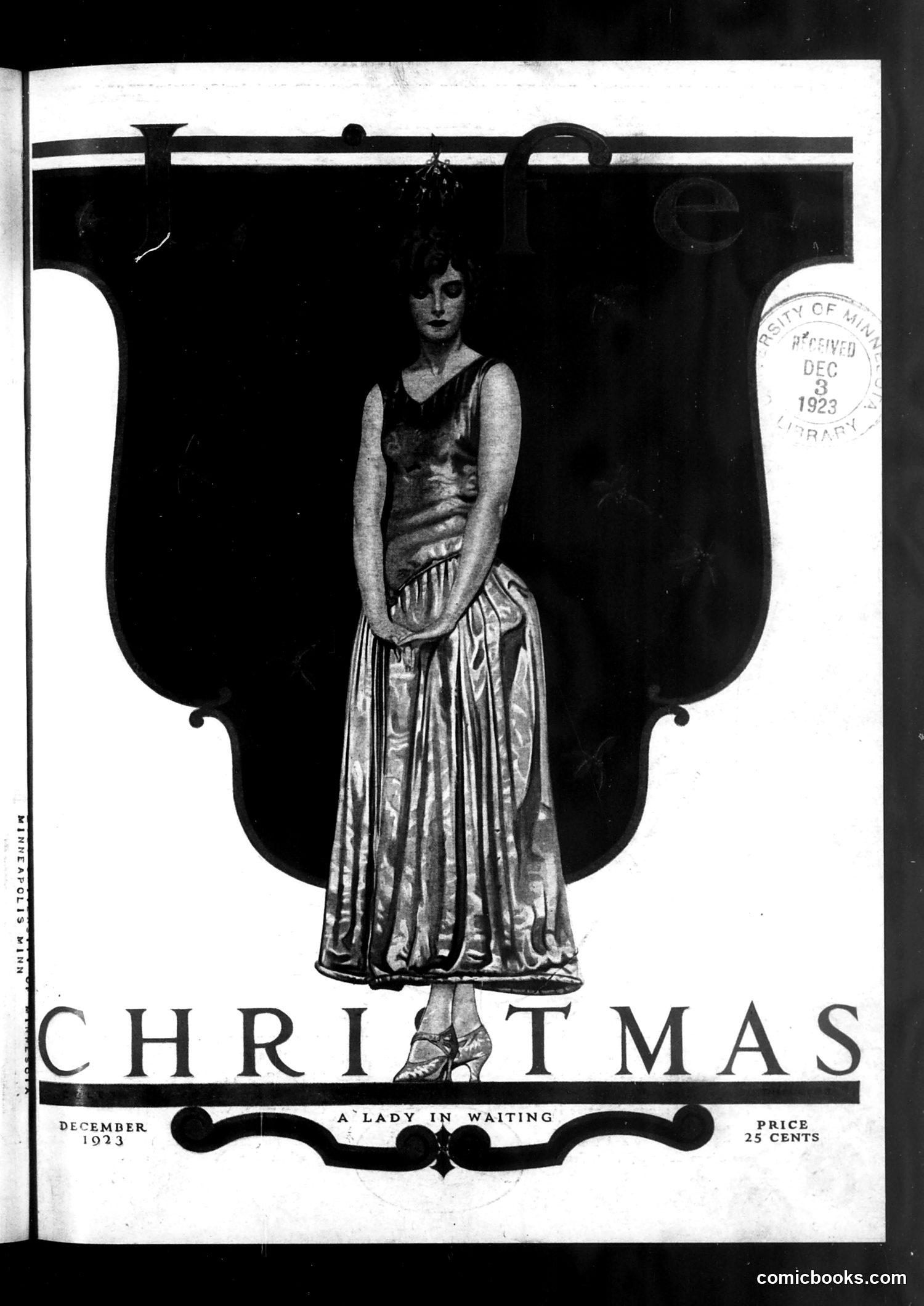
This is a Christmas cover illustration rather than political satire. It depicts a fashionably dressed woman in 1920s attire—a sleeveless dress with a pleated skirt—standing expectantly within an ornamental frame styled like a large lute or violin. The musical instrument framing suggests elegance and artistic refinement. The subtitle "A Lady in Waiting" plays on the dual meaning: both a woman of refined status and a woman literally waiting (presumably for Christmas gifts or celebrations). The styling and composition are typical of *Life* magazine's upscale aesthetic during the 1920s. This appears to be decorative holiday cover art marketed toward middle and upper-class readers, priced at 25 cents.
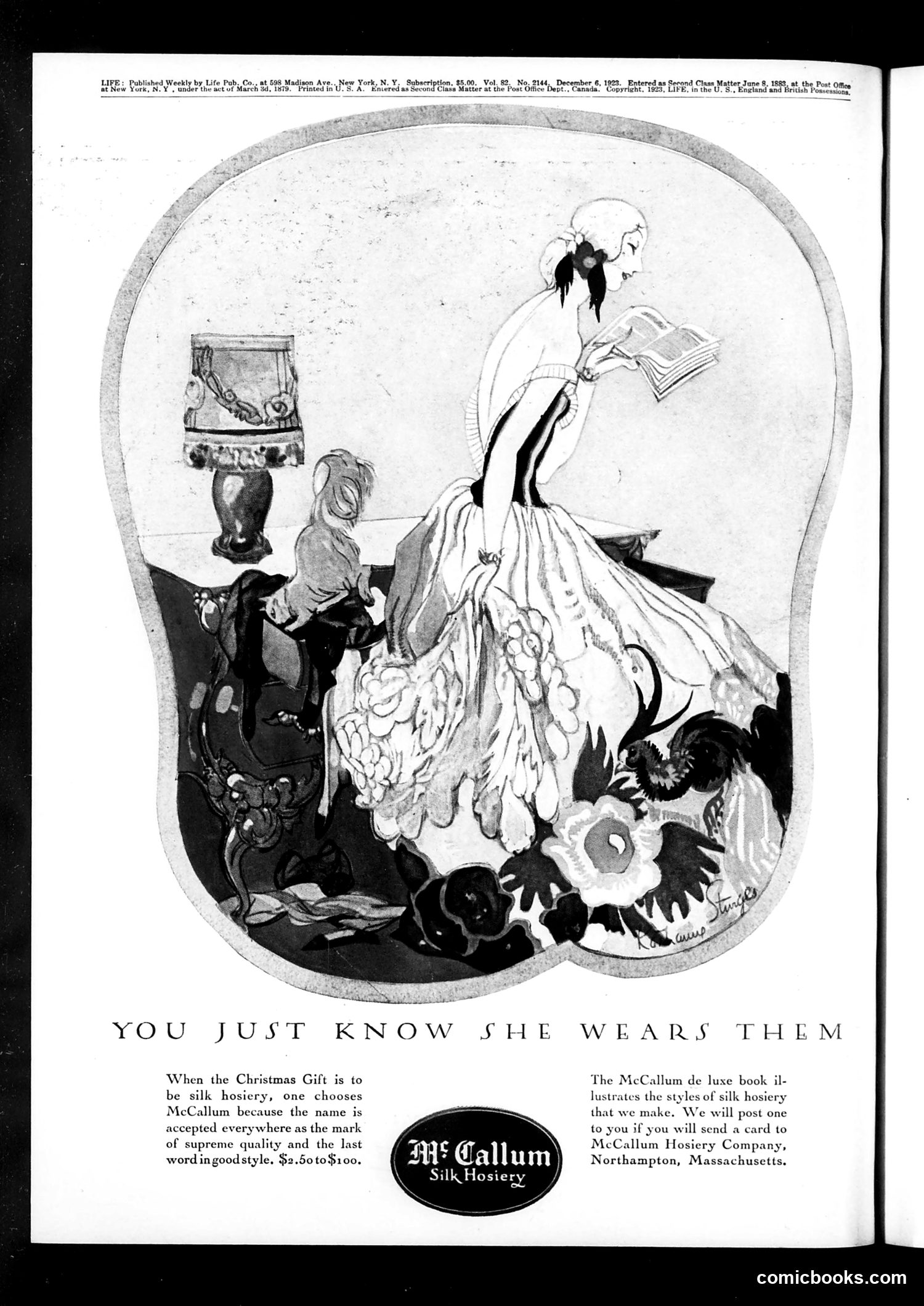
This page is primarily **an advertisement for McCallum Silk Hosiery** rather than political satire. The illustration depicts a fashionable woman in elegant dress reading a magazine, with decorative flowers and furnishings, embodying 1920s glamour and refinement. The ad's tagline—"YOU JUST KNOW SHE WEARS THEM"—uses a common advertising strategy of the era: associating quality products with social status and sophistication. The message suggests that silk hosiery marks a woman of good taste and breeding. The accompanying text emphasizes that McCallum is "accepted everywhere as the mark of superior quality," positioning the brand as a prestige Christmas gift. This reflects 1920s consumer culture where branded goods signaled social standing. This is **commercial content, not political commentary**.
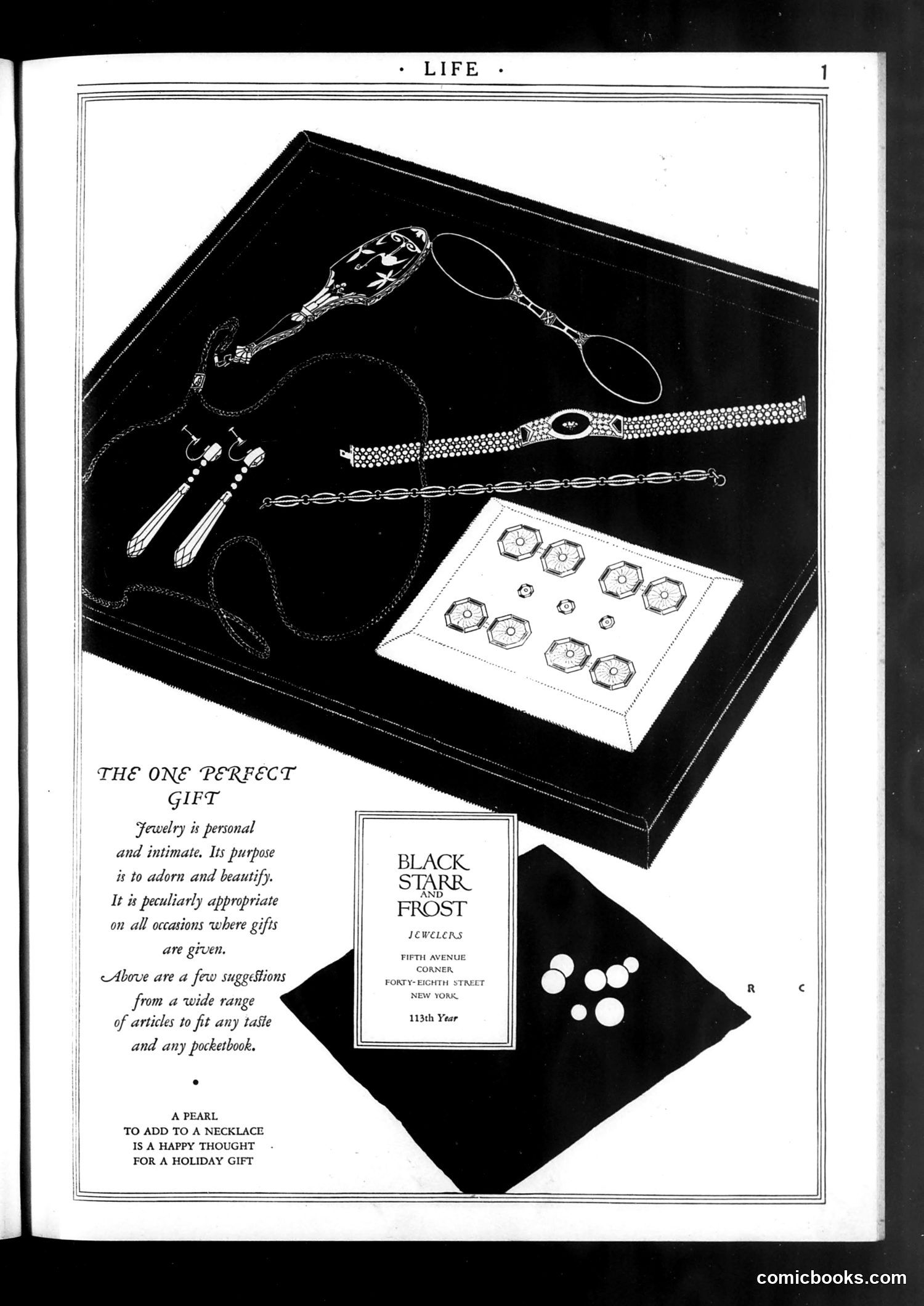
This is **not a political cartoon or satire**—it's a jewelry advertisement for Black Starr & Frost, a luxury jeweler on Fifth Avenue in New York. The page displays various jewelry items (necklaces, bracelets, earrings, and loose pearls) arranged in an elegant presentation box to appeal to holiday gift-buyers. The accompanying text emphasizes jewelry as "the one perfect gift" suitable for any occasion and recipient. The magazine *Life* included advertisements alongside its satirical content. This appears to be a straightforward luxury goods advertisement targeting affluent readers, likely from the early 20th century based on the "115th Year" notation and styling of the jewelry pieces shown.
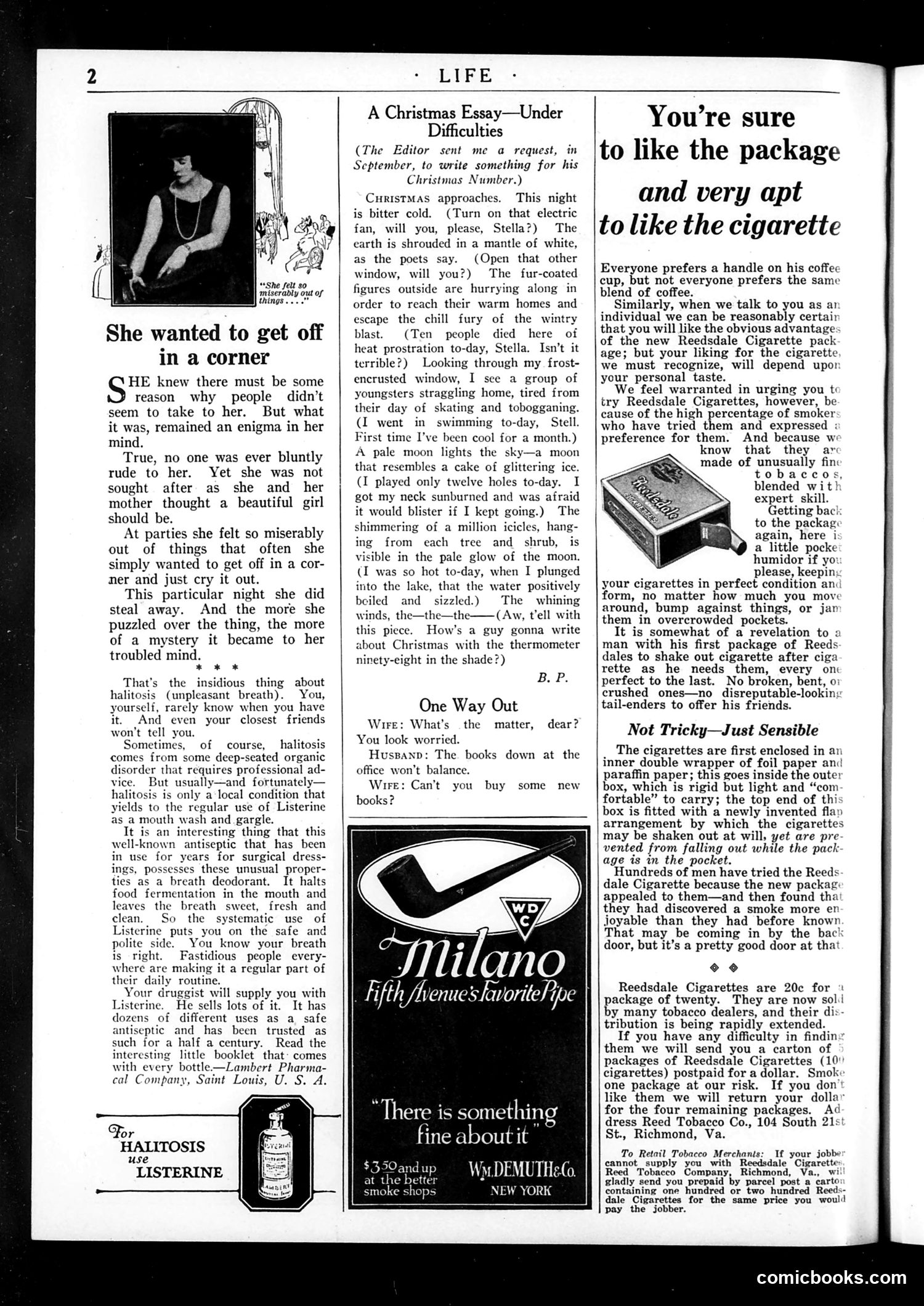
This page is **primarily advertising** rather than editorial satire. The main content includes: 1. **"A Christmas Essay—Under Difficulties"** by B.P.: A humorous essay about winter discomforts (cold, icicles, wet conditions) presented as reasons why someone wants to "get off in a corner." 2. **"One Way Out"**: A brief comedic dialogue between wife and husband about financial troubles. 3. **Multiple advertisements**: The dominant feature is a large Reedsdale Cigarettes ad emphasizing the new package's protective qualities, plus ads for Listerine mouthwash, Milano pipes, and W. DeMuth & Co. pipes. The page reflects **1920s consumer culture** where magazines mixed editorial humor with prominent advertising. No clear political cartoons or caricatures are present—the content is lifestyle-focused, not satirical commentary on current events.
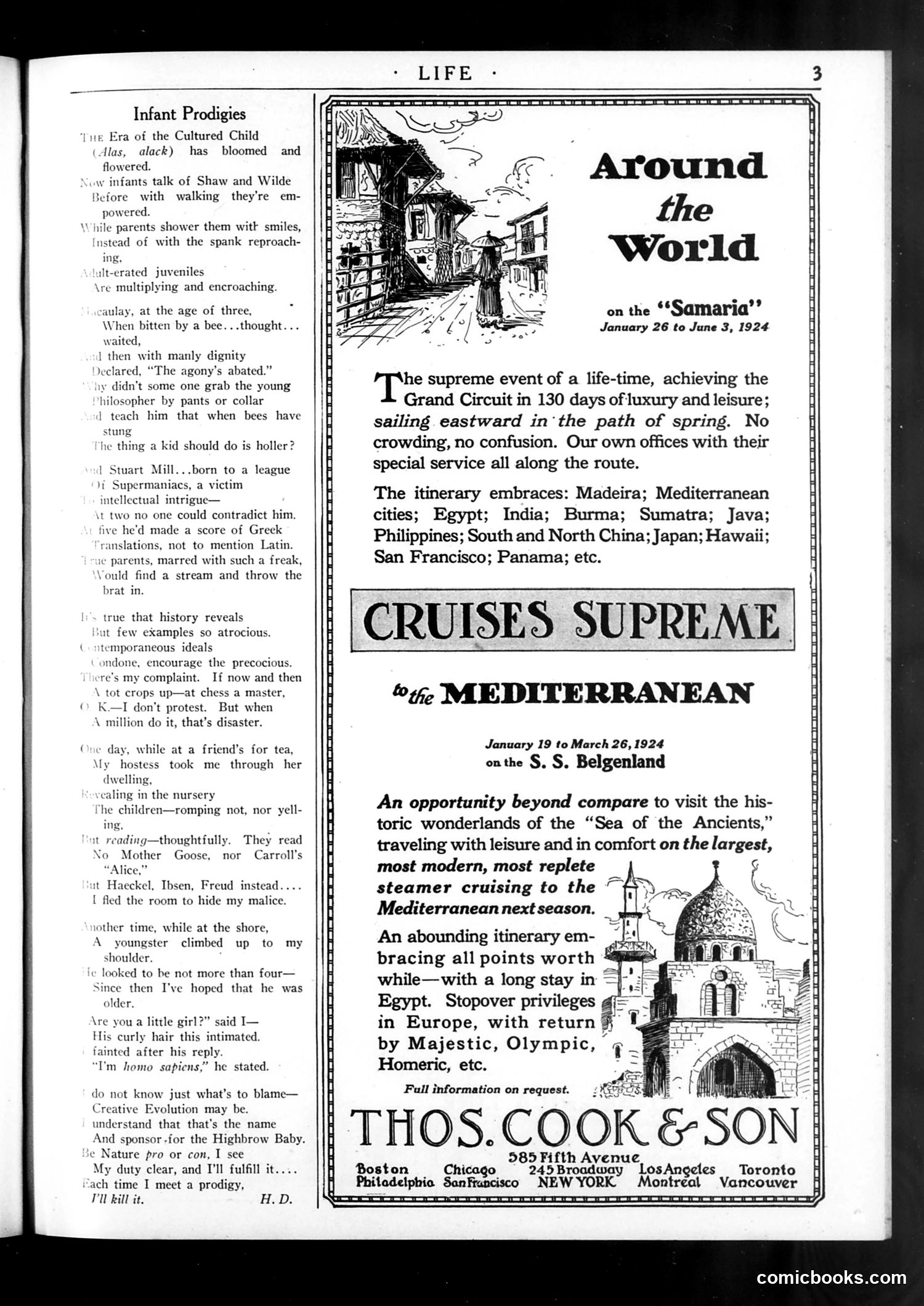
This page is **primarily advertising**, not editorial content or satire. The dominant feature is a large advertisement for Thomas Cook & Son travel cruises, promoting two luxury voyages: 1. **"Around the World" cruise** on the Samaria (January 26–June 3, 1924), spanning 130 days with stops across Asia, the Pacific, and Hawaii 2. **Mediterranean cruise** on the S.S. Belgienland (January 19–March 26, 1924) The left column contains an article titled "Infant Prodigies," discussing precocious children like Shaw and Wilde, with anecdotes about child behavior. This is editorial content, not satire or political commentary. The cruises advertised represent luxury travel available to wealthy readers—a marketing pitch emphasizing modernity, comfort, and exotic destinations during the Jazz Age.
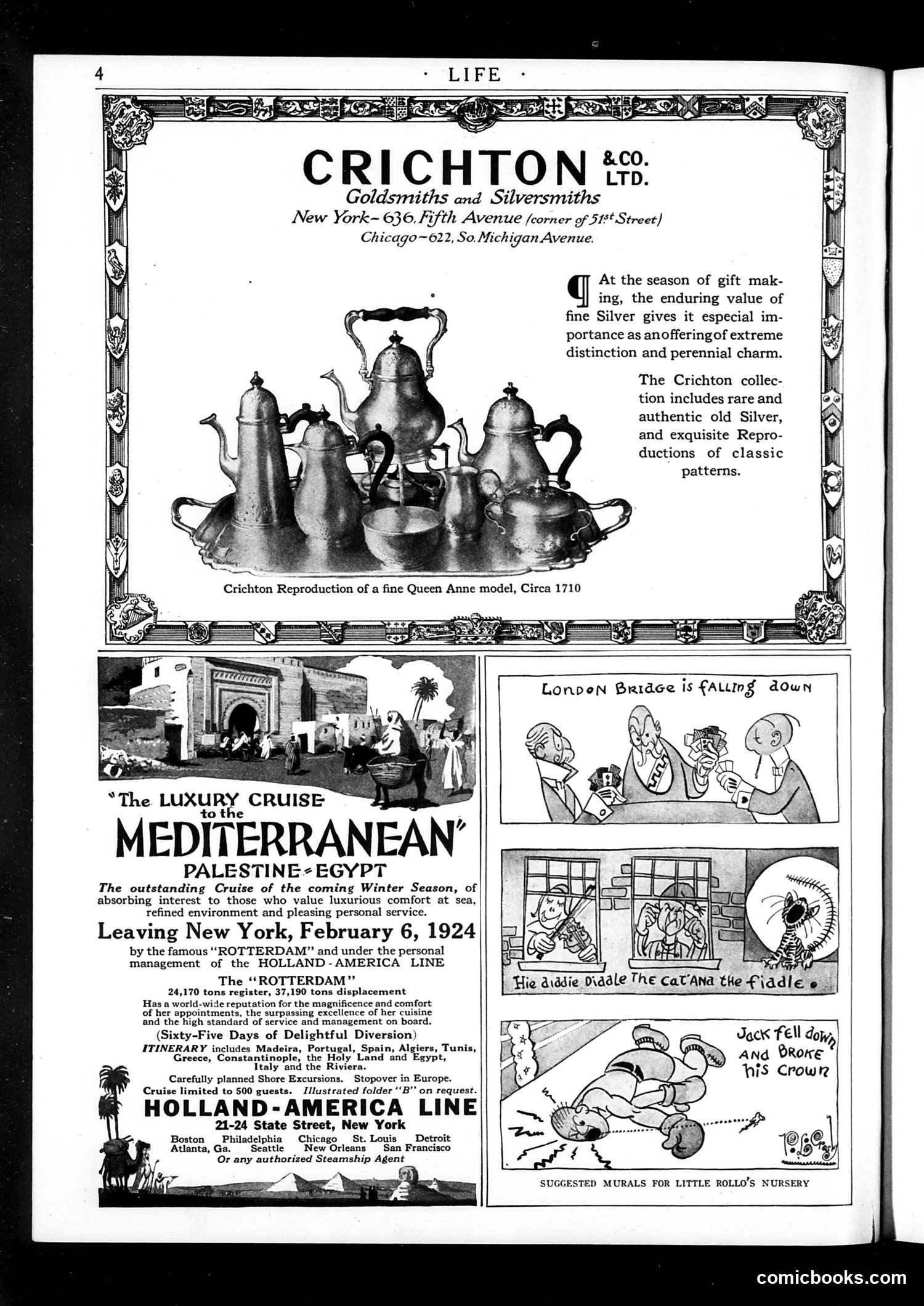
This Life magazine page (page 4) is primarily **advertising content** rather than political satire. The top advertisement showcases **Crichton & Co., Ltd.**, goldsmiths and silversmiths, displaying a reproduction of a fine Queen Anne silver tea service from circa 1710—positioning silver gifts as valuable, distinguished offerings. Below that is a cruise ship advertisement for the Holland-America Line's "Rotterdam," promoting luxury Mediterranean cruises to Palestine and Egypt, departing February 6, 1924. The right side contains **comic strips** titled "Suggested Murals for Little Bollo's Nursery"—humorous illustrations including "London Bridge is Falling Down," "The Diddie Riddle The Cat and the Fiddle," and "Jack Fell Down and Broke His Crown," featuring playful depictions of nursery rhyme characters. This page reflects 1920s consumer culture and entertainment rather than political commentary.
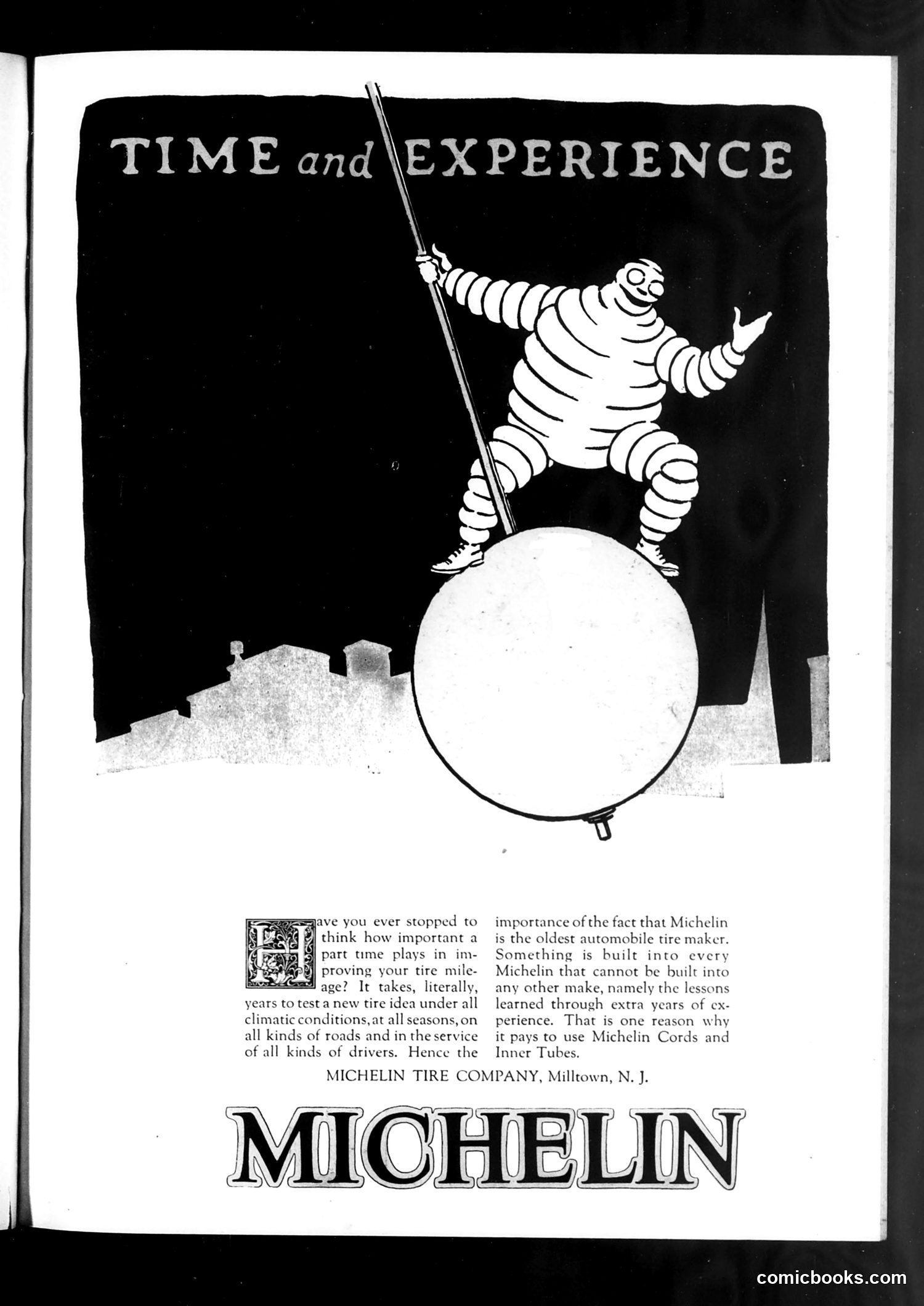
This is a Michelin tire advertisement, not political satire. The illustration shows the Michelin Man (Bibendum), the company's mascot—a rotund, bandaged figure—balancing atop a large tire while wielding a sword or pole like a circus performer. The ad's message plays on the phrase "time and experience": Michelin claims that years of testing tires under various conditions and climates prove their superiority. The circus/acrobat imagery suggests that mastering tires requires skill built through experience. The bandaged appearance of Michelin Man humorously implies the tire company has endured countless "trials" to perfect their product. The ad concludes by promoting Michelin Cords and Inner Tubes as products justified by this accumulated expertise.
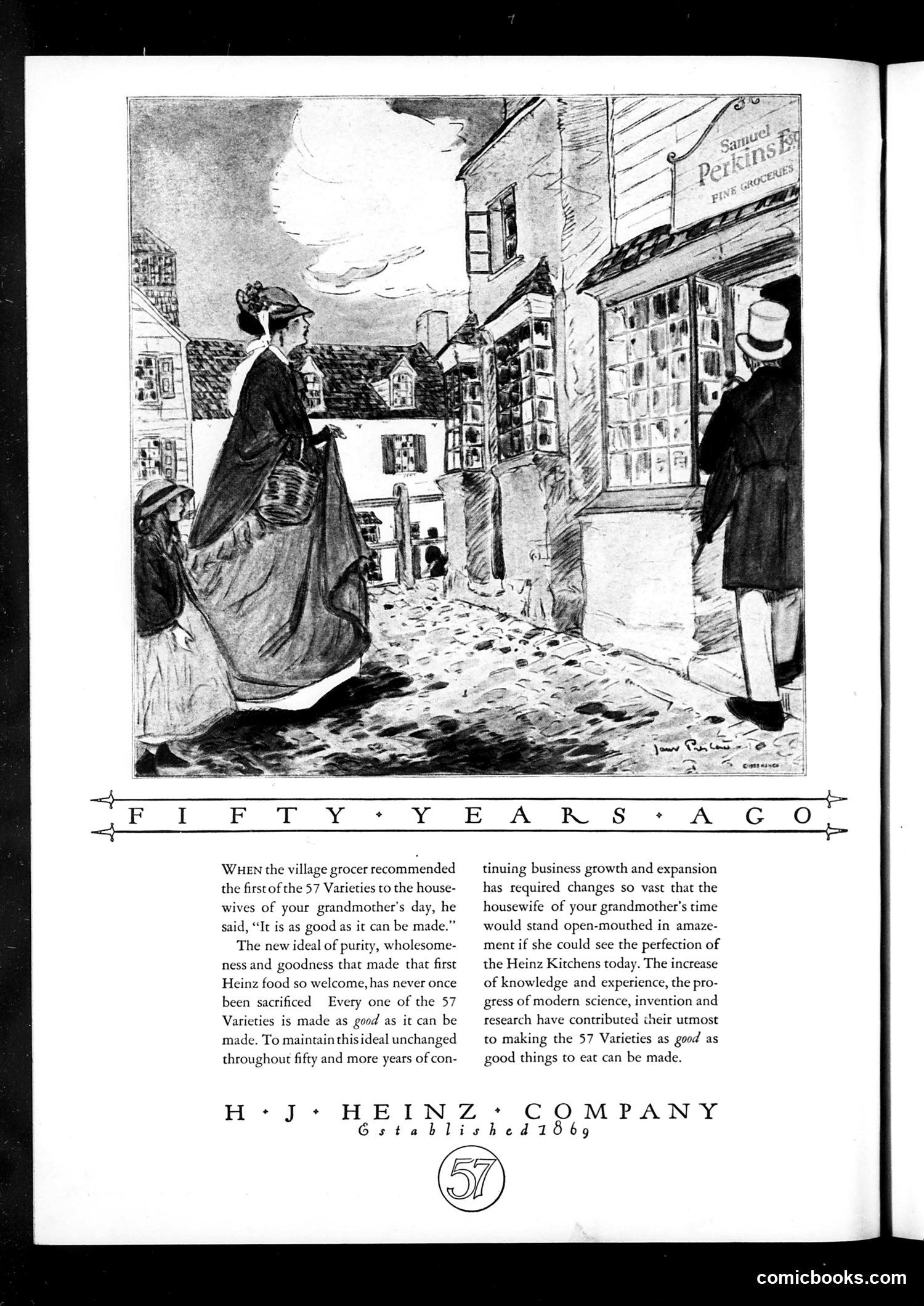
This is a **Heinz Company advertisement**, not political satire. The illustration shows a street scene from "Fifty Years Ago" featuring a village grocer's shop and pedestrians in period dress (roughly 1860s clothing and hairstyles). The ad's message contrasts past and present: fifty years ago, a grocer recommended Heinz's "57 Varieties" as "as good as it can be made." The text argues that despite business expansion and modernization, Heinz maintains this original quality standard through "knowledge and experience, the progress of modern science, invention and research." The nostalgic imagery—cobblestone street, old architecture, period clothing—emphasizes brand longevity and tradition, while the text celebrates how modern methods have actually *improved* product quality rather than compromised it. This is corporate brand-building through appeals to heritage.
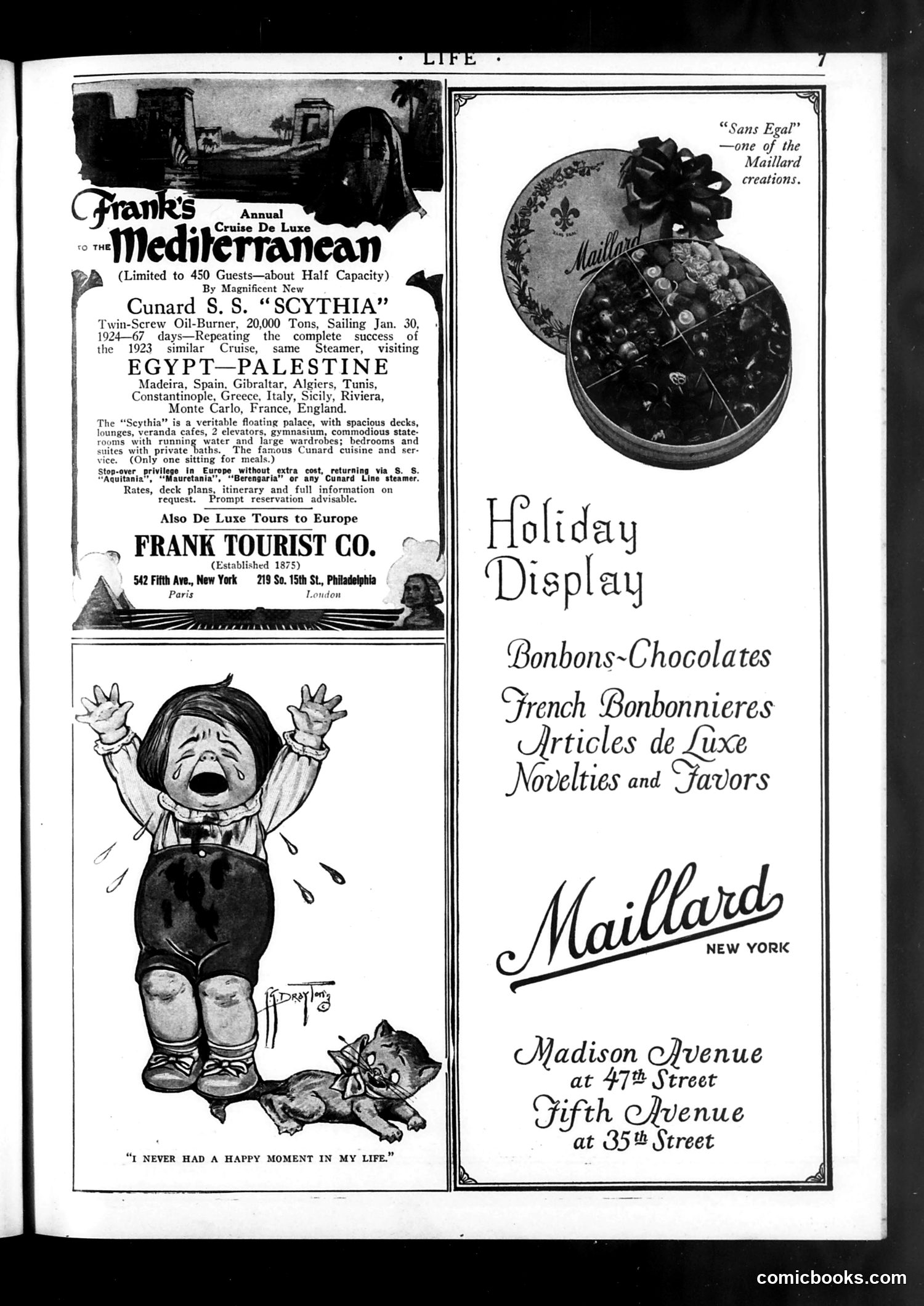
This page is primarily **advertising**, not editorial content or satire. The left side features Frank Tourist Co.'s cruise advertisements for the Cunard S.S. Scythia to Egypt and Palestine, along with an unrelated cartoon illustration of a distressed child with the caption "I Never Had a Happy Moment in My Life." The right side advertises **Maillard chocolates and bonbons**, a luxury French confectioner with New York locations. The child cartoon appears to be a generic humorous illustration (signed, suggesting it's by a staff cartoonist) rather than political satire—likely meant to provide visual interest and mild humor on an advertisement-heavy page. There's no clear political or social commentary visible; this is a commercial publication page mixing ads with filler illustrations.
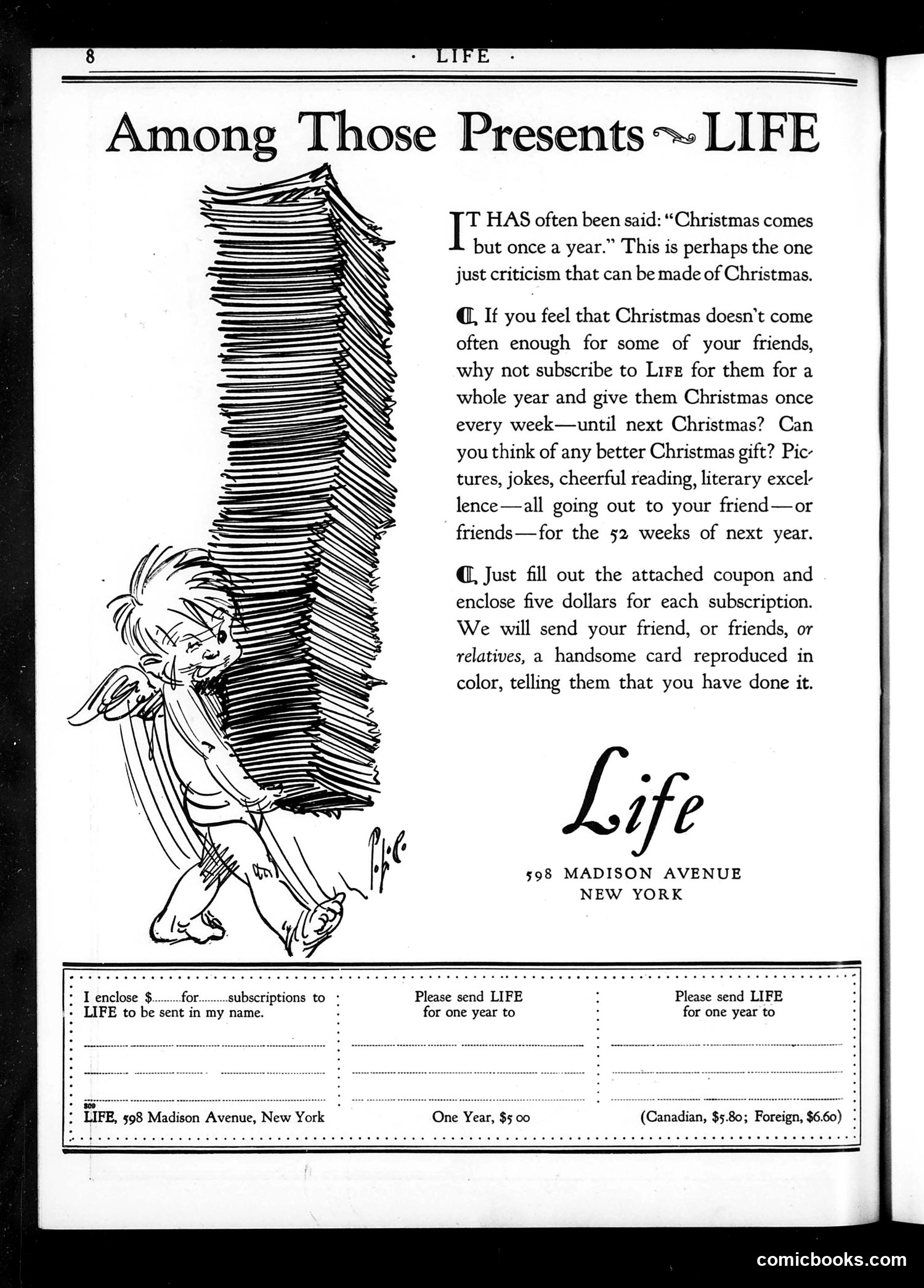
This is primarily a **gift subscription advertisement** for *Life* magazine, not a political cartoon. The page promotes purchasing year-long subscriptions as Christmas presents for friends and relatives. The illustration shows a **cartoon cherub or cupid figure** straining to support an enormous stack of magazines, visually communicating the weekly delivery concept—"Christmas once every week" for 52 weeks. The advertisement's pitch emphasizes *Life*'s content (pictures, jokes, literary excellence) as superior to traditional gift-giving. At five dollars per subscription, it positioned magazine subscriptions as an affordable yet intellectually valuable present. The coupon at bottom allows buyers to arrange direct sending to recipients with a notification card. This represents early 20th-century magazine marketing targeting middle-class gift-givers.
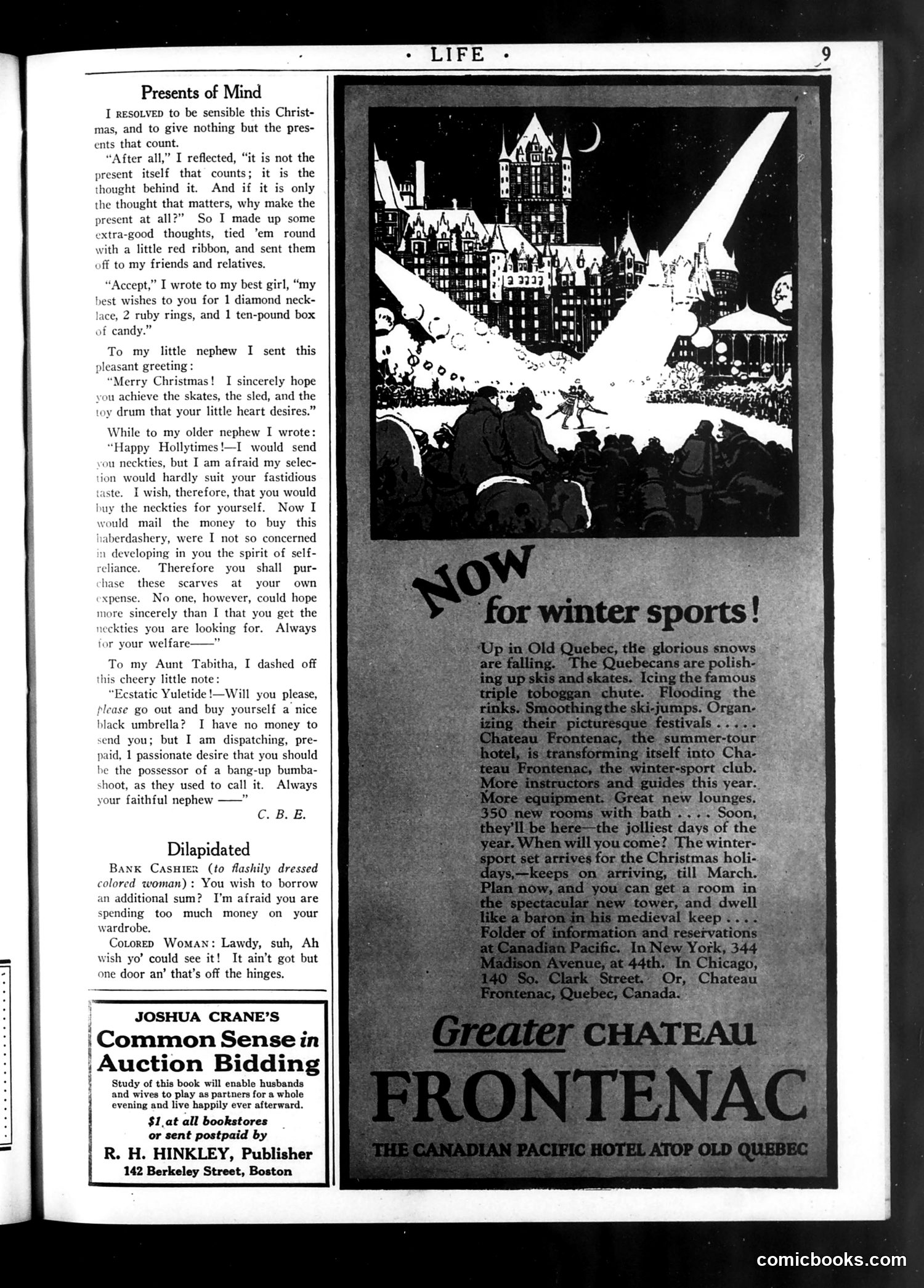
This page contains a humor column titled "Presents of Mind" discussing gift-giving strategies, alongside a large advertisement for Chateau Frontenac, a Canadian Pacific Hotel in Quebec City. The left column features humorous letters about Christmas gifts—including notes about sending jewelry, neckties, and umbrellas—written in a tongue-in-cheek advisory style. The tone is satirical about consumer culture and gift-giving obligations. The right side advertises winter sports at Quebec's Chateau Frontenac resort, featuring an illustration of a snow-covered castle with people enjoying winter activities below. The advertisement emphasizes skiing, skating, and new hotel amenities. There are no political cartoons on this page. The content is primarily satirical humor about everyday middle-class concerns (gift-giving, holiday spending) mixed with tourism advertising—typical of Life magazine's format blending social commentary with commercial content.
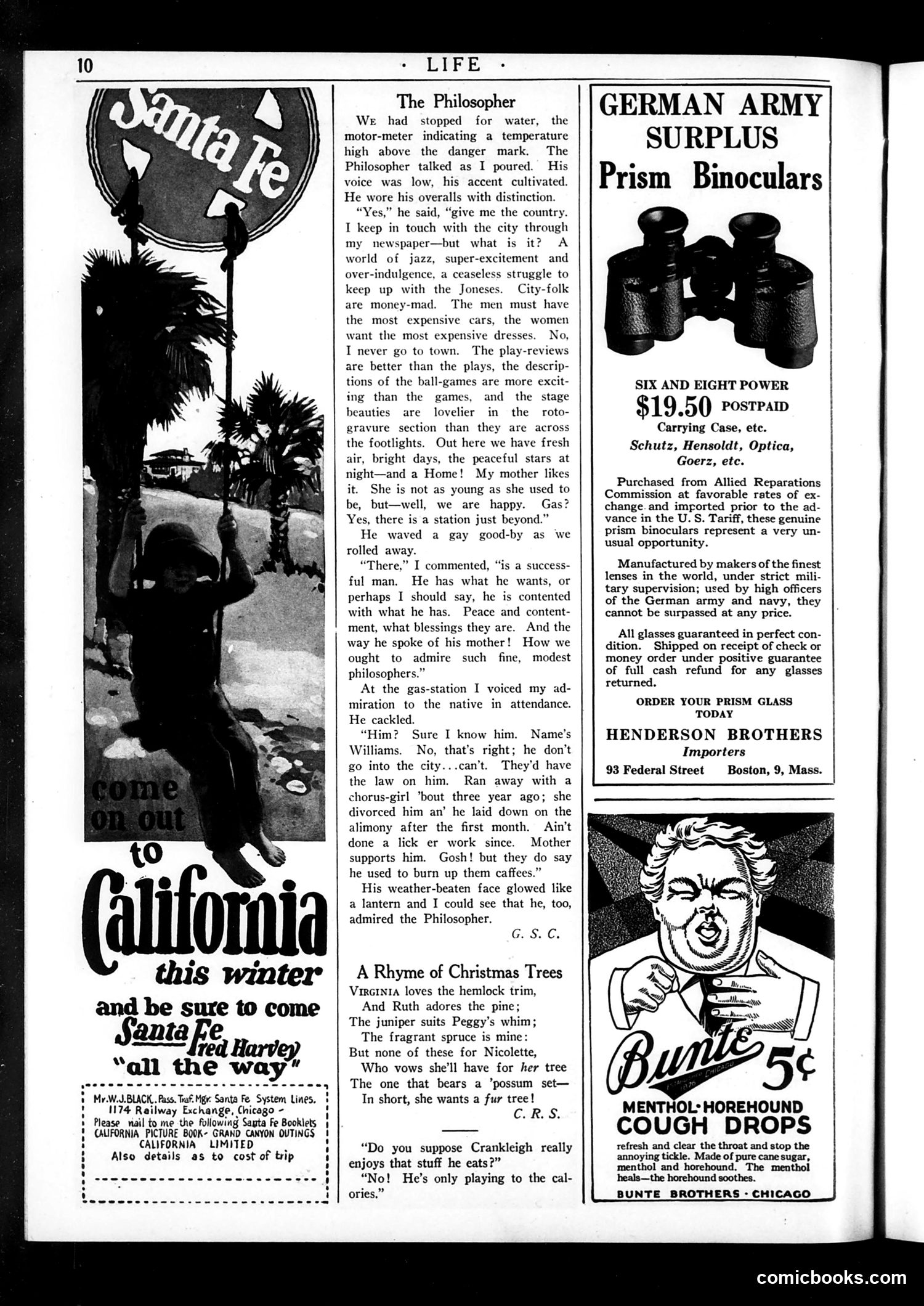
This page is primarily **advertising and fiction**, not political satire. The main content is "The Philosopher," a short story about a cultivated man who has retreated from city life to the countryside. He describes urban society's obsession with wealth and status—expensive cars, fashionable clothes, and entertainment reviews valued over actual performances. The narrative contrasts this shallow materialism with rural contentment and family values. The left advertisement promotes California travel via Santa Fe railroad, using an illustrated Santa Claus figure. The right side advertises German Army surplus prism binoculars and Bunte cough drops. A brief poem about Christmas trees and a joke about a cat named Crankleigh complete the page. The overall theme emphasizes simple living versus urban excess—a common early-20th-century literary trope.
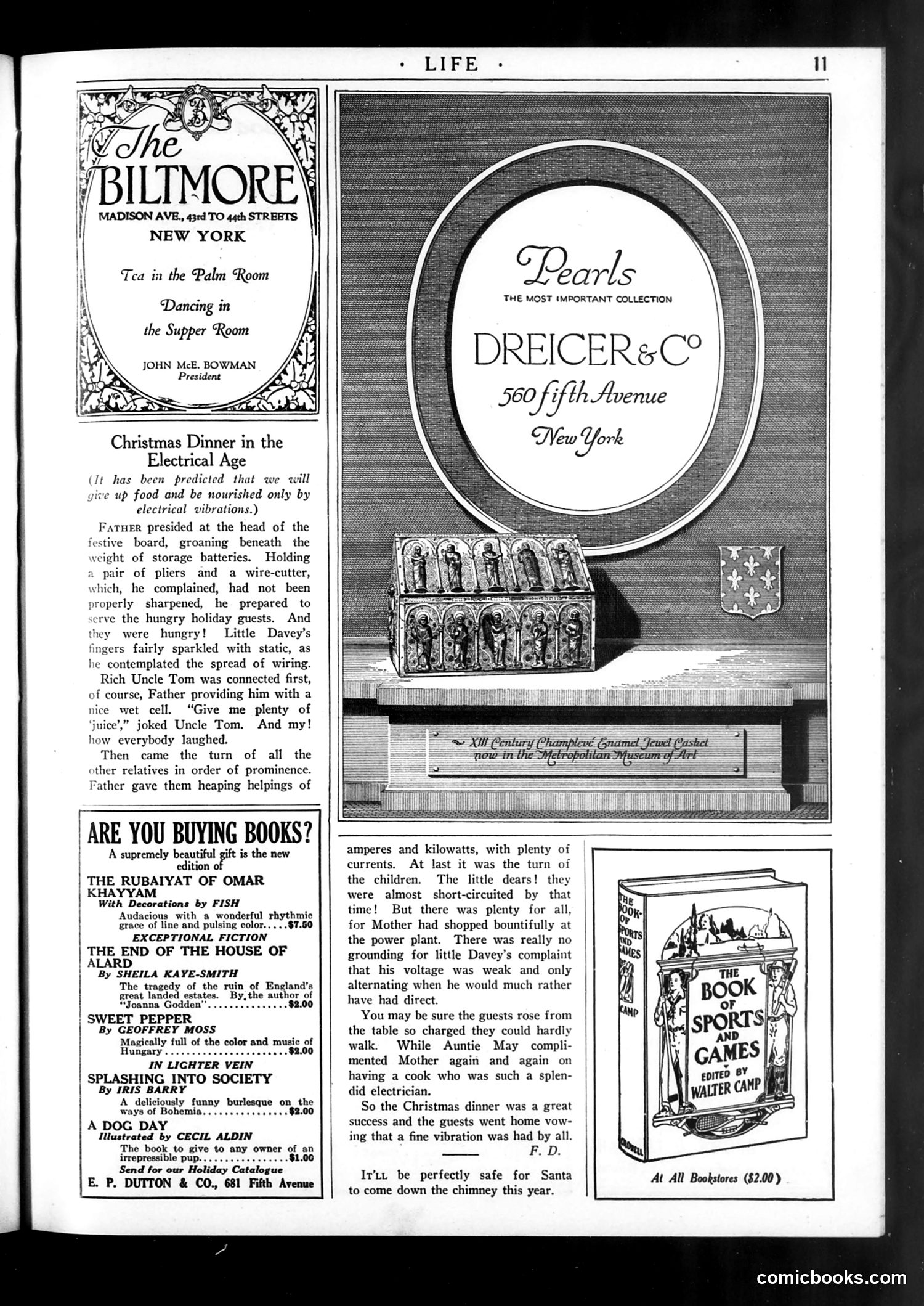
This page is primarily **advertising and book promotion** rather than political satire. The left side features ads for luxury hotels (The Biltmore in New York), books including "The Rubaiyat of Omar Khayyam" and "A Dog Day," and other merchandise. The main image shows a pearl collection from Dreicer & Co., a jewelry store, displayed as "the most important collection" with what appears to be a XIII-century enamel jeweled casket. The article "Christmas Dinner in the Electrical Age" is a **humorous domestic satire** imagining a future holiday meal powered entirely by electricity rather than traditional cooking. The joke centers on electrical "vibrations" nourishing guests instead of food—satirizing early-20th-century fascination with electricity as a transformative technology.
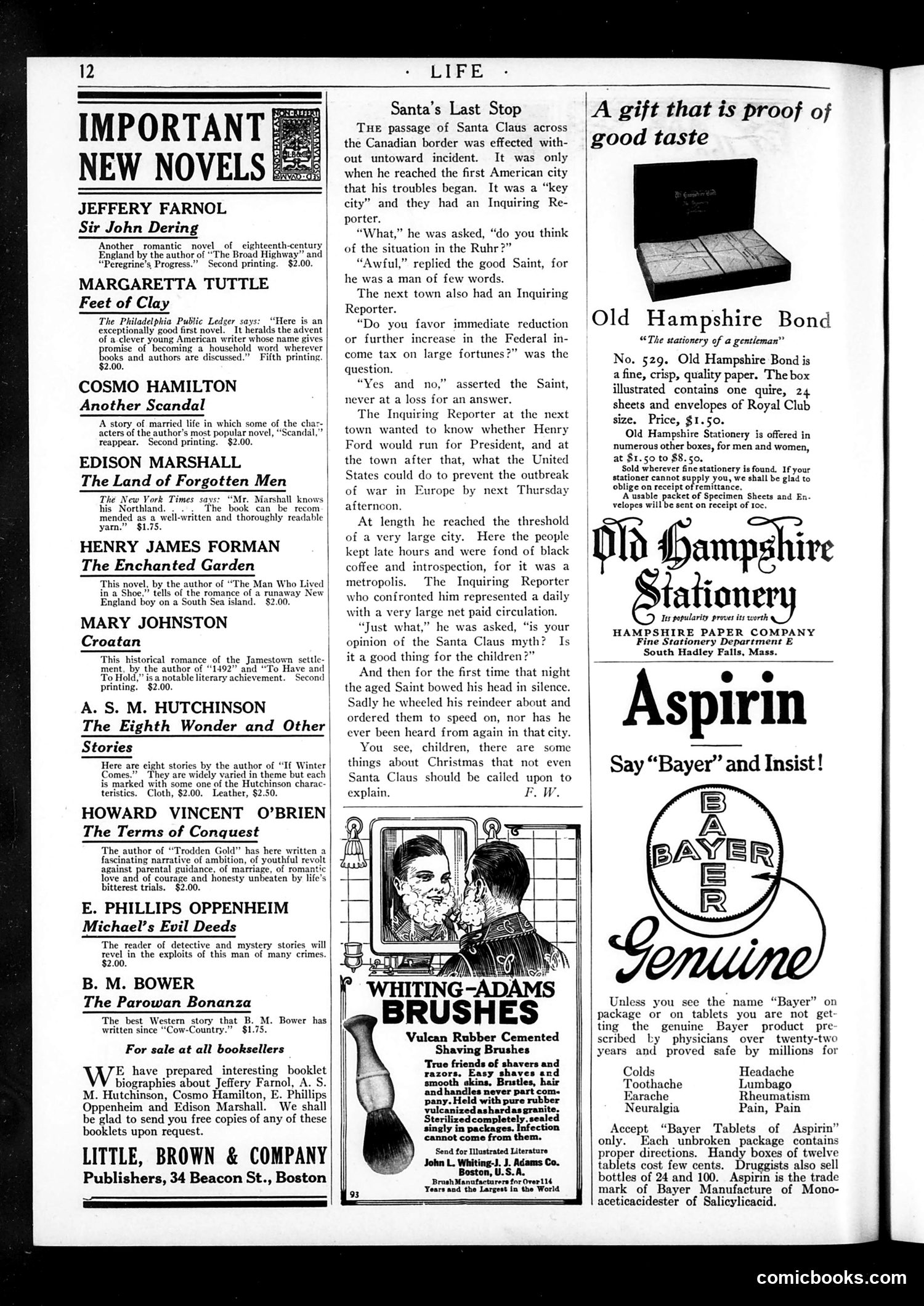
This page is primarily **advertising and book notices** rather than political satire. The left column lists "Important New Novels" from publishers like Little, Brown & Company, covering works by authors such as Jeffery Farnol and Cosmo Hamilton. The main illustration shows a **Whiting-Adams Brushes advertisement** featuring a man shaving while looking in a mirror—a straightforward product pitch for "Vulcan Rubber Cemented Shaving Brushes." An **Old Hampshire Bond stationery ad** appears upper right, emphasizing quality materials "for men and women." The **Bayer Aspirin advertisement** (lower right) warns consumers to verify the "Bayer" name on packaging, as the genuine product was "prescribed by physicians over twenty-two years." This is a typical early 20th-century magazine page mixing literary promotion with patent medicine and consumer goods advertising.
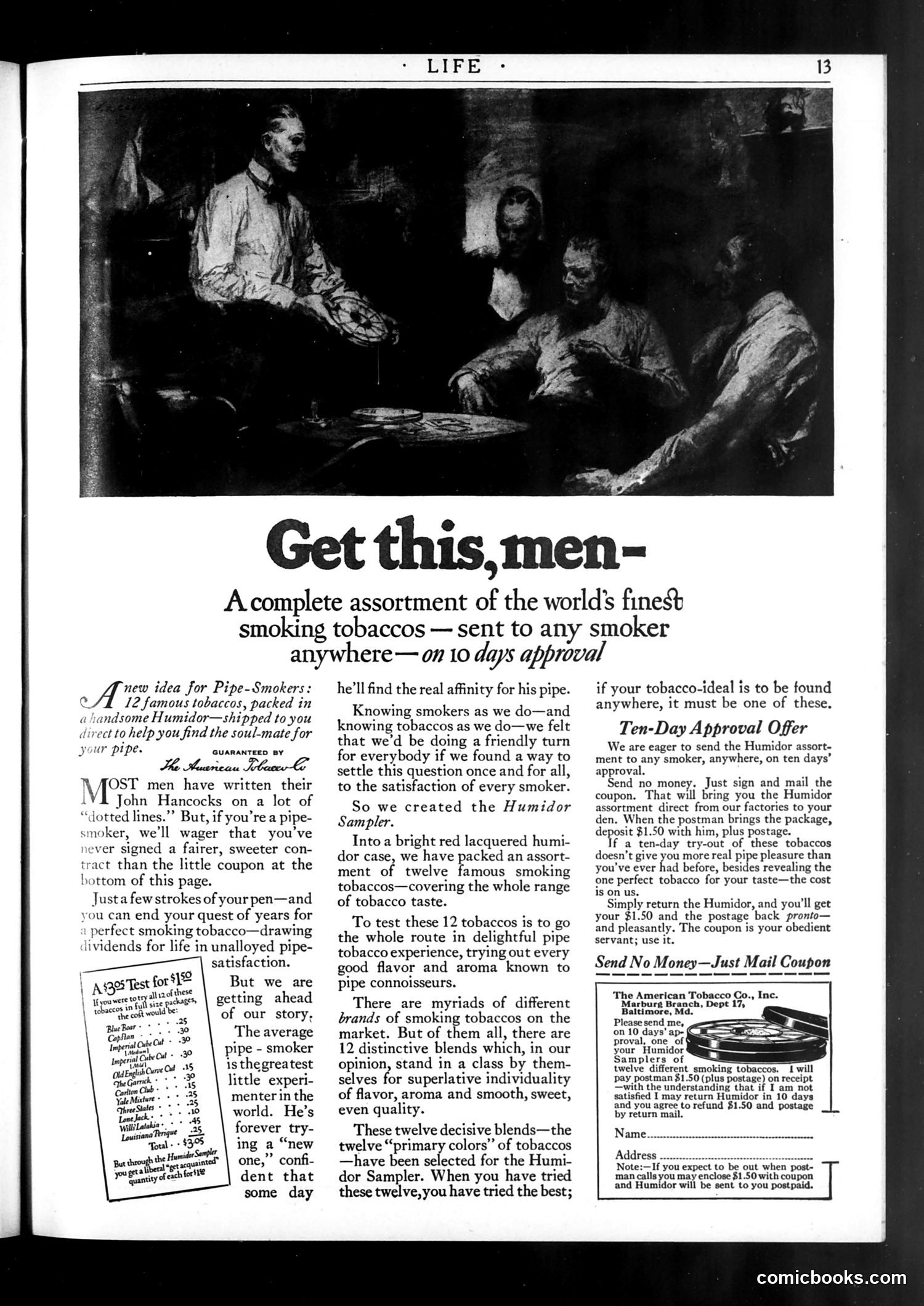
This page is primarily an **advertisement**, not political satire. It's a 1920s-era tobacco company ad from The American Tobacco Co., promoting the "Humidor Sampler"—a mail-order assortment of 12 different pipe tobacco blends. The illustration at top shows men in what appears to be a **casual social setting**, likely meant to evoke camaraderie and masculine leisure. The ad uses appeals to connoisseurship, claiming these are the "world's finest smoking tobaccos" and suggesting pipe smokers are discerning gentlemen. The "10 days approval" offer and coupon-based marketing reflect early 20th-century direct mail tactics. There's no political commentary—this is straightforward commercial messaging targeting pipe-smoking men as an aspirational consumer demographic.
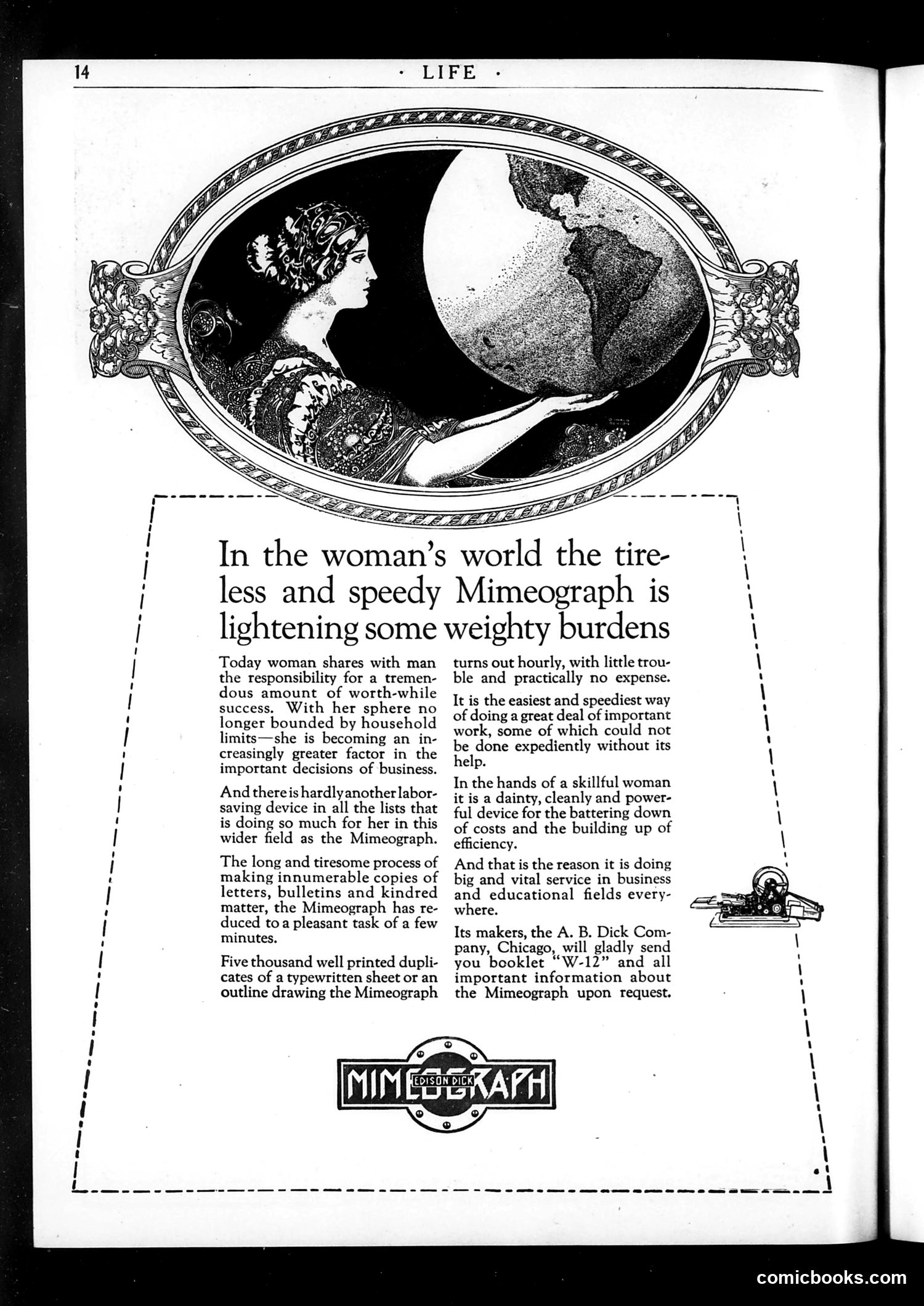
This is primarily **advertising content**, not satire or political commentary. The page promotes the Mimeograph, a copying machine made by the A.B. Dick Company of Chicago. The illustration shows a stylized woman in profile holding what appears to be a globe or spherical object, suggesting women's expanding roles in business and education. The text argues that the Mimeograph reduces women's labor burdens by quickly producing multiple copies of documents—"five thousand well printed duplicates of a typewritten sheet or outline drawing." The appeal frames this as empowering: the device enables women to handle important clerical and administrative work efficiently, "lightening some weighty burdens" as they increasingly share responsibility for business decisions alongside men. It's essentially a sales pitch positioning the Mimeograph as essential office equipment for the modern working woman of the era.
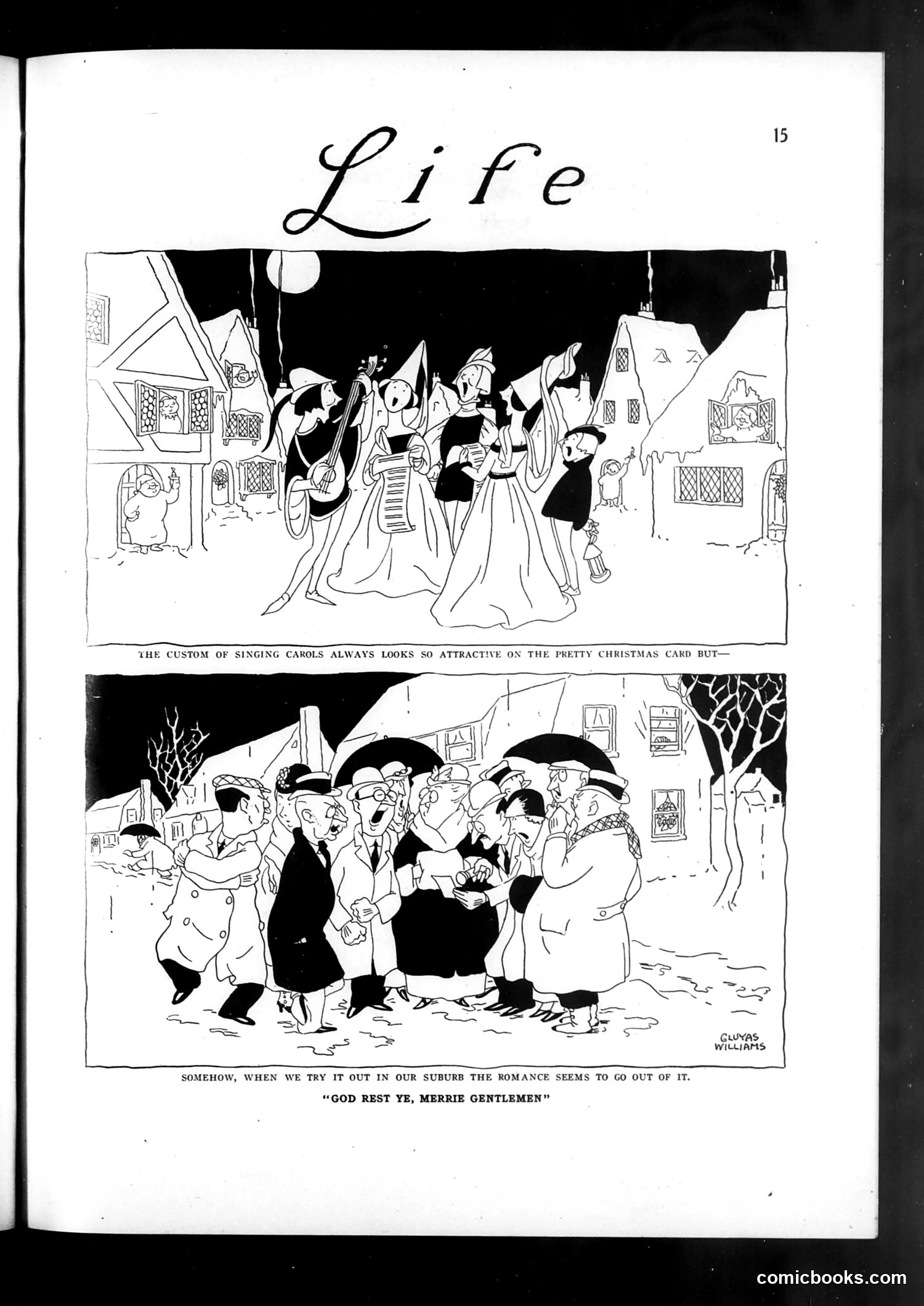
This page features two cartoons about Christmas caroling traditions, by artist Clyde Williams. **Top cartoon:** Shows elegantly dressed carolers performing on a snowy street lined with Tudor-style houses. The caption notes that singing carols "always looks so attractive on the pretty Christmas card"—satirizing the idealized version of caroling presented in commercial holiday imagery. **Bottom cartoon:** Depicts the reality: a ragged group of poorly dressed men with umbrellas in the rain, singing "God Rest Ye, Merie Gentlemen." The caption reveals the contrast: when attempted "in our suburb the romance seems to go out of it." The satire contrasts romanticized Christmas card imagery with the unglamorous reality of actual caroling in suburban weather conditions.
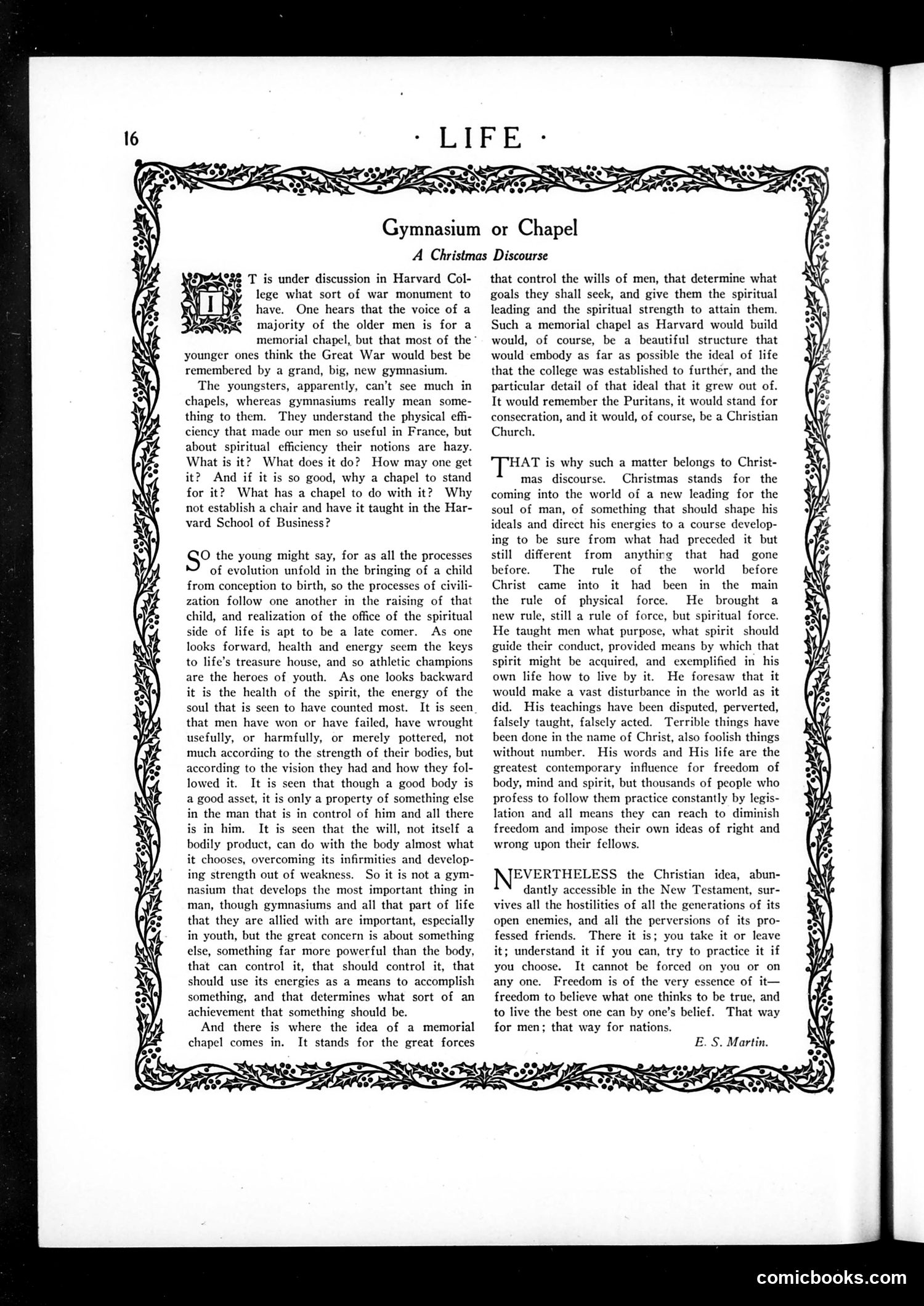
This is not a cartoon but an editorial essay debating Harvard College's proposed war memorial. The piece presents a generational divide: younger alumni favor a gymnasium to commemorate physical vigor that served soldiers in WWI, while older men prefer a chapel emphasizing spiritual values. The author (E. S. Martin) argues the younger generation prioritizes physical fitness because youth naturally does so, but maturity reveals that willpower and spiritual purpose—not bodily strength—ultimately determine human achievement. He contends a memorial chapel better honors the war dead by embodying the Christian spiritual ideals that should guide conduct, contrasting Christ's "spiritual force" with the pre-Christian world's "rule of physical force." The piece uses Christmas as its moral framework: Christ's teachings introduced spiritual direction to human purpose. Therefore, Martin concludes, a chapel appropriately memorializes sacrifice by emphasizing the values worth dying for.
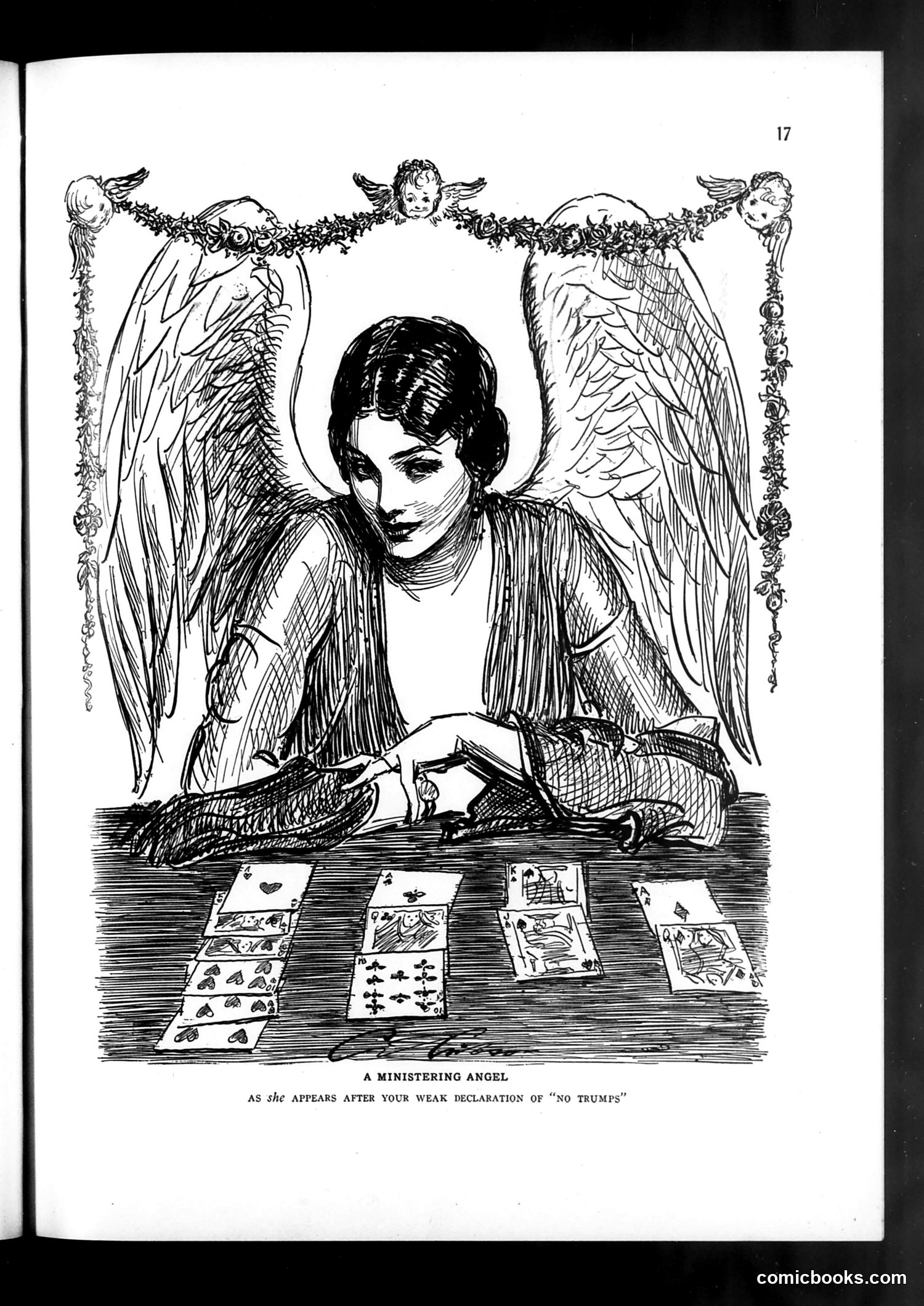
This is a satirical cartoon about card playing, specifically the bridge variant. The image shows an angelic female figure with wings hovering over a card table, appearing to comfort a card player who has just declared "no trumps"—a weak bid in bridge. The joke targets male bridge players of the era who made poor strategic declarations. The "ministering angel" sarcastically suggests that only divine intervention could save someone from the consequences of such a weak play. The angel's presence implies the player needs supernatural help to recover from their blunder. This reflects early 20th-century Life magazine's humor about card games as popular pastimes among the middle class, gently mocking players' competitive anxieties and tactical failures.
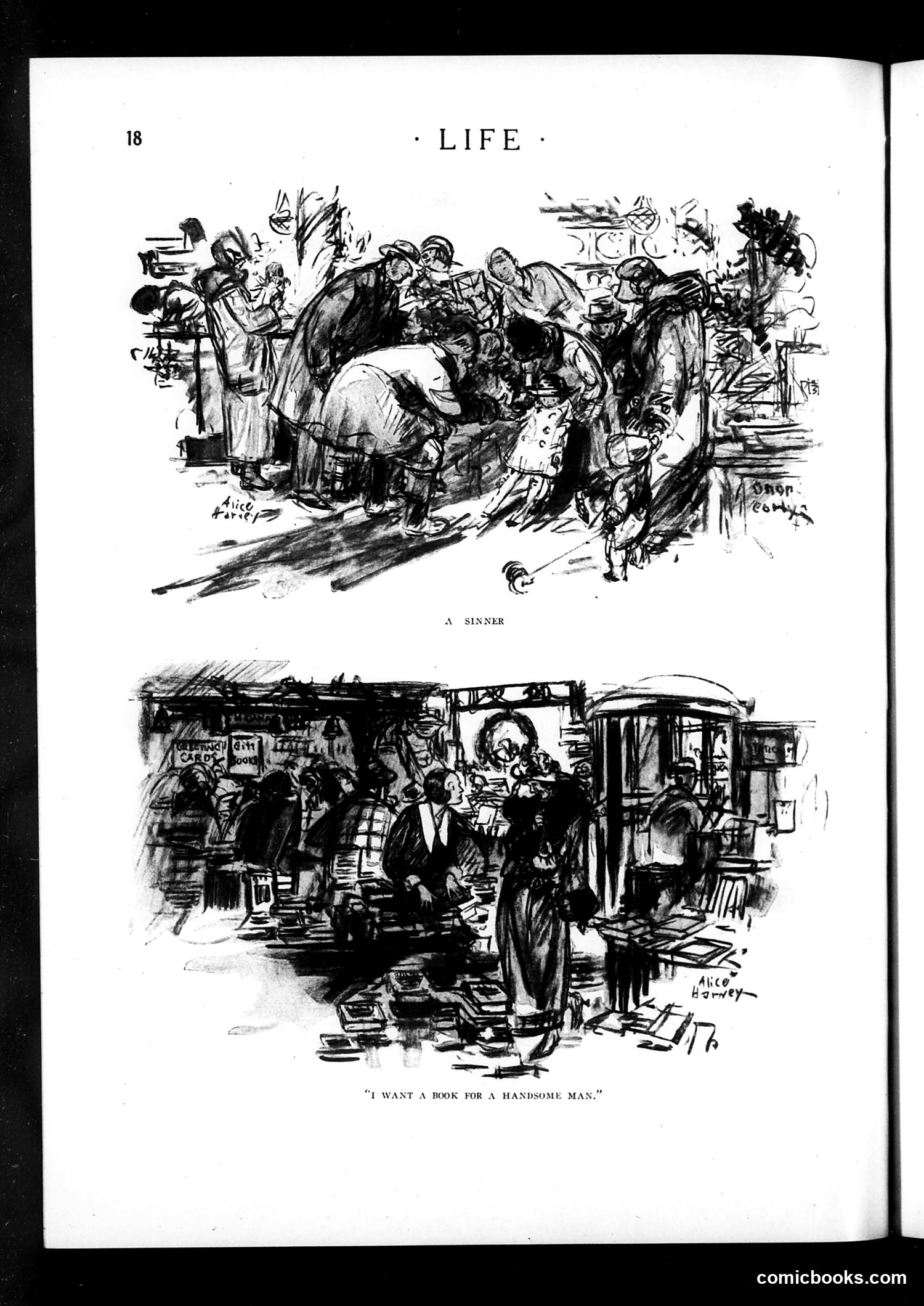
This page contains two satirical sketches by what appears to be Alice Harvey (signed on both cartoons). **Top cartoon ("A Sinner"):** depicts a crowded religious confessional scene. A figure appears to be confessing sins to a priest, surrounded by onlookers. The "sinner" reference suggests moral judgment or hypocrisy. **Bottom cartoon:** shows a woman at what appears to be a bookstore counter requesting "I want a book for a handsome man." The humor likely plays on the irony of selecting literature as a gift—suggesting either that handsome men don't read, or that finding appropriate books for vain/superficial men is difficult. This reflects early 20th-century gender and class commentary about masculinity and intellectual pursuits. Both cartoons employ satire to comment on social behavior and morality.
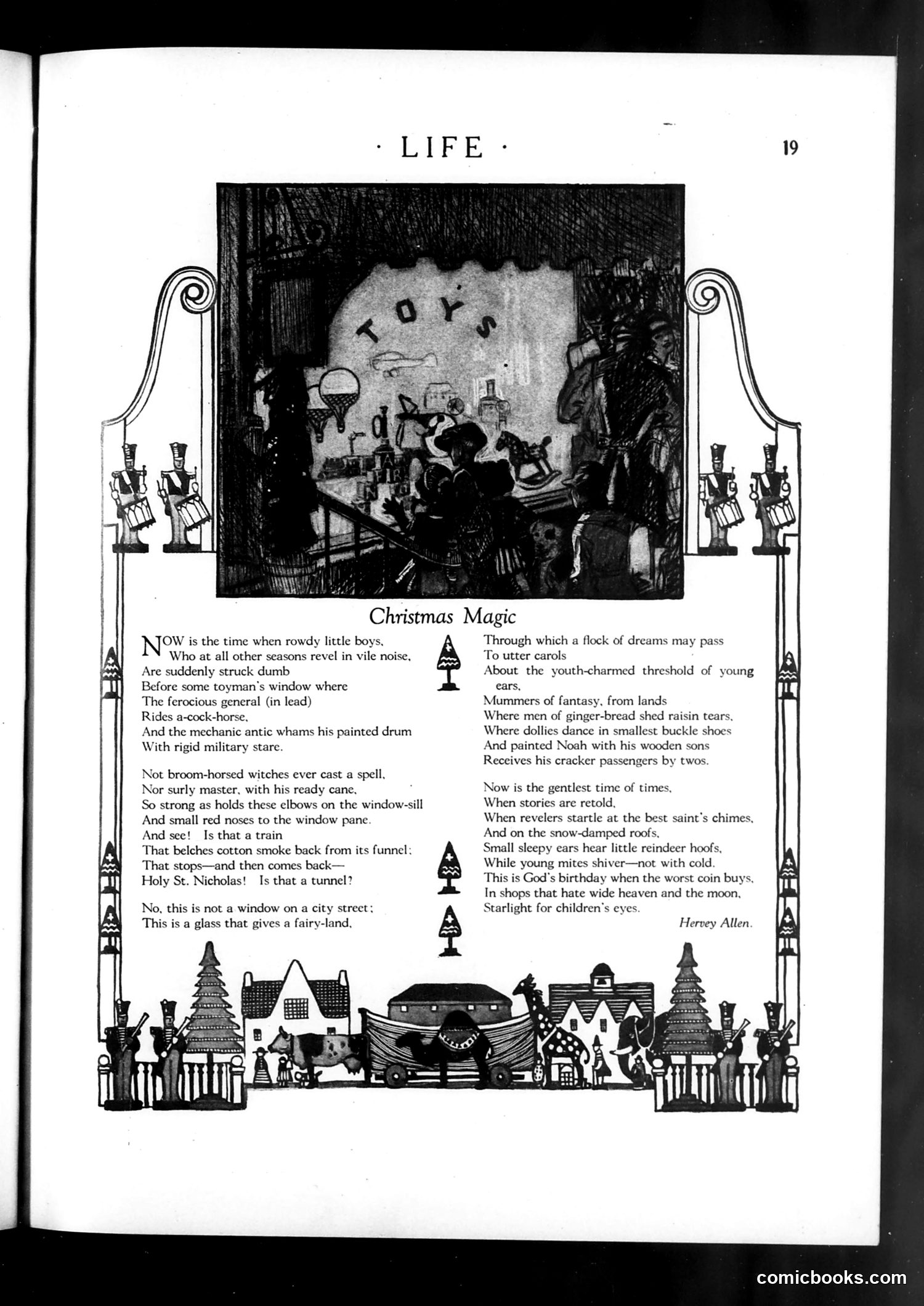
This is not a political cartoon but rather a sentimental poem about Christmas wonder, illustrated with decorative silhouettes. The text celebrates how toy-shop windows mesmerize rowdy children into silent awe—a "magic" more powerful than witches' spells or schoolmaster discipline. The poem contrasts the commercialism of toy-sellers ("shops that hate wide heaven and the moon") with childhood's capacity for enchantment. It evokes period-authentic toys: lead soldiers, mechanical drums, wind-up trains with cotton-smoke, Noah's Ark sets, and dolls. The central illustration shows children pressed against a shop window labeled "TOYS," gazing at displayed merchandise. The decorative border features toy soldiers, gingerbread houses, Christmas trees, and miniature scenes—visualizing the fantasy worlds the poem describes. Rather than satire, this is nostalgic Americana celebrating innocent childhood wonder during the Christmas season.
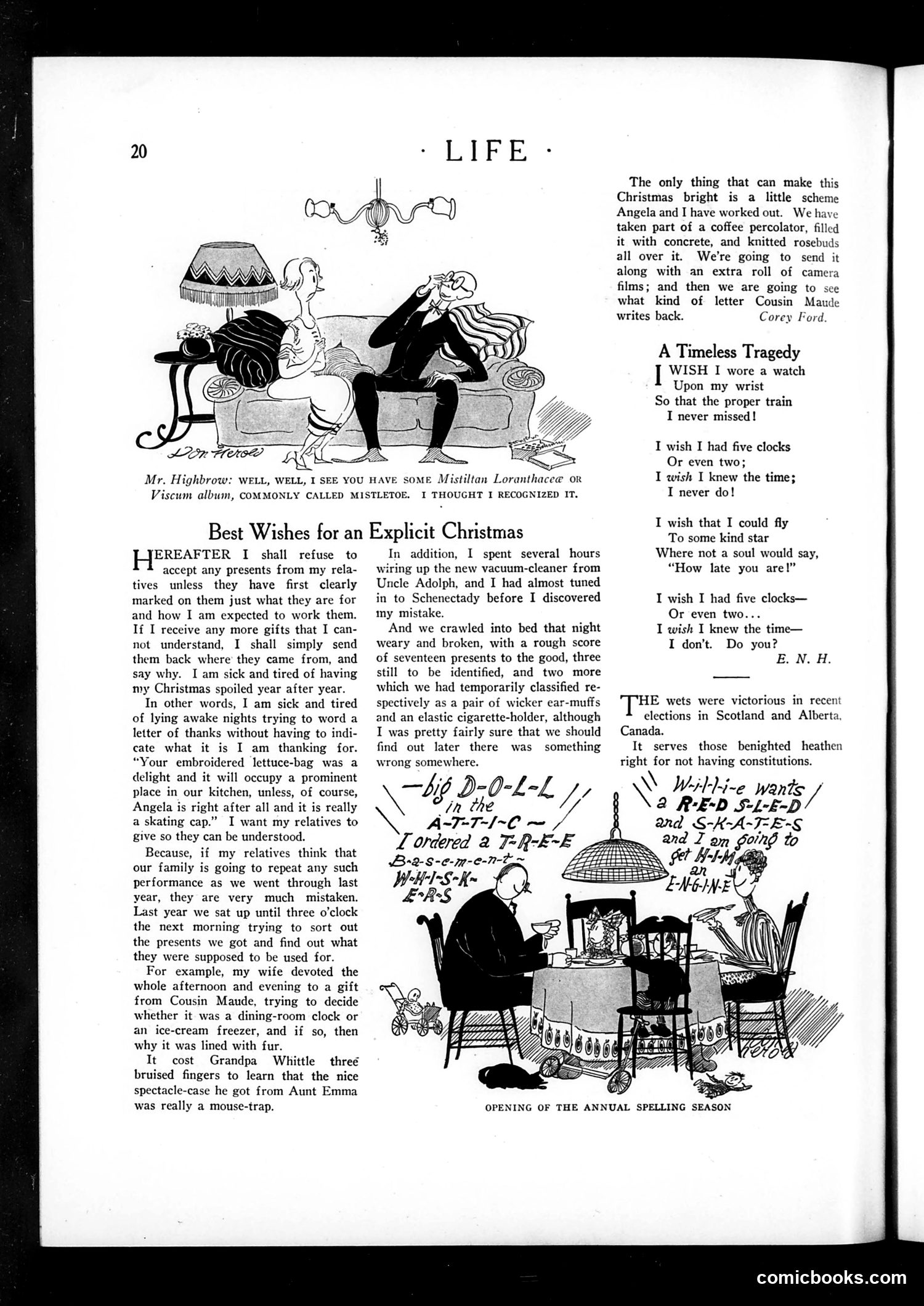
This page contains three satirical pieces lampooning modern life's frustrations: **"Best Wishes for an Explicit Christmas"** (main article by Corey Ford): A husband complains that Christmas gifts arrive without clear instructions or purposes—he's spent nights trying to identify presents from relatives. One gift from Cousin Maude might be a clock or ice-cream freezer (lined with fur, inexplicably); Aunt Emma's "spectacle-case" was actually a mousetrap. The satire targets both the impracticality of novelty gifts and the social obligation to write thank-you letters for items you can't identify. His revenge scheme: send Cousin Maude a concrete-filled coffee percolator decorated with knitted rosebuds, along with camera film, to see her bewildered response. **Top cartoon**: A snobbish "Mr. Highbrow" pedantically identifies mistletoe by its Latin names to impress someone, mocking pretentious Christmas decoration commentary. **"A Timeless Tragedy"** and **spelling bee cartoon**: Minor pieces about chronic lateness and the annual spelling season—light observational humor about everyday anxieties.
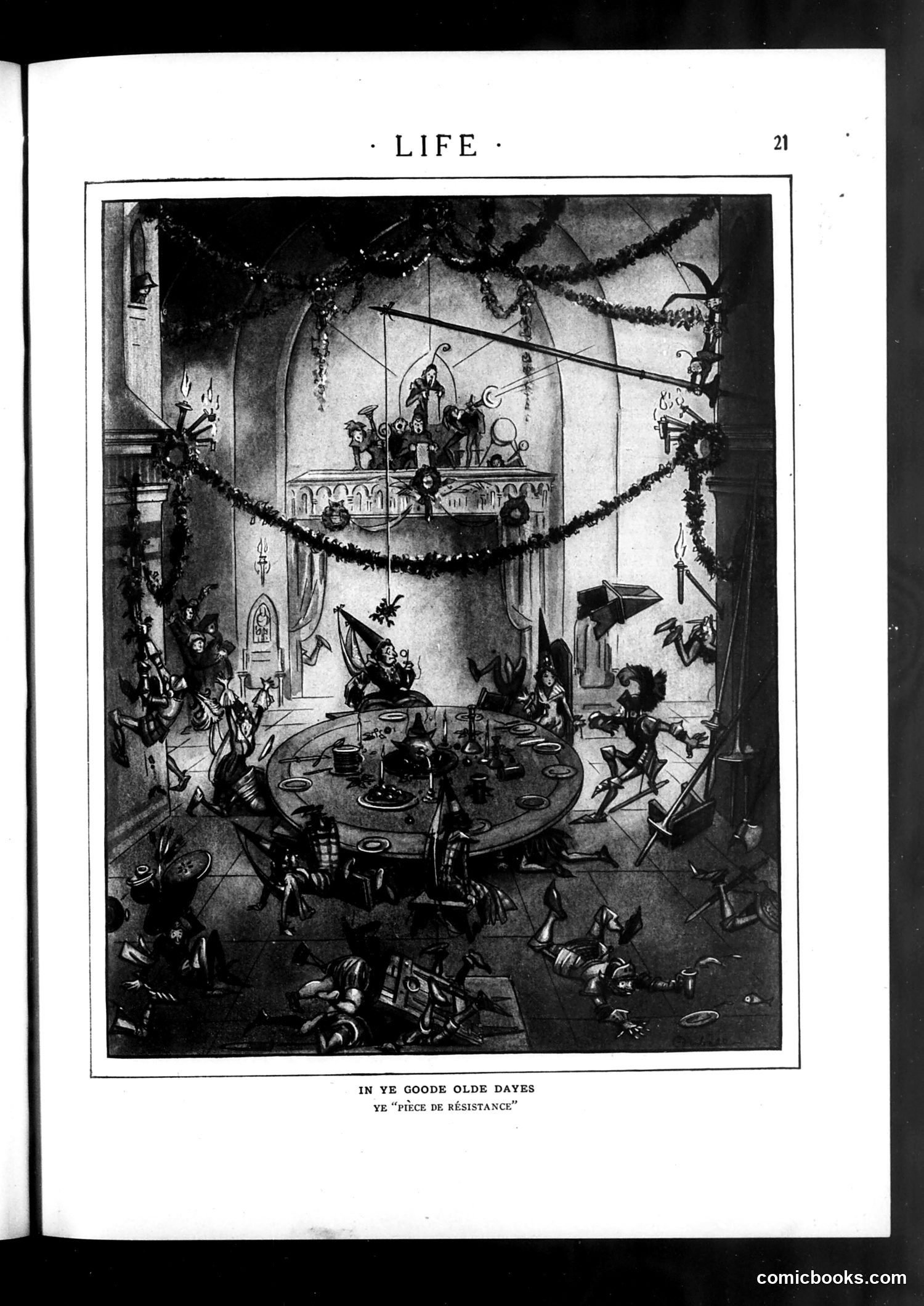
This is a satirical illustration titled "IN YE GOODE OLDE DAYES / YE 'PIÈCE DE RÉSISTANCE'" depicting a medieval or Renaissance-style feast scene with demonic or grotesque figures gathered around a large circular table. The setting includes elaborate architectural details, garlands, and a gallery above where additional figures observe. The satire appears to mock elaborate, ostentatious dining or celebration—possibly referencing excess, indulgence, or pretentious social gatherings presented as "good old days" nostalgia. The grotesque characters suggest the scene is mocking those who participate in such affairs. The French phrase "pièce de résistance" (the showstopper dish) reinforces the theme of gastronomic pretension. Without additional context about the publication date or contemporary events, the specific social or political target remains unclear, though the work clearly satirizes affectation and excess.
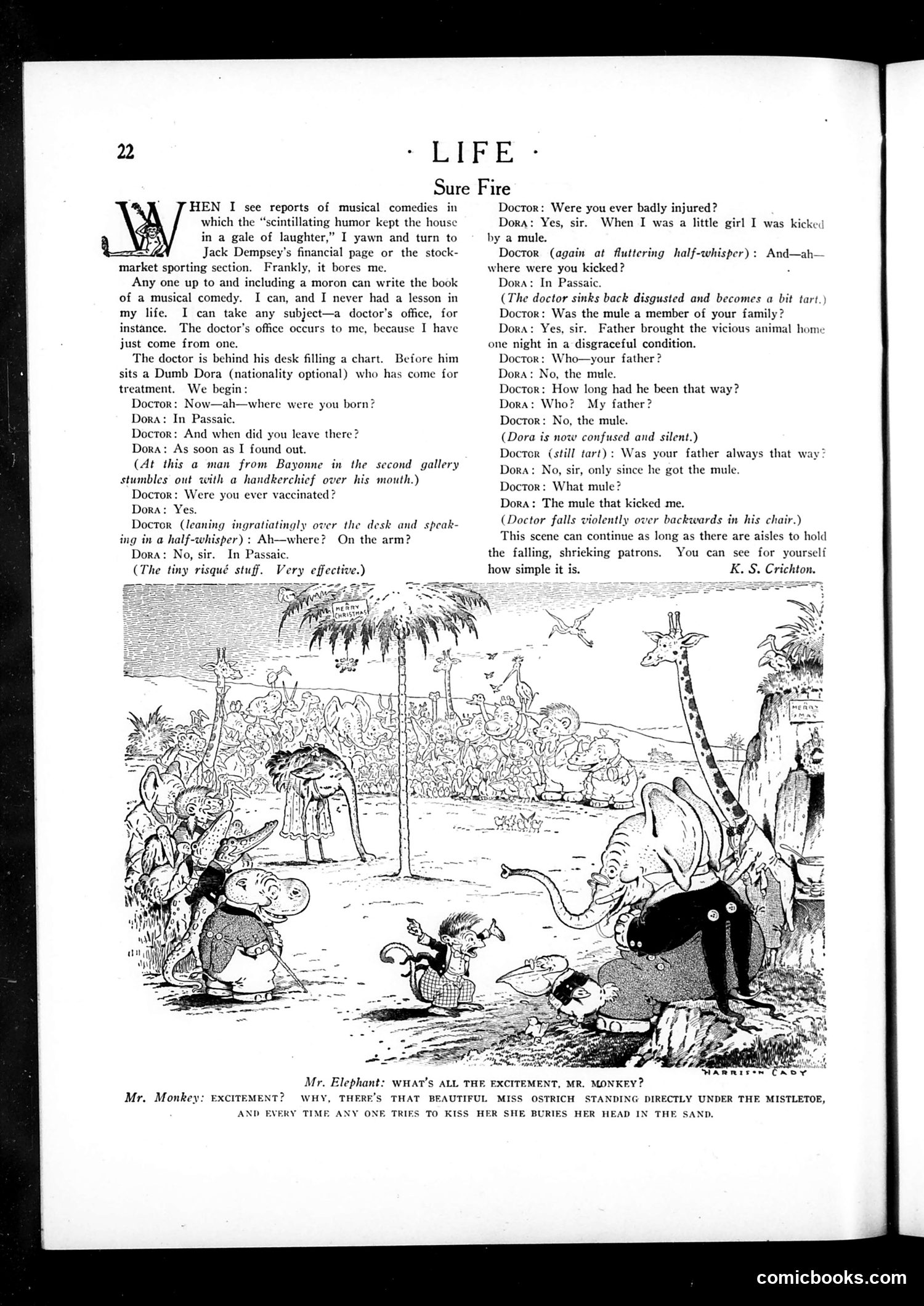
This page satirizes both cheap musical comedy writing and the "dumb blonde" character type popular in early 20th-century entertainment. The main text presents a deliberately stupid comic dialogue between a doctor and "Dora," a stock "Dumb Dora" character (a common vaudeville archetype). The humor relies on Dora's inability to understand context—she keeps confusing who kicked her (a mule) with her father, and misunderstanding simple questions. The author, K.S. Crichton, presents this as an example of lazy, formulaic comedy writing that requires no skill or originality, just stringing together obvious misunderstandings until audiences laugh. The accompanying cartoon (bottom) shows animals at a holiday gathering, with the elephant and monkey discussing an ostrich under mistletoe—another simplistic gag based on animal behavior stereotypes. The piece mocks both the lowbrow entertainment industry and audiences who find such predictable material hilarious.
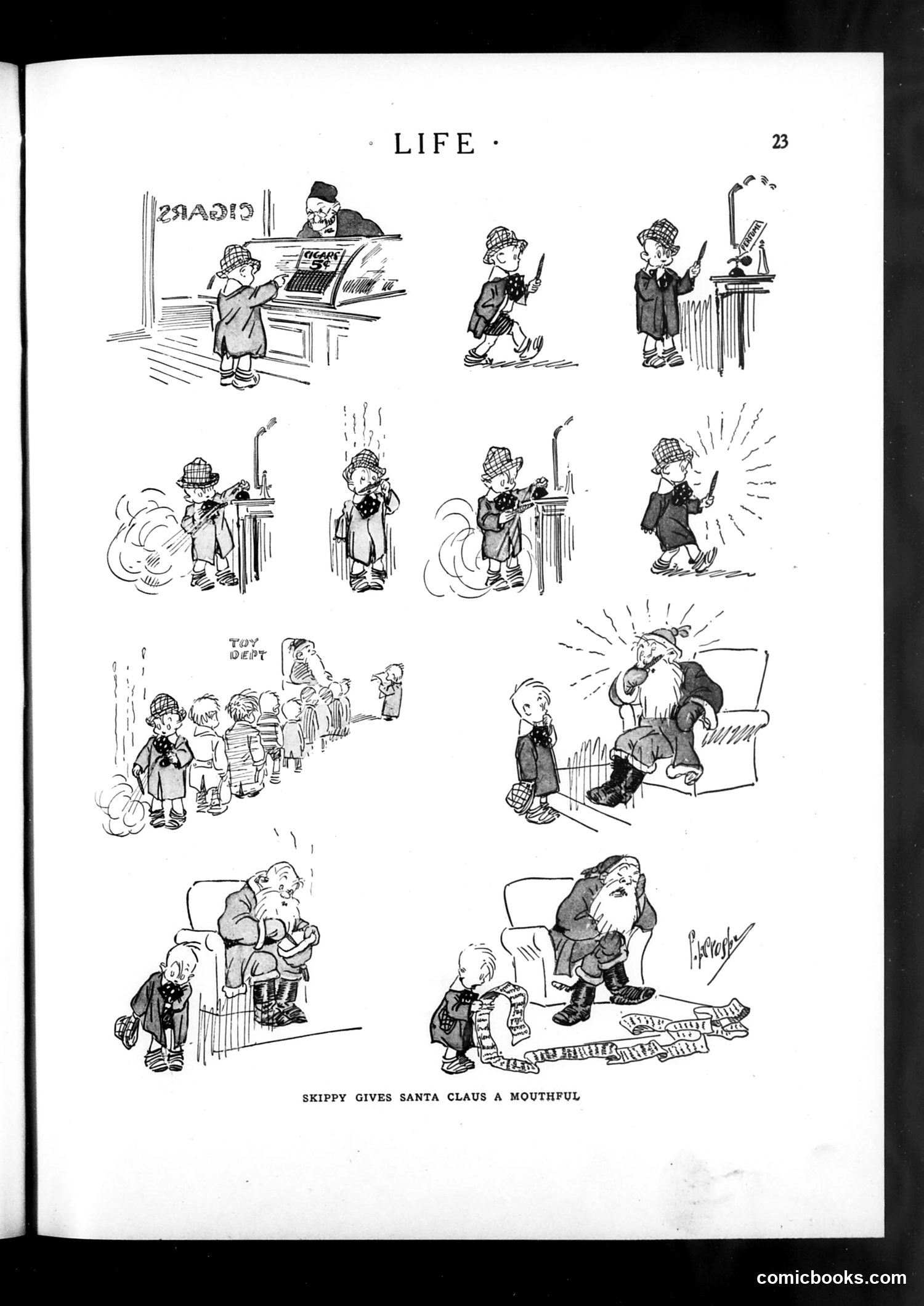
This comic strip sequence depicts a character named Skippy (recognizable by his distinctive plaid cap) in escalating confrontations with what appears to be a fire hydrant, progressing through various mischievous actions involving the hydrant and possibly creating water or steam effects. The caption "Skippy Gives Santa Claus a Mouthful" suggests a humorous subversion of Christmas expectations. The joke likely plays on the contrast between innocent holiday tradition (telling Santa what you want) and Skippy's irreverent behavior—the child is figuratively "giving Santa a mouthful" (talking back/being disrespectful) rather than respectfully presenting a gift list. The fire hydrant may represent a substitute "Santa" or the punchline involves Skippy's mischievous nature disrupting seasonal sentimentality.
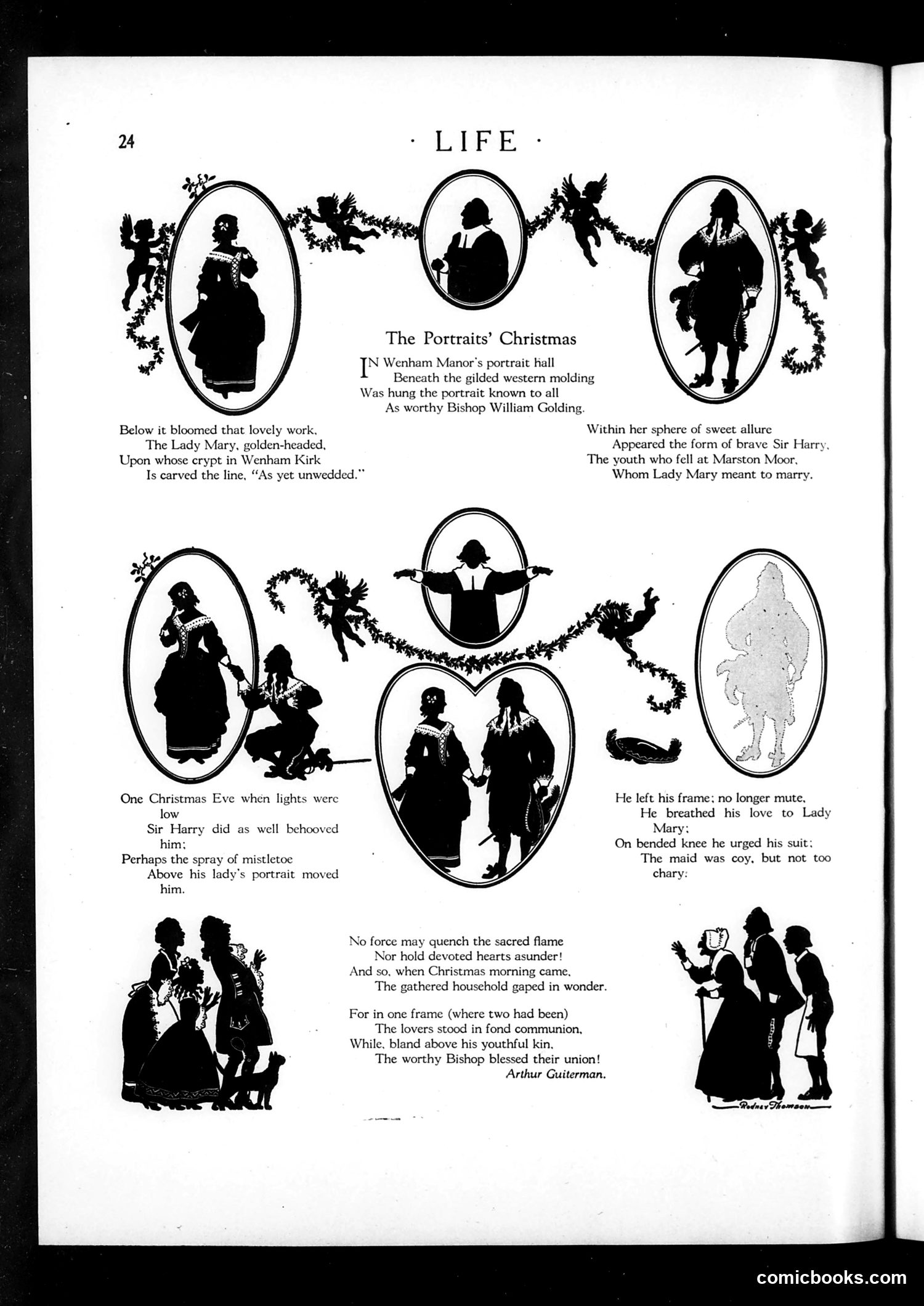
This is a whimsical romantic narrative poem illustrated with silhouette art, not political satire. The story depicts portraits in Wenham Manor that magically come to life on Christmas Eve. The narrative follows Sir Harry—a soldier who fell at Marston Moor (a 1644 English Civil War battle)—whose portrait mysteriously animates. He declares his love to Lady Mary's portrait, a golden-headed unmarried woman. Despite her initial coyness, she accepts him. By Christmas morning, the household discovers both figures now occupy a single frame together, with Bishop William Golding's portrait positioned above them, appearing to bless their union. The "satire" is gentle and sentimental rather than pointed: it plays on the Victorian fascination with ghostly romance and the notion that true love transcends even death and artistic medium. The author is Arthur Guiterman, a popular American humorist and poet of the early 20th century.
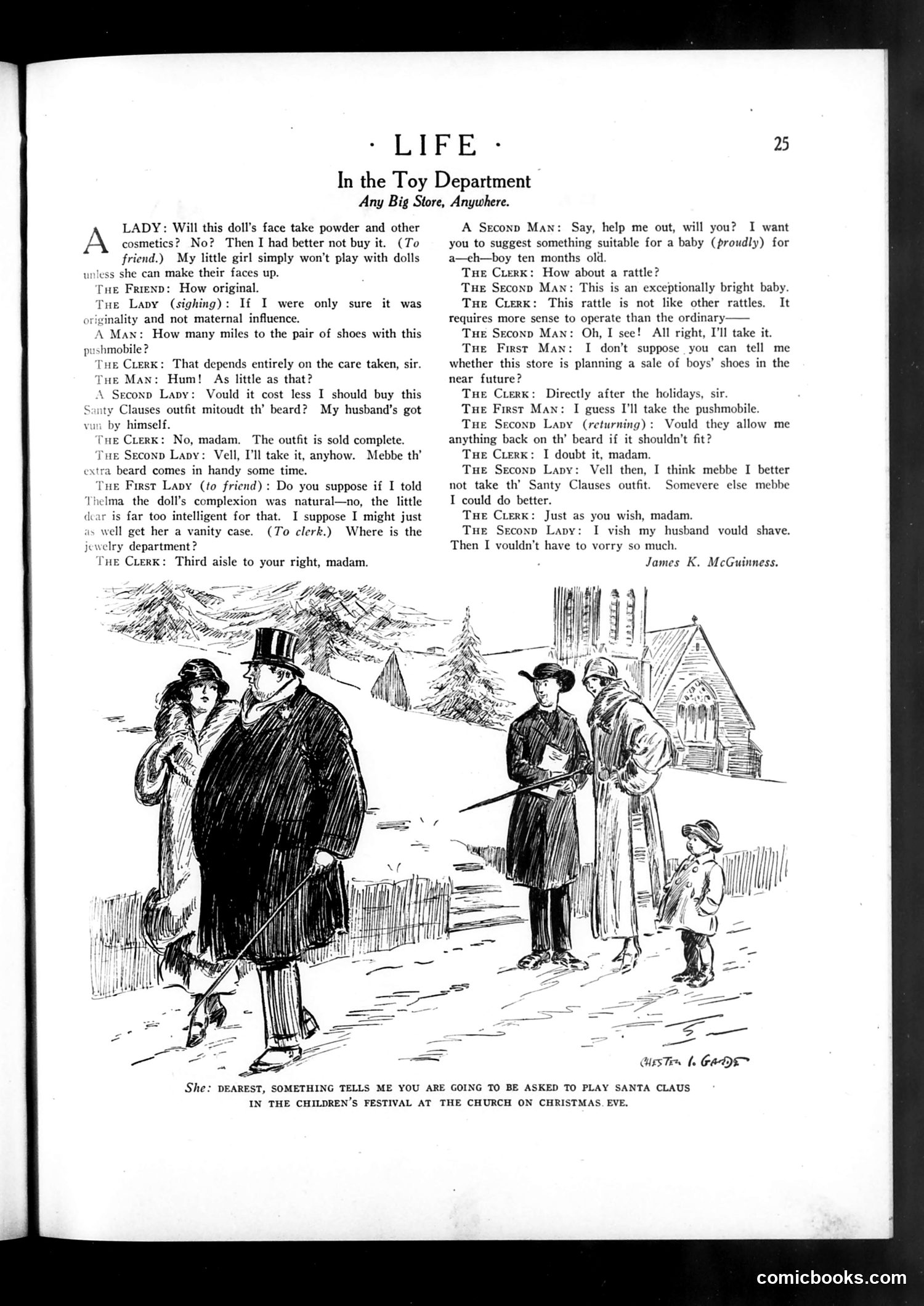
This page mocks early 20th-century consumer culture and parenting trends through overlapping conversations in a department store. The humor targets: **Consumer absurdity:** A mother won't buy a doll unless it accepts makeup—she's worried her daughter won't play with it otherwise, then anxiously considers whether this reflects her own vanity or maternal influence. **Gendered expectations:** Men ask impractical questions about toys (mileage on a pushmobile). A working-class woman (indicated by dialect spelling) buys a Santa suit without a beard, hoping the beard will "come in handy" later—apparently for her husband to use instead of shaving. **Class commentary:** The dialect-speaking women contrast with wealthier customers, suggesting different consumer sophistication levels. The bottom cartoon shows a wife hinting her bearded husband will be volunteered as a church Santa—a gentle jab at domestic pressure and holiday obligations. Overall, the satire depicts consumerism as increasingly disconnected from actual children's needs, and modern parenting as driven by adult anxieties and fashions rather than sense.
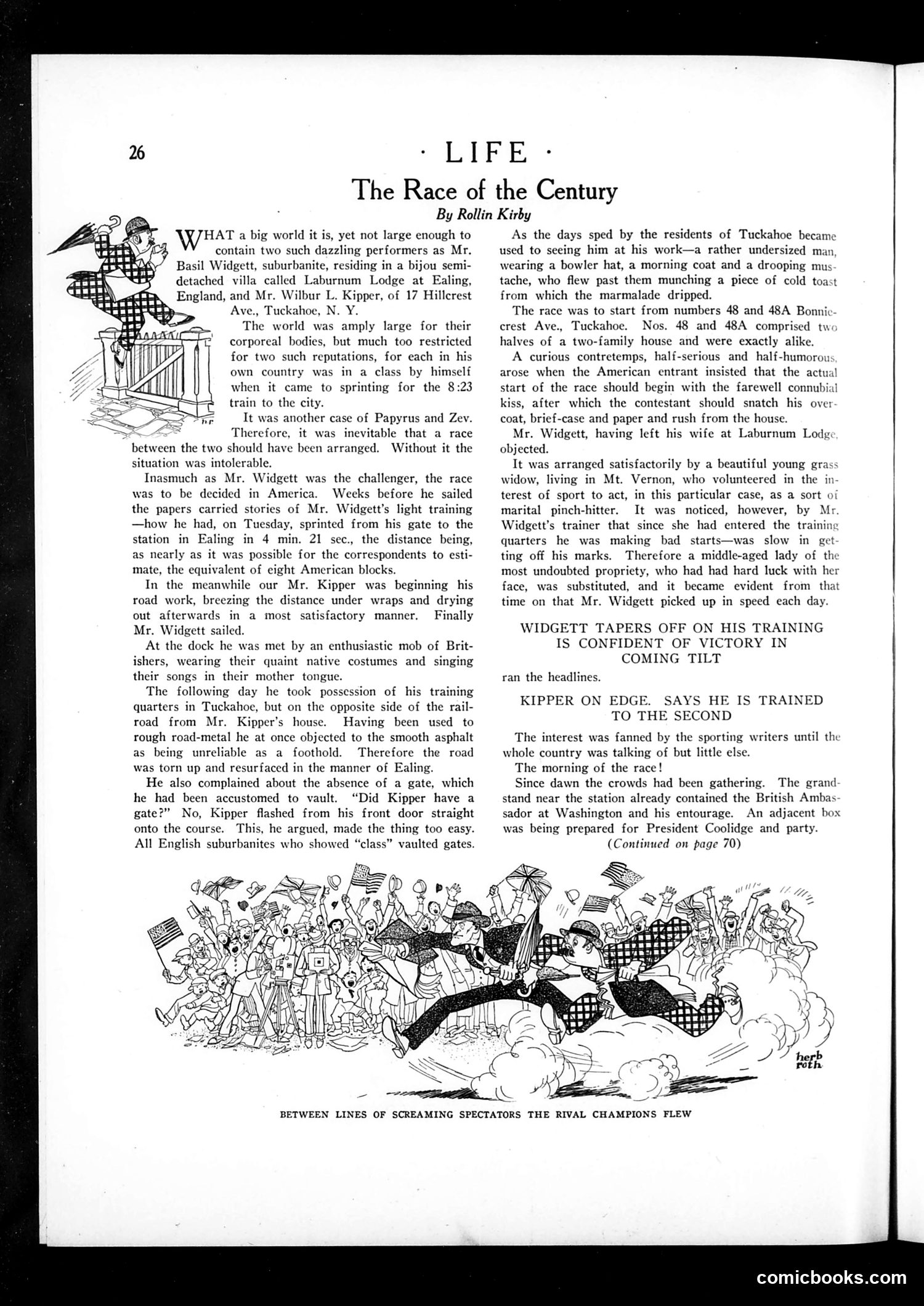
This is a humorous satire of transatlantic athletic rivalry, likely referencing the famous 1923 horse race between British horse Papyrus and American horse Zev (explicitly mentioned in the text). **The Setup:** A British suburbanite (Basil Widgett) challenges an American (Wilbur Kipper) to a sprint race—not for sport, but because each is the local champion at catching their morning commuter trains. The story parodies the excessive hype, training coverage, and national pride surrounding international sporting competitions. **The Satire:** The piece mocks both British pretentiousness (Widgett complains about asphalt, demands a gate to vault, wears morning coat while training) and American spectacle-building. Widgett's trainer troubles—distracted by an attractive woman, then refocused by an unattractive one—absurdly trivialize the "serious" competition. **The Point:** This deflates the grandiose rhetoric around international athletic contests by reducing them to suburban commuters sprinting for trains, exposing how trivial the underlying competition actually is beneath all the national fanfare and elaborate preparation.
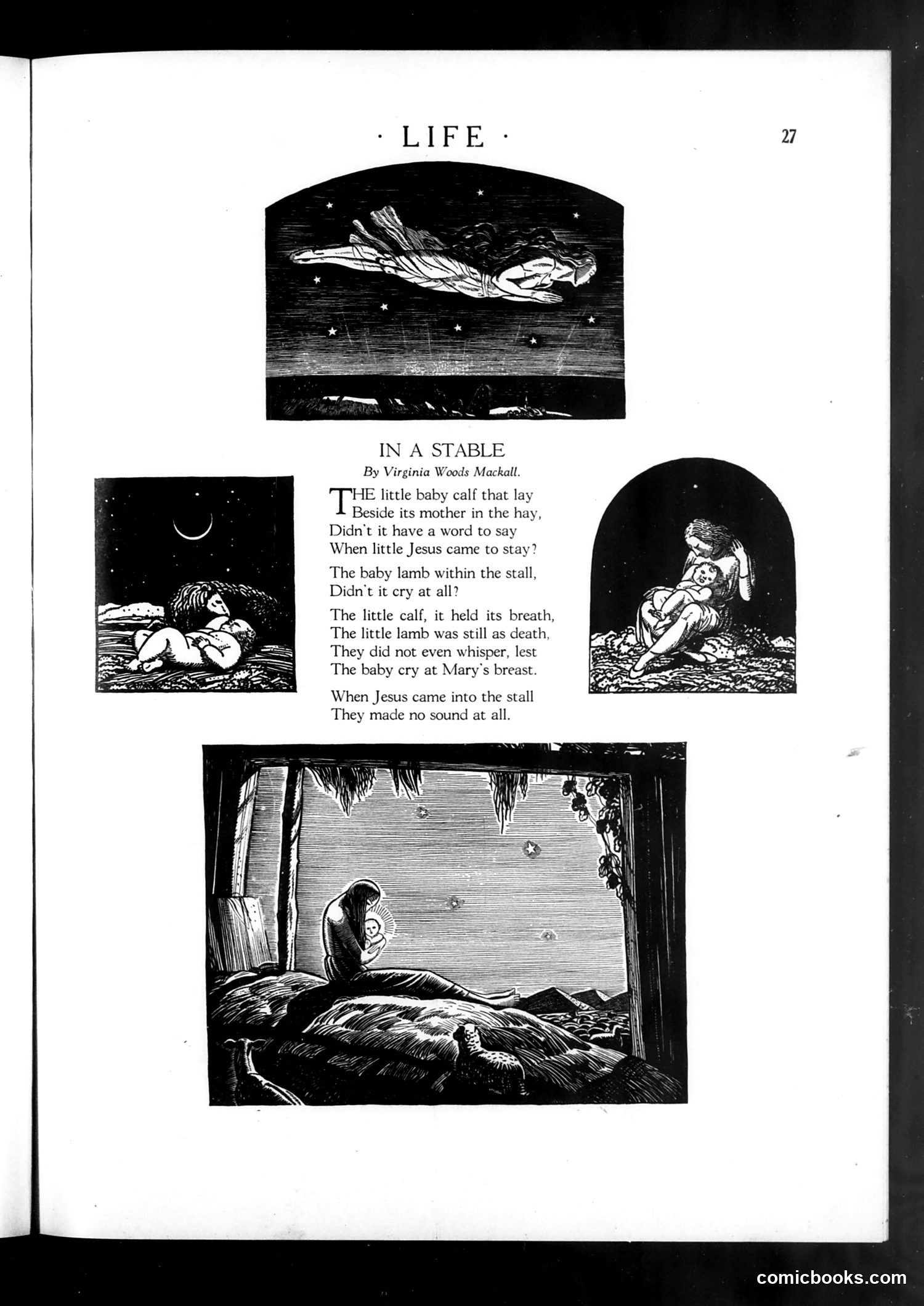
This is a **religious poem by Virginia Woods Mackall**, not political satire. The page presents a nativity-themed meditation on the birth of Jesus, illustrated with four woodcut-style images. The poem imagines the animals present at Jesus's birth—a calf and lamb—remaining unnaturally silent and reverent out of respect for the holy infant. The conceit is that even barnyard creatures recognized the sacred significance of the moment and suppressed their natural sounds. The illustrations depict: sleeping figures under stars (top), animals in darkness (left), Mary cradling the infant (right), and Mary with the child in the stable (bottom). This represents **early 20th-century sentimental religious literature**—common in general-interest magazines like Life. The piece appeals to Christian readers through gentle, child-friendly verses about nativity spirituality rather than through humor or satire.
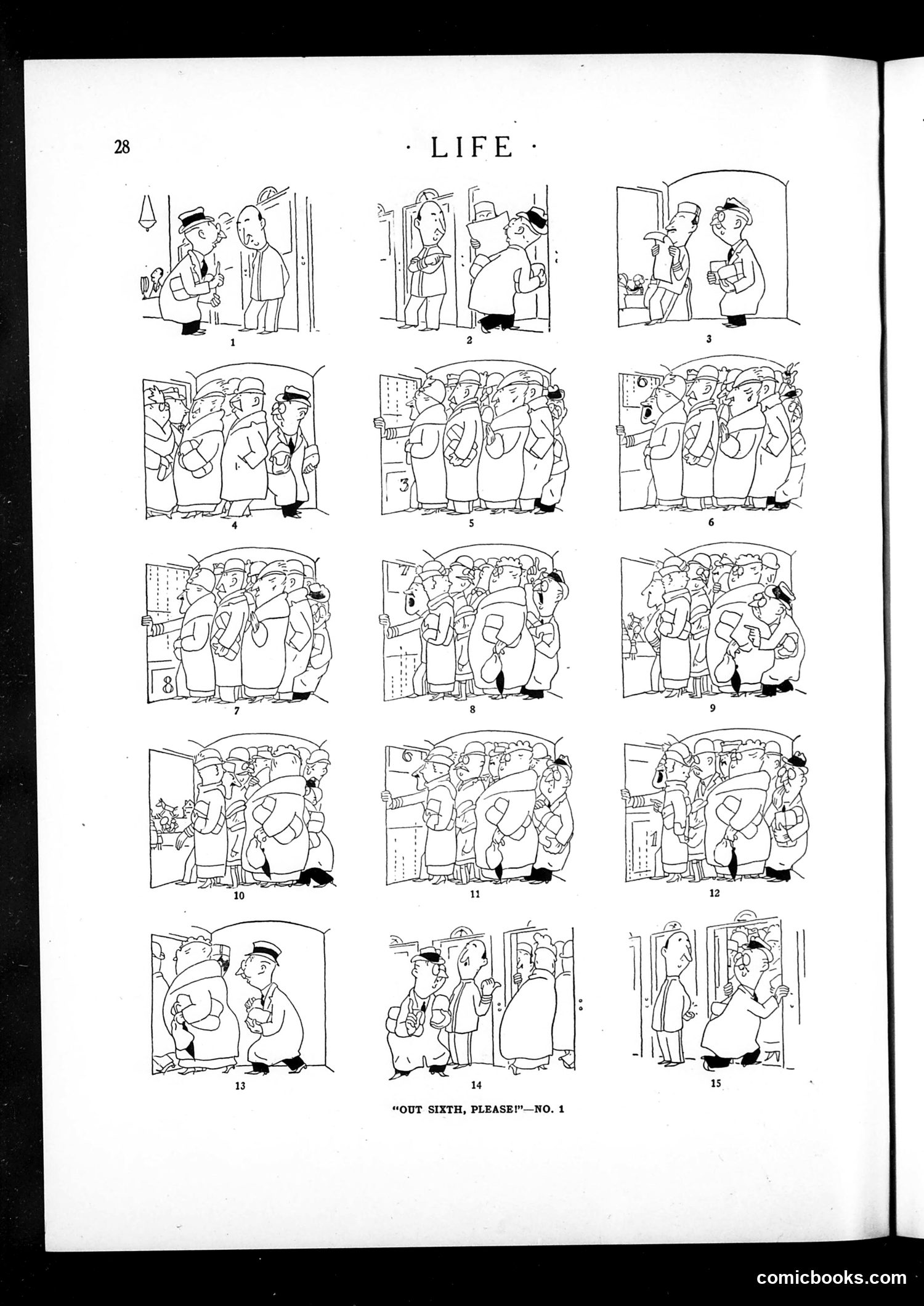
This multi-panel comic satirizes crowded urban public transportation, likely a subway or elevator. The sequence shows an increasingly packed vehicle where passengers are wedged together uncomfortably. The humor escalates as more people squeeze in despite obvious space constraints, with exaggerated body contortions. The title "Out Sixth, Please!" suggests someone requesting their stop while trapped in the crush. The satire targets the indignity of commuter life in a densely populated city—the absurdity of ever-tighter packing and the resigned acceptance of uncomfortable conditions as normal. This appears to be early Life magazine content (before mid-20th century), reflecting contemporary urban overcrowding anxieties common to readers experiencing rapid city growth and expanding transit systems.
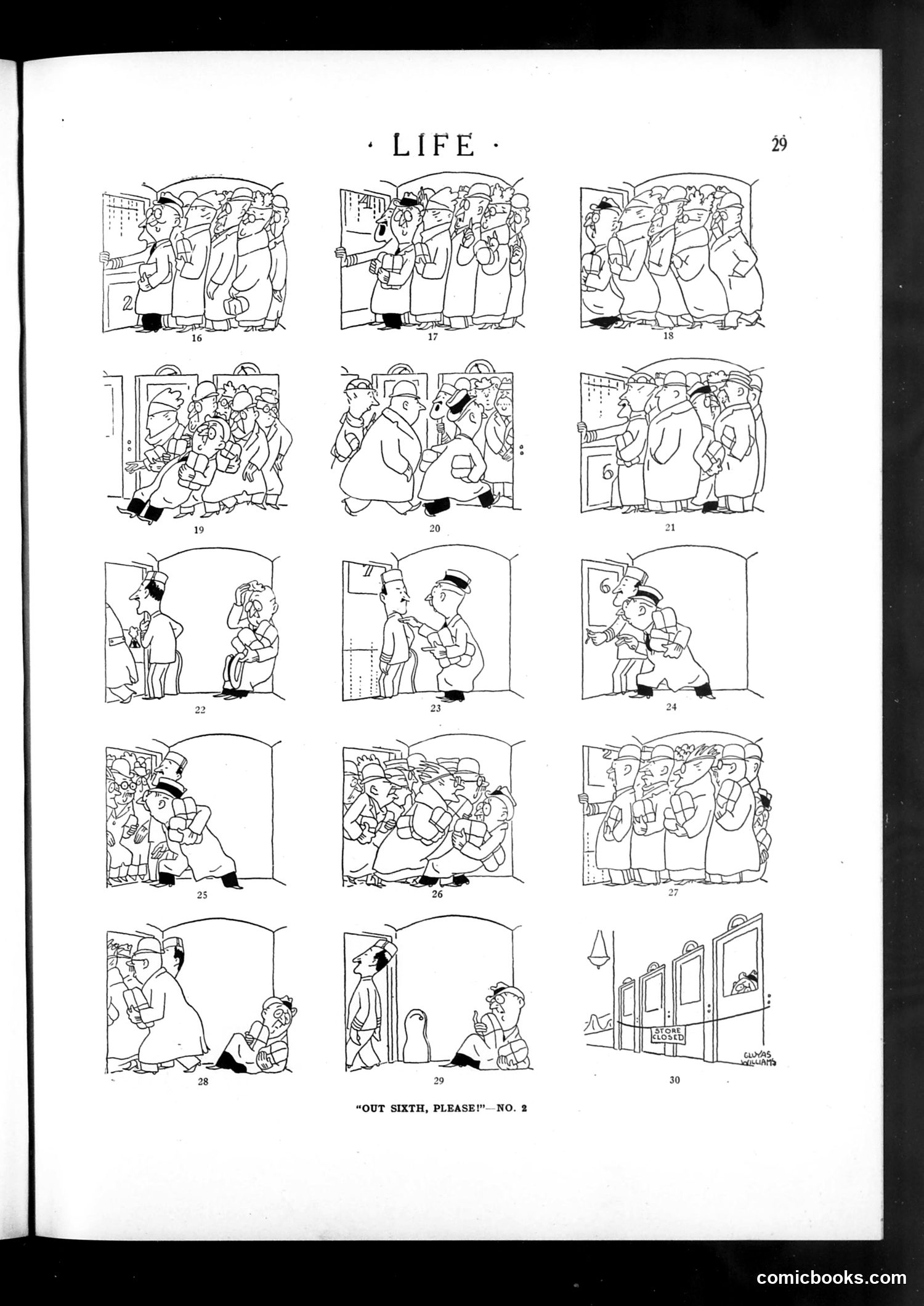
This is a sequential comic strip showing a crowded elevator scenario. The title "Out Sixth, Please!" suggests passengers repeatedly requesting the sixth floor stop. The humor derives from the escalating chaos of an overcrowded elevator. Early panels (16-21) show normal boarding, while subsequent panels depict increasingly absurd crowding as more people squeeze inside. By panels 25-27, the space is comically packed with bodies. The final panels shift perspective: panel 28-29 shows someone outside the elevator, while panel 30 reveals the exterior—suggesting the elevator has become so full it's physically distorted or burst outward. This satirizes urban rush-hour transit conditions and the desperation of commuters attempting to fit into inadequate public transportation. The exaggeration emphasizes how ridiculous actual crowding conditions were in early 20th-century cities, making social commentary through absurdist humor about modern metropolitan life.
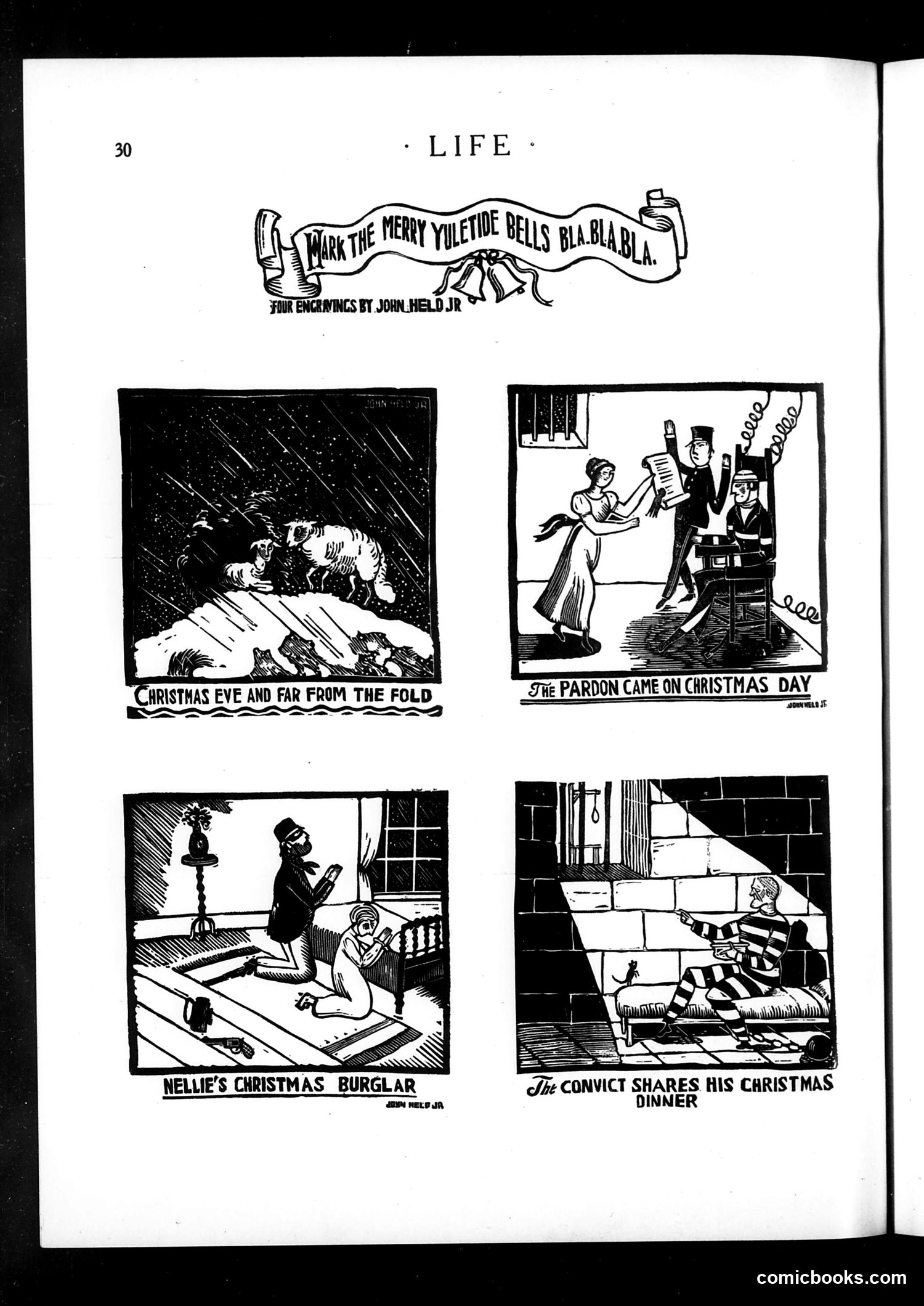
This page from *Life* magazine presents four Christmas-themed comic strips, all credited to artist John Held Jr. The cartoons appear to be humorous takes on holiday scenarios: 1. **"Christmas Eve and Far From the Fold"** — depicts people/animals in snow, likely playing on the sentiment of being separated from loved ones during Christmas. 2. **"The Pardon Came on Christmas Day"** — shows what appears to be an official or authority figure granting mercy to a prisoner, a common sentimental Christmas trope. 3. **"Nellie's Christmas Burglar"** — features a burglar in a home; the humor likely derives from an unexpected encounter or the burglar's role in the Christmas narrative. 4. **"The Convict Shares His Christmas Dinner"** — depicts an imprisoned person, again using Christmas redemption as subject matter. These strips use Christmas as backdrop for satirical commentary on crime, poverty, and social conditions.
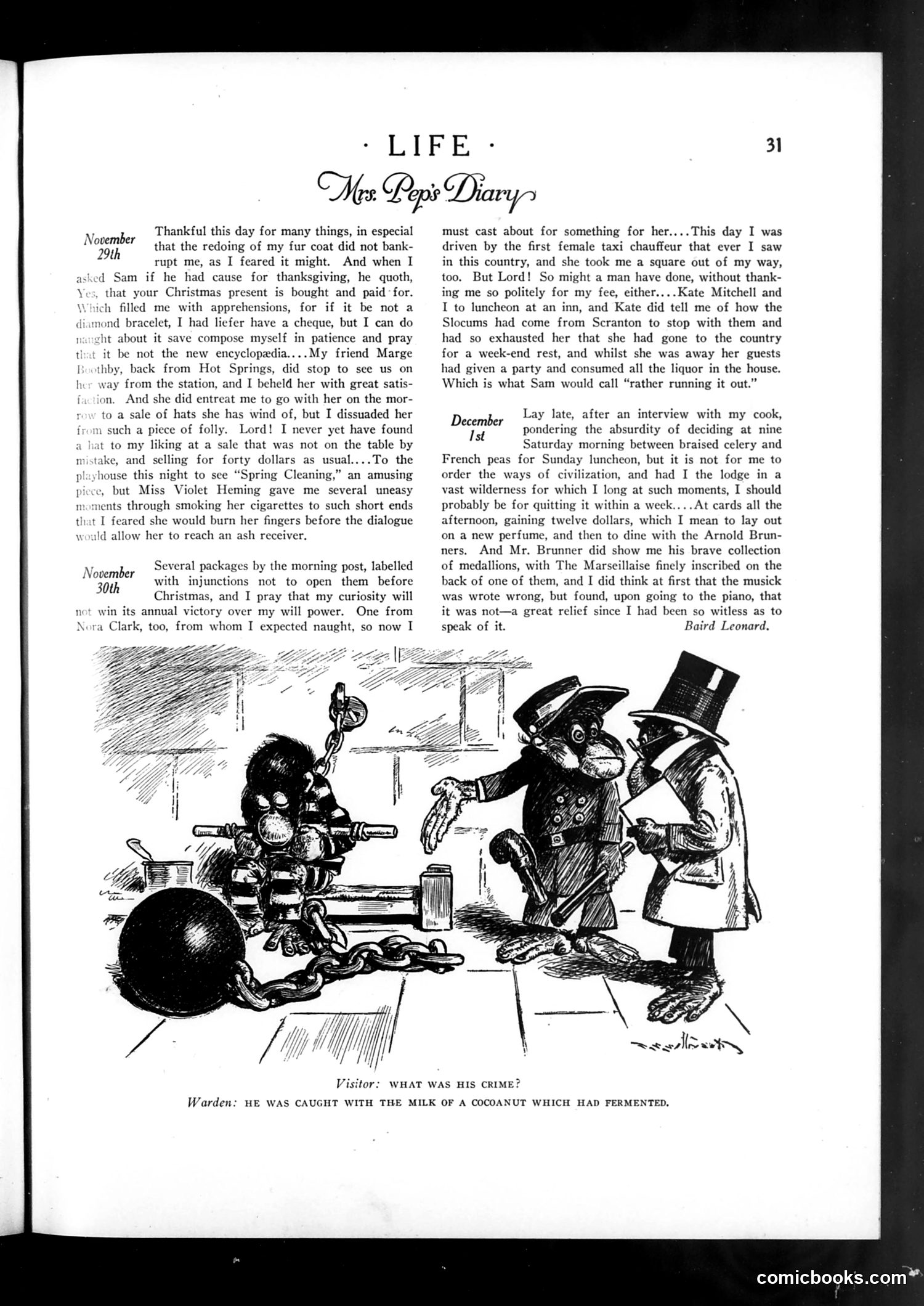
This page from *Life* magazine contains two distinct pieces: **Mrs. Pep's Diary** is a serialized humor column written in the voice of an affluent, gossipy society woman. The entries (November 29th-December 1st) satirize upper-class preoccupations: anxiety over Christmas gifts, shopping for hats, card games, dinner parties, and obsessing over trivial decisions like vegetable selection. The humor relies on her self-absorbed tone and concern with social propriety. **The cartoon below** depicts a prison scene where a visitor asks a warden about an inmate's crime. The warden's reply—that the prisoner was "caught with the milk of a cocoanut which had fermented"—is a joke about Prohibition-era alcohol laws. Fermented coconut milk could produce an alcoholic beverage, making possession a criminal offense under Prohibition. The cartoon satirizes the absurdity of such strict enforcement, where a minor fermenting mishap constitutes a serious crime warranting imprisonment.
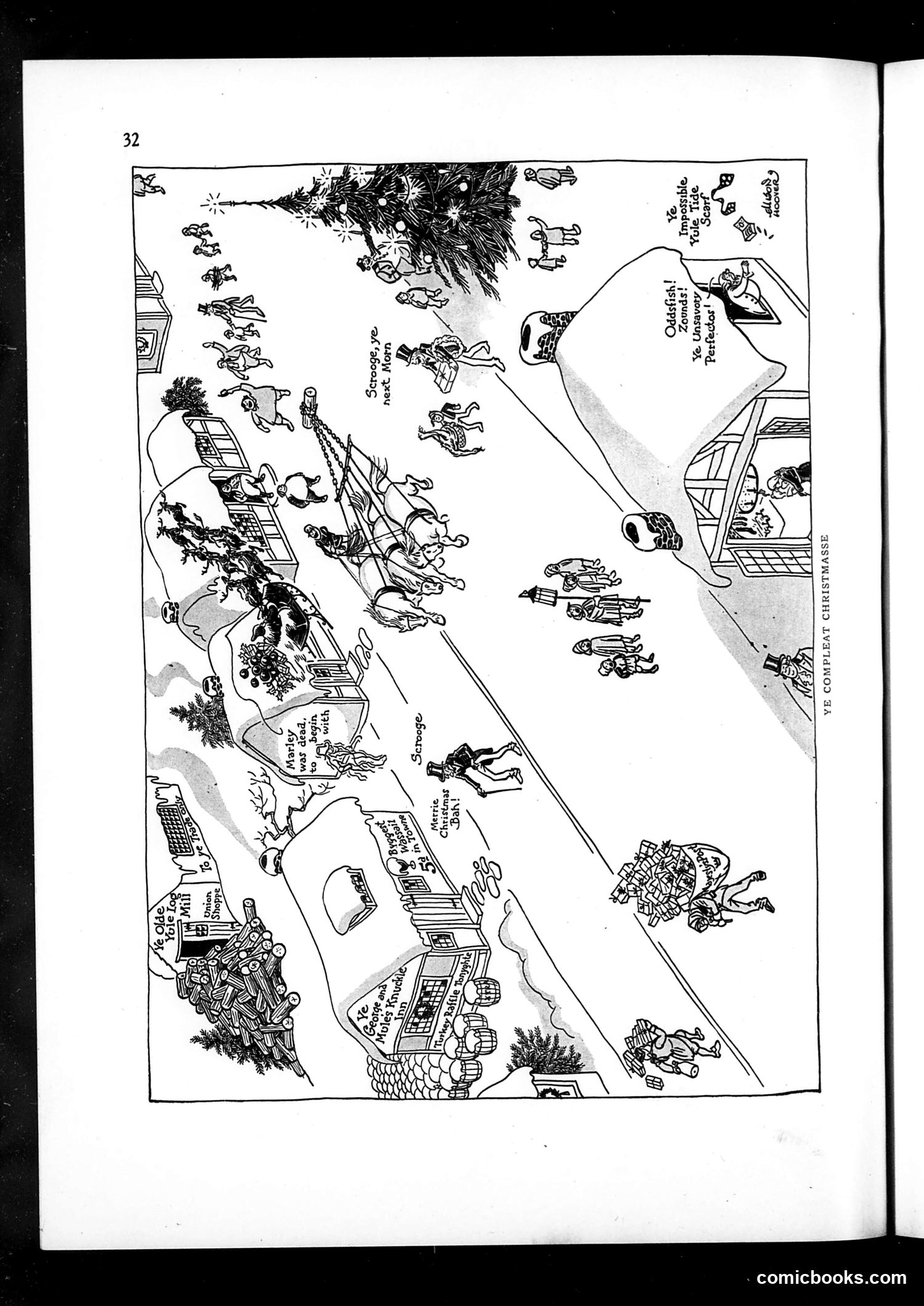
I can see this is page 32 of Life magazine, containing an illustration that appears to be rotated 90 degrees. The image shows multiple figures and buildings arranged in a street or neighborhood scene, with various labeled elements and text boxes throughout. However, the OCR text provided is largely corrupted and unreadable, making it impossible to identify specific figures, political references, or the satirical point with confidence. The image itself, while detailed, is difficult to interpret clearly at this reproduction quality and angle. To accurately explain what this cartoon means to a modern reader, I would need either legible OCR text or a clearer, properly-oriented image. I cannot reliably identify the caricatures or historical references without this supporting information.
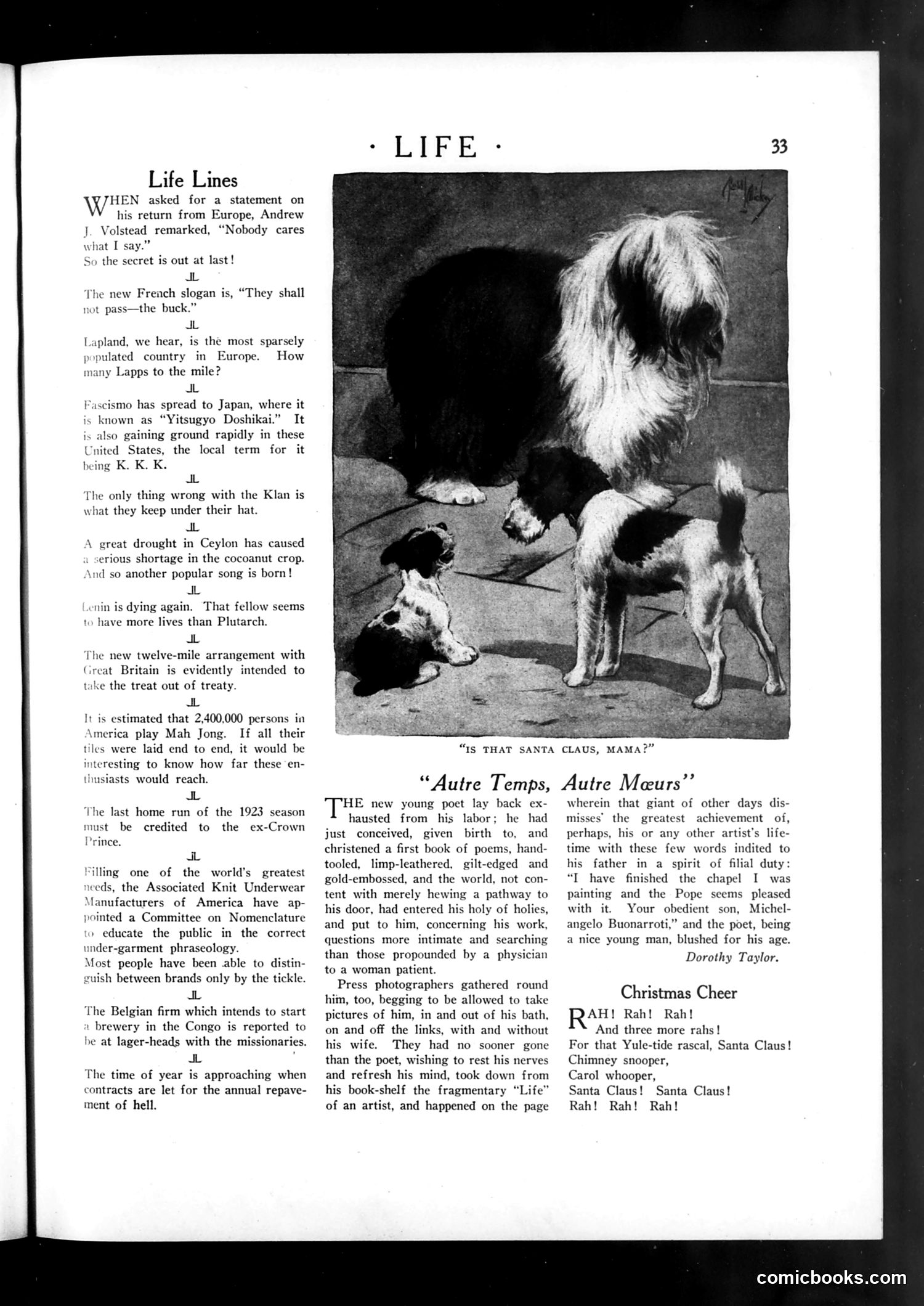
This page contains satirical "Life Lines"—brief political and social jokes—plus two literary pieces. **Key satirical references:** - **Andrew J. Volstead**: The congressman behind Prohibition; the joke mocks his irrelevance after passing the 18th Amendment. - **"They shall not pass—the buck"**: A French slogan joke playing on WWI's "They shall not pass," transformed to mock French reluctance to pay war debts. - **K.K.K. reference**: Equates American fascism with the Ku Klux Klan, suggesting both are gaining ground domestically. - **Klan joke**: Dark wordplay suggesting the Klan's ignorance ("what they keep under their hat"). - **The dog photograph**: Captioned "Is that Santa Claus, Mama?"—likely mocking something contemporary, though unclear from image alone. The literary pieces include a poem about a young poet's success and a Christmas carol. The overall tone is satirical commentary on 1920s American politics, Prohibition, international relations, and fascism's rise.
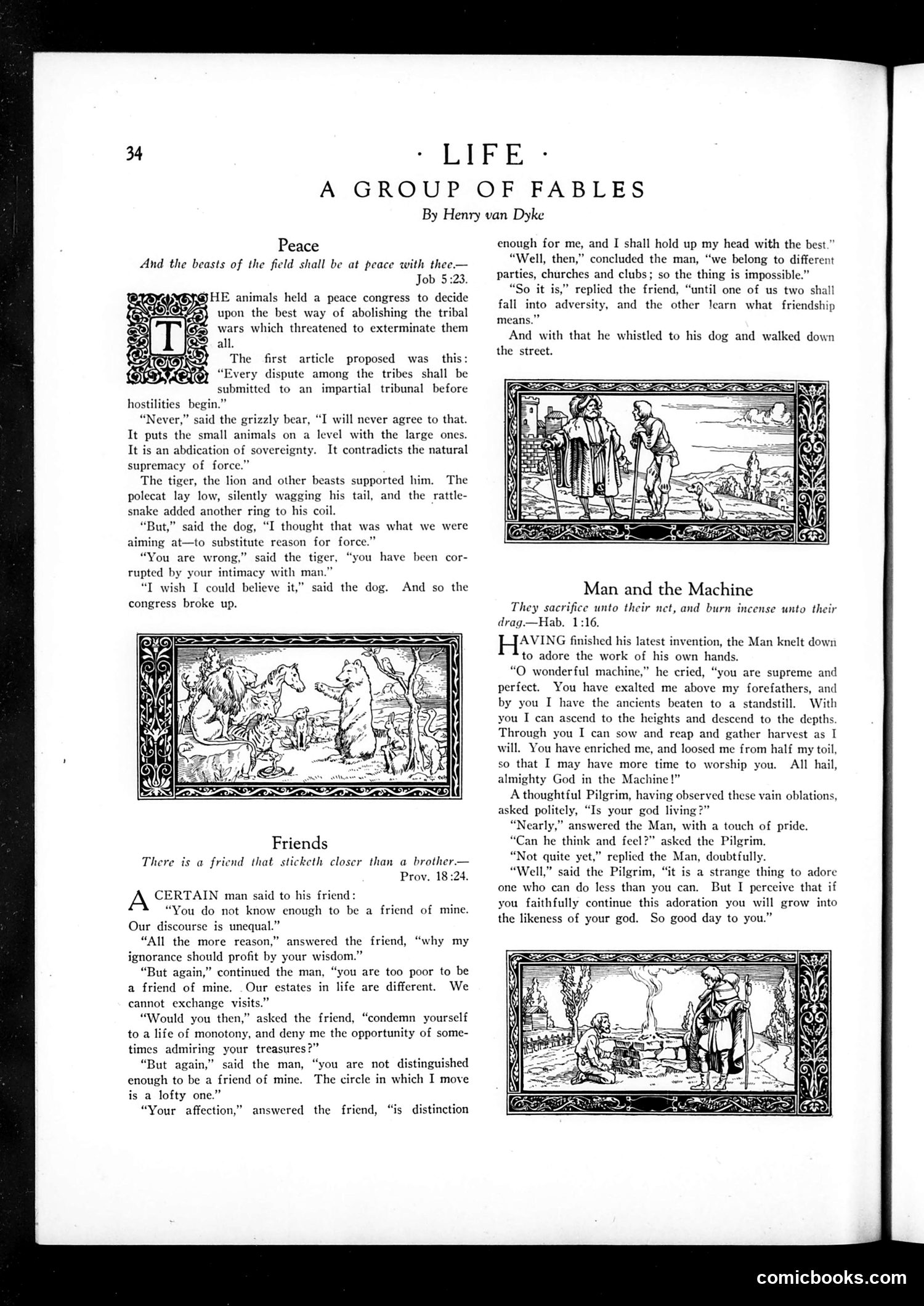
This page presents three allegorical fables addressing early 20th-century social tensions: **"Peace"**: Animals debate abolishing tribal warfare through impartial tribunals. The grizzly bear, tiger, and lion—representing powerful interests—reject this, claiming it violates "natural supremacy of force." The dog (representing humanity's conscience, corrupted by association with man) argues for reason over force. The satire critiques how the powerful resist arbitration and equality before law to preserve dominance. **"Friends"**: A wealthy man rejects friendship with a poor, less-distinguished person based on class differences. His friend argues affection transcends social hierarchy. The satire mocks snobbery and suggests true friendship emerges only through shared adversity. **"Man and the Machine"**: A man worships his technological creation as a god. A Pilgrim observes the machine lacks consciousness or feeling, warning that blind devotion to technology will diminish humanity itself. Together, these fables critique power inequality, class prejudice, and uncritical technological worship—concerns relevant to Progressive Era readers.
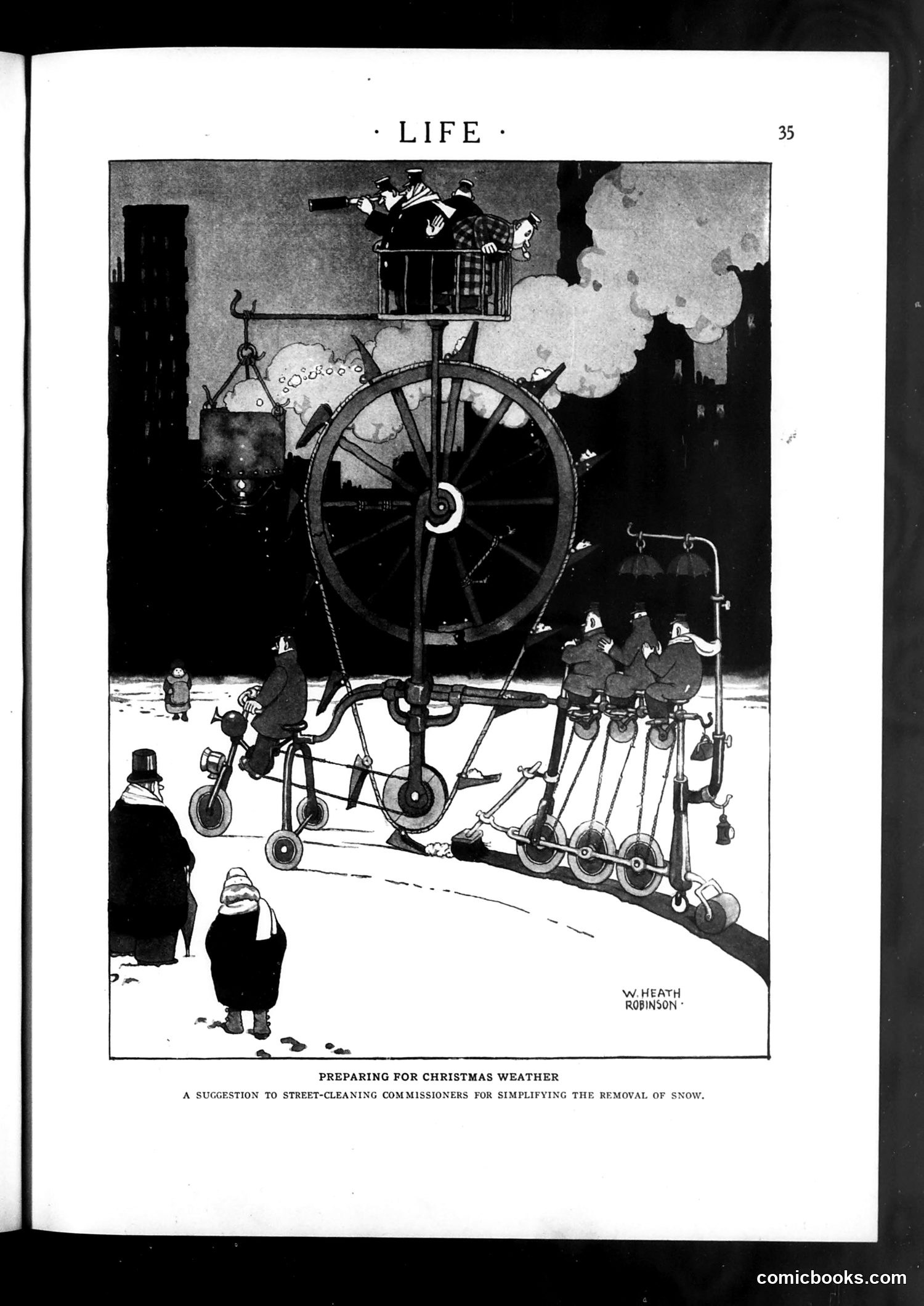
This is a satirical cartoon by W. Heath Robinson, a famous British artist known for depicting absurdly overcomplicated mechanical contraptions. The cartoon mocks street-cleaning commissioners by proposing a deliberately ridiculous solution to snow removal. The cartoon shows an enormous, impractical machine featuring a giant wheel, pulley systems, and mechanical components operated by multiple workers. A basket suspended above collects snow, while the contraption includes numerous bicycles and wheels powering the apparatus—vastly overcomplicated for a simple task. The satire targets municipal bureaucracy's tendency toward inefficiency and unnecessary complexity. Rather than straightforward snow removal, Robinson imagines city officials creating an elaborate, expensive mechanical system that requires numerous operators. The humor derives from the gap between the simple problem and the absurdly engineered "solution," critiquing wasteful government spending and overwrought administration.
This editorial page attacks well-meaning reformers and moral crusaders who the author believes cause more harm than good. The piece criticizes figures like William Jennings Bryan (referenced as "Bro. Bill Bryan"), who pushed his religious and political ideas onto others despite, the author claims, never thinking "entirely straight." The author argues that life itself naturally improves society through evolution and gradual development—we don't need self-righteous "know-betterest people" interfering. These crusaders, the text suggests, misunderstand how positive change actually occurs and damage society through their zealous moralizing. The cartoon at top (showing skeletal death figures) reinforces themes of mortality and life's natural processes. This 1923 piece reflects post-WWI skepticism toward progressive reformers and Prohibition advocates—Bryan had championed both causes.
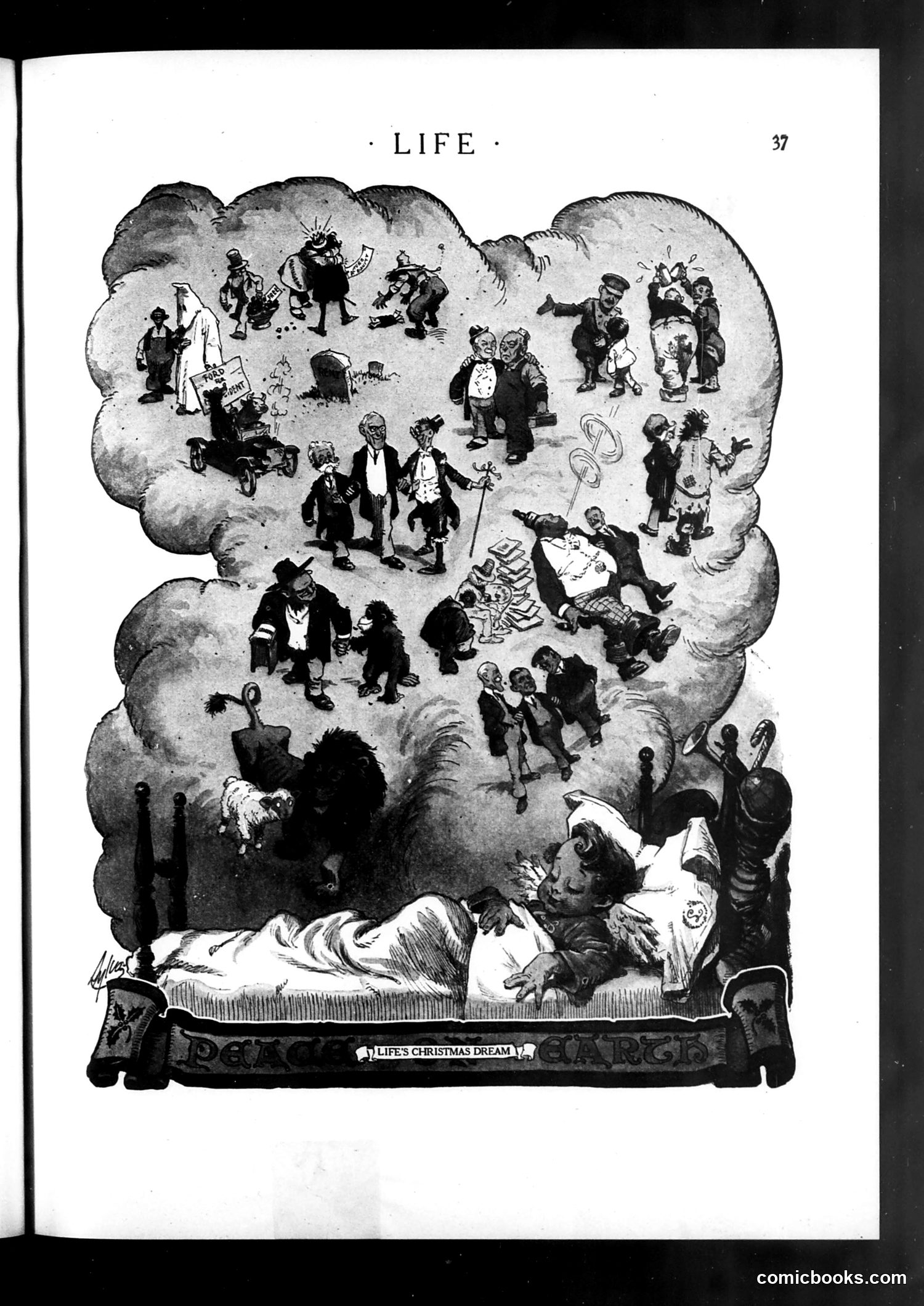
This illustration depicts a dreamer's vision of Christmas revelry, shown as a thought-bubble emanating from a sleeping figure at the bottom. The composition is surreal and satirical, crowded with numerous small figures engaged in various Christmas activities—gift-giving, celebration, dancing, drinking, and socializing—all rendered in the exaggerated caricature style typical of early 20th-century Life magazine. The satire appears to mock the commercialization and excess of Christmas festivities, presenting an almost chaotic vision of holiday indulgence. The sleeping figure's elaborate dream contrasts sharply with the reality of actual Christmas observance, suggesting commentary on idealized versus practical holiday experiences, or perhaps critiquing the consumerist aspects of modern Christmas celebration.
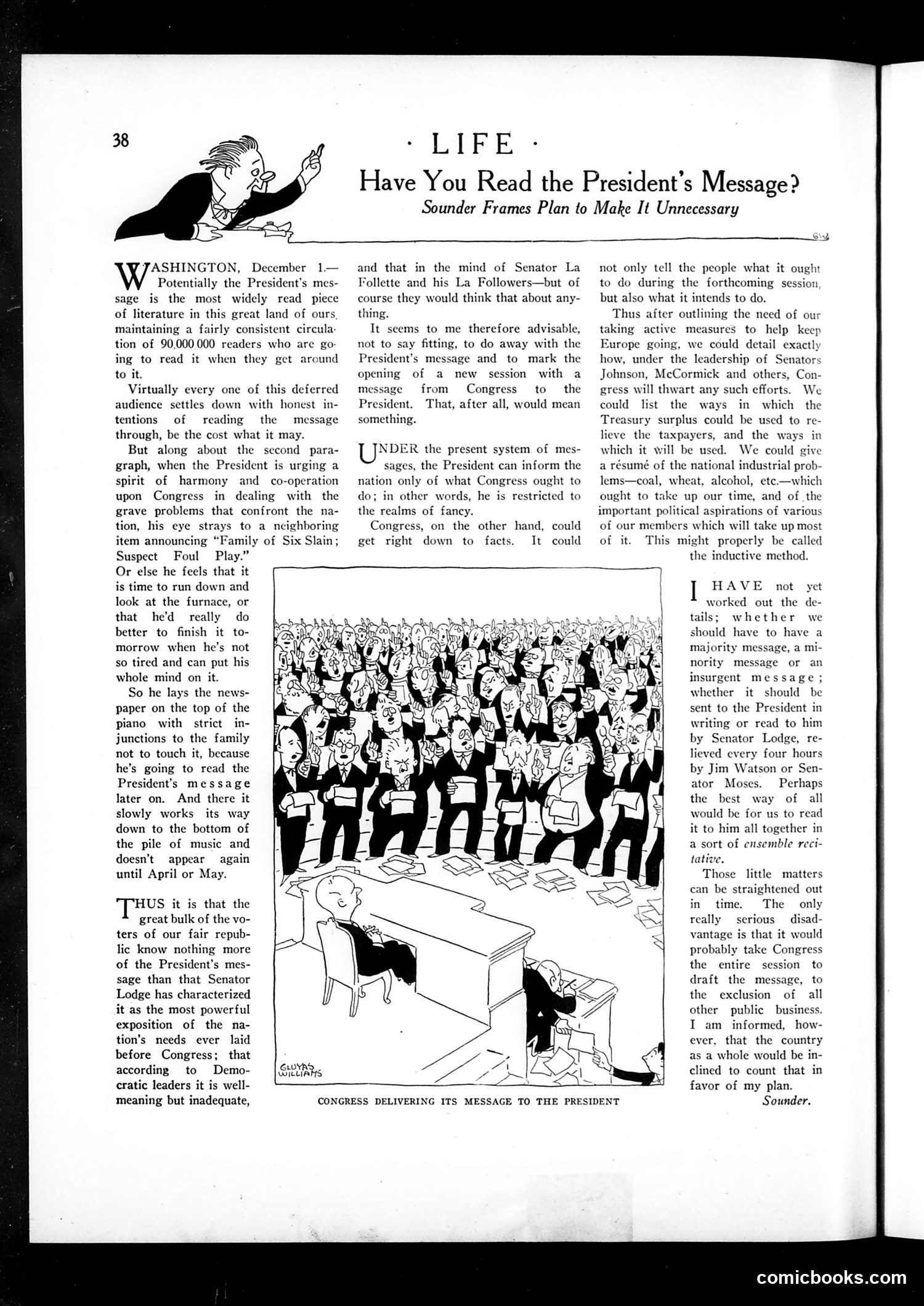
This satirical piece mocks the President's annual message to Congress as an unread formality. The author proposes a humorous alternative: have *Congress* deliver a message to the President instead, since Congress actually knows what it will do (or won't do), whereas the President can only suggest ideals. The cartoon depicts Congress presenting stacks of papers to a seated President, illustrating the absurdity of role-reversal. The satire targets post-WWI political gridlock: Congress members like Senator Lodge (Republican critic of the President) and insurgent Republicans (likely referencing opposition to Wilson's League of Nations) consistently blocked presidential initiatives. The author suggests Congress should be honest about its obstructionist intentions rather than pretend to listen to presidential rhetoric. The joke is that most Americans never actually read the President's message anyway—they abandon it halfway through to read gossip columns, then forget about it until next year.
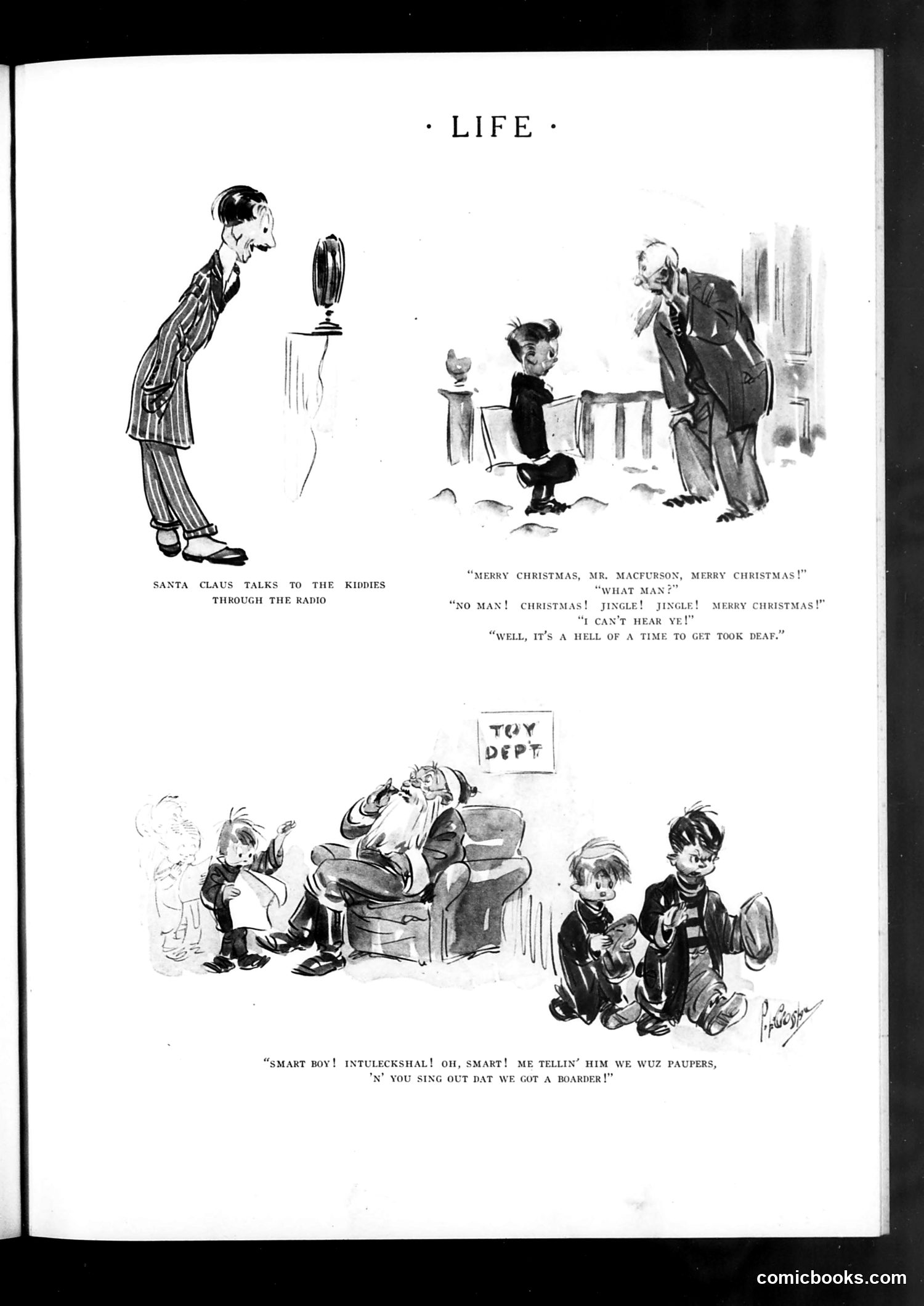
This page contains two satirical cartoons about Christmas during economically difficult times (likely the Depression era). **Top cartoon**: A man listens to Santa Claus on the radio wishing him "Merry Christmas," but he's gone deaf—a dark joke about hardship making people unable to enjoy holiday cheer even when it's broadcast to them. **Bottom cartoon**: Children in poverty sit near a "TOY DEPT" sign. One child boasts to another that they told Santa they're poor but have "a boarder" (a paying tenant living in their home). The satire mocks how working-class families must present their circumstances to appear respectable, even to fictional figures, while surviving by taking in roomers. Both cartoons use humor to expose the gap between Christmas ideals and economic reality for ordinary Americans.
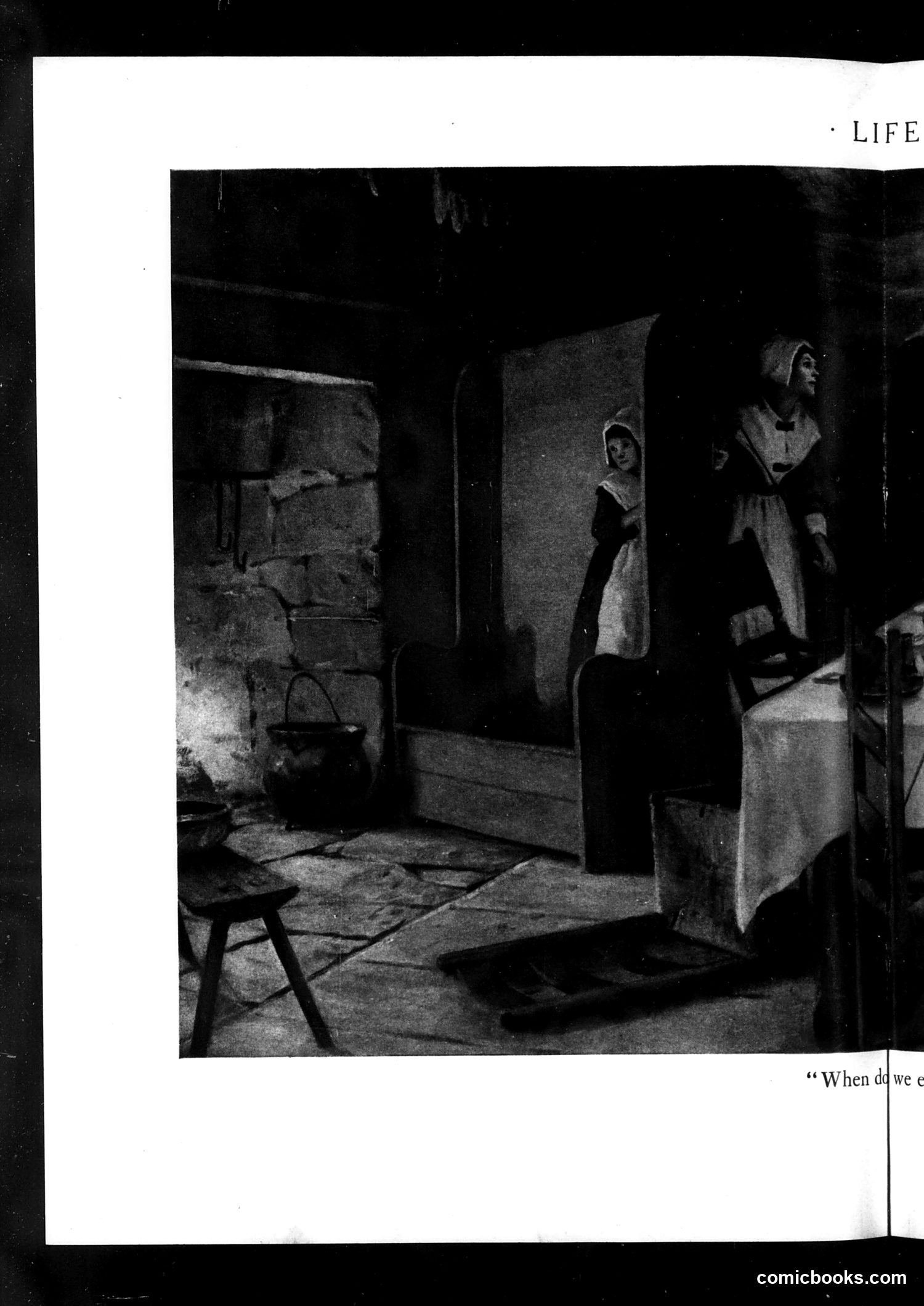
This appears to be a dramatic black-and-white photograph or theatrical scene rather than a traditional political cartoon. The image shows what looks like an interior domestic setting with figures in period clothing (possibly early 20th century), including someone in an apron and headscarf. The partial caption visible reads "When do we..." but is cut off, making it impossible to determine the specific satirical point or social commentary intended. Without the complete text and given the theatrical quality of the staging, this could be illustrating a social commentary about domestic labor, class relations, or a contemporary social issue—but the incomplete caption and lack of clear identifying context prevent confident interpretation of the specific satirical message or figures depicted.
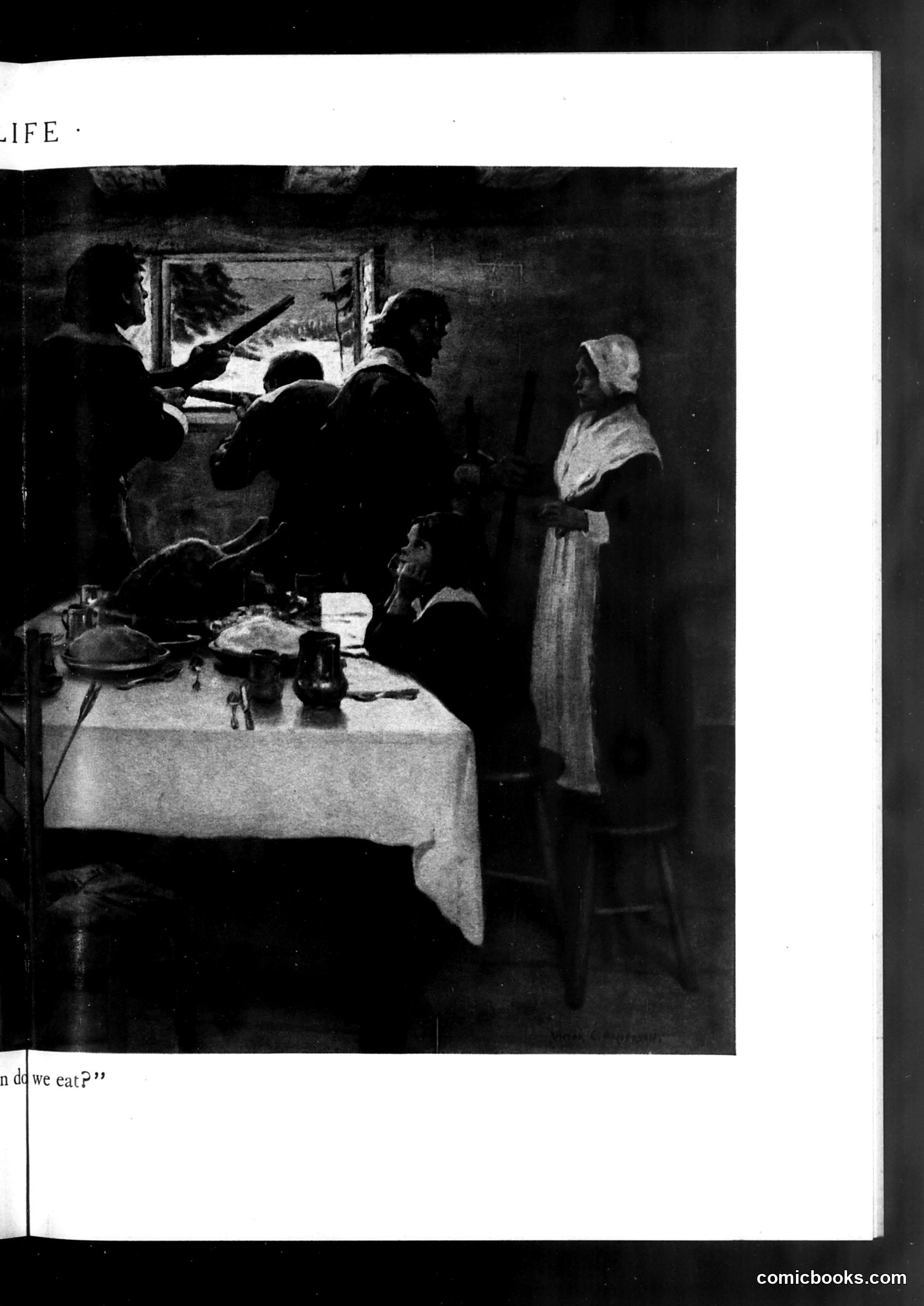
This appears to be a satirical scene depicting a domestic or institutional kitchen setting, likely from the early-to-mid 20th century based on the clothing and photography style. The image shows several figures gathered around a table with food, while others look toward a window or opening. The caption "When do we eat?" suggests commentary on food scarcity, rationing, or hunger—possibly referencing wartime conditions or economic hardship. The composition emphasizes anticipation or desperation around meal provision, with the figures' body language suggesting impatience or concern about sustenance. Without additional context about the specific issue date and surrounding articles, the precise political target remains unclear, though the satire appears to critique institutional food management or wartime hardships affecting ordinary people.
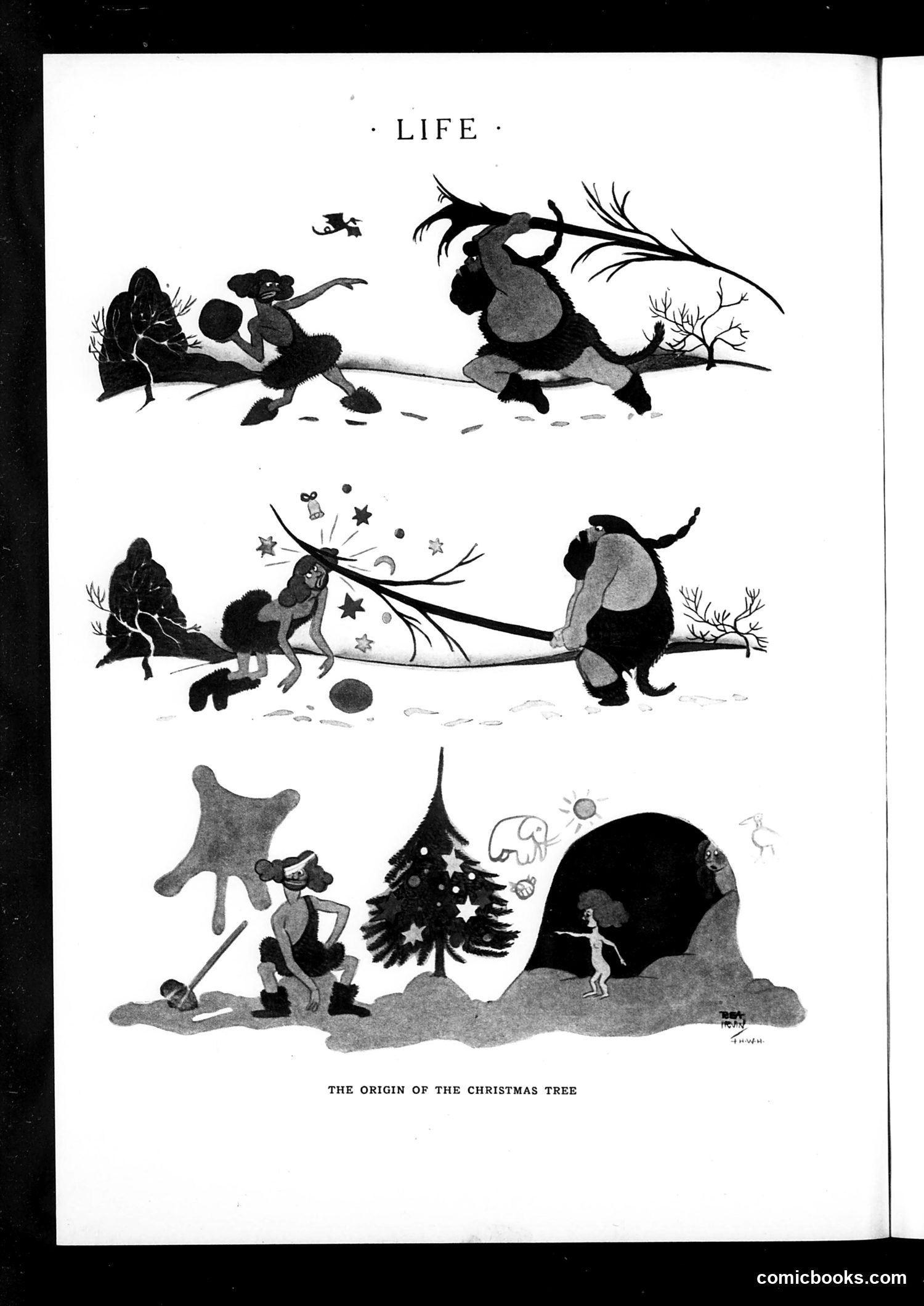
This satirical illustration traces Christmas tree traditions through three comic panels. The top panel shows figures engaged in tug-of-war with a bare branch, suggesting competition or conflict over the holiday's origins. The middle panel depicts similar struggle with magical elements (stars, sparkles), implying supernatural or mythological dimensions to the tradition. The bottom panel shows figures around a decorated tree near a cave, suggesting primitive or ancient origins of the custom. The satire likely mocks competing cultural and religious claims about Christmas traditions—whether pagan, Germanic, or Christian in origin. By presenting "life" evolving toward the modern Christmas tree through conflict and magical thinking, Life magazine appears to humorously debunk earnest historical narratives about holiday customs, suggesting their actual origins are muddled, contested, or absurdly oversimplified.
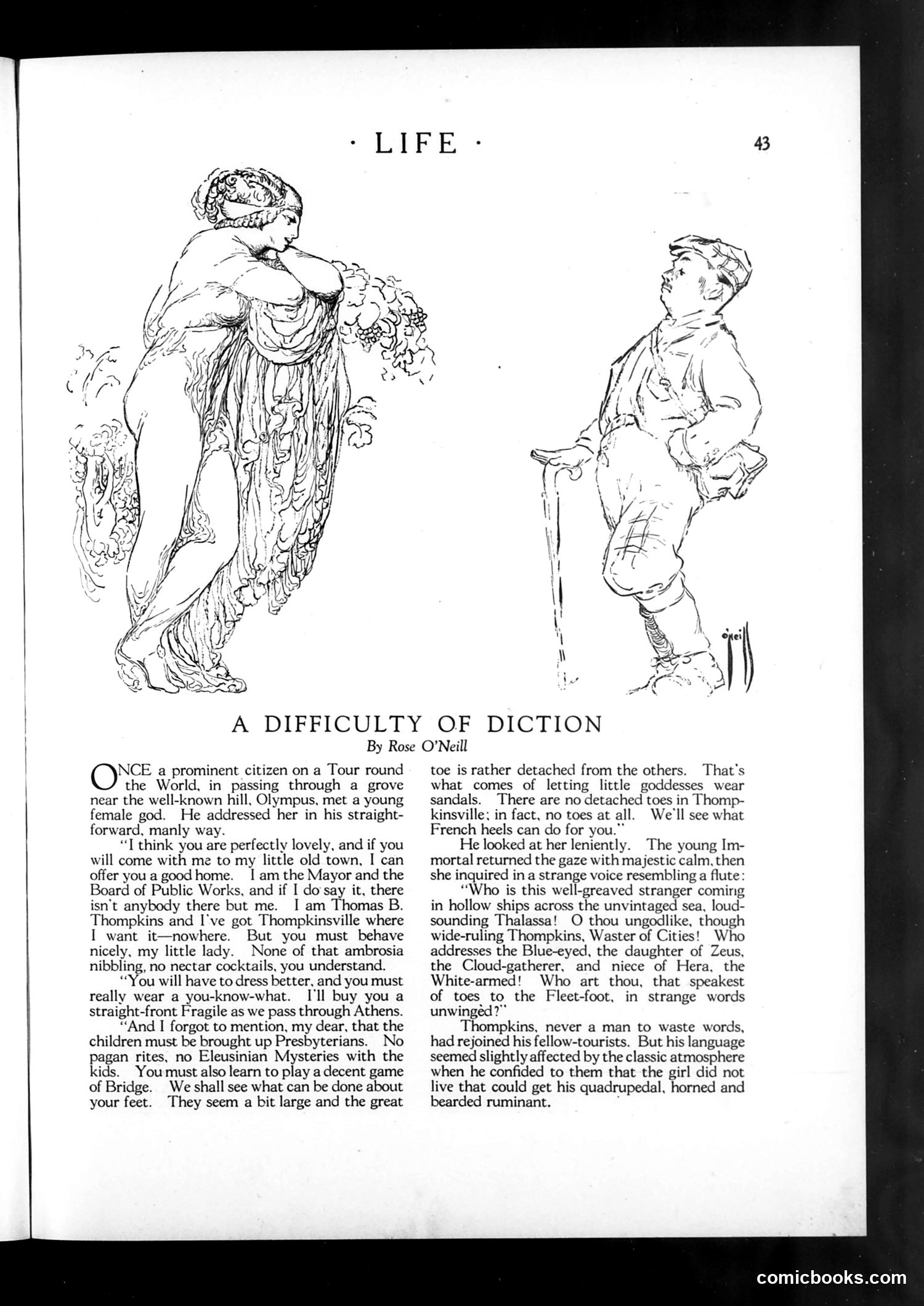
This satirical story contrasts American commercialism with classical mythology. A small-town American mayor named Thomas B. Thompkins encounters a Greek goddess near Mount Olympus and attempts to court her with offers of marriage and middle-class respectability—insisting she abandon her "pagan" ways, adopt Presbyterian values, wear corsets, and play Bridge. The goddess responds in elevated Homeric Greek, addressing him as an uncultured outsider ("ungodlike"). The humor mocks American provincial arrogance: Thompkins tries to "civilize" divinity itself through Victorian propriety and consumerism. The goddess's formal classical language exposes his mundane materialism. The ending reveals his complete cultural disconnect—he abandons the encounter and later crudely describes her in crude terms to fellow tourists. O'Neill satirizes American tourists' cultural ignorance and the era's assumption that Western middle-class values represented civilization itself.
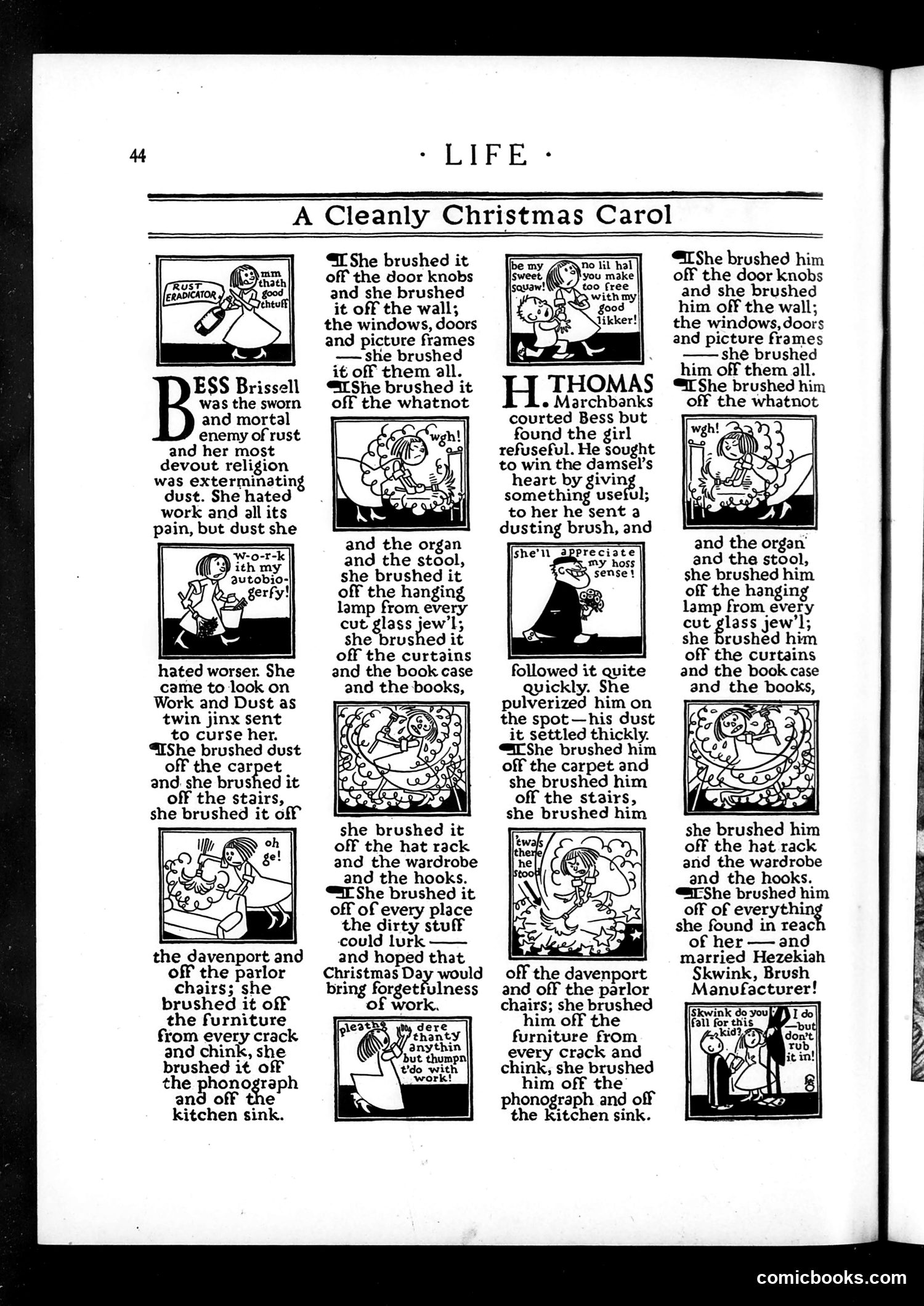
This humorous story parodies Dickens's *A Christmas Carol* through a cleaning-obsessed woman named Bess Brissell. The satire targets both obsessive domesticity and courtship customs of the era. Bess is pathologically devoted to eliminating dust—her "sworn enemy." When Thomas Marchbanks courts her with a dusting brush (attempting to appeal to her interests), she literally "brushes him off" by using the brush on him repeatedly, treating him like household debris. The dark joke: she violently rejects his romantic gesture. The punchline subverts expectations: rather than marrying for love, Bess marries Hezekiah Skwink, a *brush manufacturer*—a practical union based on her obsession, not romance. The satire mocks 1920s-era gender roles: women defined by domestic labor, and the absurdity of male courtship strategies that completely miss the mark. It's also gentle mockery of excessive cleanliness as a character flaw rather than virtue.
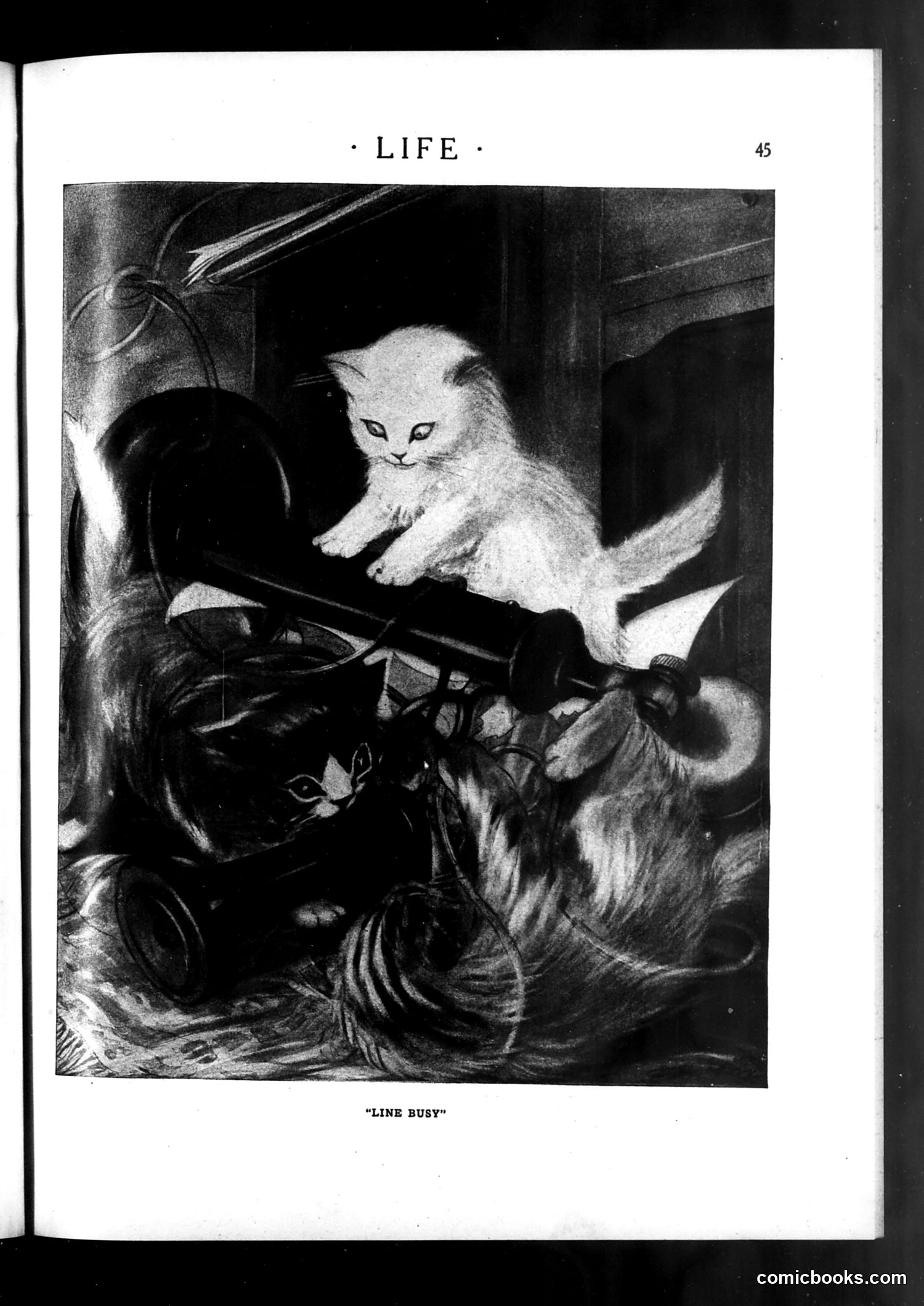
This cartoon depicts a white cat sitting at what appears to be an old-fashioned telephone switchboard or similar communication device, with tangled telephone lines or cords visible below. The title "Line Busy" suggests the joke concerns telephone communication difficulties. The humor likely references the frustration of attempting to reach someone by phone only to find the line continuously busy—a common modern inconvenience in the era when this *Life* magazine was published. The cat's bemused or focused expression suggests the absurdity of this situation. The visual pun of an animal operating human communication technology adds comedic anthropomorphism typical of early-to-mid 20th-century satirical cartooning.
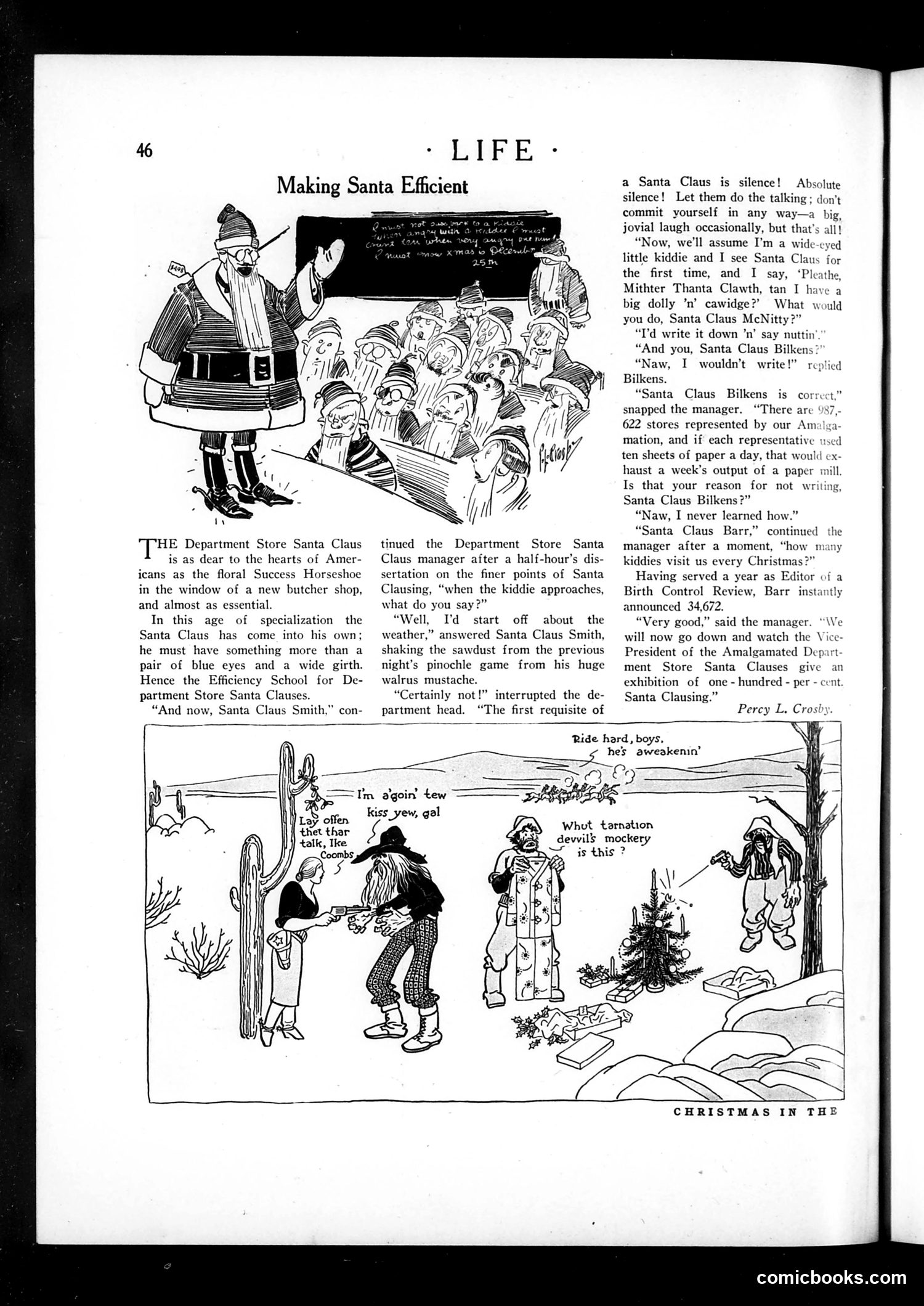
This page satirizes early 20th-century American obsession with "efficiency" and scientific management in unlikely contexts. The article mocks department stores training Santa Clauses like factory workers, enforcing rigid protocols to maximize profit over authenticity. The satire targets: **The main article** shows a manager instructing multiple "Santa Claus" employees—identified only by surnames (Smith, Bilkens, Barr, McNitty)—on how to respond to children. Rather than genuine jolly spontaneity, Santas are coached to remain silent, write requests on paper (to avoid wasting the store's paper supply with verbal conversation), and provide no personality. **The joke**: One Santa admits "I never learned how [to write]"—exposing the absurdity of applying industrial efficiency metrics to something inherently human and magical. Another Santa, having edited a Birth Control Review, instantly calculates exact visitor statistics, revealing these are interchangeable corporate functionaries, not characters. **The desert cartoon** (bottom) appears unrelated—possibly advertising or filler—showing cowboys in a comedic Western scene. The satire critiques dehumanizing corporate management of holiday traditions.
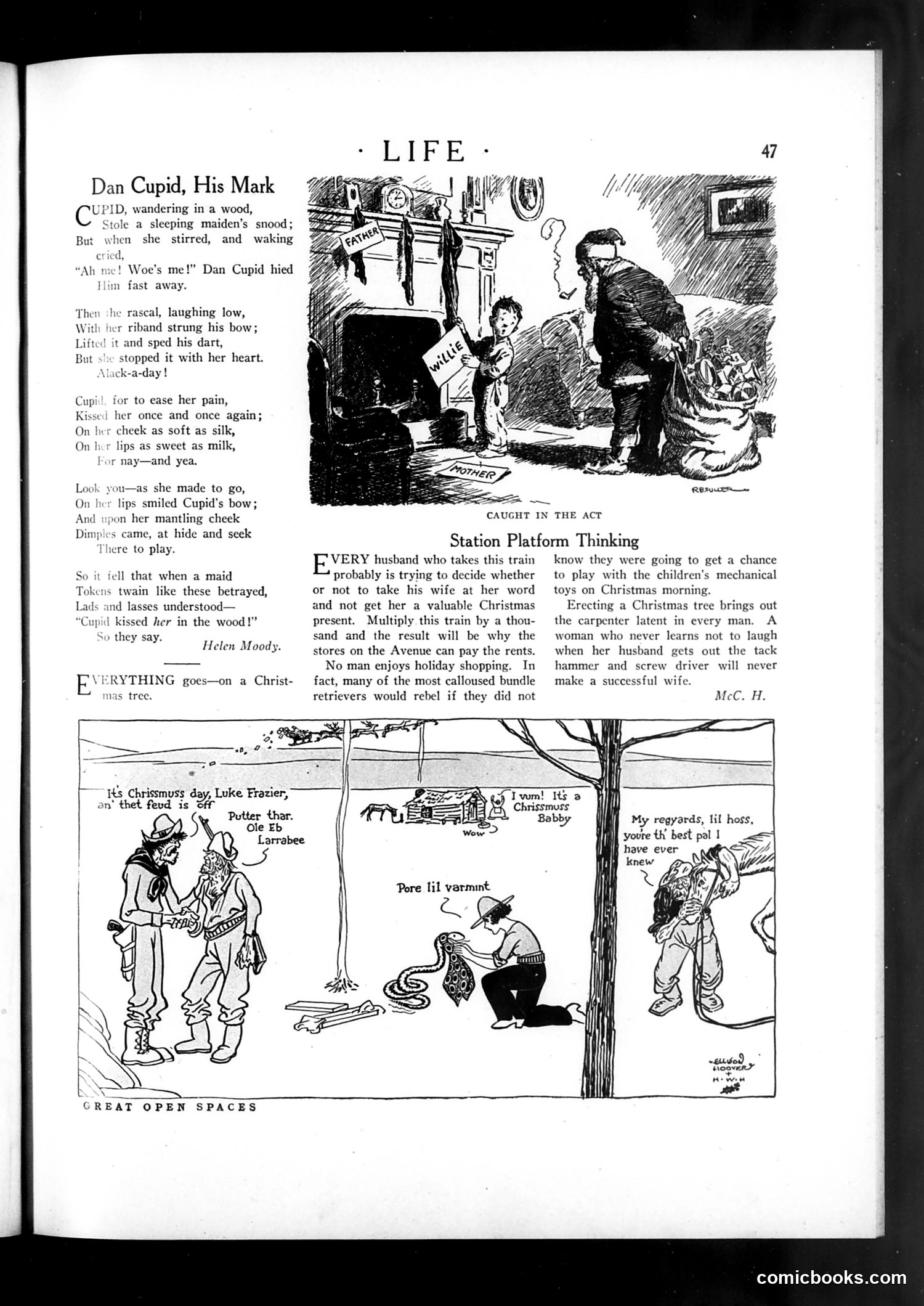
The page contains two separate pieces of humor from Life magazine's satirical tradition. **"Dan Cupid, His Mark"** is a romantic poem with accompanying illustration showing Cupid stealing a maiden's hair ribbon, shooting her with his arrow, and kissing her repeatedly. It's lighthearted verse about love's conquest, with the illustration labeled "Caught in the Act." **"Station Platform Thinking"** satirizes husbands' anxiety about Christmas shopping. The article jokes that men boarding trains are debating whether to buy their wives valuable gifts or believe their claims they don't want anything—multiply this indecision across thousands of commuters, and you explain why Fifth Avenue stores afford high rents. The humor targets masculine reluctance toward holiday shopping and gift-buying, while also gently mocking men who procrastinate, then get distracted playing with their children's mechanical toys. Both pieces reflect early-20th-century gender dynamics and consumer culture anxieties around Christmas gift-giving.
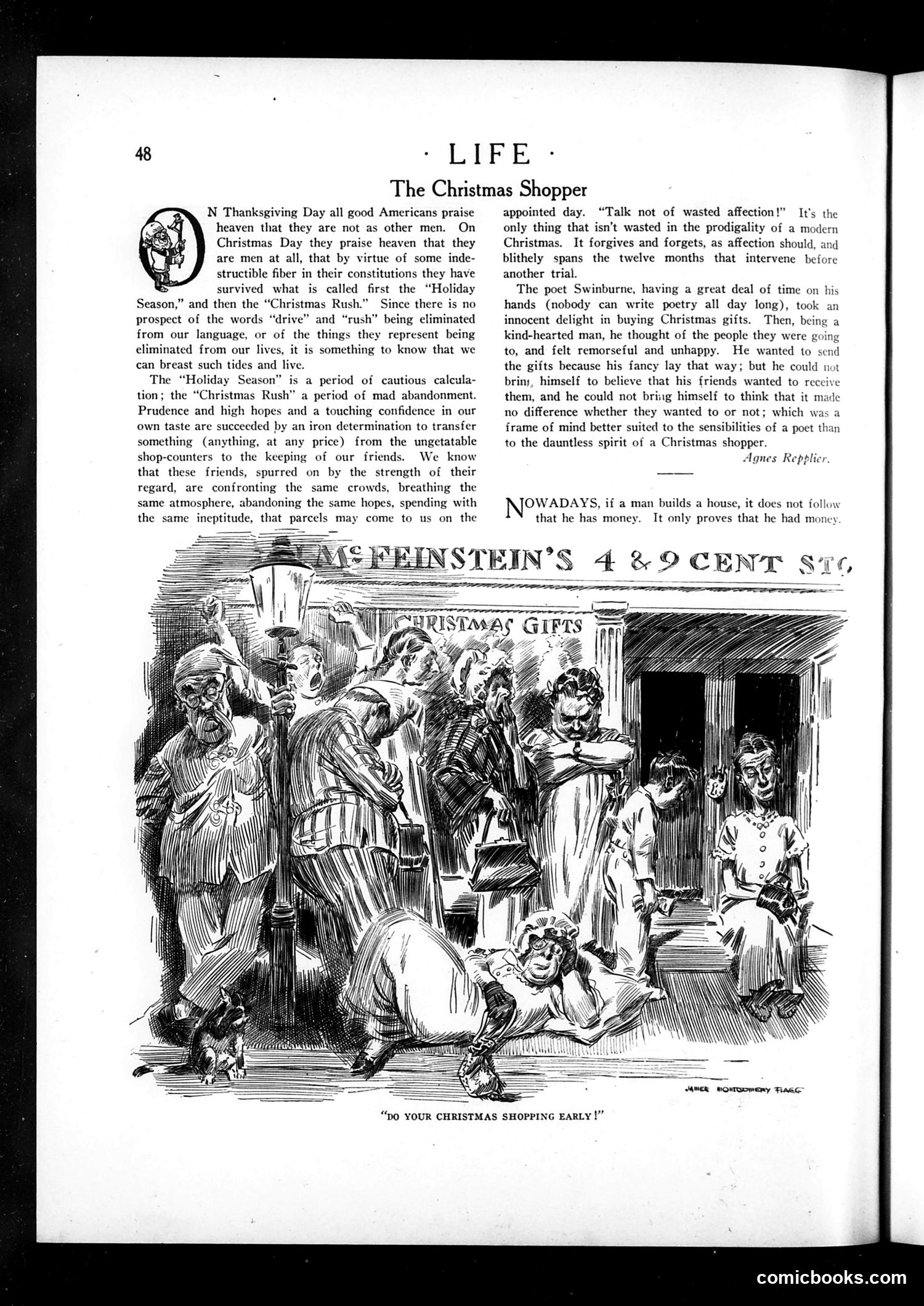
This is a satirical essay with accompanying illustration about the frenzied American Christmas shopping season. The text, attributed to essayist Agnes Repplier, contrasts two periods: the cautious "Holiday Season" and the chaotic "Christmas Rush"—when shoppers abandon prudence and frantically purchase gifts, regardless of cost or appropriateness, simply to fulfill social obligation. The illustration depicts crowded chaos at "Melnstein's 4 & 9 Cent Store," showing masses of shoppers (adults and children) packed at a storefront labeled "Christmas Gifts," with the caption urging "Do Your Christmas Shopping Early!" The satire targets the commercialization and social pressure of Christmas: people buy gifts not from genuine affection but from compulsion and anxiety about social expectations. The essay notes this "wasted affection" is the only thing actually wasted in modern Christmas excess. The illustration visualizes the mob mentality and desperation underlying holiday shopping culture.
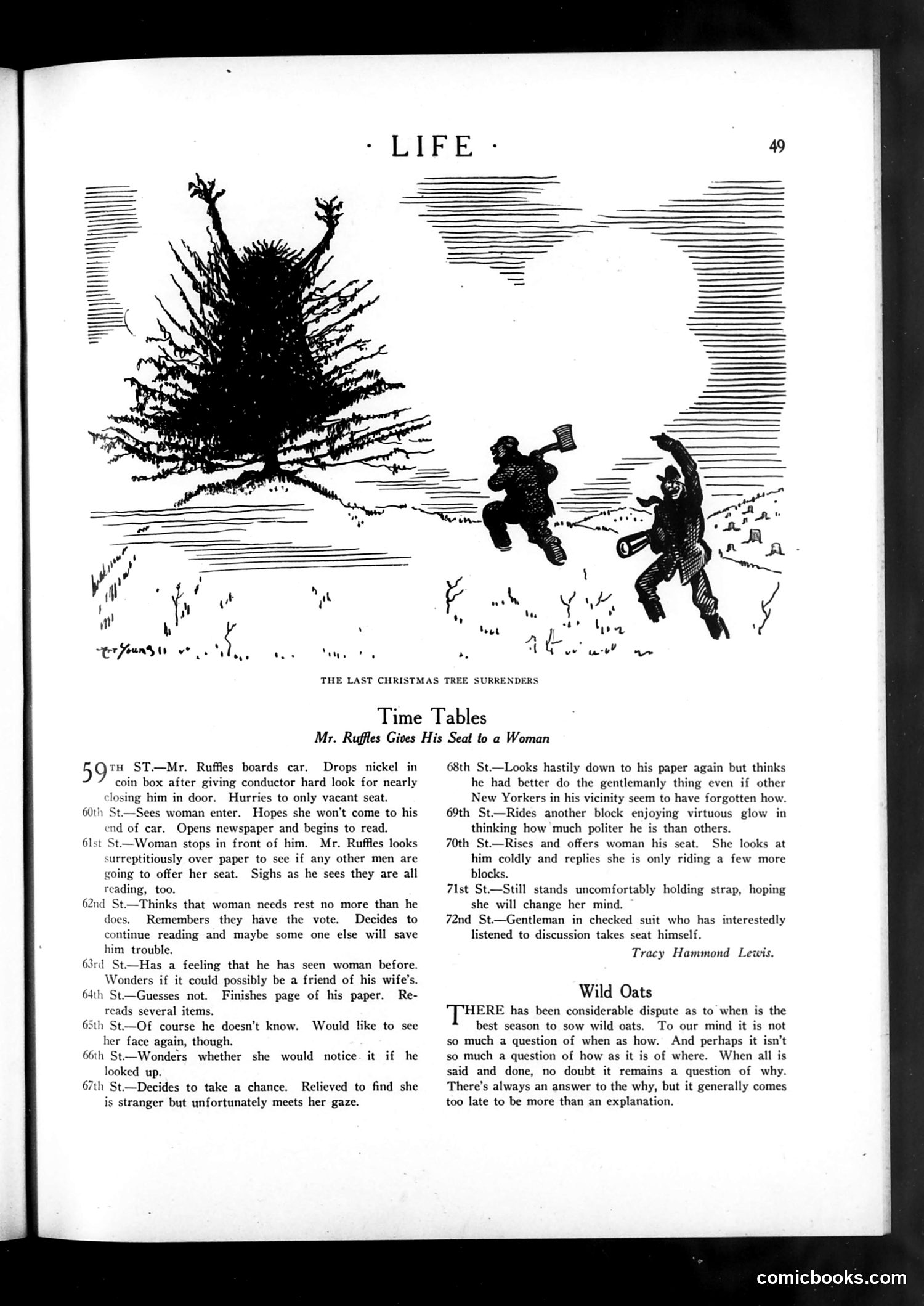
The top cartoon depicts two figures fleeing from a spiky, menacing Christmas tree in a snowy landscape—likely satirizing wartime scarcity or rationing during WWI, when resources were diverted to military use. The main feature is a comedic time-table narrative following Mr. Ruffles on a streetcar from 59th to 72nd Street. It satirizes male hypocrisy regarding women's equality: Ruffles refuses to give his seat to a standing woman, rationalizing that women now have voting rights (recently granted), so they don't need chivalry. He internally debates whether to act "gentlemanly" versus selfish, finally offers his seat, but is coldly rebuffed—she's only riding a few blocks. He then stands awkwardly while another man immediately takes a seat, leaving Ruffles both morally uncomfortable and practically worse off. The humor mocks men who weaponize feminism to avoid courtesy while resenting modern women's independence.
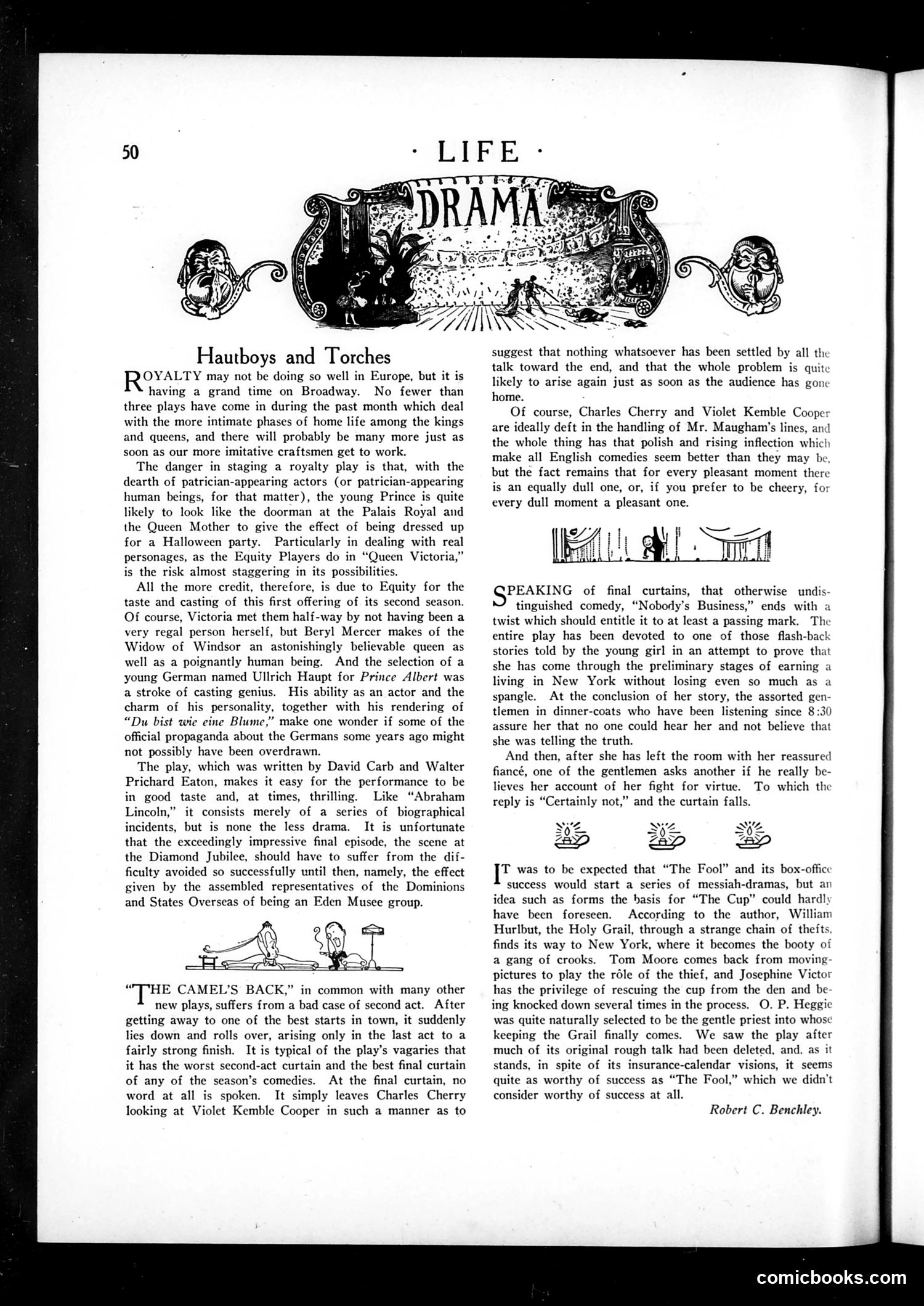
This is a theater criticism page reviewing three Broadway plays from the 1920s era. The main content consists of written reviews with no political cartoons. **Key theatrical references:** 1. **"Queen Victoria"** — An Equity Players production praised for its casting, particularly Beryl Mercer as Queen Victoria and German actor Ullrich Haupt as Prince Albert. The critic notes the risk of royalty plays looking ridiculous due to casting difficulties, but credits this production with tasteful execution. 2. **"The Camel's Back"** — A comedy criticized for a weak second act, though praised for strong performances by Charles Cherry and Violet Kemble Cooper in handling Somerset Maugham's dialogue. 3. **"Nobody's Business"** — A flashback-structured play about a young woman's experiences earning a living in New York, receiving mild approval for its final curtain twist. The page reflects 1920s Broadway's fascination with royalty plays and contemporary comedies featuring romantic complications and clever dialogue—typical entertainment concerns of that theatrical era.
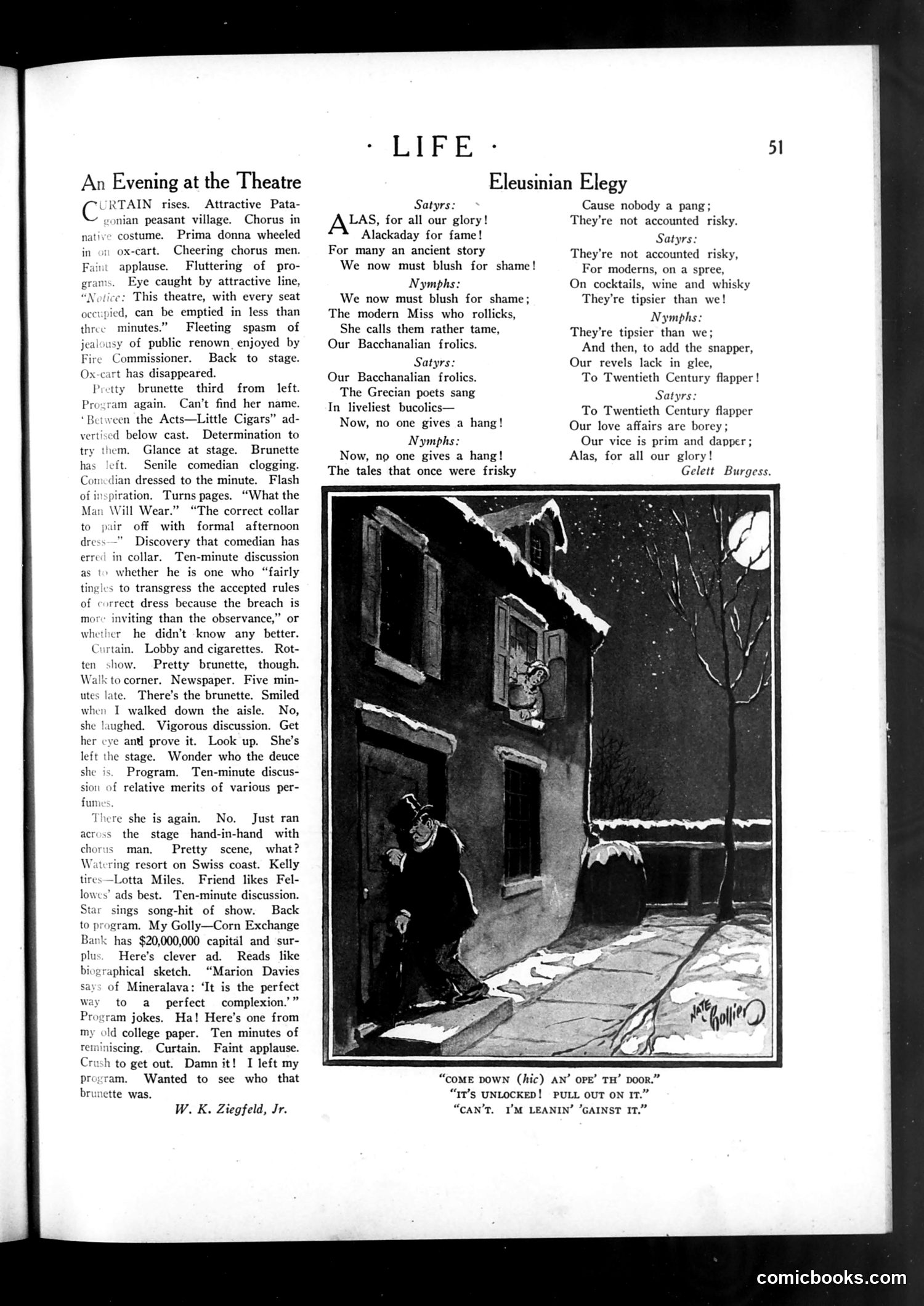
This two-part page satirizes early 20th-century theater audiences and changing morality. **Left column** ("An Evening at the Theatre") by W.K. Ziegfeld Jr. mocks theatergoers' shallow attention spans. The narrator spends the entire show distracted—reading ads, discussing fashion details, chatting about unrelated topics—while obsessing over an unnamed attractive chorus girl. The satire targets how audiences prioritize entertainment magazines, advertisements, and gossip over actual theater appreciation, with the final punchline revealing his inability to identify the girl he spent the evening pursuing. **Right side** includes two pieces: "Eleusinian Elegy" (a classical reference to ancient Greek mysteries) humorously compares mythological satyrs' wild revelry unfavorably to modern youth's tame, alcohol-fueled behavior. The cartoon below depicts an inebriated person unable to exit a door, labeled with drunk dialogue—satirizing Prohibition-era drinking culture and its failures. Together, the page mocks audience distraction, modern vice, and social hypocrisy.
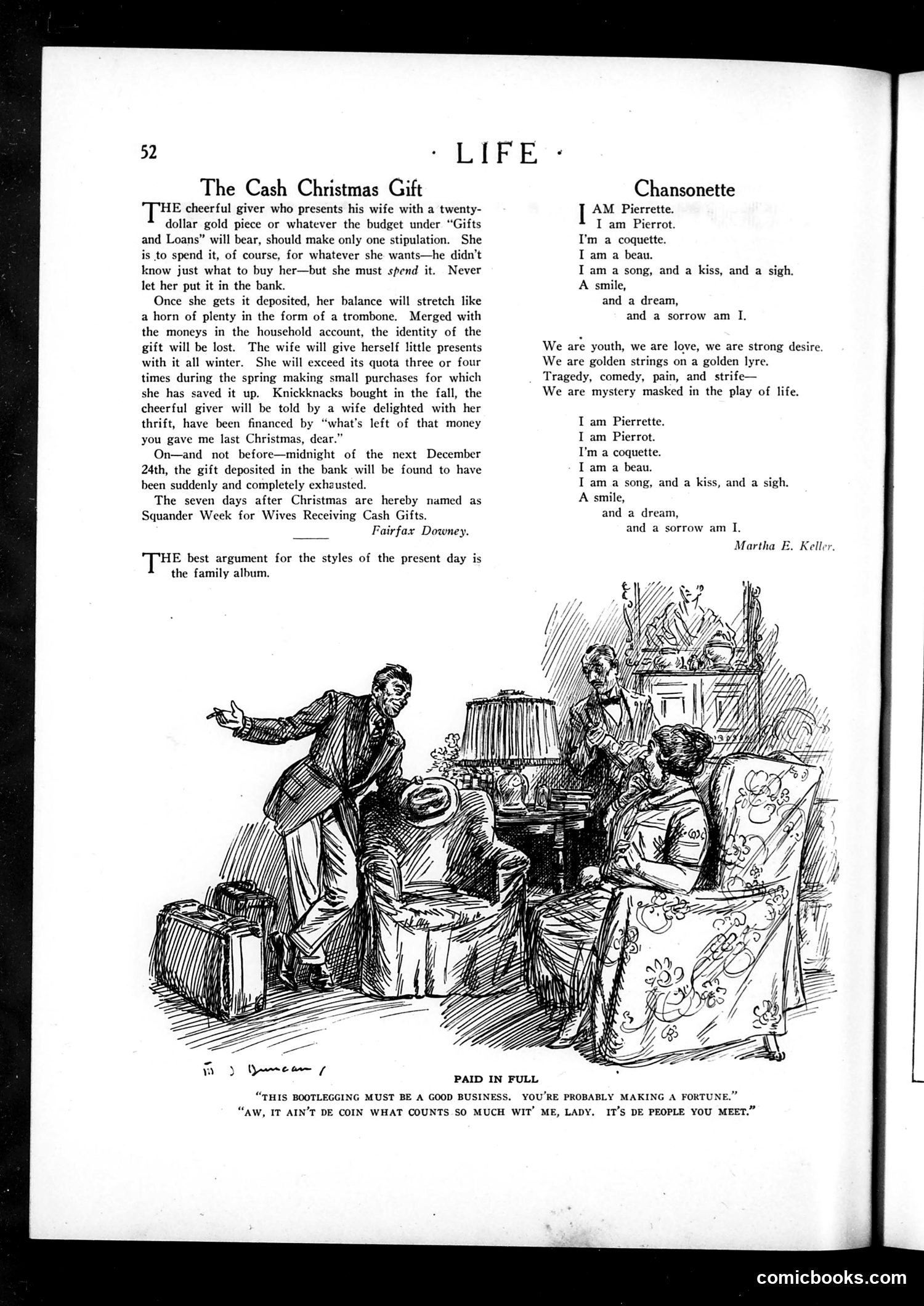
This page contains two satirical pieces about early 1920s American life: **"The Cash Christmas Gift"** (left column) mocks husbands who give wives cash instead of thoughtful presents. The satire predicts wives will deposit money into household accounts, lose track of the original gift, and spend it piecemeal throughout the year on small purchases. By the following December, it will be completely depleted. The author coins "Squander Week for Wives Receiving Cash Gifts" to mock this cycle. **The cartoon** (bottom) depicts bootleggers during Prohibition. One criminal boasts about the illegal alcohol business to a well-dressed woman. His response—that profit matters less than "the people you meet"—satirizes how organized crime created social networks and status among criminals and their associates. The caption emphasizes bootlegging's social cachet during Prohibition, when illegal liquor trade was rampant and sometimes glamorized in popular culture.
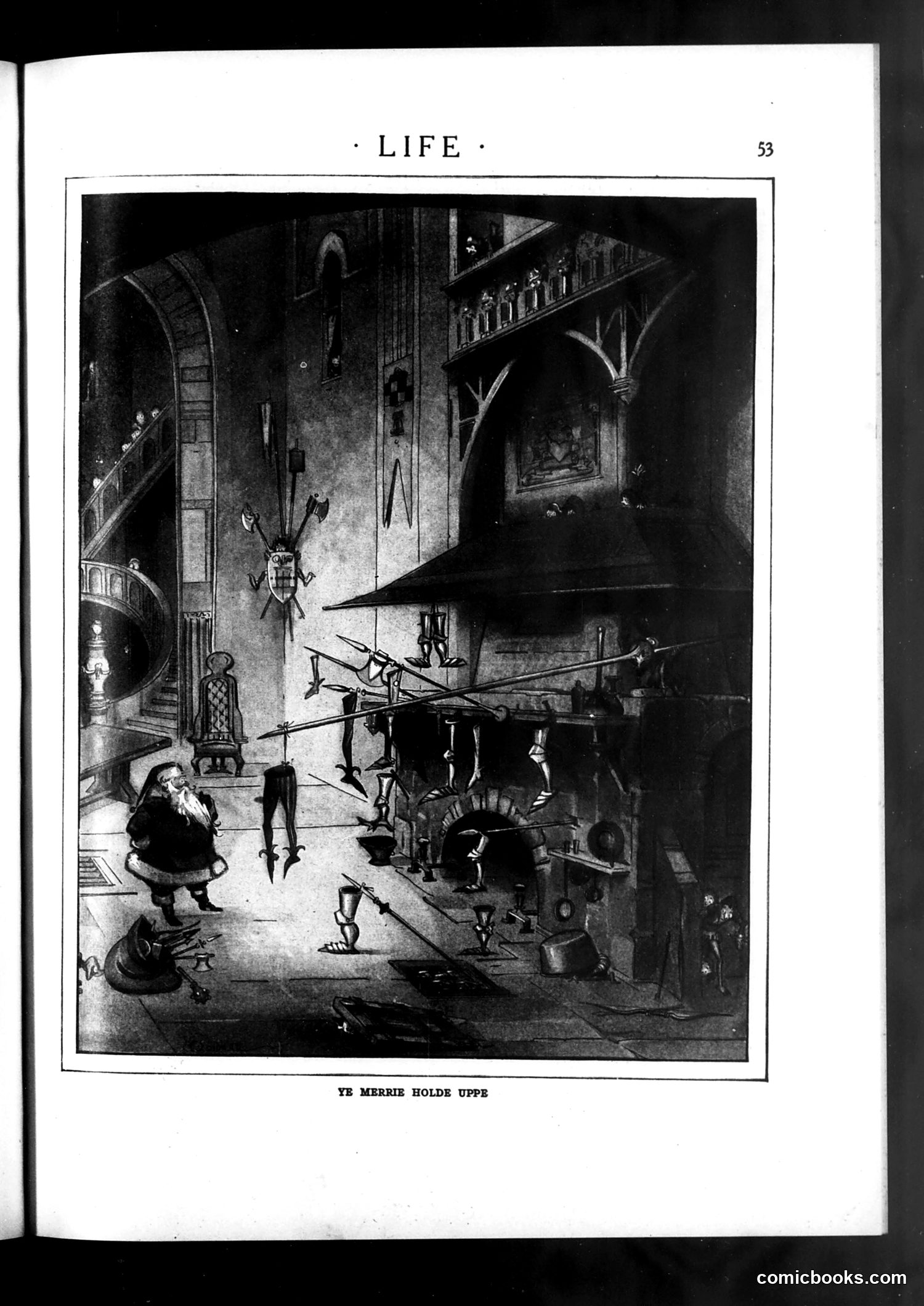
This page from *Life* magazine (page 53) features a single satirical illustration titled "Ye Merre Holde Uppe" — a play on medieval English phrasing. The image depicts what appears to be a robbery or theft in progress within a Gothic cathedral or church setting, complete with period architectural details like arches and ornate decorations. The scene shows figures engaged in what looks like a heist, with various tools and equipment scattered about. The satire likely mocks either contemporary crime, religious hypocrisy, or wealthy institutions being "held up" financially. The faux-archaic title suggests the cartoon is commenting on how supposedly timeless or established institutions face modern disruptions — though without additional historical context, the specific political or social target remains unclear.
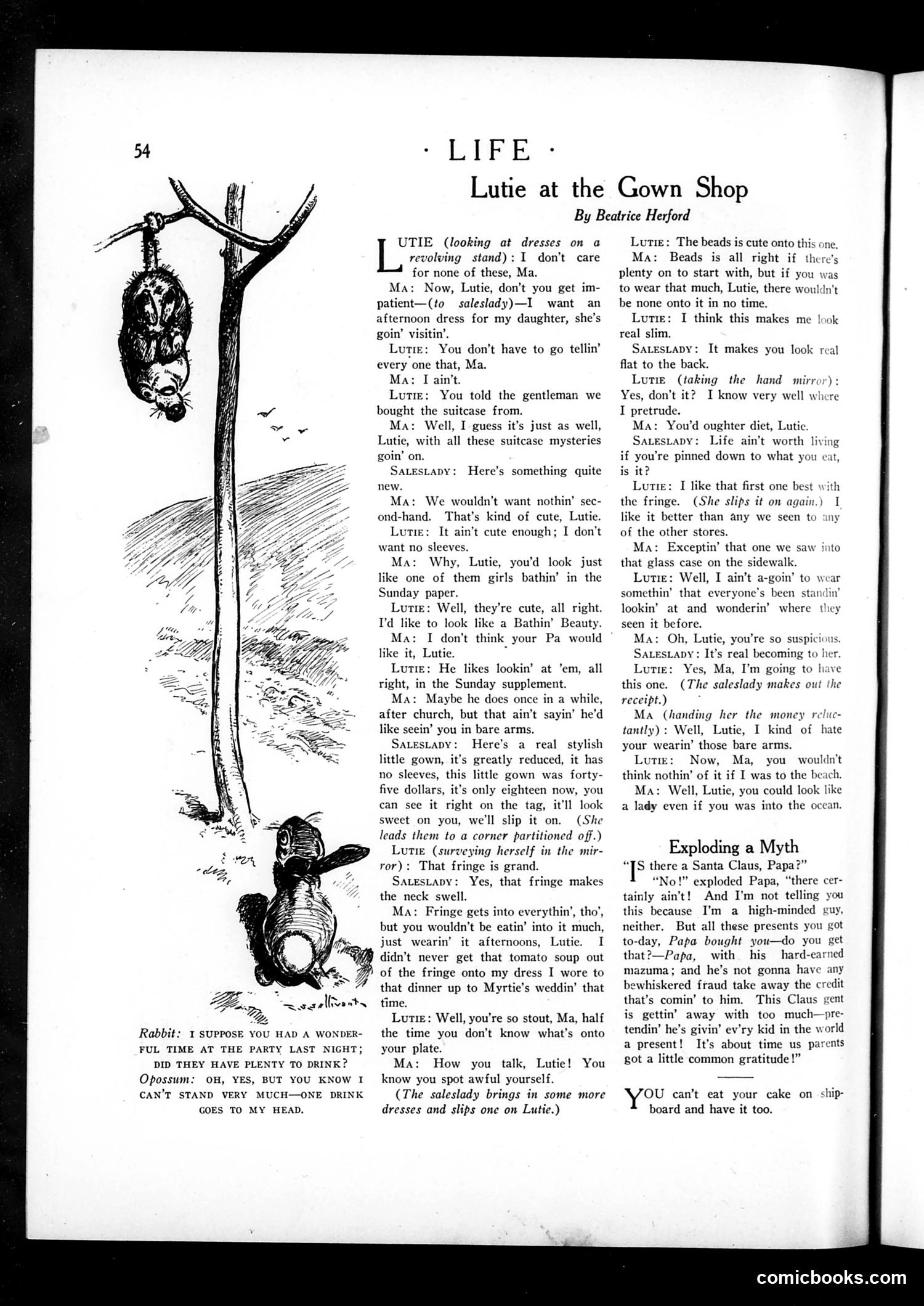
This page contains two satirical pieces from Life magazine: ## "Lutie at the Gown Shop" A humorous dialogue by Beatrice Herford depicting a mother-daughter shopping trip. The satire targets working-class speech patterns and vanity. "Lutie" wants a sleeveless dress (fashionable "bathing beauty" style), while her mother worries about propriety and practicality. The humor derives from malapropisms ("pretrude" for protrude), the mother's anxiety about what neighbors will think, and tensions between modern fashion and old-fashioned modesty. The saleslady enables the daughter's desires while the mother frets over cost and decorum—a generational clash typical of the era. ## "Exploding a Myth" A brief satirical piece debunking Santa Claus. A father explains to his child that *he* bought the presents, not Santa, because parents deserve credit—and gratitude—for their generosity rather than letting an imaginary figure receive the recognition. Both pieces mock middle-class anxieties and social pretensions through dialogue and character types common to Life's humor of this period.
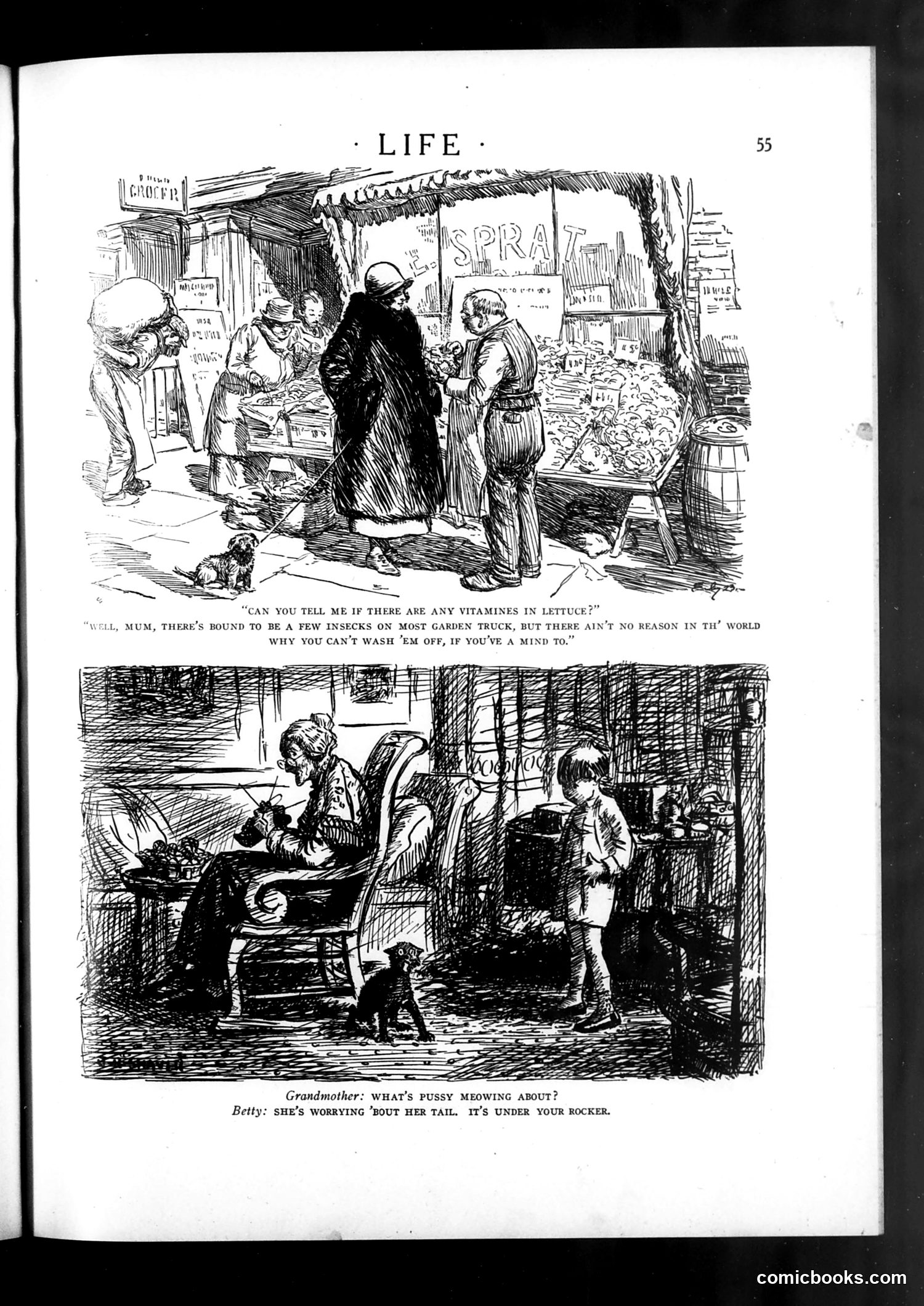
**Top cartoon:** A woman at a vegetable stand asks a vendor about vitamins in lettuce. The vendor's response—acknowledging insects but dismissing concerns—satirizes public anxiety about food safety and cleanliness during the early 20th century. The joke mocks both the questioner's newfound concern with "vitamines" (a newly-popular concept) and the vendor's casual indifference to produce quality. **Bottom cartoon:** A grandmother asks why a cat ("pussy") is meowing; her granddaughter explains the cat's tail is caught under the grandmother's rocking chair. This plays on generational disconnect—the elderly grandmother is unaware of her immediate surroundings, while the child must point out the obvious problem. Both cartoons use working-class dialect and domestic scenes to gently mock everyday human obliviousness and the era's emerging food-science anxieties.
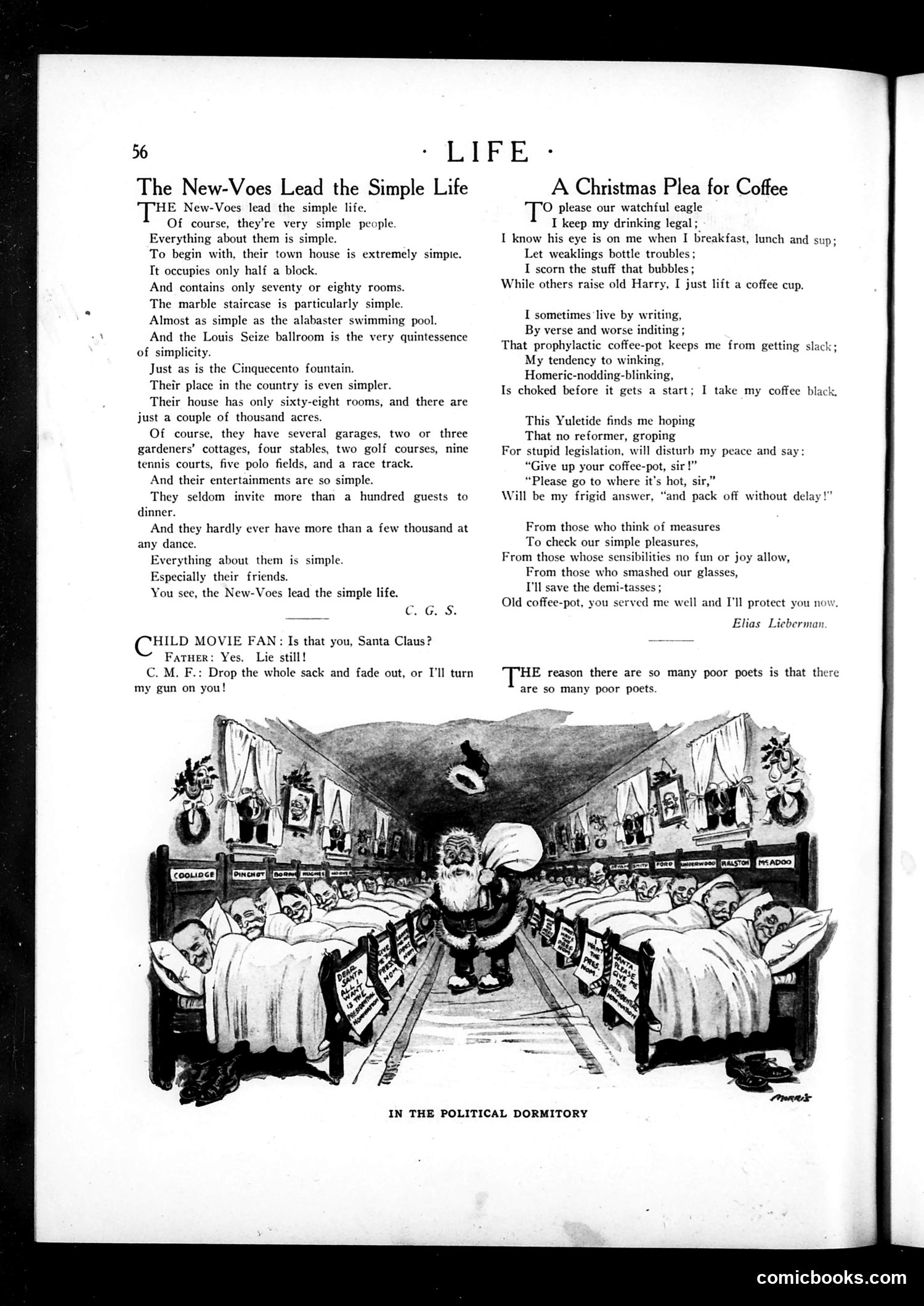
This is satire mocking wealthy Americans' self-deception about their opulence. The New-Voes (likely a fictional family name parodying the wealthy "Vanderbilt" class) claim to live a "simple life," but the text reveals absurd contradictions: their "simple" town house has 70-80 rooms; their country estate has 68 rooms plus thousands of acres, multiple golf courses, polo fields, and race tracks. The joke is ironic understatement—each boast of simplicity is immediately contradicted by examples of extravagant luxury, creating humorous tension. This reflects 1920s Progressive-era criticism of the ultra-wealthy's disconnect from ordinary Americans' reality. The political cartoon below shows Santa Claus in a dormitory full of beds, satirizing politicians as self-interested children. The page also includes "A Christmas Plea for Coffee," defending coffee-drinking against Prohibition reformers—referencing the contemporary Prohibition era (1920-1933) when alcohol was banned.
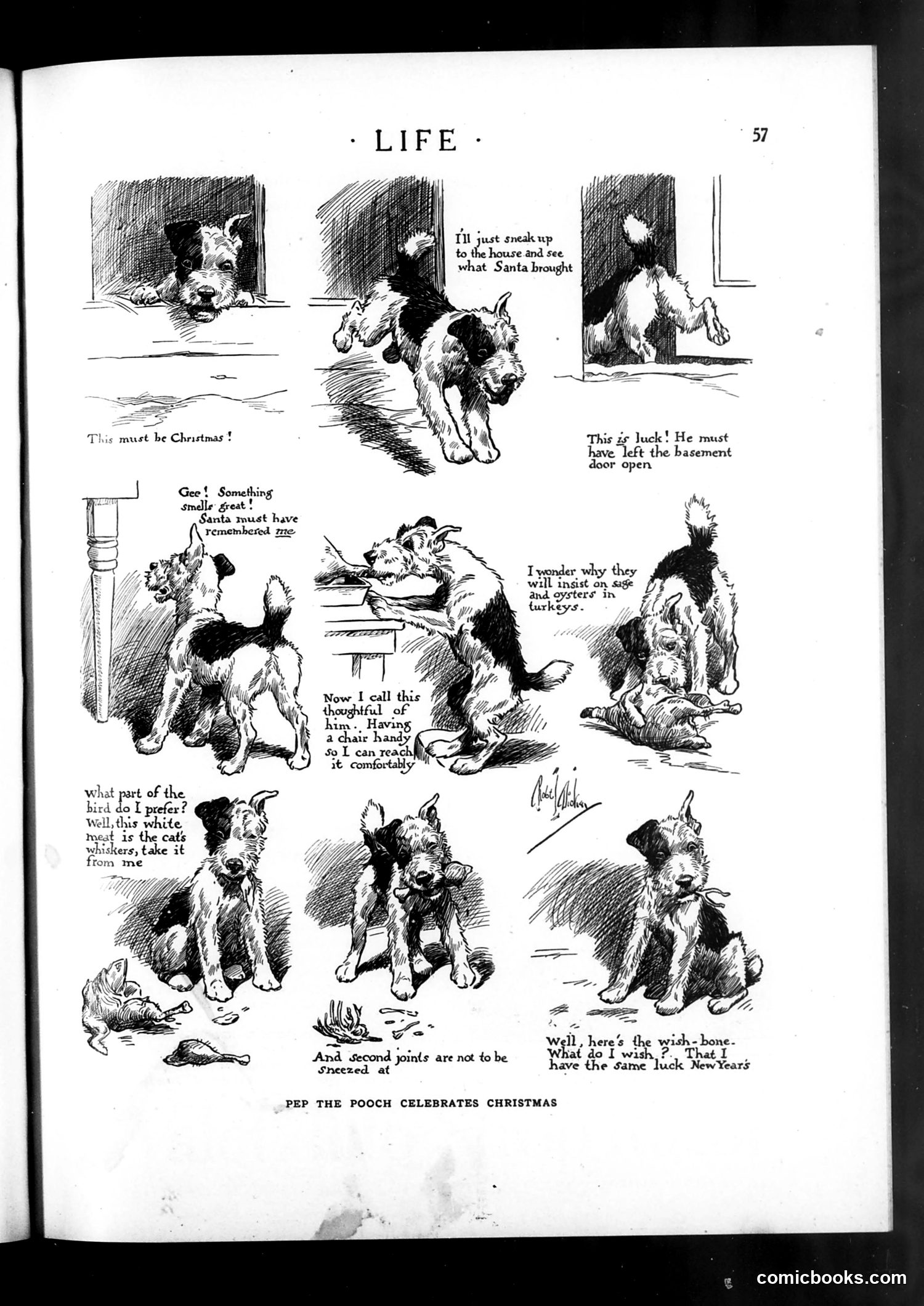
This is a humorous strip following a dog named Pep as he sneaks into a house on Christmas Eve, hoping to discover what Santa left. The joke centers on Pep's misinterpretation of Christmas gifts: he finds the holiday dinner preparations (a raw turkey or chicken) and assumes it's his present from Santa. Throughout the panels, Pep reacts with delight to various parts of the bird, using period slang like "cat's whiskers" (excellent). The satire gently mocks how pets might view human holiday traditions—Pep sees the festive meal as a wonderful gift meant for him, complete with thoughtful touches like a nearby chair to reach it from. The final panel shows Pep with the wish-bone, hoping for the same luck in the new year. It's straightforward pet humor typical of early 20th-century Life magazine comics, with no deeper political content.
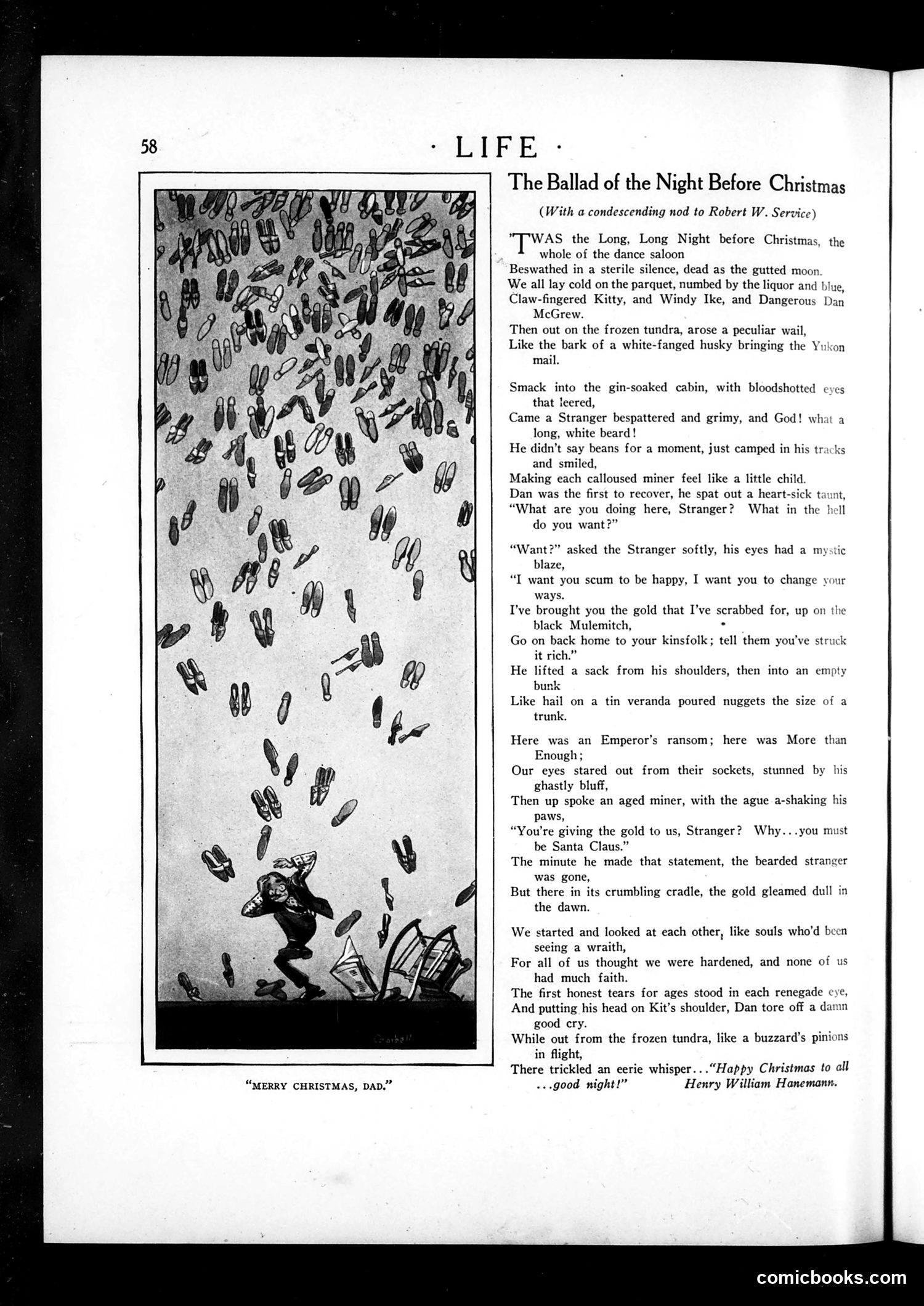
This is a parody of Robert W. Service's famous poem "The Shooting of Dan McGrew," transplanting its rough Yukon frontier setting into a Christmas miracle tale. The illustration shows footprints in snow converging on a figure—presumably Santa Claus arriving at a remote cabin. The satire works by subverting expectations: hardened, cynical miners in a "gin-soaked cabin" encounter a mysterious bearded stranger who distributes gold and urges moral reform. When one recognizes him as Santa Claus, he vanishes—leaving readers uncertain whether the gold was real or a shared hallucination born of faith and redemption. The poem mocks both Service's melodramatic style and sentimental Christmas narratives, while commenting on frontier toughness versus hidden human sentiment. The inscription "With a condescending nod to Robert W. Service" signals affectionate literary mockery.
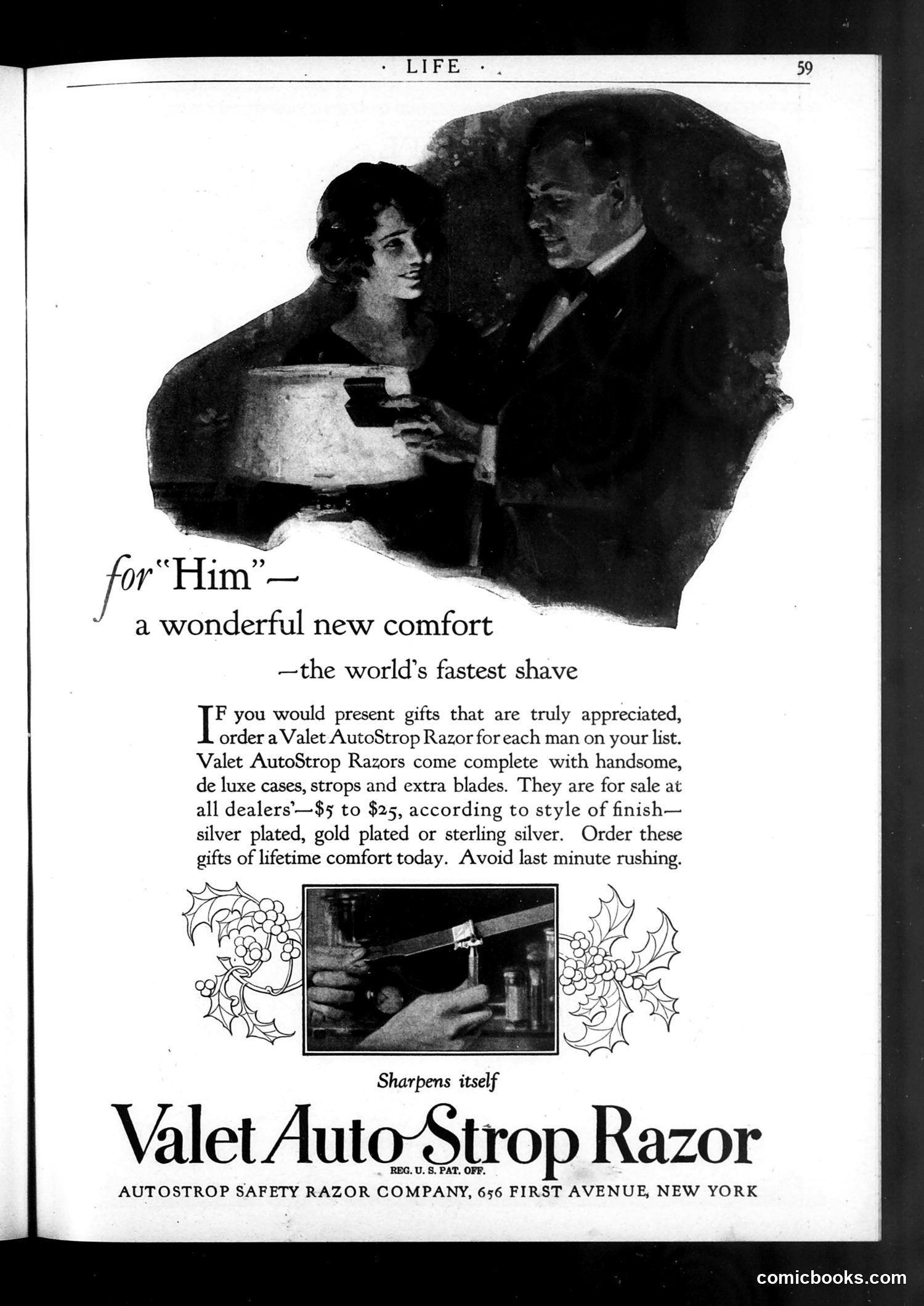
This is primarily a **product advertisement**, not political satire. The page promotes the Valet AutoStrop Razor, a safety razor that automatically sharpens itself. The image shows a man and woman in an intimate domestic scene—the woman presenting a wrapped gift (the razor) to a man. The advertisement uses this scenario to suggest the razor makes an ideal gift "for Him," emphasizing masculine comfort and convenience. The phrase "world's fastest shave" was the product's marketing claim. The ad positions AutoStrop razors as luxury items (priced $5–$25 in various finishes), encouraging holiday gift-giving with the tagline "gifts of lifetime comfort." The small illustration below demonstrates the self-sharpening mechanism. This is straightforward commercial advertising typical of *Life* magazine's content during the early 20th century.
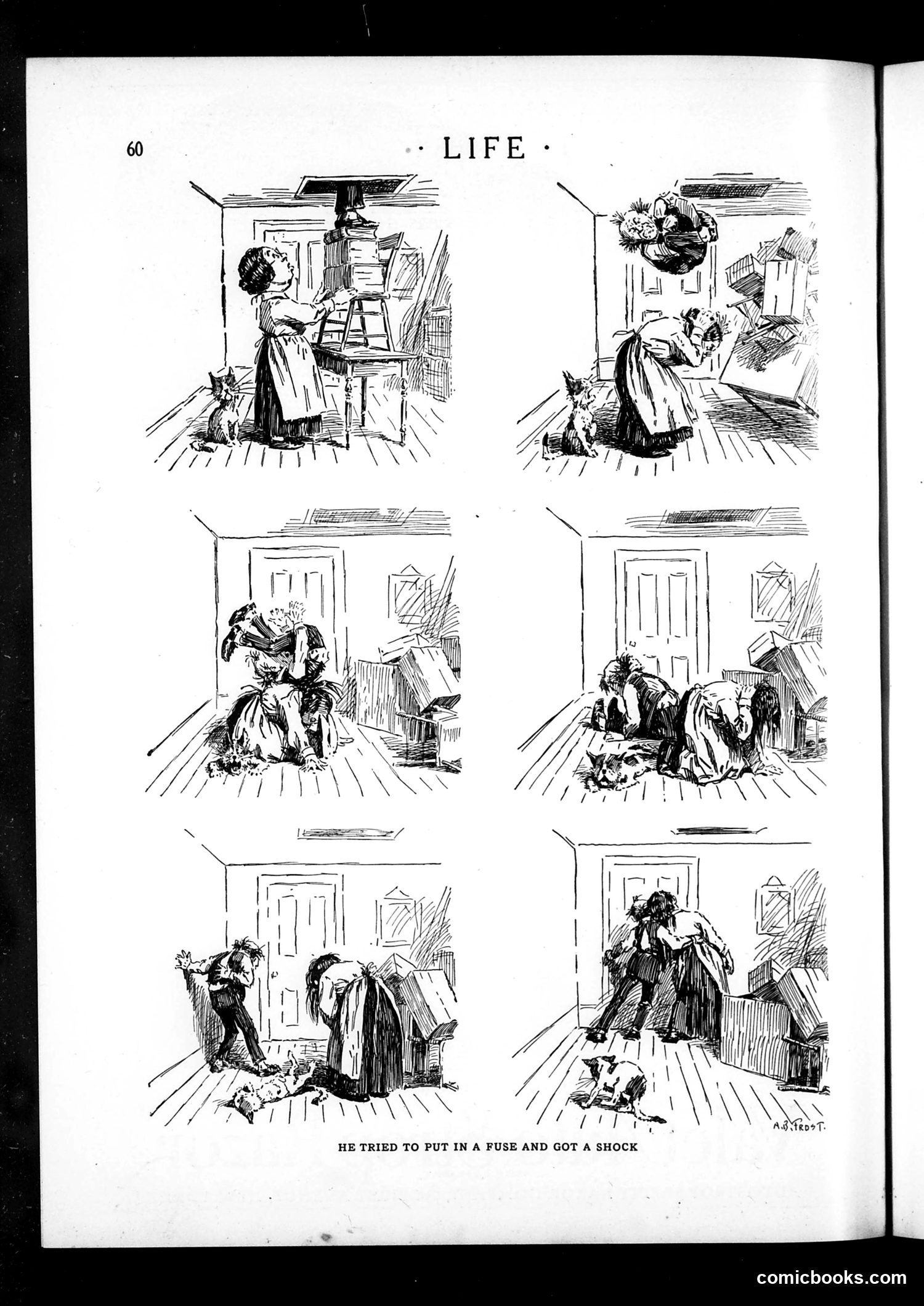
This six-panel domestic comedy strip depicts a man attempting to replace an electrical fuse in his home's fuse box, with increasingly chaotic results. The progression shows him getting progressively electrocuted—starting with a shock that throws him backward, then escalating to him being knocked down repeatedly as he struggles with the electrical panel. The humor derives from early 20th-century anxiety about household electricity—still a relatively new and poorly understood technology for many Americans. The joke plays on the common domestic mishap of getting shocked while handling electrical components, exaggerated for comedic effect. The strip satirizes male incompetence with modern home technology rather than any political figure or event. This reflects Life magazine's typical focus on domestic humor and everyday American life during this era.
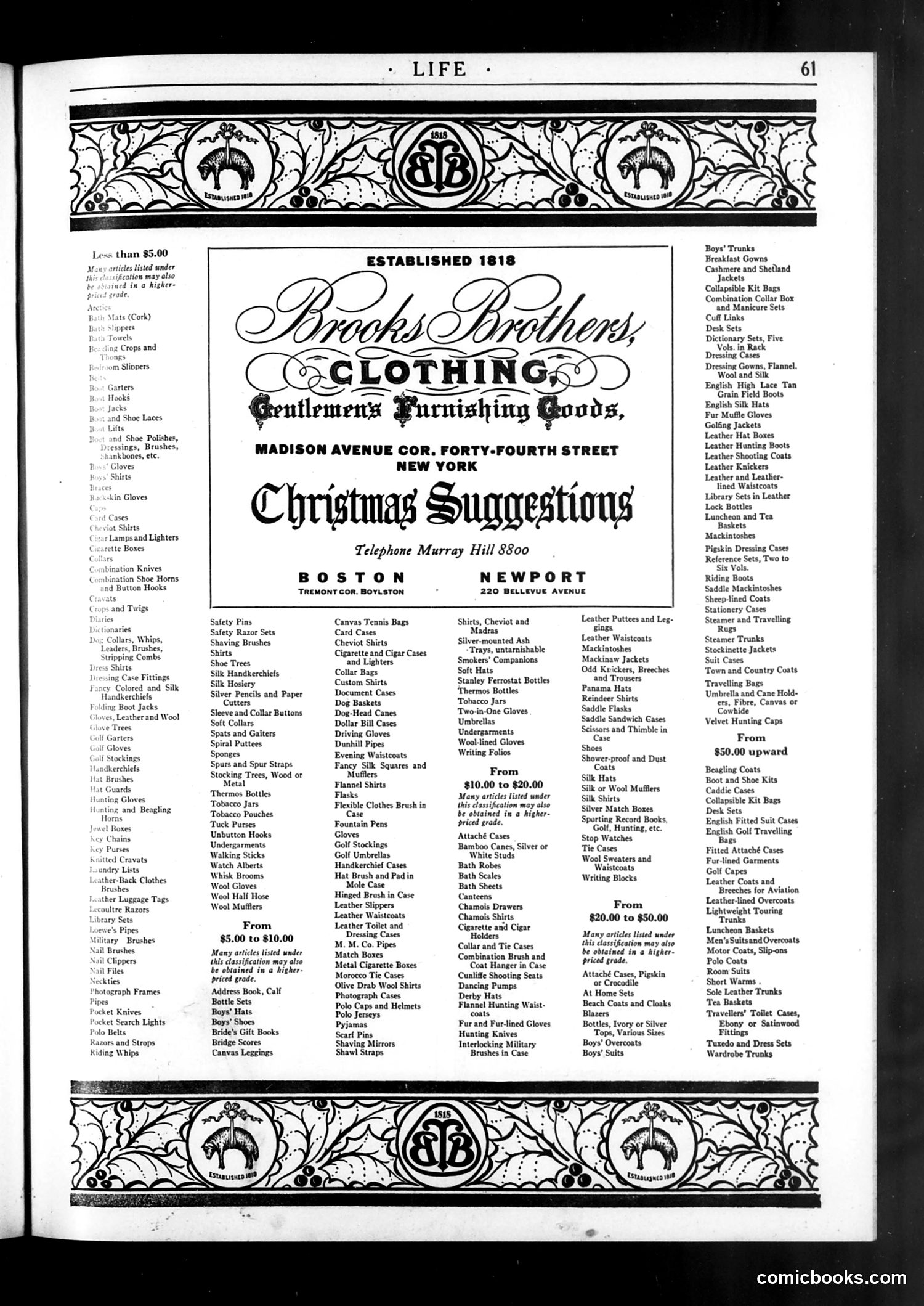
This is primarily a **Brooks Brothers advertisement**, not a cartoon or satirical content. The page displays a "Christmas Suggestions" gift catalog from the established menswear retailer (founded 1818), featuring locations in New York, Boston, and Newport. It lists hundreds of gentlemen's clothing and accessory items organized by price point: under $5.00, $5-10, $10-20, and $20-50+. The items reflect early 20th-century male fashion and lifestyle: dress shirts, ties, hunting gear, tobacco accessories, leather goods, sporting equipment, and personal grooming items. The extensive catalog suggests Brooks Brothers' positioning as a luxury merchant catering to wealthy, leisure-class men. There is **no political satire or cartoon content** on this page—it is a straightforward commercial advertisement designed to attract affluent holiday shoppers.
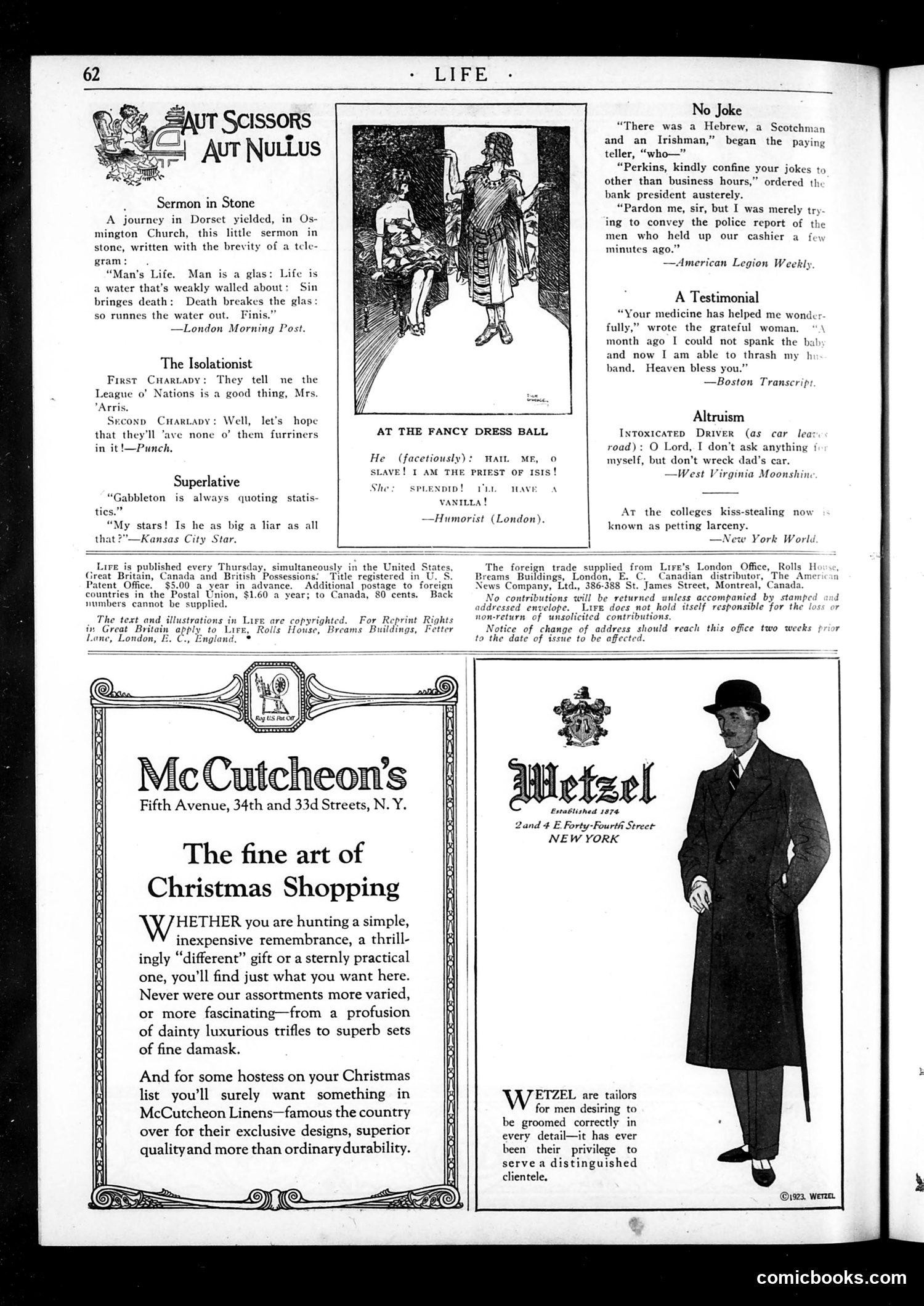
This page contains several brief humorous anecdotes typical of Life's satirical format, plus advertisements. **The cartoons/jokes satirize:** 1. **"The Isolationist"**: A dialogue mocking British reluctance to participate in the League of Nations—two working-class women express skepticism about foreign involvement, reflecting 1920s isolationist sentiment. 2. **"At the Fancy Dress Ball"**: A couple at a costume party; he claims to be "the priest of Isis" (an Egyptian deity), she responds that she has "splendid" vanilla—apparently a absurdist non-sequitur joke about costume pretension. 3. **Other brief jokes** target: statistic-spouting bores, ethnic joke-telling at work, a woman grateful medicine lets her "thrash" her husband (dark domestic humor), and a drunk driver's selfless prayer for his father's car. The page is primarily **advertising**—McCutcheon's department store and Wetzel tailors dominate the lower half. The content reflects early 1920s American attitudes: isolationism, class-based humor, casual ethnic stereotypes, and domestic violence as comedy.
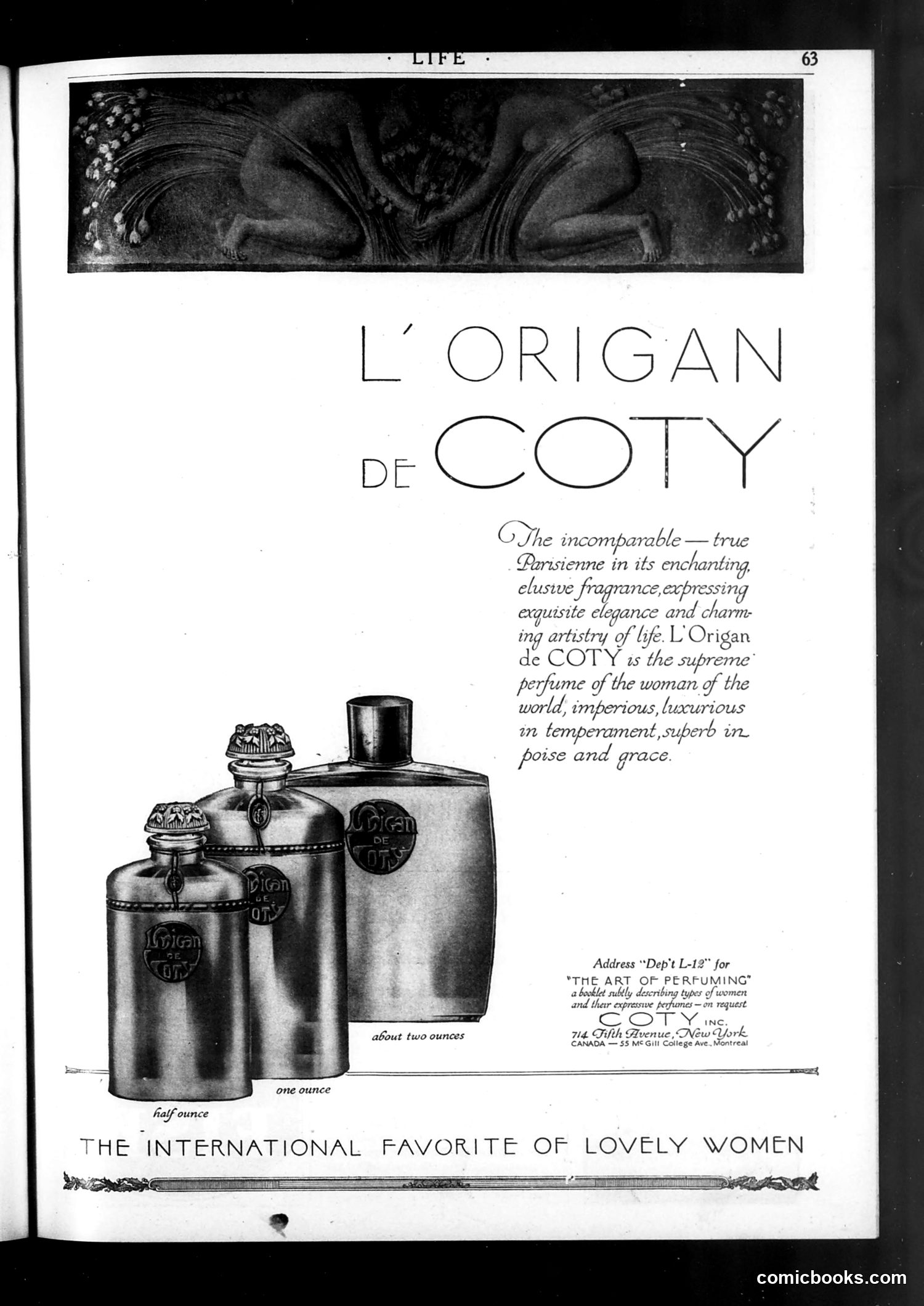
This is **not a cartoon or satire page**—it's a full-page perfume advertisement for "L'Origan de Coty," placed in Life magazine. The ad features three ornate perfume bottles of decreasing size (half-ounce, one ounce, and two ounces) with decorative stoppers. The accompanying text uses flowery, aspirational language typical of luxury goods marketing from this era, describing the perfume as "the supreme perfume of the woman of the world" and "the international favorite of lovely women." The ornamental relief sculpture at the top depicts classical figures, reinforcing the product's positioning as sophisticated and refined. The ad includes ordering information and promotes a supplementary booklet called "The Art of Perfuming." This represents straightforward early-20th-century perfume marketing, emphasizing elegance, exclusivity, and femininity—not political satire or social commentary.
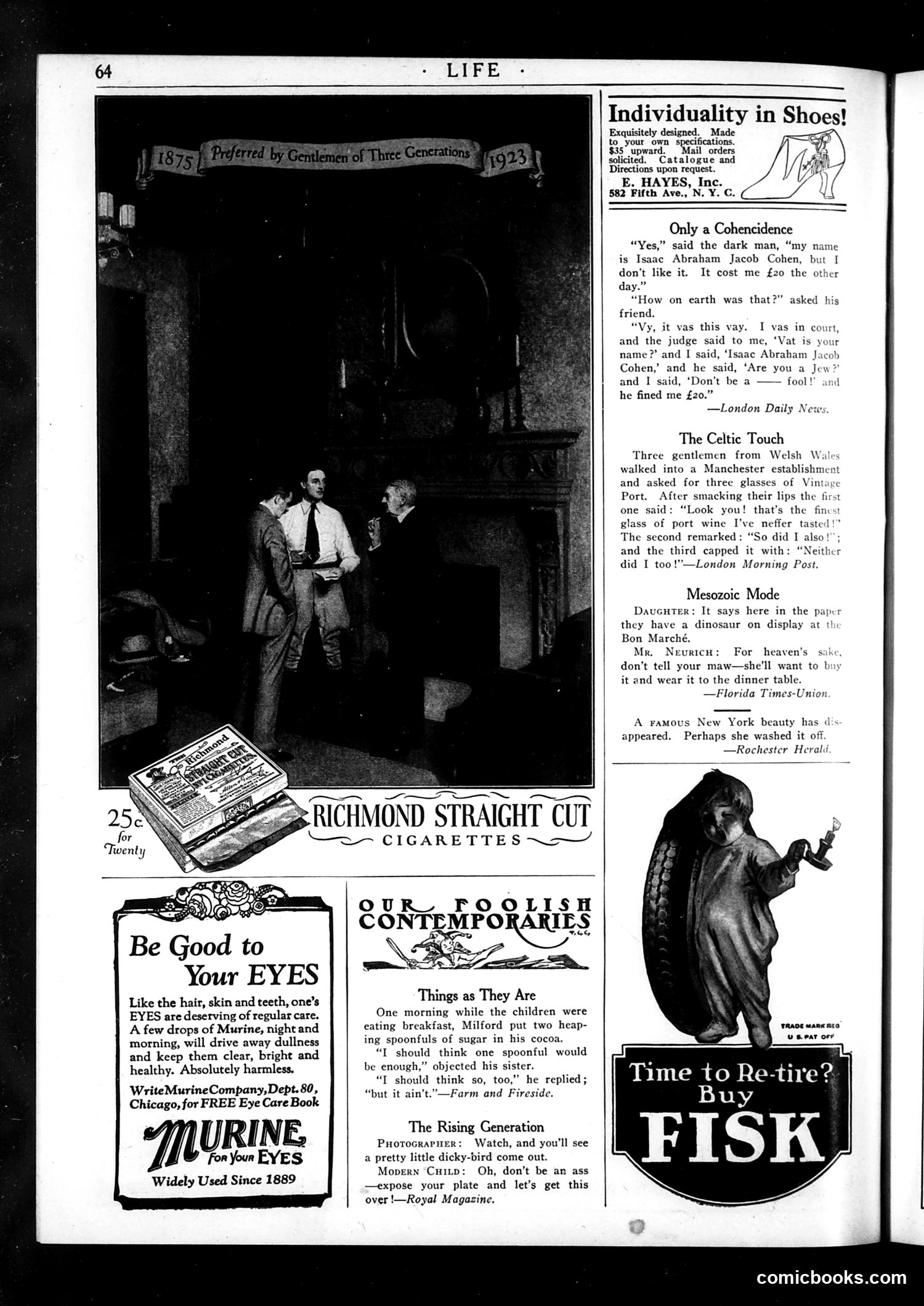
This page contains primarily **humorous anecdotes and advertisements** from early 20th-century Life magazine (dated 1875-1923 based on the masthead). The jokes reflect period attitudes and anxieties: **"Only a Coincidence"** plays on **anti-Semitic stereotypes**, mocking a Jewish man (Isaac Abraham Jacob Cohen) fined by a judge for having a Jewish name—the "humor" relies on portraying antisemitic discrimination as amusing coincidence. **"The Celtic Touch"** is a **ethnic stereotype joke** about Welsh men unable to distinguish quality port wine, suggesting they're unsophisticated drinkers. **"Mesozoic Mode"** jokes about a woman wanting to wear a dinosaur display piece as fashion—mocking women's supposedly frivolous consumer habits. **"Things as They Are"** depicts a child's stubbornness about sugar in cocoa, with mild domestic humor. The page is otherwise dominated by **period advertisements** for cigarettes (Richmond Straight Cut), eye drops (Murine), custom shoes, and Fisk tires. The cartoons and text together illustrate Life's formula: mixing ethnic/gender humor with product placement—reflecting early-20th-century commercial magazine culture and casual bigotry now considered offensive.
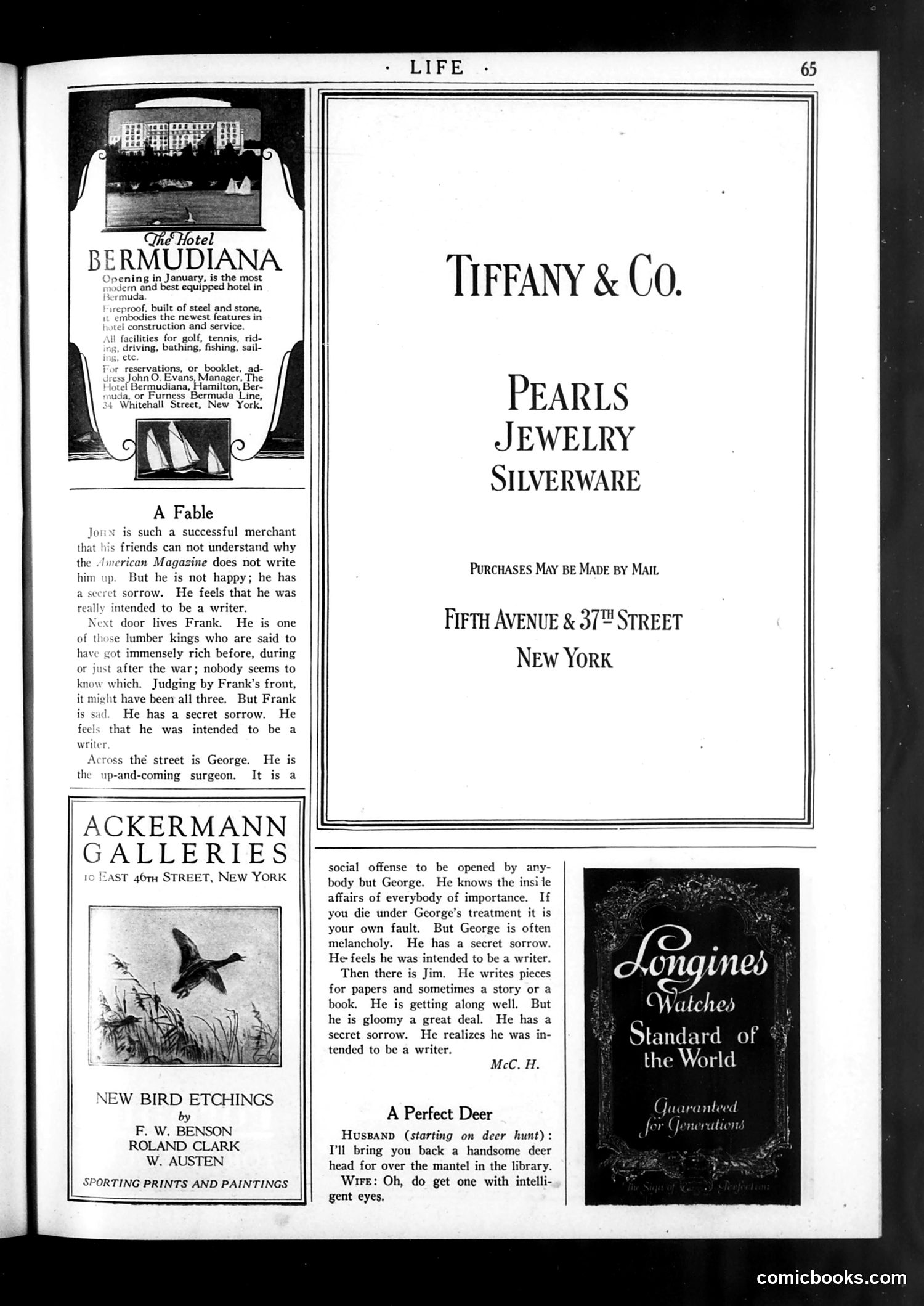
This satirical piece mocks a specific social type of the early 20th century: successful men plagued by unfulfilled artistic ambitions. The fable presents four characters—a wealthy merchant, a lumber magnate, an accomplished surgeon, and a working writer—who all share one thing: **secret sorrow that they were "intended to be a writer."** The joke is the ironic inversion: the actual writer (Jim) is also miserable, realizing he *was* meant to be one but still unhappy doing it. The satire targets the era's romanticization of "the writer" as a higher calling—suggesting that many successful men felt their real careers were somehow beneath their true talents. It's a gentle mockery of both unfulfilled ambition and the cultural assumption that writing was inherently more noble than business or medicine. The page is otherwise advertisements (Bermudiana hotel, Tiffany & Co., Ackermann Galleries).
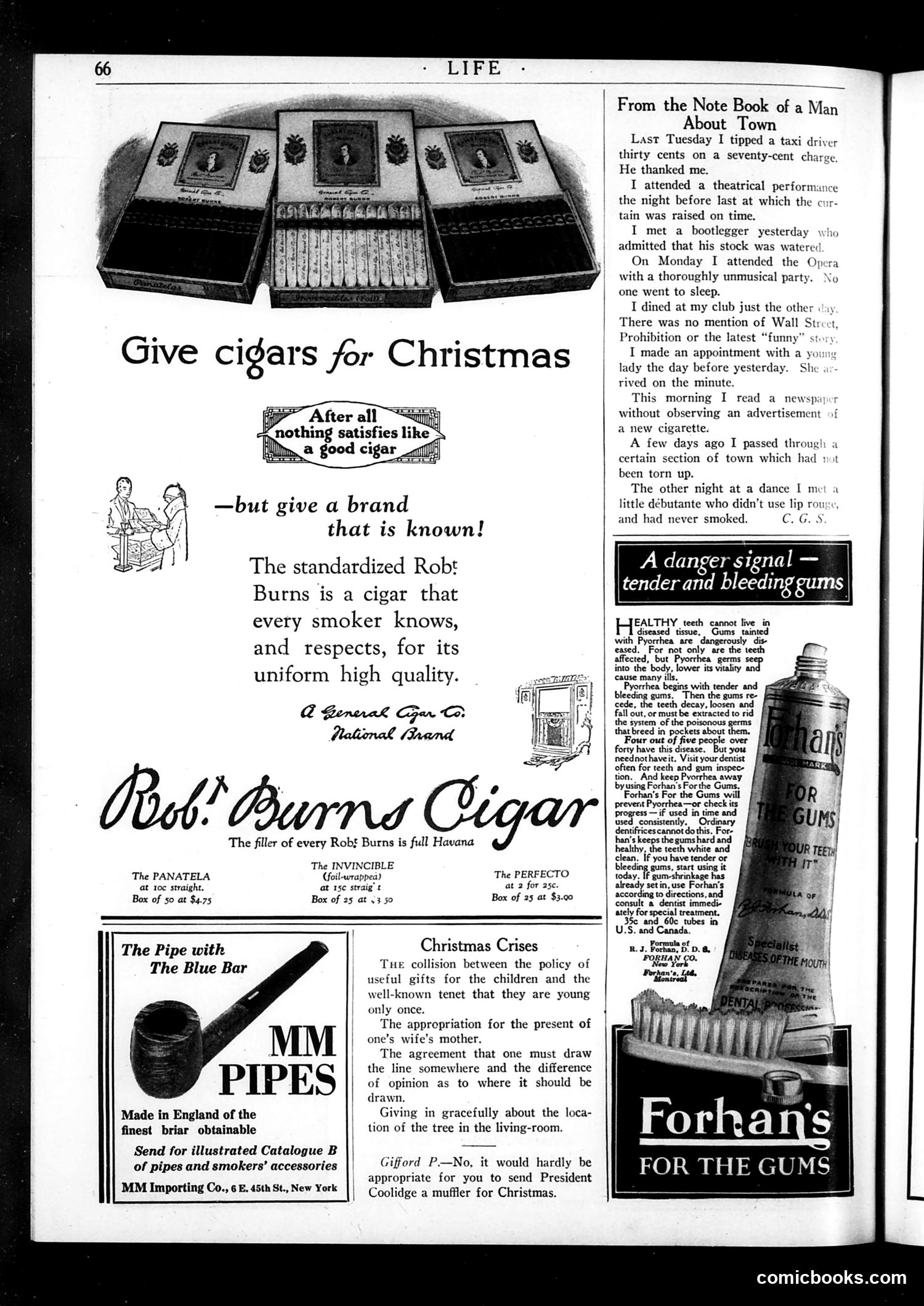
This page is primarily **advertising and humor columns**, not political satire. The main advertisements promote **Robt Burns cigars** and **MM pipes** — luxury gift items for Christmas shopping. The text emphasizes brand reliability and quality. The humor section titled **"Christmas Crises"** is a satirical list of holiday frustrations: conflicts between practical and indulgent gift-giving, disagreements about gift budgets for in-laws, and family arguments over Christmas tree placement. It's gentle social commentary on middle-class domestic tensions. **"From the Note Book of a Man About Town"** documents urban absurdities: a taxi driver admitting watered bootleg stock (referencing Prohibition-era hypocrisy), an opera performance where no one slept (unusual), and meeting a woman who never smoked (presented as remarkable). The **Forhan's toothpaste advertisement** warns against pyorrhea (gum disease), a common health concern of the era. A final joke suggests sending President Coolidge a muffler—a pun implying he should "muffle" his communication, likely referencing his reputation for taciturnity.
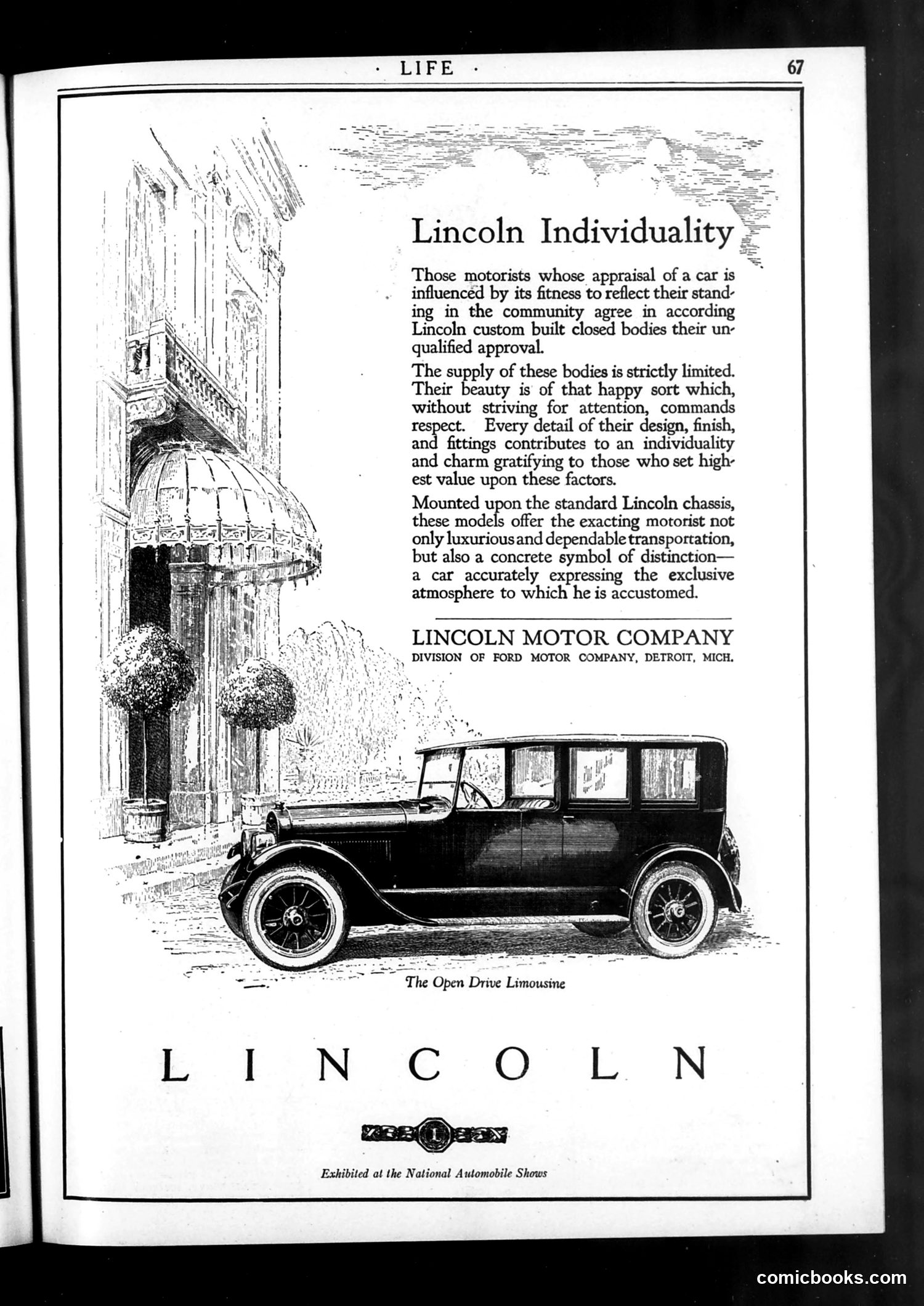
This is not satire—it's a straightforward automobile advertisement from *Life* magazine's advertising pages. It promotes Lincoln Motor Company's custom-built cars to wealthy buyers. The ad appeals to status-conscious motorists by emphasizing that a Lincoln isn't merely transportation but a "concrete symbol of distinction" reflecting one's social standing. The accompanying illustration shows an elegant "Open Drive Limousine" parked before a mansion, reinforcing the luxury market positioning. The language—"exclusive atmosphere," "individuality and charm," "those who set highest value"—targets affluent readers who see cars as markers of social class. Lincoln, as a Ford Motor Company division, positioned itself as the premium alternative to mass-market vehicles, offering limited-supply custom bodies to distinguish owners within their community. This represents early 20th-century automotive marketing that equated car ownership with personal status and refined taste.
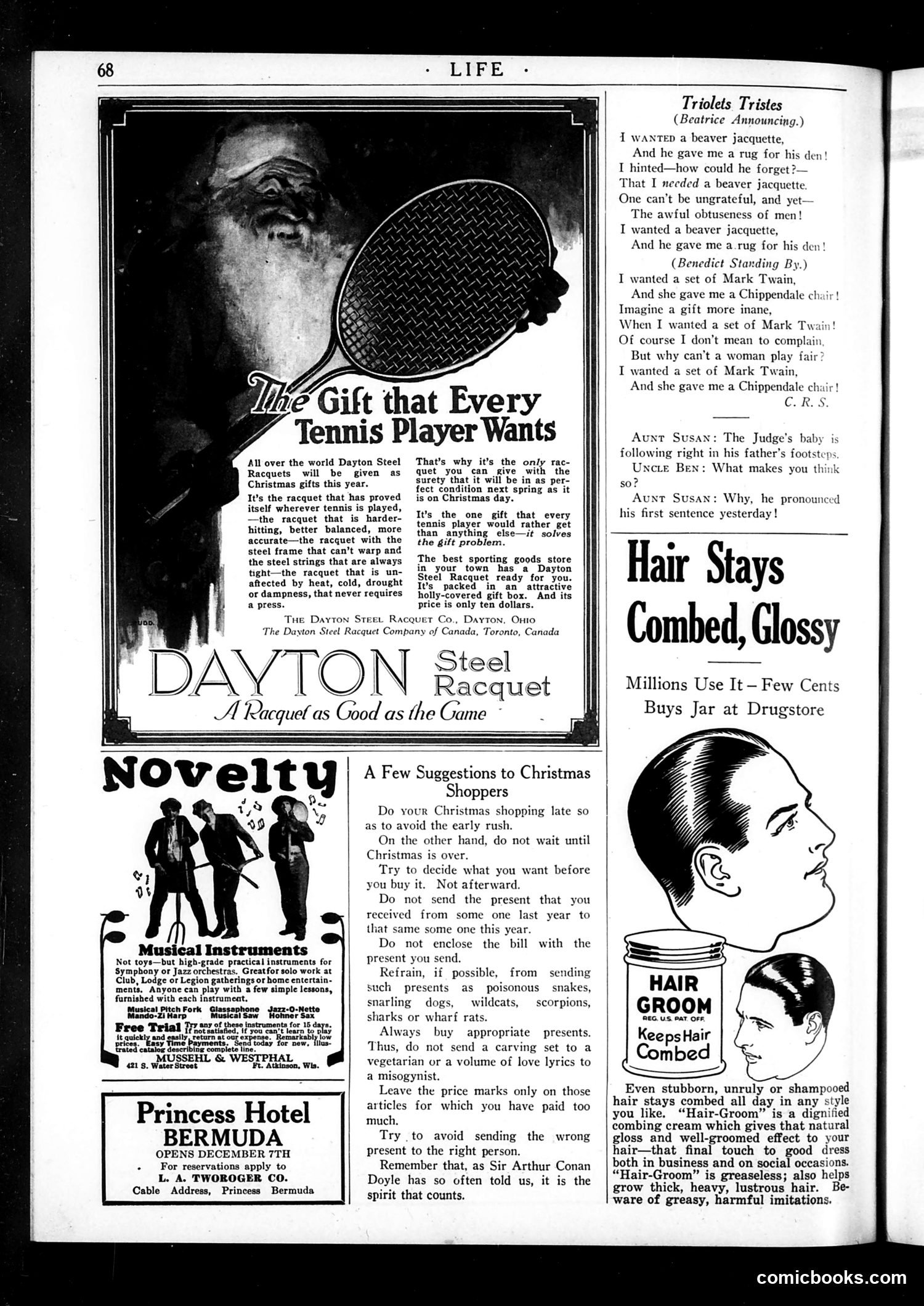
This Life magazine page (circa 1920s) contains mostly **advertisements and light humor**, not political satire. The main ad promotes **Dayton Steel Tennis Racquets** as the ideal Christmas gift—emphasizing durability and reliability. Tennis was a fashionable leisure activity for the affluent in this era. The **"Triolets Tristes"** poems humorously depict gift-giving disappointment between couples: a woman wanted a beaver jacket but received a den rug; a man wanted Mark Twain books but got a Chippendale chair. The satire targets **marital miscommunication**—spouses giving practical or decorative gifts when partners wanted specific items they'd hinted at. A brief joke plays on the word "sentences"—the Judge's baby imitated his father by pronouncing his "first sentence" (legal ruling), not literal speech. The **"Hair Stays Combed"** ad and other advertisements promote grooming products. The "Christmas Shopper" advice column offers practical, slightly comic guidance about gift selection—avoiding sending live dangerous animals or inappropriate books, for instance. The page is primarily **consumer-focused content**, reflecting 1920s middle-class concerns about proper gift-giving etiquette and personal grooming.
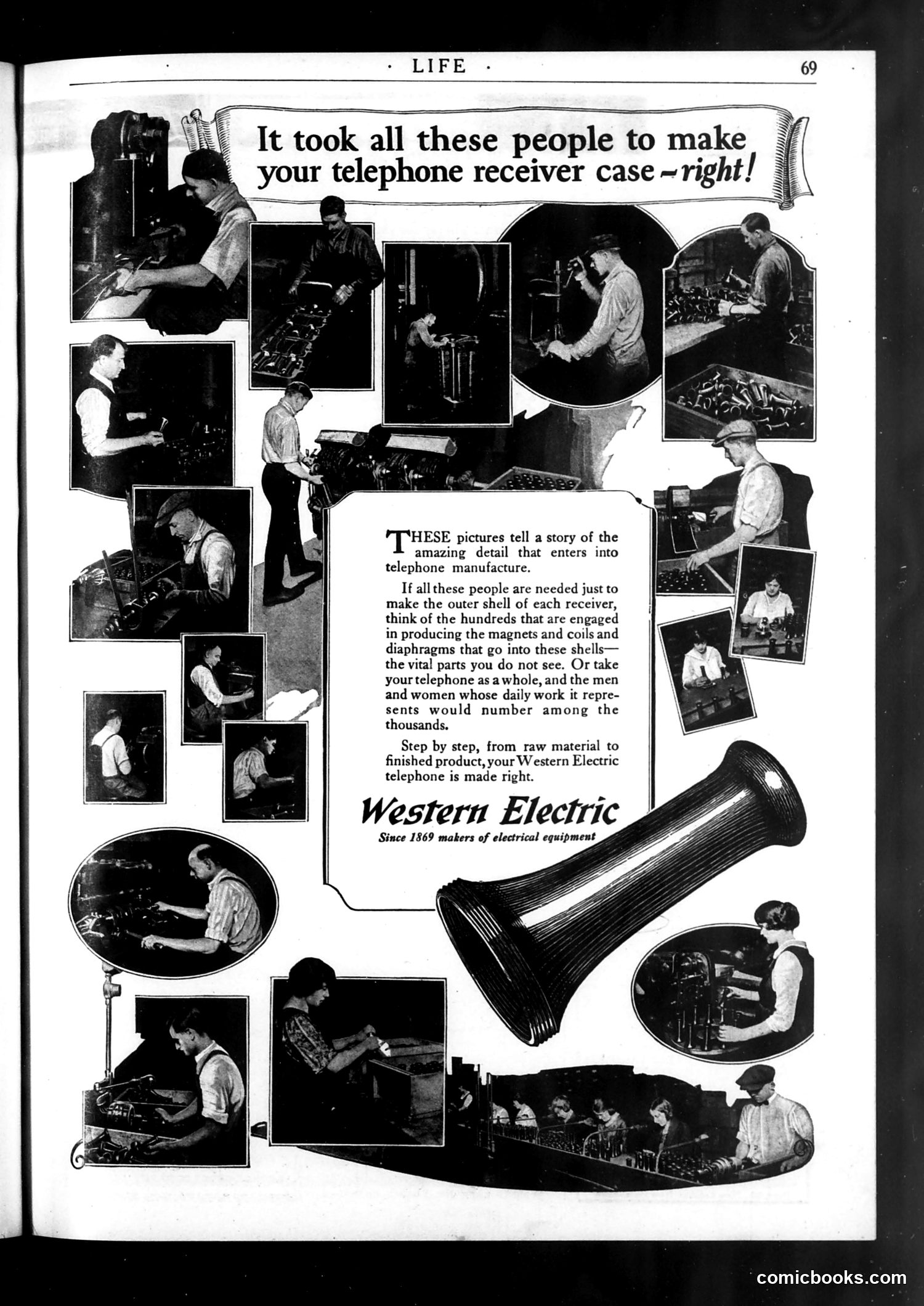
This is **not satire or a cartoon**, but rather **corporate advertising** for Western Electric Manufacturing Company. The page uses multiple photographs of factory workers performing different manufacturing tasks to showcase the complexity of telephone receiver production. The message celebrates industrial labor and manufacturing precision: even just the outer "case" of a receiver requires many skilled workers, implying the finished product represents hundreds or thousands of person-hours. The central image is an actual telephone receiver, positioned like a trophy. The headline and accompanying text serve as promotional copy emphasizing quality and craftsmanship—a common marketing strategy of the era to build consumer confidence in manufactured goods. This represents **industrial-age boosterism**, presenting factory work as dignified and the modern corporation as impressively organized. There is no satire intended; rather, it's genuine advertising celebrating American manufacturing capability.
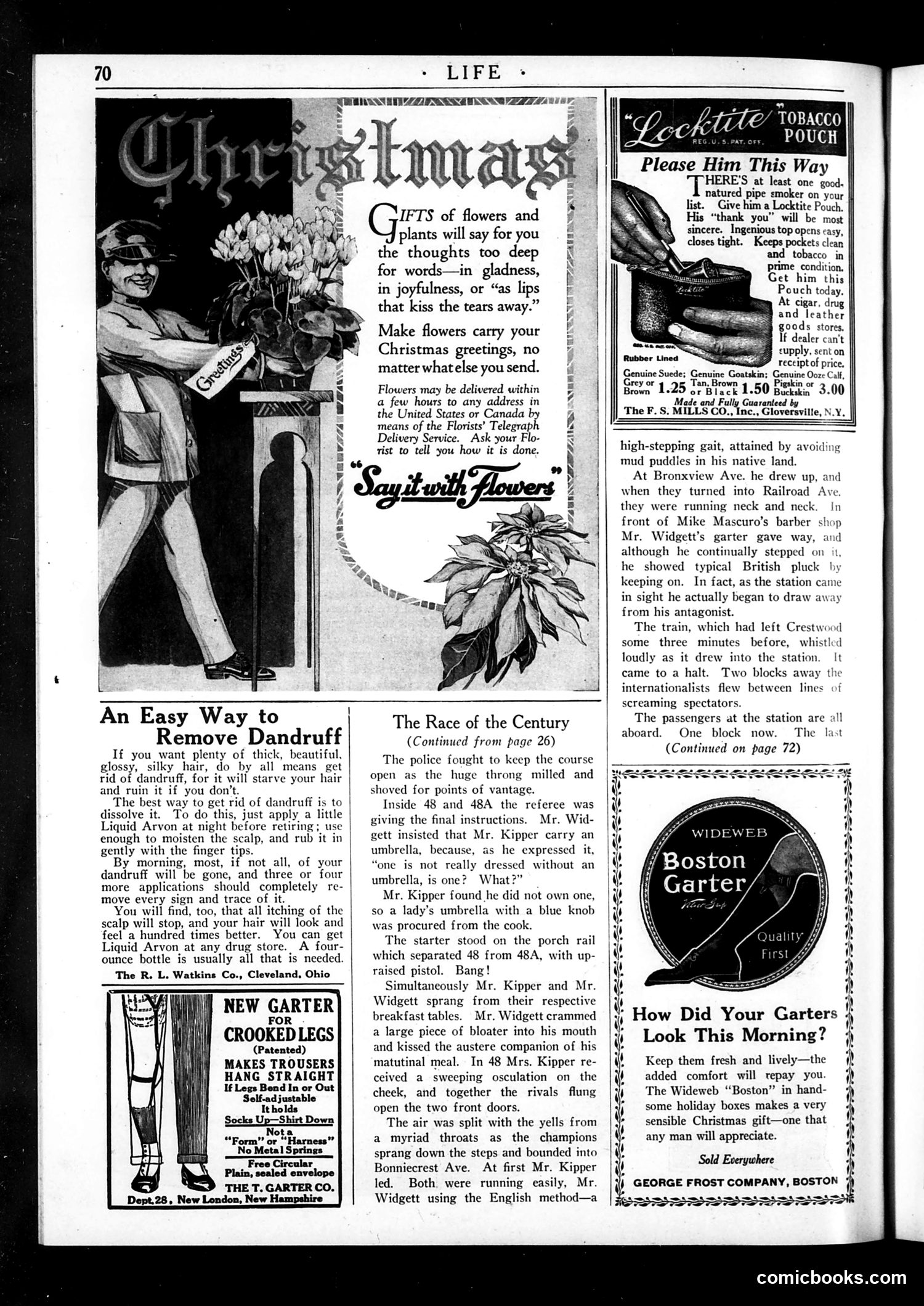
This page from *Life* magazine is primarily **advertising and serialized fiction**, not political satire. The main content is "The Race of the Century," a humorous serialized story about two neighbors—Mr. Widgett (British, fussy about etiquette) and Mr. Kipper—competing in a comedic race from their homes. The joke relies on class humor: Widgett insists on carrying an umbrella because one "is not really dressed without an umbrella," embodying British social pretension. The narrative contrasts Widgett's fussiness with Kipper's practicality (he doesn't own an umbrella and borrows a lady's one). The other content consists of **period advertisements**: dandruff removal, garters (for holding up socks/shirts), a tobacco pouch, flowers via telegraph, and Boston garters. These ads reflect early 20th-century concerns and products now obsolete. There is no political cartoon on this page—just consumer advertising and light satirical fiction poking fun at British social conventions and masculine vanity, typical of *Life's* humor during this era.
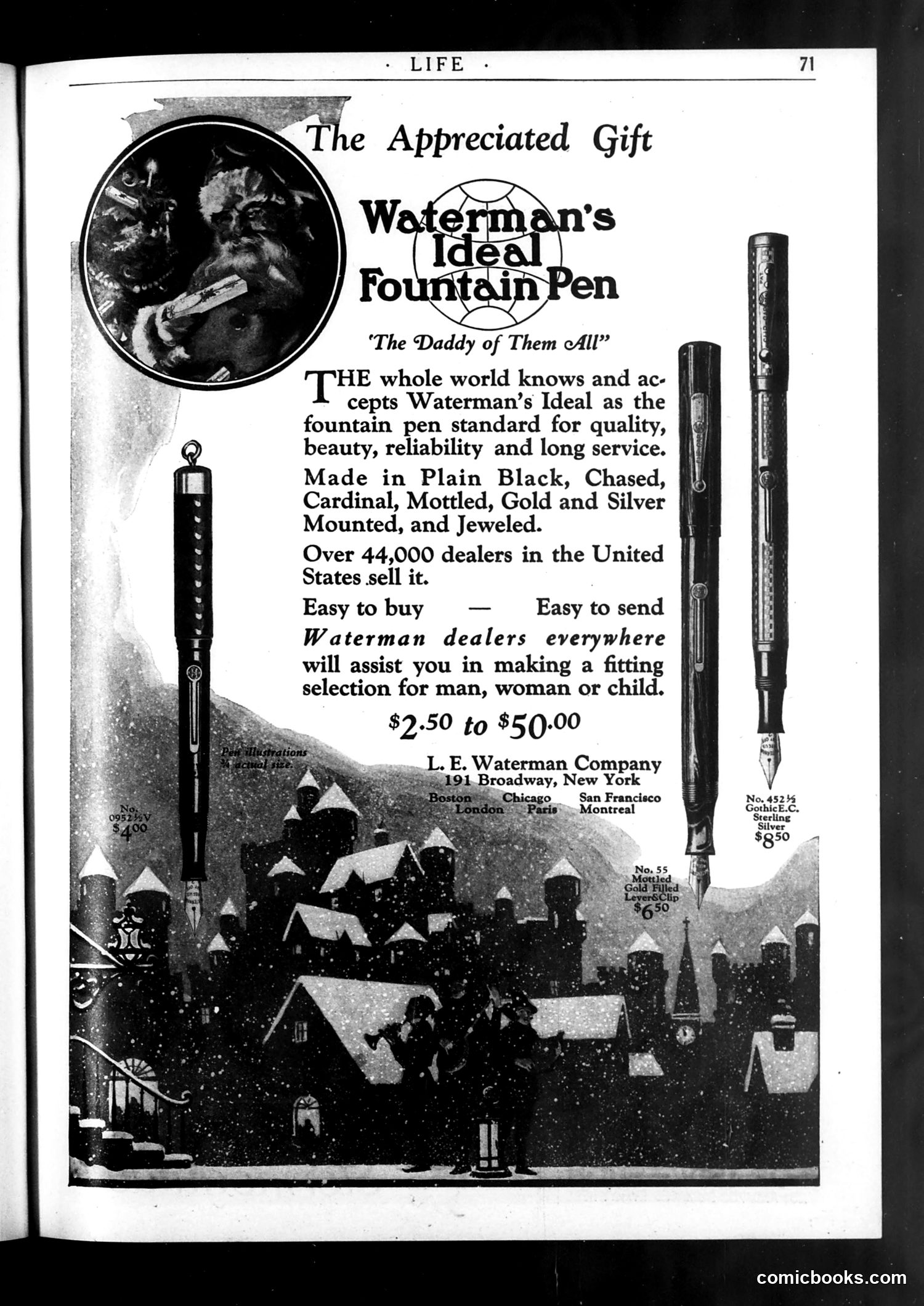
This page is primarily a **Waterman's fountain pen advertisement**, not a political cartoon. The ad features a circular portrait (upper left) of what appears to be a bearded man, likely the product's founder or namesake, positioned above an illustrated winter village scene with snow-covered houses and church spires. The text emphasizes Waterman's Ideal as the market-leading fountain pen—marketed as "The Daddy of Them All"—claiming 44,000 U.S. dealers and positioning it as an ideal gift across price points ($2.50–$50.00). The advertisement highlights quality, reliability, and availability through Waterman dealers nationwide. There is **no satire or political messaging** visible. This is straightforward commercial advertising from Life magazine's back pages, typical of early 20th-century publications that relied heavily on paid advertisements.
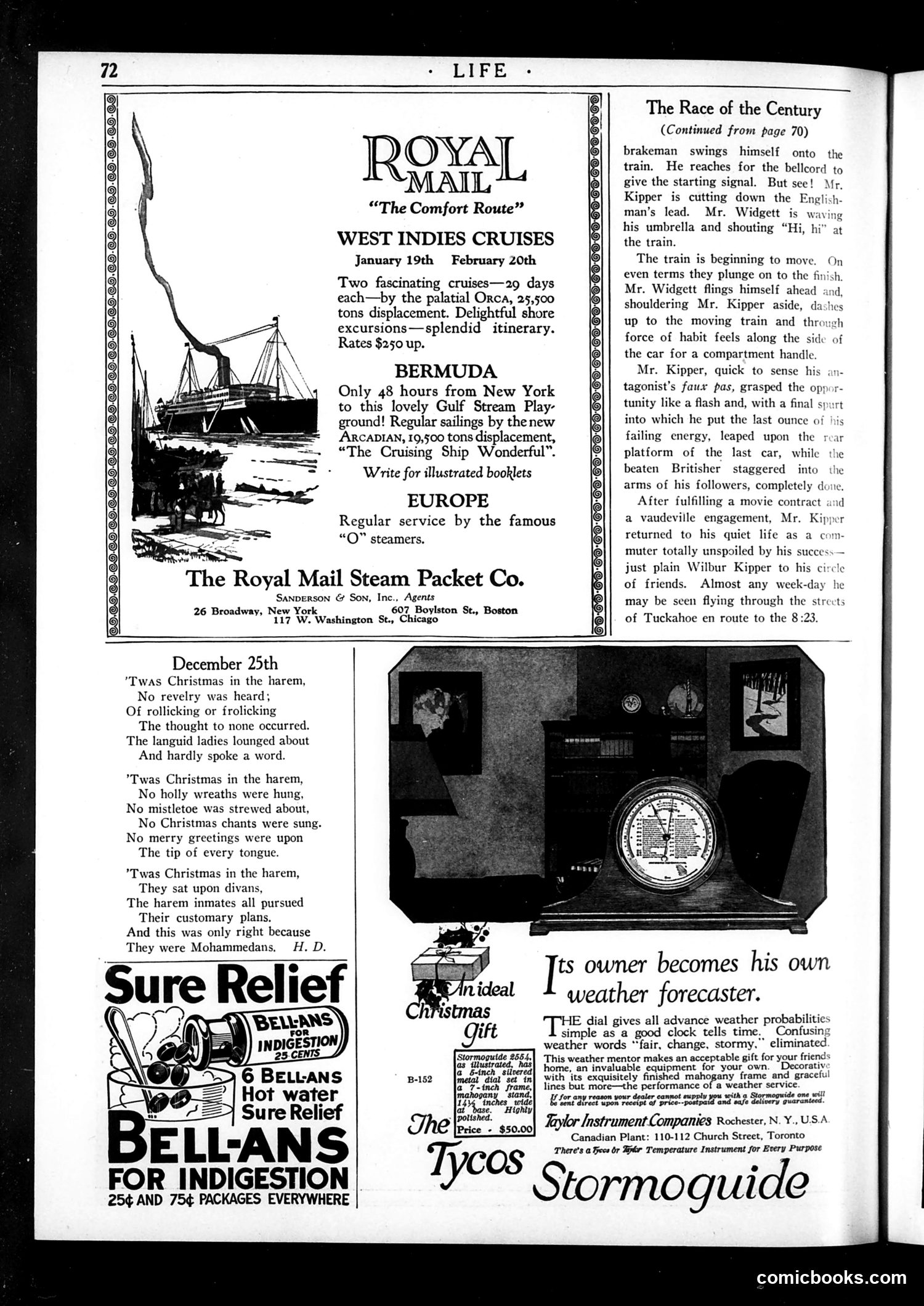
This page mixes advertisements with serialized fiction and period commentary. The main content is "The Race of the Century" (continued from page 70), describing a competitive race between two men—Mr. Kipper and Mr. Widgett—to board a moving train. Kipper ultimately wins by using his momentum to leap onto the platform while Widgett, attempting to follow proper etiquette by feeling for a compartment handle along the car's side, loses the race. The narrative concludes with Kipper returning to his ordinary commuter life in Tuckahoe. The page also includes a poem titled "December 25th," offering social commentary: it notes that Christmas celebrations in a harem were absent because the inhabitants were Muslim and therefore didn't observe Christian holidays. This reflects early 20th-century attitudes toward religious difference. The advertisements promote cruise ships, a weather-forecasting barometer, and Bellans indigestion relief—typical period marketing.
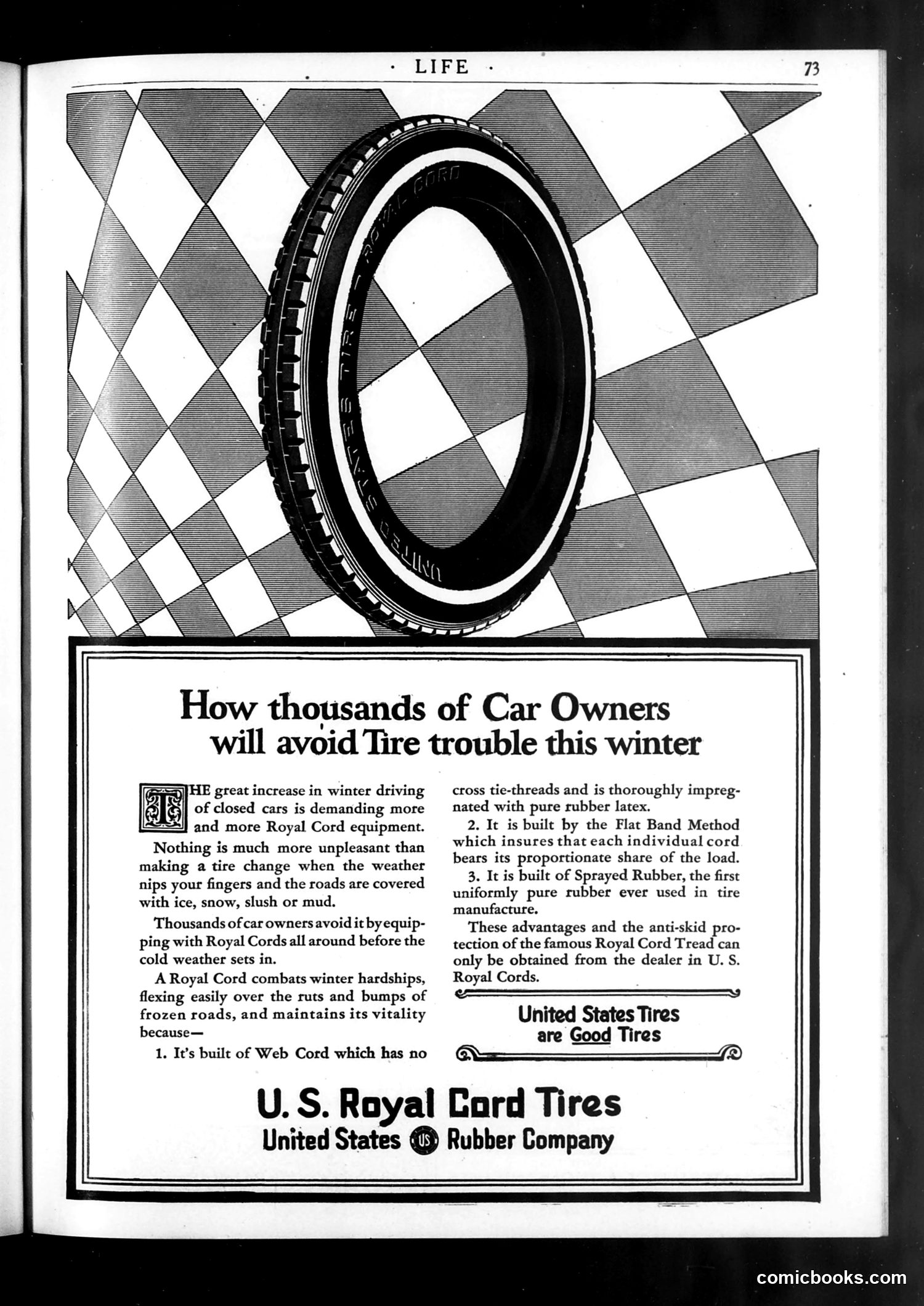
This is **not a cartoon or satire**—it's a straightforward advertisement for U.S. Royal Cord Tires, published in *Life* magazine (which contained both humor and ads). The page features a large illustration of a tire against a geometric diamond-patterned background, designed to catch readers' attention. The ad addresses a genuine practical concern: winter tire failures were common and dangerous in the early automotive era, and changing a tire in freezing conditions was genuinely unpleasant. The advertisement sells Royal Cord tires by highlighting three technical advantages (Web Cord construction, Flat Band Method manufacturing, and Sprayed Rubber composition) as solutions to winter driving problems—flexing over frozen roads while maintaining durability. This reflects the era when tire quality directly affected safety and reliability, making tire brand loyalty a significant consumer decision.
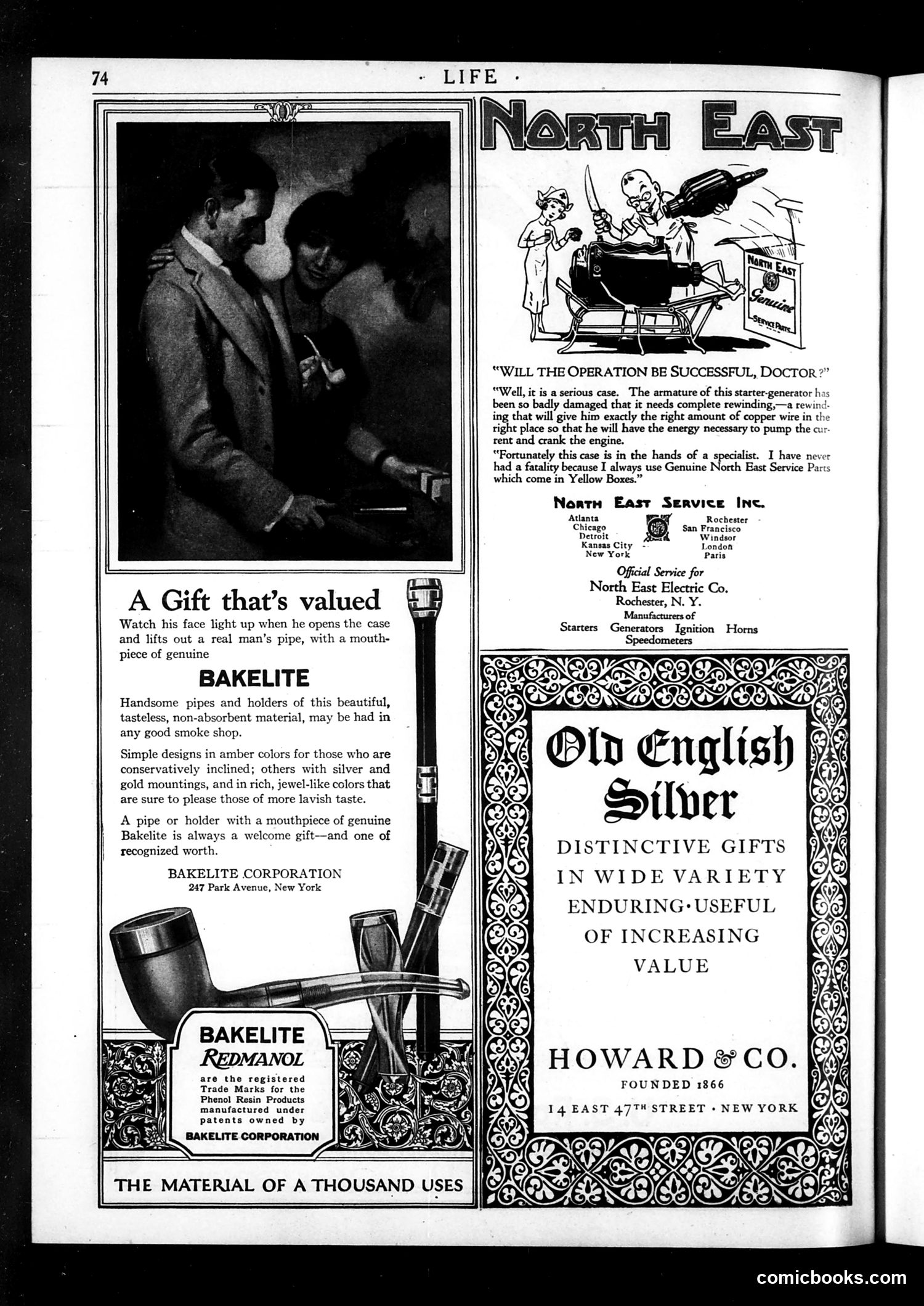
This page consists entirely of **advertisements**, not editorial cartoons or satire. The top-left features a **Bakelite Corporation ad** promoting pipe holders made from their synthetic plastic material—positioning it as a prestigious gift for male smokers. The image shows a man examining a pipe case. The right side contains two ads: a **North East Service Inc.** advertisement uses a humorous "doctor and patient" scenario to pitch automotive electrical parts (starters, generators), with the "patient" being a damaged engine starter. The doctor endorses using their genuine parts in yellow boxes. Below that, **Howard & Co.** advertises Old English Silver goods as luxury gift items. These ads reflect early-20th-century consumer marketing: synthetic materials like Bakelite were novel and promoted as modern; automotive parts advertising was growing; and silver gifts targeted affluent customers. The "doctor" scenario in the North East ad is the closest to humor—using medical language metaphorically for mechanical repair.
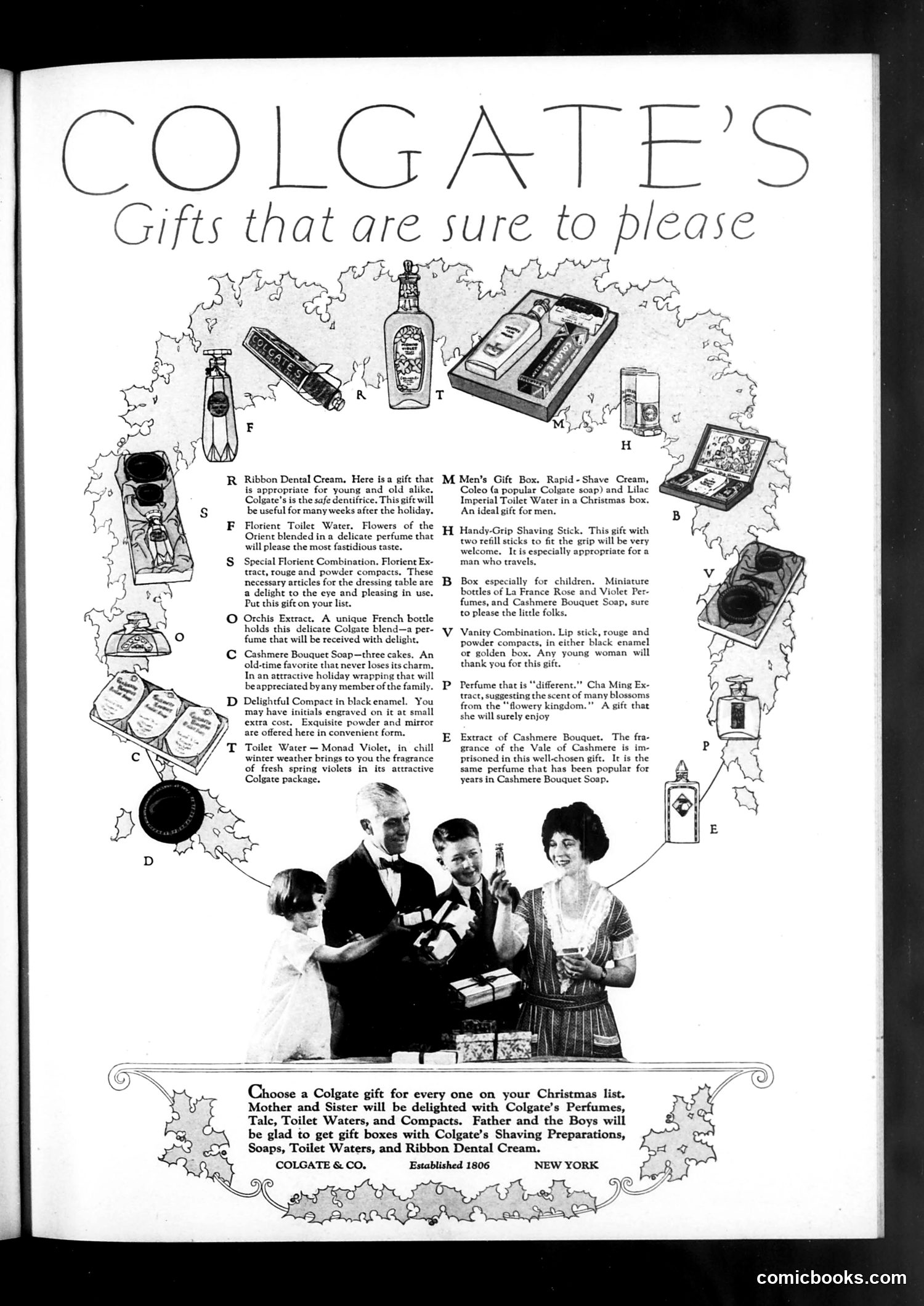
This is a vintage **product advertisement**, not political satire. It promotes Colgate toiletries and cosmetics as Christmas gifts for the 1920s era. The page uses a map of Italy as a decorative frame, positioning different products around it with letter labels (A-P). At the bottom, four illustrated figures—representing a family (woman, older man, younger man, woman)—examine gift boxes, embodying the ideal consumers. The copy appeals to gender stereotypes of the period: women receive perfumes, powders, and compacts; men get shaving creams and dental products. Products have exotic names ("Orchis Extract," "Cha Ming Extract") suggesting luxury and travel. The "different" approach here isn't satirical but *aspirational*—positioning affordable Colgate products as sophisticated, travel-inspired gifts suitable for any family member. This reflects early-20th-century marketing's shift toward presenting personal hygiene and cosmetics as tasteful, necessary luxuries rather than frivolities.
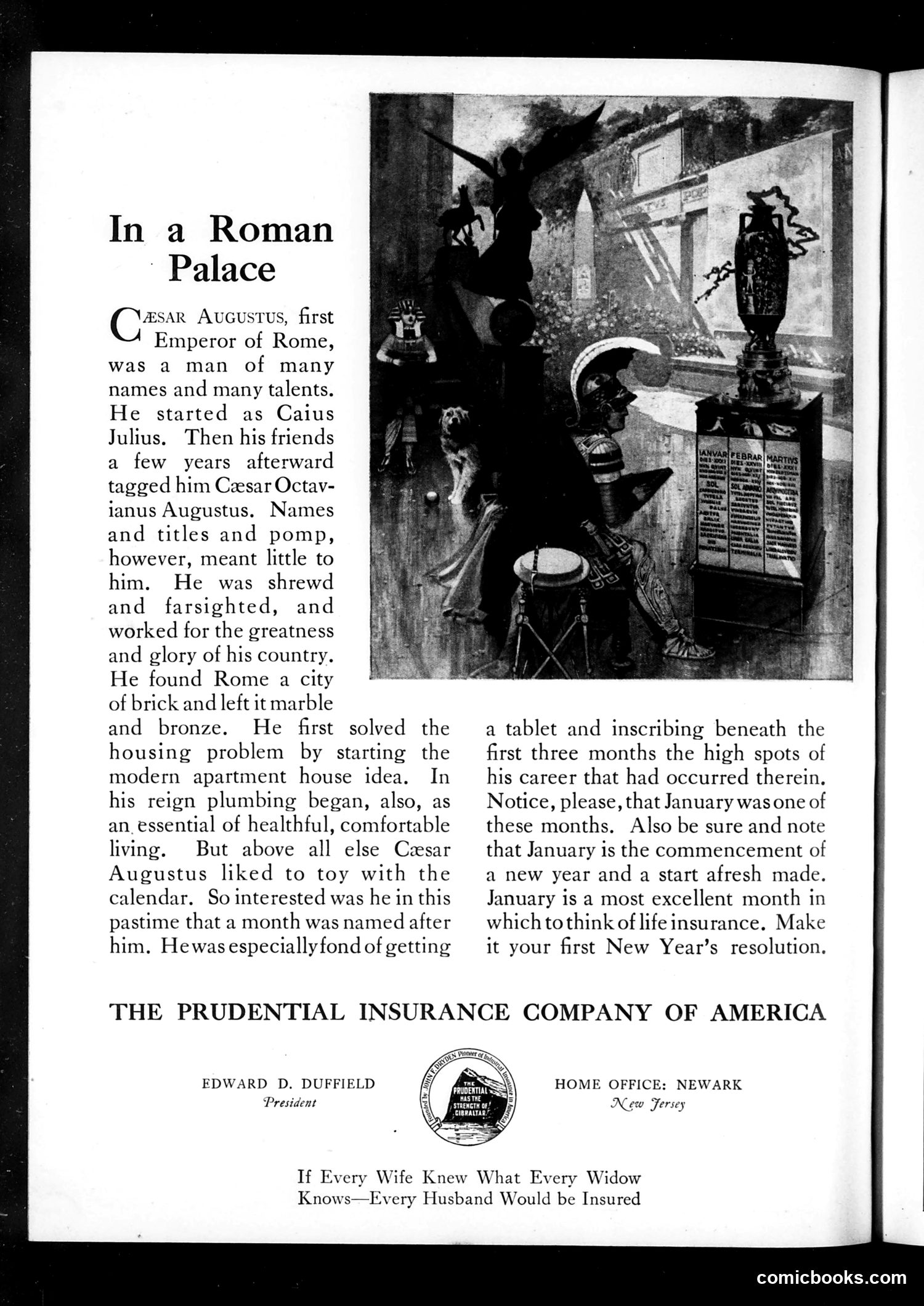
This is a **Prudential Insurance advertisement** disguised as historical commentary. The text humorously compares Caesar Augustus to a modern insurance company executive, crediting the Roman emperor with practical innovations (plumbing, apartment housing, calendar reform) to establish him as a forward-thinking leader. The actual pitch comes at the end: just as Augustus reorganized Rome, modern men should make life insurance their "New Year's resolution." The tagline—"If Every Wife Knew What Every Widow Knows—Every Husband Would be Insured"—suggests that widows understand (through hardship) what living husbands should anticipate: the financial devastation of losing a breadwinner. The black-and-white image shows what appears to be classical Roman statuary and architectural elements, reinforcing the "Roman Palace" theme and lending gravitas to the insurance pitch. This is **advertising as cultural education**—wrapping a sales message in historical prestige.
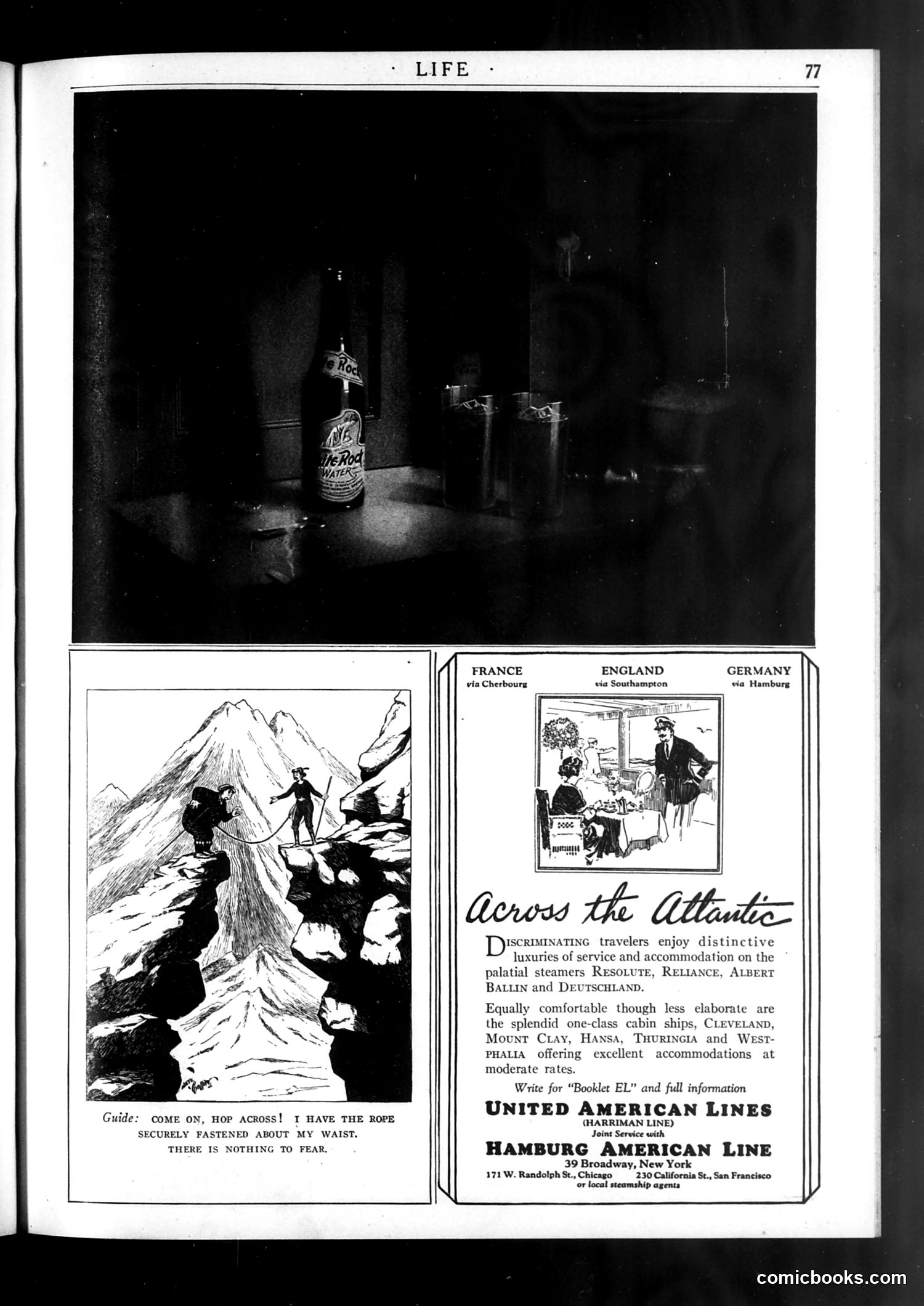
This page is primarily **advertising**, not satire. It promotes transatlantic steamship travel via United American Lines and Hamburg American Line. The left cartoon is a humorous guide encouraging passengers to cross the Atlantic, depicting a figure on a mountain saying "Come on, hop across! I have the rope securely fastened about my waist. There is nothing to fear"—a lighthearted pitch reassuring nervous travelers that the journey is safe. The right panel shows three travel routes (France, England, Germany) with a small sketch of passengers boarding, promoting various ships offering "distinctive luxuries" on premium vessels and "excellent accommodations at moderate rates" on one-class options. The overall message: transatlantic voyage is safe, accessible, and appealing to discriminating travelers seeking comfort at various price points.
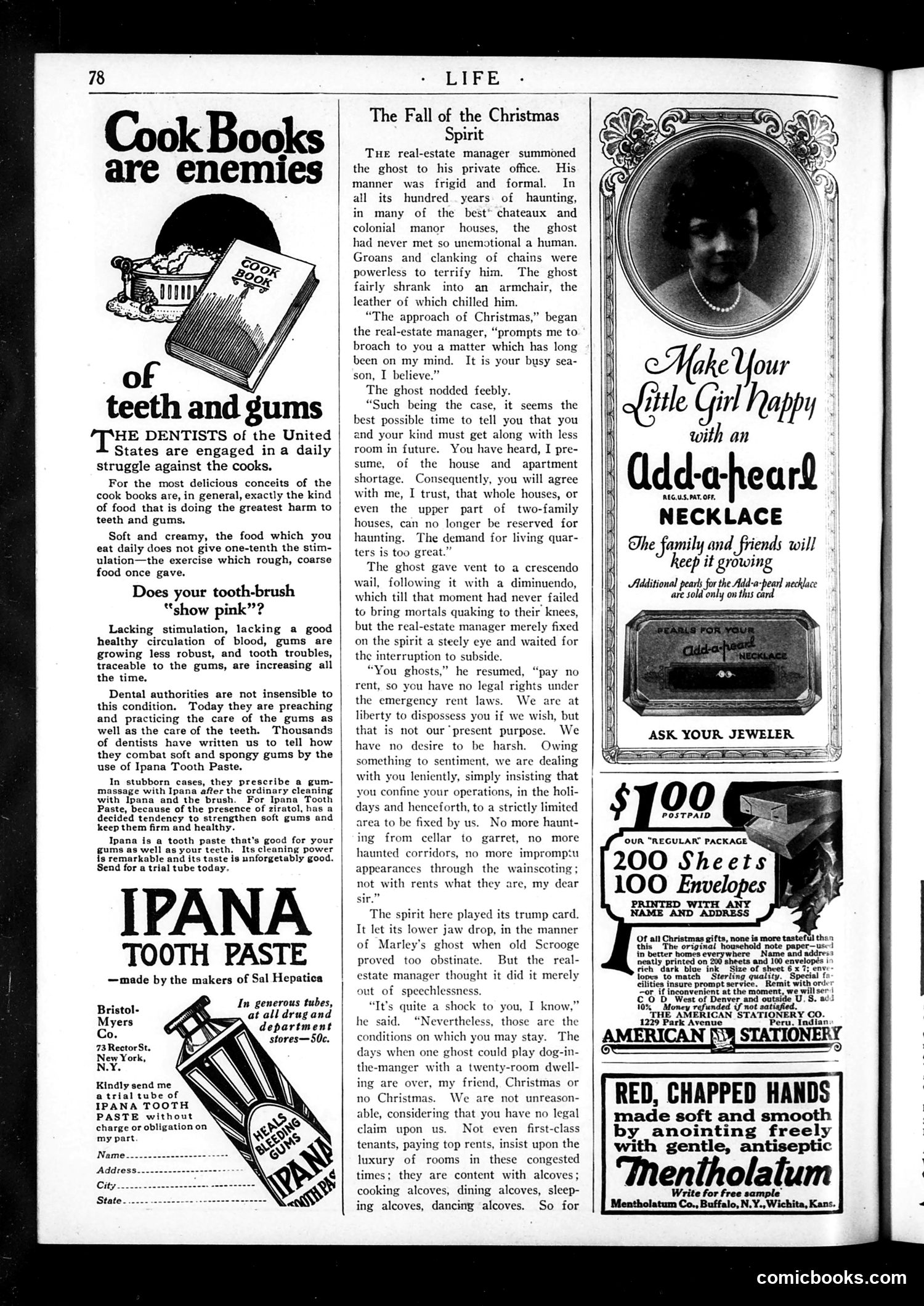
This page contains two distinct pieces from Life magazine's satirical content. **Left side:** An advertisement disguised as editorial content argues that cookbook recipes harm teeth and gums because they emphasize soft, creamy foods lacking the stimulation that rough foods provide. Dentists, the piece claims, must combat this by recommending Ipana Tooth Paste with "ziratol" to strengthen gums. This reflects early-20th-century nutritional misconceptions and aggressive patent-medicine marketing. **Right side:** A short story satirizes post-WWI housing shortages by having a real-estate manager evict a ghost from a haunted house, citing the need for rental properties. The ghost's supernatural powers prove useless against bureaucratic logic and rent laws—a darkly comic commentary on how pragmatic economic concerns have displaced traditional sentimentality and spirituality, even at Christmas.
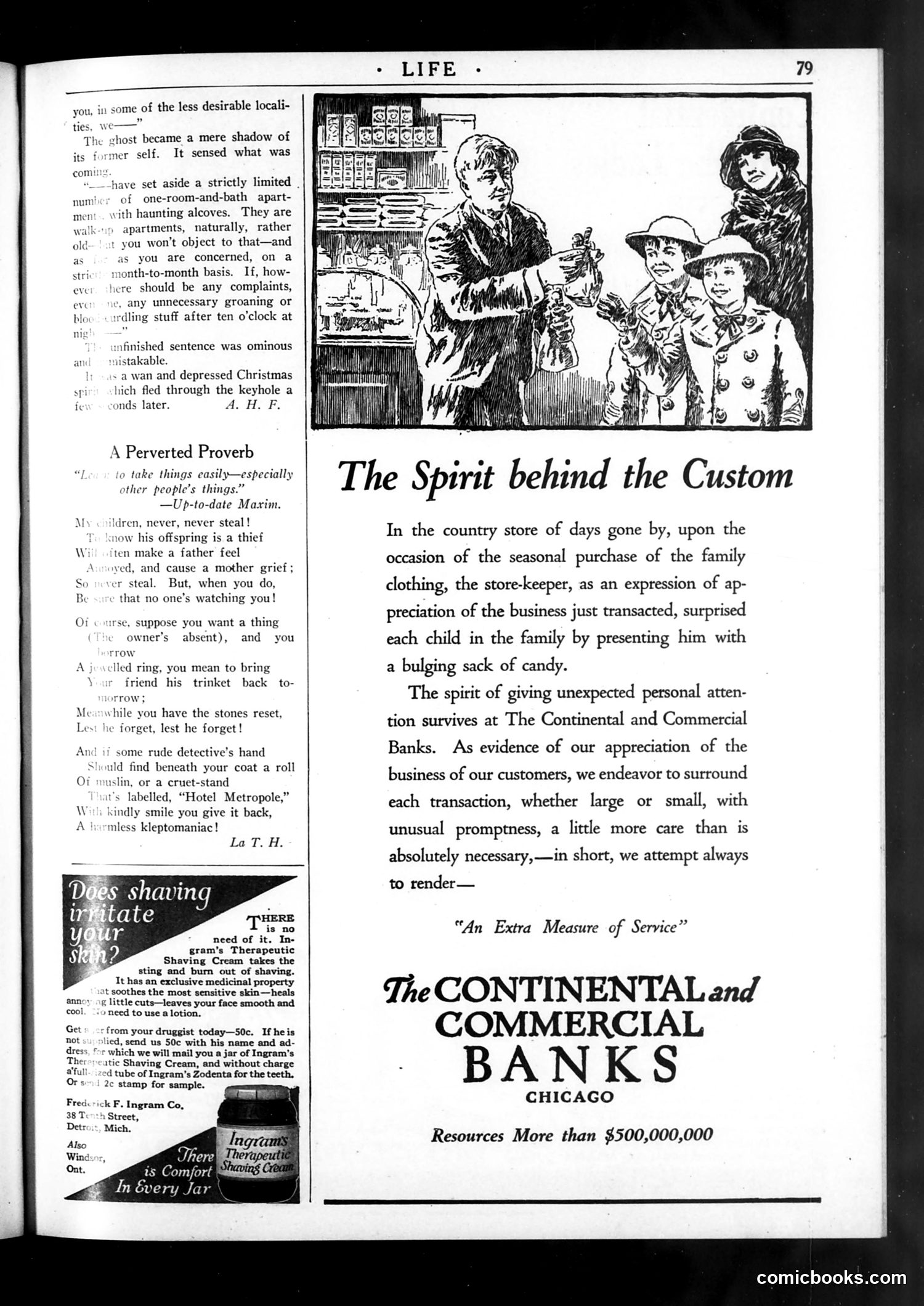
This Life magazine page contains two distinct elements: **Left side:** A satirical poem titled "A Perverted Proverb" that darkly jokes about teaching children to steal. It humorously inverts moral instruction, suggesting that if one *must* steal, at least do it carefully—don't get caught, have stolen goods reset by jewelers to avoid detection, etc. The satire mocks both petty theft and parental hypocrisy. **Right side:** A bank advertisement for Continental and Commercial Banks (Chicago) illustrating "The Spirit behind the Custom"—referencing nostalgic country-store practices where shopkeepers gave children candy as goodwill gestures. The bank claims to replicate this "extra measure of service" in financial transactions. The illustration shows an older man (presumably a banker or shopkeeper) distributing gifts to children, evoking small-town Americana and personal service. The page juxtaposes cynical humor about theft with earnest banking nostalgia—a typical Life magazine blend of satire and advertising from the early 20th century.
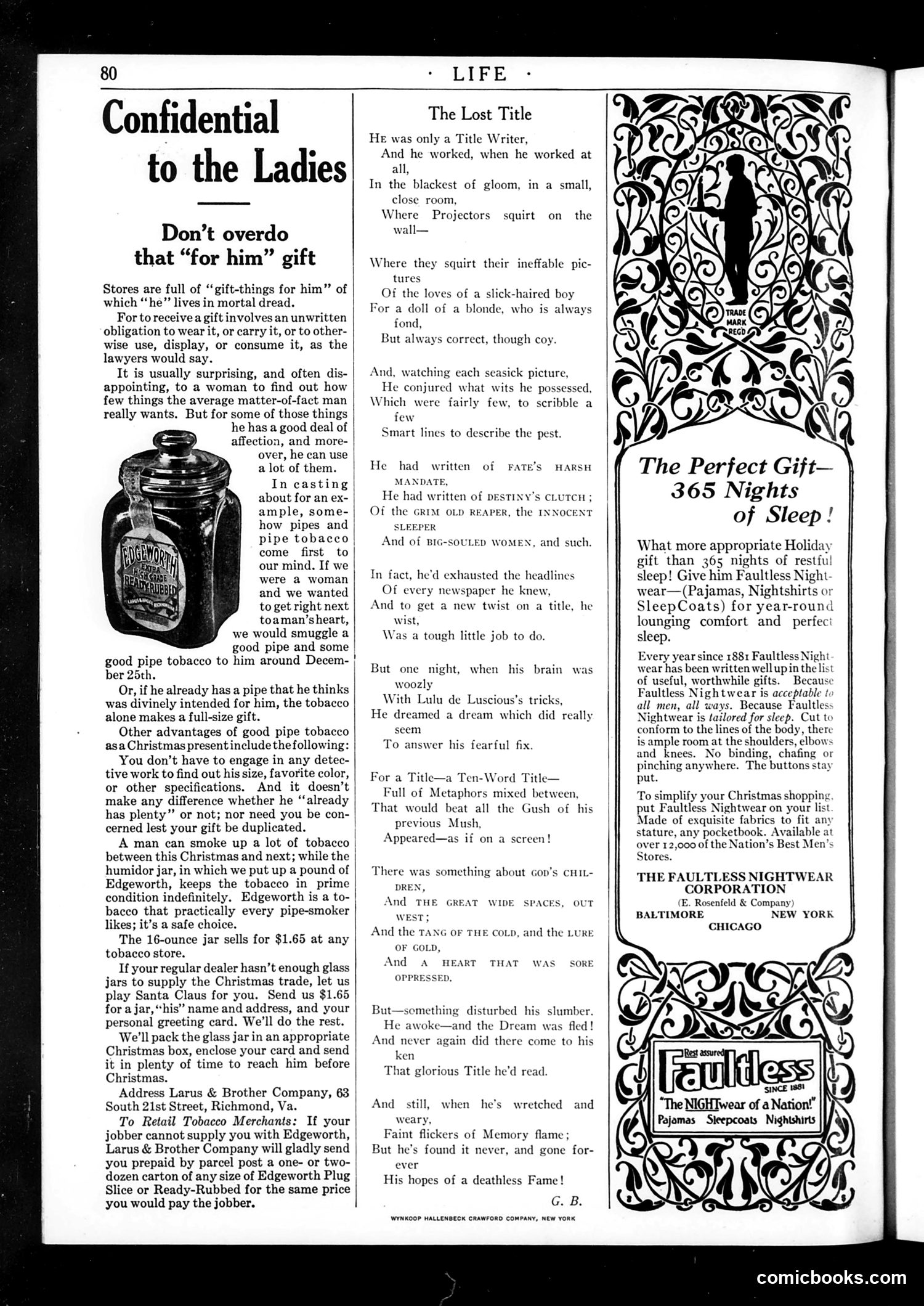
This page contains two distinct sections: **Left side ("Confidential to the Ladies"):** A humorous gift-giving advisory warning women not to give impractical gifts to men. The author argues that pipe tobacco makes an ideal Christmas present because men actually want it, it doesn't require knowing sizes or preferences, and a jar keeps indefinitely. This is essentially an advertorial for Edgeworth pipe tobacco disguised as lifestyle advice. **Right side ("The Lost Title"):** A satirical poem about a struggling Hollywood title writer in the silent film era. He works in a dark room writing intertitle cards (text cards inserted between scenes). Having exhausted clichéd dramatic titles about "Fate's Harsh Mandate" and "Destiny's Clutch," he dreams of a brilliant new ten-word title combining melodramatic metaphors. The poem mocks both the pretentiousness of silent film titling and the writer's desperation for inspiration—suggesting even his dreams can't escape the formula. Both pieces reflect 1920s consumer culture and film industry conventions familiar to Life's contemporary readers but now historically distant.
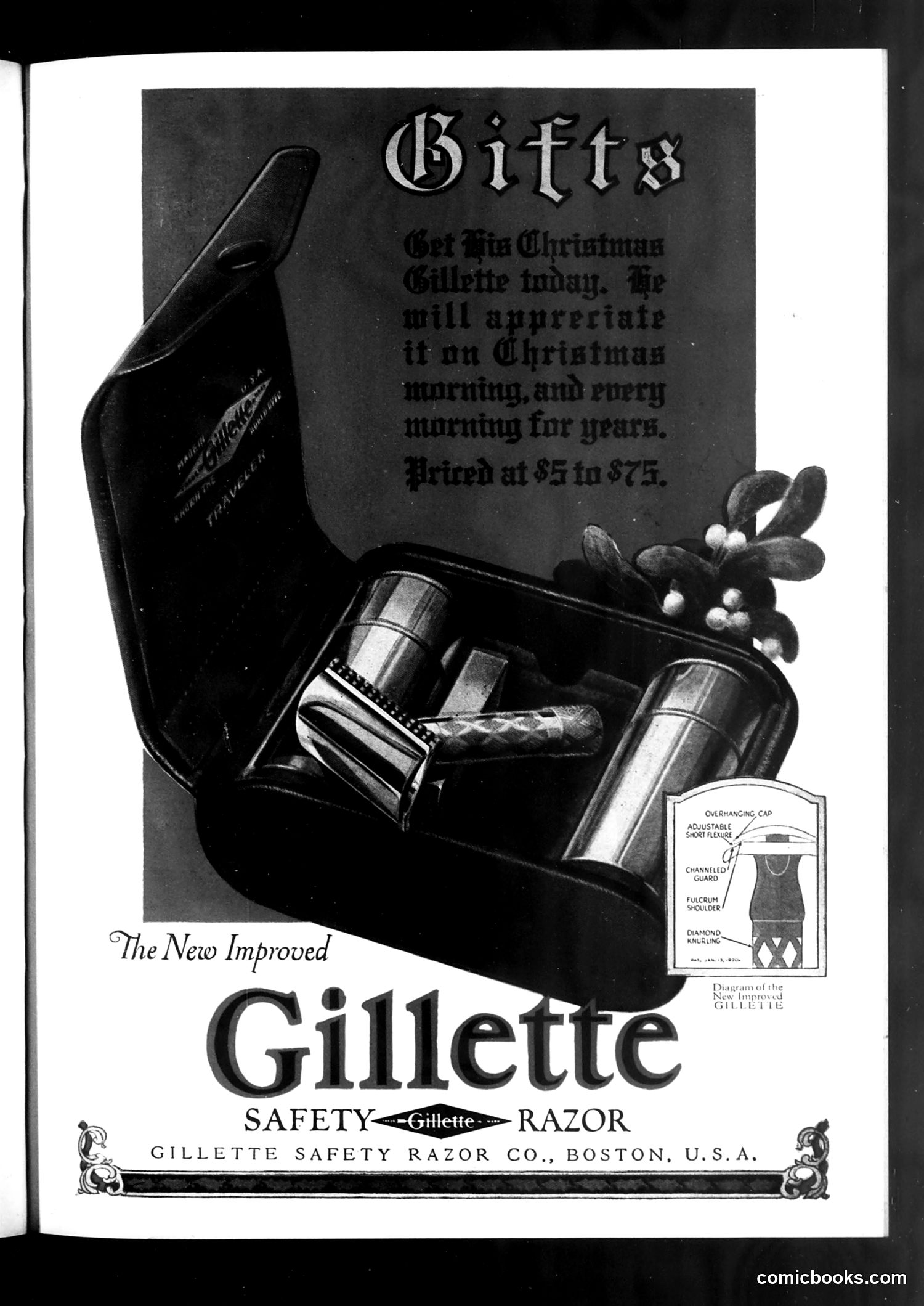
This is a Gillette Safety Razor advertisement, not a political cartoon. The ad promotes the "New Improved Gillette Safety Razor" as a Christmas gift, priced at $5 to $75. The visual shows an open case containing razor components and accessories (including what appears to be bottles and a brush), decorated with holly sprigs. A technical diagram on the right labels parts like the "overhanging cap," "channeled guard," and "diamond knurling." The copy promises the recipient will "appreciate it on a Christmas morning, and every morning for years." This is straightforward product advertising emphasizing durability and gift-worthiness for the holiday season—typical early-twentieth-century marketing with no satirical intent.
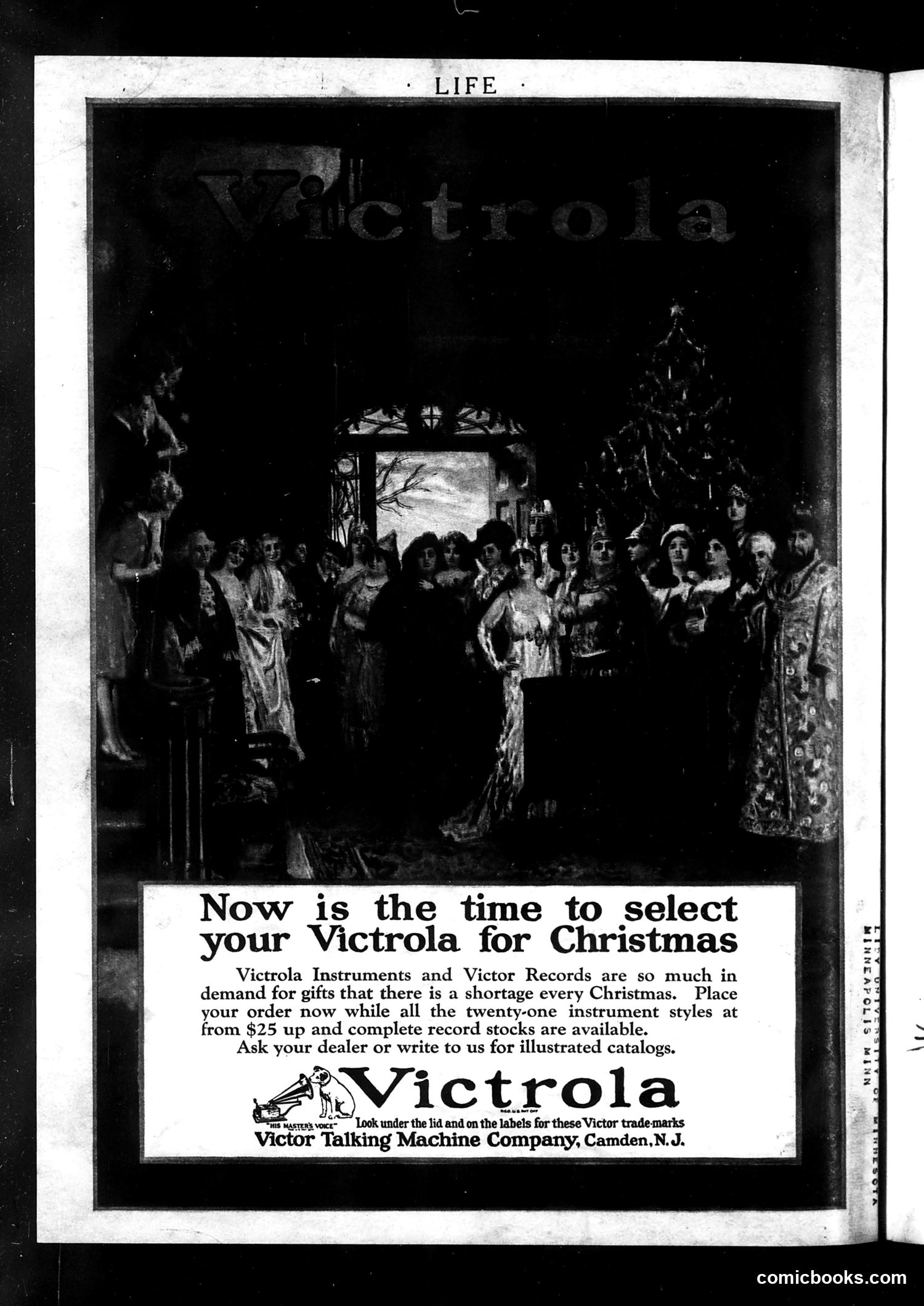
This is primarily a **Victrola advertisement**, not political satire or a cartoon. The page features a theatrical illustration showing elegantly dressed figures gathered in what appears to be a formal interior space, likely depicting a Christmas celebration or social gathering centered around listening to recorded music. The ad's message is straightforward commercial messaging: Victrola phonographs are popular Christmas gifts with frequent shortages, so consumers should order early. The company offers twenty-one instrument styles starting at $25, emphasizing the desirability and scarcity of their products. The illustration serves as aspirational imagery—showing well-dressed people in refined surroundings enjoying music together—to appeal to middle and upper-class consumers. This reflects early 20th-century marketing that associated consumer products with social status and cultural refinement. There is no political satire or social commentary present on this page.