
Life, 1923-12-06 · page 52 of 84
Life — December 6, 1923 — page 52: what you’re looking at
What you’re looking at
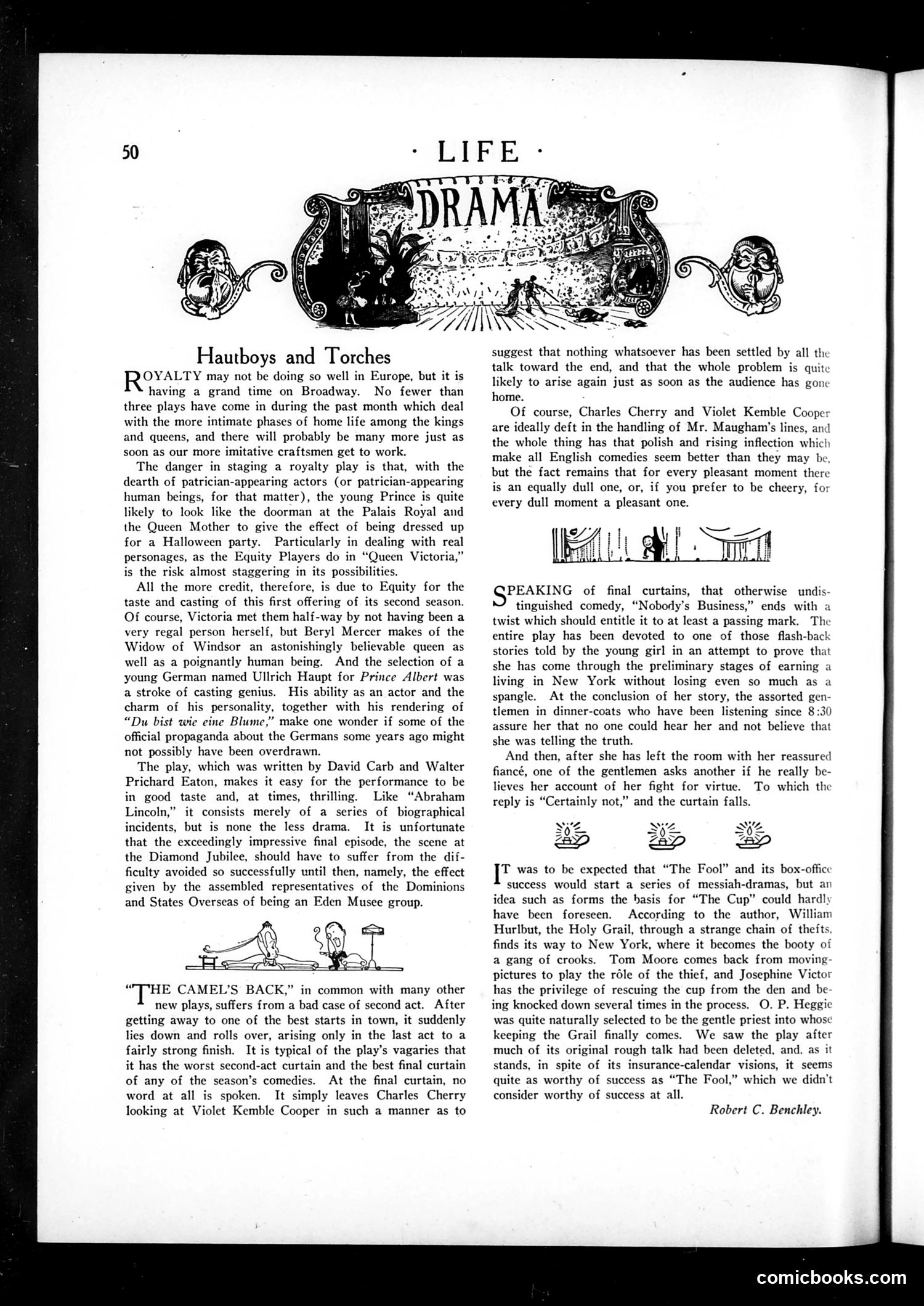
This is a theater criticism page reviewing three Broadway plays from the 1920s era. The main content consists of written reviews with no political cartoons. **Key theatrical references:** 1. **"Queen Victoria"** — An Equity Players production praised for its casting, particularly Beryl Mercer as Queen Victoria and German actor Ullrich Haupt as Prince Albert. The critic notes the risk of royalty plays looking ridiculous due to casting difficulties, but credits this production with tasteful execution. 2. **"The Camel's Back"** — A comedy criticized for a weak second act, though praised for strong performances by Charles Cherry and Violet Kemble Cooper in handling Somerset Maugham's dialogue. 3. **"Nobody's Business"** — A flashback-structured play about a young woman's experiences earning a living in New York, receiving mild approval for its final curtain twist. The page reflects 1920s Broadway's fascination with royalty plays and contemporary comedies featuring romantic complications and clever dialogue—typical entertainment concerns of that theatrical era.
📄 Transcribed text from this page (OCR, searchable)
Machine-transcribed from the original scan — historical spelling and the odd misread are preserved.
Hautboys and Torches OYALTY may not be doing so well in Europe, but it is having a grand time on Broadway. No fewer than three plays have come in during the past month which deal with the more intimate phases of home life among the kings and queens, and there will probably be many more just as soon as our more imitative craftsmen get to work. The danger in staging a royalty play is that, with the dearth of patrician-appearing actors (or patrician-appearing human beings, for that matter), the young Prince is quite likely to look like the doorman at the Palais Royal and the Queen Mother to give the effect of being dressed up for a Halloween party. Particularly in dealing with real personages, as the Equity Players do in “Queen Victoria,” is the risk almost staggering in its possibilities. All the more credit, therefore, is due to Equity for the taste and casting of this first offering of its second season. Of course, Victoria met them half-way by not having been a very regal person herself, but Beryl Mercer makes of the Widow of Windsor an astonishingly believable queen as well as a poignantly human being. And the selection of a young German named Ullrich Haupt for Prince Albert was a stroke of casting genius. His ability as an actor and the charm of his personality, together with his rendering of “Du bist wie eine Blume,” make one wonder if some of the official propaganda about the Germans some years ago might not possibly have been overdrawn. The play, which was written by David Carb and Walter Prichard Eaton, makes it easy for the performance to be in good taste and, at times, thrilling. Like “Abraham Lincoln,” it consists merely of a series of biographical incidents, but is none the less drama. It is unfortunate that the exceedingly impressive final episode, the scene at the Diamond Jubilee, should have to suffer from the dif- ficulty avoided so successfully until then, namely, the effect given by the assembled representatives of the Dominions and States Overseas of being an Eden Musee group. “"THE CAMEL’S BACK,” in common with many other new plays, suffers from a bad case of second act. After getting away to one of the best starts in town, it suddenly lies down and rolls over, arising only in the last act to a fairly strong finish. It is typical of the play’s vagaries that it has the worst second-act curtain and the best final curtain of any of the season’s comedies. At the final curtain, no word at all is spoken. It simply leaves Charles Cherry looking at Violet Kemble Cooper in such a manner as to suggest that nothing whatsoever has been settled by all th: talk toward the end, and that the whole problem is quite likely to arise again just as soon as the audience has gone home. Of course, Charles Cherry and Violet Kemble Cooper are ideally deft in the handling of Mr. Maugham’s lines, and the whole thing has that polish and rising inflection w make all English comedies seem better than they may be, but the fact remains that for every pleasant moment there is an equally dull one, or, if you prefer to be cheery, for every dull moment a pleasant one. Z PEAKING of final curtains, that otherwise undis- tinguished comedy, “Nobody’s Business,” ends with a twist which should entitle it to at least a passing mark. The entire play has been devoted to one of those flash-back stories told by the young girl in an attempt to prove that she has come through the preliminary stages of earning a living in New York without losing even so much as a spangle. At the conclusion of her story, the assorted gen- tlemen in dinner-coats who have been listening since 8:30 assure her that no one could hear her and not believe that she was telling the truth. And then, after she has left the room with her reassured fiancé, one of the gentlemen asks another if he really be- lieves her account of her fight for virtue. To which the reply is “Certainly not,” and the curtain falls. ay T was to be expected that “The Fool” and its box-officc success would start a series of messiah-dramas, but an idea such as forms the basis for “The Cup” could hardly have been foreseen. According to the author, William Hurlbut, the Holy Grail, through a strange chain of thefts, finds its way to New York, where it becomes the booty of a gang of crooks. Tom Moore comes back from moving- pictures to play the réle of the thief, and Josephine Victor has the privilege of rescuing the cup from the den and be- ing knocked down several times in the process. O. P. Heggie was quite naturally selected to be the gentle priest into whose keeping the Grail finally comes. We saw the play after much of its original rough talk had been deleted, and. as it stands, in spite of its insurance-calendar visions, it seems quite as worthy of success as “The Fool,” which we didn’t consider worthy of success at all. Robert C. Benchley. comicbooks.com