
Life, 1923-12-06 · page 50 of 84
Life — December 6, 1923 — page 50: what you’re looking at
What you’re looking at
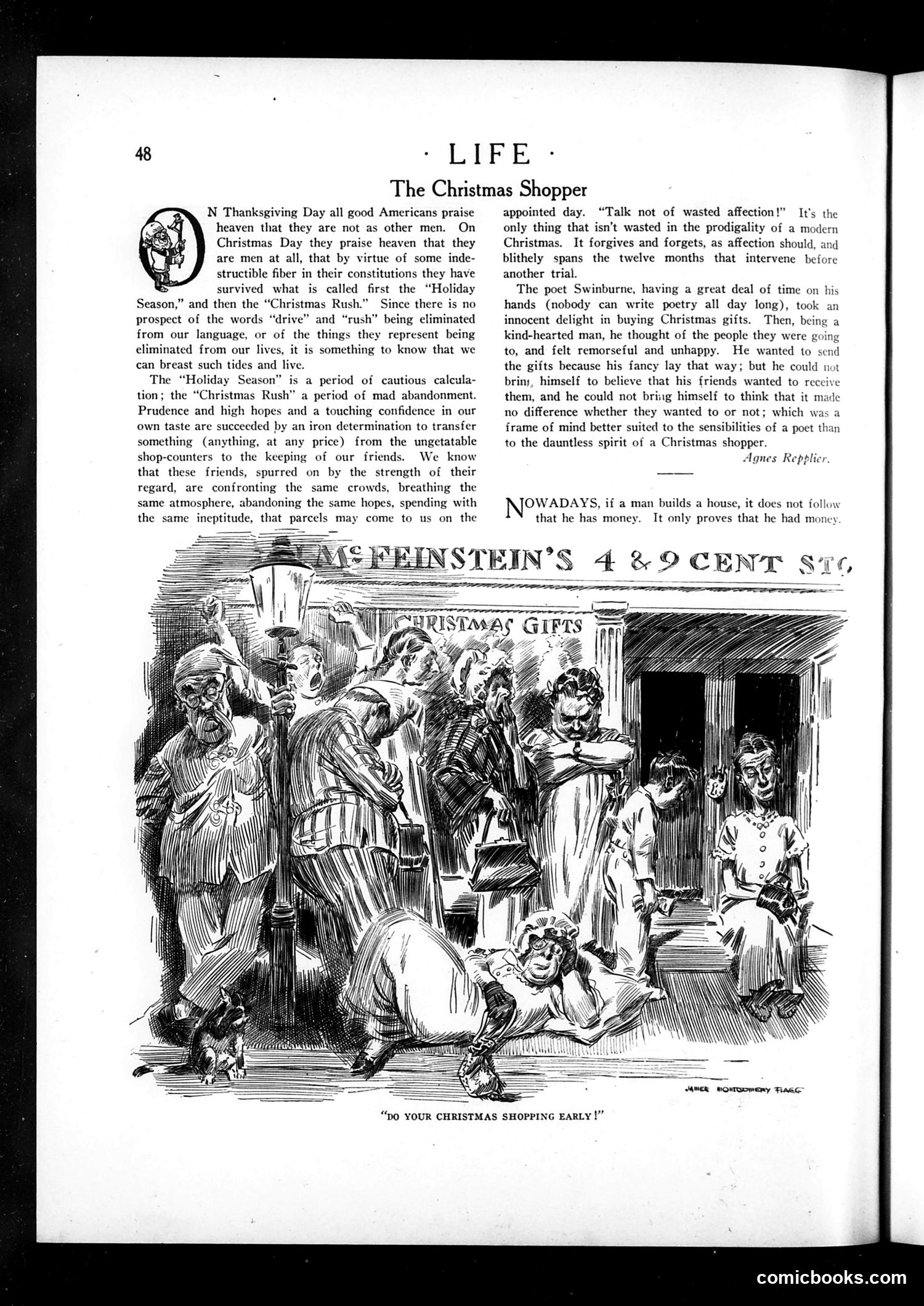
This is a satirical essay with accompanying illustration about the frenzied American Christmas shopping season. The text, attributed to essayist Agnes Repplier, contrasts two periods: the cautious "Holiday Season" and the chaotic "Christmas Rush"—when shoppers abandon prudence and frantically purchase gifts, regardless of cost or appropriateness, simply to fulfill social obligation. The illustration depicts crowded chaos at "Melnstein's 4 & 9 Cent Store," showing masses of shoppers (adults and children) packed at a storefront labeled "Christmas Gifts," with the caption urging "Do Your Christmas Shopping Early!" The satire targets the commercialization and social pressure of Christmas: people buy gifts not from genuine affection but from compulsion and anxiety about social expectations. The essay notes this "wasted affection" is the only thing actually wasted in modern Christmas excess. The illustration visualizes the mob mentality and desperation underlying holiday shopping culture.
📄 Transcribed text from this page (OCR, searchable)
Machine-transcribed from the original scan — historical spelling and the odd misread are preserved.
LIFE The Christmas Shopper N Thanksgiving Day all good Americans praise heaven that they are not as other men. On Christmas Day they praise heaven that they are men at all, that by virtue of some inde- structible fiber in their constitutions they have > survived what is called first the “Holiday Season,” and then the “Christmas Rush.” Since there is no prospect of the words “drive” and “rush” being eliminated from our language, or of the things they represent being eliminated from our lives, it is something to know that we can breast such tides and liv The “Holiday Season” is a period of cautious calcula- tion; the “Christmas Rush” a period of mad abandonment. Prudence and high hopes and a touching confidence in our own taste are succeeded by an iron determination to transfer something (anything, at any price) from the ungetatable shop-counters to the keeping of our friends. We know that these friends, spurred on by the strength of their regard, are confronting the same crowds, breathing the same atmosphere, abandoning the same hopes, spending with the same ineptitude, that parcels may come to us on the appointed day. “Talk not of wasted affection!” It's the only thing that isn’t wasted in the prodigality of a modern Christmas. It forgives and forgets, as affection should, and blithely spans the twelve months that intervene before another trial. The poet Swinburne, having a great deal of time on his hands (nobody can write poetry all day long), took an innocent delight in buying Christmas gifts. Then, being a kind-hearted man, he thought of the people they were going to, and felt remorseful and unhappy. He wanted to send the gifts because his fancy lay that way; but he could not brins, himself to believe that his friends wanted to receive them, and he could not bring himself to think that it made no difference whether they wanted to or not; which was a frame of mind better suited to the sensibilities of a poet than to the dauntless spirit of a Christmas shopper. Agnes Repplier. IOWADAYS, if a man builds a house, it does not follow that he has money. It only proves that he had money “AMER MOMTEOMERY FLAGG “DO YOUR CHRISTMAS SHOPPING EARLY !” comicbooks.com