
Life, 1923-12-06 · page 38 of 84
Life — December 6, 1923 — page 38: what you’re looking at
What you’re looking at
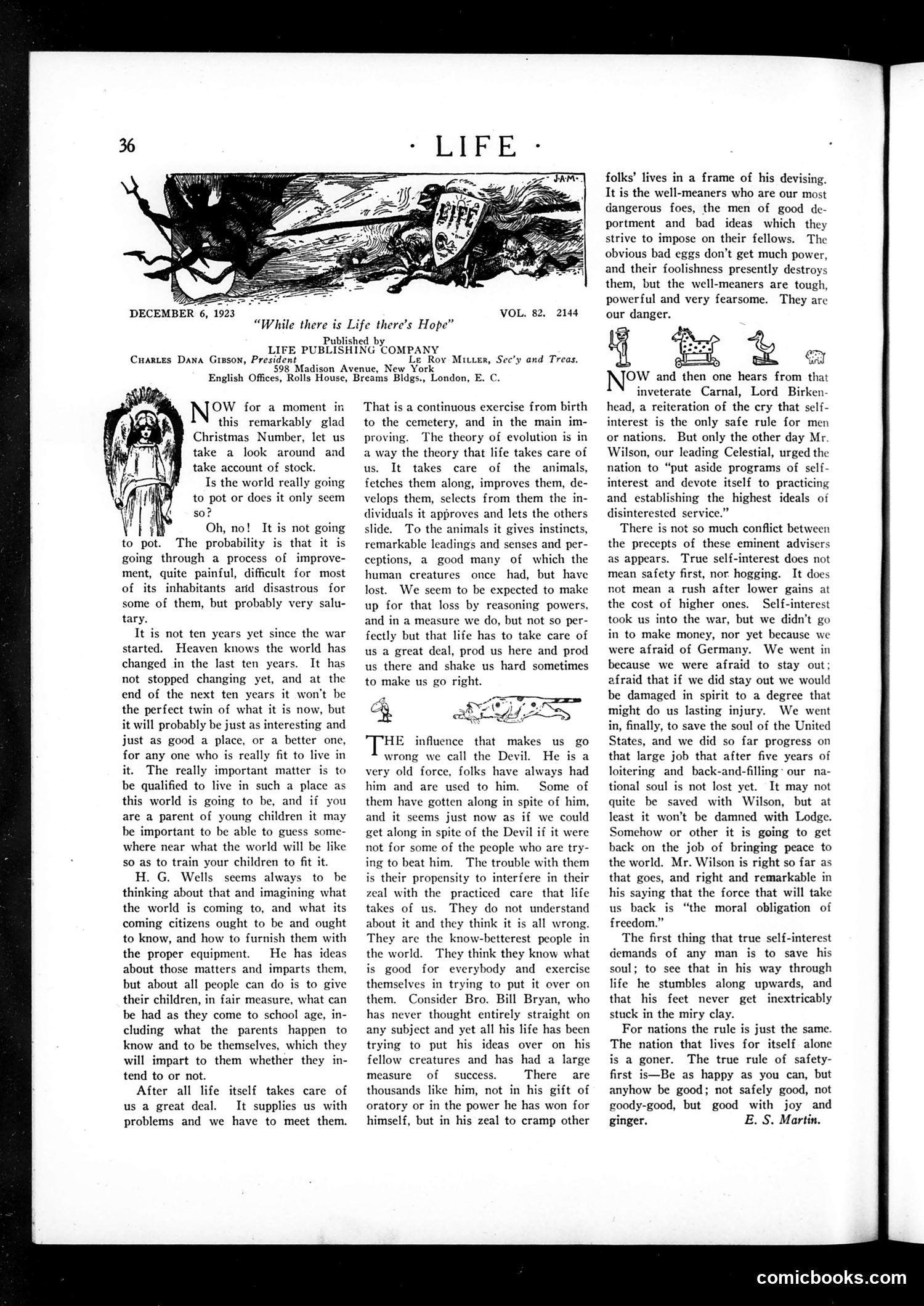
This editorial page attacks well-meaning reformers and moral crusaders who the author believes cause more harm than good. The piece criticizes figures like William Jennings Bryan (referenced as "Bro. Bill Bryan"), who pushed his religious and political ideas onto others despite, the author claims, never thinking "entirely straight." The author argues that life itself naturally improves society through evolution and gradual development—we don't need self-righteous "know-betterest people" interfering. These crusaders, the text suggests, misunderstand how positive change actually occurs and damage society through their zealous moralizing. The cartoon at top (showing skeletal death figures) reinforces themes of mortality and life's natural processes. This 1923 piece reflects post-WWI skepticism toward progressive reformers and Prohibition advocates—Bryan had championed both causes.
📄 Transcribed text from this page (OCR, searchable)
Machine-transcribed from the original scan — historical spelling and the odd misread are preserved.
aE Vb DECEMBER 6, 1923 VOL. 82. 2144 “While there is Life there’s Hope” Published by LIFE PUBLISHING COMPANY Cuartes Dana Grason, President Le Roy Miter, Sec’y and Treas, 598 Madison Avenue, New York English Offices, Rolls House, Breams Bldgs., London, E. C. OW for a moment in this remarkably glad Christmas Number, let us take a look around and take account of stock. Is the world really going to pot or does it only seem so? Oh, no! It is not going to pot. The probability is that it is going through a process of improve- ment, quite painful, difficult for most of its inhabitants arid disastrous for some of them, but probably very salu- tary. It is not ten years yet since the war started. Heaven knows the world has changed in the last ten years. It has not stopped changing yet, and at the end of the next ten years it won't be the perfect twin of what it is now, but it will probably be just as interesting and just as good a place, or a better one, for any one who is really fit to live in it. The really important matter is to be qualified to live in such a place as this world is going to be, and if you are a parent of young children it may be important to be able to guess some- where near what the world will be like so as to train your children to fit it. H. G. Wells seems always to be thinking about that and imagining what the world is coming to, and what its coming citizens ought to be and ought to know, and how to furnish them with the proper equipment. He has ideas about those matters and imparts them, but about all people can do is to give their children, in fair measure, what can be had as they come to school age, in- cluding what the parents happen to know and to be themselves, which they will impart to them whether they in- tend to or not. After all life itself takes care of us a great deal. It supplies us with problems and we have to meet them. That is a continuous exercise from birth to the cemetery, and in the main im- proving. The theory of evolution is in a way the theory that life takes care of us. It takes care of the animals, fetches them along, improves them, de- velops them, selects from them the in- dividuals it approves and lets the others slide. To the animals it gives instincts, remarkable leadings and senses and per- ceptions, a good many of which the human creatures once had, but have lost. We seem to be expected to make up for that loss by reasoning powers, and in a measure we do, but not so per- fectly but that life has to take care of us a great deal, prod us here and prod us there and shake us hard sometimes to make us go right. a BLUES THE influence that makes us go wrong we call the Devil. He is a very old force, folks have always had him and are used to him. Some of them have gotten along in spite of him, and it seems just now as if we could get along in spite of the Devil if it were not for some of the people who are try- ing to beat him. The trouble with them is their propensity to interfere in their zeal with the practiced care that life takes of us. They do not understand about it and they think it is all wrong. They are the know-betterest people in the world. They think they know what is good for everybody and exercise themselves in trying to put it over on them. Consider Bro. Bill Bryan, who has never thought entirely straight on any subject and yet all his life has been trying to put his ideas over on his fellow creatures and has had a large measure of success. There are thousands like him, not in his gift of oratory or in the power he has won for himself, but in his zeal to cramp other folks’ lives in a frame of his devising. It is the well-meaners who are our most dangerous foes, the men of good de- portment and bad ideas which they strive to impose on their fellows. The obvious bad eggs don’t get much power, and their foolishness presently destroys them, but the well-meaners are tough, powerful and very fearsome. They are our danger. OW and then one hears from that inveterate Carnal, Lord Birken- head, a reiteration of the cry that self- interest is the only safe rule for men or nations. But only the other day Mr. Wilson, our leading Celestial, urged the nation to “put aside programs of self- interest and devote itself to practicing and establishing the highest ideals of disinterested service.” There is not so much conflict between the precepts of these eminent advisers as appears. True self-interest does not mean safety first, nor hogging. It does not mean a rush after lower gains at the cost of higher ones. Self-interest took us into the war, but we didn’t go in to make money, nor yet because we were afraid of Germany. We went in because we were afraid to stay out; afraid that if we did stay out we would be damaged in spirit to a degree that might do us lasting injury. We went in, finally, to save the soul of the United States, and we did so far progress on that large job that after five years of loitering and back-and-filling* our na- tional soul is not lost yet. It may not quite be saved with Wilson, but at least it won’t be damned with Lodge. Somehow or other it is going to get back on the job of bringing peace to the world. Mr. Wilson is right so far as that goes, and right and remarkable in his saying that the force that will take us back is “the moral obligation of freedom.” The first thing that true self-interest demands of any man is to save his soul; to see that in his way through life he stumbles along upwards, and that his feet never get inextricably stuck in the miry clay. For nations the rule is just the same. The nation that lives for itself alone is a goner. The true rule of safety- first is—Be as happy as you can, but anyhow be good; not safely good, not goody-good, but good with joy and ginger. E. S. Martin. comicbooks.com